













 0 comments
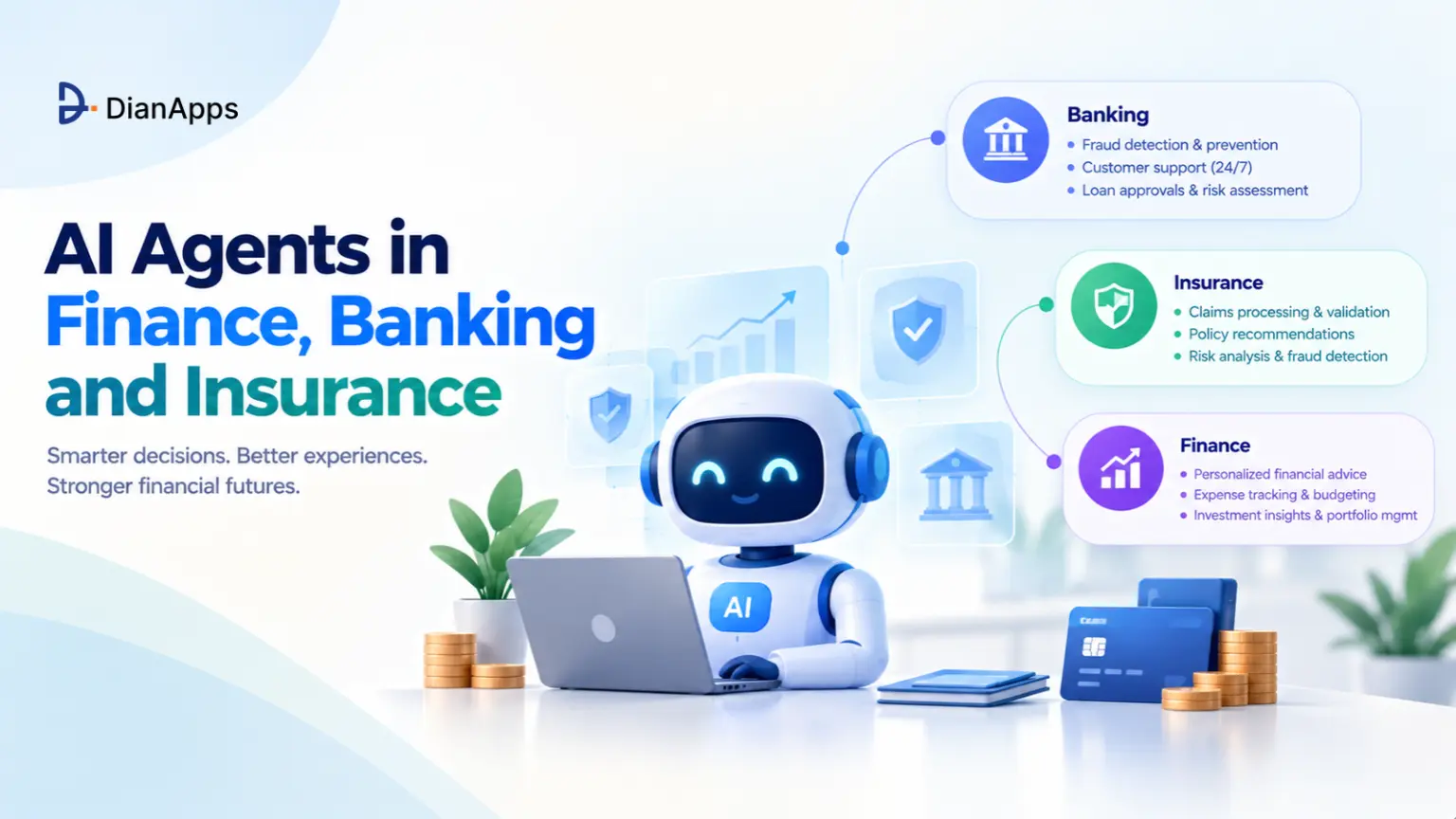





Key Takeaways:
- Gartner is placing accounts payable automation among the top AI use cases already running inside finance teams, which is showing how quickly AI agents for finance are moving from pilots to real work.
- AI agents in banking are taking care of KYC checks, fraud alerts, loan processing and customer queries, which is helping banks serve customers faster without adding more staff.
- AI agents for insurance are handling claims, underwriting support and policy servicing, while AI agents for insurance agencies and AI for insurance agents are helping qualify leads and manage renewals.
- When people are asking will AI replace insurance agents, the honest answer is that AI is taking over the paperwork while humans are still owning advice and relationships.
- Agentic AI for accounts payable and every other finance workflow is needing audit trails, human approvals and strict data controls before it is going live in a regulated environment.
Quick Answer: AI agents for finance, banking and insurance are autonomous software systems that are processing invoices, checking KYC documents, detecting fraud, handling claims and answering customer queries without someone having to do each and every step manually. Unlike simple automation, they are reading documents, making decisions within set rules and passing anything risky to a human, which is helping financial institutions work faster, stay compliant and keep their customers happy at the same time.
Month-end close is one of those times when each and every finance team is running on coffee and spreadsheets, chasing missing invoices, matching payments line by line and replying to the same vendor emails again and again, and this is not making it easy for anyone. This is where AI agents for finance are stepping in, taking care of the repetitive work from beginning until completion, while giving finance managers/controllers a clear, real-time view of where each and every rupee and dollar is going.
And this is not just a finance team problem either, because banks are struggling with long KYC queues and endless fraud alerts, while insurers are dealing with piles of claims, policy documents and customers who are wanting answers right away.
But what is the need for AI agents when banks and insurers are already using so much automation in their daily operations? Well, most of that automation is only following fixed rules, whereas an agent is reading documents, understanding the situation, making a decision within the limits you set and passing anything unusual to a human, and that is making a big difference in an industry where each and every mistake is costing money.
In this blog, we are going to cover how AI agents in banking, insurance and finance are being used today with real use cases and examples, how agentic AI for accounts payable is working and whether these agents are really safe for compliance, so let’s take a look.
What Are AI Agents for Finance and How Are They Different?
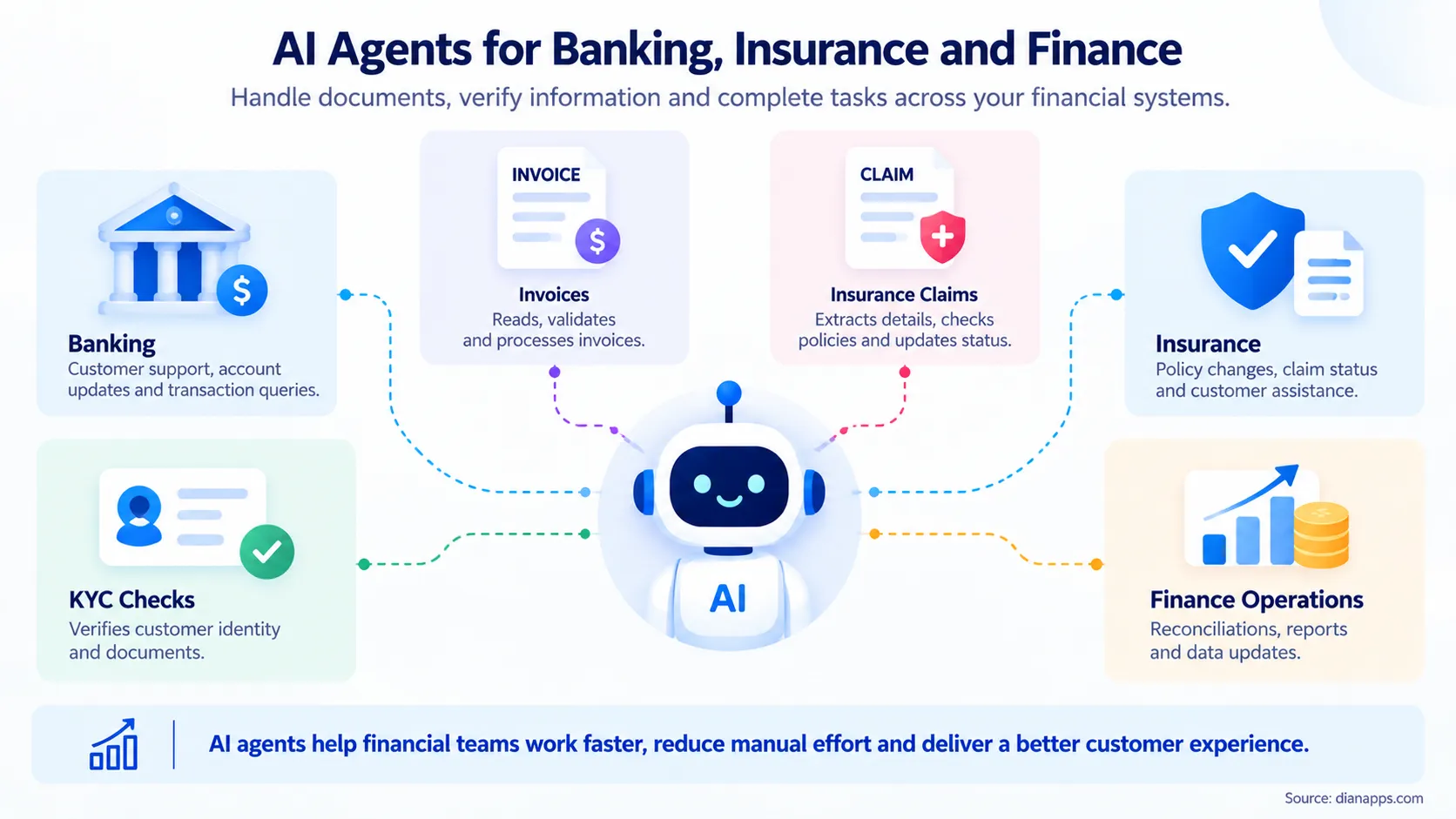
AI agents for finance are software systems built on large language models (LLMs) that are reading financial data and documents, planning the steps needed to finish a task, using tools like the ERP, core banking system or policy admin platform and then acting on their own within the rules set by the business.
A regular automation bot is only copying data from one field to another, whereas an AI agent is understanding what an invoice, claim form or bank statement is actually saying, spotting when something is not adding up and deciding whether to approve it, flag it or send it to a person for review.
If you are getting confused between all these terms, our blog on AI agents vs agentic AI vs generative AI is explaining the difference in simple words, but to keep it short, let’s break it down with a quick comparison:
| Feature | Traditional Automation (RPA) | AI Agents |
| Data Handling | Structured fields only | Documents, emails, PDFs and scans |
| Decision Making | Fixed rules | Reasoning within set policies |
| Handling Exceptions | Stops and waits for a human | Investigates and suggests a fix |
| Learning Over Time | No | Yes, from feedback and outcomes |
| Compliance Trail | Basic logs | Full reasoning and action history |
| Best Suited For | Simple, repetitive steps | Multi-step, judgement-based workflows |
This is why finance leaders are not looking at agents as a replacement for their existing automation, they are looking at them as the layer on top that is finally handling the exceptions that were always landing on someone’s desk.
Now that the difference is clear, the next question that is naturally coming up is why so many banks, insurers and finance teams are moving towards these agents right now, and the reasons are not hard to see.
Why Finance, Banking and Insurance Are Adopting AI Agents?
Financial services is one of those industries where the work is heavy on documents, rules and checks, and each and every one of these is taking time, people and money to get right.
Capgemini’s research is estimating that AI agents could be creating up to $450 billion in economic value by 2028, with around one-third of banks already building their own agents in-house, but only about 10% of firms have actually rolled them out at scale so far.
Banking and insurance executives in the same study are naming KYC, loan and claim processing and underwriting as the least efficient parts of their business, which is exactly where agents are fitting in the best.
Switching to AI agents is bringing a number of real advantages for financial institutions, resulting in:
- Faster processing of loans, claims and invoices, with customers getting answers in minutes instead of days.
- Lower operating costs, since agents are handling the high-volume work that was earlier needing large back-office teams.
- Fewer manual errors, because the agent is checking each and every document against the same rules every single time.
- Better fraud detection, with suspicious patterns being flagged in real time rather than after the money has already left.
- Round-the-clock customer support that is answering queries even when the branch or office is closed for the day.
This is why AI agents for finance are no longer being treated as an experiment, they are becoming a part of the core operations for banks, insurers and finance teams of all sizes.
And some of the biggest changes of all are happening inside banks, so let’s take a look at how they are putting these agents to work.
How Are Banks Using AI Agents?
AI agents in banking are being used across the entire customer journey, from the moment a new customer is opening an account until the time they are applying for a loan, raising a dispute or simply asking about their balance.
Customer Onboarding and KYC
As per Capgemini, three out of five banks and insurers are naming customer onboarding as one of the leading reasons for adopting AI agents, and it is easy to see why, because KYC is one of the slowest and most document-heavy steps for any bank.
An onboarding agent is reading ID documents, matching them against official databases, checking sanctions and PEP lists and then either approving the customer or sending the case to a compliance officer with a clear summary of what is missing.
Fraud Detection and Transaction Monitoring
AI agents in banking are also watching each and every transaction in real time, comparing it with the customer’s usual behaviour and blocking or flagging anything that looks suspicious before the money has even left the account.
This also is helping the fraud teams, because instead of going through thousands of false alerts every day, they are only looking at the cases that the agent has already investigated and marked as high risk.
Loan Processing and Credit Decisions
A lending agent is collecting bank statements, salary slips and tax documents, pulling the credit score, checking the eligibility and preparing a recommendation for the credit officer, which can bring the approval time down from weeks to just a few days.
Customer Service and Virtual Assistants
Banks like Bank of America with its Erica assistant have already shown how comfortable customers are with using AI for everyday banking, and today’s agents are going a step further by actually completing tasks like blocking a card, raising a dispute or rescheduling an EMI.
Voice is also becoming a big channel here, and our guide on AI voice agents for business is explaining how banks and lenders are using them for payment reminders and customer support calls.
Banks are not the only ones seeing these benefits though, because insurance companies are using AI agents in some really interesting ways as well, so let’s break it down.
AI Agents for Insurance: Claims, Underwriting and Policy Servicing
Insurers are using AI agents to take on the work that has always been slowing them down, like reading claim forms, checking policy wordings, assessing damage photos and answering the same coverage questions again and again.
Industry analysis is showing that full AI adoption among insurers jumped from 8% in 2024 to 34% in 2025, which is making insurance one of the fastest-moving regulated industries when it comes to AI.
Claims Processing From FNOL to Settlement
A claims agent is collecting the first notice of loss (FNOL), asking the customer for photos and documents, checking the policy coverage, estimating the damage and settling simple claims quickly, while sending the complex or suspicious ones to a human adjuster.
Lemonade’s AI Jim is one of the most well-known examples of this, where customers are filing a claim through a simple chat and straightforward claims are getting reviewed and paid without a single phone call.
Underwriting Support
An underwriting agent is pulling data from applications, medical reports, property records and third-party sources, checking it against the underwriting guidelines and preparing a risk summary, so the underwriter is spending time on decisions rather than on data entry.
Policy Servicing and Renewals
Address changes, nominee updates, premium reminders and renewal quotes are being handled by the agent end to end, which is improving the overall customer experience while freeing up the service team for the more complex requests.
And that is not all, because AI is also changing the way insurance agents and agencies are selling and servicing policies, so let’s take a look.
AI Agents for Insurance Agencies and AI for Insurance Agents
For brokers and independent agencies, AI agents for insurance agencies are acting like an extra team member who is never taking a day off, answering enquiries, collecting quote details and following up with leads while the producers are busy meeting clients.
Recent industry data is showing that 64% of US insurance agencies are now using AI in at least one workflow, compared to just 38% back in 2024, so this is clearly no longer something only the big carriers are doing.
When it comes to the day-to-day work, AI for insurance agents is taking care of a lot of the routine tasks, resulting in:
- Leads getting qualified instantly on WhatsApp, live chat or the website, even late at night or over the weekend.
- Quote details being collected from customers and entered into multiple carrier portals without anyone having to retype them.
- Certificate of insurance requests being processed in minutes, instead of sitting in an inbox for a day or two.
- Renewal reminders going out on time, with the agent re-checking coverage and suggesting better options to the customer.
- Policy documents being explained in simple language, so customers are understanding what they are covered for and what they are not.
Tools like these don’t just save time for the producers, they also help smaller agencies compete with large brokers that are having much bigger teams and budgets. This is why AI for insurance agents is quickly becoming a must-have rather than a nice-to-have, especially for agencies that are wanting to grow without hiring more staff.
The best part is that AI agents for insurance agencies are connecting with the agency management system and CRM you are already using, so there is no need to change the way your team is working.
If you are wondering whether you need a full agent or just a simple chatbot for this, our comparison of an AI agent vs chatbot is explaining which one is the right fit for different agency needs.
But with AI doing so much of the work, there is one question that each and every insurance professional is asking right now, so let’s break it down.
Will AI Replace Insurance Agents?
Well, when people are asking will AI replace insurance agents, the honest answer is no, at least not in the way most people are fearing, because AI is replacing tasks rather than the people who are doing the advising and selling.
Insurance is a product that is built on trust, and when a family is choosing a life cover or a business is choosing liability insurance, they are still wanting a real person who is understanding their situation and standing by them when a claim is happening.
Gartner’s research on the finance function is pointing in the same direction, with fewer than 10% of finance leaders expecting headcount reductions even as around 90% of finance functions are deploying AI, and insurance is following a very similar pattern.
So instead of asking will AI replace insurance agents, a better way to look at it is how the role is changing, which is looking something like this:
| Task | Handled by AI | Handled by the Agent |
| Lead Qualification | Instantly and 24/7 | Reviews and calls hot leads |
| Quote Collection | Across multiple carriers | Recommends the right option |
| Policy Questions | Simple coverage queries | Complex or sensitive advice |
| Claims Support | Documents and status updates | Advocacy and tough conversations |
| Renewals | Reminders and re-shopping | Relationship and retention calls |
So the real answer to will AI replace insurance agents is that it is replacing the paperwork and not the person, and AI agents for insurance agencies are making this shift much easier for the agents who are embracing it.
Now, moving from the front office to the back office, one of the biggest areas where agents are making a difference is accounts payable, so let’s take a look.
Planning to Bring AI Agents Into Your Insurance or Banking Operations?
DianApps, an AI-first product development company, is building custom AI agents for banking, insurance and finance teams that are handling claims, KYC checks and customer queries while following your compliance rules.
How Can Agentic AI Automate Accounts Payable?
Accounts payable is one of the most manual parts of any finance team, where invoices are arriving in different formats, POs are not matching, vendors are calling about payments and someone is always chasing an approval over email.
This is exactly why agentic AI for accounts payable is getting so much attention, and a Basware survey found that 72% of finance professionals are seeing AP as the most obvious place to start with agentic AI.
At the same time, Tipalti’s 2026 Global Finance Outlook Index is showing that 46% of finance teams have implemented AI tools or agents, yet only 6% are describing their AP as fully automated with agentic AI, so there is still a big gap to fill.
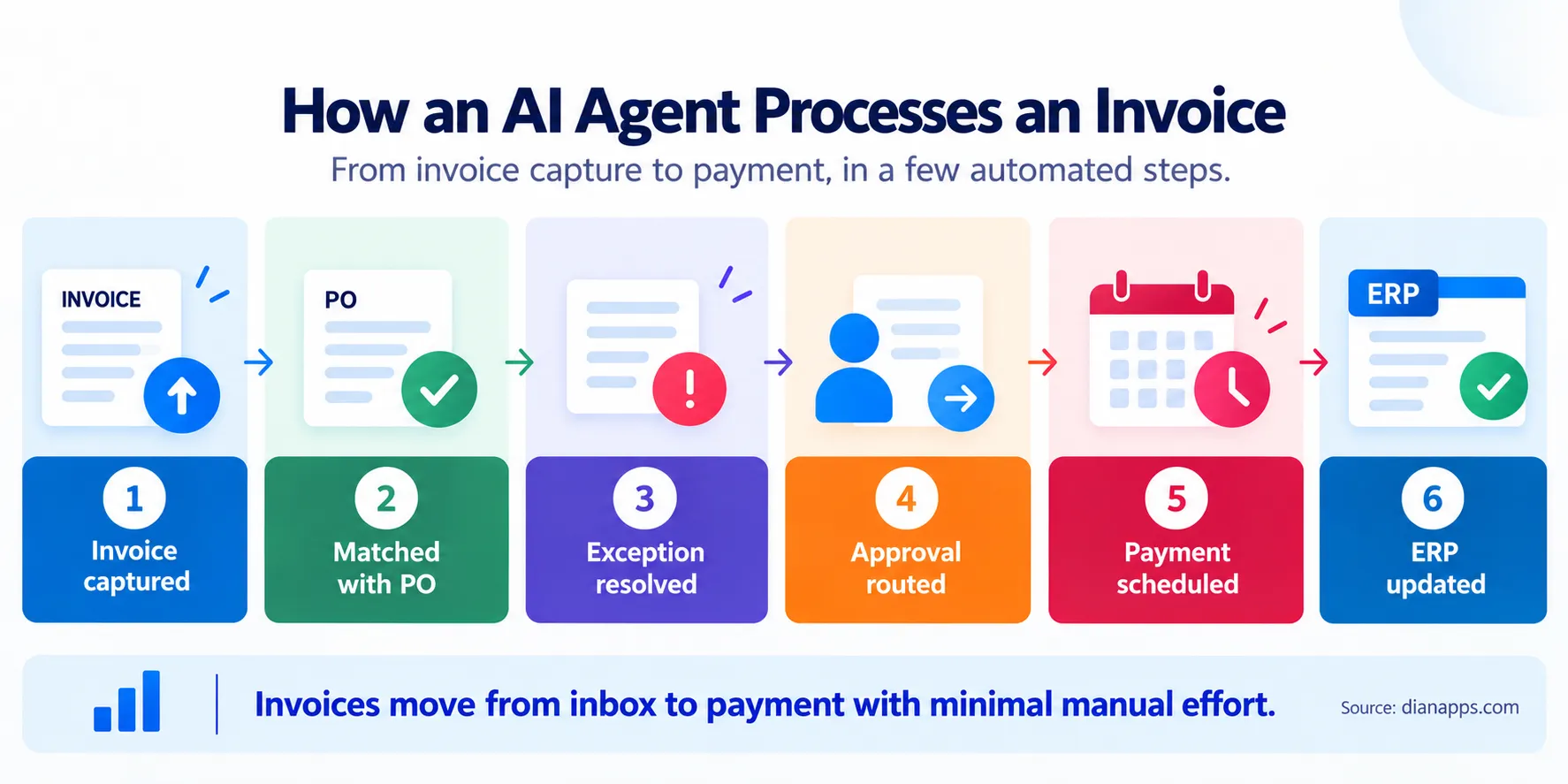
A well-built AP agent is usually working through the following steps for each and every invoice that is coming in:
- Invoice Capture: The agent is reading invoices from email, vendor portals and scanned PDFs, and pulling out the vendor, amount, tax and line items.
- Matching and Validation: It is matching each invoice with the purchase order and goods receipt, and checking for duplicates, wrong tax or pricing differences.
- Exception Handling: When something is not matching, it is reaching out to the vendor or buyer, finding the reason and suggesting the right fix.
- Approval Routing: It is sending the invoice to the right approver based on amount, department and policy, and following up if nobody is responding.
- Payment and Posting: Once approved, it is scheduling the payment, posting the entry to the ERP and updating the vendor on the payment status.
This not only saves the AP team hours of manual work each and every week, this also is helping companies avoid late payment fees, capture early payment discounts and keep their vendors happy.
And that is not all, agentic AI for accounts payable is also keeping a full record of why each invoice was approved, held or rejected, which is making audits much easier and much less stressful for the finance team.
If your team is planning to build its own AP agent, it is definitely worth going through the best AI agent frameworks first, because the right framework is making a big difference to how well the agent is connecting with your ERP.
To make it all a bit easier to picture, here is a quick summary of how these agents are being used across finance, banking and insurance, along with some real examples.
AI Agents for Finance Use Cases and Examples at a Glance
The table below is bringing together the most common use cases of AI agents for finance, banking and insurance, along with what the agent is doing and some real-world examples you might already know:
| Sector | Use Case | What the Agent Is Doing | Real-World Example |
| Banking | Customer Service | Answers queries and completes simple tasks | Bank of America’s Erica |
| Banking | Fraud Monitoring | Flags unusual transactions in real time | Card network fraud scoring systems |
| Banking | KYC and Onboarding | Verifies IDs and screens against watchlists | Digital banks and fintech apps |
| Insurance | Claims Handling | Collects FNOL details and settles simple claims | Lemonade’s AI Jim |
| Insurance | Agency Support | Qualifies leads and handles COI requests | Independent agencies using AI chat agents |
| Finance | Accounts Payable | Captures, matches and routes invoices | Ramp, BILL and Vic.ai |
| Finance | Contract Review | Reads legal documents and extracts key terms | JPMorgan’s COiN |
Most of these examples started with one focused use case, proved the value and then expanded, and that is really the best approach for any bank, insurer or finance team that is just getting started.
If you are looking for ideas beyond financial services, our blog on AI agent use cases is covering how businesses in other industries are putting agents to work as well.
But in an industry as tightly regulated as finance, there is one question that always comes up before any agent goes live, and that is about compliance, so let’s take a look.
Are AI Agents Safe for Financial Compliance?
Well, AI agents can definitely be safe for financial compliance, but only when they are built with the right controls from day one, because an agent that is making decisions about money, credit or claims is always going to be under the regulator’s microscope.
Gartner is expecting more than 40% of agentic AI projects to be cancelled by the end of 2027, with unclear business value and weak risk controls being the leading reasons, so getting governance right is extremely crucial for AI agents for finance.
Capgemini also found that 96% of financial institutions are seeing the regulatory and compliance burden as a challenge to scaling AI, which is showing just how seriously the industry is taking this.
To keep AI agents in banking, insurance and finance safe and compliant, these are the controls that each and every team should be putting in place:
- Human Approval: High-value payments, loan rejections and claim denials should always be reviewed by a person before the final decision is made.
- Audit Trails: Each and every action taken by the agent should be logged with the reason behind it, so auditors can trace it back later.
- Data Protection: Customer and financial data should be encrypted, access should be role-based and sensitive data should never leave approved systems.
- Regulatory Alignment: Agents should be designed around rules like GDPR, PCI DSS, SOX, the EU AI Act and local central bank guidelines.
- Bias and Fairness Checks: Credit and underwriting decisions should be tested regularly to make sure no group of customers is being treated unfairly.
This is why governance is not something that should be added at the end, it should be planned from the very beginning, and our guide on AI agent security and governance is covering these controls in much more detail.
Once the compliance side is clear, the next step is actually getting started, and the good news is that the process is not as complicated as it might sound, so let’s break it down.
Want AI Agents for Finance That Are Built for Compliance From Day One?
Our team is designing secure, auditable agents with human approvals, encrypted data flows and full decision logs, so your banking, insurance or finance workflows are staying compliant at every step.
How to Get Started With AI Agents for Finance?
Getting started with AI agents for finance is less about picking the most advanced model and more about choosing the right process, cleaning up your data and deciding how much the agent is allowed to do on its own.
For most banks, insurers and finance teams, the journey is usually looking something like this:
- Pick One Use Case: Start with a high-volume, rule-heavy process like invoice processing, KYC checks or simple claims, where the results are easy to measure.
- Clean Your Data: Fix vendor master data, policy records and customer files first, because an agent is only as good as the data it is reading.
- Plan the Architecture: Decide how the agent is going to connect with your ERP, core banking or policy admin system, and where humans are stepping in.
- Choose Build or Buy: Compare ready-made platforms with a custom agent based on your workflows, integrations, data rules and long-term costs.
- Pilot and Scale: Run the agent on a small batch first, compare the results with your current process and expand only when the numbers are holding up.
Architecture is the step that most teams are underestimating, and our detailed guide on AI agent architecture is explaining how layers like data, reasoning, tools and governance are working together.
This is especially important for banks and insurers, because a lot of off-the-shelf tools are storing data on the vendor’s servers, which is not suitable nor suggested for highly sensitive financial and customer information.
Deciding between a platform and a custom build is a big decision for regulated businesses, and our comparison of custom AI agent development vs off-the-shelf agents is breaking down the pros and cons of each approach in detail.
So whether you are a bank, an insurer, an agency or a finance team, the opportunity is really clear, and here is what it all comes down to.
Final Thoughts
AI agents for finance, banking and insurance are moving from small pilots to everyday operations, and the businesses that are seeing real results are the ones starting with one clear use case, clean data and strong compliance controls rather than trying to automate everything at once.
Whether it is AI agents in banking checking KYC documents, AI agents for insurance settling simple claims, AI for insurance agents qualifying leads or agentic AI for accounts payable processing invoices, the real value is coming from how well each agent is fitting your process and how closely your team is staying involved where judgement matters.
So if you are planning your first agent or looking to scale an existing pilot, DianApps is helping banks, insurers and finance teams design, build and govern custom agents end to end, and if you are still comparing partners, our list of top AI agent development companies in the USA is a good place to start. Whichever route you are choosing for your business, we’ve got you covered.
Ready to Put AI Agents to Work in Your Finance Operations?
Share your goals with our team and we will recommend the right use case, architecture and rollout plan for your bank, insurance business or finance team, along with a clear estimate and timeline.
 0 comments











Your email address will not be published. Required fields are marked *