















 0 comments




Key Takeaways:
- LangGraph is being built around explicit stateful orchestration, making it a strong fit when teams are needing durable execution, branching and human-in-the-loop control.
- CrewAI is making role-based multi-agent development approachable, while its Flows are adding more deterministic control for production workflows.
- AutoGen is an important framework in the history of multi-agent development, but Microsoft is now describing the project as being in maintenance mode and directing new projects toward Microsoft Agent Framework.
- OpenAI Agents SDK is keeping the core runtime small, with agents, tools, handoffs, guardrails, sessions and tracing covering a broad range of application patterns.
- MCP and A2A are making interoperability a bigger part of framework selection, so developers are increasingly evaluating how a framework connects agents to tools and other agents, not just how quickly it creates a demo.
Quick Answer: For most teams comparing agentic AI frameworks in 2026, the decision is being driven less by a single feature and more by how much control the application is needing. LangGraph is being suited to explicit, stateful and production-heavy orchestration, CrewAI is being attractive for role-based collaboration and structured flows, OpenAI Agents SDK is being useful when a lightweight agent loop with handoffs, guardrails and tracing is enough, and AutoGen is mainly making sense for existing projects that are already invested in its ecosystem. For new production work, AutoGen is needing an important qualification: Microsoft now says AutoGen is in maintenance mode and recommends Microsoft Agent Framework for new projects. That is making it different from the other three options in this comparison.
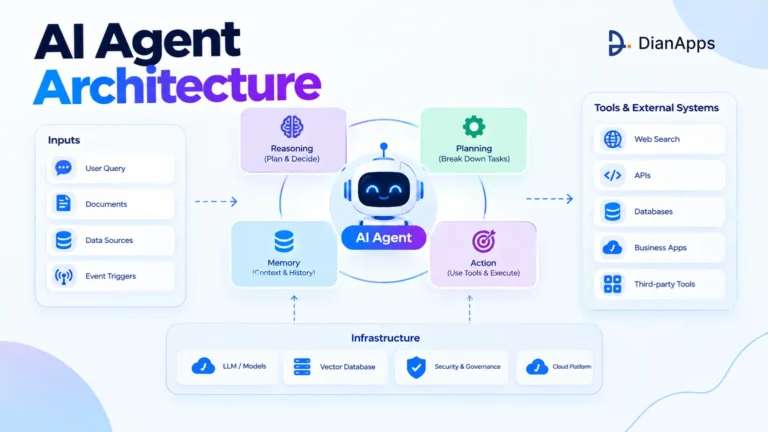
The agent framework conversation is changing in 2026. Building an agent is no longer mainly about connecting a model to a tool and hoping the loop behaves. The harder work is becoming orchestration, what state is being kept, which tools are available, how work is being delegated, what happens when a tool fails and where a human is stepping in. These decisions are also shaping the broader AI agent architecture, because the framework is only one layer of the system.
That is why AI agent frameworks are becoming so important. They are providing the runtime pieces around the model, and the differences between frameworks are showing up in the less glamorous parts of the system. Persistence, retries, state, tracing, approvals and tool boundaries are often mattering more once the prototype is meeting real users.
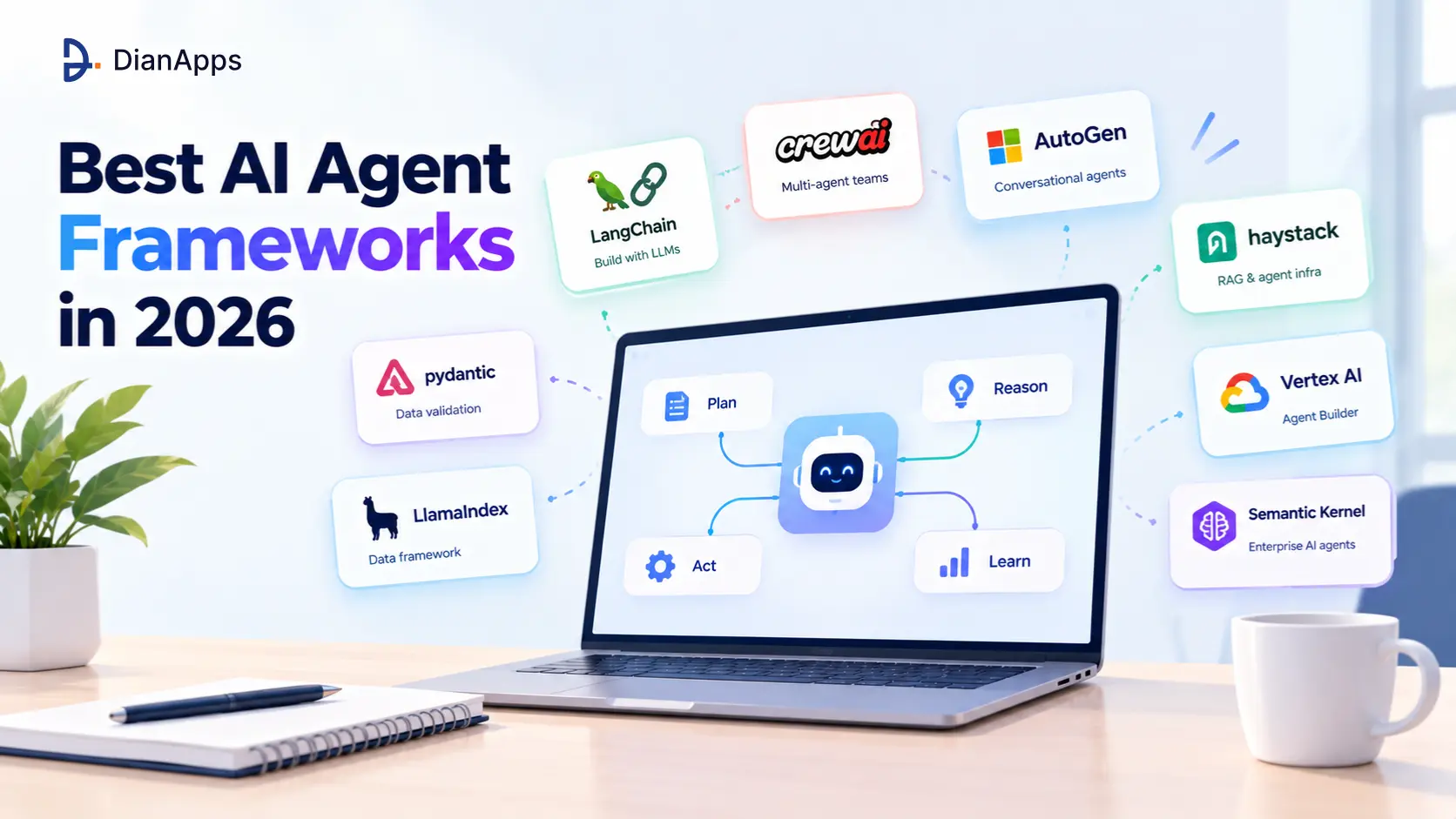
This comparison is focusing on LangGraph, CrewAI, AutoGen and OpenAI Agents SDK. It is also looking at MCP and A2A, because a framework that works nicely in isolation can become awkward once an agent is needing to talk to external tools or other agents.
How We Are Comparing These AI Agent Frameworks?
- Orchestration: How much control is the developer getting over execution, branching, delegation and state?
- Multi-agent design: How naturally is the framework supporting several agents working together or handing work between specialists? The answer also depends on the types of AI agents being used and whether the application actually needs multiple specialized agents.
- Production control: What is available for persistence, retries, human approval, tracing and predictable execution?
- Tool connectivity: How easily is the framework connecting agents to APIs, databases, MCP servers and application-specific tools?
- Developer experience: How quickly can a developer understand the abstractions and get from a blank project to a working agent?
- Ecosystem direction: Is the project actively developing, and is its current roadmap making sense for a new 2026 project?
The useful comparison is not asking which framework has the most features, it is asking which framework is giving the team the right amount of control without making the application harder than it needs to be.
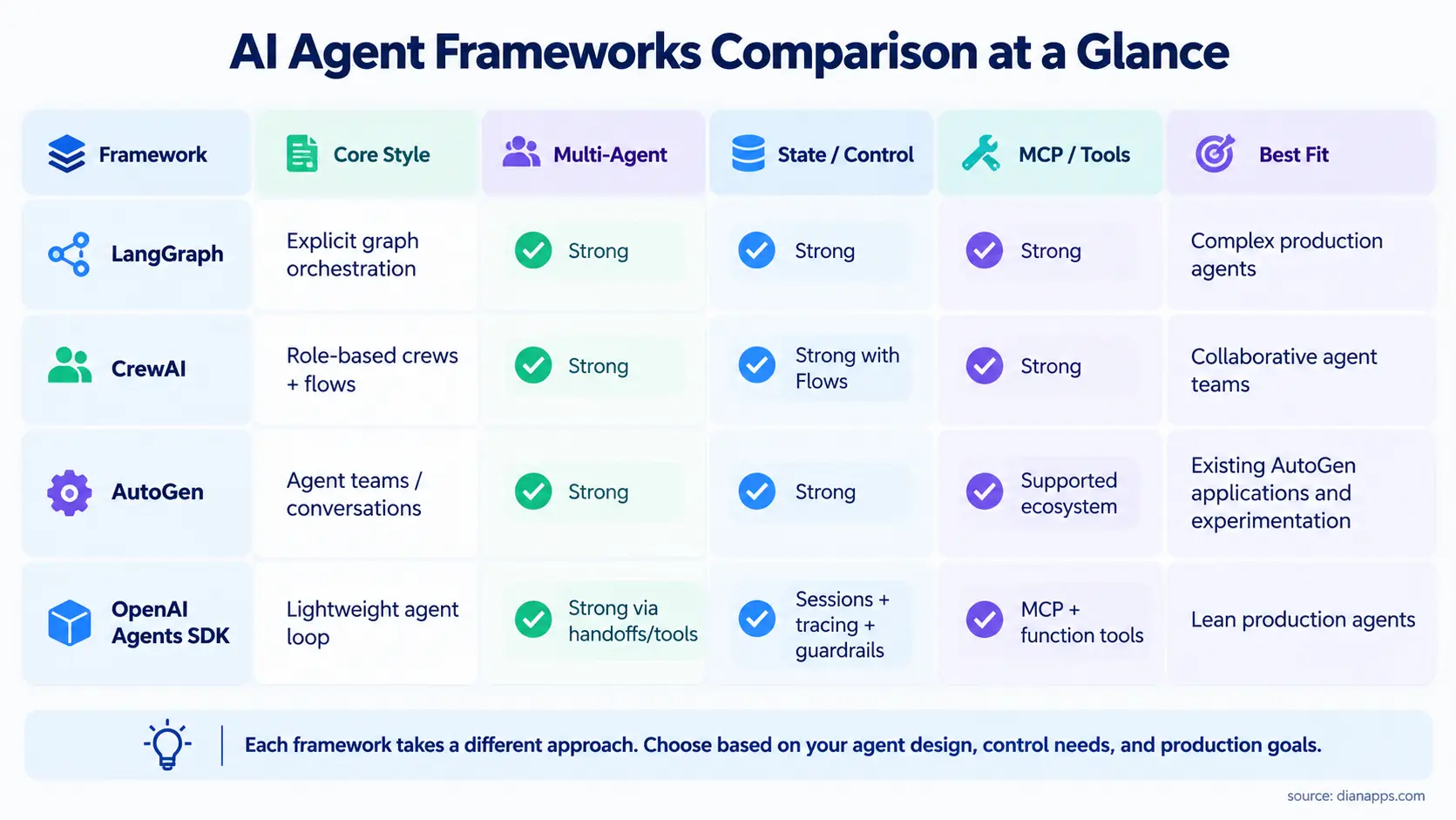
AI Agent Frameworks Comparison at a Glance
Planning an AI Agent Project?
Talk with our AI experts about your use case, framework requirements, integrations and production architecture.
The frameworks are overlapping in capability, but their mental models are different, and that difference is becoming noticeable once a project is growing.
1. LangGraph
LangGraph is being positioned as a low-level orchestration framework for long-running, stateful agents. Instead of hiding the workflow behind one high-level abstraction, it is letting developers model the application as a graph of nodes that read and update shared state.
That design is making LangGraph useful when a workflow has multiple paths. A request might move from intake to research, then branch into validation, tool execution and human approval before returning to the main flow. For teams moving from the framework decision into implementation, the broader process of how to build an AI agent also helps put these orchestration decisions into context.
Current LangGraph documentation highlights durable execution, streaming, human-in-the-loop, persistence and memory, and recommends LangGraph for advanced applications combining deterministic and agentic workflows or requiring heavy customization. LangChain agents are built on LangGraph, making LangChain for agentic AI a higher-level entry point into the same broader ecosystem (LangChain documentation, 2026).
LangGraph makes the most sense when the team is caring about exactly what the agent is doing, where it is in the workflow and how it is recovering when something goes wrong.
- Best fit: Production agents with complex control flow, persistent state, approvals, branching and custom orchestration.
- Watch for: The learning curve is being higher than with frameworks that let developers describe agent roles and tasks more abstractly.
In a crewAI vs langgraph comparison, LangGraph is generally being the more explicit orchestration choice, while CrewAI is giving more of the workflow shape through its agent and crew abstractions.
2. CrewAI
CrewAI is taking a different route. The core idea is easy to understand: agents have roles, goals, tools and tasks, and a crew coordinates those agents around a larger job. That makes the framework approachable for multi-agent applications where collaboration is central.
The interesting part in 2026 is that CrewAI is not stopping at autonomous crews. Its Flows provide event-driven orchestration, state management, branching and more predictable execution, allowing developers to combine regular code, direct model calls and agent crews in one workflow.
Current CrewAI documentation also shows MCP and A2A as part of its agent ecosystem. Its A2A implementation lets agents delegate to remote agents and expose CrewAI agents as A2A-compatible servers, which is becoming more relevant as multi-agent systems move beyond one application boundary.
CrewAI is useful when the mental model of the application is closer to a team of specialists than a graph of low-level execution states. This becomes particularly relevant when evaluating AI agent use cases where research, analysis, content, sales or operational tasks can be divided among specialized agents.
- Best fit: Research, content, analysis and business workflows where several role-based agents are collaborating.
- Watch for: Teams still need to decide where autonomy is useful and where deterministic Flow logic is safer.
3. AutoGen
AutoGen deserves to be in this comparison because it has been one of the most recognizable names in multi-agent development, particularly around agent conversations, group chats and research-oriented orchestration. Understanding where these systems sit within the broader distinction between AI agents, agentic AI and generative AI is useful before comparing the frameworks themselves.
But there is a major 2026 update that cannot be skipped. Microsoft’s current AutoGen repository describes AutoGen as being in maintenance mode, with no new features or enhancements planned, and directs new users toward Microsoft Agent Framework as the enterprise-ready successor.
That changes the architecture conversation. Existing teams with AutoGen applications can continue using the project, and the concepts remain valuable, but a new team needs to think about long-term framework ownership before starting a fresh production system around AutoGen.
AutoGen is still important to understand, but its 2026 position is being shaped more by maintenance and migration considerations than by a new feature race.
- Best fit: Existing AutoGen applications, research, experimentation and teams deliberately maintaining an established AutoGen stack.
- Watch for: New projects need to account for Microsoft’s maintenance-mode status and the migration path toward Microsoft Agent Framework.
The langgraph vs autogen conversation is therefore changing. It is no longer only about graph orchestration versus multi-agent conversation patterns, it is also about project direction and long-term support.
4. OpenAI Agents SDK
OpenAI Agents SDK is taking the lightweight route. Its core model is built around a small set of primitives: agents, tools, handoffs and guardrails, with sessions, tracing and other runtime capabilities around those building blocks.
That simplicity is useful. A developer can create an agent, give it instructions and tools, then use handoffs when a specialist needs to take over. The SDK also supports the opposite pattern, where an agent is called as a tool while a manager agent retains control of the conversation.
Current SDK documentation describes MCP server tool calling, sessions, human-in-the-loop capabilities and built-in tracing, so the minimal SDK description should not be confused with a toy framework. The abstraction is kept small while the runtime covers real production concerns.
Guardrails are also becoming a significant part of the architecture. The SDK supports input, output and tool guardrails, including guardrails around local MCP tools, which can block or validate operations before or after execution.
OpenAI Agents SDK is making a strong case when a team wants a small agent runtime and does not want the framework itself becoming the main architecture.
- Best fit: Teams wanting a lightweight Python-first runtime with tools, handoffs, guardrails, sessions and tracing.
- Watch for: Complex state-machine workflows may still benefit from a more explicit orchestration layer such as LangGraph.
Need Help Choosing the Right Framework?
Get guidance on selecting the right agent framework based on your workflow, scalability, integrations and control requirements.
CrewAI vs LangGraph: What Is the Real Difference?
CrewAI and LangGraph can both build multi-agent systems, but they encourage developers to think about those systems differently. CrewAI starts with agents, roles, tasks and collaboration.
LangGraph starts with state, nodes, edges and execution control.
That difference becomes visible in the codebase. A CrewAI application can read like an organizational chart: researcher, analyst, writer, reviewer. A LangGraph application can read more like a workflow diagram: intake, retrieve, evaluate, branch, approve, execute, complete.
Neither model automatically fits every project. A research system with several specialists can benefit from CrewAI’s role-based model, while a customer-facing workflow with strict approval boundaries can benefit from LangGraph’s explicit state transitions.
- Choose CrewAI when: The collaboration model is central and you want role-based agents to work together quickly.
- Choose LangGraph when: The control flow, state transitions, persistence and recovery behavior are central.
Ready to Build Your AI Agent?
Discuss your agent architecture with the DianApps team and turn your framework choice into a production-ready solution.
LangGraph vs AutoGen in 2026
The langgraph vs autogen comparison is becoming more straightforward once project direction is included. LangGraph is being actively positioned as an orchestration layer for production agents, while AutoGen is now being maintained rather than expanded by Microsoft.
AutoGen’s concepts remain useful, particularly for group chat and multi-agent collaboration. Its current documentation shows several team patterns and human-in-the-loop mechanisms, but Microsoft now points new projects toward Microsoft Agent Framework.
For an existing AutoGen deployment, migration cost is part of the decision. For a new project, the framework roadmap becomes a first-class selection criterion rather than a footnote.
Latest AI Agent Frameworks 2025-2026: What Is Actually Changing?
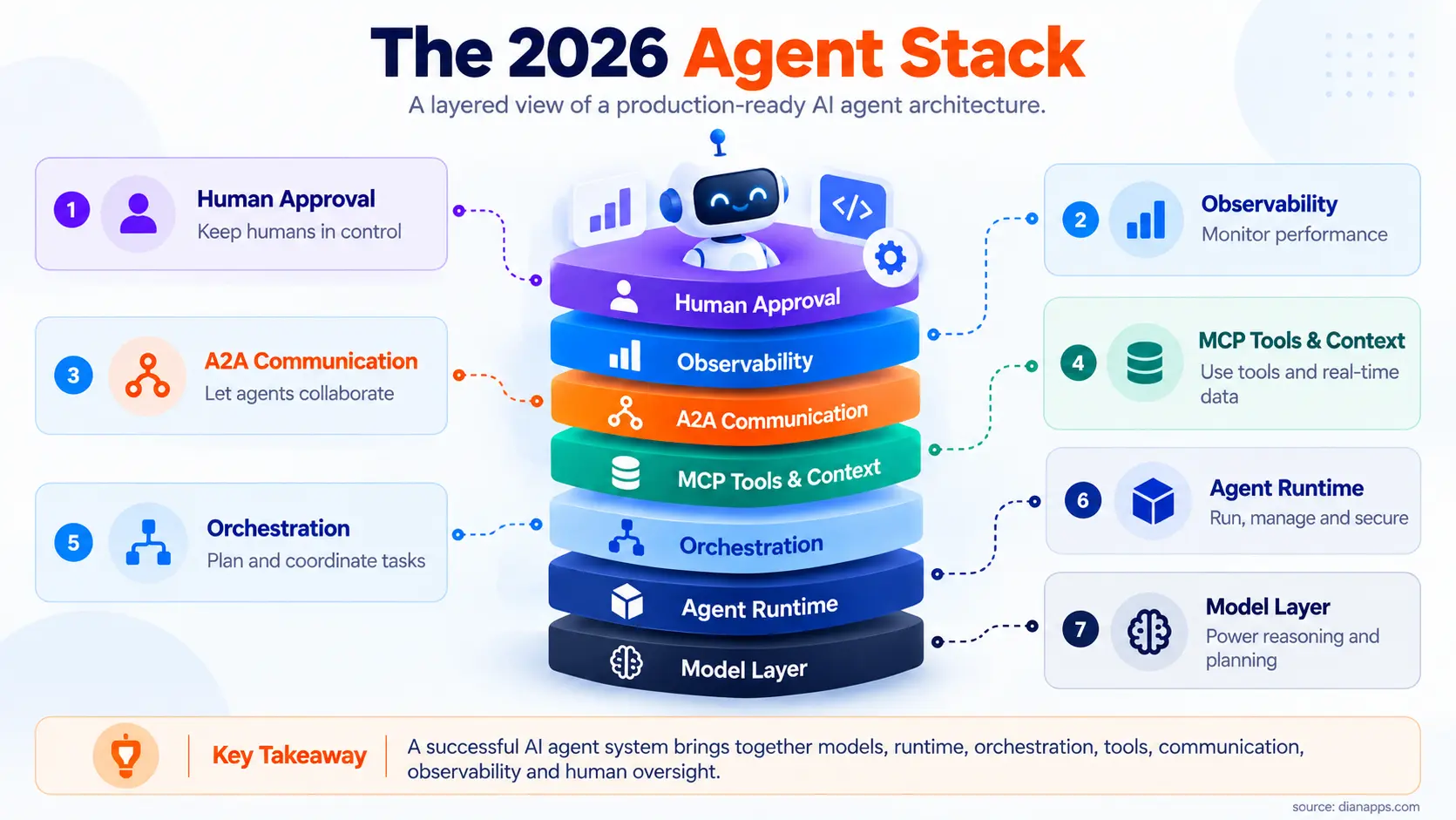
The biggest change in the latest AI agent frameworks 2025 2026 mcp a2a crewAI conversation is not another framework appearing every few weeks. It is the movement toward common ways for agents to access tools and communicate with other agents.
MCP is becoming a common tool and context integration layer, while A2A is being used for agent-to-agent communication and delegation. CrewAI supports both, and OpenAI Agents SDK supports MCP server tool calling. AutoGen’s later releases also added MCP-related capabilities, although the project is now in maintenance mode.
This is making the framework boundary a little less important than it used to be. A team can build an agent in one framework and still need it to interact with services, tools or specialist agents built elsewhere.
The framework decision in 2026 is increasingly being about interoperability as well as orchestration.
AI Agent Frameworks Updates 2026: What Developers Should Watch?
- Interoperability: MCP and A2A are reducing the need to build every integration as a proprietary connector.
- Durable execution: Long-running agents are needing state, resumability and recovery rather than one request and one response.
- Guardrails: Frameworks are increasingly treating permissions, validation and approval as runtime features instead of application afterthoughts.
- Observability: Tracing is becoming essential because an agent can be making several model calls and tool decisions before producing an answer.
- Hybrid workflows: Production systems are combining deterministic code with agentic steps instead of making the entire application autonomous.
- Model flexibility: Developers are increasingly wanting to change models without rebuilding the entire orchestration layer.
Best Frameworks for Building AI Agents in 2026: A Practical Decision Guide
There is a temptation to choose a framework based on a tutorial that feels pleasant for the first hour. That is useful for prototyping, but production architecture is being decided by what happens after the first successful demo.
A good framework is reducing engineering friction. A bad fit is creating an abstraction layer that the team spends more time working around than using. That choice can also affect AI agent development cost, particularly when the application requires custom orchestration, integrations, testing, observability and ongoing maintenance.
- Complex state: Start with LangGraph when the application needs durable state, branching, recovery and precise execution control.
- Role-based teams: Start with CrewAI when several specialized agents naturally map to roles and collaborative tasks.
- Existing AutoGen: Continue evaluating the current stack carefully, but include Microsoft’s maintenance-mode status and migration guidance in the roadmap.
- Lean runtime: Start with OpenAI Agents SDK when a small set of primitives is enough and you want handoffs, tools, guardrails, sessions and tracing.
- Interoperability: Evaluate MCP and A2A support as architecture requirements rather than treating them as optional buzzwords.
How LangChain Fits Into Agentic AI?
LangChain provides higher-level agent abstractions and integrations, while LangGraph provides lower-level orchestration capabilities for durable execution, streaming, persistence and human-in-the-loop behavior. Together, these technologies can be viewed as part of the wider generative AI platforms. LangChain provides higher-level agent abstractions and integrations, while LangGraph provides lower-level orchestration capabilities for durable execution, streaming, persistence and human-in-the-loop behavior.
That means langchain for agentic AI is not necessarily competing with LangGraph. In many applications, the two are being used together. LangChain is making the developer experience faster at the application layer, while LangGraph is providing the lower-level runtime when it is needed.
The practical question is how much of the execution model the team needs to own. If the answer is not much, higher-level abstractions can save time. If the answer is almost everything, an explicit graph or lower-level orchestration model becomes more attractive.
Where DianApps Fits Into Agent Framework Development?
DianApps, an AI-first product development company, is approaching agent development as an application architecture problem, not simply a framework installation. Through its AI agent development services, the framework is being selected around the workflow, model strategy, tool requirements, security boundaries and the level of control the product needs.
That can mean using LangGraph for a stateful orchestration layer, CrewAI for role-based collaboration, OpenAI Agents SDK for a lean agent runtime or another framework when the requirements point somewhere else. The important part is avoiding a framework-first decision where the technology is chosen before the business workflow is understood.
DianApps’ AI capabilities span generative AI, LLM development, AI agents, conversational AI, machine learning, NLP and computer vision, alongside mobile, web, backend and DevOps capabilities. That broader delivery model is useful when an agent needs to move beyond a prototype and become part of a real product.
The framework is being treated as a component of the product architecture, because the production system is always becoming bigger than the agent itself.
Conclusion
The AI agent framework market is getting more mature, but it is not becoming simpler. The names are familiar, the capabilities overlap and the terminology moves quickly, yet the core engineering questions remain practical: who controls the workflow, where is state stored, what can the agent actually do and what happens when the model gets something wrong?
LangGraph is making a strong fit for explicit, stateful orchestration. CrewAI is making agent teams and structured flows approachable. OpenAI Agents SDK is keeping the agent runtime small while adding tools, handoffs, sessions, guardrails and tracing. AutoGen remains important to understand, particularly for existing systems, but its maintenance-mode status changes how new projects need to evaluate it.
MCP and A2A are adding another layer to the decision because the future agent stack is not being built as one isolated framework. Agents are needing to use tools, call services and collaborate with other agents, sometimes across organizational boundaries.
The right framework is therefore being the one that fits the product you are actually building. A small workflow does not need a giant orchestration system, and a complex production agent does not become reliable simply because its first demo was easy to build.
If you are planning an AI agent system and need help choosing the architecture, framework and integration strategy, talk to the DianApps AI team.
 0 comments







Leave a Comment
Your email address will not be published. Required fields are marked *