















 0 comments





Key Takeaways:
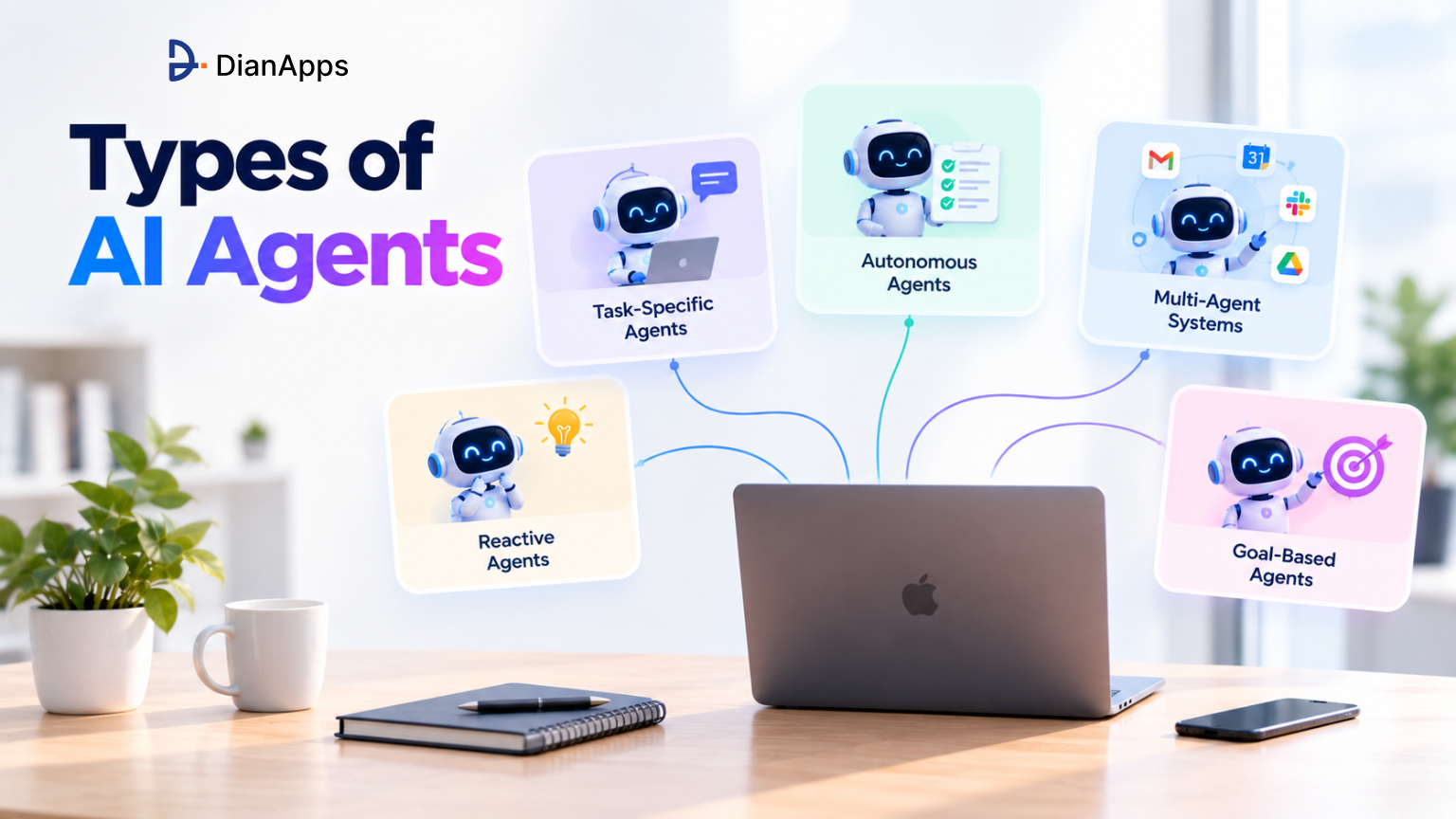
- AI agents range from simple rule-based systems to complex multi-agent architectures with very different capabilities.
- The seven types include simple reflex, model-based reflex, goal-based, utility-based, learning, hierarchical, and multi-agent systems.
- Learning agents improve through experience, while hierarchical and multi-agent systems coordinate multiple tasks or specialized agents.
- The right agent type depends on input variability, task complexity, and how much the system needs to improve over time.
Quick Answer: The seven main types of AI agents are simple reflex, model-based reflex, goal-based, utility-based, learning, hierarchical, and multi-agent systems. They differ in how they use memory, planning, learning, and coordination. Simple reflex agents work well for predictable rule-based tasks, while goal-based and utility-based agents handle planning and trade-offs. Learning agents improve from experience, and hierarchical or multi-agent systems are designed for more complex workflows involving multiple specialized tasks.
Not all types of AI agents are built the same way or designed for the same problems. A simple FAQ chatbot and a multi-agent enterprise automation system are both “AI agents” but they operate on fundamentally different architectures, have vastly different capability profiles, and are suited to completely different use cases. Building the wrong type for your problem is as costly as choosing the wrong tool in any engineering discipline.
AI agents can be classified in several ways. This guide covers seven commonly discussed agent architectures and modern agent-system patterns. In 2026, the taxonomy has grown beyond the academy and now includes multi-agent systems, learning agents, and autonomous LLM-driven agents that are able to plan for and act in difficult real-world situations-architectures that have only become feasible with the maturation of large language models.
This guide explains all seven types, compares them in a single reference table, and gives real 2026 examples of each type in production. For businesses looking to apply these architectures in real products, AI Development Services can help turn the right agent approach into a production-ready AI solution.
Complete Comparison Table: 7 Types of AI Agents
| Agent Type | Memory | Planning | Learning | Complexity | Best For | Example |
| Simple
Reflex |
None | None | No | Very Low | Fully
predictable, structured inputs |
FAQ bot, rule
based email filter |
| Model
Based Reflex |
Internal
state model |
Minimal | No | Low | Partially
observable environments |
Smart
thermostat, GPS navigation |
| Goal-Based | State +
goal |
Multi-step | No | Medium | Tasks with
defined end states |
Search engines, route planners |
| Utility
Based |
State +
utility function |
Optimization | Sometimes | Medium–
High |
Competing
goals requiring trade-offs |
Recommendation engines, ad
bidding |
| Learning | Experience memory | Evolves with learning | Yes | High | Environments that change
over time |
Fraud detection, AI medical
coding |
| Hierarchical | Layered
state |
Decomposed goals | Sometimes | High | Complex
goals requiring sub task coordination |
Enterprise
workflow orchestration |
| Multi-Agent System | Shared +
individual |
Distributed | Possible | Very High | Problems
requiring multiple specializations |
Agentforce,
UiPath Maestro, CrewAI |
Not Sure Which AI Agent You Need?
Tell us about your workflow, and we’ll help you identify the right agent architecture.
Type 1: Simple Reflex Agent
The concept of simple reflex agents is straightforward as it does not rely on any past percepts of the history, making it completely unable to plan for the future. The design of these agents is restricted to condition-action rules: “if we see X, do Y.” Because simple reflex agents keep no memory of the past nor any model of the world (a knowledge that represents something about the world that is not part of the current input), it has no notion of what will happen in the future and consequently no ability to act to change that future in any way.
This is the most basic agent architecture, and for the right kinds of problems – those where input is fully structured and predictable and there’s no ambiguity – it’s also the most reliable. There are no hallucinations, no confusion over new circumstances, and there’s always a faithful and consistent response for any given input. The negative is just as clear, though: any input that falls outside the rule set gets no response, or the wrong one.
Real examples of simple reflex agents:
- An email filter that automatically classifies an email as spam if it contains certain words
- A chatbot that searches a predefined set of questions and gives a preprogrammed answer
- You check the rating of the thermostat: turn it on if the temperature falls below a threshold, and so on.
- A script that automatically applies a validation rule to a web form and rejects any invalid entries out of a specified format.
What is the difference between a simple reflex agent and a learning agent? The rules of a simple reflex agent are hard-coded when the system is built, and do not change. A learning agent adjusts its rules, weights, or behavior according to feedback about how well previous actions performed. The rules of a simple reflex spam filter are hard-coded; a learning spam filter learns based on whether email is marked as spam or not.
Type 2: Model-Based Reflex Agent
A model-based reflex agent extends the simple reflex agent by maintaining an internal model of the world, a representation of the parts of the environment it can’t directly observe at any given moment. This internal model lets the agent act appropriately even when it can’t see the full current state of the environment.
The model in this context doesn’t refer to a machine learning model – here it is an internal understanding of what the world is like and how it changes over time. This allows the agent to infer information about the current state of the world that isn’t available, before actually using its condition-action rules.
Real examples of model-based reflex agents:
- A GPS navigation system that maintains a model of traffic conditions even between GPS updates A smart thermostat that models occupancy patterns and adjusts temperature before residents return home A robot vacuum that maintains a map of a room it has partially explored.
- An inventory management system that models current stock levels based on sales transactions even before physical count.
Type 3: Goal-Based Agent
The goal-based agent builds upon the model-based agent, and on top of the current state, it is explicitly given the goal. This means that the goal-based agent does not just react to the current state, but that it knows its current goal and that it is asked to determine the sequence of actions necessary to get to the goal. This means that planning is required.
Goal-based agents are not restricted to scenarios where an action is immediately goal-satisfying – they think ahead, even several steps ahead, to find a sequence of actions from where you are now to where you want to be. This is much more powerful than reflex agents, but also much harder to compute.
Goal-based agents are also where the architecture starts becoming more practical for real business workflows. If you’re looking at how these systems are actually developed, see our guide on how to build an AI agent.
Real examples of goal-based agents:
- A search engine that plans a series of web crawls to index all pages within a domain
- A route-planning system (Google Maps, Waze) that reasons about a sequence of turns to reach a destination A chess engine that evaluates sequences of moves to reach a winning position
- An AI agent that plans a sequence of API calls to complete a user’s research request
- GitHub Copilot Workspace, which plans a sequence of code changes across
Type 4: Utility-Based Agent
A utility-based agent extends the goal-based structure with a utility function-something to say ‘how good’ each state or result is, rather than a goal (or not). This enables the agent to deal with having more than one way to reach a goal, competing goals, or uncertainty about the optimal path. The agent then chooses the action that will maximize its utility.
What is responsible for this agent type taking trade-offs: faster but less safe, cheaper but lower quality, higher short-term gain but more long-term risk? The goal-based agent will do the goal by any means, the utility based agent will do the goal in the most maximising way.
Real examples of utility-based agents:
- Netflix and Spotify recommendation engines that balance relevance, novelty, and engagement in content suggestions
- Algorithmic trading bots that balance expected return against risk within defined constraints Advertising bid management systems that optimize for conversion value given a cost-per-acquisition constraint AI scheduling systems that optimize appointment slots for revenue and patient satisfaction simultaneously Route planners that balance distance, tim
Type 5: Learning Agent
A learning agent is an agent that learns from its experience. A learning agent is not hard-wired like a reactive agent but has the capacity to learn while acting: it must have a dedicated module for learning that acts on the information it gets either explicitly from a human (learning by instruction) or implicitly by observing the effects of its own actions.
This is the kind of AI agent that improves the longer it runs and this is the kind of AI agent that most of the advanced types of AI agents running in production in 2026 are. These are sometimes called learning agents, because training sets their parameters by using backpropagation – gradient descent on a loss function – to improve the expected output on novel inputs.
Many modern learning and autonomous agents are built around generative AI models, so understanding the available generative AI platforms can help when choosing the underlying technology.
Real examples of learning agents:
- Fraud detection models that update based on new labeled fraud cases, when a new fraud pattern emerges, the model learns to recognize it
- AI medical coding tools (Medicodio CODIO, CodaMetrix) that improve first-pass accuracy based on payer denial feedback
- Email spam filters that update based on user feedback (marking as spam / not spam)
- Language models that are fine-tuned on domain-specific data to improve performance on specialized content AI customer support agents that incorporate human reviewer feedback to improve resolution accuracy over time
LangChain’s State of AI Agent Engineering reports that 52% of teams building agents run offline evaluations and 37% evaluate agents in production. The teams with high evaluation rates are typically running learning agents, where performance measurement is the prerequisite for improvement.
Ready to Build an AI Agent?
Build AI agents that learn from feedback and adapt to your business workflows.
Type 6: Hierarchical Agent
A hierarchical agent system means several levels of agents with the topmost agent for the broadest goals, then it’s broken down into sub-goals for lower-level agents, which can further subdivide if they need to, until the lowest-level agents are just carrying out all the atomic actions directly.
Note that this is just how large human organizations tend to work: the general keeps handing down overarching goals and a department manages that goal, then an individual manages how their sub-tasks are carried out, then there’s a person executing those tasks, and so on.
These hierarchical architectures are particularly useful for enterprise automation, where multiple workflows and systems need to work together. See our guide to AI automation platforms for enterprises for a closer look at the platforms supporting these deployments.
Real examples of hierarchical agents:
- UiPath Maestro: An orchestrator agent coordinates RPA robots and AI agents across complex IT workflows, routing tickets, assigning resolution paths, monitoring completion, escalating exceptions.
- A content production system where a planning agent defines the research topics, research agents gather information, a writing agent produces the draft, and an editing agent reviews it.
- A customer onboarding orchestrator that delegates documentation collection to a document agent, account setup to a provisioning agent, and welcome communications to a communications agent.
- An enterprise compliance monitoring system where a master compliance agent delegates jurisdiction-specific monitoring to regional compliance agents.
Type 7: Multi-Agent System (MAS)
A multi-agent system (or MAS) is a number of AI agents that work together in a network to tackle a problem. They can cooperate, compete or communicate with one another to obtain their own (or shared) objectives. Agents in a multi-agent system need not be linked in a hierarchy, as in a hierarchy of agents, and can work as peers.
2026 is described by multiple framework developers as “the year of multi-agent systems.” Gartner expects 40% of enterprise applications to embed task-specific agents by the end of 2026. The fastest-growing AI agent frameworks, CrewAI (44,600+ GitHub stars), LangGraph (34.5M monthly downloads), are built specifically for multi-agent orchestration.
What Is an Autonomous AI Agent?
An autonomous AI system is an agent that can do things on its own without humans needing to trigger the next step: small-scale multi-agent systems and hierarchical agent structures are, in reality, autonomous once they are launched, it is just defining the goal and setting up the structure.
Autonomous systems send themselves or conduct their own operations; it’s not the case of human-in-the-loop systems. The level of autonomy is essential for governance: autonomous systems take irreversible actions (email, payments, creating records); human-in-the-loop systems take actions but leave users to approve major actions.
Real examples of multi-agent systems and autonomous AI agents in production:
- Salesforce Agentforce: Multiple specialized agents, service agents, sales agents, marketing agents, employee experience agents, operating within Salesforce CRM data. Each agent specializes in a domain; the platform coordinates which agent handles which workflow.
- UiPath Maestro: Coordinates deterministic RPA robots and probabilistic AI agents within the same workflow, using each where it’s most appropriate and handing off between them based on task type and confidence level.
- CrewAI Content Pipelines: A Researcher agent gathers information, a Writer agent produces a draft, an Editor agent reviews it, three specialized agents collaborating sequentially on a shared output.
- DianApps Orby (Enterprise LAM): The first enterprise AI system powered by a Large Action Model, a multi-agent architecture designed to take coordinated multi-step actions across enterprise software systems.
- Microsoft Copilot Studio Multi-Agent Workflows: Multiple Copilot agents handling different domains (IT support, HR, sales) that hand off to each other and to human specialists based on the nature of incoming requests.
Need AI Developers?
Hire AI developers to design and build reliable agentic systems for complex workflows.
Which Type of AI Agent Should You Build?
The right type depends on three questions: How variable are the inputs? How complex is the task? How much does performance need to improve over time? These considerations also shape AI Agent Development Services, where the architecture, level of autonomy, tools, memory, and orchestration approach need to be matched to the workflow the agent is expected to handle.
| Your Situation | Agent Type | Why |
| Fully predictable, rule-definable inputs; reliability is the primary requirement | Simple Reflex | Most reliable and auditable; zero
hallucination risk |
| Clear goal; variable path to achieve it; single workflow | Goal-Based | Can plan the path to the goal rather than needing it specified step-by-step |
| Multiple competing objectives; quality vs. cost vs. speed trade-offs | Utility-Based | Optimizes across competing priorities; handles ambiguous “best” outcomes |
| Environment changes over time;
performance needs to improve with use |
Learning | Accuracy improves with feedback; adapts to changing conditions |
| Complex goal requiring specialized sub tasks; single coordinating authority | Hierarchical | Decomposes complex goals; coordinates specialists; maintains accountability |
| Multiple distinct expertise areas; parallel workstreams; cross-check requirements | Multi-Agent
System |
Specialist agents for each domain; parallel execution; peer review between agents |
The practical principle from Anthropic’s Building Effective Agents guide: “Find the simplest solution possible, and only increase complexity when needed.” A simple reflex agent that works reliably is worth more than a multi-agent system that occasionally fails in ways you can’t predict. Build the minimum viable architecture that solves the problem, then expand as you have evidence more complexity is needed.
 0 comments










Leave a Comment
Your email address will not be published. Required fields are marked *