















 0 comments





Key Takeaways:
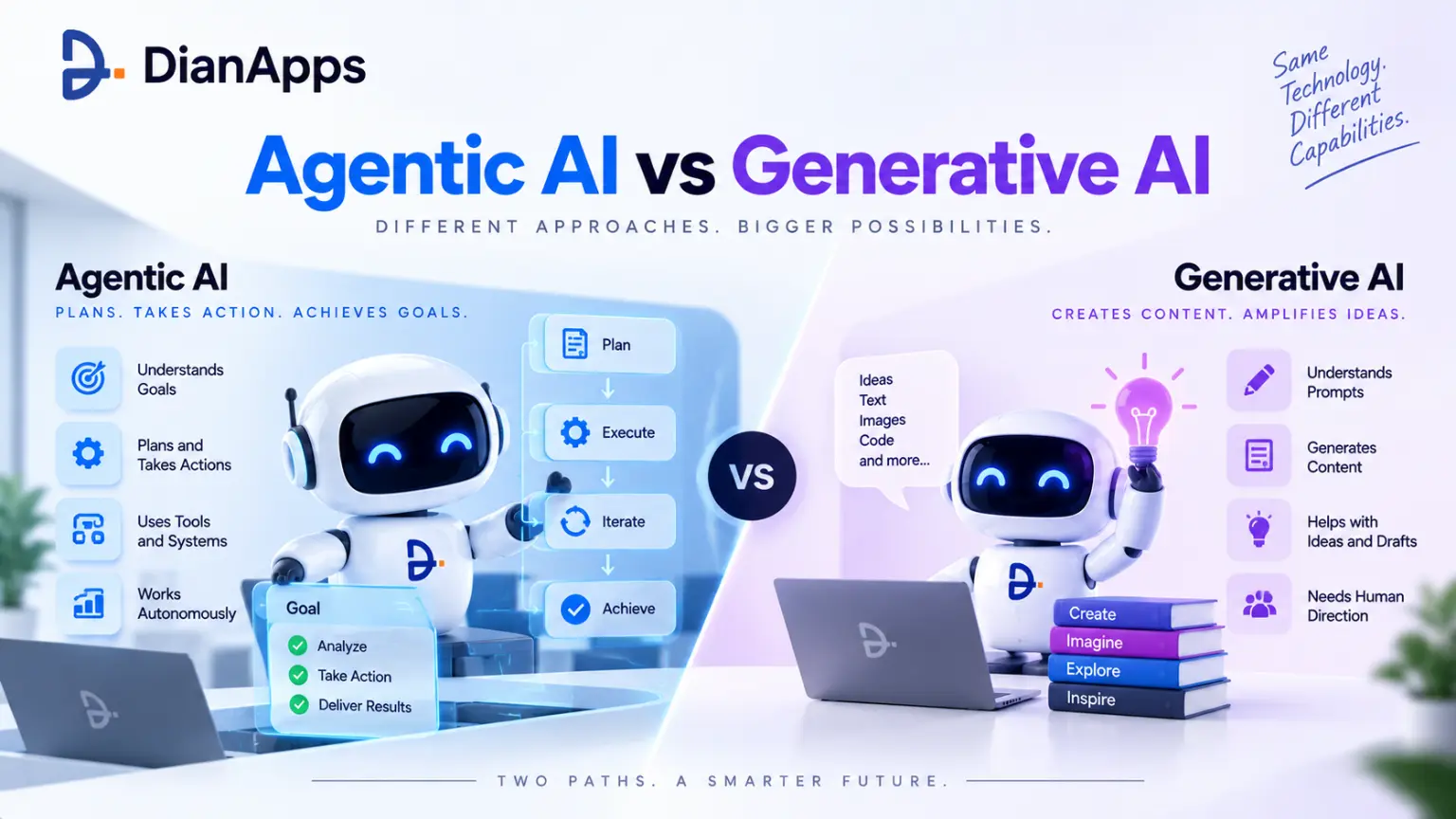
- Generative AI creates content, while agentic AI pursues goals through multiple steps.
- AI agents are deployed systems built using the agentic AI approach.
- Agentic AI adds planning, tools, memory and autonomous action to generative AI.
- Generative AI suits content, Q&A and one-time analysis, while agentic AI fits ongoing workflows and automation.
Quick Answer: Generative AI creates content in response to prompts, while agentic AI can plan, use tools, take actions and adapt across multiple steps. AI agents are the specific software systems built on this agentic approach. In simple terms, generative AI responds, agentic AI acts, and AI agents are what you deploy to get that work done.
Most people use the terms generative AI, agentic AI and AI agents interchangeably while they shouldn’t. These three terms describe distinct architectures with different capabilities, different failure modes and different use cases and choosing the wrong one for a problem is the fastest path to a system that works in a demo and fails in production.
The confusion is understandable as all three involve large language models, each can produce human-like text responses and the marketing around all three tends to blur together into a single narrative about “AI doing things.” But the differences are real and they matter for anyone deciding how to build with AI, what to buy or how to evaluate whether an AI product will actually solve their problem.
This guide draws a clean line between each term, answers the most searched questions about the topic including whether ChatGPT and Claude are agentic AI and gives you a decision framework for choosing the right type of AI for your specific use case.
Agentic AI vs Generative AI: The Core Difference
The most direct way to understand this distinction is through what each type of AI actually does when you give it a task to complete.
Say for example, the task is: “Research competitors in the project management software space, summarize their pricing and features and draft a one-page competitive analysis.”
A generative AI model like ChatGPT, given this as a prompt, will produce a response based on its training data. It will write a competitive analysis, potentially a good one but it will be drawing from knowledge that has a cutoff date and it won’t search the web, check current pricing pages or verify that its information is still accurate, just one prompt and one generated response.
- An Agentic AI System Given The Same Task Will: Search the web for current competitor information, visit multiple pricing pages, read and extract data from each one, compare the information, identify gaps, search for missing data, organize the findings and produce a competitive analysis grounded in information it gathered in real time. Multiple steps, multiple tool calls, one outcome.
That difference, reactive generation versus goal-directed multi-step action is what differentiates generative AI from agentic AI. It’s not a difference in intelligence or model quality.
| Property | Generative AI | Agentic AI | AI Agents |
| What it does | Generates content from a prompt | Pursues goals through multi-step planning and action | Software implementations of the agentic paradigm |
| Operation mode | Reactive , and responds to each prompt independently | Proactive , and initiates and continues actions toward a goal | Autonomous , and operates independently once deployed |
| Memory | Context window only (within one session) | Short-term + long-term (vector stores, databases) | Persistent state across sessions |
| Tool use | None (unless tool use is explicitly enabled) | Central , and uses tools to gather information and take actions | Central , and defines tools at build time |
| Human involvement | Required at each step (prompt → response loop) | At goal definition and escalation points only | At deployment and for exception handling |
| Best for | Content creation, drafting, Q&A, summarization | Complex, multi-step tasks requiring real-world action | Ongoing automated workflows in production |
| Examples | ChatGPT, Claude, Gemini, Midjourney | Claude in agentic mode, GPT-4o with tools, AutoGPT | Customer support agents, coding agents, research agents |
Have an AI Project in Mind?
Tell us what you’re building, and we’ll help you choose the right AI approach.
What Is Generative AI? Definition, How It Works and Real Examples
Generative AI is a category of artificial intelligence systems that generate new content, from text, images, code, audio, video to any other data, by learning statistical patterns from large training datasets and applying those patterns to produce outputs that match new inputs.
The core mechanism is a large language model (for text and code) or a diffusion model (for images and video) trained on billions of examples. When you give the model a prompt, it predicts the most statistically appropriate continuation of that input based on what it has learned. It doesn’t retrieve stored answers or look things up, it generates a response from patterns in its training data.
The generative AI market reached $91.57 billion in 2026, according to IDC data. 65% of organizations now use generative AI in at least one business function, double the rate from ten months earlier, per McKinsey’s Q1 2026 survey.
The technology is now available through a growing range of generative AI platforms, each designed around different models, capabilities, and business use cases.
What Generative AI Is Good At
- Writing And Editing: Drafting emails, reports, blog posts, marketing copy, legal documents
- Code Generation: Writing, explaining and debugging code across programming languages
- Summarization: Condensing long documents, meeting transcripts, research papers
- Translation: Converting content between languages with contextual accuracy
- Creative Work: Generating images, composing music, writing scripts, visual design ideation
- Q&A: Answering questions from training knowledge or provided context documents
What Generative AI Cannot Do on Its Own
- Search the web or access information beyond its training cutoff (unless web search is enabled)
- Take actions in external systems: create a calendar event, send an email, update a CRM record
- Run a multi-step workflow without a human prompting each next step
- Remember previous conversations by default (context window resets with each new session)
- Monitor a business process and act when a condition is triggered
Real Examples Of Generative Ai In Production: ChatGPT (1B+ active users, generating text and code across millions of use cases), Claude (200K token context window, used for long-document analysis and enterprise coding), Midjourney (image generation, $500M revenue), GitHub Copilot (AI writes 41% of all code globally in 2026).
What Is Agentic AI? Definition, How It Works and Real Examples
Agentic AI is an architectural paradigm where AI systems pursue goals over multiple steps, using tools to take real-world actions, observing the results of those actions and adjusting their approach based on what they find without requiring a human prompt at each step.
The word “agentic” comes from “agency”, the capacity to act independently in the world. An agentic AI system doesn’t just respond to a prompt; it executes a plan. It reasons about what needs to be done, selects the tools required to do it, takes action, checks whether the action produced the expected result and continues until the goal is reached or it determines it needs human help.
Gartner predicts 40% of enterprise applications will embed task-specific AI agents by the end of 2026, up from less than 5% in 2025. The agentic AI market reached $10.8 billion in 2026, growing at 43.8% annually toward $196.6 billion by 2034, per Cyntexa.
The Four Things Agentic AI Has That Generative AI Doesn’t
- Planning: Before acting, an agentic AI system breaks a goal into a sequence of steps. Generative AI responds to what it’s given. Agentic AI plans what to do before it starts.
- Tool use: Agentic AI calls external tools, web search, APIs, databases, code executors, email systems, to gather information and take actions. A generative AI model without tool use enabled is limited to what’s in its training data and the context window.
- Observation and adaptation: After each action, an agentic AI system reads the result and adjusts its next step accordingly. If a web search returns unexpected information, the agent revises its plan. Generative AI produces its output in one step based on the input it received.
- Persistence: Agentic AI systems maintain state across steps within a session and with long-term memory implementations, across sessions. A generative AI model resets with each new conversation by default.
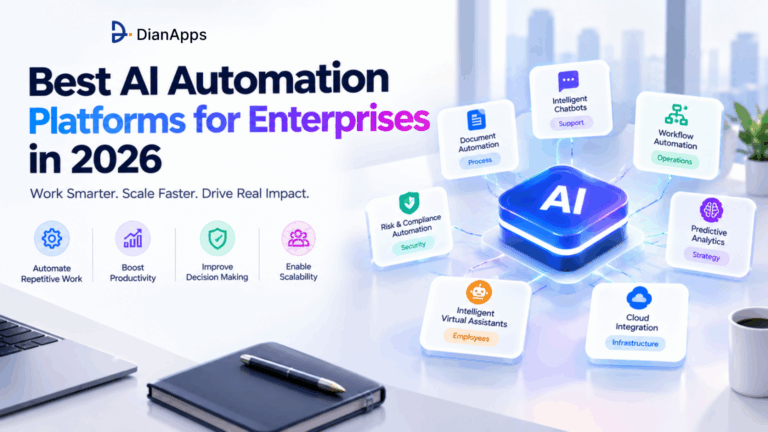
For organizations looking to put these capabilities into production, comparing AI automation platforms for enterprises can help clarify the differences in integrations, orchestration, and scalability.
Real Examples of Agentic AI in Production
- Salesforce Agentforce: AI agents that act on Salesforce CRM data , and resolving support cases, qualifying leads, drafting follow-ups , and without a human directing each step. ~$800M ARR, up 169% YoY (Salesforce fiscal 2026).
- UiPath Maestro: Orchestrates RPA robots and AI agents together to handle IT service workflows end-to-end. $1.853B ARR (FY2026).
- Orby AI (built by DianApps): Enterprise AI powered by the first Large Action Model (LAM) , and an agentic AI architecture designed to take multi-step actions across enterprise software systems.
- GitHub Copilot Workspace: An agentic extension of code completion that plans and executes multi-file code changes across a codebase based on a natural language task description.
Ready to Build with AI?
Build practical generative and agentic AI solutions around your business workflows.
What Are AI Agents? Definition, Structure and Real Examples
If agentic AI is the paradigm, AI agents are the implementations. An AI agent is a specific software system built on the agentic AI architecture, a deployed application that uses an LLM as its reasoning engine, connects to tools and data sources, maintains memory and executes tasks autonomously within a defined scope.
Every AI agent, regardless of the framework it runs on, has four components:
- Llm (Reasoning Engine): The model that interprets the task, plans the approach and decides what tool to call next. GPT-4o, Claude Sonnet, Gemini Pro are the most common in production.
- Tools: The external systems the agent can interact with , and web search, APIs, databases, email, calendars, CRM systems. Without tools, the agent can reason but not act.
- Memory: Short-term (context window within a session) and long-term (vector databases like Pinecone or Chroma or structured databases that persist across sessions).
- Orchestration Loop: The runtime that drives the reasoning cycle , and LLM thinks, tool is called, result is observed, LLM thinks again. Implemented by frameworks like LangGraph, CrewAI and OpenAI Agents SDK.
Real examples of AI agents:
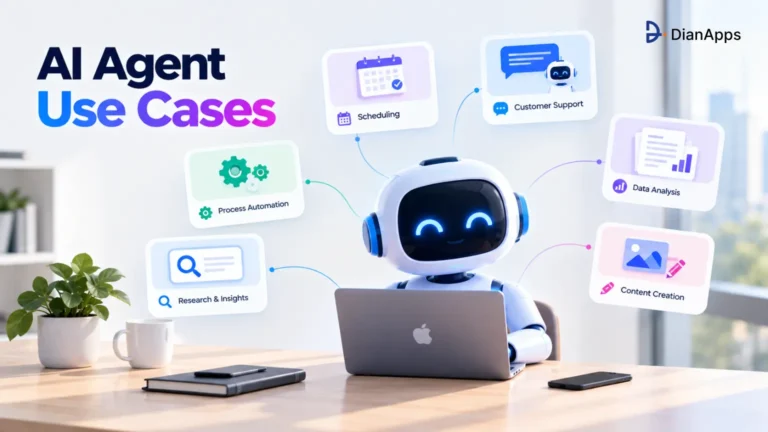
- A customer support agent that reads new Zendesk tickets, classifies them, drafts responses and escalates complex cases to human agents.
- A research agent that takes a company name, searches the web, reads their website and recent news and produces a competitive intelligence summary.
- A coding agent that reads a bug report, finds the relevant code, writes a fix, runs tests and opens a pull request.
- A scheduling agent that reads an incoming meeting request, checks the calendar, proposes times and sends a confirmation without a human doing any of those steps.
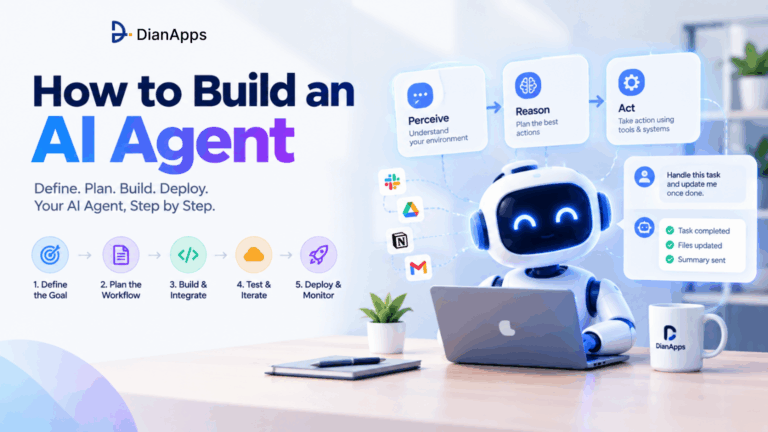
If you’re moving from understanding AI agents to actually building one, our guide on how to build an AI agent covers the architecture, development process, tools, and deployment considerations.
Need AI Developers?
Hire experienced AI developers to build and deploy AI agents for real business workflows.
Agentic AI vs AI Agents: Is There Actually a Difference?
This is the most common source of confusion in the category and it’s worth being precise about.
Agentic AI is an approach to building AI systems , and the design philosophy that AI should pursue goals through multi-step reasoning and action rather than responding to one prompt at a time. It’s the paradigm, the principle, the category.
AI agents are the specific systems built on that paradigm. When someone says “we deployed an AI agent for customer support,” they mean a specific software application running on an agentic AI architecture, connected to specific tools, configured for a specific task, operating in their production environment.
The distinction is like the difference between “machine learning” (the paradigm) and “a recommendation engine” (the specific system). You build an AI agent using agentic AI principles. The two terms point at the same underlying technology from different angles , and one describes the design philosophy, the other describes the deployed artifact.
In practice, the terms are used interchangeably in most business conversations and that’s largely fine. The distinction matters most when evaluating vendor claims: a company claiming to sell “agentic AI” might be selling a platform (the infrastructure for building agents) rather than a specific deployed agent and understanding that difference affects what you’re actually buying.
Is Agentic AI Generative AI? The Relationship Explained
This is the most technically important question in the category and the answer requires some precision.
Most agentic AI systems use a generative AI model , and specifically a large language model , and as their reasoning engine. GPT-4o, Claude and Gemini are generative AI models. When you build an AI agent, the LLM at the center of it is a generative AI model. In that sense, agentic AI is built on top of generative AI.
But agentic AI is not the same thing as generative AI, here’s why:
Generative AI in its base form is purely responsive and it generates an output when it receives an input, in a single inference step with no connection to external tools, no persistent state and no loop. An agentic AI system adds planning, tool use, observation and persistence on top of that base model. The generative AI component provides the reasoning. The agentic architecture provides the capability to act.
- Think Of It This Way: A car engine is essential to the car but “engine” and “car” are not the same thing. The engine provides power; the car adds steering, transmission, brakes and every other system that makes the engine useful in the real world. Similarly, a generative AI model provides reasoning; an agentic AI system adds planning, tool integration, memory and the execution loop that makes that reasoning useful for autonomous action.
So agentic AI uses generative AI but it is not the same as generative AI.
Is ChatGPT Agentic AI? Is Claude Agentic AI?
Both of these questions have the same nuanced answer, sometimes, depending on how they’re configured.
Is ChatGPT Agentic AI?
ChatGPT in its default chat interface is a generative AI application, you provide a prompt, it generates a response. Single step, no tools (unless you’ve enabled them), no persistent loop.
ChatGPT with tools enabled such as web search, code interpreter, DALL-E image generation, third-party plugins starts to exhibit agentic behavior. It can search the web mid-conversation, run code and incorporate the results into its response. This is tool-augmented generative AI, closer to agentic AI but still primarily responding to prompts rather than autonomously pursuing goals.
ChatGPT Operator, OpenAI’s computer-use agent and custom GPTs wired to external APIs are genuinely agentic, they take multi-step actions in the world based on a high-level goal. So ChatGPT the product spans from pure generative AI to genuinely agentic, depending on the feature and configuration.
Is Claude Agentic AI?
The same logic applies to Claude as well. Claude.ai in a standard conversation is a generative AI application, impressive reasoning and long-context capability but one prompt at a time.
Claude with tool use enabled via the API, web search, code execution, file reading, MCP tool connections and operates agentically. Claude Code, Anthropic’s command-line coding agent, is a fully agentic system: it reads a codebase, plans changes, writes files, runs tests and iterates based on results. Anthropic holds 40% of the enterprise LLM API market (Menlo Ventures, December 2025) and a significant portion of that API usage is in agentic applications where Claude is the reasoning engine inside deployed agent systems.
The Honest Answer For Both: The model itself (GPT-4o, Claude) is generative AI. The application you build with it, when it includes planning, tool use and a multi-step execution loop, is agentic AI. The same underlying model can power both a standard chat interface and a production AI agent.
How Is Agentic AI Different from Earlier Forms of AI?
To understand what makes agentic AI distinct, it helps to know what came before it.
| AI Generation | What It Could Do | What It Couldn’t Do | Examples |
| Rule-based AI (1980s–2000s) | Follow explicit programmed rules in predictable environments | Handle anything outside the rules; learn from experience | Chess engines, expert systems, spam filters |
| Machine learning AI (2000s–2015) | Learn patterns from data; improve with more data | Understand language naturally; generalize across domains | Recommendation engines, image classifiers, fraud detection |
| Generative AI (2020–present) | Generate human-quality text, code, images; understand nuanced language | Take multi-step actions; access real-time information; persist across sessions | ChatGPT, Claude, Gemini, Midjourney |
| Agentic AI (2024–present) | Pursue goals autonomously; use tools; maintain state; handle multi-step tasks without per-step human instruction | Operate without scope constraints; guarantee deterministic outputs; replace human judgment on complex decisions | Salesforce Agentforce, UiPath Maestro, Claude Code, GitHub Copilot Workspace |
The key transition between generative AI and agentic AI is the addition of agency, the capacity to decide what to do next, rather than waiting to be told. Earlier AI forms were either rule-bound (they could only do what they were explicitly programmed to do) or pattern-bound (they could classify and predict but not generate novel outputs). Generative AI broke the creativity constraint.
Which Type of AI Is Better for Data Analysis: Generative or Agentic?
This is one of the most practically important comparisons and the answer depends on what “data analysis” means in your context.
For single-document or in-context analysis, reading a report, a spreadsheet or a research paper and summarizing findings, extracting key figures or answering specific questions about it, generative AI with a long context window (Claude at 200K tokens, for example) is fast, cheap and accurate. You provide the data, it analyses it, you get the result.
For multi-source, real-time or ongoing data analysis, monitoring dashboards, querying live databases, aggregating information from multiple sources or running analysis on a schedule, agentic AI is the right architecture. An agentic data analysis system can: pull fresh data from your data warehouse on a schedule, run statistical analysis, identify anomalies, cross-reference with external data, generate a summary report and email it to stakeholders without a human initiating any step beyond the initial configuration.
The Bottom Line
Generative AI responds. Agentic AI acts. AI agents are the deployed implementations of the agentic AI paradigm. Most agentic AI systems use generative AI models as their reasoning core but they add the planning, tool use, memory and execution loop that transforms a smart text generator into a system that can complete real work autonomously.
The practical decision: generative AI for content, analysis and Q&A use cases where one-step responses are sufficient. Agentic AI for multi-step tasks, live data access, ongoing monitoring and any workflow where you currently need a human to execute a sequence of actions across multiple systems. In most mature AI products in 2026, both types are present, generative AI for the content features, agentic AI for the automated workflow features.
Businesses looking to automate complex workflows and deploy intelligent solutions can explore our AI Agent Development Services to build customized AI agents tailored to their operational needs.
Concrete example: A generative AI model given last quarter’s sales data as a spreadsheet will analyze it accurately. An agentic AI system connected to your CRM, your sales database and your marketing platform will monitor performance daily, detect when conversion rates drop below a threshold, identify which campaigns or channels are underperforming and send an alert with context, automatically without being asked.
According to Anthropic’s 2026 enterprise report, data analysis and report generation is the top AI agent use case at 60%. Organizations are moving from one-off generative AI analysis (prompt it, read the result) to ongoing agentic analysis (define the goal, let the system monitor and report continuously).
 0 comments










Leave a Comment
Your email address will not be published. Required fields are marked *