















 0 comments
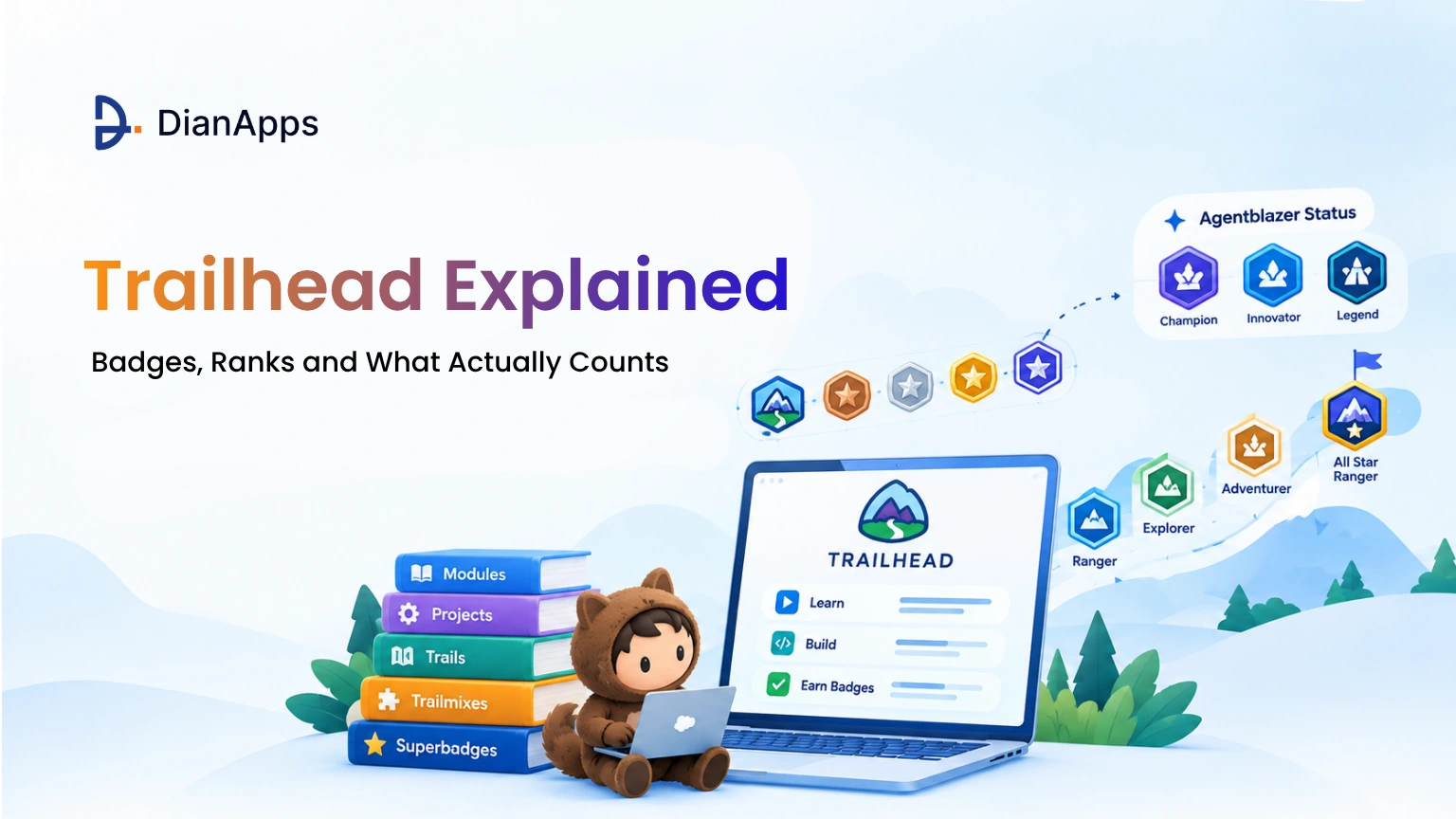




Key Takeaways:
- Trailhead is free and provides Salesforce learning modules, projects, trails, superbadges, and practice Playgrounds.
- Superbadges matter more than badge count because they demonstrate practical Salesforce skills without step-by-step instructions.
- Trailblazer ranks are mainly a progress signal, while Agentblazer Status focuses on current Agentforce and AI skills.
- Trailhead can support career development and team onboarding, but it does not replace certification or knowledge of a company’s actual Salesforce org.
- Badges do not count toward certification, although some certifications may require specific superbadges.
Quick Answer: Trailhead is Salesforce’s free learning platform for learning Salesforce through interactive modules, projects, curated trails, hands-on superbadges, and practice environments. It is useful for beginners, Salesforce professionals, and teams, but not every Trailhead achievement carries the same weight. Superbadges are the strongest practical skills signal, while certifications provide formal validation.
Trailhead is Salesforce’s free online learning platform. Launched in 2014, it’s how most people in the ecosystem learned the platform, including most of the certified professionals you’ll hire.
It’s genuinely free, requires no Salesforce licence, and includes practice environments so you can build things without touching a production system. That combination is unusual in enterprise software, and it’s a large part of why the Salesforce talent pool is as deep as it is.
But the gamification confuses people. Badges, points, ranks, superbadges, statuses- not all of them mean the same thing, and only some of them matter to anyone else. This guide separates them.
How Trailhead Is Structured
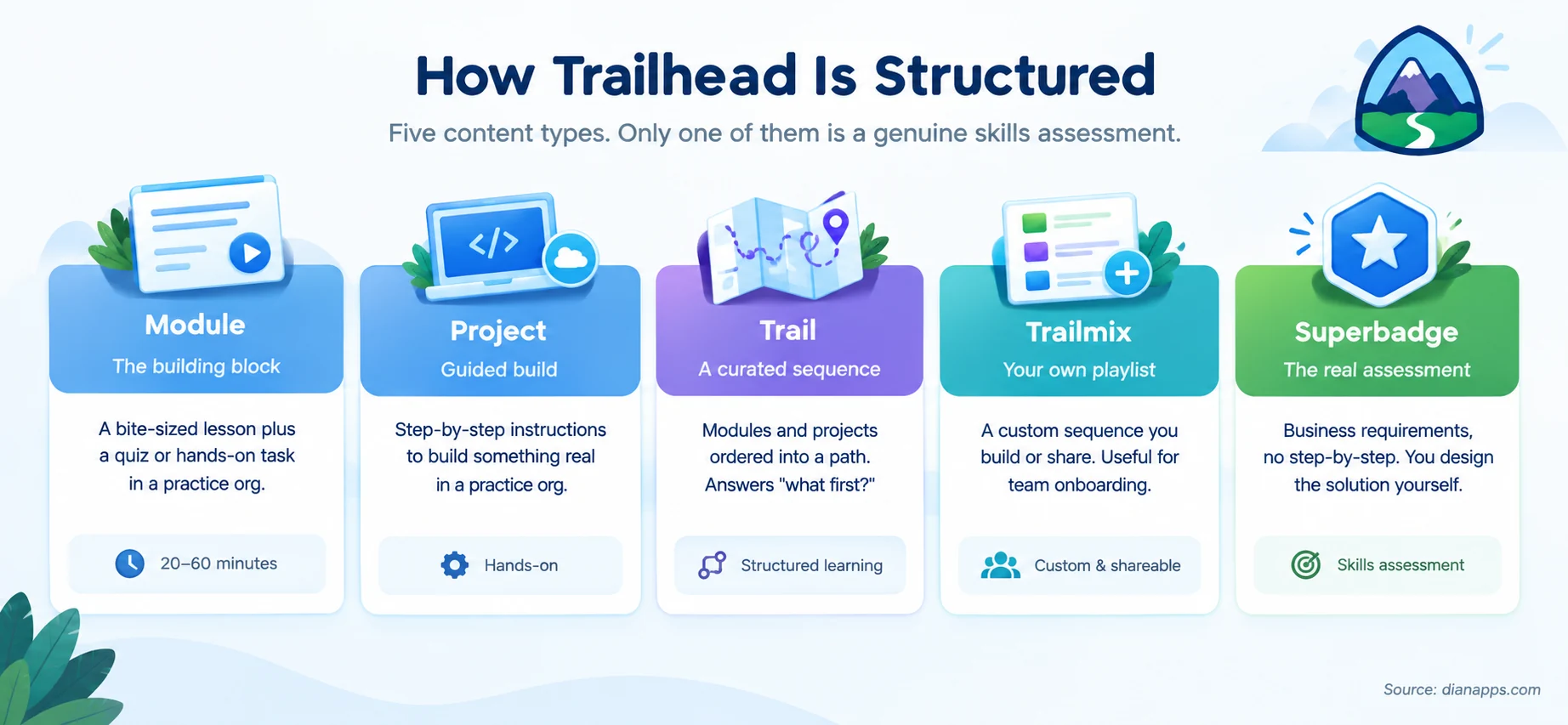
- Modules are the building block, a short lesson followed by a quiz or a hands-on task in a practice org. Twenty to sixty minutes each.
- Projects are guided builds. Step-by-step instructions that walk you through creating something real.
- Trails are curated sequences. They answer the question a beginner actually has: what should I learn first, second, third?
- Trailmixes are custom playlists you build yourself or share with others. This is the feature most relevant if you’re onboarding a team, and it’s covered below.
- Superbadges are different in kind, not degree. You’re given business requirements and no step-by-step guidance, and you design the solution yourself in a practice org. Everything else on Trailhead tells you what to click; a superbadge doesn’t.
That difference is the whole point. Badges prove you worked through material. Superbadges prove you can build something when nobody’s telling you how.
Ranks Are Decorative. One Status Isn’t.
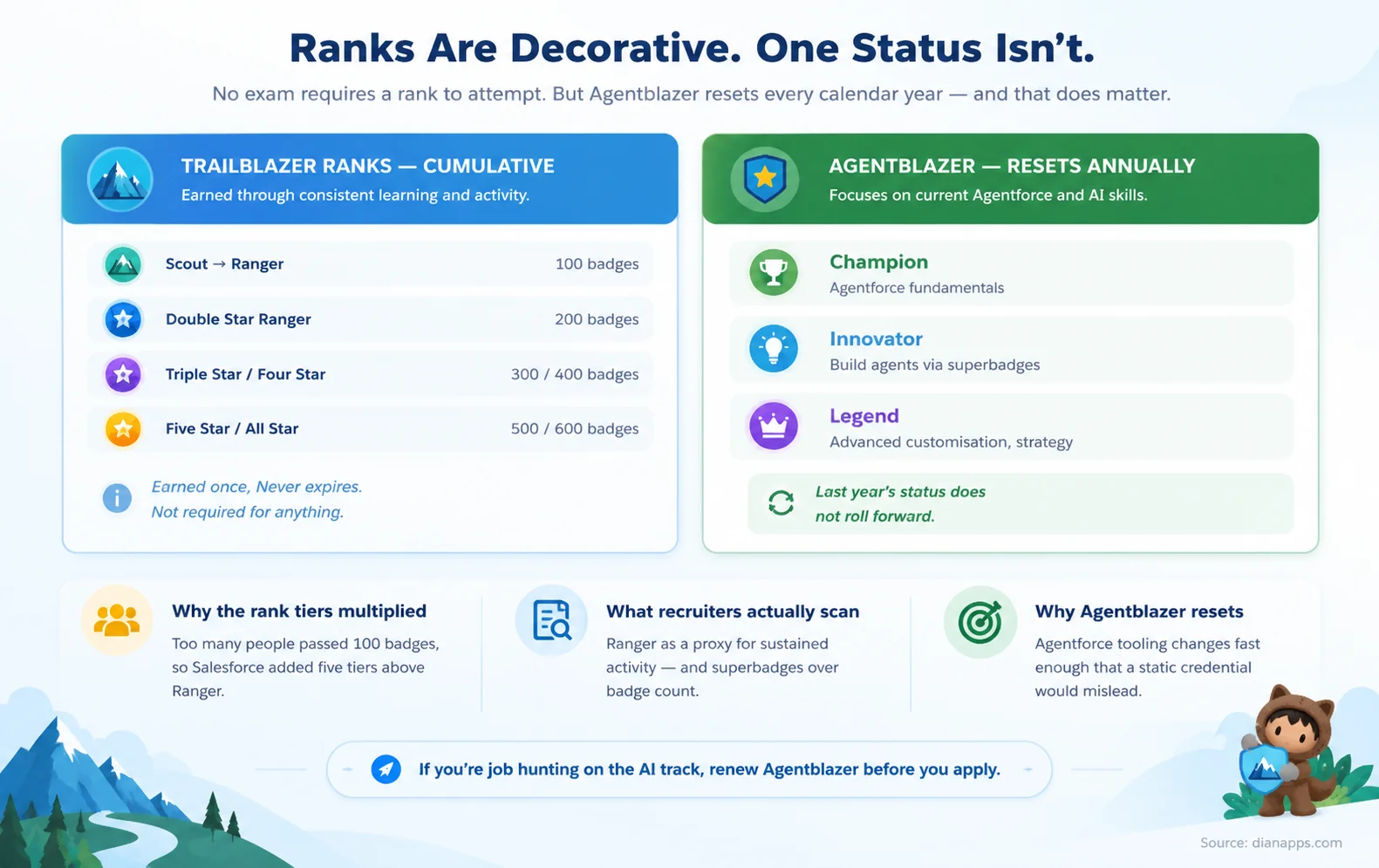
- Trailblazer Ranks Are Cumulative And Permanent: You climb from Scout through to Ranger at 100 badges, and then because too many people reached Ranger, through five further tiers up to All Star Ranger at 600 badges and 300,000 points.
- No Exam Requires A Rank: Nothing is gated behind one. The rank appears as a chevron next to your profile name, and it signals sustained activity, which is a real if modest thing.
- The Rank Inflation Story Is Worth Knowing: Ranger used to be the top. Enough Trailblazers passed 100 badges that Salesforce added five tiers above it. That tells you something about what a badge count actually proves.
Agentblazer Status works completely differently, and most guides get this wrong.
It launched in 2024 as a static status. In 2026, it became a yearly designation with three explicit tiers: Champion, Innovator, and Legend, and it resets every calendar year. Last year’s Champion badge does not roll forward.
- Why Salesforce Did That: Agentforce tooling changes fast enough that a two-year-old credential would misrepresent someone’s current ability. It’s the only part of Trailhead that expires, the only part marketed alongside paid certifications, and the only part targeting Agentforce specifically.
- The Practical Implication: if you’re job hunting on the AI track, renew it before you apply. And if you’re hiring, check the year on it.
Related: What is Agentforce
Trailhead or Certification?
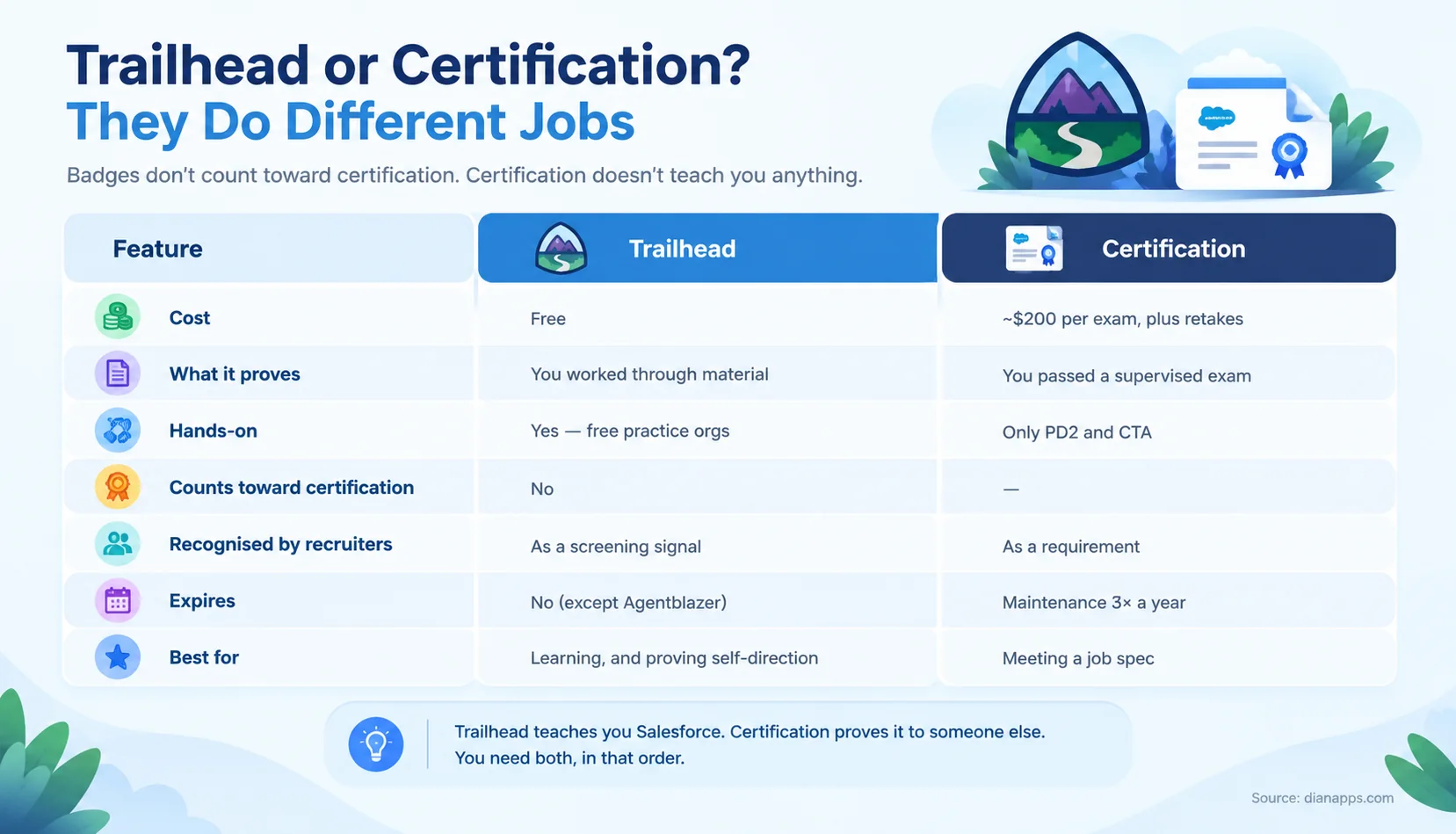
The Question People Actually Ask: Do badges count toward certification? No. They’re separate systems. Trailhead is preparation; certification is examination.
They do different jobs, and you need both, in that order. Trailhead teaches you Salesforce. Certification proves it to someone who hasn’t seen you work.
One Genuinely Useful Overlap: Trailhead runs monthly Trailblazer Quests, timed challenges with prizes that sometimes include certification vouchers. If you’re planning to sit an exam, they’re worth watching, because a voucher covers a $200 fee.
And superbadges are prerequisites for some certifications, so the two systems do connect at the upper end even though badges alone don’t.
Deeper: Salesforce certifications guide
What Recruiters Actually Look At
Worth being direct about, because the gamification encourages the wrong behaviour.
| What’s on your profile | What it signals |
|---|---|
| Superbadges, recent | The strongest signal. Proves you can build without guidance |
| Ranger rank | Sustained self-directed learning over months |
| Agentblazer, current year | Current AI capability check this year |
| Badge count alone | Very little. Easy to accumulate on easy modules |
| Certifications | Meets the job spec; a filter rather than a differentiator |
| Nothing at all | For a junior role, a genuine problem |
Hiring managers at Salesforce consultancies check which superbadges someone completed and how recently, frequently weighting that above total badge count. Recency matters because the platform moves.
The uncomfortable implication for learners: grinding through fifty easy modules to reach a rank threshold produces a worse profile than completing three relevant superbadges. The points system rewards volume; hiring doesn’t.
Need Salesforce Talent?
Hire Salesforce developers with the hands-on skills your org actually needs.
Related: 40 Salesforce developer interview questions · admin vs developer vs architect
Trailhead Playgrounds
- Free Practice Orgs. Full Salesforce environments where you can build, break, and rebuild without touching anything real.
- What They’re Good For: Completing hands-on challenges, testing something before you try it in a sandbox, and learning without needing an employer to give you access.
- What They’re Not: A substitute for a proper development environment. They have limits; they’re not connected to your real data, and they aren’t where you’d build anything you intend to keep. For real work, you want sandboxes.
- The Barrier This Removes Is Genuine: Learning most enterprise software requires an employer who already owns it. Trailhead doesn’t, which is why career-changers can enter the Salesforce ecosystem in a way they can’t easily enter, say, SAP.
The Trailblazer Community
Over twenty million members across roles, regions, and product specialisms.
- What It’s Actually Useful For: Answering the questions Trailhead doesn’t cover the “why is my flow doing this” problems that don’t appear in a module. Product-specific and regional groups are more useful than the general forums.
- And It’s A Hiring Channel: A substantial amount of Salesforce recruitment happens through community groups and local Trailblazer events rather than job boards, which is worth knowing on both sides of the table.
Using Trailhead to Onboard Your Own Team
This is the part most guides skip, and it’s the reason a business reader is here.
Build A Trailmix For Each Role. A custom sequence of modules and projects, in the order you want people to take them. New admin, new developer, new business user each gets a curated path rather than “go explore Trailhead”.
Structure it as a three-stage ramp:
| Stage | Content | Timeline |
|---|---|---|
| Week 1 | Platform fundamentals, your org’s structure | Modules only |
| Weeks 2–4 | Role-specific trails, hands-on projects | Projects in a Playground |
| Months 2–3 | One relevant superbadge | Proves they can apply it |
Track completion, but assess with the superbadge. Module completion tells you someone spent time. A superbadge tells you they can build.
Trailhead Academy offers instructor-led training and virtual classes if self-paced learning isn’t landing; that’s paid, unlike Trailhead itself, and worth considering for teams who need structure.
What Trailhead Can’t Teach Them: Your org. Your objects, your automations, the reason someone built that thing in 2019. Budget for internal documentation alongside it, or consider Salesforce consulting services to map and document the environment properly. That’s the gap that actually slows new joiners down.
Make Salesforce Onboarding Easier
We document your Salesforce org so new admins and developers can get productive faster.
Is It Actually Free?
Yes, genuinely. No subscription, no licence, no credit card. Modules, projects, trails, superbadges, and Playgrounds all cost nothing.
What costs money:
- Certification Exams: Around $200 each, separate from Trailhead
- Trailhead Academy: Instructor-led training and virtual classes
- Premier Success Plans: Bundled learning for organisations, sold with support
Why Salesforce gives the core away is straightforward and worth understanding: a large trained talent pool removes the biggest objection to adopting enterprise software. Free training isn’t philanthropy; it’s a moat, and it’s worked well enough that competitors have copied it.
Where to Go Next
For turning learning into credentials, Salesforce certifications guide.
For understanding which role to aim at, admin vs developer vs architect vs consultant.
For the AI skills Agentblazer covers, what is Agentforce and Data 360.
For real environments beyond Playgrounds, Salesforce sandboxes explained.
For hiring people who’ve used it, how to hire a Salesforce developer and 40 developer interview questions.
For the platform itself, what is Salesforce, Salesforce clouds compared, and what is Salesforce+.
Free Training Doesn’t Solve the Real Onboarding Problem
Trailhead is genuinely excellent, and every new Salesforce hire should use it.
What it can’t do is teach someone your org the custom objects, the automations nobody documented, the workaround built four years ago that everything now depends on. That’s the gap that actually keeps new admins unproductive for months, and no amount of badges closes it.
Need Help With Salesforce?
Tell us what you’re working on, and our Salesforce experts can help you find the right next step.
 0 comments






Leave a Comment
Your email address will not be published. Required fields are marked *