















 0 comments
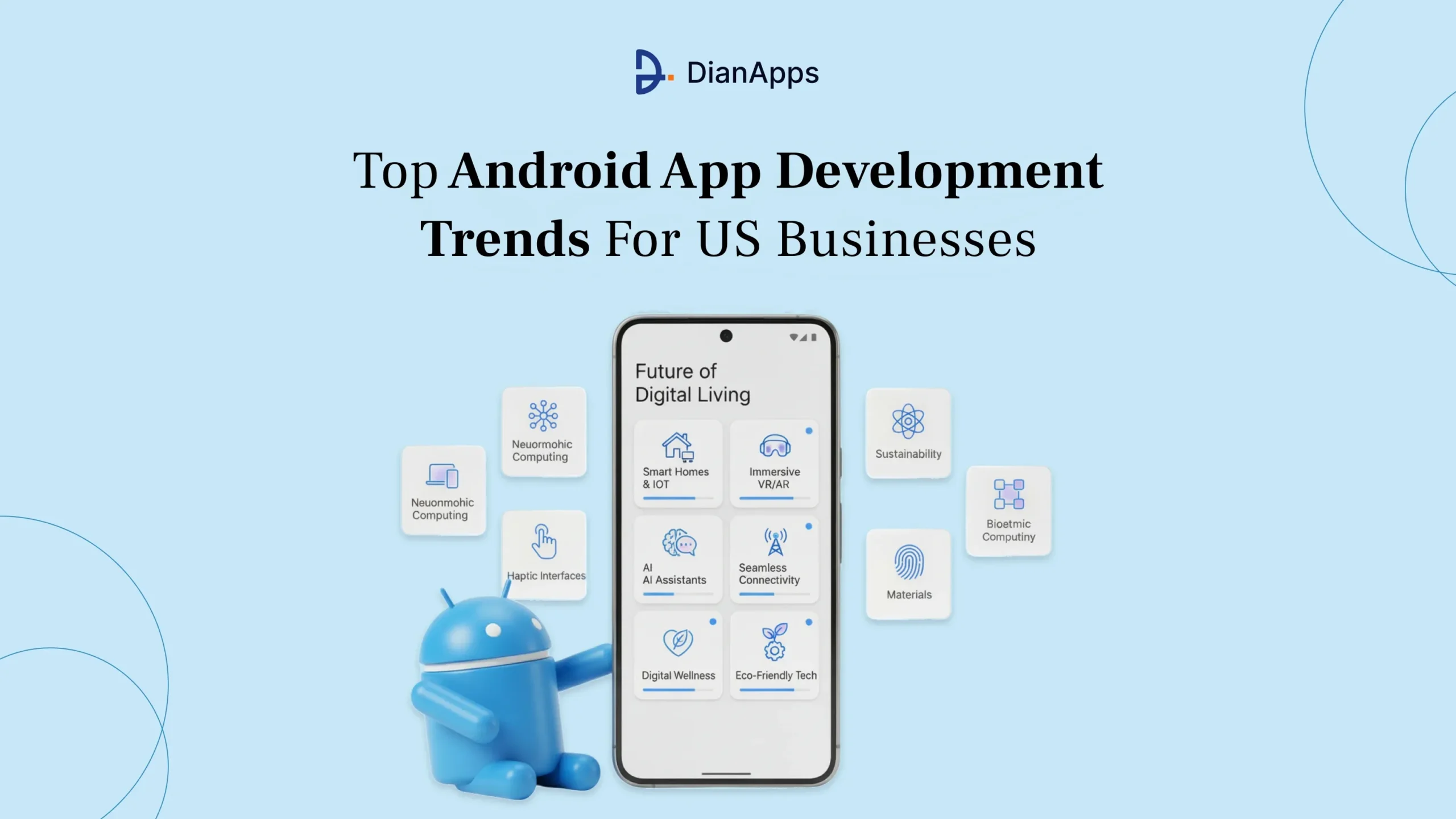





Quick Summary:This blog covers every major Android app development trend building in 2026, built for developers, product managers, and business leaders who need to stay ahead.
Key Stat: Android powers 3.9 billion active devices globally. The mobile app market hits $391.3B in 2026. |
If you are building an Android application in 2026, one thing is clear: its rules have changed completely. The days when we were shipping a functional application and calling it done are firmly behind us.
Today’s Android users expect apps that are extremely intelligent, highly adaptive across devices, respect their privacy, and respond in milliseconds. It’s definitely considered a quick expectation, but it is also a massive opportunity for businesses and developers who know where the platform is heading.
Android still continues to dominate the global smartphone market, powering its operating system market share to be around 68.24% globally, according to the latest (Feb 2025 – Feb 2026) research results by StatCounter Global Research.
The global mobile app market is projected to reach $391.3 billion by the end of 2026 (Mordor Intelligence), and worldwide app downloads are on track to surpass 181 billion. These are not just impressive numbers; they are a signal that the stakes for getting Android development right have never been higher.
What this blog covers?
This blog covers the most important Android App Development Trends in 2026, with real statistics, practical implications, and clear guidance on what your team should actually be doing about each one.
Whether you are a CTO making roadmap decisions, a developer leveling up your stack, or a business owner evaluating your next app investment, this is your complete picture of where Android is right now. However, these Android development trends also help businesses determine whether the Android app development company is using the right technologies.
Every year brings updates to the Android ecosystem. But 2026 feels different.
Three forces are colliding at the same time: AI has moved from the cloud to the device itself, multi-device form factors have gone mainstream, and user expectations for personalization and privacy have hit a new ceiling.
The result is that what was modern in 2023 is now simply expected.
Android 16 is the most significant OS release in years. It enforces orientation and resizability standards that require developers to rethink layouts, introduces the Eco Metrics API for energy tracking, and deepens the integration of Gemini AI across the system.
Developers who are still building apps the way they did two or three years ago are not just missing features; they are actively creating technical debt.
Android App Development Trends That Will Rule 2026
Android, being a dominating operating system over iOS, Linux, and others, has so many popular trends that can’t be ignored if you are looking to build an Android app in 2026. So, let’s move ahead and look at the latest Android App Development Trends:
AI-First Development: From Cloud Add-On to Core Architecture
On-Device AI: The Biggest Architectural Shift in Android History
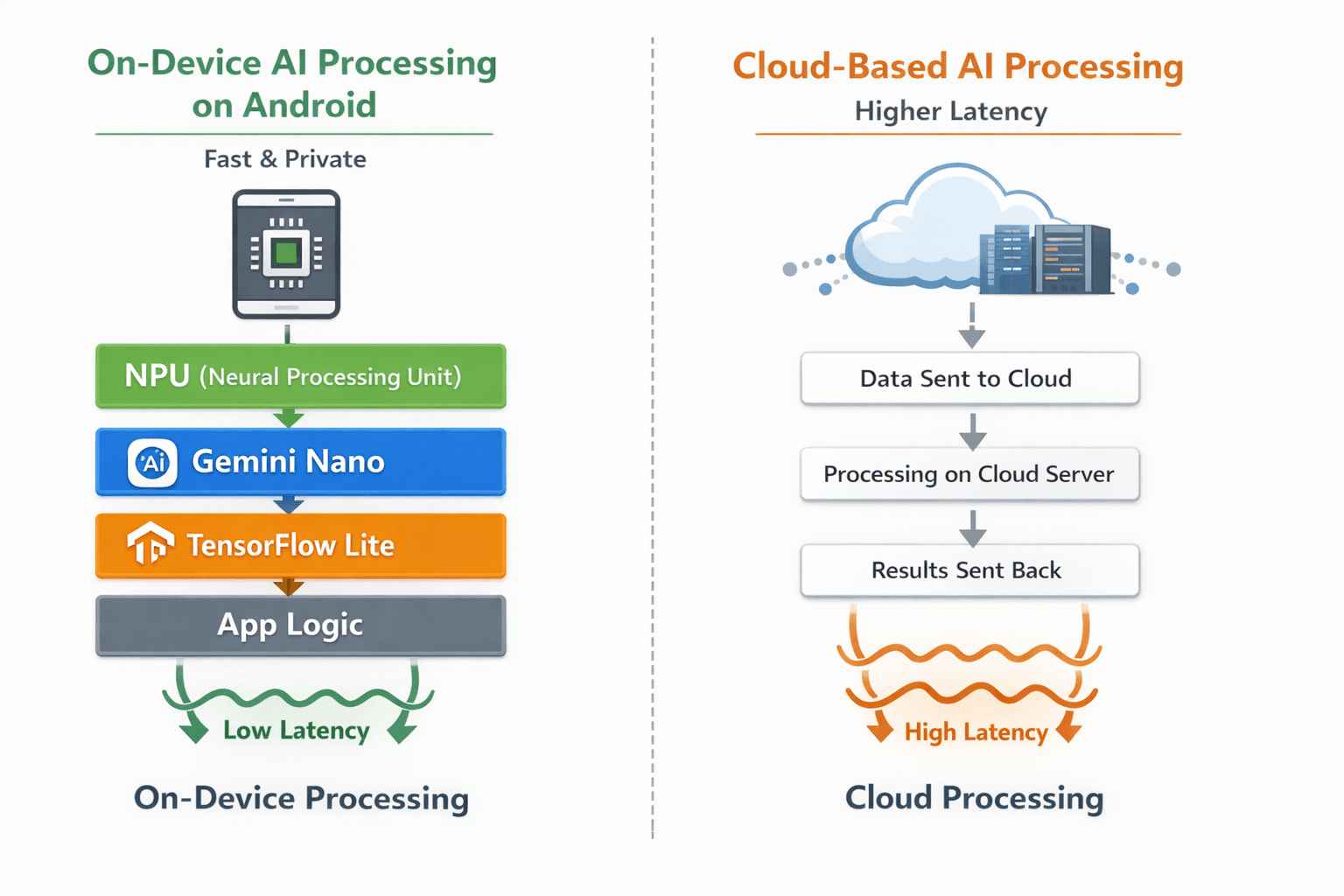
The on-device AI market is valued at $33.21 billion in 2026, growing at a 24.8% CAGR (Coherent Market Insights). That number tells you everything you need to know about where Android development is headed. AI is no longer a feature you bolt onto an app it is the foundation you build on.
Thanks to powerful neural processing units (NPUs) in modern Android devices and compact models like Google’s Gemini Nano 2.0, AI now runs directly on the device. This means real-time translation, intelligent autocomplete, personalized UI adjustments, and content recommendations all happen instantly without sending a single byte to a server. The privacy benefits are enormous, and the speed is transformational.
Users globally spent 48 billion hours in AI-powered apps in 2025, which is 3.6 times more than in 2024 (Sensor Tower State of Mobile 2026). Generative AI apps alone are projected to generate over $10 billion in consumer spending in 2026. Gartner also estimates that 40% of enterprise apps will feature task-specific AI agents by the end of the year.
Predictive Personalization and Generative AI Integration
On-device intelligence is changing how apps behave moment to moment. Rather than showing the same interface to every user, AI-native apps now adapt their UI in real time based on individual behavior, predicting which feature you want before you tap it.
Generative AI is also being woven into content creation workflows, coding assistants, and customer support within apps.
For development teams, the practical implication is clear: treat AI as an architectural layer, not a module. Google’s Gemini 2.0 Flash is already being used inside Android 16 for everything from notification summarization to contextual search.
The teams winning in 2026 are the ones who planned for AI from day one, not the ones trying to retrofit it.
Jetpack Compose and Kotlin Multiplatform Are Now the Standard
Jetpack Compose: XML Layouts Are Officially in Maintenance Mode
Over 60% of the top 1,000 apps on the Google Play Store now use Jetpack Compose (Simpalm, 2026). That stat alone should settle any debate about whether Compose is worth learning. It is not a trend anymore it is the default.
Jetpack Compose is Google’s modern, declarative UI toolkit for Android. Instead of writing verbose XML layouts and manually managing view states, developers describe what the UI should look like under specific conditions, and Compose handles the rendering automatically. The result is dramatically less boilerplate code, faster iteration cycles, and UIs that update reactively when underlying data changes.
With Compose 1.10 delivering near-parity performance with the old View system, and Navigation 3.0 replacing the Fragment manager, the technical arguments for sticking with XML have essentially evaporated. As Google’s Android Developer Relations Engineer Florina Muntenescu put it, Compose fundamentally changes the performance profile and maintainability of codebases at scale.
Kotlin Multiplatform (KMP): Share Logic, Keep Native UI
KMP adoption jumped from 7% in 2024 to 23% in 2025, a 3x increase in a single year (Java Code Geeks). In 2026, it is no longer a question of whether to adopt KMP, but how much of your codebase to share.
KMP lets teams write shared business logic, networking, and data management code once in Kotlin, then deploy it across Android, iOS, web, and desktop while keeping fully native UIs for each platform. Companies already running KMP in production include Netflix (shared analytics modules), Autodesk (data and preference storage), and Philips (healthcare settings and authentication). Teams using KMP report reducing code duplication by up to 50%.
| Framework | UI Approach | Code Sharing | Best For | 2026 Status |
| Jetpack Compose | Declarative (Kotlin) | Android-native UI | New Android projects | Glod Standard |
| Kotlin Multiplatform | Native per platform | Business logic + data | Android + iOS teams | Enterprise Ready |
| Flutter | Custom widget tree | Full UI + logic | Rapid cross-platform MVP | Losing ground to KMP |
| React Native | JS bridge to native | Full UI + logic | Web-first teams | Niche use cases |
| XML Layouts | Imperative (XML) | Android only | Legacy maintenance | Maintenance Mode |
If you’re evaluating your technology stack for a new project, partnering with an experienced Android app development company in Houston can ensure you’re starting with the right foundation: Compose-first, KMP-ready, and AI-compatible from day one.
Recommended Read: Android App Development: Native or KMM, What Do You Think?
Multi-Device & Foldable Optimization Design for Every Screen
Adaptive Layouts Are No Longer Optional
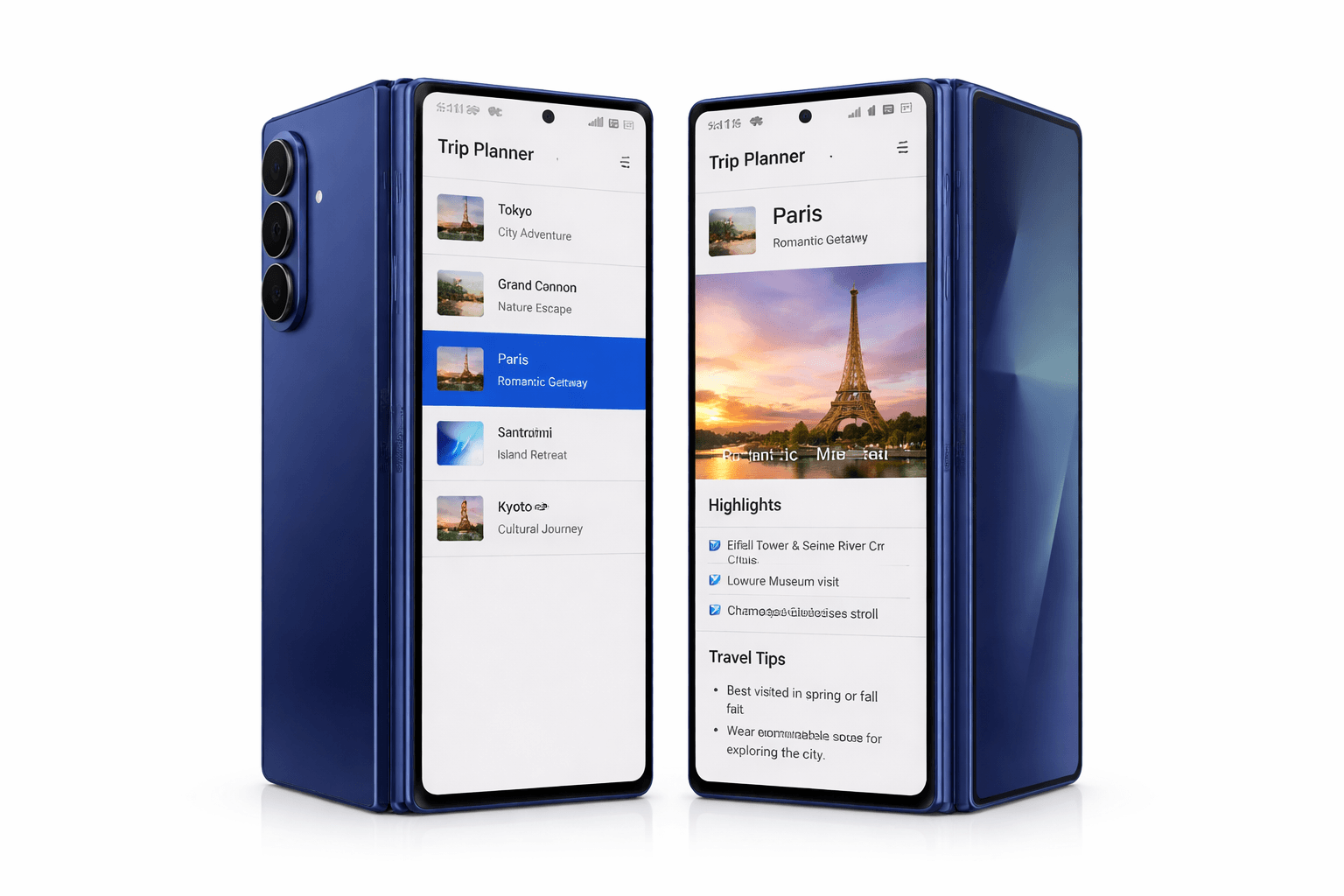
For years, foldable phones were a luxury curiosity. That narrative is over. Big-screen foldable devices are on track to account for 65% of all foldable shipments in 2026, up from 52% in 2025. Android 16 is now enforcing orientation and resizability standards. Apps that do not support split-screen and multi-pane layouts will be flagged on Google Play.
Building adaptive layouts with Jetpack Compose’s window size classes is the practical path forward. You design one core component and adjust its presentation based on whether the user is in compact (phone), medium (small tablet/folded), or expanded (large tablet/unfolded) mode. Compose reduces the code volume required for this by up to 70% compared to the old XML system.
Wearable Ecosystems and Wear OS
Gemini AI is now available on Wear OS, and Google is actively pushing developers to build for the wrist as part of their multi-device strategy. The most competitive apps in 2026 are those that deliver a smooth experience, whether the user is on their phone, their watch, their tablet, or their car’s Android Auto screen. If your app only works on one device form factor, you’re leaving users and retention on the table.
Low-Code and No-Code Tools Are Reshaping Who Can Build Apps
Gartner predicts that 75% of new application development will use low-code or no-code tools by the end of 2026. IDC puts a similar figure at over 60% of new mobile apps built via low-code platforms. The driver is not laziness it is a developer shortage. 84% of businesses are adopting LCNC tools specifically to fill talent gaps (Simpalm, 2026).
This does not mean custom native development is dying. It means the use cases have bifurcated. For internal tools, MVPs, simple business workflows, and rapid prototyping, low-code platforms deliver faster and cheaper. For performance-critical, highly personalized, or complex consumer apps, expert-built native Android development remains the clear choice.
The practical implication for teams: use low-code where it genuinely saves time, and invest in native expertise where quality and performance are non-negotiable. HubSpot, COIN, and Traverse are among the companies using hybrid approaches, low-code for peripheral tools and native development for their core product experiences.
5G, Extended Reality (XR), and IoT Are Unlocking New App Categories
Android XR: Google’s Biggest Platform Bet of 2026
5G coverage is reaching 60–80% of developed markets in 2026, and Android apps are being redesigned from the ground up to take advantage of it. High-bandwidth, low-latency connectivity is enabling use cases that were previously impossible: real-time collaborative AR, cloud-rendered gaming, high-resolution video processing, and ultra-responsive IoT control interfaces.
Android XR is Google’s dedicated extended reality platform, and 2026 is its commercial launch year, with at least five Android XR devices expected. Google Project Aura is actively recruiting developers to build spatial experiences. For businesses in retail, healthcare, manufacturing, education, and real estate, AR and VR app development on Android is shifting from experimental to production-viable this year.
IoT Hub Integration
Android’s role as the control center for smart home and industrial IoT ecosystems is growing fast. Apps are being designed as IoT hubs managing dozens of connected devices, processing sensor data locally using on-device AI, and presenting actionable dashboards in real time. If your business operates in logistics, manufacturing, healthcare, or smart environments, IoT-connected Android apps are a high-value 2026 investment.
Privacy-First and Secure Apps: Zero Trust Is Now the Baseline
Zero-Trust Security Architecture
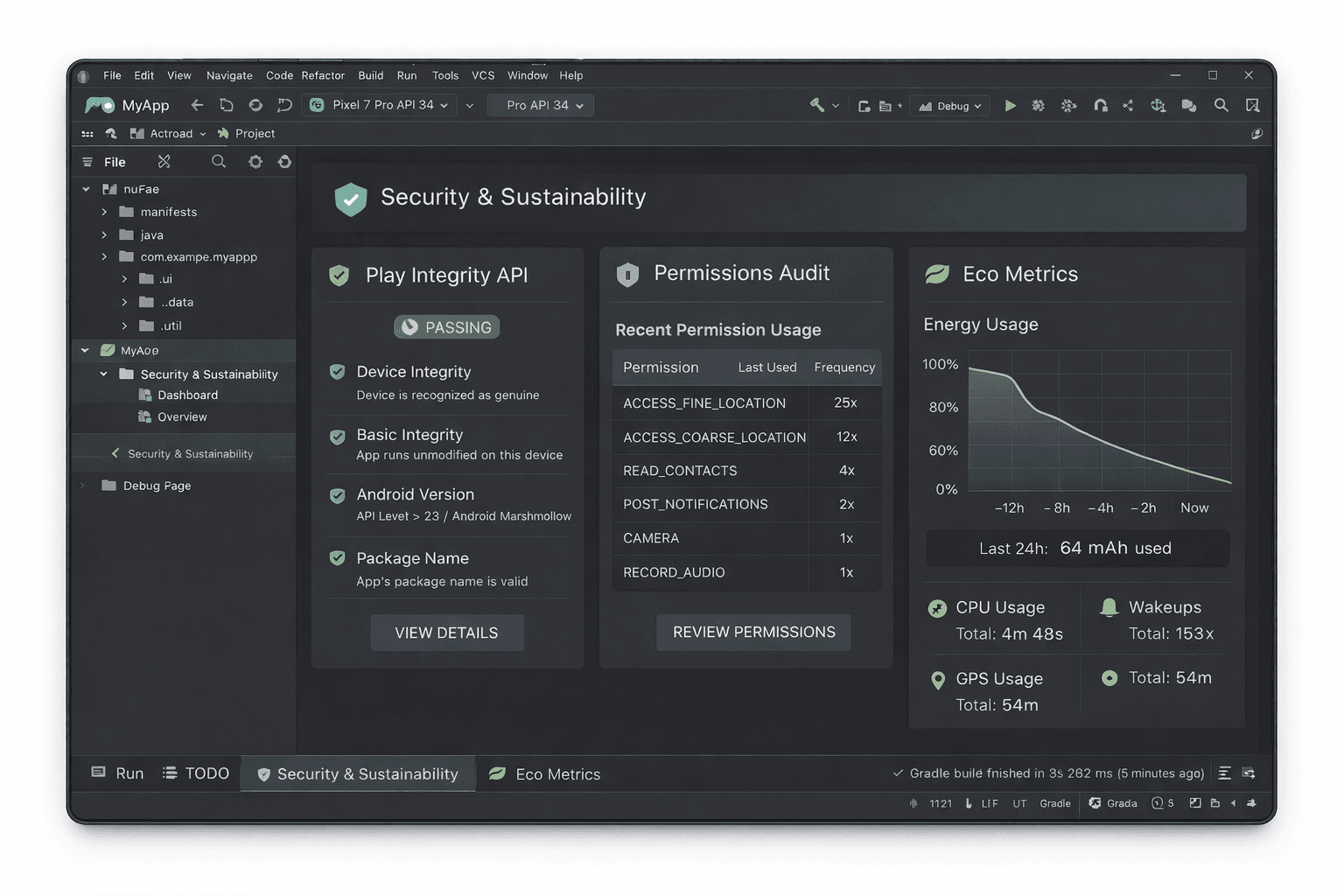
The regulatory environment in 2026 is not forgiving. GDPR, CCPA, and India’s Digital Personal Data Protection (DPDP) Act aenfoces actively, and the Android Play Integrity API replaces the older SafetyNet system as the standard for verifying app and device integrity. Zero-trust security means every interaction is validated no component trusts another by default.
Practically, this means least-privilege permission requests (only ask for what you need, exactly when you need it), biometric authentication over passwords, continuous automated security testing baked into your CI/CD pipeline, and encrypted local storage as a default not an afterthought. Security is no longer a layer you add before launch; it is a design decision you make on day one.
Green Coding and Sustainable Android Development
Android 16 introduces the Eco Metrics API, a developer-facing tool for monitoring and optimizing your app’s energy consumption in real time. IDC identifies sustainable development as a 2026 standard, not an optional nice-to-have. Green coding practices include minimizing background processes, optimizing network requests with batching and caching, reducing unnecessary UI recompositions in Compose, and targeting efficient use of the NPU rather than the CPU for AI tasks.
Beyond regulation and ethics, there is a business case. Apps that consume less battery rank higher on Google Play’s quality signals and see better retention rates meaningfully. Energy efficiency and user experience are increasingly the same thing.
Super Apps and Instant Apps: The Future of App Discovery
Two app models that were once considered niche are going mainstream in 2026. Understanding both helps you think about how your app fits into a user’s broader digital life.
- Super Apps: Popularized by WeChat, Grab, and Gojek in Asian markets, the super app model combines multiple services payments, messaging, shopping, booking, maps into a single, deeply integrated experience. This model is now expanding aggressively into Western markets and enterprise environments. Internally, companies are building super apps for employee workflows, replacing a dozen separate tools with one unified interface.
- Instant Apps: Android Instant Apps let users try a full app experience without installing anything they stream a lightweight version directly from the Play Store. For e-commerce, gaming, and service-based apps, instant apps dramatically reduce the friction of first use and increase conversion rates from ad clicks and search results.
| Feature | Traditional App | Super App | Instant App |
| Installation Required | Yes | Yes (one install) | No |
| Services Covered | Single Purpose | Multiple (ecosystem) | Single feature preview |
| User Acquisition | App store discovery | Built-in network | Direct link / ad click |
| Development Complexity | Medium | High | Low-Medium |
| Best For | Focused use cases | Platforms & ecosystems | Trial & e-commerce |
| 2026 Momentum | Stable | Growing Fast | Growing Fast |
Thinking about which app model is right for your product? Our team can help whether you are building a focused native app or a multi-service platform. Working with an experienced android app development company in New York ensures you choose the right architecture before writing a single line of code.
All 2026 Android Development Trends at a Glance
| Trend | Maturity Level | Business Impact | Key 2026 Stat | Best For |
| On-Device AI | Production Ready | Critical | $33.21B market, 24.8% CAGR | All app categories |
| Predictive Personalization | Production Ready | Critical | 48B hours in AI apps | Consumer apps, e-commerce |
| Generative AI Integration | Maturing Fast | High | $10B+ consumer spend | Content, productivity |
| Jetpack Compose | Gold Standards | Critical | 60%+ Play Store top 1000 | All new Android projects |
| Kotlin Multiplatform | Production Ready | High | 7% → 23% adoption in 1 yr | Android + iOS teams |
| Foldable / Adaptive UI | Required | High | 65% of foldable shipments | Consumer & productivity apps |
| Wear OS / Wearables | Maturing | Medium | Gemini on Wear OS | Health, fitness, productivity |
| Low-Code / No-Code | Mainstream | Medium | 75% of new apps: Gartner | MVPs, internal tools |
| Android XR | Early Adopter | High potential | 5+ XR devices in 2026 | Retail, healthcare, training |
| 5G Optimization | Production Ready | Medium | 60–80% developed market coverage | Media, gaming, IoT |
| IoT Hub Integration | Growing | Medium | Rising smart device adoption | Logistics, manufacturing |
| Zero-Trust Security | Required | Critical | GDPR/CCPA/DPDP enforced | All regulated industries |
| Green Coding | Becoming Required | Medium | Eco Metrics API: Android 16 | All app categories |
| Super Apps | Expanding | High Potential | WeChat model goes Western | Platforms & ecosystems |
| Instant Apps | Proven | Medium | Reduces Install friction | E-commerce, gaming |
Recommended Read: How to Build Your First-Ever Android App from Scratch?
Final Words
The Android platform of 2026 is not the same platform it was three years ago. The stack has matured, the hardware has diversified, and user expectations have caught up to what the technology can actually deliver. On-device AI, Jetpack Compose, Kotlin Multiplatform, adaptive multi-device layouts, and privacy-first architecture are not future considerations; they are today’s table stakes.
The developers and businesses that treat these trends as a checklist will ship better products faster and with less technical debt. The ones who ignore them will find themselves rebuilding from scratch in 2027.
The good news? You do not have to navigate this alone. Whether you are building a brand new Android app or modernizing an existing one to meet 2026’s standards, the right technical partner makes all the difference.
Ready to build something great? Explore how our Android app development services can bring your product vision to life with the latest 2026 stack, or if you’re thinking cross-platform, our mobile app development company in US team covers Android, iOS, and everything in between.
Frequently Asked Questions
 0 comments









Your email address will not be published. Required fields are marked *