











 0 comments






Quick answer: Prepare one-page scope of work and budget plan before looking for a mobile application development company. Select three to five potential suppliers, try out their applications yourself, get in touch with two of their prior customers, and use the same method to rank the suppliers.
Many projects fail when suppliers are being chosen. Companies that hire the vendor that created the most impressive pitch proposals, do not realize their mistake until they receive their final bill eight months later.
This guide shows the process we’d follow if we had to select the supplier ourselves. Based on experience we have created a 7-point selection process, a scorecard, and have conducted research to gather everything needed for you to pass the selection process effectively. Judge us by them.
Why this choice matters more than most people think
Choosing a development company takes months, meaning that the wrong choice costs more than a lot of effort made in finding the right one. According to Clutch’s statistics from 2023, an average project lasts almost eleven months and costs about $90,780. No one wants to discover after four months that the company cannot finish the project. Switching suppliers too late is a double payment process because it involves paying for the work already done as well as the new company hired.
The company selected for a project has implications that go beyond its realization in terms of the software architecture, option of source code ownership, and response time for fixing bugs. These issues are hard to revert back from and hence this guide focuses more on aspects related to vendor-selection than to a vendor-search.
Start with your scope, not their pitch
Before contacting a vendor, it’s important to establish what you want to create, who your customers are and the definition of completion.
This means that you will be able to evaluate a vendor’s performance based on a particular standard instead having to analyze their skills in selling.
It usually takes one page to do that.
Your brief may include the following:
- A summary of the problem the application tackles with regards to the target audience.
- Platforms: iOS, Android or both.
- A list of essential features that need to be present for the app to be launched successfully.
- Possible integrations like payment systems or CRM, as well as an existing back end.
- Any requirements for being compliant with the law.
- A list of quantitative measures that will signify success.
- A rough estimate of the budget and the timing.
Usually, the budget line is omitted because of the fear that it can increase the quotes. Nevertheless, the results are usually contrary. A vendor without a number to pursue would tend to propose their biggest ventures.
The essential items must be distinguished from the desired ones. If a vendor is told that anything is important, they will charge for everything.
Know what type of company you’re hiring
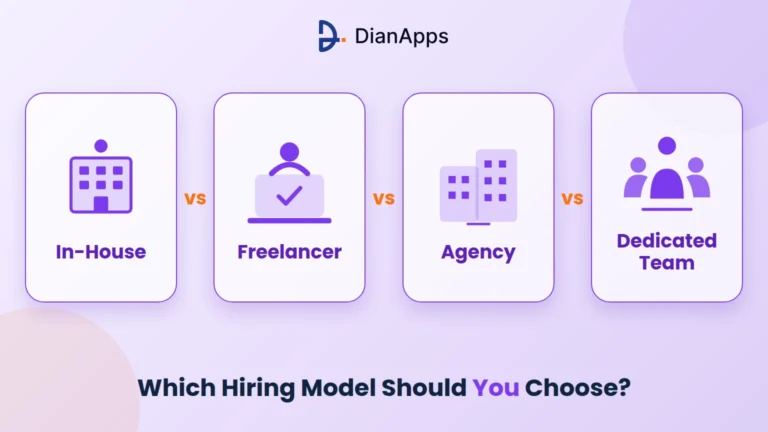
There are four major categories of companies providing mobile app development services: freelancers, boutique companies, full-service companies and big consultancies. The choice of type depends on the project requirements, money available and extent of management of the project you want to be responsible for.
| Type | Best for | Watch for |
|---|---|---|
| Freelancer | Small, well-defined builds and prototypes | One person is a single point of failure, and you manage design, QA and backend yourself |
| Boutique studio | Design-led products with a narrow scope | Limited capacity if your roadmap grows quickly |
| Full-service app development company | MVPs to complex platforms that need design, iOS, Android, backend and QA together | Check that the team you meet is the team that builds |
| Large consultancy | Enterprise programs with heavy governance needs | Higher cost and slower decisions for a startup |
Location is of great importance too. When you hire onshore developers, you work in the same time zone, and your company may be more expensive. Nearshore teams are located in adjacent time zones. Offshore companies are usually less expensive than others, which makes it important for the client and the mobile app development company to have some overlapping working hours. In accordance with the company’s database, app developers from the US charge about $100-$150 per hour, while the reviews show that development of mobile applications might cost you $25-$49.
Native or cross-platform: what to ask every vendor
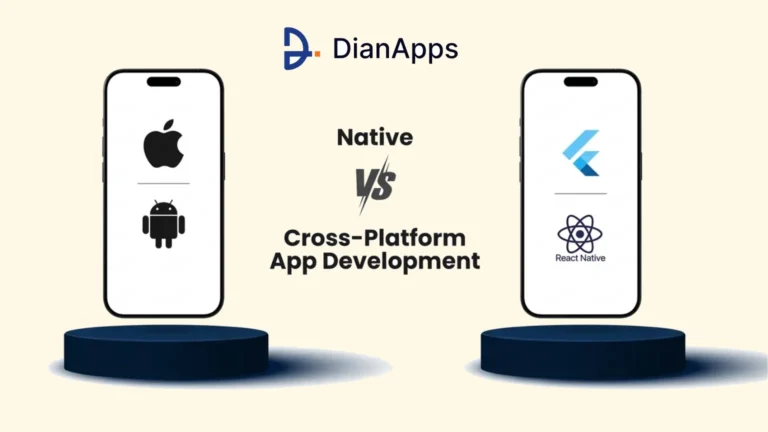
You must inquire of each vendor their reasons for recommending a particular option for your app – native or cross-platform – and pay attention to the answers that relate to your application specifically. Making a native application requires creating two separate codebases – one for iOS (Swift) and one for Android (Kotlin). At the same time, cross-platform programming implies that Flutter or React Native can be used to develop both applications using one codebase.
- Cross-platform is usually better suited for applications that have ordinary design and functionality because it provides cheaper and faster builds.
- Native programming is generally used for apps with advanced graphics and extensive use of device functionality.
- Vendors that specialize in just one method of development will give a biased recommendation. Thus, you should go with a vendor that is knowledgeable in multiple development methods.
We at (who we are) provide Android, iOS, Flutter, and React Native development services so we can provide you with objective recommendations regarding which method of development is best for your app.
The 7-step process for choosing a mobile app development company
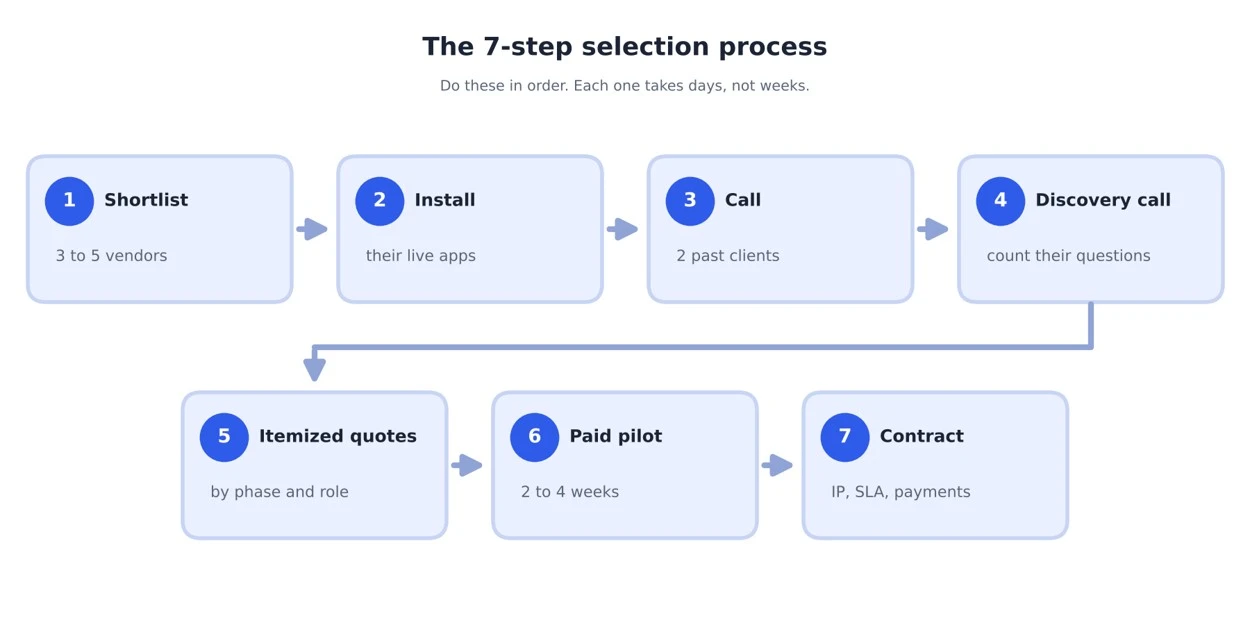
Narrow down your options to three to five vendors, check on their records, score them all on the same basis, analyze quotes provided, conduct a pilot project before locking in any contract. Each part below is something you can do this month.
- Make a list of three to five vendors. Once you have the names of a few vendors recommended by fellow startup founders you trust, get the rest from directories. More than five means wasted time on calls while fewer than three will leave you without anything to compare with.
- Install their apps. Request their Google Play and App Store URLs, install them on your old phone, and find out when they were updated last and where unhappy users have problems. Having a portfolio that showcases what a vendor is capable of designing becomes pointless if it doesn’t have any proof of the app being launched.
- Call at least two of their customers. Ask what they were unhappy with and how the vendor dealt with the situation.
- Conducting a discovery call is essential, and pay attention to questions he asks. The right vendors will challenge you—asking who will use the product, what will be cut if the cost goes down, how you will be measuring the success of the project. If the call only features their credentials and no queries, you already know how the project will fare.
- Request a breakdown of quoted prices. Having just one amount will not help you. You need to know how much you will be paying for each step (design, development, QA, launch) and list of things excluded from the project. Consult our guide on agile methodologies to find out how to translate keywords into costs.
- Start with a pilot project. About two to four weeks spent on implementing one feature or a protype will show you how the team is ready to work.
- Finalize the contract before you start. There should be much we agree on: NDA, what code and IP you receive, milestones, and what happens in case one side wants to quit before the project is fully executed.
What to ask in a reference call
A reference call is only effective when inquiring about issues during the inquiry. All a vendor can offer is glowing reviews from the best clients. Always seek two references for projects similar to yours. Speak with someone involved in the project on a daily basis and not just someone who signed the contract.
- What did the vendor deliver and when?
- Did the project stay within planned budget and duration? What went wrong if it is not?
- How well the team have dealt with issues or scope changes during the project?
- Did the original persons pitch team stay involved in the project till the very end?
- What was communication like week by week?
- Did everything go alright after the launch and would you hire the vendor again?
How to run a paid pilot
A paid pilot is defined as a short-term project that lasts from two weeks to a month and has some deliverables such as a working feature or even a clickable prototype. Before starting a paid pilot, it’s very important to agree on three things: what does “done” mean, who is going to accomplish the pilot project from the vendor’s team, and how are you going to monitor the progress.
Make sure to perform payment for the pilot, as it is necessary for maintaining the honesty of both parties. After the pilot finishing, you need to evaluate how successful the communication was. Did the team ask some important questions? Did they inform you about possible risks in advance? Did they make the demos on time? If successful, this project may serve as the pilot for future more paying projects.
A vendor scorecard you can copy
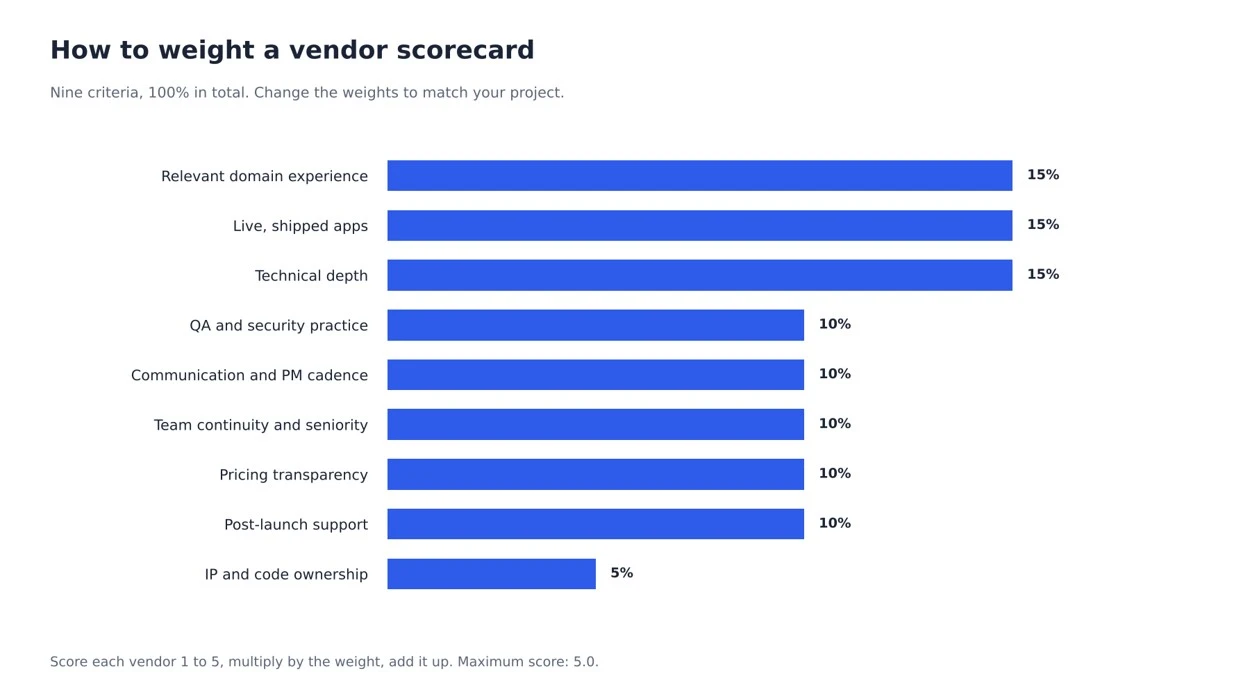
Score each vendor from 1 to 5 on nine weighted criteria, then multiply and add. It replaces a gut feeling with a number you can defend to a co-founder or a board.
| Criterion | Weight | What a 5 looks like |
|---|---|---|
| Relevant domain experience | 15% | Shipped apps in your industry, with references you can call |
| Live, shipped apps | 15% | Several apps in the stores, still updated |
| Technical depth | 15% | Clear answers on architecture and trade-offs, not buzzwords |
| QA and security practice | 10% | Testing every sprint, a security review before launch |
| Communication and PM cadence | 10% | Named point of contact, regular demos, fast replies |
| Team continuity and seniority | 10% | The people you meet are the people who build |
| Pricing transparency | 10% | Itemized quote, exclusions stated up front |
| Post-launch support | 10% | Written SLA with defined response times |
| IP and code ownership | 5% | You own everything, and the contract says so |
How to read a proposal
A good proposal tells you what you’ll get, when, from whom and for how much, and it says what it leaves out. Look for these eight things:
- Scope broken into features or modules, not a vague summary
- Phases with timelines and a clear first milestone
- The roles on the team and how senior each person is
- Cost by phase, not one total
- Assumptions and exclusions, written down
- A testing and QA approach
- Post-launch support terms
- Acceptance criteria and IP ownership
If a proposal is a two-page PDF with a single number on it, ask for more detail before you compare it with anything.
How much does a mobile app development company cost in 2026?
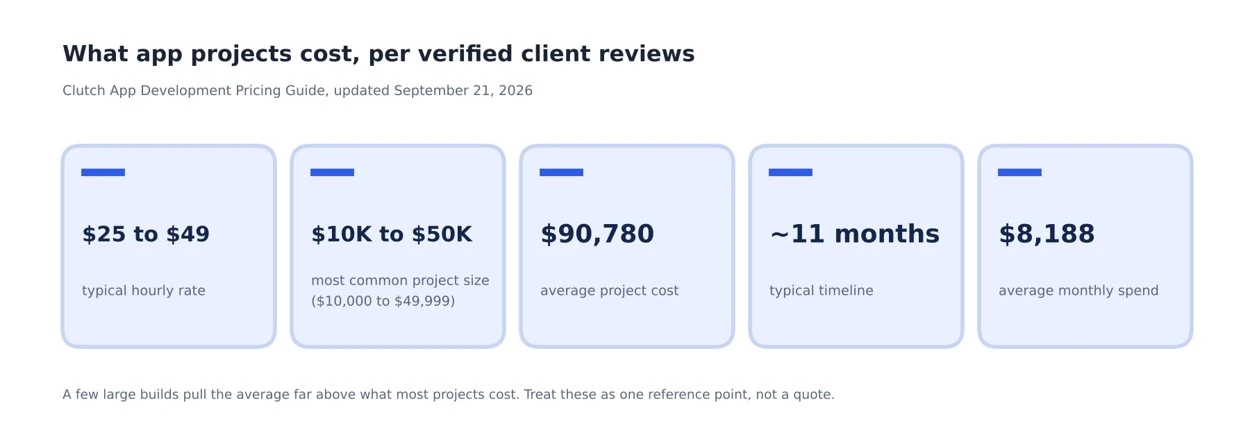
Verified client reviews on Clutch put most projects between $10,000 and $49,999, with an average of $90,780. The gap between those two numbers is the point: a handful of large builds pull the average far above what most projects cost.
Here are the figures from Clutch’s App Development Pricing Guide, last updated September 21, 2026, based on reviews written by app development clients:
| Measure | Clutch figure |
|---|---|
| Typical hourly rate | $25 to $49 per hour |
| Most common project size | $10,000 to $49,999 |
| Average project cost | $90,780 |
| Typical timeline | About 11 months |
| Average monthly spend | $8,188 |
Treat these as one reference point. Clutch data reflects the vendors and clients listed there, and rates vary a lot by region. Netguru’s guide puts US developer rates at $100 to $150 an hour and simple apps at $20,000 to $50,000, though it doesn’t cite a source for either number, so weigh it as an estimate.
Four things move a quote more than anything else:
- Two native apps cost more than one cross-platform build in Flutter or React Native.
- Payments, maps, real-time tracking and third-party APIs add the most hidden work.
- Design depth. A custom design system costs more than standard components.
- Health and finance apps carry extra security and audit work.
Two costs people forget: maintenance and third-party fees. Ask every vendor for a written post-launch support quote alongside the build quote, and add cloud hosting, map and payment fees on top. For a cost breakdown from one platform’s angle, see our guide on hiring an Android developer.
Want an itemized estimate for your app?
Send us your one-page scope. A good estimate starts with questions, so expect a few from us before any numbers. Your idea is covered by our NDA.
Fixed price, time and materials, or a dedicated team?
Fixed price fits a small, well-defined build. Time and materials fits a product that will change. A dedicated team fits a long roadmap. No model is right for everyone. The right one depends on how stable your scope is.
| Model | Best for | Main risk |
|---|---|---|
| Fixed price | A defined MVP with a stable scope | Changes cost extra, and vendors may pad the quote to cover risk |
| Time and materials | A product still being shaped | The budget drifts unless you track burn each sprint |
| Dedicated team | Months of roadmap and a need for continuity | You carry the management load unless the vendor provides a lead |
Not sure? Start with a short paid discovery phase on time and materials, then pick a model once the scope is clear.
What a good contract covers
The contract is where good intentions become enforceable, so settle these points before kickoff. Have a lawyer review the final text. This list is a starting point, not legal advice.
- Scope and deliverables, milestone by milestone
- Payments tied to accepted milestones, not calendar dates alone
- Acceptance criteria: how you confirm a milestone is done
- IP and code ownership passing to you on payment
- Repository access from day one, plus handover of source code, designs and documentation
- An NDA covering your idea and your data
- A warranty period for bug fixes after launch, and a support SLA
- A change-request process with clear pricing rules
- Termination terms: notice period, and what you receive if you part ways early
Ten questions to ask before you sign
Good answers are specific. Vague answers are your signal.
- Have you built something similar? Can I install it?
- Who exactly will work on my project, and will they stay on it from start to finish?
- How do you handle a scope change halfway through?
- What does your QA process look like, and who runs it?
- How do you protect user data and handle security reviews?
- Who owns the source code and designs when we finish?
- What does support look like after launch, and what does it cost?
- Can I speak to a client whose project hit trouble?
- How do you report progress, and how often will I see working software?
- What would make you say this project isn’t a fit for you?
Question ten is the best one. A vendor willing to turn work down is usually a vendor worth trusting.
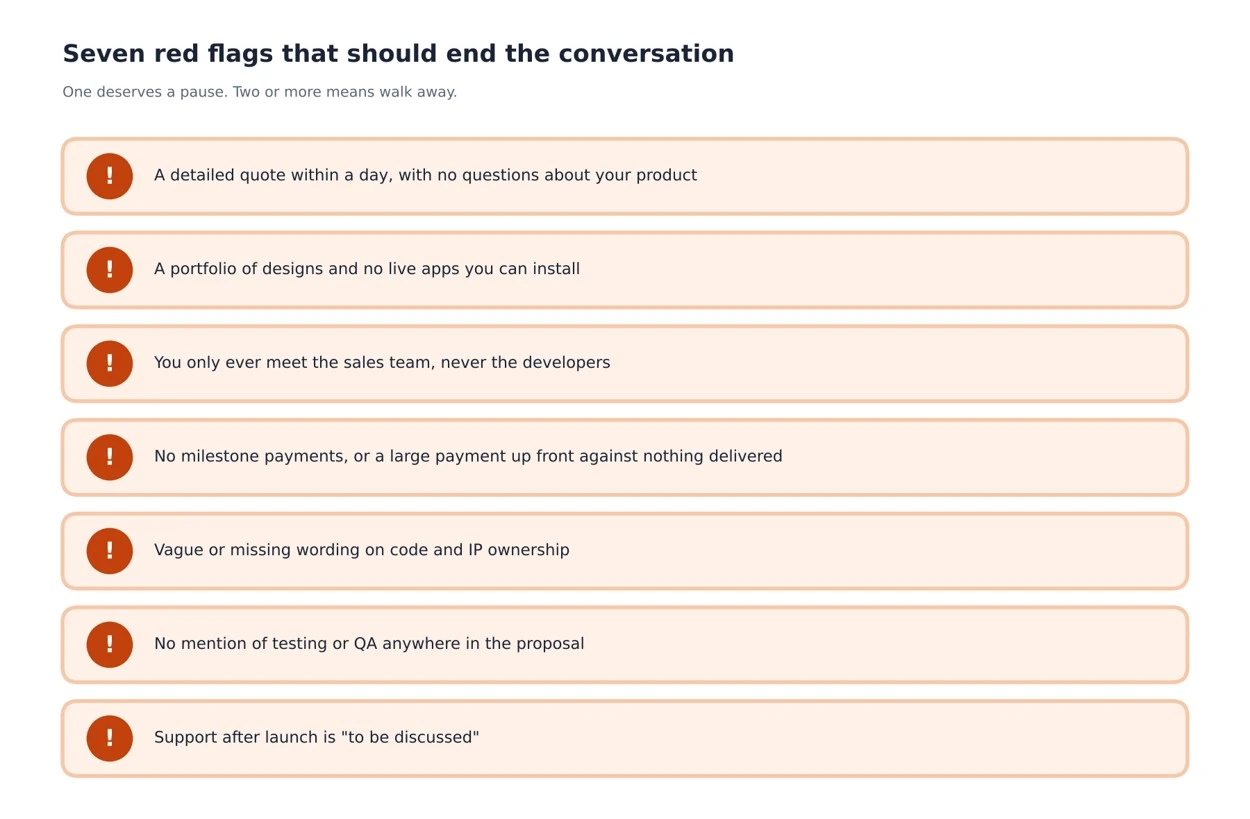
Seven red flags that should end the conversation
One red flag deserves a pause. Two or more means walk away.
- A detailed quote within a day, with no questions about your product
- A portfolio of designs and no live apps you can install
- You only ever meet the sales team, never the developers
- No milestone payments, or a large payment up front against nothing delivered
- Vague or missing wording on code and IP ownership
- No mention of testing or QA anywhere in the proposal
- Support after launch is “to be discussed”
For security specifics, our post on protecting your app against critical risks covers what a reasonable vendor should already be doing. If testing is your worry, see how to select mobile app testing platforms.
Six mistakes buyers make (and how to avoid them)
Most hiring mistakes come from skipping a step because the pitch felt convincing. Watch for these:
- Choosing on the lowest quote. The cheapest estimate often leaves things out. Compare line by line.
- Skipping reference calls because the portfolio looked great.
- Starting without a defined scope, then paying for the confusion later.
- Treating the first quote as final instead of asking what’s included and excluded.
- Paying a large amount up front with no milestones attached.
- Ignoring post-launch needs until the app is already live.
Your first 30 days after you choose
The first month sets the tone, so plan it with your vendor before kickoff. Here is what we’d ask for if we were the client:
- Week one: a kickoff meeting, named contacts on both sides, and access to the repository and project tools.
- Weeks one and two: a confirmed scope, a written definition of done, and a fixed demo schedule.
- Weeks two to four: working software in your hands, even if rough, and a first demo.
- All month: one shared channel for questions, and decisions written down where both sides can find them.
Ready to put DianApps on your shortlist?
Bring your one-page scope. We’ll tell you honestly what we think, including when someone else is the better fit.
If the vendor can’t show you working software within the first few weeks, ask why while it is still cheap to change course.
How DianApps works, so you can check us against the scorecard
DianApps is a mobile app development company founded in 2018, and we work in three phases: Discovery and Strategy, Design and Development, and Scale and Evolve. Here is what you can verify, using the same criteria as above.
On the technical side, we build in iOS, Android, Flutter and React Native, plus super apps and MVPs for teams who want to test an idea fast. Our mobile app development service describes testing from UI and UX reviews through load testing and real-user scenarios. For engagement, we offer dedicated developers plus fixed-price and milestone-based options.
On proof, our portfolio lists these results for apps and platforms we worked on:
| Client | Industry | Result listed on our portfolio |
|---|---|---|
| Uber Eats | Food delivery | 45% lower service cost, 35% better retention |
| Tira | E-commerce | 38% higher conversion rate, 42% more repeat purchases |
| HireNetix | AI web app | 40% reduction in time-to-hire |
| APIAM | Healthcare | 75% reduction in operational expenses |
If you’d rather talk to a client than read a table, ask us for references on a project similar to yours. That’s step three of the process above, and we’d expect you to do it.
When we’re probably not the right choice
A one-screen app, a throwaway prototype or a budget far below the cost of a full team usually doesn’t need a company with 150+ engineers. A freelancer or a no-code tool can get you a first version for less, and you can come back when you’ve proven demand.
If your plan includes AI features, we’ve written a separate guide on choosing an AI mobile app development company.
Final words: pick the partner, not the pitch
Every vendor can show you a polished deck. Very few can show you an app you can install, a client who’ll pick up the phone, and a contract that says plainly who owns the code.
That’s your filter. Use it on everyone, us included.
The process in this guide isn’t complicated. It’s just rarely followed, because it means a couple of weeks of unglamorous work: writing the one-pager, installing the apps, making the calls, scoring the vendors, paying for a pilot. Teams that do the work end up with a partner they trust. Teams that skip it end up in month six wondering why the budget doubled.
So start small. Write your scope this week. Shortlist three to five vendors. Score them honestly. And if DianApps makes your shortlist, hold us to everything above.
 0 comments








Leave a Comment
Your email address will not be published. Required fields are marked *