













 0 comments






Key Takeaways:
- Healthcare app development typically costs $30,000 to $80,000 for a basic MVP and $150,000 to $500,000 or more for complex enterprise platforms.
- HIPAA applies to covered entities and business associates handling protected health information, while other health apps may face FTC and state privacy requirements.
- Essential safeguards include encryption, multi-factor authentication, role-based access, audit logs, secure APIs and HIPAA-eligible cloud hosting.
- Compliance, integrations, security testing and ongoing maintenance can significantly increase development costs beyond the initial build.
- Choose a development partner with healthcare experience, BAA readiness, EHR integration expertise and a clear security testing process.
- Plan for annual maintenance, monitoring, risk assessments and security updates to protect patient data after launch.
Quick Answer: Healthcare app development in 2026 typically costs $30,000 to $80,000 for a basic MVP and $150,000 to $500,000 or more for complex platforms. Costs depend on features, integrations, security and compliance requirements. Apps handling protected health information for HIPAA-regulated organizations need appropriate safeguards, risk assessments and business associate agreements where applicable.
Imagine a patient trying to book an appointment late at night, only to find out that the clinic’s app is not loading their past reports, the video consultation is freezing halfway and the prescription refill request is sitting somewhere in an inbox that nobody is checking. Now imagine the same app quietly leaking patient data because one security setting was missed during development. Situations like these don’t just frustrate patients, they also put healthcare businesses at risk of heavy fines, lost trust and damaged brand perception.
This is why healthcare providers, clinics and healthtech startups are now taking mobile app development for healthcare much more seriously, with security and compliance planned right from day one. But how much does it actually cost to build a healthcare app in 2026, and what does HIPAA compliance really involve? Well, this guide is covering both, so let’s break it down.
What Is Healthcare Mobile App Development?
Healthcare mobile app development is the process of designing and building mobile apps that help patients, doctors, clinics, hospitals and healthcare businesses manage care, communication and health data digitally. These apps range from simple appointment booking tools to complex platforms that connect with electronic health records (EHR), wearables and AI-powered diagnostics.
Healthcare businesses are building different types of apps depending on their goals, such as:
- Telemedicine and virtual consultation apps.
- Appointment booking and patient portal apps.
- Remote patient monitoring apps connected to wearables.
- Electronic health record (EHR) and clinical apps for doctors.
- Medication reminder and chronic care management apps.
- Mental health and therapy apps.
- Fitness, wellness and nutrition apps.
- Pharmacy and prescription refill apps.
Each of these apps is handling some form of health information, and this is exactly why healthcare mobile application development is very different from building a regular consumer app, as security, privacy and compliance are not optional features that can be added later, they need to be part of the architecture from the very beginning.
Does Your Healthcare App Need to Be HIPAA Compliant?
This is one of the first questions every healthcare business should answer, because not every health app falls under HIPAA, but the ones that do have to follow strict rules. HIPAA (the Health Insurance Portability and Accountability Act) applies to two main groups in the US, namely covered entities and business associates.
Your app is likely needing HIPAA compliance when it is:
- Built for or used by a hospital, clinic, doctor or health plan.
- Creating, storing, receiving or sharing protected health information (PHI).
- Sharing patient data with healthcare providers or insurers.
- Developed by a vendor that is handling PHI on behalf of a healthcare provider.
PHI is basically any health information that can be linked back to a person, such as names combined with diagnoses, lab results, prescriptions, appointment history or insurance details. If your app is touching this kind of data for a covered entity, then both your business and your healthcare mobile app development company are falling under HIPAA as business associates, and a signed Business Associate Agreement (BAA) is required.
What If Your App Is Not Covered by HIPAA?
Many direct-to-consumer apps, like fitness trackers, diet apps or period trackers, are not covered by HIPAA because they are not working on behalf of a healthcare provider. But this does not mean they are free from rules. The FTC’s Health Breach Notification Rule requires companies that suffer a breach of consumers’ identifying health information to notify affected consumers, the FTC and, in some cases, the media. In April 2024, the FTC amended the rule to make it clear that it applies to most health apps and similar technologies, with the amendments taking effect on July 29, 2024. Companies that fail to comply can face penalties of up to $51,744 per violation.
Several US states also have their own consumer health data laws, so even apps outside HIPAA need strong privacy practices, clear consent and secure data handling from day one.
Building a Healthcare App? Get Compliance Right From Day One
Our healthcare mobile app developers design HIPAA-ready architecture, secure integrations and encrypted cloud infrastructure from the very first sprint.
What HIPAA Compliance Means for Your Healthcare App
HIPAA is mainly built around three rules that are directly affecting how a healthcare app is designed and built, and understanding them is really important before development is starting.
The Privacy Rule decides how PHI can be used and shared, and it gives patients rights over their own health information, including the right to access it.
The Security Rule is the one that matters most for developers, as it requires administrative, physical and technical safeguards to protect electronic PHI (ePHI).
The Breach Notification Rule requires covered entities and business associates to notify affected individuals, HHS and in some cases the media when unsecured PHI is breached, with individual notices due within 60 days of discovering the breach.
For a mobile healthcare app development project, this is translating into a clear set of technical requirements, resulting in:
- Encryption of health data both at rest and in transit.
- Secure user authentication, including multi-factor authentication.
- Role-based access, so users see only the data they need.
- Automatic logout after inactivity.
- Audit logs that track who accessed or changed PHI.
- Secure APIs for EHR, lab and pharmacy integrations.
- HIPAA-eligible cloud hosting with a signed BAA.
- Secure backups and a tested disaster recovery plan.
- No PHI in push notifications, logs or analytics tools.
- Regular risk assessments and penetration testing.
That last point about analytics is extremely crucial, as many healthcare apps are getting into trouble not because of hackers, but because tracking pixels and third-party SDKs are quietly sharing sensitive data. This is why experienced healthcare mobile app developers are reviewing every third-party library and integration before it goes into the app.
The HIPAA Security Rule Update: What Is Changing?
HIPAA’s Security Rule has not been updated in a big way for more than a decade, but that is now changing. In January 2025, HHS proposed the biggest update to the Security Rule since 2013, which would remove “addressable” safeguards and make MFA, encryption, asset inventories, regular vulnerability scans and annual penetration tests mandatory.
As of October 2026, the proposed rule has not been finalised, and the current Security Rule remains fully in effect. Final action on the rule is now projected for July 2027.
So why should businesses care about a rule that is not final yet? Well, the direction is very clear, and building these controls into your app today is far cheaper than rebuilding later. Many cyber insurance providers are also already asking for verifiable MFA, encrypted and tested backups and a completed risk analysis before issuing or renewing policies for medical practices. This is why smart healthcare businesses are treating encryption and MFA as standard requirements already, rather than waiting for the final rule.
The Real Cost of Getting HIPAA Wrong
Cutting corners on compliance might look like a way to save money during development, but the numbers are telling a very different story.
HIPAA civil penalties are adjusted for inflation every year. As of January 28, 2026, the maximum penalty for most HIPAA violations is $73,011 per violation, while violations due to willful neglect that are not corrected in time can reach $2,190,294. That same $2,190,294 is also the calendar-year cap for all violations of an identical HIPAA provision.
| Penalty Tier | Level of Culpability | Penalty Range Per Violation (2026) |
|---|---|---|
| Tier 1 | Did not know | $145 – $73,011 |
| Tier 2 | Reasonable cause | $1,461 – $73,011 |
| Tier 3 | Willful neglect, corrected | $14,602 – $73,011 |
| Tier 4 | Willful neglect, not corrected | $73,011 – $2,190,294 |
And that is not all, as fines are only one part of the cost. According to IBM’s latest Cost of a Data Breach report, healthcare remains the most expensive industry for data breaches, with an average cost of $7.42 million per breach. Healthcare breaches also take the longest to identify and contain, at 279 days on average, which is more than five weeks longer than the global average.
This is why compliance is not just a legal box to tick, it is one of the smartest investments a healthcare business can make, as the cost of building security in properly is only a small fraction of what a single breach can cost.
Healthcare App Development Cost in 2026
Now comes the question every healthcare business is asking, which is how much it really costs to build a healthcare app. The honest answer is that it depends on the type of app, the features, the integrations, the level of compliance and the team you are hiring, but published industry estimates are giving a clear picture of the typical ranges.
Industry estimates for 2026 put healthcare app development at around $30,000 to $80,000 for a basic MVP and $150,000 to $500,000 for complex, enterprise-grade platforms. Other estimates suggest that HIPAA compliance alone can add 20% to 50% to the base development cost.
Here is a simple view of typical cost ranges by app type.
| App Type | Typical Features | Estimated Cost Range |
|---|---|---|
| Basic healthcare MVP | Booking, profiles, reminders, secure storage | $30,000 – $80,000 |
| Telemedicine app | Video calls, chat, e-prescriptions, payments | $80,000 – $200,000 |
| Remote patient monitoring | Wearable sync, real-time alerts, dashboards | $100,000 – $250,000 |
| EHR-integrated platform | EHR/FHIR integration, clinician tools, analytics | $150,000 – $350,000 |
| Enterprise healthcare platform | Multi-role apps, AI, multiple integrations | $250,000 – $500,000+ |
These are indicative ranges based on published 2026 industry estimates. Your actual cost will depend on your scope, region and development partner.
What Is Driving Your Healthcare App Cost?
The final budget for healthcare mobile apps development is usually depending on a few key factors, including:
- Number of user roles, like patients, doctors, admins and caregivers.
- Platform choice, whether iOS, Android or cross-platform.
- Integrations with EHR systems, labs, pharmacies and insurers.
- Video, chat and real-time features.
- AI features like symptom checkers or smart triage.
- Wearable and IoT device connectivity.
- HIPAA security architecture and compliance documentation.
- Testing, including security audits and penetration testing.
- Location and hourly rate of the development team.
Choosing cross-platform frameworks like Flutter is often helping healthcare startups launch on both iOS and Android with one codebase, which is reducing both time and cost without compromising on quality.
Ongoing Costs to Plan For
A healthcare app’s cost does not end at launch. Businesses should also budget for HIPAA-eligible cloud hosting, security monitoring, regular risk assessments, app store updates, bug fixes, new features and compliance updates as regulations change. A common practice is setting aside around 15% to 20% of the initial development cost each year for maintenance and support.
How to Reduce Healthcare App Development Cost
There are a few smart ways to keep your budget under control without cutting corners on security, such as:
- Starting with an MVP focused on one core problem.
- Building compliance into the architecture from day one.
- Using HIPAA-eligible cloud services instead of building from scratch.
- Choosing cross-platform development where it fits.
- Working with an experienced offshore or hybrid team.
Building HIPAA compliance from the start is always cheaper than fixing it later, as retrofitting security into a live app usually means rewriting large parts of the backend. If you are planning to start lean, our MVP development services are helping healthcare startups validate their idea quickly and securely.
The Healthcare Mobile App Development Process
A structured process is extremely crucial in healthcare, as every stage is needing to keep both user experience and compliance in mind, and the journey usually looks like this:
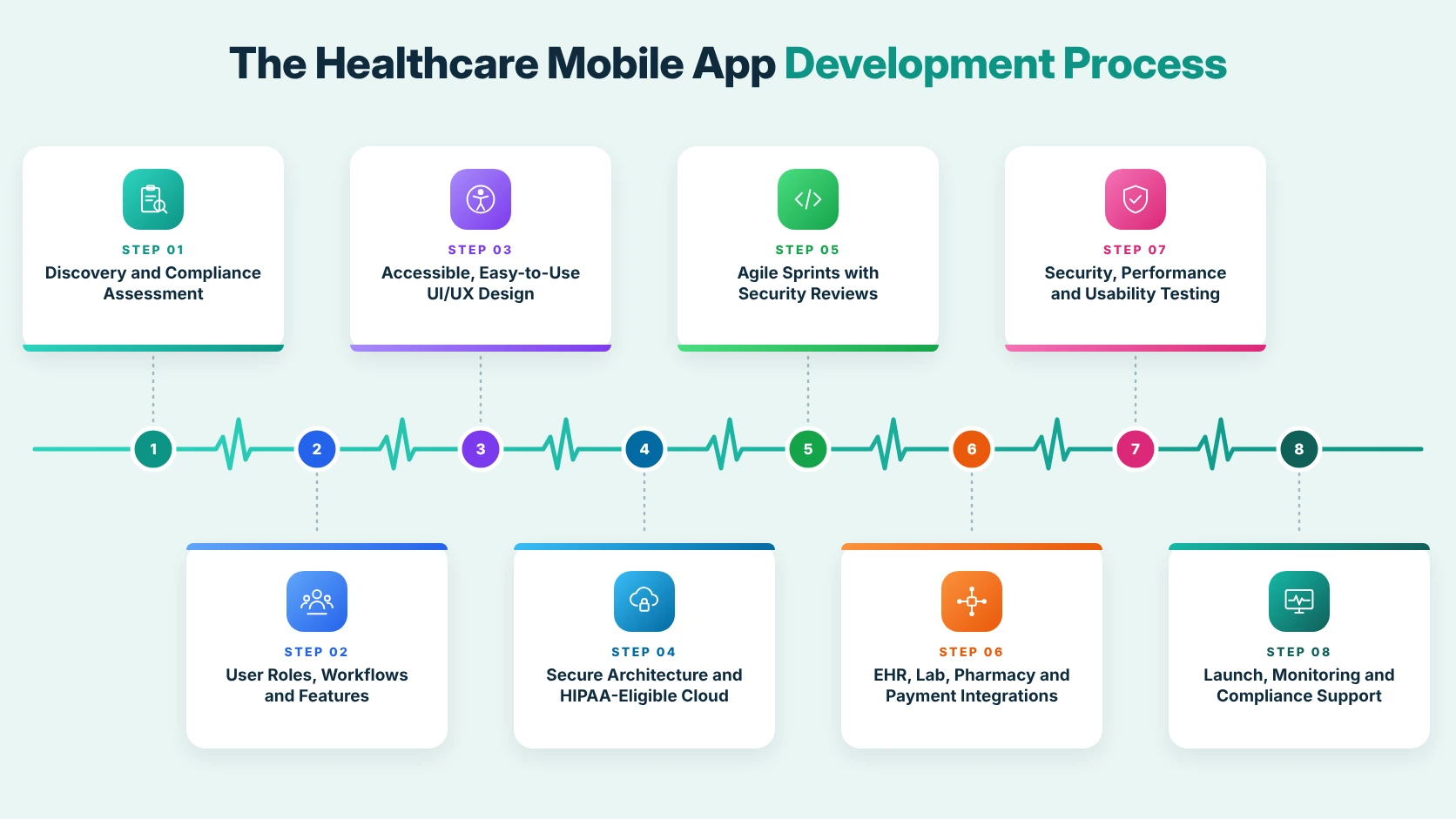
- Discovery and compliance assessment.
- Defining user roles, workflows and features.
- UI/UX design focused on accessibility and ease of use.
- Secure architecture and HIPAA-eligible cloud setup.
- Development in agile sprints with security reviews.
- EHR, lab, pharmacy and payment integrations.
- Testing, including security, performance and usability.
- Launch, monitoring and ongoing compliance support.
Good healthcare app design is just as important as security, because patients of all ages and abilities are using these apps, sometimes when they are unwell or stressed, so clear navigation, readable text and accessibility features are really making a difference. Our UI/UX design team is designing healthcare interfaces that are simple for patients and efficient for clinicians.
How to Choose the Right Healthcare Mobile App Development Company
Choosing a healthcare mobile app development company is one of the most important decisions in your project, as the wrong partner can leave you with an app that looks great but fails a compliance review. Before signing with anyone, it is worth checking a few important things, such as:
- Experience building healthcare or other regulated apps.
- Willingness to sign a Business Associate Agreement.
- Clear knowledge of HIPAA, the FTC rule and data privacy laws.
- Experience with HIPAA-eligible cloud platforms like AWS.
- Ability to integrate with EHR systems and healthcare APIs.
- A defined security testing and audit process.
- Transparent pricing and clear source code ownership.
- Post-launch support and compliance maintenance.
For US healthcare businesses, it is also helpful to work with a healthcare mobile app development company in the USA, or one with a US presence, that understands American healthcare workflows and time zones, while still offering cost-effective development.
Ready to Build a Secure, HIPAA-Ready Healthcare App?
Our healthcare mobile app developers are helping clinics, hospitals and healthtech startups launch secure, compliant and patient-friendly apps, with transparent pricing.
Why Choose DianApps for Healthcare Mobile App Development?
DianApps is offering end-to-end healthcare mobile app development services for clinics, hospitals, healthtech startups and wellness businesses, combining secure app development, cloud engineering and AI under one team. With offices in the USA, Australia, Canada, the UAE and India, DianApps is working closely with US healthcare businesses while keeping development cost-effective.
Here is what DianApps is bringing to your healthcare project:
- HIPAA-ready architecture planned from the very first sprint.
- AWS-certified team for secure, HIPAA-eligible cloud infrastructure.
- Native and cross-platform mobile app development for iOS and Android.
- AI features like chatbots, smart triage and personalised care, built with OpenAI and Claude.
- Wearable and IoT integration for remote patient monitoring.
- A 4.8 rating across 86 verified reviews on Clutch.
- Transparent pricing starting from 25–49 per hour on Clutch.
- Ongoing maintenance, security updates and compliance support.
Whether you are planning a telemedicine app, a patient portal or a remote monitoring platform, you can explore our healthcare solutions or hire dedicated developers for your project. And if you are also deciding whether your app’s AI features should run on the device or in the cloud, our guide on on-device AI vs cloud AI is explaining what works best for sensitive health data.
Final Thoughts
Healthcare apps are changing the way patients are accessing care, booking appointments, speaking with doctors and managing their health every day, but building one successfully is needing much more than good design and smooth features. HIPAA compliance, data security and careful planning are deciding whether your app is earning patient trust or turning into a costly liability, and with the Security Rule moving towards stricter requirements, the right time to build security in is from the very beginning. The cost of healthcare app development is depending on your app type, features, integrations and the team you are choosing, but investing in the right healthcare mobile app development company is always costing far less than fixing a breach or a failed compliance review later. So take your time, define your requirements clearly, choose a partner who is understanding both technology and healthcare regulations, and you will be building an app that is truly supporting patients and providers from beginning until completion.
 0 comments










Your email address will not be published. Required fields are marked *