















 0 comments





Key Takeaways:
- Understand how AI underwriting software uses machine learning, predictive analytics, automation, and AI to support insurance decisions.
- Explore AI use cases including document processing, risk assessment, fraud detection, and underwriting automation.
- Learn how AI can reduce manual work, speed up decisions, improve consistency, and help insurers handle higher application volumes.
- Understand why AI does not eliminate underwriting risk and why data quality, model monitoring, and human oversight remain essential.
- Compare buying an existing AI underwriting platform with building custom software around proprietary workflows and risk models.
- Evaluate AI underwriting accuracy through data quality, model design, relevance, monitoring, and changing market conditions.
- Understand key governance requirements, including explainability, audit trails, privacy, documentation, and human oversight.
- Learn how insurers can identify and manage bias in AI underwriting models.
- Understand why AI is more likely to augment underwriters than replace them, particularly for complex, high-value, or unusual cases.
- Consider AI software costs across model complexity, data infrastructure, integrations, security, compliance, and ongoing maintenance.
Quick Answer: AI underwriting software uses artificial intelligence, machine learning, predictive analytics, and automation to help insurers process applications, analyze documents, assess risk, detect anomalies, and support underwriting decisions. It can make underwriting faster and more scalable, but accuracy and compliance depend on high-quality data, continuous monitoring, governance, and human oversight.
Insurance underwriting has long been a job. Insurance underwriters need to look over applications, claim histories, financial records, policy papers and other data before deciding how risky a situation is.
That old process is changing because of AI underwriting software.
In 2026 insurers are using intelligence more and more. Artificial intelligence can handle piles of data, spot risk patterns, do repetitive jobs automatically and help make underwriting decisions faster. Artificial intelligence does not replace insurance underwriters entirely. Instead it lets insurance underwriters spend time on manual chores and more time on tough decisions that need experience and good judgment.
This guide tells you what AI underwriting software is, how it works, what its benefits and limits are and whether insurers should build their solution or buy a ready one.
What Is AI Underwriting Software?
AI underwriting software uses intelligence, machine learning, predictive analytics and automation to help with insurance underwriting decisions. This broader AI development process involves more than selecting a model. It also covers data, software engineering, integrations, deployment, testing, and ongoing monitoring. They find patterns. Give insights about risk.
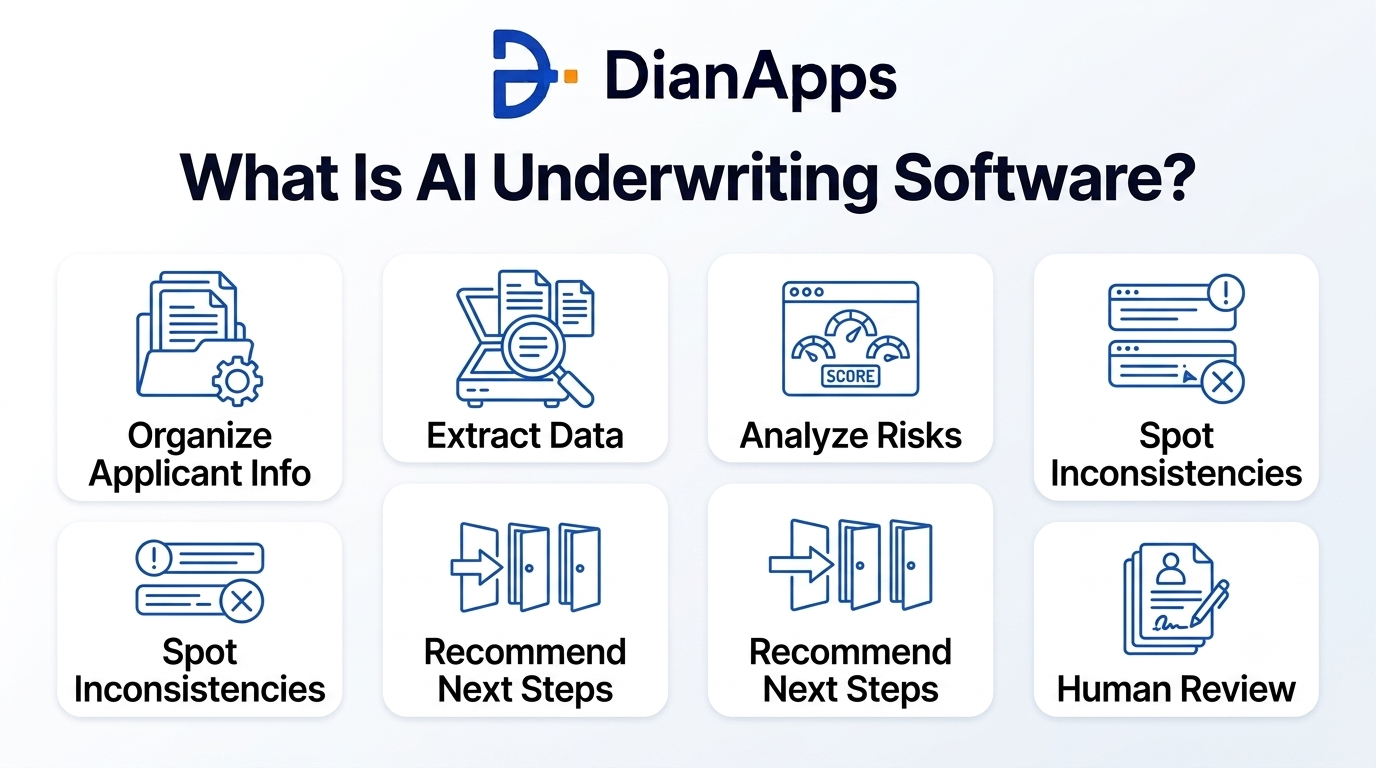
Depending on the solution an AI underwriting platform can help insurers in ways. It can:
- Organize applicant information.
- Extract data from documents like forms or scans.
- Analyze risks and generate risk scores.
- Spot inconsistencies in applications.
- Recommend what steps to take next.
- Also send cases to human underwriters for review.
The goal is not always automation. In situations the best approach is AI-assisted underwriting. Here AI takes care of tasks and basic analysis. Human underwriters stay in charge of sensitive decisions. This makes automated underwriting software especially useful, for insurers who deal with a number of applications every day.
How Is AI Used in Underwriting?
AI can support stages of the underwriting workflow. The exact implementation depends on the insurance product, available data and the company’s existing systems.
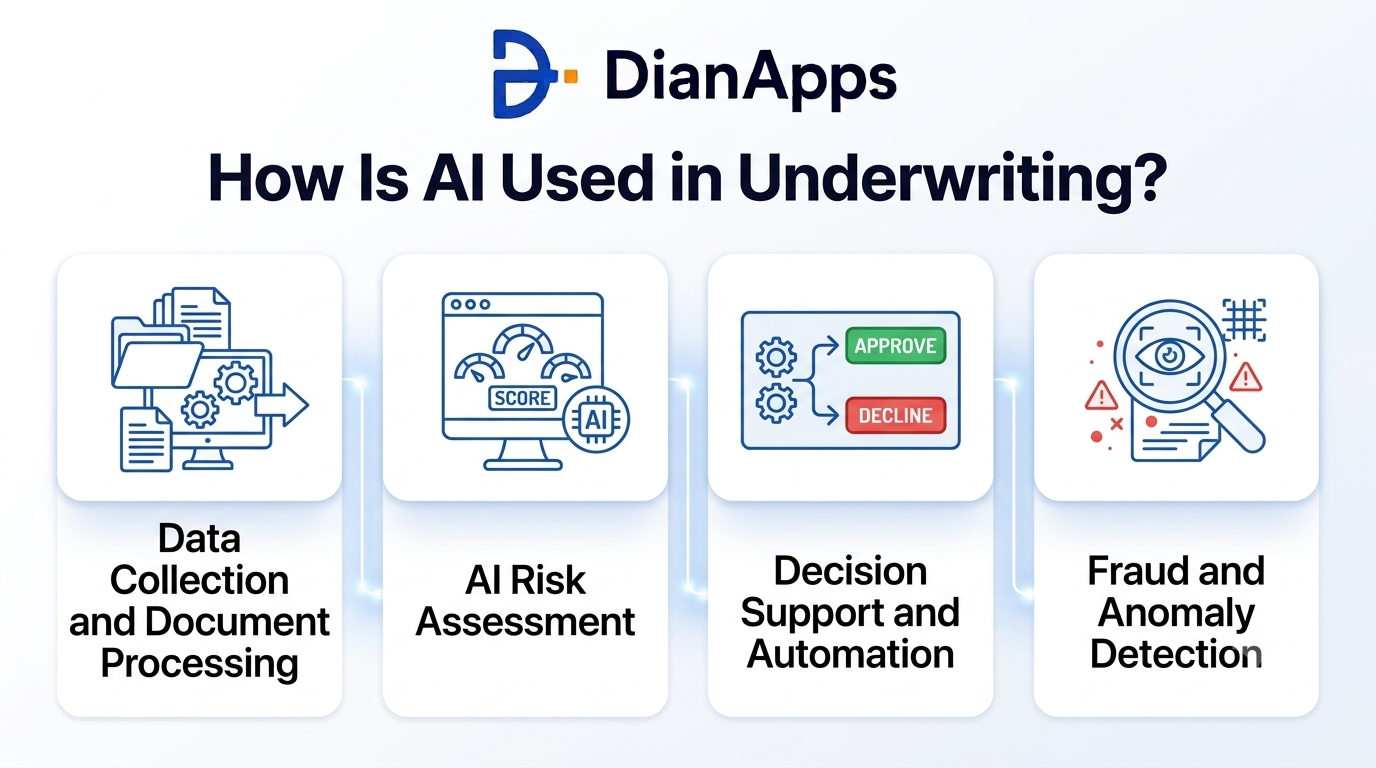
Data Collection and Document Processing
Insurance applications often involve information from sources. This may include application forms, claims history, financial records, property data, medical documents and third-party databases.
AI can help collect, organize and process this information.
- For Example: Document intelligence tools can extract details from lengthy and unstructured documents. Of manually reviewing every page an underwriter can receive organized information for faster review.
This does not eliminate the need for verification. It can significantly reduce administrative work.
AI Risk Assessment
Once relevant information is available AI models can analyze variables to identify potential risk patterns.
AI risk assessment in underwriting may involve comparing information with historical data and identifying factors associated with different levels of risk.
Depending on the insurance product and applicable regulations AI may analyze factors such as:
- Historical claims patterns
- Property characteristics
- Financial information
- Customer data
- Transactional information
- Other relevant risk indicators
The system can then provide a risk score or recommendation to support the underwriting process.
A 2026 report from the Society of Actuaries Research Institute found that AI is already producing value in life underwriting, although the results vary depending on insurer maturity, data readiness, workflow design, and how effectively underwriting teams use the technology. The report emphasizes that successful AI underwriting requires balancing automation and speed with human judgment, explainability, governance, and trust.
Decision Support and Automation
AI underwriting models can provide recommendations based on the information they analyze.
For cases insurers may use automated workflows or straight-, through processing. Complex applications can be routed to a human underwriter.
This hybrid approach allows companies to increase efficiency without removing judgment from important decisions.
Fraud and Anomaly Detection
AI can also identify patterns or inconsistencies.
For example a system may flag information, suspicious application patterns or data that differs significantly from expected risk profiles.
These insights can help underwriting teams investigate issues earlier.
Ready to Build AI Into Your Underwriting Workflow?
Build AI solutions that can automate document processing, support risk assessment, detect anomalies, and integrate with your existing insurance systems.
How Does AI Improve Underwriting?
The value of intelligence in insurance underwriting is more than just making decisions quicker. It can help insurers handle information better and manage underwriting processes effectively.
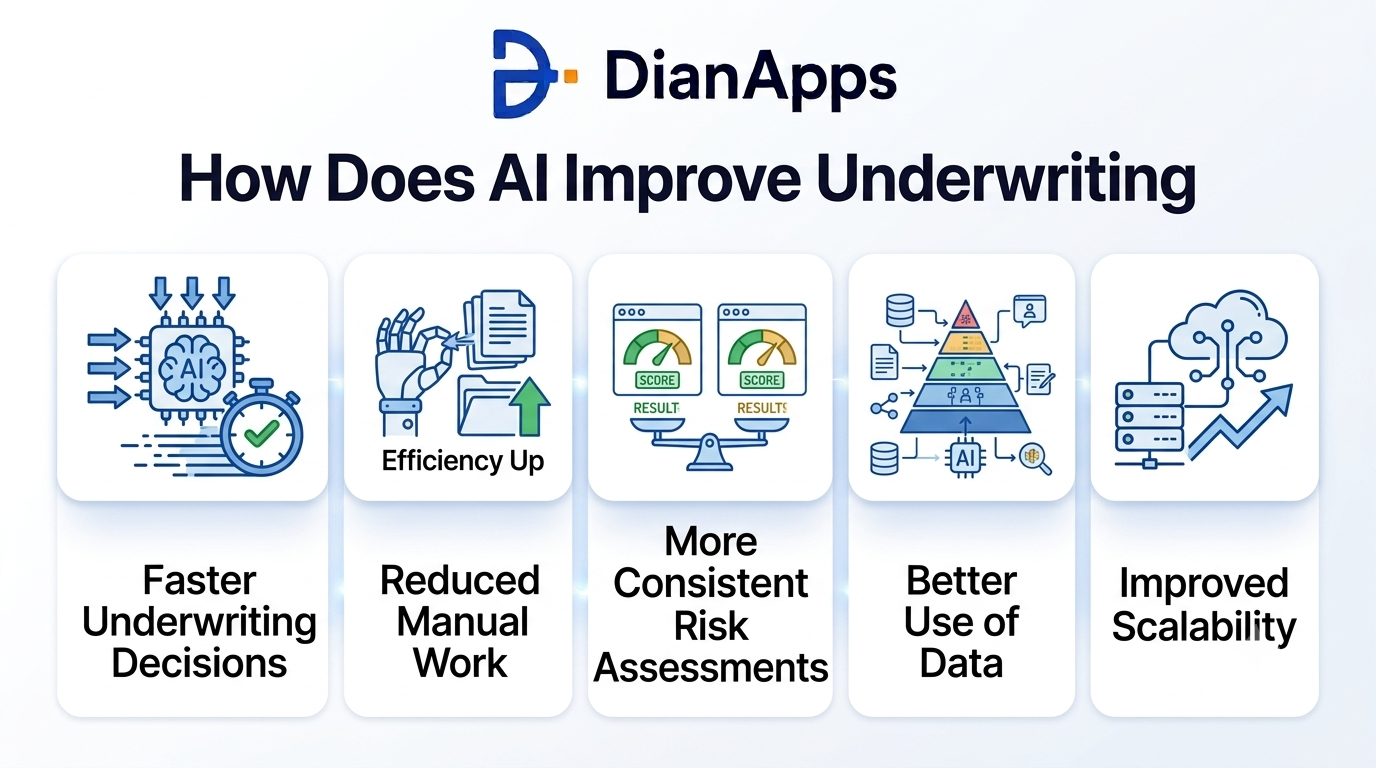
- Faster Underwriting Decisions: Manual underwriting usually requires a lot of data gathering and document checking. AI can take care of some of these tasks. Cut down the time needed to handle standard applications. Faster decisions can make operations run smoother and make customers happier.
- Reduced Manual Work: Underwriters often spend a lot of time typing data looking at documents and moving information between systems. AI tools can take care of some of these repeated tasks letting underwriting experts focus on complicated work.
- More Consistent Risk Assessments: Human knowledge is still important. Manual methods can sometimes lead to different results. AI uses the way of looking at things for similar inputs. When set up correctly and watched closely this can help make underwriting decisions more the same across the board.
- Better Use of Data: Insurance companies have more and more information available. The problem is turning that data into ideas. AI can look at groups of data and find patterns that might be hard or slow to find by hand. This can help make underwriting choices.
- Improved Scalability: When the number of applications goes up insurance companies need systems that can handle work.Insurance AI software can manage applications, in large amounts, which means they don’t have to add more manual work at the same rate.
Does AI Underwriting Actually Reduce Risk?
AI does not automatically reduce risk. Instead AI can help insurers identify, assess, classify and price risk effectively.
A designed AI system may spot patterns linked to specific outcomes, catch inconsistencies and offer extra insights during underwriting.
AI models are only as reliable as the data and processes that feed them.
Poor data can lead to recommendations. Outdated AI models may miss conditions. Historical data can also hold biases.
For this reason insurers should see AI as a tool that boosts risk intelligence, not a guaranteed way to cut risk. Regular monitoring, testing and human oversight remain essential.
What Are the Best AI Underwriting Automation Tools?
There is no best AI underwriting solution for every insurer.
The right choice depends on the company’s insurance products, workflows, data availability, technology infrastructure and compliance requirements.
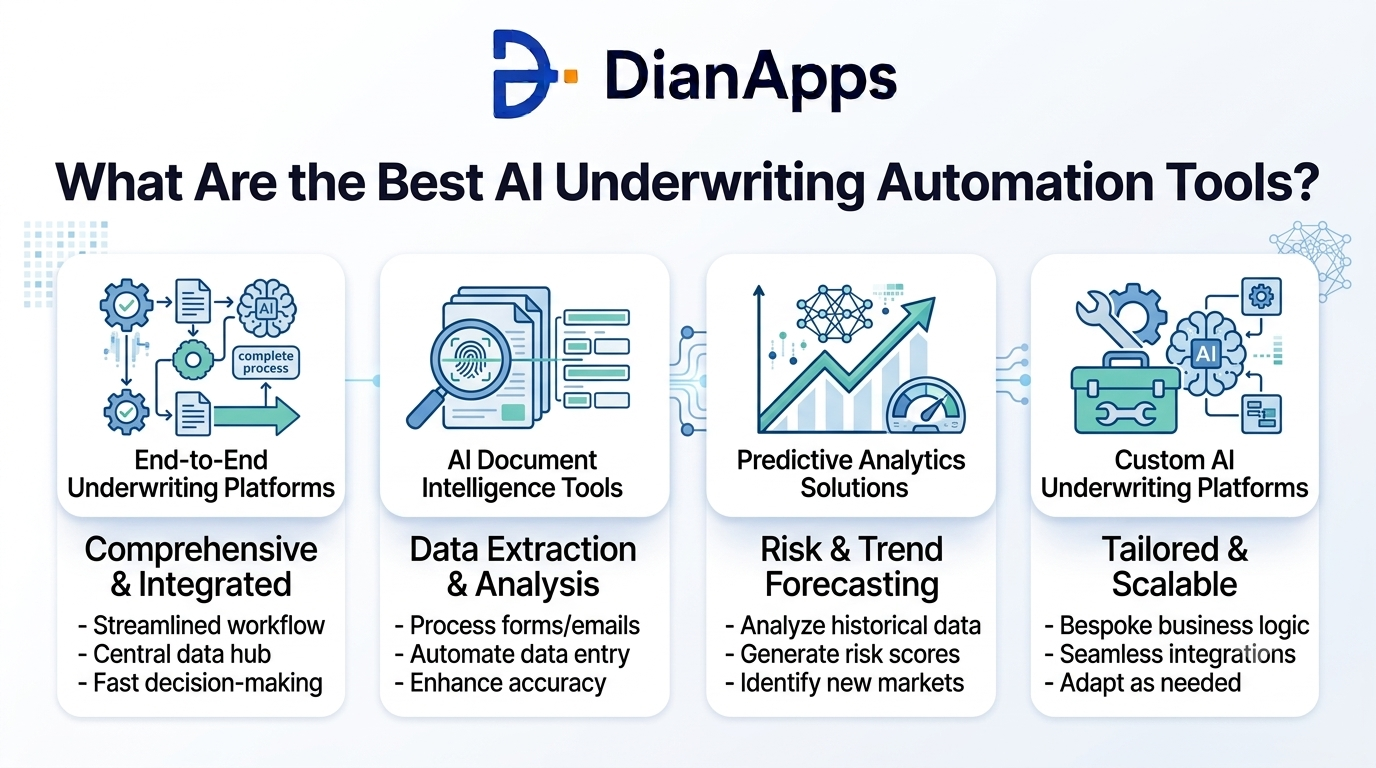
Most solutions fall into categories.
End-to-End Underwriting Platforms
These platforms support the underwriting process and may include workflow automation, decision engines, risk assessment and analytics.
They can be useful for insurers looking to modernize processes.
AI Document Intelligence Tools
Document processing is an use case for AI, in underwriting.
These tools can extract, classify and summarize information from applications, reports and supporting documents. This reduces data entry and makes information easier to review.
Predictive Analytics Solutions
Predictive analytics platforms analyze current information to identify patterns and estimate potential outcomes.
These insights can support risk scoring and underwriting decisions.
Custom AI Underwriting Platforms
Some insurers have specialized requirements that cannot be effectively addressed by a standard platform.
Depending on the generative AI capabilities required, teams may also need to evaluate the frameworks used to build and orchestrate these applications. Our guide to top LLM frameworks covers several of the major options.
This Leads To A Question: Should insurers build or buy their AI solution?
Build vs. Buy: Should Insurers Develop Custom AI Underwriting Software?
Buying an existing solution can offer implementation. Building a custom system can give flexibility.
When Buying Makes Sense?
A pre‑built solution may work well for insurers that:
- Need implementation
- Have standardized workflows
- Require limited customization
- Want to test AI capabilities
The main advantage is speed. However existing platforms may have limits around customization, integrations and proprietary underwriting processes.
When Building Makes Sense?
Custom development can be useful for insurers with needs.
For example a company may need to link AI with its policy administration system, claims platform, CRM or proprietary risk database.
A custom solution can also be built around underwriting rules and decision‑making processes.
This is where AI services for insurance can help.
AI can help underwriting teams:
- Summarize documents
- Pull out relevant data
- Get policy details
- Produce underwriting summaries
- Search internal knowledge bases
- Support employees through chat interfaces
For insurers, with complex workflows combining machine learning models with AI can create a more flexible and efficient underwriting environment.
Is AI Underwriting Accurate and Compliant?
AI can be useful. Accuracy and compliance should never be assumed.
AI Accuracy
The accuracy of AI underwriting models depends on factors including:
- Data quality
- Model design
- Training data
- Data relevance
- Changing market conditions
- Ongoing monitoring
An AI model may perform well at first but it might need updates as customer behavior changes, markets shift and risk conditions evolve.
AI systems should therefore be continuously evaluated rather than deployed and left alone.
Compliance and Governance
Insurance decisions often involve regulatory and legal requirements.
AI systems need governance, including:
- Explainability
- Audit trails
- Data privacy
- Model monitoring
- Documentation
- Human oversight
Compliance depends on how the AI system is designed, deployed and governed. Simply using an AI tool does not automatically make an underwriting process compliant.
Ready to Build AI Into Your Underwriting Workflow?
Build AI solutions that can automate document processing, support risk assessment, detect anomalies, and integrate with your existing insurance systems.
How Do Insurers Handle Bias in AI Underwriting?
Bias is a problem with AI in insurance. AI learns from data. If old data has bias AI will copy that bias.
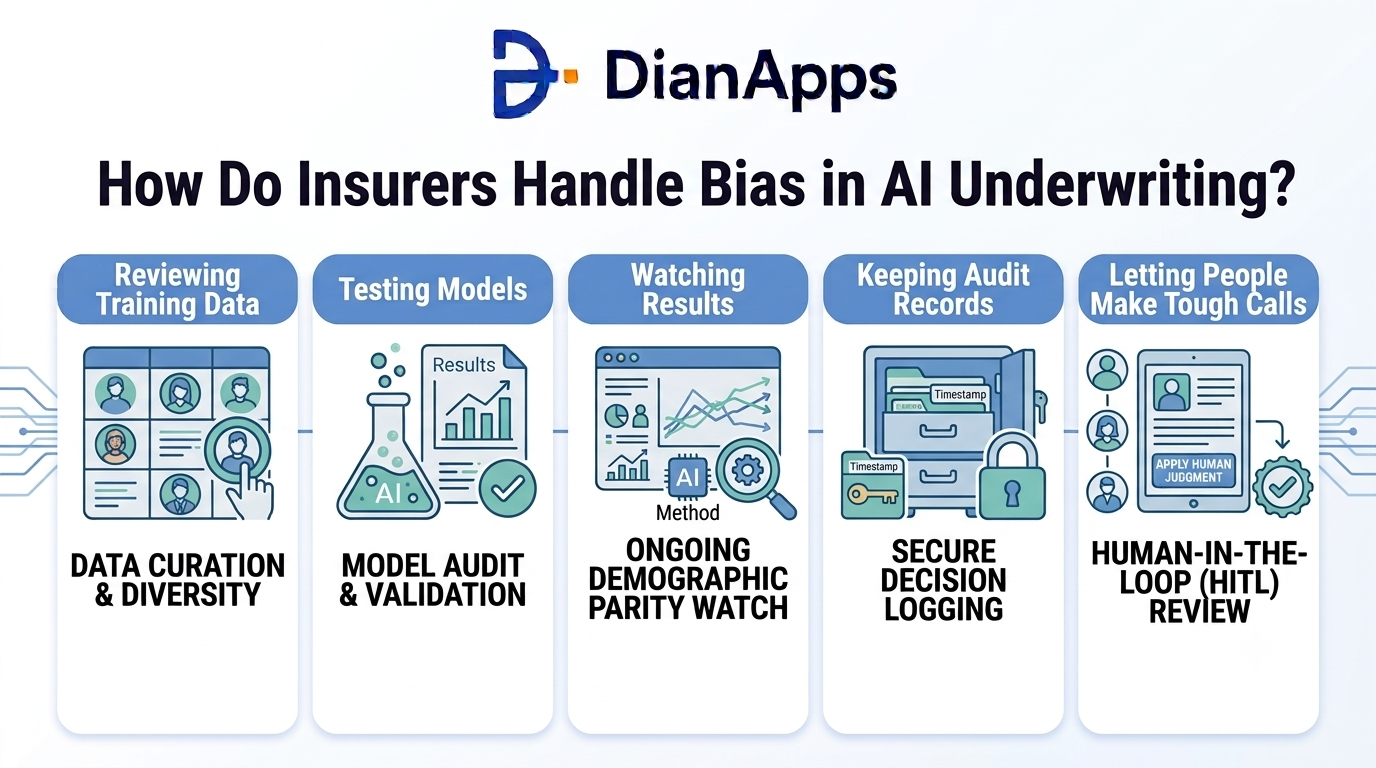
Bias can also show up through stand‑in variables or strange links, between pieces of data. Insurers can cut these bias risks by:
- reviewing training data
- testing models
- watching results using clear AI methods
- keeping audit records
- letting people make tough calls.
AI must not be seen as a box that gives answers without explanation. Without rules automation can spread bad bias decisions as fast as it speeds up work. Good AI use needs checking and clear responsibility.
Will AI Replace Underwriters?
AI is not expected to take the place of underwriters.
Instead it is expected to change the way they do their jobs.
AI works well at handling information and doing tasks that happen over and over again.. People who are underwriters are still needed when decisions need knowledge, understanding and professional thinking.
People will still have an important job in:
- Complex risks
- Unusual applications
- High-value policies
- Exceptions
- Regulatory judgment
Looking at the recommendations that AI makes, the future probably will have underwriters who work with AI instead of AI working on its own.
AI can make everyday work easier for underwriters. Let them spend their time in situations where their knowledge adds the most value.
How Much Does AI Underwriting Software Cost?
The price of AI underwriting software changes based on whether an insurance company buys a ready-made platform adding AI features to a current system or creating a solution from scratch.
Many things affect the price:
- AI Complexity: Using AI models that’re already available or using services from third parties is usually easier than creating AI underwriting models that the company owns. Custom models need money for preparing data, building the models, testing them and keeping them up to date.
- Data Infrastructure: AI systems need data that’s dependable and easy to get. The price can go up if the insurance company needs to improve how data moves, organize data or create a safe system.
- System Integrations: Most insurance companies use different technology systems. Connecting AI with policy systems claims tools, CRM systems and outside data sources can make the work harder. Choosing the right AI development tech stack is also important because the underlying models need to work with application data, APIs, infrastructure, security controls, and monitoring systems.
- Security and Compliance: Insurance systems need protection for data and clear rules. Security measures, logs for checking who does what controlling access and following rules can also change how much it costs to build.
- Ongoing Maintenance: Building AI is not something that ends after it is put into use. Insurance companies should also think about the costs of keeping the model working, updating the system, keeping security up to date, testing how well it works and making it better.
To get an idea of how much it costs to develop AI companies can check our guide on AI development costs.
For a broader breakdown of the factors that influence AI project pricing, see our guide to AI development cost.
Is AI Underwriting Software Worth It?
For insurers the answer depends on the exact problem that AI is solving.
- Long underwriting turnaround times
- High application volumes
- Manual document processing
- Repetitive administrative work
- Difficulty scaling operations
The practical way is usually to start with one clear use case instead of trying to automate all of underwriting.
An insurer might begin with AI document processing or risk analysis. When the system shows value more features can be added. This approach can lower implementation risks. Help organizations find where AI gives the strongest results.
The Future of AI Underwriting Software
I have seen AI underwriting software become an important part of the insurance technology world.
By automating tasks by processing big amounts of data and by supporting faster risk assessments AI helps insurers improve efficiency while still using human expertise.
However successful implementation requires more than picking an AI tool.
Insurers need data, clearly defined workflows, strong security, effective governance and proper human oversight. Accuracy, bias and compliance should be thought about from the start.
For companies with needs an existing platform can give a faster path to automation.. For insurers with their own risk models, complicated workflows or old systems a custom-built solution can be better.
The question is no longer whether AI will have a role in underwriting. The bigger question is how insurers can use AI responsibly while building systems that really improve underwriting decisions.
Have an AI Underwriting Project in Mind?
Tell us about your underwriting workflow, data challenges, integrations, and automation goals. We’ll help you identify the right AI approach and development scope.
Frequently Asked Questions
-
What is AI underwriting software?
- AI underwriting software uses artificial intelligence, machine learning, and automation to help insurers analyze applicant information, assess risk, process documents, and support underwriting decisions.
-
How is AI used in underwriting?
- AI is used for document processing, data analysis, risk assessment, fraud detection, predictive analytics, and underwriting automation. It can also provide recommendations to human underwriters.
-
What are the best AI underwriting automation tools?
- The best solution depends on an insurer’s specific needs. Options include end-to-end underwriting platforms, AI document intelligence tools, predictive analytics solutions, and custom AI underwriting software.
-
Will AI replace underwriters?
- AI is unlikely to completely replace underwriters. It is more likely to automate repetitive tasks and provide decision support while humans continue handling complex cases and situations requiring professional judgment.
-
How does AI improve underwriting?
- AI can improve underwriting by reducing manual work, processing information faster, identifying patterns, supporting more consistent assessments, and helping insurers scale operations.
-
Is AI underwriting accurate and compliant?
- AI underwriting can be accurate when models are trained on relevant, high-quality data and continuously monitored. Compliance depends on proper system design, governance, explainability, data privacy, and human oversight.
 0 comments












Your email address will not be published. Required fields are marked *