











 0 comments
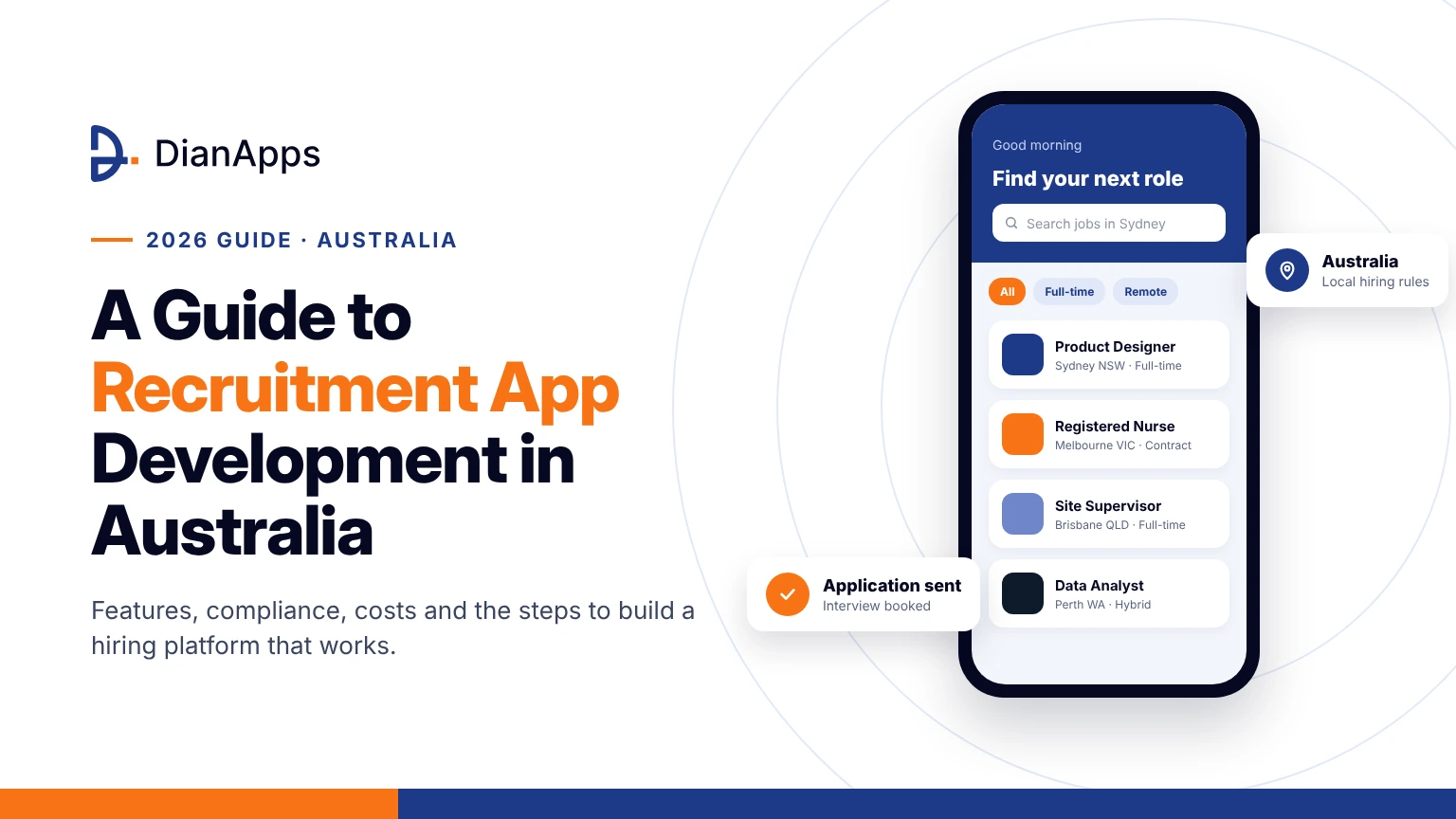





Key Takeaways:
- A recruitment platform is working best when the business is deciding its hiring goals, rules and user flows before a single screen is designed, and not trying to patch them in after the app is already live.
- Recruitment app development cost in Australia is usually sitting anywhere between AUD 70,000 and AUD 700,000+, based on how big, how regulated and how connected the platform needs to be.
- Things like candidate consent, privacy, audit history and where the data is being stored need to be part of the foundation of the app, rather than a checklist someone is ticking off after launch.
- AI in hiring is only really helpful when recruiters can see why it is suggesting a candidate, question it and overrule it whenever they feel the need to.
Quick Answer: Recruitment app development in Australia typically costs AUD 70,000 to AUD 700,000 or more, with timelines ranging from three to twelve months. Costs depend on features, AI capabilities, integrations and compliance needs. Successful platforms combine secure candidate data, explainable AI, automated workflows and clear hiring oversight.
There was a time when finding a job meant flipping through the classifieds section of the weekend paper, circling a few ads with a pen, dropping your printed resume at the reception desk and then waiting by the phone for days, sometimes weeks, for someone to call you back? Most of us are smiling at that memory today, but the sad part is that for a lot of Australian businesses, hiring is still feeling a bit like that behind the scenes, with spreadsheets being passed around, approvals stuck in someone’s inbox and candidates going quiet because nobody updated them on where they stand.
At the same time, the way Australian organisations are hiring has changed completely. A hospital group is needing nurses and specialists with the right credentials across three different states, a mining company is trying to fill fly-in fly-out roles at a remote site within a few weeks, a retailer is bringing in hundreds of casual staff before the Christmas rush and a tech company is fighting with ten other employers for the same small pool of developers. Each and every one of these situations is putting serious pressure on hiring teams, and the old set of tools is simply not built to keep up with it.
So, what is the answer here? Well, more and more businesses are now looking at recruitment app development in Australia as a proper long-term investment rather than a nice-to-have experiment. Instead of adding yet another tool to an already crowded stack, they are building AI-driven custom recruitment apps that are sitting at the centre of their hiring, talking to their HR and payroll systems, keeping candidate data inside Australia, keeping a clean record of every decision and growing comfortably as the workforce grows.
When a business decides to develop a recruitment mobile app in Australia, the real conversation is rarely about how many features it will have, it is about owning the data, owning the workflow, staying on the right side of the regulations and not getting stuck paying for a system that stops fitting in two years. If you are a business owner, HR head or tech leader weighing up this decision, this guide is walking you through everything you need to know, so let’s get started.
Why Recruitment App Development Is Mattering So Much for Australian Enterprises
For a large organisation, a recruitment app is doing a lot more than posting jobs and collecting resumes, it is basically becoming the single place where candidates, recruiters, hiring managers and compliance teams are all meeting and working off the same information. Most businesses are not waking up one day and deciding to build one for fun, they are usually reaching that point after facing the same hiring headaches over and over again.
You will probably recognise a few of these, a role is staying open for months because approvals are crawling, a candidate’s details are living in three different systems with three different versions, the compliance team is asking who viewed a particular applicant’s file and nobody can answer, recruiters are spending half of their day reading resumes that were never a fit, and leadership is asking for hiring numbers that take a week to pull together. Problems like these don’t just slow the hiring team down, they also affect the brand perception, because candidates are noticing every delay and every unanswered email.
This is where custom enterprise recruitment app development is really starting to make sense, especially when a business is large, heavily regulated or hiring at volume. Ready-made recruitment platforms in Australia are doing a decent job for smaller teams with simple needs, but once you need deep connections with your existing systems, AI-driven recruitment applications that follow Australian expectations or reporting that can go straight to the board, they are starting to show their limits pretty quickly.
Custom-Built vs Off-the-Shelf Recruitment Platforms
| Feature | Off-the-Shelf Tools | Custom Recruitment App |
|---|---|---|
| Who owns the data | The vendor | Your business |
| Compliance | Whatever the settings allow | Shaped around Australian rules |
| Integrations | Basic, surface-level | Deep links with HR, payroll and workflows |
| AI decisions | Hard to see inside | Clear, traceable and explainable |
| Growth | Tied to licence tiers | Built to grow with your workforce |
This is the reason why many Australian businesses are now teaming up with experienced custom software development companies in Australia instead of forcing a generic tool to do something it was never designed for, and once you see the table above, the reasons are not hard to see.
Different Types of Recruitment Applications Enterprises Build
There is no one-size-fits-all recruitment app, and most Australian businesses are building something that matches how they actually hire, rather than trying to cover everything in one giant system. Here are the different types of recruitment applications that enterprises are usually choosing from, depending on what their workforce looks like:
Job Board Applications
These are the apps that are built to attract as many applicants as possible, and you will see them a lot in retail, hospitality and graduate hiring. The focus here is on a smooth, quick application experience and a strong employer brand, so candidates/job seekers can find a role and apply within a couple of minutes from their phone.
Integrated HR Management Applications
In this kind of setup, recruitment is just one part of a bigger HR system, so the moment someone is hired, their details are moving straight into onboarding, payroll and workforce reports. This is working really well for healthcare groups and large service businesses that are hiring all year round and cannot afford to type the same information twice.
Niche-Specific Recruitment Applications
Industries like mining, aged care and other regulated sectors are needing checks that most general platforms are not even thinking about, such as verifying licences, confirming site access requirements and blocking a candidate from moving forward until the right documents are in place. A niche-specific app is handling all of this in the background, so recruiters are not chasing paperwork manually.
Recruitment CRM Systems
A recruitment CRM is all about relationships, helping talent teams and staffing businesses stay in touch with good candidates over months and years. Instead of losing a strong runner-up once a role is filled, the CRM is remembering them, tracking past conversations and bringing them back up when a matching role opens again.
Applicant Tracking Systems (ATS)
The ATS is still the backbone of most hiring, tracking where every applicant sits in the process, but a lot of enterprises are now building their own ATS features into a custom platform, so they can decide exactly how it works and what it reports on. If you want to understand the basics first, our blog on how an ATS system makes hiring quick and effective is explaining it really well.
Event Recruitment Applications
Think about a university career fair, a walk-in hiring day or a big push to staff a new warehouse within a week, this is where event recruitment apps are coming in. Some of the biggest event recruitment app benefits are scan-and-go candidate registration, quick screening on the spot, booking interviews before the candidate even leaves the venue and keeping every detail in one place, so nothing is getting lost in a pile of paper forms after the event is over.
Picking the right type is only half the job, the other half is making sure it has the right features inside it, so let’s break it down.
Essential Features of a Recruitment App for High-Volume, Regulated Hiring
Here is something that a lot of businesses are learning the hard way, a feature that is working perfectly in a demo can easily fall apart when two thousand applications are coming in during a single week, or when an auditor is asking for a full history of a hiring decision. The features below are the ones that are really holding a platform together when that kind of pressure is hitting.
Persistent Candidate Records
Every candidate is getting one clean, reusable profile that is staying with them no matter which role, team or year they are applying in. This is saving them from filling in the same form again and again, and it is giving recruiters a complete picture instead of scattered bits of information.
Resume Interpretation With Context
The app is reading resumes and pulling out skills, experience and qualifications automatically, but recruiters are always able to correct or change what the system has picked up. This is keeping the speed of automation without letting it make mistakes that nobody notices.
Role Matching Built on Business Logic
Matching is working off the things your business actually cares about, like skills, location, availability and how urgently a role needs filling, and the rules are visible to everyone. This is making it really easy to understand why a candidate is showing up at the top of the list.
Interview Coordination at Scale
Instead of endless back-and-forth emails, the app is lining up the calendars of candidates, recruiters and hiring managers and offering times that work for everyone. This is cutting days out of the process, especially when a large number of interviews are happening at once.
Hiring Communication Hub
Messages, updates, offer letters and documents are all living in one place, so the whole team is seeing the same conversation history. This is keeping the tone consistent with candidates and making sure nothing sensitive is floating around in personal inboxes.
Seamless ATS and HR System Connectivity
Once a hiring decision is made, the details are moving automatically into your HR, onboarding and payroll systems. This is removing double data entry, typing errors and the hours that teams are usually spending matching records at the end of the month.
Hiring Visibility for Leadership
Live dashboards are showing leaders how many roles are open, where candidates are getting stuck and whether compliance steps are being followed, all in real-time. This is helping them make decisions on the spot instead of waiting for someone to put a report together.
And that is not all, the recruitment apps that are really making a difference are going a few steps further, let’s take a look.
Is Your Hiring Tech Ready for What’s Next?
Growth, audits and AI are all testing your hiring systems at once. DianApps will review your current setup and find the gaps before they become problems.
Advanced Capabilities That Differentiate High-Impact Recruitment Apps
The basics are keeping hiring running, but the advanced capabilities are what is helping a business plan ahead, explain its decisions confidently and change its process without rebuilding the whole system. Some of the advanced features of a recruitment platform that are really standing out include:
Assisted Candidate Prioritisation
AI is going through the applicant pool and bringing the strongest matches to the top, while the recruiter is still the one making the final call. Good platforms are also keeping an eye on the AI itself, regularly checking its results, looking for any signs of bias creeping in and studying how often recruiters are overriding it, so the system is not slowly changing hiring decisions without anyone noticing.
Workflow Automation With Guardrails
Repetitive jobs like sending reminders, moving candidates to the next stage and posting status updates are happening automatically, but anything sensitive or unusual is still getting passed to a person. This is giving recruiters their time back without them losing control over the important moments.
Skills-Based Assessment Layers
Built-in tests and practical tasks are showing what a candidate can actually do, rather than what their resume is claiming. In a market where good people are hard to find, this is helping businesses spot real talent that might otherwise get overlooked.
Fair-Hiring Monitoring Controls
The platform is quietly watching hiring results over time and raising a flag if certain groups are being filtered out more than others. This is helping businesses keep their process fair, consistent and easy to defend if anyone is ever questioning it.
Predictive Workforce Signals
By looking at past hiring data alongside what is happening right now, the app is predicting how long roles will take to fill, where skill shortages are coming and which teams are likely to lose people soon. Businesses that are combining this kind of insight with sensible rules are hiring faster and better, without adding extra compliance risk.
Decision Traceability and Audit Logs
Every single action, whether it was taken by a person or by the system, is being recorded with a time and a reason. So when someone is asking months later why a candidate was rejected, the answer is already there, no detective work needed.
Configurable Governance Rules
Approval chains, screening cut-offs and who-can-see-what rules can all be changed from the admin side as policies are updating. This is meaning the business is not calling developers every time a policy changes.
Also Read: AI App Development in Australia – Key Features, Costs, and Process
All of these features are powerful, but they also come with responsibility, which is bringing us to the rules every recruitment app in Australia needs to follow.
Regulatory Considerations and Compliance Requirements While Developing a Recruitment App
A recruitment app is handling people’s personal details, influencing whether they get a job and often using automation to do it, and that combination is putting it under a lot of attention in Australia. This is why compliance has to be part of how the app is designed and built, instead of being a policy document sitting in a shared drive somewhere.
Data Privacy, Consent, and Auditability
Candidates need to clearly agree to how their information is being used, and the app needs to keep a record of that agreement along with who looked at their data and what was decided. Businesses are often being asked to explain hiring decisions long after they happened, and the Office of the Australian Information Commissioner (OAIC) is giving guidance that many enterprises are following to shape how they handle consent and record-keeping.
Data Sovereignty and Local Governance
More and more Australian businesses are wanting their candidate data to stay on Australian soil, so where the data is hosted, where the backups are kept and how the recovery plan works are all being decided in line with what the board is comfortable with.
Employment and Fair-Work Alignment
Hiring is closely tied to employment law, so automatic messages, eligibility checks and screening rules inside the app need to match fair-work principles and the business’s own legal policies from beginning until completion.
Ethical AI and Explainability
If AI is helping to rank or filter candidates, the business needs to be able to explain how it is doing that in plain language. This is extremely crucial for managing bias and for making sure leaders can stand behind every decision the system is helping to make.
Accessibility and Inclusive Design
The app needs to be easy to use for everyone, including people using screen readers, keyboard navigation or other assistive tools, and the same goes for any assessments inside it. Many enterprises are now testing against accessibility standards before rolling the app out widely.
Security and Candidate Data Protection
Resumes, ID documents and background checks are some of the most sensitive data a business is ever holding, so strong encryption, access based on roles, constant monitoring and a ready-to-go incident plan are the minimum expectations and not optional extras.
How to Build a Recruitment App: A Step-by-Step Process
Building a recruitment platform that is actually working well in the real world is not about rushing to launch, it is about taking the right steps in the right order, so each stage is making the next one easier. If you are wondering how to build a recruitment app the right way, here is the step by step recruitment app development process that we follow at DianApps.
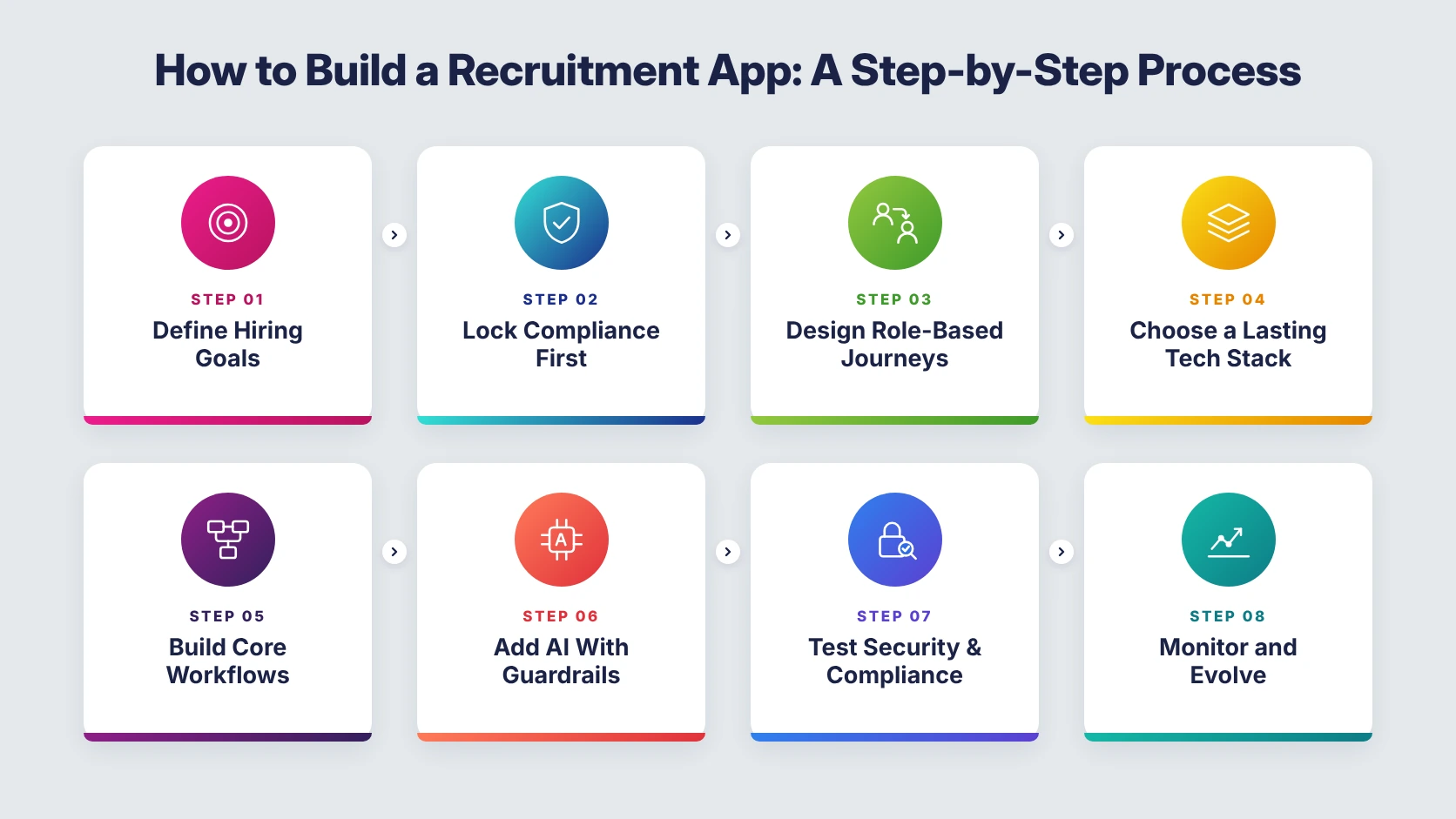
Step 1: Anchor the Platform to Hiring Outcomes and Accountability
Everything is starting with a simple question, what is this app supposed to fix? For some businesses it is filling critical regulated roles faster, for others it is staffing new projects quickly or being able to prove every hiring decision during an audit. We are also agreeing on how success will be measured, looking beyond just time-to-hire at things like how many candidates each recruiter can handle, how confident the compliance team feels and how complete the data is.
Step 2: Lock Compliance and Data Governance Before Design Begins
Before anyone is sketching a screen, we are mapping out exactly what candidate data is being collected, where it is travelling, who can see it and how long it is being kept. These answers are shaping the architecture, the hosting setup and the access rules right from day one, and some of the things we are always covering at this stage are:
- Keeping data and backups within Australia.
- Matching access levels to who is allowed to approve what.
- Being able to rebuild the full story of any hiring decision.
Sorting these out early is saving businesses from painful and costly changes once the app is already in the hands of recruiters.
Step 3: Design Role-Based Journeys That Reduce Friction Without Losing Control
Now the design work is beginning, and instead of one screen for everyone, each type of user is getting a journey that suits how they work.
| User | What Matters Most |
|---|---|
| Candidate | Quick applying, saved profile, clear updates |
| Recruiter | Easy pipeline view, shared notes, team scoring |
| Employer | Simple approvals, full visibility, compliance reports |
This step is deciding whether people will actually use the app, because if it is too complicated recruiters will find ways around it, and if it is too loose the leadership will lose the oversight they need.
Step 4: Select a Tech Stack That Supports Longevity, Not Just Launch
With the journeys mapped, we are choosing technology that is stable, secure and easy to connect with other systems, rather than whatever is trending this month. The recruitment app tech stack needs to handle busy hiring seasons, link smoothly with other platforms and adapt as rules are changing, without needing a rebuild a few years down the line.
| Layer | Recommended Choice |
|---|---|
| Mobile | React Native or Flutter |
| Backend | Node.js, Java or .NET |
| Data | PostgreSQL with secure file storage |
| AI | Custom ML models with explanation logs |
| Cloud | AWS or Azure Australian regions |
Step 5: Build Core Workflows Before Adding Intelligence
We are first building and testing the everyday parts of hiring, like receiving applications, moving candidates through stages, getting approvals and connecting to other systems. Adding AI on top of a shaky process is only making the problems bigger, so getting the foundation solid first is really important.
Step 6: Introduce Automation and AI With Clear Guardrails
Once the basics are running smoothly, we are adding automation wherever it is clearly saving time, such as booking interviews, ranking shortlists and matching candidates to roles. Every AI feature is coming with an explanation, an option for recruiters to override it and a record of what it did, and you can read more about how businesses are approaching this in our blog on the best AI automation platforms for enterprises.
Step 7: Validate the Platform Under Compliance and Security Scenarios
Testing is going far beyond checking whether the buttons work, we are testing who can access what, whether consent is being recorded properly, whether the audit trail is complete and how the system would respond to a data breach. The app is only going live once everyone is genuinely confident in it.
Step 8: Operate, Monitor, and Evolve
After launch, we are keeping a close watch on how people are using the app, how it is performing and whether it is still meeting the latest rules, and we are reviewing it regularly as the business is hiring in new places, at new volumes or for new types of roles.
Cost of Recruitment App Development in Australia
The recruitment mobile app development cost in Australia is generally falling somewhere between AUD 70,000 and AUD 700,000+, and where your project lands depends on how much it needs to do, how strict the compliance requirements are and how many systems it is connected with. A simple app might be solving one specific hiring problem, while an enterprise-grade platform is handling hiring across several companies, keeping everything audit-ready and governing its AI properly, so the gap in price is really about long-term ownership rather than how good the screens look. If you want a broader picture, our guide on how much it costs to build an app in Australia is covering this in detail.
There are a handful of things that are pushing the cost of recruitment app development up or down, and these are:
- How many HR, payroll and identity systems it needs to connect with.
- How much compliance, audit logging and data control is required.
- How advanced the AI is and how closely it needs to be monitored.
- The level of security and the local cloud setup needed.
- Ongoing improvements, support and keeping up with new regulations.
This is why two recruitment apps that look almost the same from the outside can still come with very different budgets.
Indicative Cost Breakdown
| Complexity Level | Typical Investment Range | Estimated Timeline |
|---|---|---|
| Basic | AUD 70,000–200,000 | 3–6 months |
| Mid-Range | AUD 200,000–400,000 | 6–9 months |
| Advanced / Enterprise Grade | AUD 400,000–700,000+ | 9–12+ months |
One thing worth remembering is that spending the most is not always getting you the most value, the apps that are really paying for themselves are the ones cutting down compliance headaches and reducing how much the business is spending on recruitment agencies.
Challenges in Recruitment App Development and How to Address Them
Most recruitment apps are not struggling because a feature is missing, they are struggling because of what happens once real users, real volume and real regulations are hitting the system. Here are the most common roadblocks we are seeing and how businesses are getting past them.
Integrating with Legacy HR Systems
Challenge: Many businesses are running HR, payroll and login systems that were added one after another over many years, and connecting a new app directly into that mix can be fragile and risky, especially as data volumes are growing.
Solution: Connect the new app through flexible APIs and a middleware layer, so it can be rolled out in stages without breaking the payroll, login or reporting systems the business is already relying on.
Addressing Skills Gaps and Recruiter Enablement
Challenge: Not every recruiter is equally comfortable with structured workflows, AI suggestions or data dashboards, and when the app is assuming they are, adoption is dropping and hiring quality is suffering.
Solution: Roll the app out with training made for each role, helpful tips built right into the screens and a gradual introduction of new features, so recruiters are growing confident without their current hiring being disrupted.
Ensuring Data Quality and Unbiased AI Models
Challenge: Messy candidate data and old hiring patterns that carry bias are making AI screening less accurate and quickly breaking people’s trust in it.
Solution: Make sure data is captured in a consistent format, keep people involved in reviewing AI suggestions and keep checking the AI’s results regularly, treating it as something that needs ongoing care rather than a one-off setup.
Driving Adoption Among Recruiters and Candidates
Challenge: Recruiters are pushing back when a new app is adding extra clicks during busy periods, and candidates are dropping off when they have no idea what is happening with their application.
Solution: Build workflows that are clearly making the recruiter’s day easier and show candidates/applicants exactly where they are in the process at every stage.
Data Privacy and Security
Challenge: Because a recruitment app is pulling so much personal data into one place, any breach, failed audit or internal misuse is becoming a much bigger problem.
Solution: Use strong encryption, give people access only to what their role needs, log every action in detail and have an incident response plan that has actually been tested and matches the rest of the business’s security approach.
Now that we know what to watch out for, let’s see what the recruitment software scene in Australia is looking like right now.
Real-World Examples of Recruitment Software in Australia
In Australia, recruitment technology is being shaped by practical needs like volume, compliance and speed, rather than flashy new features. The popular platforms are doing a great job of bringing candidates in, but once it is time to screen, approve and govern hiring decisions, most enterprises are adding their own systems on top, and these three examples are showing exactly that.
SEEK
SEEK is still the go-to job marketplace for most Australians, and it is especially popular with businesses hiring in large numbers for both permanent and contract roles. Enterprises are loving the reach and visibility it is giving them, but they are usually handing candidates over to their own systems when they need tighter control over the process.
Indeed
Indeed is mostly working as a big search engine for jobs, pulling listings from lots of different places into one simple search. Australian businesses are using it to bring more applicants in quickly, while the actual screening, compliance checks and approvals are happening inside their own ATS or custom platform.
Jora
Jora is really popular with small and medium businesses, particularly in fast-moving industries like retail and logistics where staff turnover is high. It is great for getting roles seen by a lot of people, but it is generally sitting outside the more controlled hiring process that larger enterprises are needing for audits and governance.
How DianApps Can Help Build AI-Powered Custom Recruitment Apps for Australia
With so much now riding on how a business hires, leaders are thinking much more carefully about who they are trusting to build their recruitment technology. It is no longer about finding someone to deliver an app and walk away, it is about finding a partner who understands hiring risks, compliance pressure and what it really takes to run a platform that is working at scale every single day.
This is exactly where DianApps is coming in, and we’ve got you covered. We are working with fast-growing startups and well-established enterprises to create recruitment software in Australia that is built around how hiring actually happens on the ground, focusing on solid governance, room to grow and results you can measure, rather than stuffing the app with features nobody will use.
DianApps has been building web, mobile and AI-powered products since 2017 for well-known names like Uber Eats, Freshworks, Khatabook and CaratLane. We have a local base in Mindarie, Western Australia, along with offices in the USA, Canada, the UAE and India, we are rated 4.8 on Clutch from more than 80 verified client reviews, and our engineering leadership has delivered over 250 AI and machine learning systems across different industries. Our teams are working hands-on with Flutter, React Native, Node.js, Python and cloud platforms like AWS and Azure, and we are treating every recruitment platform we build as a long-term asset for our client, not a short project to tick off.
Build a Recruitment App Made for Australian Hiring?
DianApps builds compliance-ready recruitment platforms with trusted AI and smooth HR integrations, which you fully own and can scale.
Hirenetix AI: A Recruitment App Development Case in Action
The Challenge: When Hirenetix AI approached us, their hiring process was eating up a lot of time and money. Recruiters were spending 5–10 minutes reading each resume, scoring a single candidate was taking anywhere from 30 to 60 minutes and was not always consistent, and every interview booking and follow-up was being handled manually, which was pushing costs higher and higher.
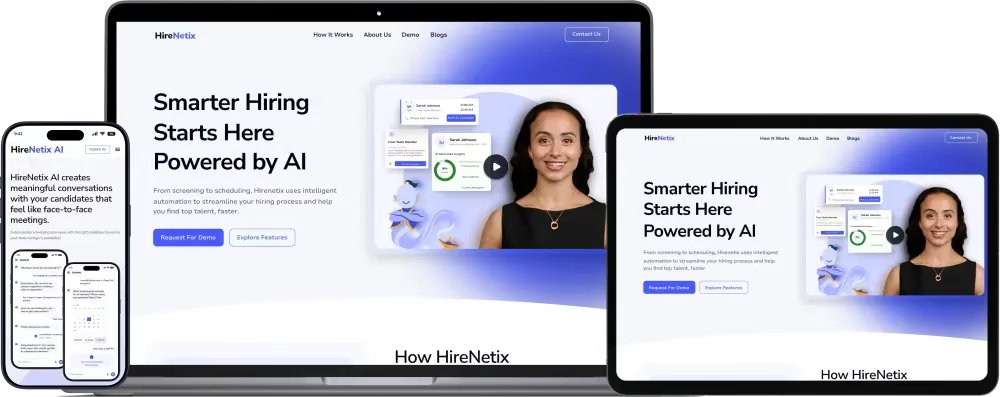
Our Solution: Our team built the complete Hirenetix AI hiring platform from the ground up, using Next.js for clean and responsive HR dashboards and candidate screens, Node.js for a strong and reliable backend and an AI engine powered by Python and Gemini APIs that is screening resumes, scoring candidates and supporting hiring decisions automatically. Today, posting jobs, shortlisting, scheduling interviews and tracking hiring insights in real-time are all happening from one simple dashboard.
The Result? Hirenetix AI has moved away from slow manual work to smart, automated hiring, resulting in:
- More than 5,000 recruiters actively using the platform every month.
- Time-to-hire cut down by 40%.
- Candidate scoring and ranking with up to 90% accuracy.
- Cost per hire brought down by up to 80%.
These numbers are showing that the platform is comfortably handling steady, high hiring volumes and giving fair, consistent results day after day, not just during a short burst of activity. You can check out the full Hirenetix AI case study.
At the end of the day, almost every business knows it needs to modernise its hiring, what really matters is whether the platform you build today will still be holding up when your hiring decisions are being looked at months from now, under pressure and at a much bigger scale. So, if you are planning to hire recruitment app developers in Australia, get in touch with DianApps and share your idea with us, our team will be with you from beginning until completion, taking ownership of the results, the risks and the long-term success of your platform just as much as you are.
 0 comments






Leave a Comment
Your email address will not be published. Required fields are marked *