















 0 comments





Key Takeaways:
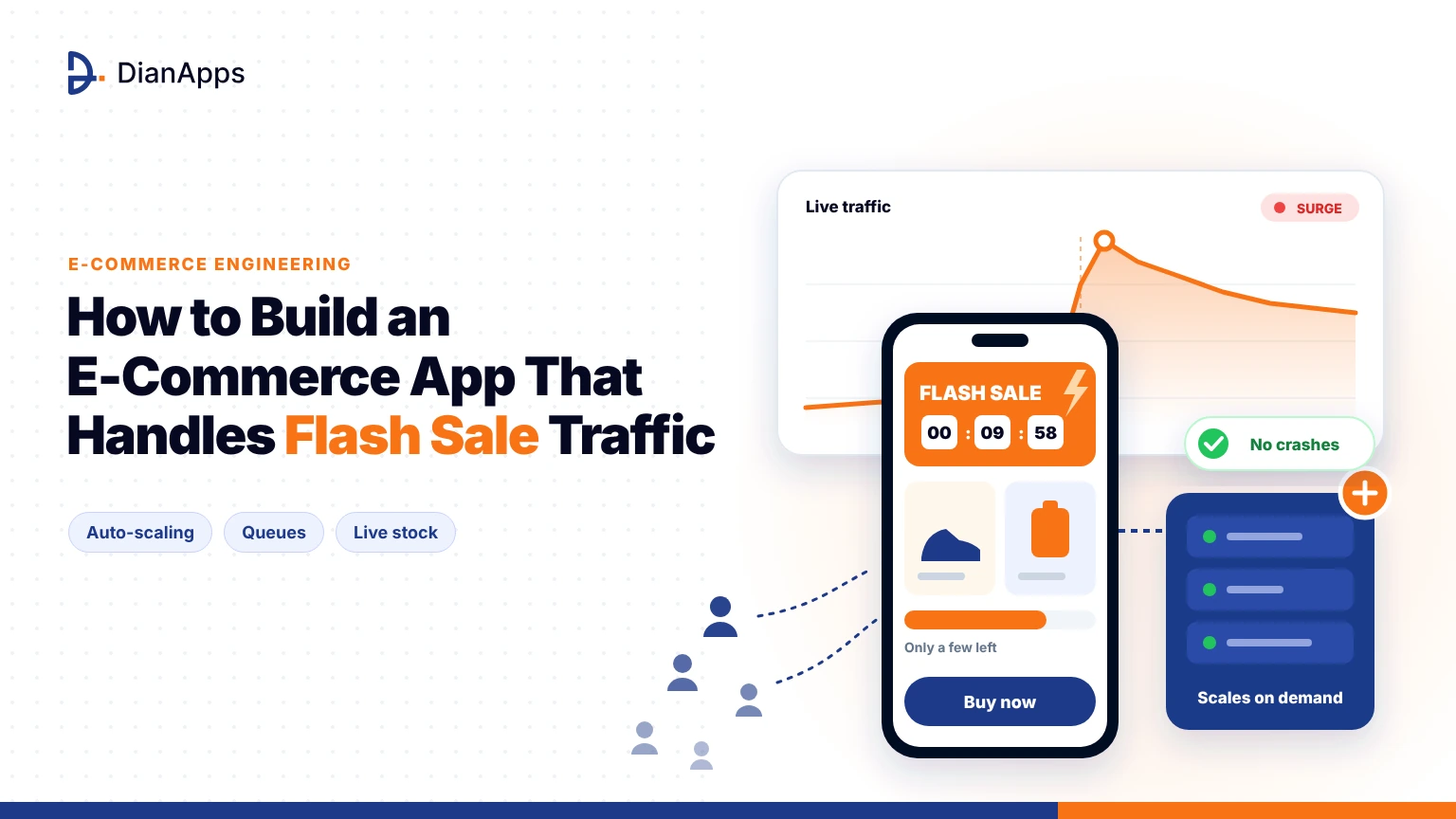
- Flash sale traffic hits mobile checkout APIs ten times harder than normal daily browsing within the first sixty seconds.
- Atomic inventory reservations in Redis prevent overselling stock when thousands of shoppers tap buy simultaneously.
- Adding a virtual waiting room protects your core database from crashing while keeping impatient shoppers informed.
- Realistic load testing before launch exposes hidden third party payment gateway bottlenecks before real money is on the line.
- Graceful degradation and idempotent payment webhooks keep orders accurate even when mobile networks wobble under heavy launch load.
Quick Answer: Building an ecommerce app for flash sales requires decoupling read heavy product browsing from checkout writes, using atomic Redis locks to prevent overselling, placing a virtual waiting room in front of traffic spikes, and running full scale load tests beforehand.
Watching a marketing campaign drive fifty thousand eager shoppers into your mobile app only for the checkout screen to freeze and throw timeout errors is every retail founder’s worst nightmare. Every second of sluggishness during a limited product drop costs real revenue and burns hard earned customer goodwill. As documented in Alhena AI, Amazon’s well known latency research showed that every 100 milliseconds of checkout delay could cost 1% in lost retail sales. Retailers investing in Mobile App Development Services now engineer every ecommerce app for flash sales around burst resilience rather than assuming normal cloud autoscaling will save them.
Why Normal Autoscaling Fails During Flash Sales
Standard cloud autoscaling rules typically watch CPU or memory metrics over sixty second intervals before provisioning fresh container nodes. During a hyped sneaker drop or holiday doorbuster, mobile traffic jumps twentyfold in under ten seconds, crushing databases long before new servers boot up.
- Cold container startups take sixty to ninety seconds while new pods download images, warm caches, and open database pools.
- Relational SQL databases can’t scale write capacity horizontally in seconds the way stateless web servers do.
- Retry storms happen automatically when impatient shoppers tap refresh repeatedly on stalled mobile checkout screens.
Preparing an ecommerce app for flash sales means pre warming capacity ahead of schedule and absorbing burst demand at the network edge.
How Do Ecommerce Apps Handle Flash Sale Traffic Spikes?
Cloud autoscaling alone often spins up new server instances too slowly when traffic jumps twentyfold in thirty seconds at midnight. Handling massive bursts means absorbing static product views at the edge while throttling database writes cleanly.
- Serve product images, descriptions, and countdown timers directly from a global CDN so origin servers stay quiet.
- Pre warm Kubernetes pods and database read replicas thirty minutes before any scheduled drop goes live.
- Isolate checkout and payment services from browsing APIs so heavy search traffic never stalls active buyers.
When teams focus on ecommerce app scalability early, they design stateless microservices that shed non essential features like personalized recommendations during peak five minute drops.
Why Do Apps Crash During Flash Sales?
Most mobile shopping outages don’t happen because the frontend app crashes on phones; they happen because downstream databases lock up under competing write requests. Understanding those failure points helps you eliminate fragile code paths before marketing launches the countdown.
- Synchronous database row locks stall hundreds of checkout threads waiting for the exact same SKU count.
- Uncached session lookups hammer primary SQL tables whenever thousands of shoppers refresh the home screen together.
- Third party shipping calculators or tax APIs time out under burst load and freeze mobile checkout spinners.
If you’re still evaluating choosing an ecommerce app development company, always ask how their engineers isolate third party API timeouts during high concurrency drops.
Prepare Your App for Peak Drops
Talk with our commerce architects about eliminating checkout bottlenecks before your next big launch.
Edge Caching and Static Product Page Delivery
During the five minutes leading up to a flash launch, tens of thousands of users sit inside your app staring at the exact same product screen and countdown timer. Serving those identical views from an origin database wastes precious compute cycles.
- Render product metadata, size charts, and high resolution media into immutable JSON payloads cached at CDN edge nodes.
- Synchronize countdown clocks using lightweight server time offsets instead of polling an API every second from every phone.
- Serve personalized wishlist or loyalty badges asynchronously so the core product screen never waits on slow user queries.
Offloading ninety five percent of read traffic to edge POPs keeps your primary application servers completely calm until actual buying starts.
How Do You Prevent Overselling Stock?
Selling five hundred units of a limited sneaker when your warehouse only holds three hundred creates a customer support disaster and costly refund fees. You need fast, atomic inventory accounting that reserves items cleanly for a short checkout window.
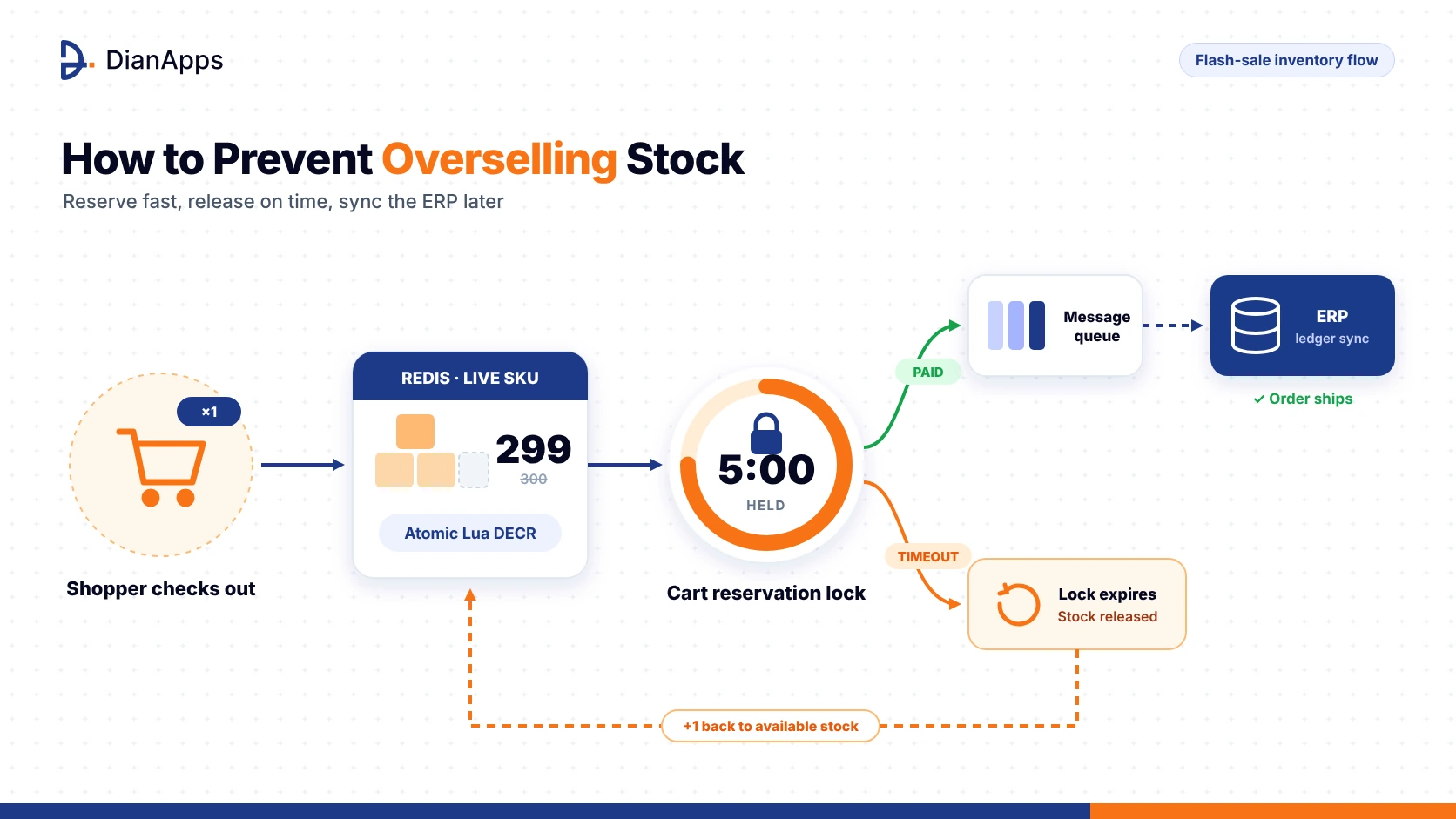
- Maintain live SKU counts inside an in memory Redis store using atomic Lua decrement scripts.
- Place a five minute cart reservation lock once a shopper enters checkout so stock stays held fairly.
- Automatically release expired cart locks back into available inventory if payment isn’t completed on time.
Writing inventory updates to a message queue before syncing your slower ERP ledger keeps checkout snappy. It protects your warehouse team from angry emails while ensuring every confirmed order actually ships.
Designing Asynchronous Checkout and Queue Architectures
Traditional monolithic checkouts run inventory checks, tax calculations, fraud scoring, and payment capture inside one long blocking HTTP request. Under flash sale pressure, one slow external call backs up worker threads across the entire cluster until everything crashes.
- Return an immediate pending order acknowledgment to the mobile app while background workers process tax and ledger writes.
- Use idempotency keys on every checkout tap so flaky cellular retries never charge a shopper’s credit card twice.
- Separate slow email receipt generation and warehouse pick ticket creation into asynchronous Kafka or SQS consumer queues.
Event driven checkout keeps mobile response times under two hundred milliseconds even while tens of thousands of orders settle concurrently.
What Is a Virtual Waiting Room?
A virtual waiting room acts like a polite digital velvet rope at the entrance of your mobile checkout when demand exceeds safe server capacity. Instead of letting every user crash the database simultaneously, the queue admits shoppers at a steady, predictable rate.
| Queue Strategy | Server Protection | Shopper Experience | Implementation Effort | Best Scenario |
|---|---|---|---|---|
| Edge FIFO queue | Very high protection | Clear wait timer | Moderate setup | Limited edition drops |
| Randomized lottery | Maximum fairness | Eliminates bot speed | Moderate setup | High hype releases |
| API rate throttling | Basic protection | Sudden error screens | Low setup | Internal admin APIs |
Edge queues give mobile shoppers an honest countdown position rather than a frozen loading wheel, which matches how ecommerce apps are shaping retail expectations today.
Stopping Sneaker Bots and Automated Scalper Traffic
High demand flash drops inevitably attract automated checkout bots that buy out entire product runs in three seconds before genuine human shoppers finish tapping Apple Pay. Unchecked bot traffic frustrates loyal community members and triggers social media backlash.
- Deploy device attestation checks using Apple App Attest and Google Play Integrity APIs on every checkout token request.
- Enforce per account, per shipping address, and per payment fingerprint purchase limits at the API gateway layer.
- Add invisible behavioral challenge signals or randomized drop entry windows so millisecond script speed stops guaranteeing wins.
Stopping bots at the edge preserves real inventory for genuine fans while cutting wasted server load by forty percent or more.
Graceful Degradation and Circuit Breakers Under Load
When external tax engines, loyalty points APIs, or shipping rate calculators slow down during a traffic surge, your mobile checkout shouldn’t die alongside them. Circuit breakers isolate failing dependencies automatically so core purchases still complete smoothly.
- Wrap every third party HTTP call in strict two second timeouts with automatic fallback flat rate shipping tables.
- Shed non critical features like live related product carousels or real time review sorting whenever database CPU crosses seventy percent.
- Cache precomputed regional tax rates locally inside checkout workers so external tax outages never stall payment capture.
Designing clear fallback paths guarantees your cash register keeps ringing even if minor supporting services stumble mid drop.
Mobile App Client Resilience and Retry Logic
Even a rock solid cloud backend looks broken if the mobile client handles slow network responses clumsily or locks UI buttons permanently after one timeout. Careful client side engineering keeps shoppers calm during brief cellular hiccups.
- Disable checkout submit buttons immediately after one tap while displaying clear progress states instead of letting users double submit.
- Use exponential backoff with jitter on read retries so fifty thousand phones don’t hammer your API simultaneously after brief blips.
- Preload Apple Pay, Google Pay, and saved shipping addresses right on the product screen to shave ten seconds off checkout.
Smooth mobile client ergonomics turn impatient drop participants into completed orders before inventory runs out.
Database Connection Pooling and Read Replica Tuning
Opening five thousand fresh TCP connections directly to PostgreSQL or MySQL during a sudden spike exhausts database memory immediately and brings every query to a grinding halt. Proper connection pooling protects your primary data store from memory exhaustion during sudden traffic spikes.
- Place PgBouncer or RDS Proxy directly in front of relational databases to multiplex thousands of worker requests safely.
- Route catalog browsing, order history, and search queries strictly to read replicas while keeping the primary node for writes.
- Remove expensive SQL joins and N plus one queries from hot checkout endpoints weeks before marketing announces the sale.
Clean connection management lets modest database clusters handle massive burst throughput without hitting max connection errors.
Payment Gateway Limits and Webhook Idempotency
Many retail teams scale their own cloud servers flawlessly only to discover their payment processor rate limits API keys during sudden volume spikes. Coordinating with payment partners and hardening webhook handlers prevents messy order reconciliation headaches.
- Notify Stripe, Adyen, or Razorpay account managers of expected peak transactions per second two weeks before major launches.
- Configure multi gateway failover routing so sudden processor degradation shifts new checkouts automatically to a backup acquirer.
- Make payment confirmation webhooks strictly idempotent so duplicate gateway callbacks never ship two boxes or double deduct loyalty points.
Testing payment edge cases carefully protects revenue accuracy when thousands of transactions settle within minutes.
How Do You Load Test an App Before a Big Sale?
Guessing how your mobile backend will behave under ten thousand concurrent buyers is a recipe for an embarrassing outage. Thorough load testing ecommerce app infrastructure simulates realistic user journeys from browsing right through final payment webhooks.
- Replay recorded production traffic patterns using k6 or Locust at triple your expected peak concurrency.
- Mock payment gateway webhooks with realistic three second delays to verify mobile retry logic holds steady.
- Monitor database connection pools, CPU saturation, and Redis memory usage in real time during every stress run.
Partnering with a dedicated ecommerce mobile app development squad ensures those bottleneck fixes get deployed and retested weeks before your campaign goes live.
Load Test Your Commerce App Now
Schedule a pre sale architecture and stress testing sprint with our mobile commerce engineers.
Push Notification Throttling Without Crashing Servers
Sending a flash sale launch alert to two million mobile phones at the exact same second creates a self inflicted denial of service attack as everyone opens the app together. Smart notification pacing smooths incoming traffic entry cleanly across mobile regions before checkout gates open.
- Stagger push notification batches in ten percent waves spaced two minutes apart ahead of the drop window.
- Deep link promotional notifications directly to edge cached product preview screens rather than heavy home feed APIs.
- Suppress redundant back in stock alerts automatically once Redis inventory counts drop below five percent remaining.
Controlled notification delivery turns sudden server shockwaves into steady, manageable waves of ready buyers.
Post Sale Reconciliation and Abandoned Cart Recovery
Once the five minute flash sale frenzy settles, finance and operations teams still need clean order records and smart follow ups for shoppers who missed out. Automated reconciliation prevents inventory mismatches from lingering across your warehouse systems and customer support queues after peak demand ends.
- Reconcile Redis reservation logs against settled payment gateway captures fifteen minutes after the sale closes.
- Release any orphaned inventory locks automatically and notify waitlisted shoppers via targeted back in stock alerts.
- Review drop off telemetry across waiting room queues, payment screens, and OTP steps to improve your next launch.
Clean post sale workflows recapture leftover demand while keeping warehouse inventory counts completely accurate for everyday orders.
Real Time Launch Day War Room Monitoring
Once the flash sale countdown hits zero, engineering teams need instant visibility into checkout funnels rather than waiting for angry customer tweets to spot broken flows. A focused real time observability dashboard keeps launch day engineering decisions calm, accurate, and fast.
- Track real time cart lock conversion rates, payment success percentages, and P99 API latency on one shared screen.
- Set automated Slack or PagerDuty alerts whenever HTTP 5xx error rates cross zero point five percent over thirty seconds.
- Keep pre approved feature flags ready so engineers can throttle queue admission rates or disable heavy widgets in two clicks.
Proactive launch day telemetry lets your team tune traffic flow smoothly in real time while sales pour in.
Final Thoughts
Engineering an ecommerce app to survive flash sale traffic comes down to respecting database limits, isolating slow dependencies, and planning for sudden bursts long before marketing emails go out. With edge caching, atomic Redis stock locks, bot defenses, and honest queue visibility, your store can convert massive spikes smoothly without crashing.
 0 comments










Your email address will not be published. Required fields are marked *