













 0 comments





Key Takeaways:
- AWS Professional Services (ProServe) is AWS’s in-house consulting team for enterprise cloud projects.
- ProServe supports migrations, modernization, architecture design, and technical enablement.
- AWS often refers mid-sized projects, application development, and ongoing operations to independent partners.
- ProServe pricing depends on project scope, team size, duration, geography, and available AWS funding.
- Large projects can combine ProServe for strategy and architecture with a partner for delivery and ongoing operations.
Quick Answer: AWS Professional Services, also called ProServe, is Amazon’s in-house consulting team that helps businesses plan, migrate, and modernize workloads on AWS. It is generally suited to large, strategic enterprise projects that need deep AWS expertise. An AWS partner may be a better fit for mid-sized projects, application development, faster delivery, or ongoing managed services. For large engagements, both can work together, with ProServe handling strategy and architecture while the partner manages implementation and operations.
The first time most people hear about AWS professional services is on a call with their account manager, somewhere between a migration estimate and a spend commitment. The name sounds like a support tier, and it isn’t, which is where the confusion begins. ProServe is AWS’s own consulting arm, staffed by AWS employees, and it sits in an odd relationship with the thousands of firms offering AWS consulting services through the partner network, sometimes competing with them and sometimes handing them work.
Our team has been on both sides, working next to ProServe on a program and later being the partner they referred a customer to, so this is written from both chairs. It covers what ProServe does, how the money actually works, when AWS will tell you to go elsewhere, and what it looks like when both teams end up on the same project.
What AWS Professional Services Actually Is
AWS Professional Services is a consulting organization inside Amazon Web Services, not something you enable from the console or buy by the hour on a pricing page. It exists to get large customers onto AWS faster, and being precise about that purpose saves you a lot of mismatched expectations.
- AWS Employees: The consultants, architects, and delivery managers work for Amazon, which colors their incentives in ways this article comes back to.
- Enterprise Focus: Engagements are built around sizable migrations and strategic workloads, not a startup’s first VPC or a side project.
- Advisory Plus Delivery: Teams can assess and design, and build, though the build portion is often shared with a partner or handed off entirely.
- Tied To The Account Team: You reach ProServe through your account manager, and that relationship shapes how every engagement gets scoped.
If your company is small, you may never meet ProServe at all, and that’s a capacity decision rather than a snub.
What ProServe does on a typical engagement
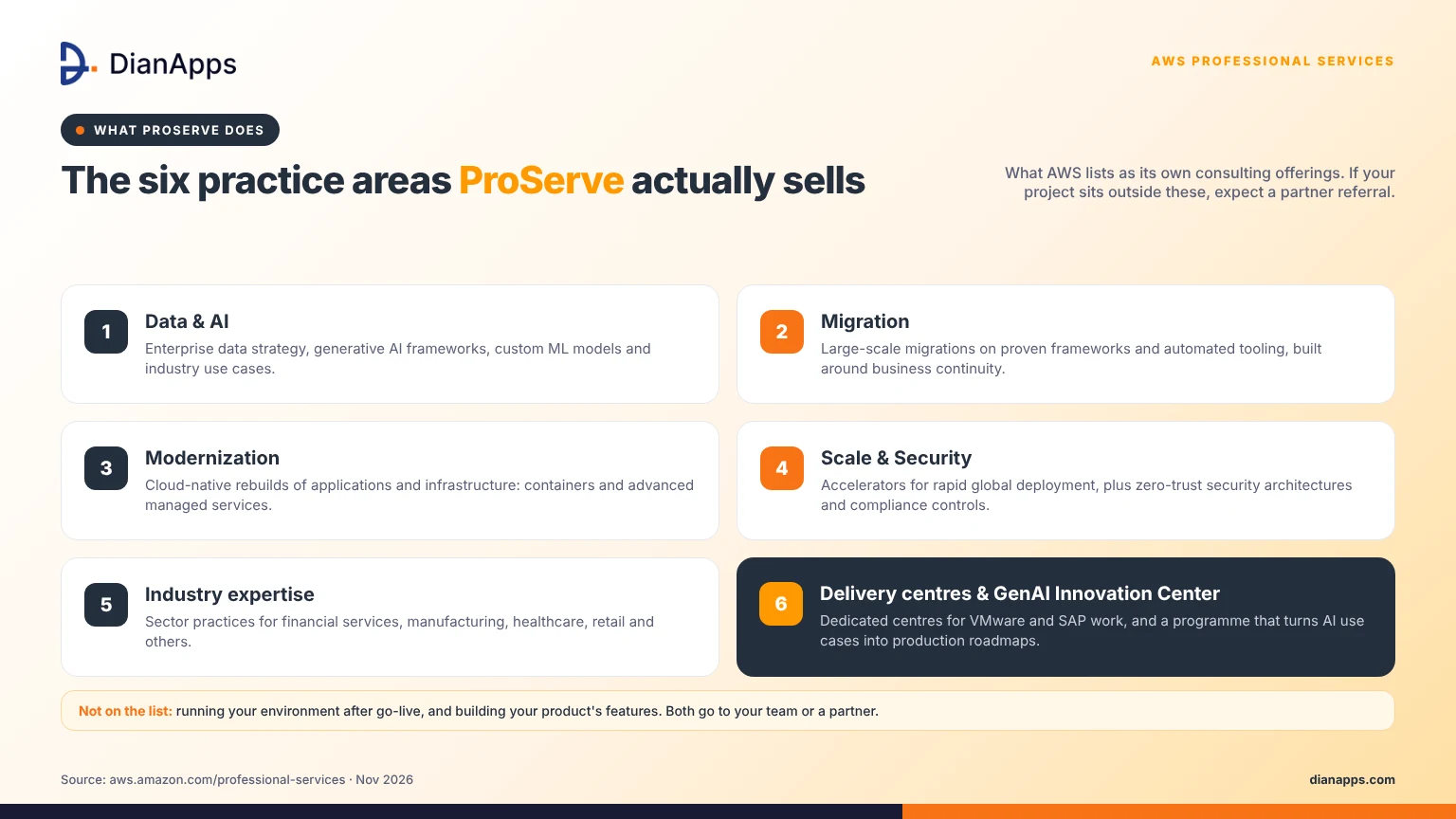
What ProServe does varies a lot by account, but a few patterns show up again and again. On a migration, they usually run or support the Migration Acceleration Program phases, starting with an assessment that inventories workloads and builds the business case your CFO wants. On a modernization, they design target architectures, stand up a landing zone, and build a couple of reference implementations your engineers are meant to copy.
A surprising amount of the time goes into enablement, meaning workshops, immersion days, and pairing sessions, so the knowledge stays when the consultants leave. What they don’t do is run your environment afterwards, since ProServe isn’t a managed services provider and has no interest in becoming one. We’ve seen a customer discover that in the week the consultants rolled off, the on-call rota suddenly had no names on it. ProServe gets you to a working pattern, and from there it’s your problem or a partner’s.
How AWS ProServe Engagements Get Started
There’s no form to fill out, because the process begins with your account team and a conversation about what you’re trying to accomplish. Knowing the order of events helps you avoid losing a quarter to meetings that go nowhere.
- Account Conversation: Your account manager and solutions architect qualify the opportunity, mostly against your spend and how strategic the workload looks to AWS.
- Scoping Workshop: A ProServe engagement manager comes in to define outcomes, timeline, and which pieces AWS does versus what you do.
- Statement of Work: A formal document with phases, deliverables, and pricing that your procurement team and AWS legal both pick over.
- Funding Discussion: Credits, program money, or a spend commitment may offset part of the bill, which the next section gets into.
If you haven’t run this kind of engagement before, cloud consulting services explained covers the generic version, and ProServe follows the same shape with considerably more paperwork.
AWS ProServe Cost: How Pricing Really Works
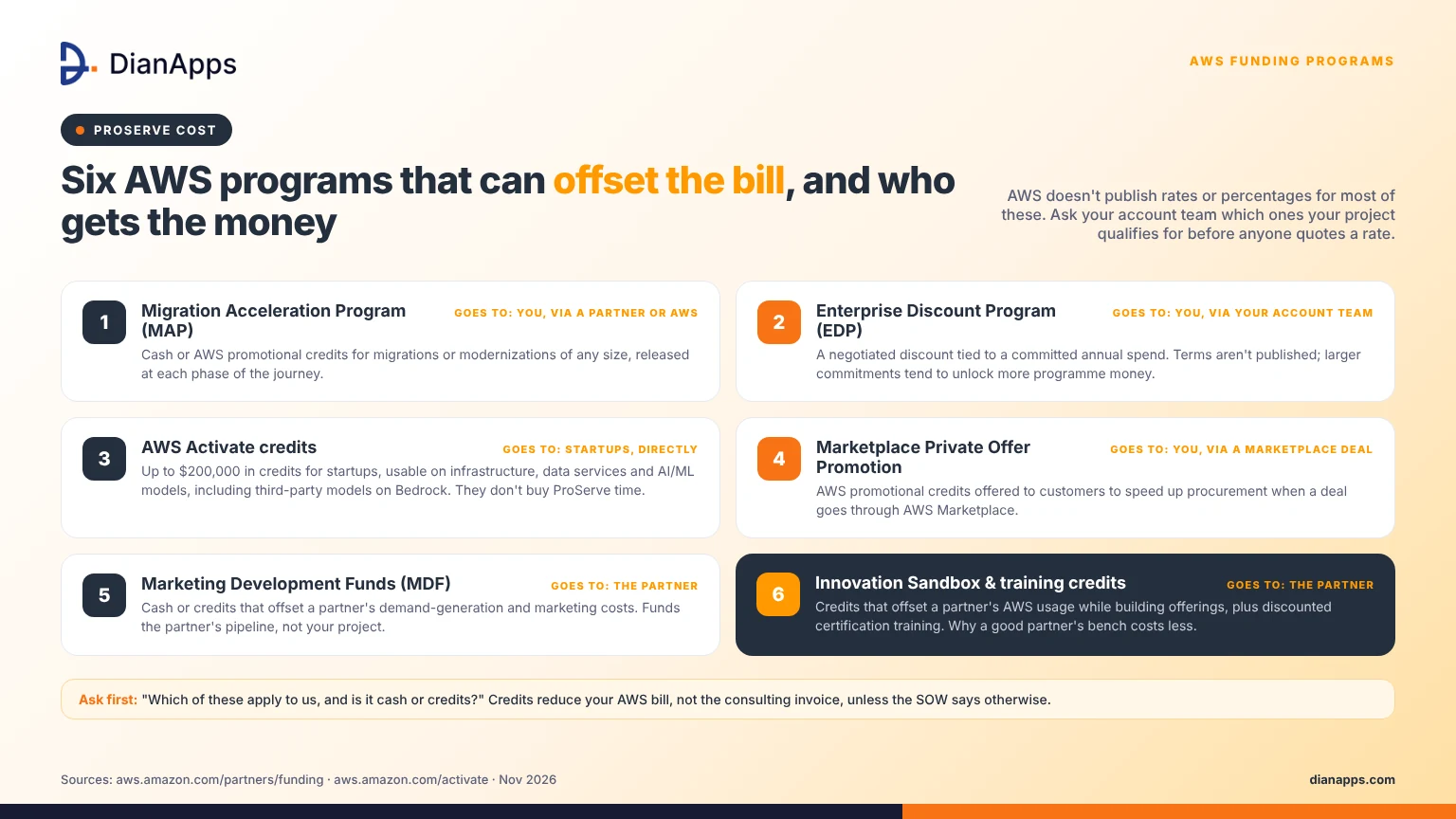
AWS doesn’t publish ProServe rates, so anyone quoting you a confident hourly figure is either guessing or remembering one particular deal. What we can say from our own engagements is that pricing comes as statements of work, either time and materials with a cap or fixed scope against defined deliverables, and the totals are enterprise-sized. A short assessment can be a relatively modest sum, while a multiphase migration program lands well into six figures and sometimes a good way past that.
The pricing conversation never happens on its own, because it sits beside your overall AWS spend, any Enterprise Discount Program you’re negotiating, and funding from programs like the Migration Acceleration Program. That’s the reason two customers with near-identical projects can see very different AWS ProServe cost numbers. One more thing startups ask about constantly: AWS Activate credits for startups cover usage, not consulting, so those credits won’t buy ProServe time even when they make the infrastructure itself close to free.
What Drives The Final ProServe Price
With no public rate card, the useful thing is knowing which levers move the number, since those are also the levers you can push back on. Most of them are about scope and commitment rather than the rate itself.
- Spend Commitment: A larger committed annual spend tends to unlock program funding that quietly offsets part of the services bill.
- Scope Shape: Assessment and design cost less than hands-on build, and build costs less when your own engineers carry most of it.
- Duration and Team Size: Three people for twelve weeks and eight people for nine months are different conversations entirely.
- Partner Split: When ProServe hands delivery to a partner, the AWS portion shrinks and a partner invoice shows up in its place.
- Geography: Where the consultants sit and how much on-site presence you expect both change the quote.
The practical move is asking your account team which programs your project qualifies for before anyone says a rate out loud.
Unsure whether ProServe fits your budget?
We’ll help you read the quote and compare it against partner options.
When AWS Refers You To A Partner Instead
AWS will often tell you to use a partner, and that still catches people off guard because it sounds like being turned away. It isn’t, really. ProServe has limited capacity and is aimed at the largest accounts and the most strategic workloads, so if your project is mid-sized or your spend is modest, the account team sends you to the partner network. They’ll also refer you when the work is ongoing operations, which ProServe doesn’t do, or when the project needs industry knowledge that a specialized partner has, and a generalist AWS team simply lacks. Application development is another common trigger, as ProServe builds cloud foundations and not your product’s features.
Sometimes the referral is about money, since a partner can run the same migration for less when the customer isn’t big enough to attract program funding. To judge who you get referred to, AWS partner competencies explained separates the badges that mean something from the ones that are mostly decoration.
AWS Professional Services vs Partner: Side By Side
The table below is deliberately blunt, because the nuanced version takes the whole article and most readers want this part first. Adjust it for your own situation, and remember that a top-tier partner and a four-person boutique aren’t the same animal either.
| Dimension | AWS professional services (ProServe) | AWS partner |
| Who does the work | AWS employees | Independent consultancy in the APN |
| Best suited for | Large migrations, strategic workloads, enterprise accounts | Mid-market projects, apps, ongoing ops, niche industries |
| Pricing model | Statement of work, often offset by AWS programs | Statement of work, rate card, more negotiable |
| Typical cost level | Enterprise-sized, rarely below six figures for build | Wide range, from small sprints to large programs |
| Ongoing operations | Not offered | Commonly offered as managed services |
| Application development | Limited, foundations focused | Core strength for many partners |
| Access to AWS internals | Direct, including service teams and roadmaps | Through partner channels, slower |
| Vendor neutrality | None, it’s AWS | Varies, some are multi-cloud |
| Engagement start | Via account team, longer lead time | Direct, often within weeks |
ProServe wins on AWS depth and partners win on flexibility, and the AWS professional services vs partner question mostly comes down to which of those you’re short on.
Where A Partner Usually Beats ProServe
On plenty of projects, a partner is the better pick even with ProServe sitting right there, and that’s not contrarianism on our part. The advantages cluster around how fast you can start and what happens once the build is done.
- Faster Start: A partner can scope and staff a project in weeks, while ProServe lead times stretch with account qualification.
- Full Lifecycle: Many partners design, build, and then run the thing, so you aren’t rebidding operations six months later.
- Application Work: If the project is a product rather than just a platform, partners with software teams are the realistic option.
- Pricing Room: Partners negotiate on rates and shape, and the smaller engagements ProServe won’t touch are their everyday work.
- Honest Tradeoffs: A good partner will say when a managed AWS service is overkill, which is an awkward thing for AWS to say.
When a partner shows you a design, ask them to map it against the AWS reference architectures for your workload, since that reveals quickly whether they’re following proven patterns or improvising on your dime.
Where ProServe Usually Beats A Partner
Some things only ProServe can do, and it’s better to say so plainly than pretend partners cover everything. Access is the big one, because ProServe consultants can pull in AWS service teams, see roadmaps, and escalate issues in ways no partner can match. On a new service, or a workload pushing a service past its documented limits, that access can be the difference between shipping and waiting a quarter for a feature. ProServe also carries weight inside your own company, as an AWS logo on the statement of work calms boards and procurement committees in a way a partner logo sometimes doesn’t.
Funding is the other lever, since ProServe work can be bundled with spend commitments and program credits that cut the effective price for large accounts by a lot. And for truly enormous migrations, thousands of servers across many business units, ProServe has run that playbook repeatedly and arrives with tooling partners would have to assemble. If that’s your scale, the AWS ProServe conversation is worth having, whatever else you decide.
Need a partner that works well with ProServe?
We’ve delivered alongside AWS teams and know where the handoffs break.
The Combined Engagement Model: ProServe And A Partner Together
What most large customers actually end up with is both, and AWS encourages that openly rather than treating it as a compromise. In the combined engagement model, ProServe owns strategy, foundation design, and anything needing AWS internal access, while a partner owns most of the hands-on delivery and everything that comes after.
- ProServe Leads Design: Target architecture, migration strategy, and the landing zone pattern come from AWS, with the partner present and taking notes.
- Partner Builds and Migrates: Wave planning, application refactoring, data moves, and testing are partner work, billed at partner rates.
- Shared Governance: One steering committee, one risk register and one milestone list, because two of each is how these programs stall.
- Partner Stays On: Operations, support, and future feature work continue with the partner after ProServe rolls off the account.
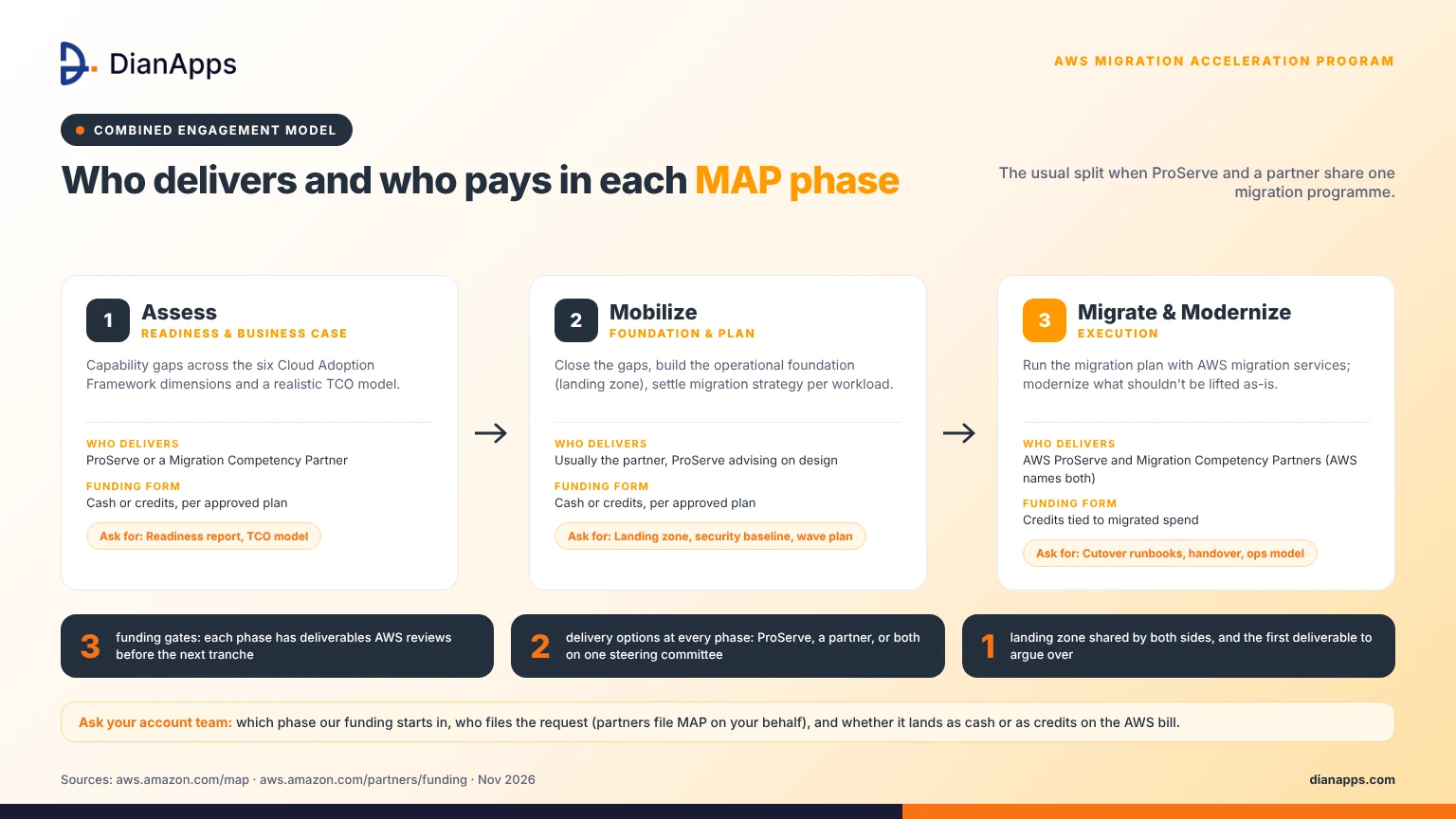
The landing zone is nearly always the first shared deliverable, and AWS landing zone and Control Tower explains why both sides fuss over that foundation before a single workload moves.
Questions To Ask Before Choosing Between Them
Instead of deciding on reputation, put a few questions to your account team and to any partner you’re weighing. The answers tell you about fit faster than any proposal deck will.
- Who Runs It Afterwards: If the answer is “you,” check whether your team is honestly ready, because ProServe will assume it is.
- What Funding Applies: Ask which programs your project qualifies for, since that can move the AWS ProServe cost by a wide margin.
- Where’s The Application Work: If features and user-facing software are in scope, ProServe isn’t the delivery team for that part.
- What Are The Lead Times: A six-week wait to start may be fine, or it may quietly kill a launch date.
- Which Regions And Rules Apply: Data residency shapes architecture early, and AWS regions and availability zones cover what both sides will assume you already know.
Write the answers down somewhere you’ll find them, because you’ll be checking them against a statement of work in a month.
How to decide, more or less
The rough version we give clients goes like this: use ProServe when the project is large, strategic and deep inside AWS, use a partner when it’s bounded or application-heavy or needs someone around afterwards; and use both when it’s all of those at once. That rule has holes, and we’ve worked with mid-sized companies with strange workloads where ProServe made complete sense, just as we’ve seen enormous migrations a strong partner ran end to end without an AWS consultant in sight. What the rule does get right is incentives. ProServe’s job is to make you successful on AWS specifically, which lines up with your goals most of the time but not every time, while a good partner’s job is to make your project succeed, and that occasionally means arguing against the shiniest service in the catalog. Decide which incentive you want in the room, and most of the choice makes itself.
Ready to scope your AWS project?
Tell us what you’re building, and we’ll map the right engagement model.
Final Thoughts
AWS professional services is a real consulting organization with real strengths, and it’s also a scarce resource that AWS aims at its largest and most strategic customers. For everyone else, and frequently for those customers as well, the partner network does most of the building, and AWS is comfortable admitting that.
The helpful frame isn’t ProServe versus partner as a rivalry; it’s knowing what each was built to do and matching that to your project’s shape, your budget, and whoever has to be awake at 3 am once the consultants are gone. Ask about funding before rates, ask who owns operations before you sign, and treat the combined engagement model as the normal setup for large work rather than a special case.
DianApps, a mobile and AI app development company, has delivered both alongside ProServe and in its place, and the projects that went smoothly were the ones where somebody made that decision on purpose instead of by whoever called first.
 0 comments












Your email address will not be published. Required fields are marked *