













 0 comments





Key Takeaways:
- Include company context, scope, technical requirements, security, qualifications, pricing, and timelines in your RFP.
- Define AWS workloads, deliverables, exclusions, and measurable project outcomes before requesting proposals.
- Evaluate vendors on architecture, experience, team credentials, security, pricing, and project management.
- Use weighted scoring and independent evaluations to compare proposals consistently.
- Include clear sample clauses for scope, security, staffing, and pricing to avoid misunderstandings.
Quick Answer: An AWS consulting RFP should include seven core sections: company background, scope of work, technical requirements, security and compliance, vendor qualifications, pricing, and project timelines. Evaluate proposals using weighted criteria, such as technical approach (30%), experience (20%), team qualifications (15%), security (15%), pricing (15%), and project management (5%). Provide reusable clauses, clear submission instructions, and a consistent scoring process to receive comparable proposals and select the right AWS consulting partner.
We have seen both sides of AWS procurement, writing the request and answering it, and the pattern is boringly consistent. Buyers who skip the AWS consulting RFP template stage end up with a vague statement of work and a budget that quietly doubles by month four. A structured request makes every bidder answer the same questions in the same order, so you’re comparing architectures and real prices instead of whoever had the nicest deck.
This guide covers each section your request for proposal needs, the scoring criteria that stop one loud evaluator from deciding everything, and sample clauses you can paste in, and also covers what to look for when evaluating AWS Consulting Services, from cloud migration and infrastructure modernization to ongoing optimization and managed support. If you’ve never written a cloud consulting RFP or cloud services RFP template, read it top to bottom, and if you have, treat it as a checklist you’ll probably argue with in places.
What An AWS Consulting RFP Template Actually Has To Do
A request for proposal isn’t paperwork for its own sake; it’s the thing that decides how your AWS engagement gets priced and who shows up to do it. Before you write a word of it, I’d get clear on what the cloud consulting RFP owes your evaluation committee.
- Comparable Responses: Every vendor answers identical questions in identical order, which is the only way scoring stays honest across proposals.
- Scope Clarity: Bidders know which AWS workloads and accounts sit inside the engagement, and which ones you’ve deliberately left out.
- Risk Visibility: Compliance and data residency expectations appear upfront instead of surfacing during contract negotiation when nobody wants to reopen pricing.
- Pricing Transparency: Rate cards and exclusions arrive in a format you can line up side by side without a spreadsheet rebuild.
Get those four into the AWS RFP document and the proposals that come back are easier to score and, frankly, harder for vendors to pad.
RFP Section 1: Company Background And Project Context
Vendors can’t propose a sensible AWS architecture if they don’t know what your business does, what’s already running, and why this project exists now rather than next year. Half a page is plenty for this part of the AWS consulting proposal request.
- Business Overview: Industry, size, and any regulatory frameworks that dictate how your workloads are allowed to run.
- Current Environment: Existing AWS accounts, on-premises systems, databases, and your rough monthly cloud bill, even if that number embarrasses you.
- Project Trigger: The thing forcing the engagement, whether that’s a data center lease ending, a cost review, or a product launch.
- Desired Outcomes: Three to five measurable results, such as cutting compute spend 30 percent within twelve months.
If you’ve never hired a cloud partner before, I’d read cloud consulting services explained first, because knowing what an engagement usually includes makes this context section much less awkward to write.
RFP Section 2: Scope Of Work And AWS Services In Play
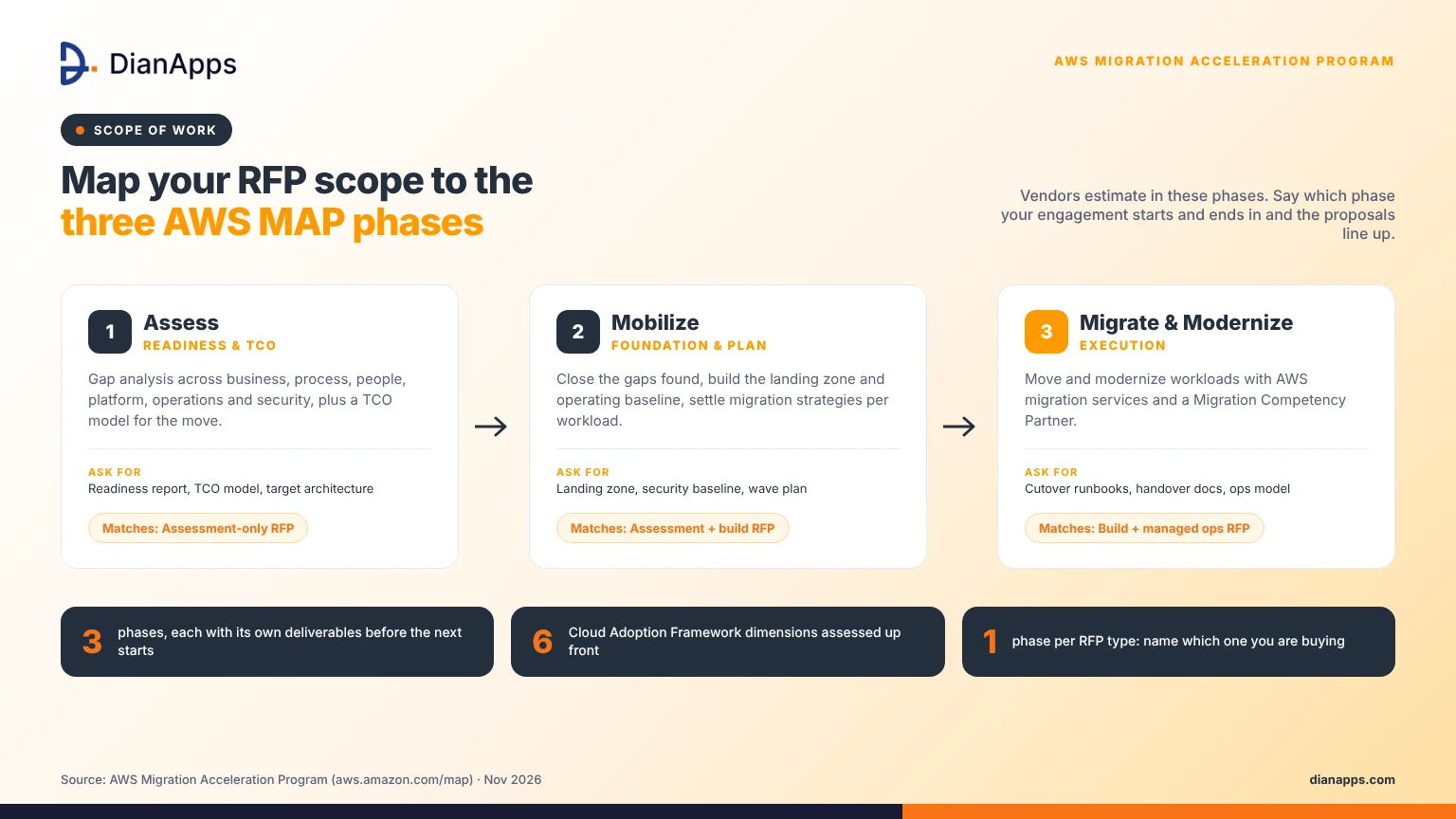
Scope is where most aws migration RFP or consulting RFPs fall apart, and they fail in one of two directions. Some buyers list every service AWS sells; others describe nothing specific at all, and both produce proposals that are guesses dressed up as estimates. A usable scope names the workloads involved, the AWS services you expect, and the deliverables due at each phase. If you’re moving a monolith to containers, say whether you lean toward Amazon ECS, Amazon EKS, or serverless, or say plainly that you want the vendor to recommend one. State whether the engagement is assessment only, assessment plus build, or build plus managed operations after going live.
Our rough test is that a competent vendor should estimate effort within 20 percent from the document alone, without a single clarification call. List exclusions too, because excluded items are where change orders come from, and a tight scope of work for AWS consulting is the main thing stopping a six-month project from becoming a fourteen-month one.
RFP Section 3: Technical Requirements And Architecture Expectations
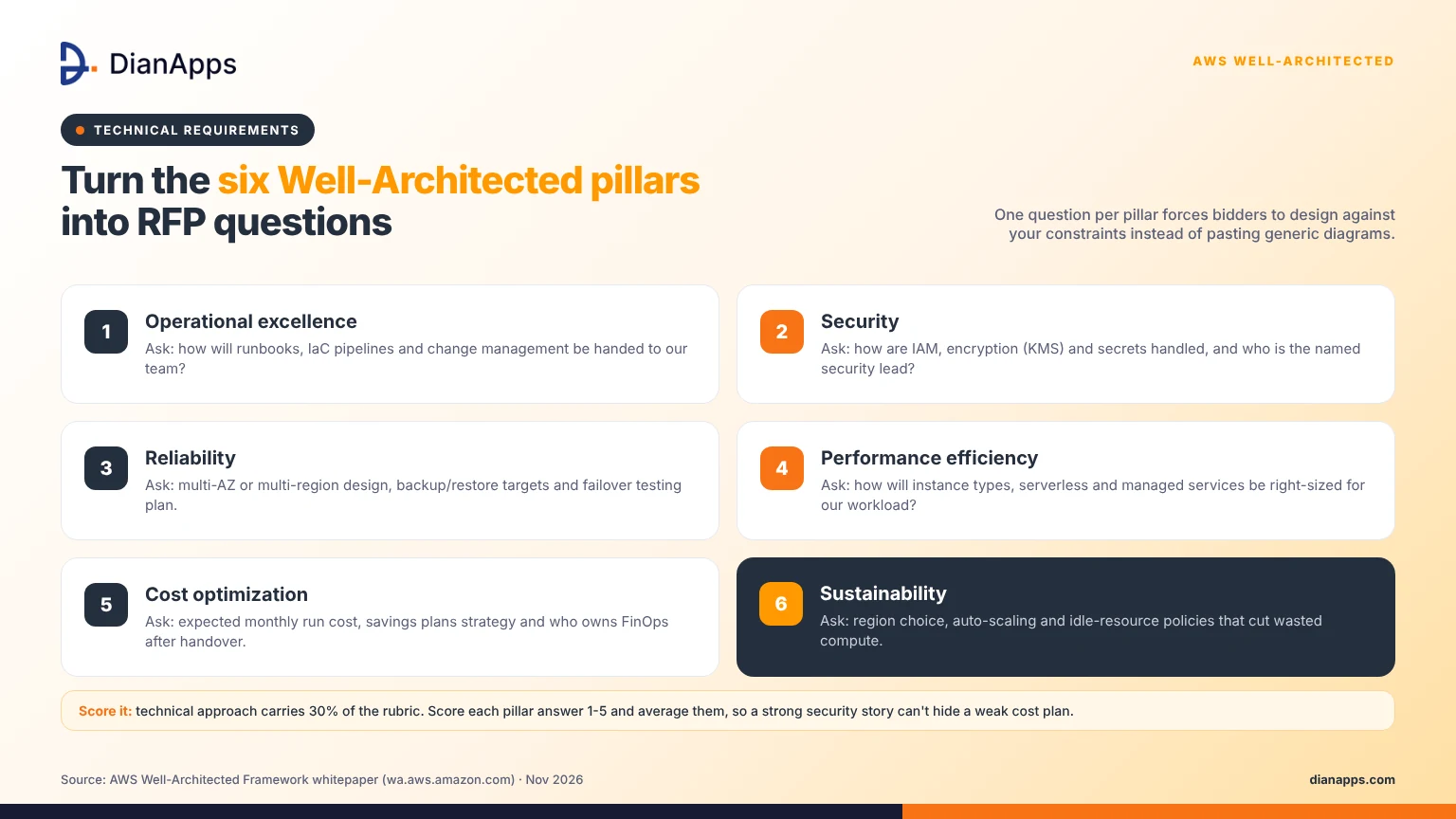
This section tells bidders how you want things designed, not just what you want built, and the distinction matters more than it sounds. Technical requirements in an AWS RFP work best as constraints and standards rather than a parts list.
- Architecture standards: Alignment with the AWS Well-Architected Framework pillars, with reliability, security, and cost optimization weighted most heavily.
- Infrastructure as code: Whether Terraform, AWS CloudFormation, or AWS CDK is required, and who owns those repositories once the vendor leaves.
- Environment strategy: Separate development, staging and production accounts under AWS Organizations, unless you have a reason not to.
- Observability: Logging and alerting through Amazon CloudWatch, or through a third-party tool your operations team already trusts.
- AI and data workloads: Any plans for Amazon SageMaker or Amazon Bedrock that the architecture needs room for later.
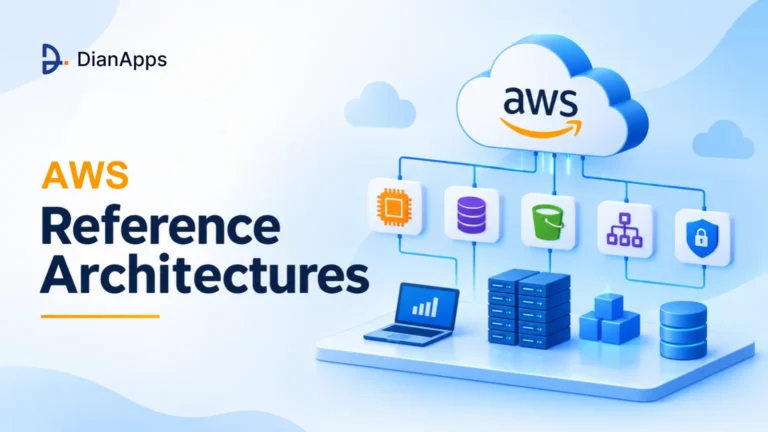
Instead of describing a target design from scratch, I’d point bidders at the AWS reference architectures closest to your workload, since shared vocabulary cuts clarification rounds and makes proposals easier to compare.
RFP Section 4: Security, Compliance And Data Residency
Security gets its own section because it’s the item vendors underquote most often, and they underquote it precisely when your expectations are vague. Name every framework that applies, whether that’s SOC 2, HIPAA, PCI DSS, GDPR, or ISO 27001, and state which AWS regions your data is legally allowed to live in. Ask bidders to explain their approach to AWS IAM, to encryption at rest and in transit, and to secret handling, in their own words rather than yours.
Require a named security lead on their side and ask how they’ll document controls for your auditors, because “we follow best practices” isn’t an answer. An AWS consulting RFP that skips compliance detail will attract proposals that look cheap and cost a fortune to remediate, and I’ve watched that happen more than once. Ask about incident response during the engagement as well, including who gets notified and how fast. Data residency matters even more when you serve customers across several jurisdictions, so name the regions yourself instead of hoping the vendor asks.
RFP Section 5: Vendor Qualifications And AWS Partner Credentials
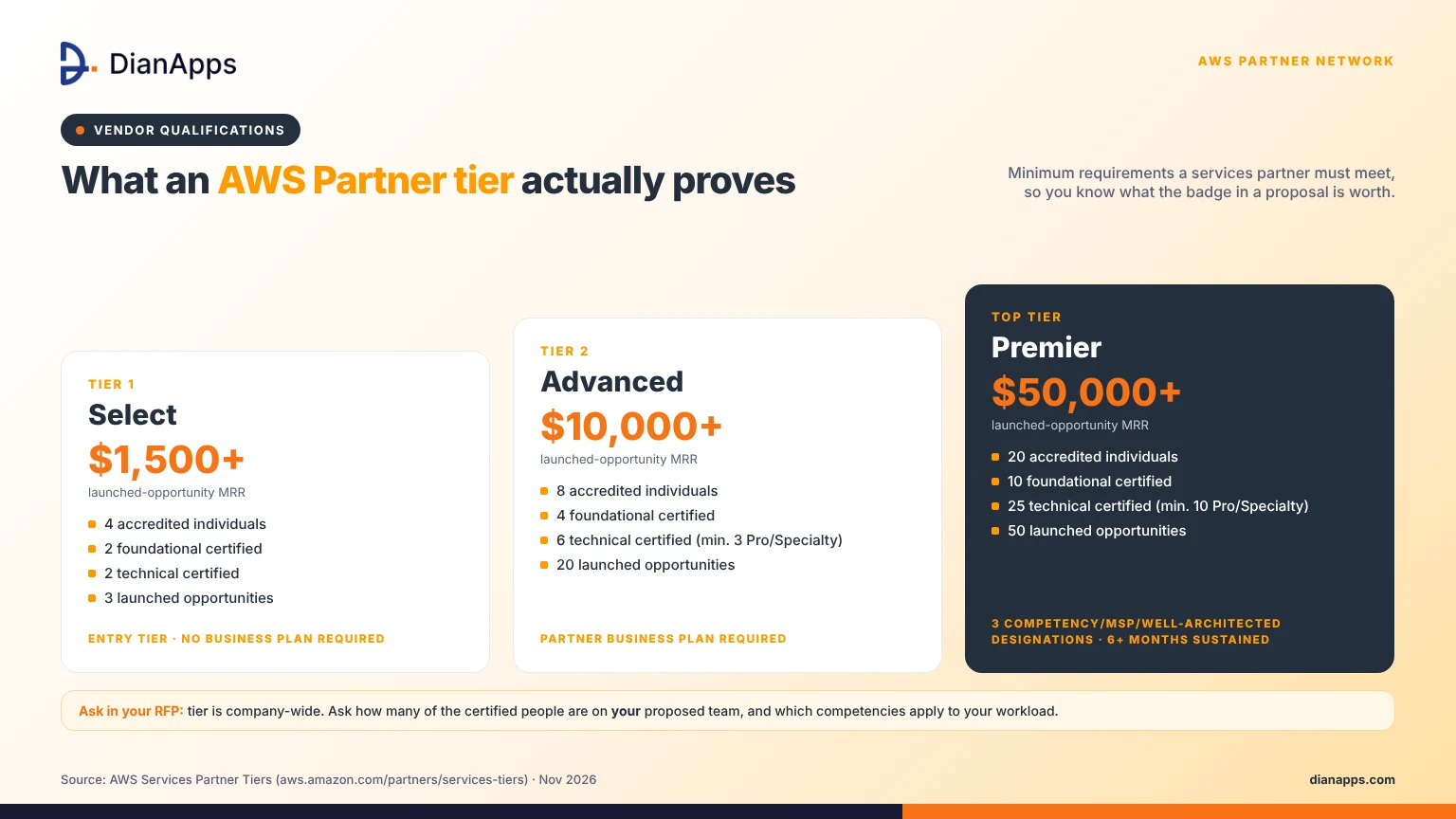
This is the section that separates firms that have run production AWS workloads from firms that passed a certification exam last quarter. The AWS consulting proposal request should ask for evidence, and evidence means things you can check.
- Partner tier: Current AWS Partner Network status, whether Select, Advanced, or Premier, plus any competency designations they actually hold.
- Certified staff: How many AWS Certified Solutions Architect Professional and DevOps Engineer Professional credentials exist on the proposed team, not the whole company.
- Reference projects: Three engagements of similar size from the past two years, with client contacts who’ll pick up the phone.
- Team composition: Named people, their roles, their weekly allocation, and whether any of the work gets subcontracted elsewhere.
Credentials alone don’t guarantee a smooth project, and AWS partner competencies explained will help you figure out which designations matter for the work you’re buying and which are mostly marketing.
Need a second opinion on your RFP?
Share your draft and our AWS team will flag the gaps before vendors do.
RFP Section 6: Pricing Structure And Commercial Terms
Pricing sections in cloud consulting RFPs tend to get one line, “provide your costs,” which guarantees six proposals in six formats that can’t be compared. Tell vendors the structure you want so AWS consulting proposal evaluation doesn’t turn into a reformatting exercise.
- Engagement model: Fixed price per phase, time and materials with a cap, or a retainer if you want ongoing managed services.
- Rate card: Hourly or daily rates by role, including architect, engineer, project manager, and whoever owns security.
- Assumptions and exclusions: Everything the number depends on, such as access to your staff or documentation that may not exist.
- AWS spend handling: Whether the vendor resells usage, passes it through at cost, or expects you to hold the billing account.
- Payment terms: Milestone invoicing, retention percentages, and what happens financially when a deliverable lands late.
Insist on a cost breakdown table in a fixed format, because how transparent a vendor is on pricing tends to predict how transparent they’ll be when delivery slips.
RFP Section 7: Timeline, Milestones And Submission Instructions
You need two schedules here, one for the procurement itself and one for the project the winner will deliver. For procurement, list the question deadline, when answers go out to all bidders, the due date, presentation slots, and the expected award date. For the project, give target milestones such as assessment complete, landing zone deployed, first workload migrated, and final handover. If you’ve never set up a multiple account structure, read about the AWS landing zone and Control Tower, because that foundation is usually the first thing the vendor builds. Submission instructions should state the file format, page limits, one email address for responses, and the person handling clarifications. Proposals that ignore those instructions are telling you something about how the vendor treats governance later, and I’d take the hint. Give bidders three weeks minimum, since rushed proposals tend to come from the firms with the least work on.
AWS Consulting RFP Scoring Criteria: A Weighted Evaluation Table
Scoring criteria turn gut impressions into numbers your committee can defend to finance when the cheapest bid doesn’t win. The weights below suit a typical migration or modernization engagement, and you should move them around when security or price matters unusually much to you.
| Evaluation criterion | Weight | What a top score looks like | What a low score looks like |
| Technical approach and architecture | 30% | Specific AWS service choices justified against your stated constraints | Generic diagrams reused from other proposals |
| Relevant experience and references | 20% | Three comparable projects with reachable client contacts | Logos without detail or references that decline calls |
| Team qualifications | 15% | Named, certified people with stated weekly allocation | Unnamed senior resources to be assigned later |
| Security and compliance approach | 15% | Controls mapped to your frameworks and a named security lead | A paragraph promising best practices |
| Pricing and commercial transparency | 15% | Itemized costs with every assumption listed | Lump sum with no breakdown provided |
| Project management and communication | 5% | Cadence, tools, and escalation paths clearly defined | Vague promises of regular updates |
Each evaluator’s score gets multiplied by the weight and averaged across the panel, which keeps one enthusiastic reviewer from carrying a vendor over the line on charm.
How To Score AWS Consulting Proposals Consistently
A scoring table only works if every evaluator uses it the same way, and that takes a bit of process design that nobody enjoys. These steps keep AWS consulting proposal evaluation fair even when your panel mixes a cloud architect with a finance lead who’s never opened the AWS console.
- Independent first pass: Everyone scores alone before any group discussion, so nobody anchors on whoever speaks first.
- Written rationale: Any score below three or above four on a five-point scale needs one sentence explaining why.
- Calibration meeting: The panel reviews outliers together and changes scores only where someone clearly misread the proposal.
- Clarification round: Shortlisted vendors get written questions, and their answers are scored against the same criteria as before.
- Reference checks last: Calls to past clients happen after technical scoring, so a charming reference can’t rescue a weak design.
Writing all this down also protects you if a losing bidder challenges the award, which in public sector AWS procurement happens often enough that I’d plan for it.
Want help scoring the shortlist?
Our architects can sit on your panel and pressure-test each proposal.
Sample RFP Language For AWS Consulting You Can Reuse
The clauses below come from requests that produced clear, comparable proposals, and you should adapt them rather than copy them blindly. For scope: “The vendor shall deliver a migration readiness assessment covering all workloads listed in Appendix A, including a recommended target architecture, dependency mapping, and a phased cutover plan.” For security: “All proposed solutions must support encryption at rest using AWS KMS customer-managed keys, and the vendor shall document how each control maps to SOC 2 Type II requirements.”
For pricing: “Bidders shall present costs using the template in Appendix C, separating professional services fees from AWS usage charges, and shall list every assumption on which pricing depends.” For staffing: “The vendor shall name each proposed team member, state their AWS certifications and confirm their minimum weekly allocation for the project duration.” When you get to the data residency clause, naming regions precisely matters, and AWS regions and availability zones cover the distinction bidders will assume you already understand.
Common Mistakes When Writing An RFP For AWS Consulting Services
Most weak RFPs share the same handful of errors, and each one quietly adds to the final invoice. Catching them before the document goes out is cheaper than renegotiating after it comes back.
- Prescribing the solution: Dictating every service and instance type leaves a good vendor no room to suggest something smarter.
- Hiding the budget: Withholding a range produces proposals spread across an order of magnitude, most of them unfundable.
- Skipping the question window: Vendors who can’t ask questions pad their estimates to cover the unknowns you never explained.
- Ignoring post-migration operations: Forgetting who runs the environment after handover leaves a gap that costs more than the migration did.
- Underestimating internal effort: Your own team’s availability for interviews, testing, and sign-off shapes the timeline more than the vendor’s does.
Startups especially should check AWS Activate credits for startups before publishing, because available credits change how much of the budget can go to consulting instead of usage.
How Experienced Vendors Read Your AWS Cloud Consulting RFP
Knowing how a good consultancy reads your request helps you write one that attracts serious bidders instead of quietly repelling them. The firms I’d want to hire look first at whether the scope is realistic for the timeline, and they’ll decline politely when it isn’t rather than overpromise and hope. They check whether your criteria reward quality or just the lowest number, because a price-dominated scoring model attracts firms that win on day one and start losing money by month three.
They notice whether your technical requirements reflect real constraints or copied boilerplate, and they respect buyers who admit uncertainty and ask for a recommendation. The best AWS consulting RFP template signals that you’re worth the presales effort, which is unpaid work vendors ration carefully. If you’re planning AI workloads on Amazon Bedrock or Amazon SageMaker, say so early, since that tells vendors which services to design around before they commit to an architecture.
Ready to start your AWS project?
Tell us what you’re building, and we’ll scope it with you.
Final Thoughts
An AWS consulting RFP template isn’t bureaucracy; it’s the cheapest insurance against a cloud engagement that drifts somewhere expensive. The seven sections above give vendors enough context to estimate honestly, the weighted scoring criteria keep your decision defensible, and the sample clauses save you from drafting legal-sounding language at midnight.
Buyers who spend two or three days on a careful request consistently get sharper proposals and tighter pricing, and they tend to get partners who understood the job before signing. Adjust the weights, cut the sections you don’t need, and keep whatever forces honesty from bidders. DianApps, a mobile and AI app development company, has written and answered enough of these documents to believe the quality of the RFP predicts the quality of the project better than any vendor pitch does.
 0 comments










Your email address will not be published. Required fields are marked *