













 0 comments
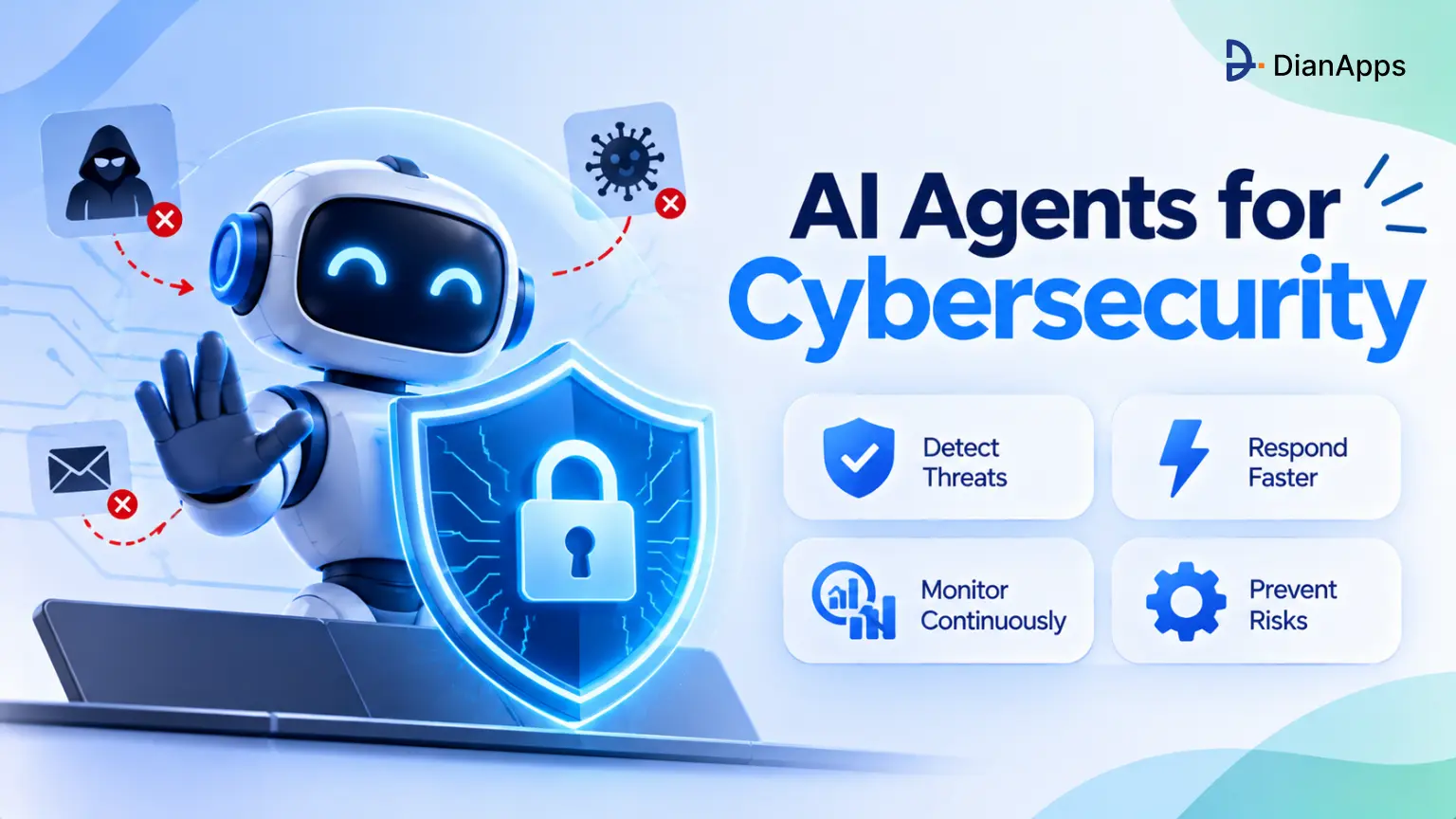





Quick answer: AI agents for cybersecurity are AI systems that investigate and act on security signals on their own, within limits set by the security team. The proven use cases today are alert triage, investigation, phishing analysis, threat hunting, and vulnerability prioritization. The main risks are prompt injection, over-privileged agents, hallucinated findings, and attackers using the same agents against you.
Security teams have a volume problem that hiring cannot solve. A typical alert investigation still takes 30 minutes or more, and most of it is the same routine: pull logs, check reputation, look up the user, decide whether it is benign. AI agents now do that routine work in minutes. Google Cloud reports its triage agent has investigated more than 5 million alerts, cutting a typical 30-minute review to about 60 seconds.
Attackers have the same tools. In November 2025, Anthropic disclosed the first reported AI-orchestrated cyber espionage campaign, in which a state-sponsored group used an AI agent to perform an estimated 80–90% of the intrusion work. Gartner expects AI agents to halve the time needed to exploit exposed accounts by 2027.
This guide explains where AI agents deliver real value in security operations, where they fail, how to secure the agents themselves, and how to roll them out without creating a new attack surface.
Key Takeaways
- Definition: A cybersecurity AI agent pursues a security goal, such as “determine whether this alert is malicious,” by planning steps, querying tools, and acting within guardrails.
- Highest-ROI use case: Tier-1 alert triage and investigation, where vendors report cutting 30–45 minute investigations to under 5 minutes.
- Survey reality check: 72% of SOC teams using AI report cutting investigation time by at least 25%, with an average reduction of about one-third (Prophet Security, 2026).
- Agents augment analysts, they do not replace them. Gartner expects SOCs to have 50% more engineers than analysts by 2028 as analysts shift to supervising agents.
- Top risks: prompt injection, excessive agency, hallucinated findings, data leakage, and attackers using agents to move at machine speed.
- Attackers are already using agents: an AI agent performed an estimated 80–90% of a state-sponsored espionage campaign disclosed by Anthropic in November 2025.
- Safe adoption pattern: start read-only on one alert category, measure accuracy against analysts, and require human approval for containment actions.
Read More: What is an AI agent?
AI Agents in Cybersecurity: Key Statistics for 2026
AI agents are moving into production SOCs quickly, and early results on investigation speed are strong. At the same time, attackers are using agents too, and most organizations spend far more on AI security tools than on securing the AI itself.
| Statistic | Figure | Source |
|---|---|---|
| Alerts investigated by Google’s SecOps triage agent | 5M+, with typical review cut from 30 min to ~60 sec | Google Cloud via TechInformed, Jun 2026 |
| SOC teams using AI that cut investigation time by 25%+ | 72% (average cut about one-third) | Prophet Security, State of AI in the SOC 2026 |
| Teams that built their own AI SOC tooling and then scrapped or replaced it | 46% | Prophet Security 2026 |
| Average thorough alert investigation time | ~75 min (median ~45 min) | Prophet Security 2026 |
| Share of AI-driven state espionage campaign done by the agent | 80–90%, with 4–6 human decision points | Anthropic, Nov 2025 |
| Reduction in time to exploit account exposures due to AI agents | 50% by 2027 | Gartner, Mar 2025 |
| Incident response effort on custom-built AI applications | 50% by 2028 | Gartner, Mar 2026 |
| Enterprises using AI security platforms | Over 50% by 2028 | Gartner, Mar 2026 |
| SOC engineers vs analysts | 50% more engineers than analysts by 2028 | Gartner (via BleepingComputer) |
| Reduction in human-touch incidents for SOCs using AI effectively | 30% by 2028 | Gartner |
| Buyers expecting AI agents to replace Tier-1 SOC analysts within 3 years | 35% | McKinsey survey, Sep 2025 (via Cynet) |
| Autonomous pentest agent on HackerOne’s US leaderboard | #1 with ~1,060 reports in ~90 days (XBOW, Jun 2025) | XBOW |
Vendor-reported speedups vary widely and are rarely published with false-positive or false-negative rates. Treat them as upper bounds and measure your own.
Ready to put AI agents to work in your SOC, safely?
We design and build custom AI agents for alert triage, phishing analysis, and incident response. They connect to your SIEM, EDR, and identity tools, with least-privilege access, human approval gates, and prompt-injection testing built in from day one.
What Are AI Agents in Cybersecurity?
An AI agent in cybersecurity is software that uses a large language model to investigate and respond to security events: it gathers evidence from security tools, reasons about it, and takes or recommends an action. Unlike SOAR playbooks, it decides the next step itself instead of following a fixed script.
A security agent typically runs a loop: perceive (receive an alert or signal), gather (query SIEM, EDR, identity, threat intelligence), reason (correlate and score), act (close, escalate, or contain, often behind a human approval gate), and verify (confirm the outcome and learn from analyst feedback).
AI agents vs SIEM rules vs SOAR vs copilots
| Capability | SIEM detection rules | SOAR playbooks | AI copilots / assistants | AI agents |
|---|---|---|---|---|
| What it does | Detects known patterns | Runs predefined response steps | Answers analyst questions, summarizes | Investigates and acts toward a goal |
| Who decides next step | Rule author | Playbook author | The analyst | The agent, within guardrails |
| Handles novel alerts | No | Only if a playbook exists | Helps a human handle it | Yes, by adapting its investigation |
| Unstructured data (emails, tickets, logs in prose) | Limited | Limited | Yes | Yes |
| Maintenance | Rule tuning | Playbook upkeep for every scenario | Low | Prompt, tool, and evaluation upkeep |
| Main risk | Missed detections, noise | Brittle when scenarios change | Hallucinated answers | Wrong actions at machine speed |
In practice, agents do not replace SIEM or SOAR. They sit on top of them: the SIEM still detects, the agent investigates, and SOAR or the agent’s own tools execute approved responses.
Levels of autonomy
- Assist: summarizes alerts and answers questions; humans do everything else.
- Recommend: investigates and proposes a verdict and action; humans approve.
- Act on low-risk tasks: closes known false positives, enriches tickets, notifies users automatically.
- Act with approval gates: isolates hosts or disables accounts after a human approves, or automatically for pre-approved scenarios.
- Fully autonomous: rare in 2026 and generally limited to narrow, reversible actions.
Read More: How to Build an AI Agent: Step-by-Step Guide for Businesses
10 Use Cases for AI Agents in Cybersecurity
The strongest production use cases are high-volume, evidence-gathering tasks: alert triage, phishing analysis, threat hunting, and vulnerability prioritization. Autonomous containment is growing, but most teams still keep a human approval step for disruptive actions.
| # | Use case | What the agent does | Typical autonomy in 2026 |
|---|---|---|---|
| 1 | Alert triage and investigation | Enriches, correlates, and assigns a verdict to SIEM/EDR alerts | Closes clear false positives; escalates the rest |
| 2 | Phishing triage | Analyzes user-reported emails, headers, links, and attachments | Auto-resolves benign reports; flags real phish |
| 3 | Threat hunting | Runs hypothesis-driven searches across telemetry | Recommends; analysts confirm |
| 4 | Detection engineering | Drafts and tests detection rules from threat intel | Proposes rules for review |
| 5 | Vulnerability discovery | Finds flaws in code and applications (authorized testing) | Findings validated by humans |
| 6 | Vulnerability prioritization and remediation | Ranks CVEs by exploitability and asset context, drafts fixes | Pre-approved fixes only |
| 7 | Incident response | Builds timelines, drafts reports, coordinates containment | Containment behind approval gates |
| 8 | Identity threat response | Investigates risky sign-ins and privilege changes | Recommends or forces reset with approval |
| 9 | Cloud security posture | Detects misconfigurations and applies safe fixes | Applies pre-approved remediations |
| 10 | Compliance and reporting | Gathers evidence, maps controls, drafts audit packs | Drafts for human sign-off |
1. Alert triage and investigation
This is where agents deliver the clearest return. The agent pulls endpoint, identity, network, and cloud context for every alert, builds an attack narrative, and either closes it with a written rationale or escalates it with the investigation done. Reported results include Google SecOps cutting a typical 30-minute review to about 60 seconds across 5 million+ alerts, and Elastic’s own InfoSec team cutting triage from 30 minutes to under 3. Because every alert gets the same depth of review, agents also reduce the risk of real threats being ignored during busy shifts.
2. Phishing triage
User-reported phishing is high volume and mostly benign, which makes it an ideal agent workload. Agents inspect sender reputation, headers, URLs, and attachments, then resolve the report and notify the user. Microsoft’s Phishing Triage Agent in Defender has since expanded into a broader Security Alert Triage Agent covering identity and cloud alerts.
3. Threat hunting and detection engineering
Agents turn threat intelligence into hunt queries, run them across the data lake, and summarize hits. The analyst hours they free up matter: in Prophet Security’s 2026 survey, 49% of teams that hunt weekly or more said a hunt had found malicious activity their detections missed. Agents can also draft new detection rules for engineers to review and test.
4. Vulnerability discovery and prioritization
Agents now find real vulnerabilities. Google’s Big Sleep agent discovered SQLite flaw CVE-2025-6965 and helped pre-empt its exploitation, and the XBOW autonomous pentesting agent reached the top of HackerOne’s US leaderboard in 2025, with findings reviewed by humans before submission. On the defensive side, agents rank open vulnerabilities by exploitability and business context so teams patch what matters first.
5. Incident response and containment
During an incident, agents assemble timelines, query affected systems, draft stakeholder updates, and prepare containment steps such as isolating a host or revoking sessions. Swimlane reports that one SOC customer cut incident response time by 70% and automated over 60% of Level 1 triage within three months. Most organizations keep containment behind a human approval gate.
6. Identity, cloud, and compliance
Identity agents investigate impossible-travel sign-ins and risky privilege changes. Cloud posture agents detect misconfigurations and apply pre-approved fixes. Compliance agents collect evidence and map it to control frameworks, saving weeks of audit preparation. In each case, the safe pattern is the same: agents gather and recommend broadly, but act only within narrow, pre-approved boundaries.
Already running AI agents? Find the gaps before attackers do.
Our team reviews your agents’ permissions, identities, and data flows against the OWASP Top 10 for LLM and Agentic Applications, then gives you a prioritized fix list.
AI Security Agent Platforms: The 2026 Landscape
Every major security platform now ships named AI agents, mostly optimized for its own telemetry. Independent AI SOC vendors and custom-built agents cover mixed-vendor environments and specialized workflows.
| Category | Examples | Best fit | Watch out for |
|---|---|---|---|
| Platform-native SOC agents | Microsoft Security Copilot agents (Defender, Entra, Purview), CrowdStrike Charlotte AI, Palo Alto Cortex AgentiX (successor to XSOAR), Google Security Operations agents, SentinelOne Purple AI, Cisco agents for Splunk | Teams standardized on one vendor | Weaker coverage of third-party telemetry |
| Independent AI SOC analysts | Dropzone AI, Prophet Security, Torq, Radiant Security, Simbian, Intezer, Swimlane | Mixed-vendor stacks, MSSPs, lean SOCs | Integration depth varies by tool |
| Offensive security and testing agents | XBOW, Google Big Sleep (research) | Authorized pentesting and code review at scale | Findings need human validation |
| Agent security platforms | Palo Alto Prisma AIRS, Microsoft Entra Agent ID, CrowdStrike identity protection for AI agents, Zenity | Securing your own AI agents and their identities | Fast-moving category; standards still forming |
| Custom-built agents | LLM + orchestration framework + MCP tools against your SIEM, EDR, ticketing | Unique workflows, data residency, regulated sectors | Prophet found 46% of teams scrapped or replaced homegrown AI SOC tools |
Product names and capabilities in this category change quarterly; check each vendor’s current documentation for what is generally available versus in preview.
Buy or build? Buy when a platform agent already covers your main telemetry. Build, usually with an AI agent development services partner, when you need agents across mixed tools, on-premises or sovereign deployment, or workflows no vendor supports, and invest in evaluation from day one.
Suggested Read: Types of AI Agents: 7 Kinds Explained With Real Examples
Risks of AI Agents in Cybersecurity
The biggest risks are agents that are confidently wrong, agents with too much access, and agents manipulated through the very data they analyze. Because security agents read attacker-controlled content all day, prompt injection is a bigger threat in the SOC than almost anywhere else.
| Risk | What it looks like in a SOC | Mitigation |
|---|---|---|
| Hallucinated or wrong verdicts | Agent closes a real attack as benign, or invents evidence | Require cited evidence for every verdict; sample-audit closed alerts; track false negatives |
| Prompt injection | Malicious text in an email, log, file, or web page instructs the agent to ignore or misclassify it | Treat analyzed content as untrusted data; separate instructions from evidence; red-team with injected samples |
| Excessive agency | Agent can disable accounts, change firewall rules, or delete data beyond its task | Least-privilege, task-scoped tools; human approval for disruptive actions |
| Identity and credential abuse | Agent’s service account or API keys are stolen and reused | Give each agent its own identity, short-lived credentials, and monitoring |
| Data leakage | Sensitive logs or incident details sent to an external model or retained | Data residency controls, redaction, contractual no-training terms |
| Automation bias and skill erosion | Analysts accept agent output without checking; junior skills fade | Show reasoning and evidence; rotate analysts through manual investigations |
| Cascading errors | One wrong step early in an investigation drives every later step | Short, scoped tasks; validation checkpoints between steps |
| Runaway cost | Agents loop on noisy alerts and burn token budget | Per-workflow cost limits and alerting |
| Vendor hype and “agent washing” | Tools sold as autonomous that only summarize | Proof-of-value on your own data with measured accuracy |
Why accuracy claims need testing?
A report by Anton Chuvakin of Google Cloud’s Office of the CISO and Oliver Rochford, drawing on Reddit and Discord practitioner commentary, cites a practitioner who ran a language model against 348 known false positives and one synthetic true positive. The model reached 71% accuracy, labeled obvious false positives as malicious, and missed the real incident. The same report found many deployments stall at enrichment and summarization, with humans keeping decision authority.
The OWASP Top 10 for LLM Applications (2026) keeps prompt injection at No. 1 and moves excessive agency up to No. 3, and OWASP’s separate Top 10 for Agentic Applications lists agent goal hijack and tool misuse first. Gartner also warns that organizations skipping pre-production offensive testing of AI deployments will face twice as many incidents by 2028.
How Attackers Are Using AI Agents?
Attackers use AI agents to compress reconnaissance, credential abuse, and lateral movement from days into hours. Defenders need machine-speed detection and response because human-speed review alone can no longer keep up.
The first documented AI-orchestrated espionage campaign
In mid-September 2025, Anthropic detected a campaign by a group it assessed with high confidence as Chinese state-sponsored (designated GTG-1002). The attackers built a framework around Claude Code and targeted roughly 30 organizations in technology, finance, chemical manufacturing, and government. Key findings from Anthropic’s report:
- The AI performed an estimated 80–90% of the operational work, with humans stepping in at only 4–6 critical decision points per campaign.
- The agent issued thousands of requests, often several per second, a pace no human team can match.
- A small number of intrusions succeeded.
- The agent overstated findings and occasionally fabricated data, which limited its effectiveness.
- Anthropic detected the campaign through anomalous usage patterns, banned the accounts, and notified affected parties.
What this means for defenders?
| Attacker capability | Defensive implication |
|---|---|
| Faster account takeover | Gartner predicts AI agents will cut time to exploit exposed accounts by 50% by 2027; prioritize phishing-resistant MFA and rapid credential revocation |
| Machine-speed lateral movement | Automate first-response containment for high-confidence detections |
| Scaled, personalized social engineering | Gartner predicts 40% of social engineering attacks will target executives as well as the broader workforce by 2028; train and verify out-of-band |
| Rapid vulnerability discovery | Shorten patch cycles and use agents to prioritize exploitable exposure |
| Noisy, high-volume probing | Agent-driven attacks generate distinctive request patterns that behavioral detection can catch |
The same capabilities that help attackers help defenders: Anthropic used Claude extensively to analyze the data from its own investigation.
Governance, Frameworks, and Compliance for Security AI Agents
Govern AI agents like privileged non-human identities: register them, scope their permissions, log every action, and test them adversarially before and after deployment. Map controls to established frameworks so auditors and regulators can follow your reasoning.
Frameworks to map against
| Framework | What it covers | Use it for |
|---|---|---|
| OWASP Top 10 for LLM Applications (2026) | Prompt injection, sensitive data disclosure, excessive agency, supply chain, unbounded consumption | Threat modeling any LLM-based agent |
| OWASP Top 10 for Agentic Applications | Goal hijack, tool misuse, identity and privilege abuse, rogue agents | Agent-specific design and red-team test plans |
| NIST AI Risk Management Framework | Govern, map, measure, manage AI risk | Enterprise AI risk program structure |
| MITRE ATLAS | Adversary tactics and techniques against AI systems | Red teaming and detection coverage |
| ISO/IEC 42001 | AI management system requirements | Certifiable AI governance |
| EU AI Act | Risk-based obligations; high-risk rules apply from 2 December 2027 for Annex III systems | EU deployments, especially agents touching employment, credit, or critical infrastructure |
Agent governance checklist
- Inventory every security agent, its owner, data access, and autonomy level
- Give each agent a distinct identity with least-privilege, short-lived credentials
- Define which actions are automatic, which need approval, and which are forbidden
- Log every prompt, tool call, verdict, and action in an immutable store
- Require evidence citations for every verdict the agent issues
- Red-team agents for prompt injection and tool misuse before go-live and after changes
- Sample-audit closed alerts weekly during rollout, monthly at steady state
- Keep a kill switch and a fallback to human-only triage
Gartner has flagged identity and access management for AI agents, including registration, credential automation, and policy-based authorization for machine actors, as a top cybersecurity trend for 2026. Expect auditors to ask about agent identities the same way they ask about service accounts.
Start with one alert category. Prove it in 30 days.
Our AI agent development services team will build a read-only triage agent for your noisiest alert queue. We’ll run it alongside your analysts and show you the accuracy, time saved, and false-negative rate on your own data.
How to Implement AI Agents in Your SOC: A 6-Step Roadmap
Start with one noisy, low-risk alert category in read-only mode, prove accuracy against your analysts, then expand autonomy one action at a time. Data quality and integration depth matter more than which model you choose.
- Fix the data first. Agents inherit your telemetry gaps and tuning problems. Normalize schemas, confirm endpoint, identity, and cloud coverage, and clean up the noisiest detection rules.
- Pick one alert category. Choose a high-volume category where most alerts are false positives, such as user-reported phishing or impossible-travel sign-ins.
- Run read-only in shadow mode. Let the agent investigate every alert in parallel with analysts for 2–4 weeks without taking action, and compare verdicts.
- Set autonomy by action, not by agent. Allow automatic closure of clear false positives, require approval for containment, and forbid destructive actions.
- Integrate through scoped tools. Connect the agent to SIEM, EDR, identity, and ticketing through narrowly scoped APIs or MCP servers, with separate credentials per agent.
- Scale with SOC engineering. Build reusable investigation templates, evaluation sets, and feedback loops. Gartner expects SOC engineering roles to outnumber analysts by 2028 for exactly this reason.
KPIs to track
| KPI | Why it matters |
|---|---|
| Mean time to investigate (MTTI) and mean time to respond (MTTR) | The core speed gain |
| Verdict agreement rate with senior analysts | Accuracy on your own data |
| False negative rate on sampled closed alerts | The risk that matters most |
| Share of alerts fully resolved without human touch | Real workload reduction |
| Escalation quality (analyst rating of agent handoffs) | Whether escalations save time |
| Analyst hours redirected to hunting and engineering | Strategic value |
| Cost per investigated alert (tokens, licenses, people) | Unit economics |
The Future of AI Agents in Cybersecurity (2027–2028)
Security is becoming agent-versus-agent: defensive agents will handle most Tier-1 work while new controls emerge to secure the agents themselves. The analyst role shifts from responder to supervisor and engineer.
- Analysts become supervisors. Gartner predicts organizations using AI effectively in the SOC will reduce human-touch incidents by 30% by 2028, shifting analysts from “responder” to “supervisor.”
- SOC engineering grows. Gartner expects SOC teams to have 50% more engineers than analysts by 2028, as detection engineering broadens into building and tuning agents.
- AI applications become a major incident source. Gartner predicts half of enterprise incident response effort will involve custom-built AI applications by 2028, and that more than 50% of enterprises will use AI security platforms by then.
- Guardian agents. Expect agents whose job is to monitor and constrain other agents, enforcing policy at runtime.
- Agent identity becomes a core IAM discipline. Directories are adding first-class agent identities, such as Microsoft Entra Agent ID, so agents can be governed like users and service accounts.
- Faster attack timelines. With AI agents cutting time to exploit exposed accounts, defenders will automate more first-response containment for high-confidence detections.
- Proof over promises. As practitioner skepticism grows, buyers will demand published false-negative rates and proof-of-value on their own data before granting autonomy.
Read More: AI Agent Security and Governance
Conclusion: Use AI Agents for Speed, Keep Humans for Judgment
AI agents are already the fastest way to clear Tier-1 alert backlogs, but their value depends on scoped permissions, evidence-backed verdicts, and continuous testing. Treat every security agent as a privileged identity that attackers will try to manipulate.
The teams getting results in 2026 start narrow, measure accuracy on their own data, and expand autonomy one action at a time. They also secure the agents themselves, because the same technology that clears alert queues is now being used to run intrusions at machine speed.
Planning to add AI agents to your security operations? Our AI agent development services help you design, build, and secure custom agents for alert triage, phishing analysis, and incident response, integrated with your SIEM, EDR, and identity stack and governed from day one. Book a free security AI assessment
 0 comments









Your email address will not be published. Required fields are marked *