













 0 comments





Key Takeaways:
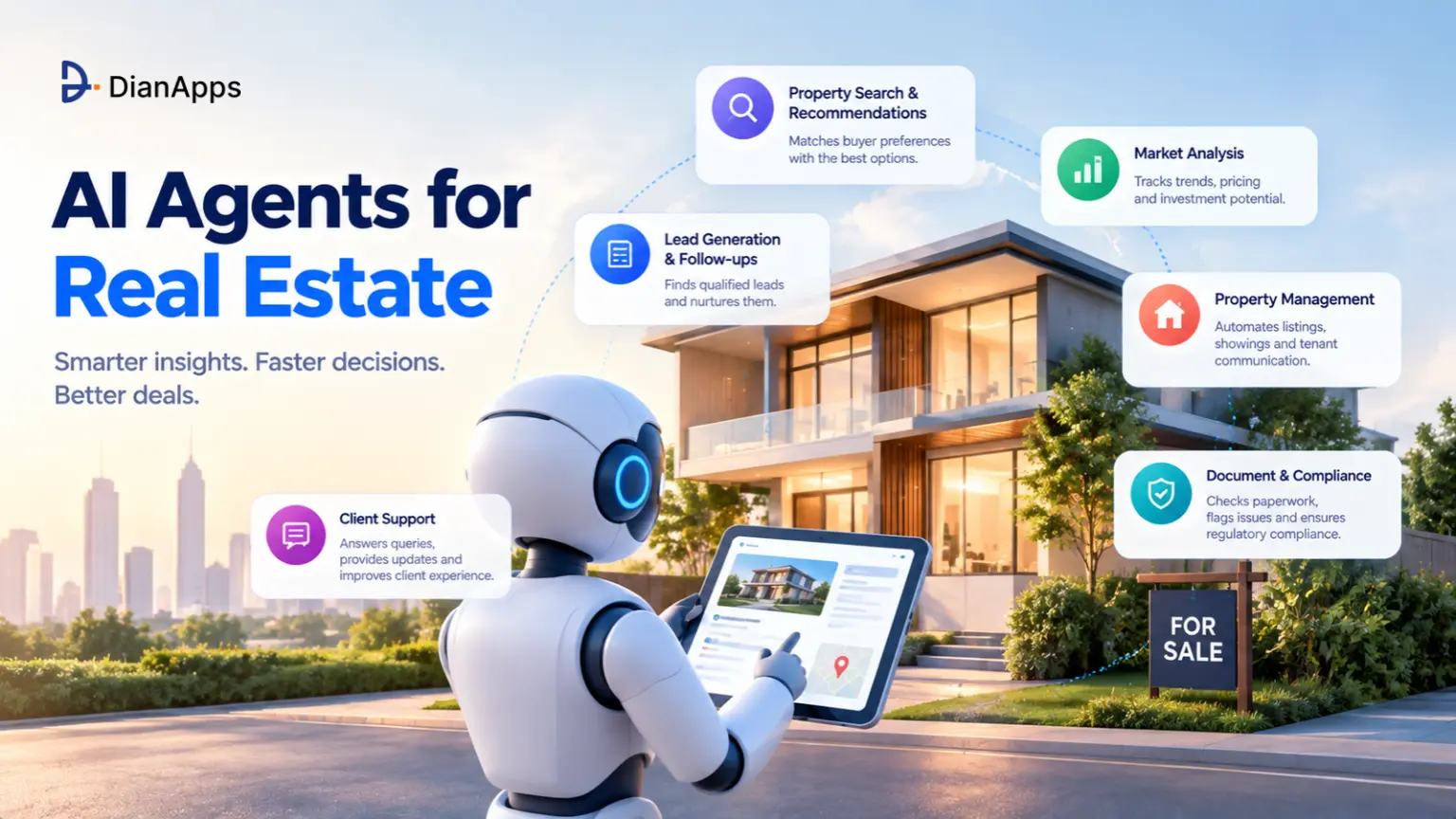
- These agents are not just drafting messages like a basic chatbot, they are also replying to leads, booking showings and answering calls on their own.
- An AI agent for real estate is replying within seconds, day or night, which is really keeping portal and ad leads warm before another agent is calling them back.
- An AI voice agent for real estate is handling inbound calls, qualification calls and confirmations, as long as consent and disclosure rules are being followed properly.
- AI is taking over the repetitive follow-up and admin work, while negotiation, pricing advice and client trust are definitely staying with the human agent.
- Ready-made AI tools for real estate agents are working well for solo agents, but brokerages with their own CRM and workflows are getting much more value from custom-built agents.
Quick Answer: AI agents for real estate are autonomous assistants that are following up with leads in seconds, booking showings into calendars and handling calls through natural voice, giving agents/brokers more time for clients, negotiations and closings.
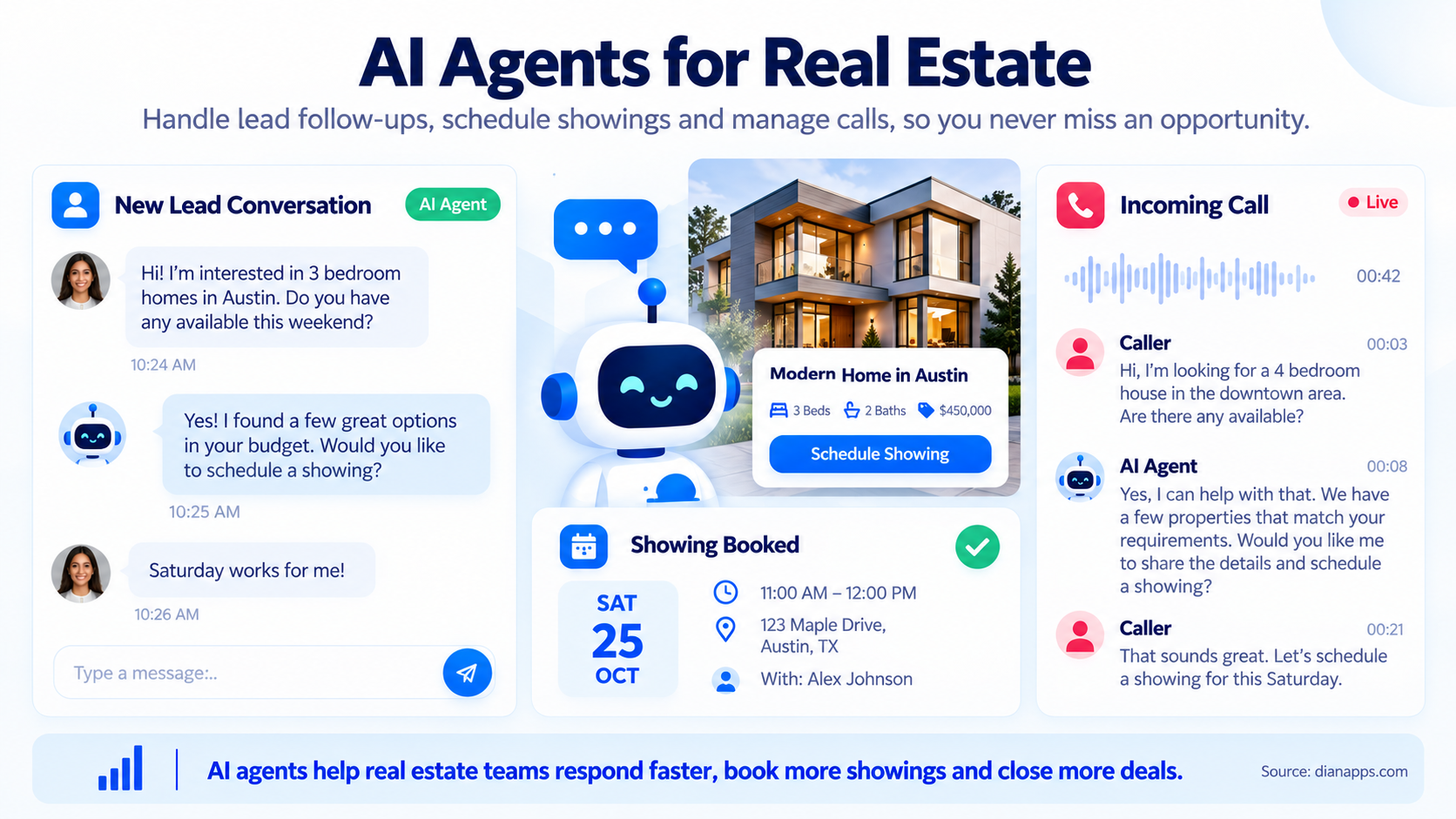
The buyer would just call the number he saw on the yard sign, the agent would pick up and a showing would get booked over a quick five-minute chat? That is not how buyers are behaving anymore, they are filling out inquiry forms on three or four listings at 10:40 at night, and whichever agent is replying first is usually the one getting the showing. This is where, much like AI agents for customer service are handling support queues in other industries, AI agents for real estate are now stepping in, making sure each and every lead/inquiry is getting a reply even when the agent is busy at a showing, on another call or simply asleep.
But what exactly is an AI agent, and how is it really any different from the chatbot sitting on most brokerage websites? Well, an AI agent is not just answering questions, it is also taking actions like updating the CRM, checking calendar availability, sending reminders and calling leads back, all while following the rules your team is setting for it.
And this shift is not just a prediction anymore, the NAR 2026 Technology Report is showing that nearly half of surveyed Realtors are now using AI at least once a week, while 48% are interested in AI-powered lead generation and follow-up tools.
In this guide, we are covering how these agents are working across lead follow-up, scheduling and voice, which tools are actually worth your time and the question every agent is quietly asking, will AI replace real estate agents, so let’s take a look.
What Are AI Agents for Real Estate and How Do They Work?
AI agents for real estate are software systems built on large language models (LLMs) that are reading incoming messages, understanding what the lead/client is really asking for and then taking the next step on their own, whether that is replying, qualifying a buyer or booking a showing.
This is what is making them extremely different from the old rule-based autoresponders that are sending the same template to everyone, because these agents are reasoning over the conversation and pulling context from your CRM, MLS (Multiple Listing Service) feed and calendar before they respond.
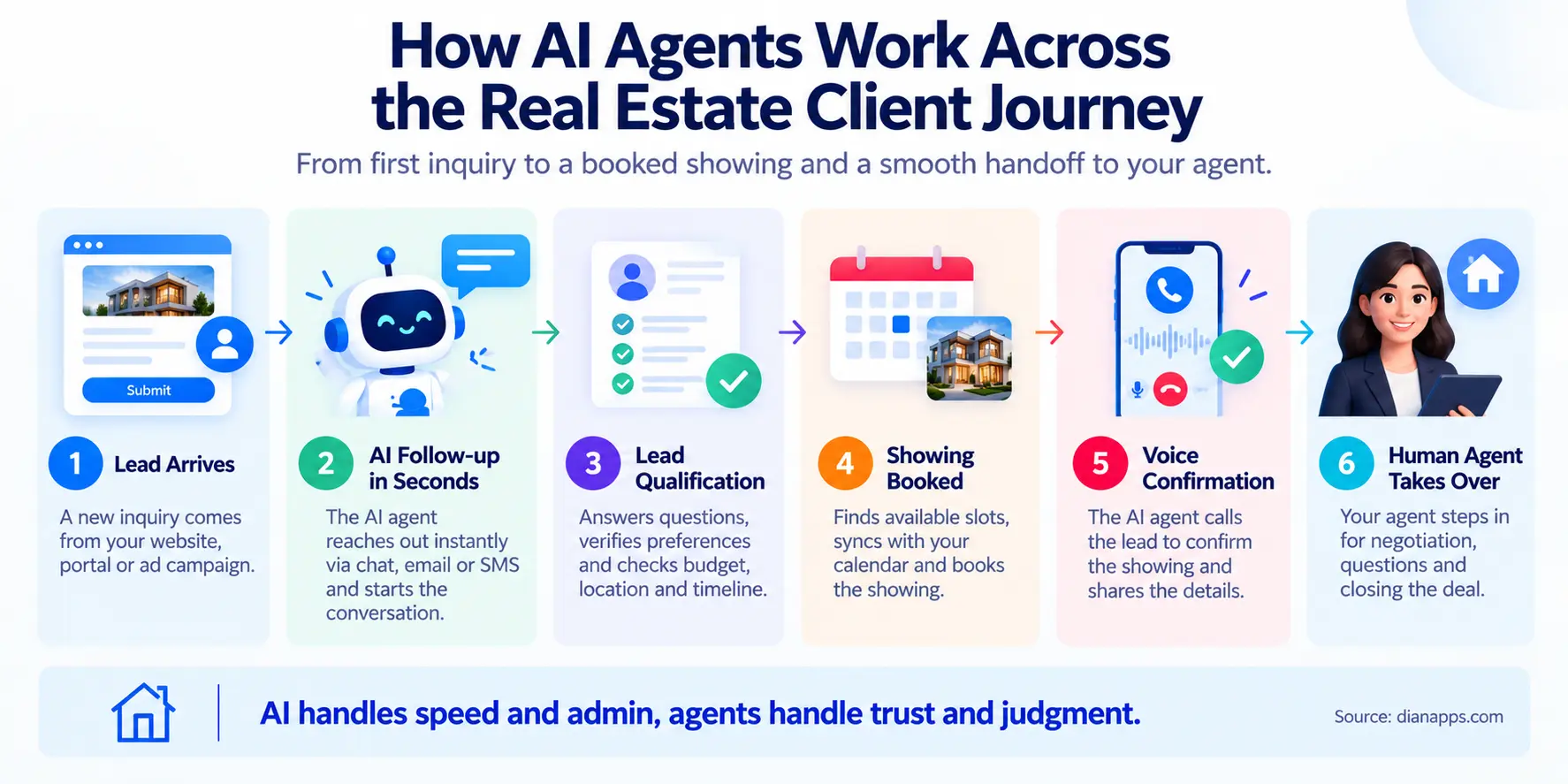
But how does an AI agent for real estate actually work behind the scenes on a day-to-day basis? Well, a typical one is working through a simple, repeatable loop that is pretty much the same for each and every lead, resulting in:
- Trigger Detection: A new portal lead, missed call, website chat or text message is coming in and the agent is picking it up instantly, at any hour of the day.
- Context Gathering: The agent is pulling the lead’s history, the listing details and the assigned agent’s availability from the CRM, MLS feed and shared calendar.
- Decision and Action: Depending on what the lead is asking, the agent is replying, asking qualifying questions, booking a showing or passing the conversation to a human.
- Logging and Handoff: Each and every interaction is getting written back into the CRM, so the human agent is walking into the next conversation with the full picture.
This connection between the AI and your existing systems is what is really making these agents useful, and standards like the Model Context Protocol (MCP) are making it easier for agents to securely talk to CRMs, calendars and databases without fragile one-off integrations.
And that is not all, when several agents are working together, one for follow-up, one for scheduling and one for voice, they are needing proper coordination, which is where AI agent orchestration is coming into the picture for larger brokerages, so let’s take a look at how agencies are actually using them.
How Do Real Estate Agencies Use AI Agents?
Real estate agencies are now deploying AI agents for real estate across almost each and every stage of the client journey, from the first inquiry until the closing paperwork, and the table below is breaking down where they are being used and what each one is really handling.
| Use Case | What the AI Agent Handles | Primary Benefit |
| Lead Follow-up | Instant replies to portal, ad and website leads via SMS, email and chat | Faster response and higher contact rate |
| Lead Qualification | Budget, timeline, pre-approval and location questions | Agents focus on sales-ready leads |
| Showing Scheduling | Calendar checks, booking, reminders and rescheduling | Fewer no-shows and less back-and-forth |
| Voice Calls | Inbound call answering, outbound callbacks and confirmations | No missed calls after hours |
| Long-Term Nurture | Market updates, new listing alerts and periodic check-ins | Revives cold and older leads |
| Transaction Coordination | Deadline reminders, document requests and status updates | Fewer missed contract dates |
| Property Management | Tenant inquiries, maintenance requests and rent reminders | Lower admin load for managers |
Most agencies are starting with lead follow-up and scheduling, and the reasons are not hard to see, these are the two areas where response time is directly affecting conversions, and once the first agents are proving their value, voice and transaction support are naturally following.
This also is overlapping with traditional automation on the transaction side, like moving data between forms and systems, and many of the RPA use cases that operations teams are already running are now being combined with AI agents inside brokerage back offices.
AI Agent for Real Estate Lead Follow-up and Qualification
Lead follow-up is where most deals are being won or lost, because online leads are usually contacting several agents/brokers at once, and the first one replying with something useful is often the one walking away with the appointment.
The problem is that agents are busy at showings, on calls or with their family when these leads are coming in, and manual follow-up is slipping, especially during evenings, weekends and holidays, giving a poor impression before the relationship has even started.
This is exactly where an AI agent for real estate is stepping in, replying within seconds through SMS, email or chat in a tone that is sounding like your team and not like a generic template. It is asking qualifying questions in a natural way, like whether the buyer is pre-approved, which neighbourhoods they are looking at and how soon they are planning to move, and then scoring the lead based on those answers.
What a Strong Follow-up Agent Should Handle?
A follow-up agent that is really worth deploying should be covering these responsibilities without needing your team to keep an eye on it all the time, and these include:
- Multi-Channel Replies: Responding across text, email, website chat and social messages, while keeping one continuous conversation history for every single lead.
- Qualification Logic: Asking about budget, financing, timeline and property preferences, and updating the lead score in the CRM after each and every answer.
- Smart Handoff Rules: Alerting the human agent right away when a lead is showing high intent, asking for a showing or requesting a phone call.
- Long-Term Nurture: Checking in with cold leads over weeks or months with relevant listings, so older leads are not getting forgotten inside the database.
This is extremely crucial for teams buying leads from portals, because every unanswered lead is money that has already been spent with absolutely no return coming back on it.
AI Scheduling Agents for Showings and Property Viewings
Scheduling one showing is sounding simple enough, but it is often involving the buyer, the listing agent, the seller’s availability, lockbox access and travel time between properties, which is quickly turning into several messages and calls for every single appointment.
AI scheduling agents are taking all of this coordination off your plate by checking calendars in real time, offering open slots to the buyer and confirming the booking, without anyone on your team needing to touch it.
And that is not all, these agents are also sending reminders a day before and an hour before the showing, handling reschedule requests and following up after the visit to collect feedback, which the agent is then using in the next conversation with the seller. For open houses, they are registering visitors, sending thank-you messages and moving interested buyers/visitors into the follow-up pipeline automatically, from beginning until completion.
For all of this to work properly and accurately, a scheduling agent is typically connecting with the following systems:
- Calendar Platforms: Google Calendar, Outlook or the calendar inside your CRM, so availability is always staying accurate across every agent on the team.
- Showing Services: The showing management tools your MLS is already using, so requests and listing agent approvals are flowing through one single place.
- CRM Records: Lead profiles inside the CRM, so every booked showing is getting attached to the right contact, property and deal.
This is resulting in fewer no-shows, fewer double bookings and a buyer/seller experience that is feeling organised and professional right from the very first interaction.
What Is an AI Voice Agent for Real Estate?
An AI voice agent for real estate is a phone-based AI system that is answering and placing calls in natural, human-like speech, understanding what the caller is saying and responding in real time, instead of pushing them through a frustrating “press 1, press 2” keypad menu. It is built on speech recognition, a language model and text-to-speech all working together, and it is connected to the same CRM and calendar as your text-based agents.
But why is voice really needed when text follow-up is already working so well for most teams? Well, voice is becoming one of the most important layers of AI agents for real estate because many buyers and sellers are still preferring to call, especially from yard signs, and a missed weekend call is very often meaning a missed client, so let’s break it down.
Inbound Call Answering
The voice agent is picking up calls on listing lines and office numbers, answering questions about price, square footage, HOA fees and availability, and booking showings right there during the call. After hours, it is acting as a 24/7 receptionist, so no caller/prospect is reaching voicemail and then simply moving on to the next agent on their list.
Outbound Qualification and Callback Calls
For new leads who have given their consent, the AI voice agent for real estate is placing a quick call within minutes, confirming interest, asking qualifying questions and transferring hot leads live to an available agent. This also is helping with appointment confirmations, re-engagement calls to older leads and check-ins with past clients, wherever the consent records are allowing it.
Compliance and Disclosure Requirements
Voice agents are definitely carrying more regulatory weight than text, because in February 2024 the FCC clarified that AI-generated voices are counting as artificial voices under the TCPA (Telephone Consumer Protection Act), which means prior express consent is required before these calls are made.
Agencies should also be disclosing that the caller is an AI, respecting Do Not Call lists and storing call recordings in line with state consent laws, and these checks should be built into the agent from day one, not added later after a complaint has already come in.
Ready to Stop Losing Leads After Hours?
DianApps, a mobile and AI app development company, is designing and building AI follow-up, scheduling and voice agents that are connecting with your CRM, MLS and calendar, so each and every inquiry is getting a reply within seconds, day or night.
Which AI Tools Do Real Estate Agents Use?
Most agents are starting their AI journey with general-purpose assistants, and NAR’s 2026 report is showing ChatGPT as the most-used tool among surveyed agents, followed by Gemini, Copilot and Claude, mostly for listing descriptions, emails and social posts.
But writing content is only one part of the job, and the best AI tools for real estate agents in 2026 are really the ones that are taking action, like following up with leads, managing CRM pipelines and handling phone calls on your behalf.
Best AI Tools for Real Estate Agents in 2026
The table below is comparing widely used AI tools for real estate agents by category, what each one is best suited for and the kind of team that is usually getting the most out of it.
| Tool | Category | Best For | Ideal User |
| ChatGPT | General AI Assistant | Listing descriptions, emails and social content | Solo agents and teams |
| Ylopo AI | AI Text and Voice Follow-up | Lead nurture tied to listing ads | High-volume teams |
| Structurely | AI Inside Sales Agent (ISA) | Instant lead qualification via text, email and chat | Teams buying portal leads |
| Lofty | AI-Powered CRM | All-in-one IDX site, CRM and follow-up | Small to mid-size teams |
| BoldTrail (formerly kvCORE) | Brokerage Platform | Lead routing and marketing automation at scale | Brokerages |
| Follow Up Boss | CRM System of Record | Central lead management with wide integrations | Teams of all sizes |
| Custom AI Agent | Purpose-Built Agent | Proprietary workflows, voice and multi-agent setups | Brokerages and proptech firms |
Note: Tool features and pricing are changing quite frequently, so it is definitely worth confirming the current details with each vendor before signing any annual contract.
Off-the-shelf tools are working really well when your workflow is fitting inside their platform, but brokerages with their own CRM, unique lead sources or multi-market operations are often finding that stitching together several subscriptions is creating more gaps than it is closing, and this is where the custom vs off-the-shelf question is coming in.
Custom AI Agents vs Off-the-Shelf AI Tools for Real Estate Agents
Choosing between a subscription tool and a custom-built agent is mostly depending on how unique your workflows are, how much lead volume you are handling and how much control you are needing over the data your AI agents for real estate are processing.
A detailed comparison of custom AI agent development vs off-the-shelf agents is covering this decision across industries, and the table below is summarising how it is applying to real estate specifically, so let’s take a look.
| Factor | Off-the-Shelf AI Tools | Custom AI Agents |
| Setup Time | Days to a few weeks | Several weeks to a few months |
| Upfront Cost | Low, monthly subscription | Higher, one-time build plus maintenance |
| Workflow Fit | Fixed to the vendor’s logic | Built around your exact process |
| Integrations | Limited to supported platforms | Any CRM, MLS, phone system or internal tool |
| Data Ownership | Stored on the vendor platform | Stays within your infrastructure |
| Voice and Branding | Vendor voice and scripts | Your brand voice, scripts and rules |
| Best For | Solo agents and small teams | Brokerages, franchises and proptech companies |
Many brokerages are actually landing somewhere in the middle, using off-the-shelf tools for content creation while building a custom agent layer on top of their CRM for follow-up, scheduling and voice.
This also brings up another extremely crucial question, which is how the agent is going to know your listings, policies and local market details, and teams are usually deciding between retrieval and training approaches, which this breakdown of RAG vs fine-tuning vs prompt engineering is explaining really well.
For most real estate use cases, RAG (Retrieval-Augmented Generation) connected to live listing data is the more practical choice, because listing prices, statuses and availability are changing almost every single day.
Build an AI Agent Around Your Brokerage Workflow
Whether you are needing a voice agent for listing calls or a complete follow-up and scheduling system, our team is building custom AI agents that are fitting right into your CRM, data and brand.
Data Security, Fair Housing and Governance for Real Estate AI Agents
Real estate conversations are carrying a lot of sensitive information, including financial details, pre-approval amounts, home addresses and family situations, so security just cannot be treated as an afterthought when AI agents for real estate are being deployed.
And agents are aware of this too, as privacy and security concerns were cited by 36% of agents in NAR’s 2026 survey, which is showing that the industry is really paying attention to this risk.
Fair housing is equally important, because an AI agent should never be steering buyers toward or away from neighbourhoods based on protected characteristics, and its replies about schools, safety or “the right area” need careful guarding, which is why agencies should be putting these practices in place:
- Access Controls: Limiting what each agent can read and change inside the CRM, so a follow-up agent is not accessing financial documents it does not need.
- Fair Housing Guardrails: Blocking replies that are describing neighbourhoods by demographics and routing sensitive questions directly to a licensed human agent.
- Audit Trails: Logging every message, call and action, so the brokerage is able to review what the agent said if a complaint or dispute is arising.
- Human Escalation: Defining clear triggers, like legal questions, pricing advice or frustrated callers, where the AI is handing the conversation over immediately.
A deeper framework for this is available in our guide on AI agent security and governance, and before going live, each and every agent should be checked against real conversation scenarios using a structured approach to testing and evaluating AI agents.
Will AI Replace Real Estate Agents?
Well, no, AI is not replacing real estate agents, but it is definitely replacing a large part of the repetitive work that is eating up their day, and the agents who are using it well are likely to outperform those who are not.
Turn Every Lead Into a Booked Showing
Share your current lead flow with our team, and we will be showing you exactly where AI follow-up, scheduling and voice agents are fitting into your brokerage operations.
Buying or selling a home is one of the biggest financial decisions most people are ever making, and buyers/sellers are still wanting a trusted person who is guiding the pricing, negotiating offers, reading the room at a showing and handling the emotions that come with a move. AI agents for real estate are built to support that person, not take their place, and the split between the two roles is getting clearer every year.
| Tasks AI Agents Are Handling | Tasks Staying With Human Agents |
| Instant lead replies and qualification | Pricing strategy and listing advice |
| Showing scheduling and reminders | Offer negotiation and counteroffers |
| After-hours call answering | Reading client emotions and priorities |
| Nurture emails and listing alerts | Local market judgment and relationships |
| Deadline and document reminders | Handling inspection and appraisal issues |
So when people are asking “will AI replace real estate agents”, the more honest answer is that AI is replacing slow follow-up, missed calls and manual admin, and the agents still relying on those habits are the ones who are most at risk.
NAR’s 2026 report is also showing that 55% of surveyed agents are reporting a moderately or significantly positive impact from AI on their business, up from 50% in 2025, which is clearly suggesting that the technology is supporting agents rather than competing with them.
How to Implement AI Agents for Real Estate: A Step-by-Step Approach?
The learning curve was cited by 63% of agents in NAR’s 2026 survey as their biggest AI challenge, and this is exactly why rolling out AI agents for real estate is working best in stages, rather than trying to automate every workflow in the very first month, and a practical rollout is usually following these steps:
- Audit Your Lead Flow: Map every lead source, the current response time and where leads are dropping off, so you are knowing exactly which gap the first agent should be closing.
- Start With One Use Case: Begin with lead follow-up or scheduling, because these are giving measurable results quickly and are building trust within the team.
- Connect Your Core Systems: Integrate the agent with your CRM, calendar, MLS feed and phone system, since an agent without context is giving generic and unhelpful answers.
- Define Rules and Escalations: Set clear boundaries for what the agent is allowed to say, when it should hand over and which topics it should never be answering.
- Test With Real Scenarios: Run the agent through actual past conversations, edge cases and fair housing checks before it is talking to any live leads.
- Measure and Expand: Track response time, contact rate, booked showings and conversions, then add voice, nurture or transaction agents once the first one is proving its value.
If your team is not having in-house AI expertise, working with an experienced partner is shortening this timeline considerably, and this list of top AI agent development companies in the USA is a really useful starting point for comparing your options.
Final Thoughts
AI agents for real estate are no longer just an idea for the future, they are already replying to leads at midnight, booking showings while agents are driving between properties and answering calls that would have otherwise gone straight to voicemail. The agencies seeing the best results are the ones treating these agents as a support layer for their people, starting with one clear use case, connecting it properly to their systems and putting the right guardrails around compliance and fair housing.
Whether you are choosing ready-made AI tools for real estate agents or building a custom AI agent for real estate around your own workflows, the goal is staying the same, making sure each and every lead is getting a fast, helpful reply and every agent is spending more time on the work that is actually closing deals, and if you are not sure where to start, we’ve got you covered.
 0 comments












Your email address will not be published. Required fields are marked *