














 0 comments
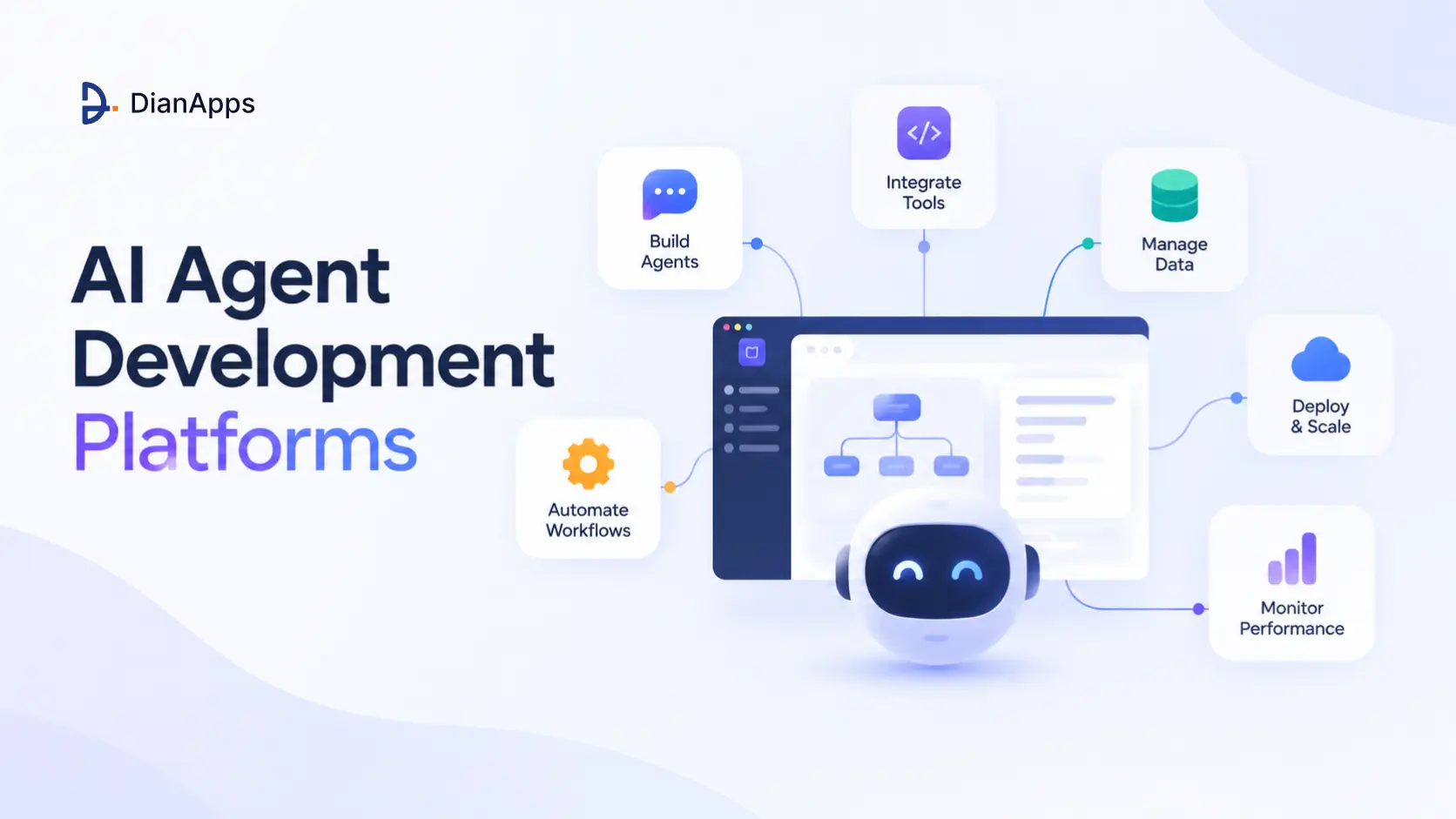





Most companies exploring AI agents in 2026 run into the same fork in the road early: pick an existing AI agent builder and configure it, or have a development team build a custom agent from the ground up. Both paths work. Both also fail for reasons that only become obvious after money and time are already spent.
This guide walks through the leading AI agent platforms on the market today, what they are actually good at, where they fall short, and a practical framework for deciding whether an off-the-shelf agent builder or custom development is the right call for your project.
What an AI Agent Builder Actually Does?
An AI agent builder is a platform that gives you the scaffolding to create an autonomous or semi-autonomous AI agent without writing the entire system from scratch. That scaffolding typically includes:
- Model access: A connection to one or more large language models, such as GPT, Claude, or Gemini.
- Tool calling: A way to let the agent call external APIs, databases, or internal systems to take action, not just generate text.
- Memory management: Short-term conversation memory and, in more mature platforms, long-term memory across sessions.
- Orchestration logic: Rules for how the agent reasons, retries failed steps, and hands off to other agents or humans.
- Deployment and monitoring: A way to run the agent in production and see what it is doing.
The difference between an AI agent platform and a plain chatbot builder is that the agent is meant to take multi-step action, not just respond to a single prompt. It might read a support ticket, look up an order in your system, decide on a resolution, and execute it, rather than simply drafting a reply for a human to send.
The Major AI Agent Development Platforms in 2026
The market has consolidated somewhat since 2024, but three categories of platforms still dominate most build-vs-buy discussions: cloud-native enterprise platforms, workflow automation tools with agent capabilities, and code-first developer frameworks.
Vertex AI Agent Builder (Google Cloud)
Vertex AI Agent Builder is Google Cloud’s platform for building and orchestrating agents, and it has gone through a significant rebrand. At Google Cloud Next in April 2026, Google folded the developer platform into what it now calls the Gemini Enterprise Agent Platform, though most teams still search for and refer to it as Vertex AI or Vertex AI Agent Builder.
The platform bundles a few distinct pieces:
- Agent Development Kit (ADK): A code-first, open-source framework for building production agents with fine-grained control over reasoning and tool use.
- Agent Studio: A lower-code visual builder aimed at teams that do not want to write agent logic by hand.
- Model Garden: Access to a large catalog of foundation models, including Google’s Gemini family and, as of Cloud Next 2026, Anthropic’s Claude models alongside Meta’s Llama and Google’s open Gemma models.
- Agent Engine: A managed runtime for deploying and scaling agents, with observability and evaluation tooling added throughout 2026.
- Agent2Agent (A2A) protocol: A standard that lets agents built on different frameworks, including LangChain, LangGraph, AG2, and CrewAI, communicate with each other. A2A is now governed by the Linux Foundation rather than run solely by Google.
Vertex AI Agent Builder is a strong fit if your infrastructure already sits on Google Cloud and you need enterprise governance, identity controls, and observability across multiple agents. ADK itself is open source and can technically run on any Kubernetes environment, but you lose most of the platform’s practical value, including Agent Engine and its governance layers, if you are not running on Google Cloud. Pricing is usage-based across compute, model tokens, and search queries, which gives flexibility but makes monthly costs harder to predict without active monitoring.
n8n AI Agent
n8n AI agent functionality sits inside n8n’s broader workflow automation platform, and it approaches agent building differently than Vertex AI or OpenAI’s tools. Rather than a standalone agent product, n8n has an AI Agent node that plugs into its existing visual workflow canvas.
The AI Agent node accepts a chat model, an optional vector store for retrieval, and a set of tools, which can be n8n sub-workflows or direct HTTP requests. Internally, it runs a reasoning loop, either ReAct-style or function-calling depending on configuration, until the model completes the task or hits a step limit. As of 2026, the node supports OpenAI, Anthropic, Mistral, Google Vertex AI, Ollama for local models, and any OpenAI-compatible endpoint through a generic connector.
For memory, n8n offers window buffer memory for recent messages, summary memory for longer conversations, and external memory backed by Redis or Postgres for agents that need to persist context across sessions. A January 2026 update added structured tool calling that reduces the risk of the agent looping indefinitely on malformed tool calls, which had been a real production issue in earlier versions.
n8n works well for teams that already use it for integrations and want to add agent behavior to an existing automation, such as a support ticket triage flow or a research assistant that reads a webpage and writes a summary to a workspace tool. It is less suited to teams whose entire product is the AI agent itself; at that point, the workflow canvas can start to feel like extra scaffolding around what is fundamentally a custom application. n8n Cloud offers tiered pricing, with a lower-cost starter plan, a mid-tier plan, and custom enterprise pricing above that; exact figures should be confirmed on n8n’s pricing page, as they change periodically.
OpenAI Agent Builder
Open AI agent builder deserves a direct callout here because its status has changed significantly during 2026, and this is a detail worth knowing before you commit to it.
OpenAI launched AgentKit, including a visual drag-and-drop Agent Builder, at its DevDay event in October 2025. It bundled Agent Builder for designing multi-agent workflows, ChatKit for embedding a chat interface, a connector registry, and an evaluations platform. On June 3, 2026, OpenAI announced it was deprecating both the visual Agent Builder and the Evals platform, with both scheduled to shut down on November 30, 2026. OpenAI’s guidance for teams that had built on the visual canvas is to migrate to the code-first Agents SDK for production workflows, or to Workspace Agents inside ChatGPT for natural-language, no-code use cases.
If you are evaluating platforms in late 2026, this means the standalone Agent Builder product is not a viable long-term foundation. The durable part of OpenAI’s stack going forward is the Agents SDK combined with the Responses API and ChatKit, which is a code-first approach rather than a no-code one. Teams that want to stay in the OpenAI ecosystem without maintaining an orchestration codebase themselves may be better served by ChatGPT’s Workspace Agents for simpler use cases.
Other Notable AI Agent Development Tools
A few other platforms come up frequently in AI agent development platforms research and are worth a brief mention:
- LangChain and LangGraph: Open-source frameworks for building agent logic in code, widely used as the foundation other platforms, including Vertex AI, support natively.
- CrewAI and AG2 (formerly AutoGen): Frameworks focused specifically on multi-agent collaboration, where several specialized agents coordinate on a task.
- Flowise and Langflow: Lower-code visual builders on top of LangChain, generally stronger for prototypes and internal pilots than for production-grade deployments with audit trails and cost monitoring built in.
Build vs Buy: A Practical Comparison
The honest answer to “should I build or buy” depends less on the platform and more on what your agent needs to do, how it needs to integrate with your existing systems, and how much ongoing engineering capacity you have to maintain it.
| Factor | Buy (Agent Builder Platform) | Build (Custom Development) |
|---|---|---|
| Time to first working version | Days to a few weeks | Several weeks to a few months |
| Upfront cost | Lower; usage-based pricing | Higher; engineering time is the main cost |
| Ongoing cost predictability | Variable; scales with usage and tokens | More predictable once built, but requires maintenance |
| Customization depth | Limited by the platform’s architecture | Not limited by a vendor’s platform, within your own engineering resources |
| Integration with proprietary systems | Works well for common integrations; custom systems need extra engineering | Built to fit your exact stack from day one |
| Vendor lock-in risk | Real, and platform roadmaps can change, as with OpenAI Agent Builder in 2026 | Low; you own the architecture |
| Team skill requirement | Lower for low-code tools; higher for code-first kits like ADK | Requires dedicated AI or ML engineering capacity |
| Best fit | Well-defined, common workflows such as support triage or internal research assistants | Differentiated products where the agent is core to your value proposition |
A useful gut check: if the agent you are building is a supporting feature inside a broader product, an agent builder platform likely gets you there faster and cheaper. If the agent’s behavior, reasoning, and integrations are the actual product you are selling, custom development gives you the control and independence that a vendor’s roadmap decisions, like OpenAI’s Agent Builder shutdown, can otherwise take away from you.
Where Off-the-Shelf Platforms Fall Short?
No AI agent platform, however mature, completely removes the need for engineering judgment. Common gaps teams run into include:
- Debugging non-deterministic behavior: Independent reviewers described Google’s own Vertex AI Agent Builder updates in late 2025 as a solid step forward but still early-stage for debugging complex, non-deterministic agent chains, with deeper observability integrations like OpenTelemetry or Datadog requiring custom connector work rather than native support.
- Knowledge-base connectors: Some platforms, including n8n, lack a native knowledge-base connector out of the box, meaning retrieval-augmented generation setups need extra scaffolding.
- Platform roadmap risk: A hosted visual builder is, ultimately, a surface the vendor controls. OpenAI’s decision to sunset its Agent Builder less than a year after launch is a clear example of why teams building something business-critical should weigh how much of their agent logic lives inside a proprietary, vendor-hosted canvas versus in portable, standards-based code.
- Cost unpredictability at scale: Usage-based pricing across model tokens, compute, and API calls can make monthly costs hard to forecast, particularly for platforms like Vertex AI, where billing spans multiple line items.
When Custom AI Agent Development Makes More Sense?
Custom development tends to be the stronger choice when:
- The agent needs deep integration with proprietary systems, legacy databases, or workflows that do not map cleanly onto a platform’s built-in connectors.
- Data privacy, residency, or compliance requirements rule out routing sensitive data through a third-party platform.
- The agent is a core, differentiating part of your product rather than an internal efficiency tool.
- You need architectural control that survives a vendor’s roadmap changes, rather than being exposed to the kind of shutdown OpenAI announced for its own Agent Builder in 2026.
This is where working with an experienced AI agent development team pays off. A team that has built agents across different industries can help you scope what genuinely needs custom engineering versus what an existing platform can already handle well, so you are not over-building or under-building for the problem in front of you.
Planning Your AI Agent Build vs. Buy Decision?
Share your use case, budget, and technical requirements with our AI team to find the right approach for your project.
 0 comments









Leave a Comment
Your email address will not be published. Required fields are marked *