















 0 comments





Key Takeaways:
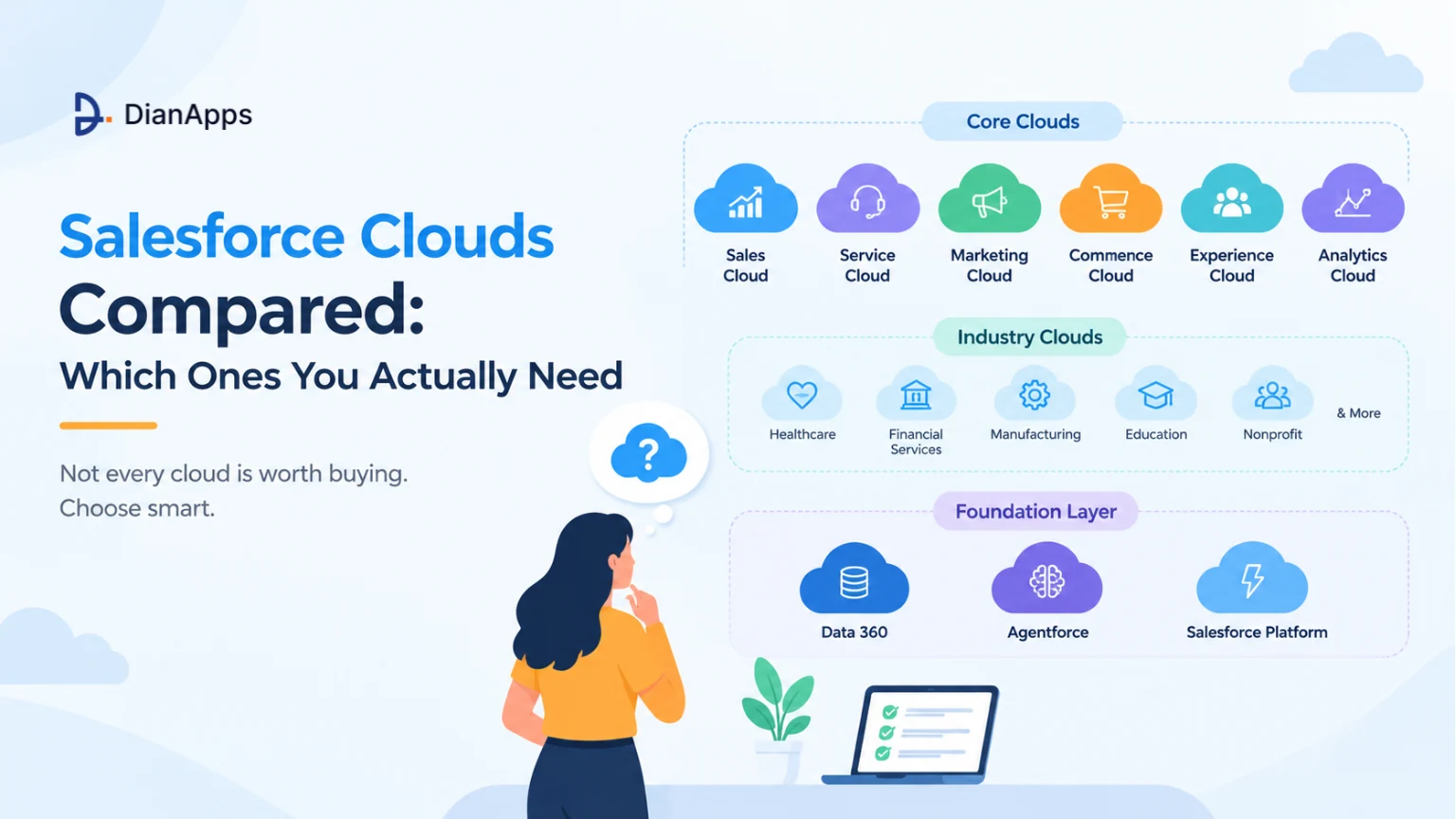
- Salesforce cloud counts vary because “cloud” is not a clearly defined category, with guides counting core products, industry clouds, or acquired products differently.
- The six core clouds are Sales, Service, Marketing, Commerce, Experience, and CRM Analytics.
- Salesforce rebranded several clouds with Agentforce names from late 2025, then returned to the familiar names in 2026. Its product and pricing pages now say Sales Cloud, Service Cloud, Marketing Cloud, and Commerce Cloud again, while certifications kept their Agentforce names.
- Data 360, Agentforce, and the Salesforce Platform are foundation layers rather than additional Salesforce clouds.
- Industry clouds provide pre-built data models for sectors such as healthcare, financial services, manufacturing, education, and nonprofit.
- Businesses often create unnecessary overlap by purchasing multiple products that perform similar functions, particularly Marketing Cloud vs. Marketing Cloud Account Engagement and CRM Analytics vs. Tableau.
- Most businesses should start with one or two clouds, rather than attempting a multi-cloud rollout from the beginning.
- Salesforce licences are purchased separately by cloud and user, making role-based licensing important for controlling costs.
- Data 360 and Agentforce are generally better added after an organization has clean data and well-established processes.
- The right Salesforce cloud mix depends on business processes, customer journeys, existing systems, and actual operational needs, not simply the size of Salesforce’s product catalogue.
Quick Answer: Most businesses do not need all Salesforce clouds. Sales Cloud is typically the starting point for sales-led organizations, while Service Cloud fits businesses focused on customer support. Marketing, Commerce, Experience, CRM Analytics, industry clouds, Data 360, and Agentforce should be added based on specific business needs. Starting with one or two clouds and expanding after adoption is usually more practical than implementing the entire Salesforce ecosystem at once.
Ask how many Salesforce clouds there are, and you’ll get confident, contradictory answers. Six. Fifteen. More than twenty.
All three are right, and the reason nobody explains it is the most useful thing on this page: “cloud” isn’t a defined term. Some guides count only the core products. Some add industry clouds. Some include acquired products like Tableau and Slack that Salesforce sells but runs separately.
There’s a second reason the guides disagree, and it’s newer: names keep changing. From late 2025 Salesforce marketed several clouds under Agentforce names (Agentforce Sales, Agentforce Service and so on), and in 2026 it went back to the familiar ones. Its product and pricing pages now say Sales Cloud, Service Cloud, Marketing Cloud and Commerce Cloud again. So depending on when an article was written, the same product can have two names.
This guide sorts the portfolio properly, then answers the question you’re actually asking – which ones do you need.
The Portfolio, Grouped Properly
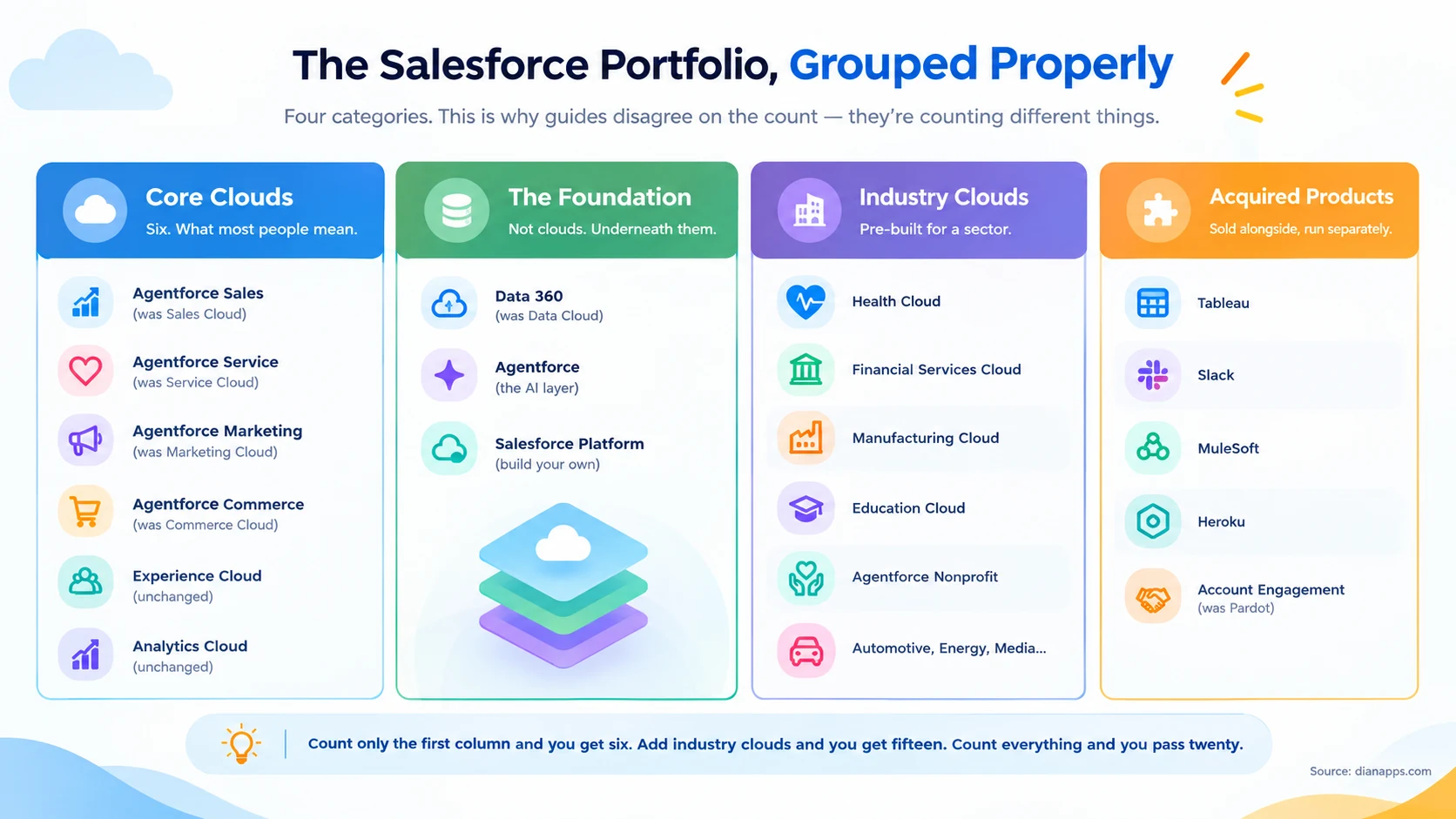
Count only the core clouds, and you get six. Add the industry clouds, and you’re near fifteen. Count acquisitions, and you pass twenty. That’s the whole explanation for the discrepancy, and once you see the grouping, the catalogue stops being confusing.
The foundation column matters more than it looks. Data 360, Agentforce and the Platform aren’t clouds – they sit beneath all of them. A guide that lists Data Cloud as “the seventh cloud” has miscategorised it, which then makes the rest of the advice harder to follow.
The Six Core Clouds
| Cloud | Also seen as | What it’s for | Typical buyer |
|---|---|---|---|
| Sales Cloud | Agentforce Sales (2025–26 name) | Pipeline, forecasting, quoting, deal management | Sales leadership |
| Service Cloud | Agentforce Service (2025–26 name) | Cases, routing, knowledge, chat, phone | Support leadership |
| Marketing Cloud | Agentforce Marketing (2025–26 name) | Email, journeys, SMS, advertising | Marketing leadership |
| Commerce Cloud | Agentforce Commerce (2025–26 name) | B2B, D2C and B2C storefronts | Ecommerce leadership |
| Experience Cloud | Community Cloud (old name) | Portals, communities, partner sites | Whoever owns the audience |
| CRM Analytics | Analytics Cloud, Einstein Analytics, Tableau CRM (old names) | Dashboards and reporting inside CRM | Operations, leadership |
Sales Cloud and Service Cloud remain the most deployed by a wide margin. Most Salesforce projects still start with one or both, and that hasn’t changed despite everything else that has.
The fastest-growing area isn’t a cloud at all; it’s Data 360, because unified data is what makes the AI layer worth having.
Deeper: Sales Cloud guide · Service Cloud guide · Marketing Cloud guide
The Foundation: Not Clouds, but Underneath Them
Data 360 (formerly Data Cloud) unifies customer records from every system you run – Salesforce and otherwise – into one profile. It’s what makes “one customer view” real rather than aspirational, and it’s what agents are grounded in. See Data 360 explained.
Agentforce is the AI agent layer spanning every cloud. Not a separate product you use in isolation – it acts inside Sales, Service, Marketing, and the rest. See what Agentforce is.
The Salesforce Platform is what all of it is built on, and what you build your own applications on. It also has its own licences: Platform Starter lists at $25 and Platform Plus at $100 per user/month, against $195 for a Sales Cloud Core seat, which matters if you have users who never touch a Lead or Case. See the Salesforce Platform explained.
Industry Clouds
These are pre-built data models for specific sectors – not add-ons or templates, but genuine object models Salesforce builds and maintains.
| Industry cloud | What it adds |
|---|---|
| Health Cloud | FHIR-aligned clinical model: patient, care plan, encounter |
| Financial Services Cloud | Household and relationship model, financial accounts, policies |
| Manufacturing Cloud | Sales agreements, account forecasting, rebates |
| Education Cloud | Student journey: applications, programmes, affiliations |
| Nonprofit Cloud | Gift transactions, grantmaking, programme management |
| Automotive, Energy, Media, Public Sector | Sector-specific models for each |
Since September 2026, Salesforce sells its industry clouds as Industry Editions (Core, Advanced and Max), which include the full Sales and Service capabilities plus the sector data model. Salesforce has said new Industry Edition pricing takes effect later this fall, so check current pricing before you budget.
The argument for buying rather than building is simple arithmetic. Rebuilding an industry data model costs six figures, and you maintain it forever; the industry cloud costs more per seat and Salesforce maintains it. For anything genuinely clinical, financial or regulated, the industry cloud wins on total cost by year three.
Deeper: Salesforce for healthcare · Salesforce for financial services · Salesforce for manufacturing
Where Clouds Overlap, and You Pay Twice
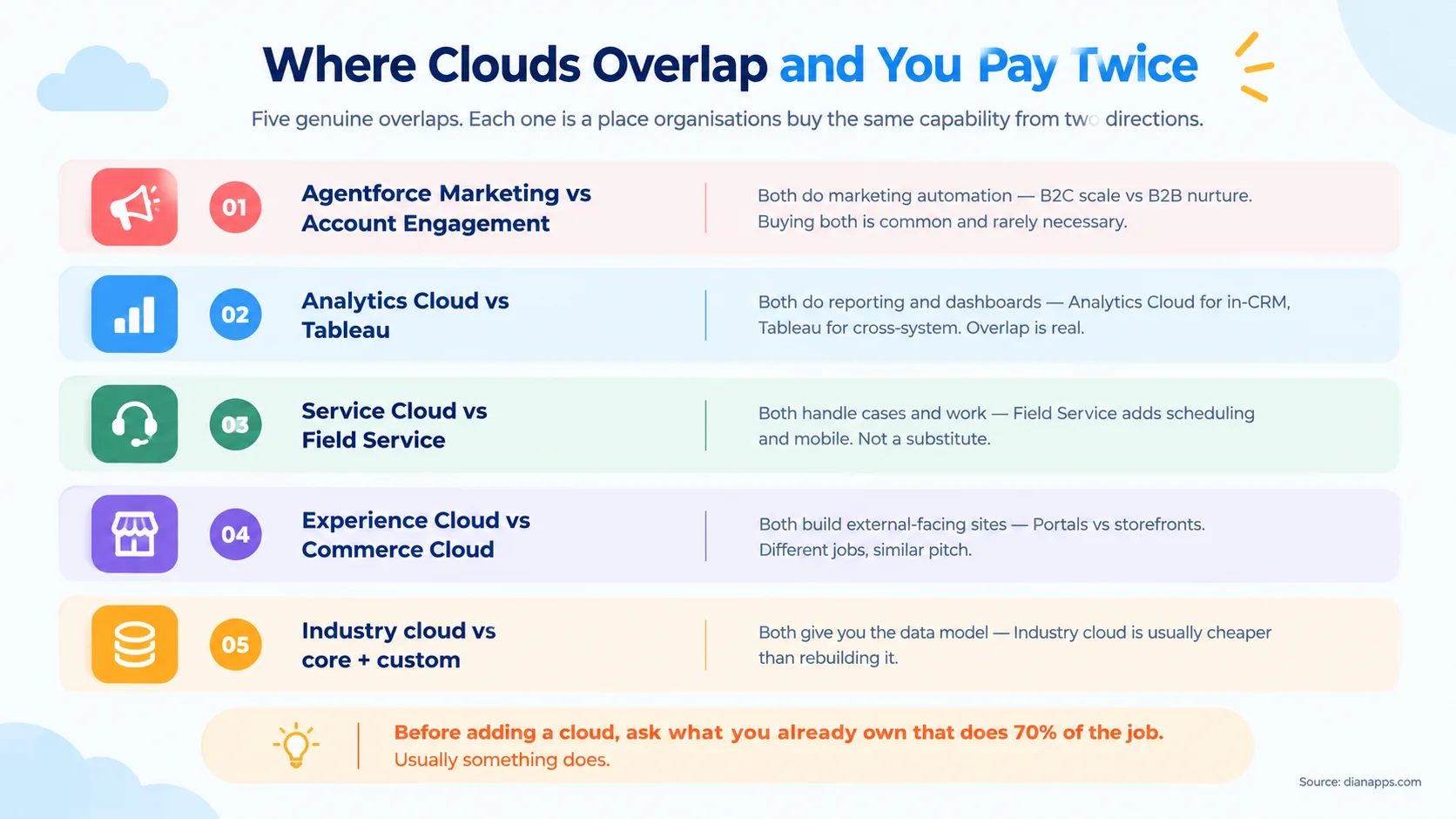
The Two Worth Understanding Before You Buy Anything:
- Marketing Cloud versus Marketing Cloud Account Engagement: Account Engagement is what used to be Pardot, and it’s a genuinely separate product from Marketing Cloud despite both doing marketing automation. The rough split is B2C scale versus B2B nurture. Plenty of organisations end up owning both because different teams bought them at different times, and one usually goes unused.
- CRM Analytics versus Tableau: Both do reporting. CRM Analytics lives inside the CRM and is good at CRM data. Tableau is stronger across systems and better for analysts. The overlap has also shifted: since September 2026, Salesforce’s new Core, Advanced, and Max editions include Tableau Next, so check what your edition already includes before buying either separately.
- Before adding any cloud, ask what you already own that does 70% of the job: This is where Salesforce consulting services can help businesses assess their existing setup, identify overlapping capabilities, and determine whether another cloud is actually necessary. Usually, something already does 70% of the job, and 70% with no additional licence often beats 100% with one.
Related: How to reduce Salesforce licence costs
Are You Paying for Unused Salesforce Clouds?
Get expert help auditing your Salesforce licences, eliminating unnecessary overlap, and choosing the right cloud mix for your business.
What to Start With
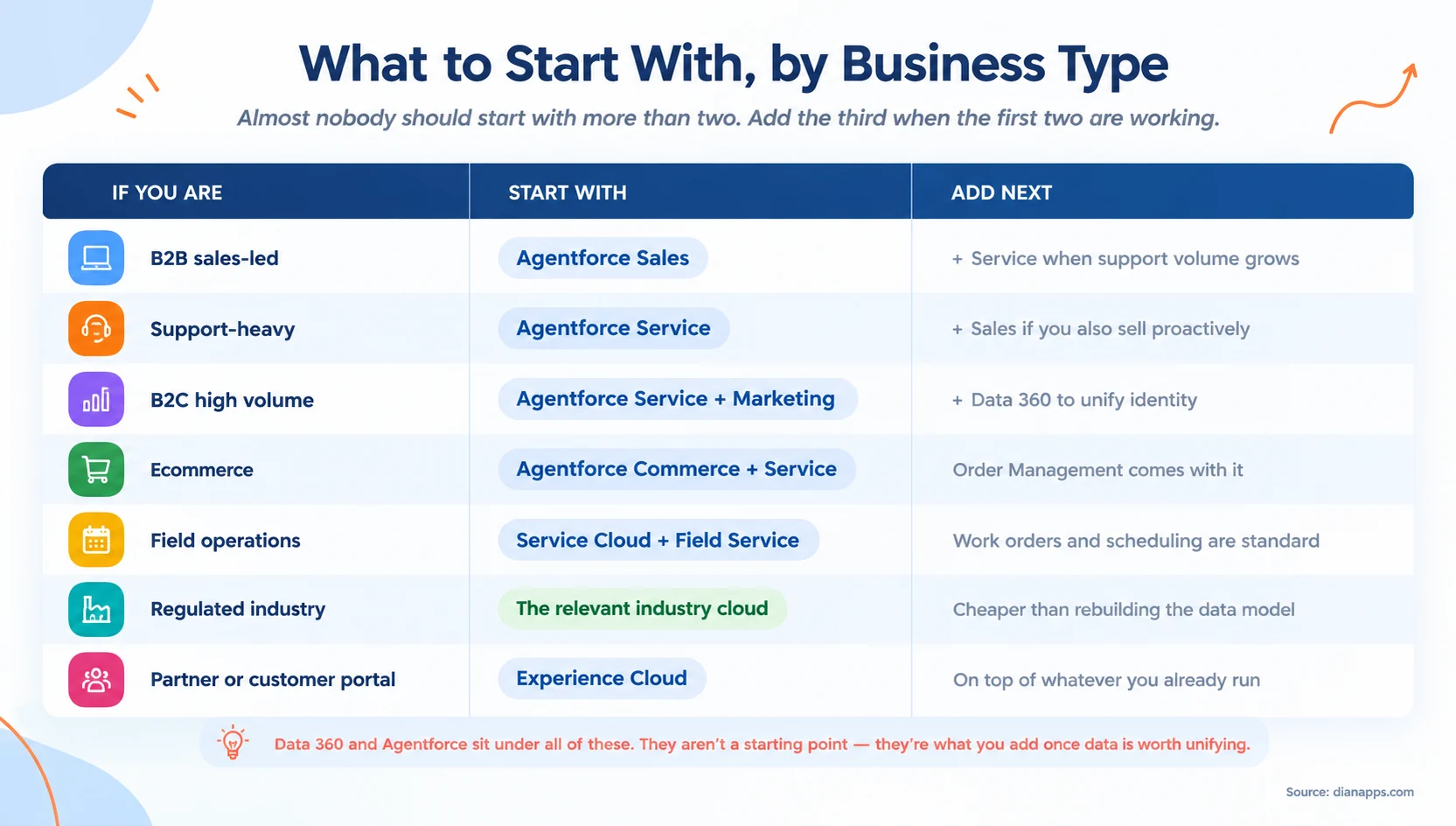
- Almost Nobody Should Start With More Than Two: The most common implementation failure isn’t picking the wrong cloud – it’s buying four and rolling out none of them properly.
- The Sequencing That Works: Get one cloud genuinely adopted, with clean data and people actually using it, then add the second. A working Sales Cloud beats a half-implemented Sales, Service and Marketing suite in every measurable way.
Ready to Build Out Your Salesforce Setup?
Bring in experienced Salesforce developers to customize, integrate, and scale the clouds your business actually needs.
Data 360 and Agentforce come later, not first. They’re what you add once you have data worth unifying and processes worth automating. Buying the AI layer before the data is clean is how organisations end up with agents that give confident wrong answers.
Common Combinations
| Combination | Why it works | Watch for |
|---|---|---|
| Sales + Service | The classic. Covers the full customer lifecycle | Ensure one account model, not two |
| Service + Field Service | Cases plus scheduling and mobile engineers | Field Service is a separate licence |
| Sales + Marketing (or Account Engagement) | Lead generation through to close | Decide which system owns the lead |
| Commerce + Service | Orders plus post-purchase support | Order Management is a separate product (Order Visibility and Growth editions), pre-integrated with Commerce, so budget for it |
| Industry cloud + Experience Cloud | Sector data model plus customer portal | Portal licences are counted separately |
| Any core cloud + Data 360 | Unified identity across systems | Only worth it once you have several systems |
The one to think hardest about is Sales plus Marketing. The question that prevents most problems is deciding early which system owns the lead record and which one owns consent. “Both” is how data diverges.
Licensing: What Multi-Cloud Actually Costs
Each cloud is licensed separately, per user. That’s the fact most buyers underestimate. Two clouds for fifty users is not one licence; it’s two, and the cost roughly doubles for anyone who needs both. The new Core, Advanced and Max editions (September 2026) bundle Slack, Tableau Next, Agentforce and Premier Success into each Sales or Service seat, but Sales and Service are still bought as separate editions.
Three things that reduce the bill:
- Not Everyone Needs Every Cloud: A support agent doesn’t need Sales Cloud. Licence by role, not by headcount.
- Platform Licences: Platform Starter is $25 and Platform Plus $100 per user/month, against $195 for a Core CRM seat, for users who need custom apps but never touch Leads, Opportunities, or Cases. In most organisations, that’s more people than expected.
- Editions Matter As Much As Clouds: New buyers choose between Core ($195), Advanced ($395) and Max ($550) per user/month, and the jump from Core to Advanced costs more per seat than adding a second cloud for a small team. Existing customers on legacy Enterprise or Unlimited keep their current pricing.
Deeper: Salesforce pricing in full · Editions compared · Reducing licence costs
The Naming Problem
Worth a short section, because it causes real confusion when comparing guides.
Salesforce has renamed the same products repeatedly. Pardot became Marketing Cloud Account Engagement. Force.com became the Lightning Platform, then the Salesforce Platform. Analytics Cloud became Einstein Analytics, then Tableau CRM, then CRM Analytics. Data Cloud became Data 360. And from late 2025 several clouds were marketed under Agentforce names before Salesforce returned to Sales Cloud, Service Cloud, Marketing Cloud and Commerce Cloud in 2026.
What this means practically:
- An article using only old names was written before 2026
- An article using only new names may be missing that Experience and Analytics Cloud kept theirs
- A partner listing “Sales Cloud Consultant” hasn’t updated their credentials – the certification was renamed in July 2026
Some stale content is worse than that; one widely-shared guide with a 2026 update stamp still lists “Vaccine Cloud” among the current products, a COVID-era offering. If a guide’s product list includes something that no longer exists, treat the rest of its advice accordingly.
Related: Salesforce certifications and the 2026 renames
Where to Go Next
For the individual clouds in depth – Sales Cloud · Service Cloud · Marketing Cloud · Experience Cloud
For the foundation layer – Data 360 · what is Agentforce · the Salesforce Platform
For industry clouds – Salesforce for healthcare · Salesforce for financial services · manufacturing · nonprofit
For cost – Salesforce pricing · editions compared · reducing licence costs · Salesforce ROI
For deciding whether Salesforce fits at all – Salesforce alternatives · vs HubSpot · for startups and SMBs
For implementing – choosing an implementation partner · every Salesforce product
The complete guide to Salesforce is the hub.
Buying More Clouds Than You Need Is the Default Outcome
Salesforce sells by cloud, so the conversation naturally trends toward more of them. Nobody in that meeting is incentivised to say “you don’t need Marketing Cloud yet.”
We are, because an implementation that covers two clouds properly succeeds, and one that covers four badly becomes a rescue project.
Not Sure Which Salesforce Clouds You Need?
Tell us about your business and existing systems, and our team can help you determine the right Salesforce setup without paying for unnecessary products.
 0 comments





Your email address will not be published. Required fields are marked *