















 0 comments





Key Takeaways
- Announced 26 August 2026: Salesforce and Anthropic are announcing Claudeforce on the same day Salesforce is reporting Q2 FY27 earnings, with Marc Benioff and Dario Amodei presenting it together (Salesforce Newsroom, 2026).
- The first product is a plugin: Salesforce in Claude is shipping with 37 prebuilt sales skills covering meeting prep, deal health review, pipeline review, and account planning.
- Access is limited today: Select pilot customers are using it now, an open beta is planned for September 2026, and no standalone pricing is published.
- The unlock is administrative, not intelligent: One admin is connecting the org once, and every seller is inheriting the permissions they already have instead of wiring a personal connection.
- Claudeforce is not Agentforce: Agentforce is the agent platform running inside Salesforce; Claudeforce is the partnership that is putting governed Salesforce context inside Claude.
- Preparation is the real project: Permission audits, field-level security, and read-only scoping are the tasks deciding whether a pilot is safe to run on production data.
Quick Answer: Claudeforce is the expanded Salesforce and Anthropic partnership announced on 26 August 2026. Its first product, Salesforce in Claude, is a plugin with 37 prebuilt sales skills that lets sellers read and update live CRM data from inside Claude. Pilot access is open now; open beta is planned for September 2026. Most teams are starting with a permissions audit before touching it, which is where Salesforce development services teams are getting involved first.
For most of its history, Salesforce has been selling screens. On 26 August 2026, the company is announcing a product whose central promise is that a seller might not need to open one. That product is Claudeforce, and what it actually contains matters more than the launch headline does.
This guide covers what is shipping today versus what is still framing, the architecture underneath the Salesforce Claude plugin, the permission model, the cost questions nobody is answering yet, and a practical checklist for preparing a Salesforce org before the September open beta.
What is Claudeforce?
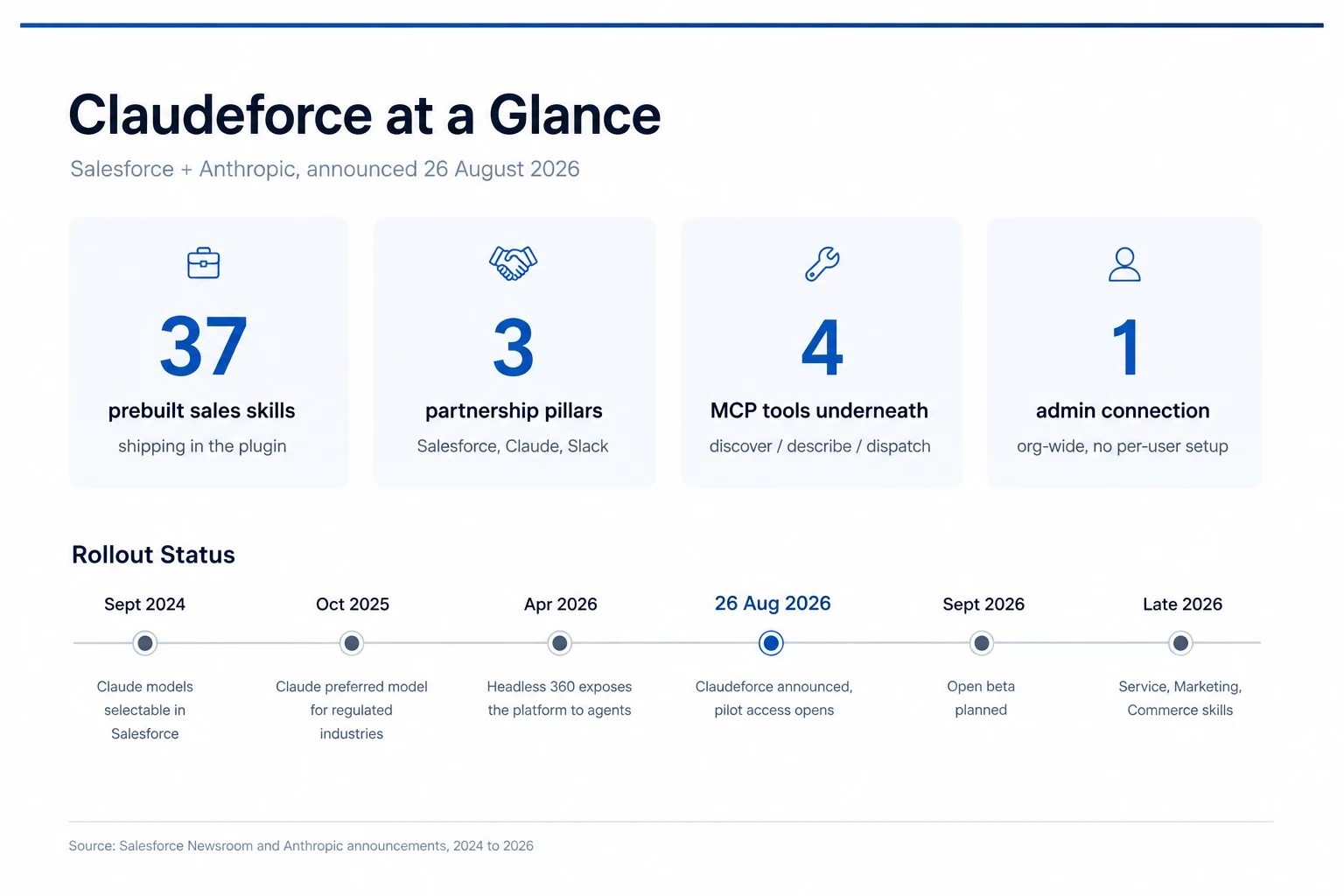
Claudeforce is the expanded strategic partnership between Salesforce and Anthropic, announced on 26 August 2026 during Salesforce Q2 FY27 earnings (Salesforce Newsroom, 2026).
It is running in two directions at once: Claude is moving into Salesforce as a reasoning model, and Salesforce is moving into Claude as a plugin carrying 37 prebuilt sales skills.
Two clarifications are worth making early, because launch coverage is blurring both.
- It is not a new model: Claudeforce is a commercial and product partnership, not a Salesforce foundation model and not a fine-tuned Claude variant.
- It is not a first date: Claude is already a foundation model inside Agentforce since late 2025, and Salesforce is already selecting Claude models through Amazon Bedrock since September 2024. Claudeforce is formalising and deepening that relationship.
The strategic bet is unusual for a company that is selling user interfaces. Salesforce is arguing that when people stop using the platform through its own screens and start using it through an agentic interface, the platform is becoming more valuable rather than less.
Why the Salesforce Anthropic partnership is arriving now
Claudeforce is the commercial packaging of architecture Salesforce is shipping four months earlier.
In April 2026, Salesforce announced Headless 360, the initiative exposing platform capabilities as APIs, MCP tools, and CLI commands instead of screens. The Headless 360 MCP server is becoming the underlying connection layer for this approach, while the Hosted MCP Servers are entering Beta in July 2026, so the plumbing is already in place.
What is missing is scale. After TDX 2026, teams building agent interfaces against those MCP servers are hitting the same wall repeatedly: managing authentication, enforcing permissions across a hundred or more users, and governing the whole arrangement without a central control point.
Claudeforce is solving an administration problem more than an intelligence problem. One admin connects the org, everyone gets access scoped to their own profile, and nobody re-audits account by account.
What Claudeforce actually includes
Claudeforce is an umbrella name covering three separate workstreams. They carry different maturity levels, different buyers and very different risk profiles, so it helps to keep them apart. The broader Salesforce AI strategy also includes products and initiatives sometimes discussed under the AIforce umbrella, but Claudeforce itself refers specifically to this Salesforce-Anthropic partnership and its associated products.
| Pillar | What Claude is doing | Status as of Sept 2026 |
|---|---|---|
| Claude in Salesforce | Reasoning model across Atlas Reasoning Engine, Agentforce Vibes, Agentforce Coworker and Agent Builder | Available; default in Vibes and Coworker |
| Salesforce in Claude | Plugin bringing live CRM data and Claudeforce 37 sales skills. | Select pilot customers; open beta planned Sept 2026 |
| Claude in Slack | Default model for Slackbot, Claude Tag and Slack Code | Rolling out |
The deployment detail that regulated industries are caring about sits in the first row. Claude is being served through Amazon Bedrock inside the Salesforce Trust Boundary, so inference workloads are staying within the Salesforce security perimeter rather than making a round trip to a third-party API. CrowdStrike and RBC Wealth Management are named early adopters (Anthropic, 2025).
What are the 37 Salesforce in Claude skills?
Salesforce is describing the 37 skills as capabilities co-engineered with Anthropic against Claude reasoning, agentic tool use and generated interfaces, rather than generic CRM prompts wrapped around a REST API.
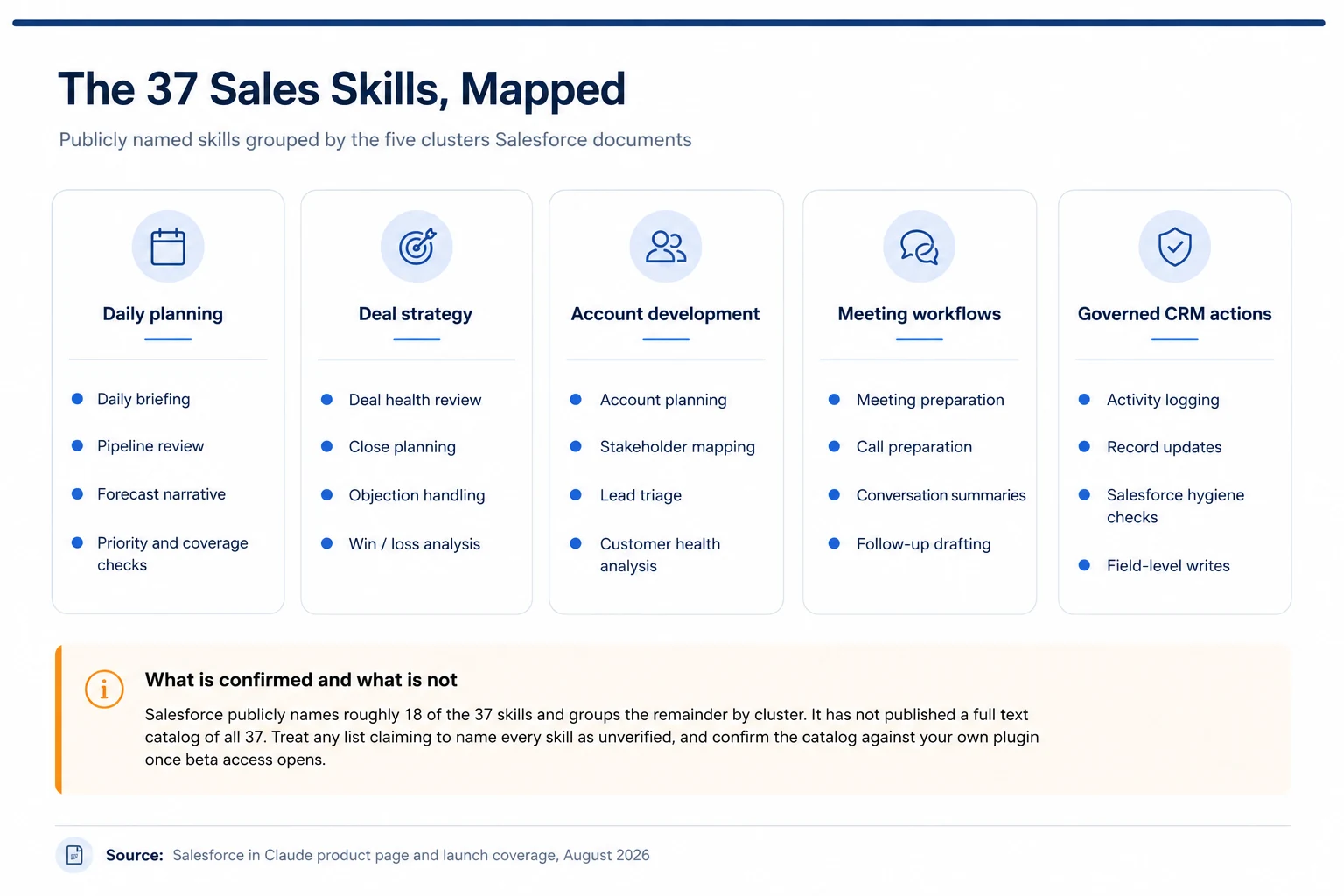
One Honest Caveat Before The List: Salesforce is publicly naming roughly 18 of the 37 and grouping the remainder into five clusters, so no complete text catalog of all 37 names exists yet. Any article claiming to list every one is inventing the rest. What follows is every skill that is confirmed in the launch material and the product page, mapped to its cluster.
The confirmed skills, cluster by cluster
| Cluster | Confirmed named skills | What the cluster is replacing | Read or write |
|---|---|---|---|
| Daily planning | Daily briefing, pipeline review, forecast narrative, priority and coverage checks | The morning spent assembling a picture across list views and reports | Read |
| Deal strategy | Deal health review, close planning, objection handling, win/loss analysis | Manual deal inspection across calls, emails and stage history | Read |
| Account development | Account planning, stakeholder mapping, lead triage, customer health analysis | Account research and territory prioritisation done by hand | Read |
| Meeting workflows | Meeting preparation, call preparation, conversation summaries, follow-up drafting | Pre-call context gathering and post-call note writing | Read and write |
| Governed CRM actions | Activity logging, record updates, Salesforce hygiene checks, field-level writes | The admin work reps skip, which is why the data is unreliable | Write |
Why the skill count matters more than the skill names
Counting to 37 is not the interesting part. What is interesting is that a packaged skill library is changing the unit of governance for a RevOps team.
- A Skill Is Not A Prompt: A prompt varies by whoever typed it. A skill is encoding task-specific guidance, such as which of two overlapping fields to trust, or what deal health means in a particular pipeline.
- A Skill Is Not A Tool Either: A raw MCP connection is handing Claude a pile of operations and hoping it chooses well. The skill layer sits above the tools and decides how they are sequenced.
- Consistency Becomes The Deliverable: The practical shift is from a pipeline review that varies by rep to one that runs the same way across the team, which is what makes the output comparable.
- Governance Moves To The Catalog: Instead of approving individual integrations, a team is deciding which of the 37 skills to enable, and how much write autonomy each one gets.
What is not in the 37?
The current package is sales only, salesforce is marking Service, Marketing and Commerce capabilities as coming later in 2026 without firm dates, so anything displayed as forthcoming should not be counted as part of this pilot.
There is also an onboarding step worth flagging. On first run, the plugin is reading a seller’s context across Salesforce, Slack, and any other connector enabled in Claude, then standing up a tailored dashboard of accounts and pipeline. That first sweep is touching everything the connection can reach, which is a strong argument for auditing permissions before the pilot rather than after it.
How is Salesforce in Claude working under the hood?
Underneath the plugin branding this is the Headless 360 Hosted MCP Server architecture with a managed authentication layer sitting on top.
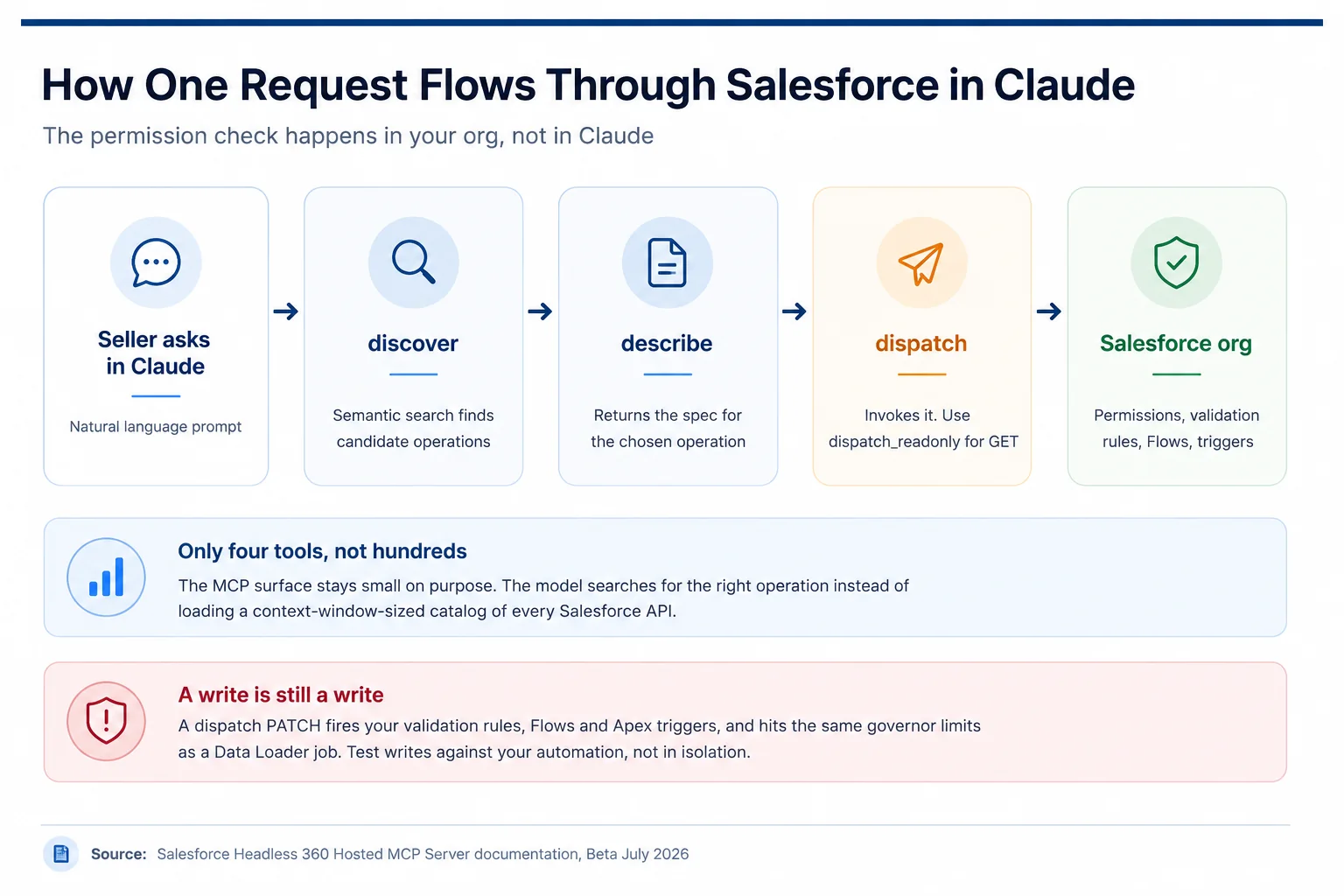
The platform/headless-360 MCP server is exposing only four tools, which surprises teams expecting hundreds.
| Tool | API name | What it does |
|---|---|---|
| Discover | discover | Semantic search across Salesforce operations, returning ranked candidates |
| Describe | describe | Returns the technical specification for a chosen operation |
| Dispatch | dispatch | Invokes the operation (GET, POST, PUT, DELETE, PATCH) |
| Dispatch (read-only) | dispatch_readonly | GET requests only |
Takeaway: The surface is deliberately small so the model is searching for the right operation rather than drowning in a context-window-sized tool catalog.
That design choice is why the architecture is scaling to the whole platform. Three steps are replacing one, and in exchange the server is not registering every Salesforce API as a separate tool.
The critical thing to understand is that writes are still normal Salesforce writes. A dispatch PATCH is firing validation rules, Flows, and Apex triggers exactly as a Data Loader job would, and CPU-time governor limits are applying in the same way. Teams mentally filing an AI action as something separate from DML are getting caught by this.
Permissions, security and write controls
Salesforce is stating that every answer and action is running through the org’s existing permissions and business rules. Claude is seeing only what the signed-in user is authorised to see, and taking only actions that user is authorised to take.
Authentication and permissions are managed centrally when an administrator connects the plugin. Salesforce is also describing configurable write controls, including confirmation before an external email is sent, and record updates scoped to the field Claude identifies.
That makes the division of Salesforce responsibilities more important, not less. Understanding the difference between a Salesforce admin, developer and architect helps clarify who should own permissions, automation, integrations and the technical design behind the connector.
The Claudeforce product page is advertising zero data retention for Sonnet, Opus and Haiku, plus in-development controls covering data location, access and automated review.
- These Are Vendor Claims: Security and compliance teams should evaluate the implementation, the contract terms and the product configuration against their own requirements before production use.
- Two Connection Routes Exist: The Hosted MCP Server route is using per-user OAuth, so every call is running as the person making it. The Claude Tag route in Slack is using a client credentials flow with a dedicated integration user, so the credential is belonging to the agent rather than to a person.
- Over-Provisioning Is The Real Risk: Profiles that are harmless behind a slow user interface are becoming genuinely risky behind an agent that can query and act in seconds.
Claudeforce vs Agentforce vs a DIY MCP connector
The names are similar enough that buyers are confusing them, and a third option already exists for teams who wired Claude to Salesforce themselves. That makes Claudeforce vs Agentforce an important distinction, particularly because the two products overlap at the model layer while serving different interface and deployment needs.
| Dimension | Claudeforce (Salesforce in Claude) | Agentforce | DIY MCP connector |
|---|---|---|---|
| Where the work happens | Inside Claude | Inside Salesforce and customer channels | Inside Claude |
| Setup effort | One admin connection, org-wide | Agent build plus org readiness | Per-user connector config |
| Prebuilt skills | 37 sales skills at launch | Build with Agent Builder, Flow, Apex | None, raw tool access |
| Governance model | Salesforce permissions and rules enforced | Einstein Trust Layer, audit trails | Salesforce permissions, no skill guidance |
| Best fit | Sellers and RevOps wanting speed | Customer-facing and regulated workflows | Technical teams prototyping |
| Availability | Pilot now, open beta Sept 2026 | Generally available | Available today |
Takeaway: these are not straight competitors. Claude is also running inside Agentforce, so the two are overlapping at the model layer and diverging at the interface layer.
How much is Claudeforce costing?
There is no standalone published price, salesforce launch material is not specifying required plans, seats, usage costs, packaging or enterprise terms, and it would be wrong to assume the plugin is included in an existing Salesforce, Claude or Agentforce subscription.
What is known about the shape of the bill is still useful for budgeting.
- You Are Paying On Two Contracts: Sales Cloud and Data 360 access continues as a mix of per-seat licences and consumption, and Claude Cowork licences are priced by consumption band on the Anthropic side. Because the pricing structures differ, these cannot be bought in a single contract today (Forrester, 2026).
- Consumption Is Token-Based, Not Seat-Based: Salesforce leadership is describing token consumption for this workload as far below a development or coding-agent use case, which is a comparison rather than a promise that it is cheap.
- Instrument Before You Commit: The only reliable number is your own. Running a small pilot cohort and measuring actual consumption is the step to take before signing anything org-wide.
Budget uncertainty, not technical risk, is the most common reason pilots are stalling at the procurement stage.
When is Claudeforce becoming available?
| Component | Status |
|---|---|
| Salesforce in Claude plugin | Select pilot customers |
| Open beta | Planned September 2026, no exact date published |
| Claude Tag including Salesforce connection | Public beta |
| platform/headless-360 MCP Server | Beta since July 2026, requires API v67.0 or later |
| Claude in Atlas Reasoning Engine and Agent Builder | Available |
| Claude in Agentforce Vibes and Coworker | Default model |
| Service, Marketing and Commerce skills | Later in 2026, no firm dates |
The Claudeforce open beta is planned for September 2026, but Salesforce has not published an exact date or general availability timeline. Teams should therefore treat the beta as a controlled evaluation window rather than a production commitment.
Takeaway: Beta means beta. A Q4 revenue process should not be sitting on this critical path.
One scheduling conflict deserves attention. Winter ’27 is introducing API version 68.0 with production waves through September and October 2026, which is landing on top of the Claudeforce open beta window. Running an AI pilot and a platform release through the same sandbox in the same fortnight is how teams end up unable to tell which change broke what.
Not sure whether your org is ready for the open beta?
Most Claudeforce pilots stall on permissions and data quality, not on the technology. Our Salesforce and AI teams run a structured org audit that tells you what to fix, in what order, before you connect anything to production.
How to prepare your Salesforce org for Claudeforce
The plugin is removing setup work; it is not removing readiness work. These six steps are the ones that matter before an open beta invitation arrives.
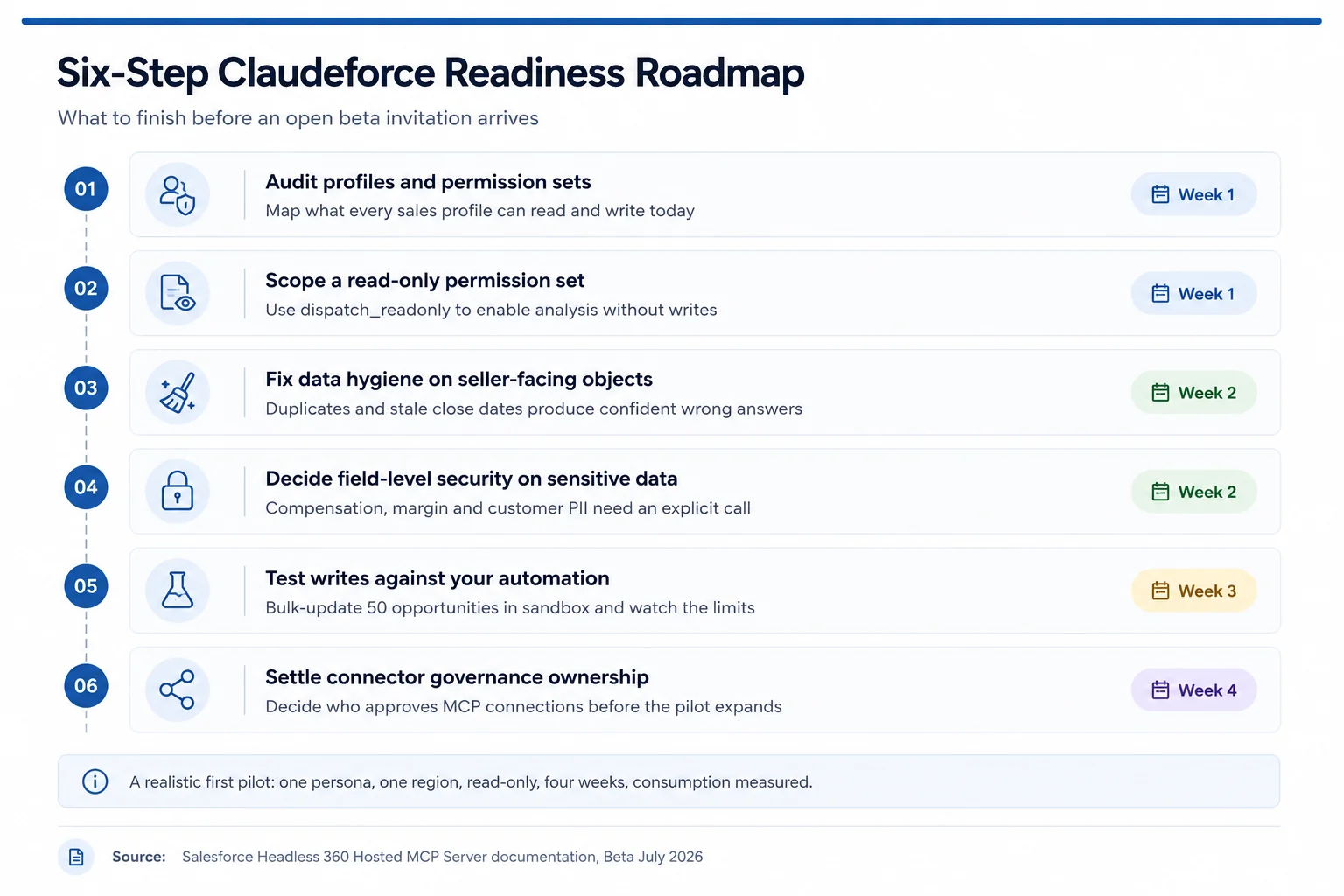
- Audit Profiles And Permission Sets First: Map what each sales profile can currently read and write. Anything over-provisioned is becoming an agent-speed liability, so tighten it before the connection exists, not after.
- Start Read-Only And Stay There For A Sprint: Create a permission set scoped to specific objects and fields with read access only. The dispatch_readonly tool exists precisely so analysis can be enabled without enabling writes.
- Fix Data Hygiene On The Objects Sellers Will Ask About: Duplicate accounts, stale close dates, and empty next-step fields are producing confident wrong answers. A reasoning layer is amplifying whatever quality already exists in the records.
- Decide Field-Level Security For Anything Sensitive: Compensation fields, margin data, and customer PII need an explicit decision, not an inherited default.
- Test Writes Against Your Automation, Not In Isolation: Run a sandbox scenario where the agent updates 50 opportunities and watch the Flows, triggers, Salesforce Flow Orchestration, and governor limits behave. This is where surprises are surfacing. This is an area where Salesforce Development Services can help, particularly when the existing automation, integrations, or data model needs to be reviewed before AI-driven writes are enabled.
- Decide Who Governs The Connector List: If individual teams stand up their own MCP connections alongside the official plugin, the outcome is shadow IT with better branding. Settle ownership before the pilot expands.
A realistic first pilot is one persona, one region, read-only, for four weeks, with consumption measured throughout.
Is Your Salesforce Org Ready for Claudeforce?
Audit permissions, field-level security, data quality, automation, and integration dependencies before connecting an AI interface to your Salesforce org.
What teams are actually asking about Claudeforce
These are the questions surfacing repeatedly across Salesforce practitioner communities, admin forums and comment threads on launch coverage in the week after the announcement.
We already connected Claude to Salesforce with an MCP server. What is actually new here?
The connection is not new; the management layer is. Previously, each user was configuring their own connector, and each admin was solving authentication and permission enforcement independently. Claudeforce is replacing that with one org-level connection plus a skills library that is standardising how the model interprets your data.
Is this going to let an agent wreck production data?
Only to the extent your permission model already allows it. The honest answer is that the risk is not the AI; it is profiles that are quietly over-permissioned because a slow user interface was acting as an accidental rate limiter. Fix the profiles and most of the anxiety resolves.
Does this mean Salesforce admins matter less now?
The opposite is happening in practice. Permissions, data model quality and automation behaviour are becoming the things that decide whether the agent is useful or dangerous, and those are all admin territory.
Should we wait for general availability?
Waiting for general availability may be reasonable for production workflows. But before deciding whether your organisation actually needs engineering work around the rollout, these signs your business needs Salesforce development help can help separate a genuine development requirement from an adoption or configuration problem.
How DianApps is approaching Claudeforce readiness
DianApps, an AI-first product development company, is working across both sides of this launch, which is unusual for a services partner. The Salesforce practice is covering consulting, development, implementation, integrations and managed services, while the AI practice is building large language model systems, AI agents and retrieval architectures. Claudeforce is sitting exactly at that intersection, and most of the preparation work is not Claude work at all. It is permission modelling, data hygiene, field-level security decisions, and automation testing inside the org.
With 150+ engineers, 350+ clients across 25+ countries, a Clutch rating of 4.8/5 and a US presence alongside delivery teams in India, DianApps is running readiness engagements that start with an org audit rather than a plugin install. Honesty matters here: not every company needs an agentic CRM interface. Teams with a clean pipeline, disciplined reps and a working reporting layer are often better served by fixing adoption than by adding a reasoning layer on top of unreliable records. Where the fit is real, our AI and ML development services teams are handling the evaluation design and consumption measurement that turn a pilot into a defensible business case.
For organisations without those capabilities internally, the in-house vs outsourced Salesforce development decision becomes part of the readiness plan, particularly when the project spans Salesforce architecture, AI integration, permissions and ongoing governance.
Need Salesforce Expertise for Your AI Rollout?
Bring in Salesforce developers who can strengthen your org’s permissions, automation, integrations, data model, and AI-readiness before deployment.
Conclusion
Claudeforce is a real architectural shift wrapped in a launch that is running ahead of its own availability. The partnership is broad, the shipping product is narrow, and the honest position in September 2026 is that pilot access is live while pricing, general availability and independent evidence from production use are all still outstanding.
What is not uncertain is the preparation. Permission audits, data hygiene and field-level security decisions are required work no matter which agentic interface a company eventually adopts, and they are the difference between a pilot that produces a business case and one that produces an incident report.
Ready for a Claudeforce Readiness Assessment?
Review permissions, data hygiene, field-level security, and sandbox write behaviour before your team moves from pilot preparation to production.
 0 comments












Leave a Comment
Your email address will not be published. Required fields are marked *