














 0 comments





Key Takeaways :
- FDEs Are A Combination Of Roles: They bring software engineering, solution architecture, consulting and business understanding to the table to solve client problems.
- They Work Directly With Clients: Unlike engineers in recent years who mainly work behind the scenes, FDEs embed themselves with client teams and build solutions within real-world environments by working on the client side.
- AI Deployment Is Their Core Strength: FDEs turn AI concepts and demos into secure, customized, production-ready systems that businesses can actually use and generate greater ROI.
- Technical And Communication Skills Both Matter: Strong FDEs need programming, data engineering, AI/ML, cloud and DevOps knowledge along with communication, ownership and comfort with ambiguity.
- The Role Is Built For Complex Deployments: FDEs are especially valuable for enterprise AI projects involving fragmented data, strict security requirements, legacy systems, or highly customized workflows.
Quick Answer : A Forward Deployed Engineer (FDE) fills the gap between advanced AI technology and real-world business execution. They work directly with clients to understand problems, build custom solutions, integrate AI into existing systems, handle security and deployment challenges and feed real-world insights back into the core product team.
AI models are unbelievably powerful, but there exists a huge gap between advanced algorithms and real world execution. Filling this gap and making use of these models in day-to-day tasks is a major challenge for modern companies.
Part senior developer and part strategic partner, an FDE is an engineer who embeds directly within client organizations to build custom solutions and solve complex technical problems on the ground with the clients. As the demand for rapid AI adoption skyrockets, this hands-on hybrid role has quickly become one of the tech industry’s most critical assets.
In this article, we break down what an FDE does, how the role compares to recent engineering positions, key skills to look for and when to deploy this high-impact model.
What Is A Forward Deployed Engineer?
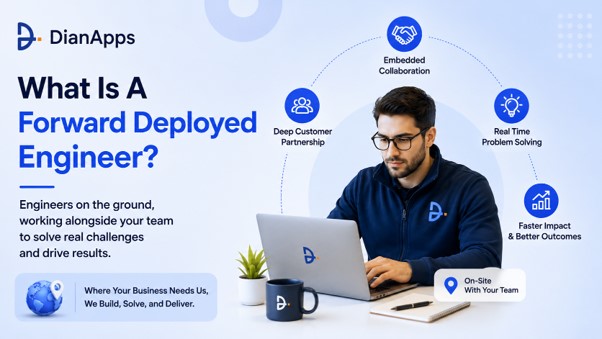
Forward Deployed Engineer (FDE or FDSE for Forward Deployed Software Engineer) or “Delta”, is a word coined by Palantir (a data-analytics company known for its work with huge companies and governments) is a software engineer who is embedded towards a company’s client’s side in order to design, build and ship custom software development, often AI solutions, inside the client’s real world systems, this is basically the forward deployed engineer meaning. They also integrate their learnings back onto the client’s core product. Take it as an employee who is part software engineer, part solution architect, part consultant and part startup CTO. In 2026, this is one of the fastest growing jobs in the IT industry and pays well for those engineers who can combine their technical knowledge with communication and business skills.
Palantir initially called FDE’s as Deltas, with their number increasing each year, they decided to call these deltas as forward deployed engineers as they carried many capabilities, from writing code to designing complete architecture by themselves.
Need Custom AI Development For Your Business?
Build, integrate, and deploy AI solutions tailored to your business workflows, data, systems, and specific requirements with experienced AI development experts.
Why Is The FDE Suddenly The Most In-Demand Role In AI?
Anthropic hires FDEs, OpenAI hires FDEs, every tech giant is now hiring for a Forward Deployed Engineer role but why? Here’s a simple answer to this.
Providing a demo on AI is way easier than the actual deployment.
To tackle this and stay consistent in the AI race, companies are hiring the FDEs to embed themselves directly into client teams turning flashy, theoretical technology into secure, everyday enterprise infrastructure.
Here are the top reasons for the rise in the FDE’s demands in 2026:
- Providing Real Value: Businesses/Enterprises are tired of paying for AI integrations that only looks good in the demo however fails to meet the expectations in real world working conditions.
- Data For AI Training: Companies cannot build the models themselves in an AI lab out of the box, they need real data on which they can train AI models. For this, FDEs are placed towards the client side to streamline this directly from the client’s side.
- Security: Sensible companies (falling under healthcare/banking/government, etc) will never share their customers data with generic public API providers. An FDE can integrate with these companies directly from the client’s office and provide a secure solution which otherwise seemed impossible.
What Is The Role Of Forward Deployed Engineers?
An FDE (Forward Deployed Engineer) is a highly skilled hybrid professional who combines engineering with high-level business consulting working at the clients side. They are the boots-on-ground in technical terms which are sent to embed themselves directly with the customers which in-turn helps the organisations in various ways.
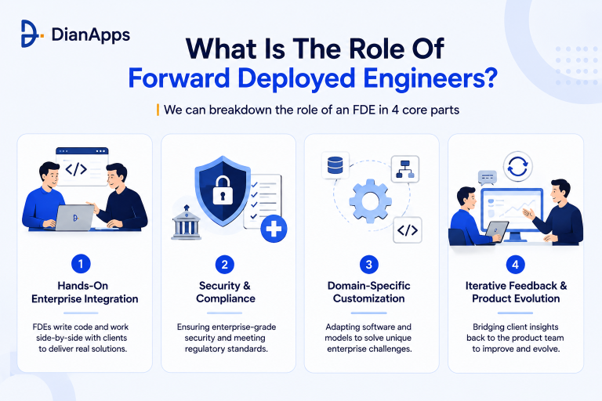
We Can Breakdown The Role Of An FDE In 4 Core Parts
-
Hands-On Enterprise Integration
The FDEs do not just give presentations to the clients, they write code, sit side-by-side with the client and provide solutions for the benefit of the client.
-
Security & Compliance
Large and secured enterprises like banks, financial institutions, government agencies, healthcare and others do not provide their internal data to public cloud API. The FDE ensures that high security is provided and the software regulatory frameworks.
-
Domain-Specific Customization
Ready made software rarely fits complex enterprise workflows requirements out of the box. FDEs deeply analyze the client’s unique operational challenges, fine-tuning models, building custom data pipelines and adapting core software to solve specific domain-level problems rather than offering generic fixes.
-
Iterative Feedback & Product Evolution
FDEs act as a direct feedback loop between the client and your core product team. By observing real-world edge cases and user pain points firsthand, they bring critical technical insights back home to refine, harden and evolve the main product roadmap.
Turn Your AI Idea Into a Working Solution
From enterprise integration and data pipelines to security and customization, get hands-on engineering support built around your business requirements.
What Are The Roles & Responsibilities of FDEs
The day-to-day life of an FDE is fast-paced and highly varied and their typical work day might look like this:
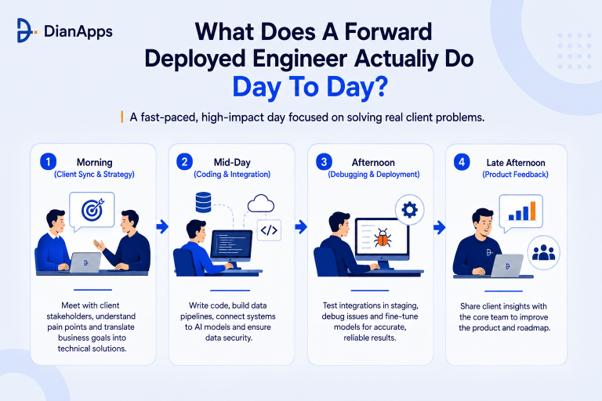
- Morning (Client Sync & Strategy): Meeting with client stakeholders (e.g., a VP of Supply Chain) to understand their pain points, FDE translates these business goals into technical requirements.
- Mid-Day (Coding & Integration): Writing code (usually Python, SQL, or TypeScript) to build data pipelines which involves connecting the client’s databases to an AI model, writing custom prompts and ensuring data security protocols are met, basically making data usable for the AI to understand and implement.
- Afternoon (Debugging & Deployment): Testing the integration in a staging environment, debugging API failures or addressing AI hallucinations by tweaking model parameters.
- Late Afternoon (Product Feedback): Syncing with the internal core engineering team “The client’s data is too fragmented for our standard API, we need to build a bulk-upload feature for the core product.”
FDE Vs Solutions Architect Vs AI Engineer Vs Consultant
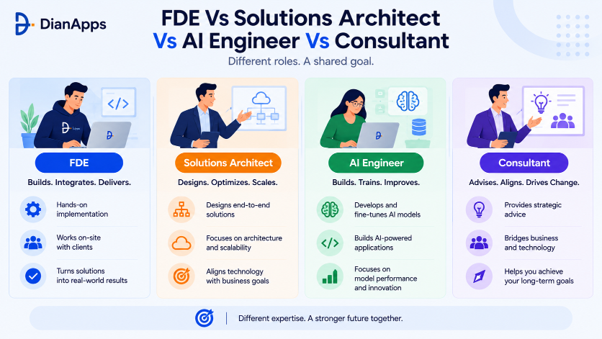
It’s easy to confuse the forward deployed engineer vs solutions architect and with other matching roles, here is how they differ from role to role:
| Role | Focus | Technical Depth | Client Facing | Key Difference |
| FDE | Deployment & Customization | High (Writes production code) | High | Codes custom solutions directly in the client’s environment. |
| Solutions Architect | System Design | Medium (High-level tech design) | High | Designs the architecture but rarely writes the final production code. |
| AI Engineer | Model Building | Very High (ML, PyTorch, TensorFlow) | Low | Focuses on training and fine-tuning the core AI model, not the business integration. |
| Consultant | Strategy & Process | Low (Business acumen) | High | Advises on what to do, but doesn’t build the technical solution. |
What Skills Should You Look For In An FDE?
As FDEs operate at the intersection of business and technology the skill set required is not just another one you’ll find a course for online, If you are looking forward to hire an FDE, you must be looking for these forward deployed engineer skills:
Hard Skills:
- Software Engineering: Good knowledge of Python, JavaScript/TypeScript and SQL.
- Data Engineering: Experience building ETL (Extract, Transform & Load) pipelines and working with messy & unstructured data.
- AI/ML Knowledge: Must know how to prompt, fine-tune and integrate LLMs (e.g., LangChain, OpenAI API).
- DevOps & Cloud: Familiarity with AWS, GCP, Azure, Docker and CI/CD pipelines.
Soft Skills:
- Ambiguity Tolerance: Ability to operate without a clear spec sheet in chaotic client environments.
- Communication: Ability to speak technical terms with engineers and business ROI with C-suite executives.
- Ownership: A mindset sounding like whatever it takes to make this work for the client.
How much does it cost to “HIRE” a FDE In 2026?
Because the FDE skill set is highly specialized and heavily recruited by best AI development firms, they do not come in an adjustable price, here is a breakdown on forward deployed engineer salary:
- Salary (Internal Hire): In the US, an internal FDE typically commands a base salary of $150,000 to $250,000+, plus equity. Senior FDEs at top AI firms can clear $400k in total compensation.
- Hourly Rate (Contractor/Agency): Independent FDE contractors generally charge between $100 to $250+ per hour, depending on the complexity of the AI deployment.
- Agency Retainer: Bringing in a specialized team of FDEs via a tech consultancy often costs $15,000 to $40,000+ per week.
When Is The FDE Model Useful?
The FDE model is not necessary for every software deployment, it shines in specific scenarios:
- Complex B2B Enterprise Sales: When selling to legacy enterprises with outdated, fragmented data systems.
- Early-Stage AI Startups: When a startup needs to prove ROI to its first few enterprise clients to secure Series A/B funding.
- High-Stakes Environments: In defense, healthcare, or finance, where AI must be perfectly integrated with strict compliance and security parameters.
- Custom Data Contexts: When an off-the-shelf SaaS tool cannot understand the proprietary nuances of a company’s internal data.
Inhouse FDEs vs Outsourced, Which Is Better?
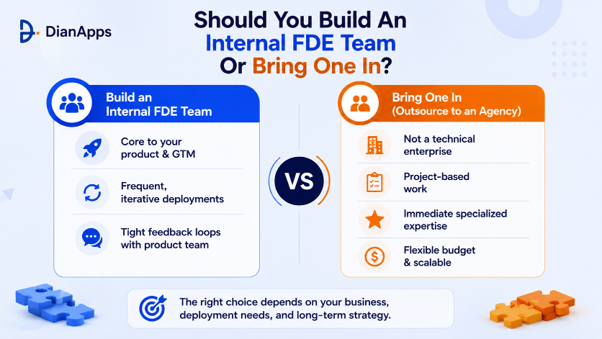
Deciding whether to hire full-time Forward Deployed Engineers or to outsource them to an experienced company is a critical strategic choice. The right answer depends entirely on your company’s business model, AI deployment frequency of your company and your business’ long-term tech strategy.
To help you understand better, here is a breakdown of when to choose each approach:
Build an Internal FDE Team
Hiring full-time FDEs is a heavy investment in recruitment and salaries but it pays off massively if deployment is a core function of your business.
When to choose this route:
- You are an AI/Tech Vendor: If your core product is an AI platform, data infrastructure or complex SaaS, FDEs should be a permanent fixture of your Go-To-Market (GTM) strategy. Your product likely requires continuous customization to prove value to new enterprise clients.
- Frequent, Iterative Deployments: If you are constantly onboarding new enterprise clients who all require tailored integrations, an internal team is necessary. They will develop deep, institutional knowledge of your product’s architecture that external contractors simply cannot match.
- Tight Feedback Loops are Critical: Internal FDEs sit directly next to your core product engineers. They can rapidly relay what features clients actually need, ensuring your core product roadmap aligns with real-world enterprise demands.
Outsource FDEs From Agencies Or Contractors
Outsourcing to a specialized tech consultancy or fractional FDEs offers flexibility and immediate expertise without the headache of full-time hires.
When to choose this route:
- You Are Not A Technical Enterprise (Non-Techy): If you are a healthcare provider, manufacturing firm, or logistics company looking to implement AI for internal transformation (e.g., automating supply chain logistics or internal document processing), you do not need a permanent FDE department.
- Project-Based Work: If you have a specific, 6-to-12-month AI integration project with a clear end goal, hiring an agency is far more efficient than building an internal team from scratch. Once the system is deployed and stable, the agency can hand off maintenance to your standard IT team.
- Immediate Specialized Expertise: The AI talent market is fiercely competitive. If you lack the internal recruiting power to land top-tier FDEs, bringing in an agency grants you immediate access to highly trained deployment veterans who have executed similar integrations across multiple industries.
- Budget Flexibility: Engaging FDEs on a contract or retainer basis (e.g., $15k–$40k/month) allows you to cap costs and scale the engagement up or down based on project milestones, rather than carrying the burden of $200k+ base salaries and equity grants during slower periods.
Build, Buy or Customize AI: The Role of an FDE
Businesses adopting AI can buy, build, customize or outsource depending on their needs.
- Buying works when an existing AI solution solves the problem.
- Building makes sense when AI is strategically important and the company has strong internal capabilities.
- Customization is useful when existing AI technology needs to fit proprietary data, workflows, or systems.
- Outsourcing works when specialized expertise is needed without building a permanent team.
A Forward Deployed Engineer (FDE) becomes valuable when AI needs complete customization, integration and real-world deployment. They help fill the gap between the AI technology and the business environment and ensure that the solution works reliably and delivers measurable value.
How Should Businesses Measure The Success Of An FDE?
The success of an FDE shouldn’t be measured simply by how much code they write or how quickly an AI system goes live. For business leaders, the more important question is whether the deployment improves an existing business outcome.
Depending on the project, companies can measure:
- Time-To-Production: How quickly did the project move from proof of concept to real-world use?
- Operational Savings: How many hours or operational costs were eliminated?
- Revenue Impact: Did the solution help generate or retain revenue?
- Adoption: Are employees or customers actually using the system?
- Error Reduction: Did automation reduce manual mistakes?
- Process Efficiency: Did a workflow become faster or easier?
- Payback Period: How long will it take for the deployment to recover its implementation and operating costs?
An FDE creates business value when technology moves from being something the company is experimenting with to something the company can measure, operate and improve.
How Can Enterprises Hire FDEs On Demand?
For large businesses the biggest hardship they face in AI adoption isn’t deciding to use AI, instead it’s finding the talent to deploy it. Recruiters actively poach top-tier AI and data engineering talent making it nearly impossible for recent companies to hire a full-time, internal Forward Deployed Engineer (FDE) in a reasonable timeframe.
To stay in the race, enterprises are shifting away from lengthy hiring processes and instead are bringing in FDEs on demand. By partnering with a specialized technology firm like DianApps, enterprises can bypass the talent war and deploy elite engineers exactly when and where they are needed.
Here is how enterprises can take advantage of DianApps to hire FDEs on demand:
Skip the Recruitment Lag with Pre-Vetted Talent
Hiring a full-time FDE internally typically takes 1-3 months of interviewing, negotiating and onboarding. DianApps eliminates this as we maintain a dedicated bench of highly vetted and enterprise-ready FDEs. When your enterprise identifies a bottleneck, whether it’s a stalled AI integration or a fragmented data pipeline, we can deploy an engineer to your environment in a matter of days, not months.
Engage for Specific Deployment Phases
Enterprises rarely need a full-time FDE year-round, they need intense, specialized focus during the deployment phase. DianApps allows you to hire FDEs on a project or phase basis. You can bring in an FDE for a 3-month proof-of-concept (POC), scale the team up to three engineers for a 6-month enterprise rollout and then scale back down once the system is stable. This way you only pay for the expertise while it’s actively delivering value.
Seamless Integration into Enterprise Workflows
Our FDEs are trained to operate as an extension of your internal organization, they easily adapt to your enterprise’s security protocols, development environments and communication tools (Slack, Jira, Teams) from day one. They don’t operate as distant contractors, they act as embedded team members who collaborate directly with your stakeholders and internal IT teams to ensure alignment.
Flexible Engagement Models
Whether you need a single FDE to architect a data pipeline or a full squad to integrate a complex LLM across multiple departments, DianApps offers flexible contracting models. Enterprises can choose from:
- Time-and-Materials (T&M): Ideal for exploratory AI deployments where the exact scope is still evolving.
- Dedicated FDE Retainer: Perfect for ongoing enterprise transformations that require a consistent, embedded technical lead.
Zero Administrative Overhead
When enterprises hire full-time employees, they take on massive overhead, benefits, equity grants, hardware provisioning and compliance. By hiring FDEs on demand through DianApps, all of that administrative burden is handled by us. We manage the HR, payroll and performance monitoring which allows you to focus purely on the technical outcomes and ROI.
Complete Process To Hire DianApps FDEs In 4 Steps
To make the process frictionless, we follow a simple four-step approach:
- Discovery Call: We align on your enterprise goals, data infrastructure and the specific business problem you are trying to solve.
- Talent Matching: We hand-select an FDE from our roster whose technical stack (Python, SQL, LangChain, Cloud Infrastructure) and industry experience match your exact needs.
- Rapid Onboarding: The FDE is integrated into your systems and introduced to your stakeholders to begin scoping the technical architecture immediately.
- Deployment & Handover: The FDE writes the production code, deploys the solution, iterates based on user feedback and ultimately trains your internal team to maintain it.
Need FDE Expertise Without Building a Full Team?
Bring in experienced engineers for project-based AI deployments, complex integrations, and specialized enterprise requirements without the long-term overhead of an internal FDE team.
Is The FDE Role Here To Stay?
Yes, as these AI models are being integrated into various systems, the advantage of having FDEs will no longer be who has the best model but who can deploy it most effectively to all kinds of businesses, from agriculture to financial ones. The FDE role is evolving from a niche position popularized by Palantir to a standard, critical function in modern tech. As long as technology requires real-world context to function, the Forward Deployed Engineer will be indispensable.
Conclusion
Building a brilliant AI model in a lab is relatively easy but making it actually work for a messy, complex business in the real world? That’s incredibly hard.
That’s exactly why the Forward Deployed Engineer stands out in the AI era, while data scientists get the credit for the algorithms, FDEs are the ones in the trenches, doing the unglamorous heavy lifting to make those algorithms actually useful. By speaking the languages of both Python and the boardroom, they fill the gap between a demo and a reliable tool your teams actually want to use.
Whether you’re an AI startup trying to land your first enterprise clients, or a non technical company looking to finally get real value out of AI, the FDE is your secret weapon. They aren’t just writing code for your business, they are the missing link between AI hype and actual, bottom-line results.
Ready to Move From AI Hype to Real Business Results?
Build and deploy AI solutions that work with your data, systems, workflows, and security requirements. Talk to our team about your AI deployment needs.
 0 comments







Leave a Comment
Your email address will not be published. Required fields are marked *