















 0 comments





Key Takeaways:
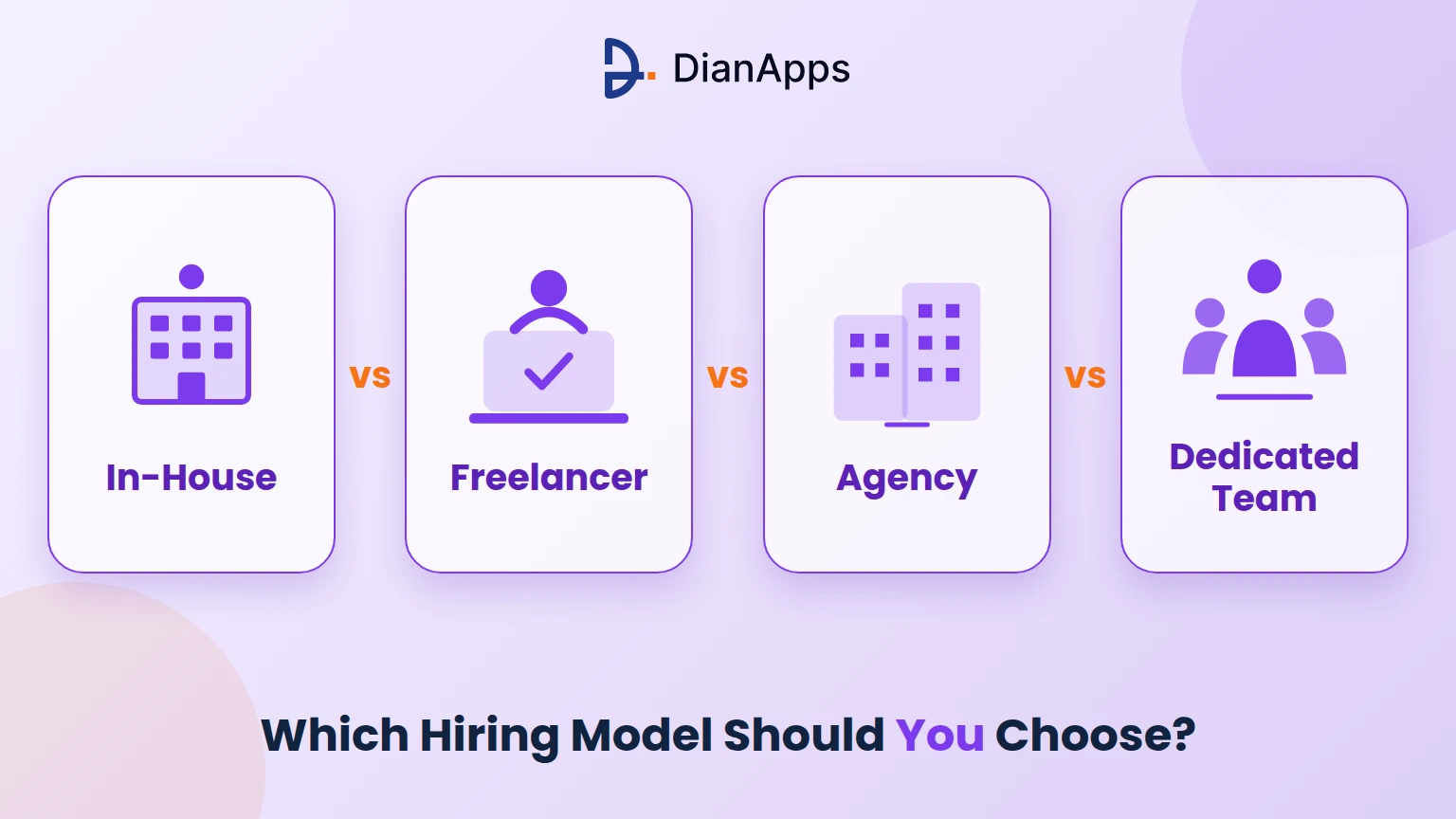
- In-house teams offer maximum control but require higher investment and longer hiring timelines.
- Freelancers suit small tasks, prototypes and specific feature development.
- Agencies manage complete app projects, from design and development to testing and launch.
- Dedicated teams provide ongoing development with greater control and flexible scaling.
- Staff augmentation fills technical skill gaps without requiring permanent hires.
Quick Answer: The best way to hire mobile app developers depends on your budget, project complexity, timeline and need for control. In-house teams suit long-term core products, freelancers work well for small tasks and bug fixes, agencies manage complete projects, and dedicated teams support ongoing development while functioning as an extension of your business. Staff augmentation is useful when your existing team needs specific skills or additional capacity. Before choosing, compare total costs, relevant experience, communication processes, source code ownership, testing practices and post-launch support.
Deciding to build a mobile app is exciting, the idea is ready, the budget is set and the excitement is high, until it comes to deciding who is actually going to build it, with options like hiring an in-house team, going with a freelancer who is charging less, handing it over to an agency or bringing on a dedicated team that is working only on your project.
Each and every option is sounding good on paper, however, choosing the wrong one is not suitable nor suggested for any business, as it is leading to missed deadlines, budget overruns and an app that is not even close to what you had in mind. To tackle that, businesses/startups are now spending more time understanding the different ways to hire mobile app developers before signing any contract, and this also is helping them avoid costly mistakes that are showing up much later in the project.
But which hiring model is actually the right one for your app? Well, it depends on your budget, your timeline, the complexity of your app and how much control you are wanting over the whole project. If you are still new to how apps are being planned and built, our guide on what mobile application development is a good place to start, otherwise, there are a lot of issues that businesses are facing when they choose the wrong hiring model, let’s take a look.
The Challenges of Choosing the Wrong Hiring Model
For many years, businesses have been deciding how to hire app developers based on the lowest quote or the first option that is coming their way, rather than what the project is actually needing. This is working fine for a while, however, as the project is moving forward and the features are growing, the problems are starting to show up, resulting in:
- Missed deadlines and delayed launches.
- Budgets going way beyond the initial estimate.
- Poor code quality needing rework.
- Missing skills for design, testing or backend work.
- Developers leaving in the middle of the project.
- No support once the app is live.
Issues like these don’t just slow down the project, they also affect the brand perception, as a buggy or delayed app is giving a poor impression to your users before they have even started using it. This is why understanding each and every hiring model is extremely crucial before you hire mobile app developers for your project.
Four Ways to Hire Mobile App Developers
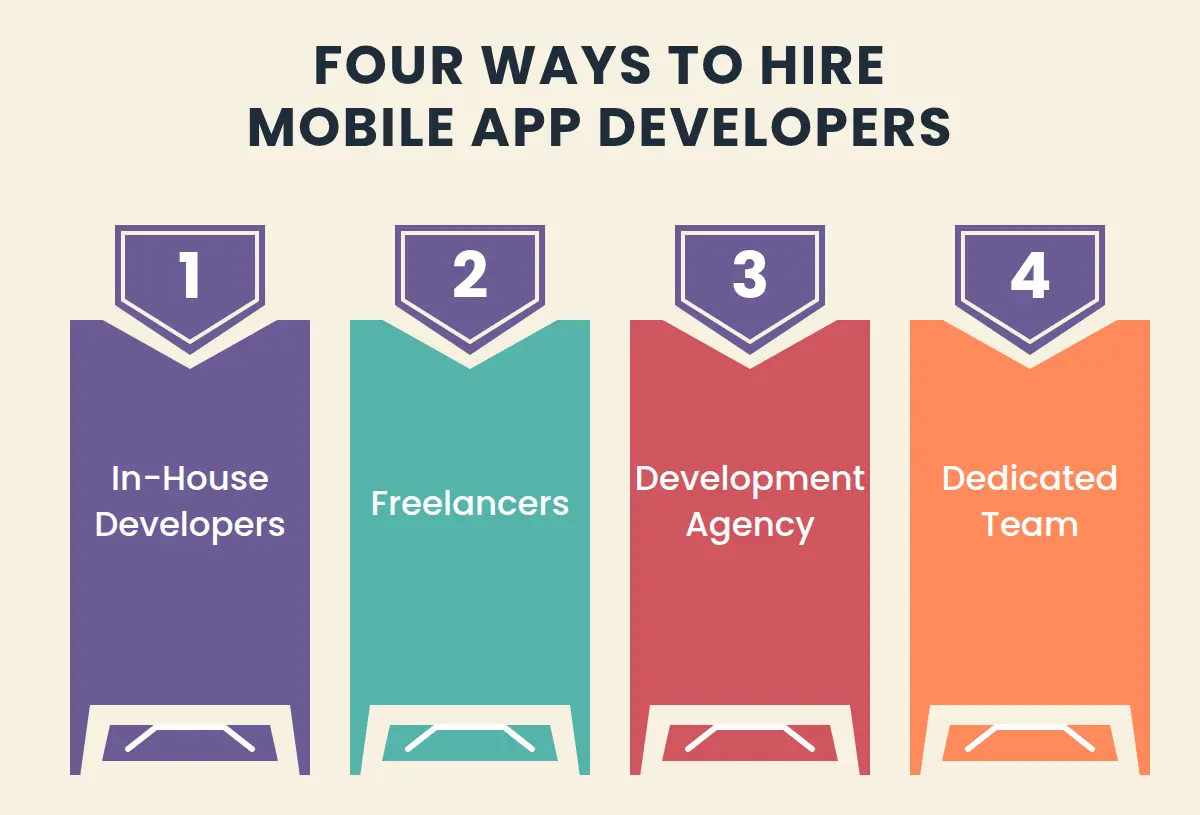
Businesses are building their mobile apps in four main ways today, and each one is having its own strengths, costs and risks, it all comes down to which one is matching your project the best, let’s break it down.
In-House Developers
Hiring in-house is bringing developers onto your own payroll as full-time employees who are working only for your business. This is giving you complete control over the team, the process and the product, and since the developers are a part of your company, they are understanding your business, your users and your goals better than anyone else.
However, building an in-house team is also the most expensive and time-consuming option, as you are paying for salaries, benefits, office space, equipment and training, and the hiring process itself is taking two to four months before even a single line of code is written. And that is not all, a complete mobile app is needing a lot more than just developers, it is also needing designers, testers, backend developers and a project manager, which is making the in-house team a big investment for most businesses.
In-house is usually the right choice for businesses where the app is the core product, the development is going on for years and there is enough budget and time to build a long-term team.
Freelancers
Freelancers are independent developers who are working on a project or hourly basis, and they are often the cheapest and fastest option to get started with. Businesses are finding freelancers on platforms like Upwork, Toptal or LinkedIn, and many of them are bringing strong skills in specific technologies like iOS, Android, Flutter or React Native.
The challenge here is that one freelancer is rarely having all the skills a complete app is needing, from design and frontend to backend, testing and deployment, so you are either hiring multiple freelancers and managing them yourself or accepting gaps in the work. Freelancers are also working on multiple projects at the same time, which is affecting their availability, and if they are leaving in the middle of the project, you are left with half-finished code and no one to support it.
This is why freelancers are working best for small tasks, bug fixes, prototypes or adding a specific feature to an existing app, rather than building a complete product from beginning until completion.
Development Agency
A mobile app development company that is offering a complete team, including project managers, designers, developers and testers, who are handling your project from the very first idea until the launch and even after it. With this, you are not needing to hire, manage or coordinate individual people, as the agency is taking care of the entire process and is also accountable for the final result.
Agencies are usually starting the fastest, as the team is already in place and the processes are already set, and they are bringing experience from many similar projects, which is helping in avoiding the common mistakes. The trade-off is that you are getting slightly less day-to-day control than with an in-house team and the rates are higher than freelancers, though the overall cost is often turning out lower once you are factoring in the quality, the speed and the fewer rework hours.
An agency is a great fit for businesses that are having a clear idea and a launch date but are not having the time or the expertise to build and manage a team on their own.
Dedicated Team
A dedicated team is a group of developers, designers and testers provided by a development company, who are working full-time and only on your project, just like an extended part of your own team. Dedicated mobile app developers are following your processes, joining your meetings and reporting directly to you, while the company is handling the hiring, salaries, infrastructure and replacements.
This model is combining the control of an in-house team with the speed and cost benefits of outsourcing, as you are able to start in two to four weeks, scale the team up or down as the project is changing and also skip the long hiring process. Dedicated mobile app developers are especially useful for long-term projects, products that are needing continuous updates and businesses that are planning to grow their app over time.
Not Sure Which Hiring Model Is Right for You?
Talk to our team and get honest advice on the best way to build your app based on your budget and goals.
What About Staff Augmentation for Mobile Development?
Staff augmentation is a slightly different model, where you are adding one or more external developers to your existing in-house team to fill a specific skill gap or to speed up the work. For example, if your team is having strong backend developers but no iOS expertise, staff augmentation mobile app development is helping you bring in an experienced iOS developer for as long as you are needing them, without going through the long hiring process.
The main difference from a dedicated team is that with staff augmentation, the external developers are joining your team and working under your management, whereas a dedicated team is usually coming as a complete unit with its own project manager. Staff augmentation mobile development is working best for businesses that are already having a technical team and are only needing extra hands or specific skills for a limited time.
In-House vs Freelancer vs Agency vs Dedicated Team: Comparison
To make the decision a lot easier, let’s compare all the four models side by side on the factors that are mattering the most.
| Factor | In-House | Freelancer | Agency | Dedicated Team |
|---|---|---|---|---|
| Time to start | 2–4 months | Days to 2 weeks | 1–3 weeks | 2–4 weeks |
| Cost | Highest | Lowest | Medium to high | Medium |
| Control | Full | Low to medium | Medium | High |
| Full skill set | Only if you hire all roles | Rarely | Yes | Yes |
| Scalability | Slow | Limited | Easy | Easy |
| Accountability | Your team | Individual | Agency | Shared |
| Long-term support | Yes | Uncertain | Yes, under contract | Yes |
| Best for | Core products, long-term | Small tasks, fixes | Full projects with clear scope | Long-term, evolving products |
As the table is showing, there is no single best option, as each and every model is suiting a different stage, budget and type of project.
How Each Model Is Affecting Your Cost
Cost is one of the biggest deciding factors when businesses are choosing how to hire mobile app developers, and the difference between the models is a lot bigger than most people are expecting, let’s take a look.
| Hiring Model | Typical Cost |
|---|---|
| In-house developer (US) | 120,000–160,000 per year in salary, plus 25–40% for benefits and overheads |
| Freelancer | 20–150 per hour, depending on country and experience |
| Agency | Project-based, usually $15,000 to $200,000+ depending on the app |
| Dedicated developer (India) | Around 3,000–6,000 per developer per month |
These are general ranges and the actual cost is depending on the location, the experience and the type of app you are building. For a complete breakdown of how much different types of apps are costing, our guide on mobile app development cost is covering the price bands and the cost factors in detail.
The key thing to remember here is that the cheapest hourly rate is not always the cheapest option overall, as a freelancer who is charging less but taking twice as long, or delivering code that is needing a complete rewrite, is ending up costing more than an experienced team that is getting it right the first time.
How Each Model Is Affecting Your Timeline
Along with the cost, the hiring model is also deciding how quickly your app is reaching the market. An in-house team is taking the longest to start, as recruiting the right developers is taking two to four months, and that is before any development work is even beginning. Freelancers are starting the fastest, however, a single freelancer is not able to work on design, frontend and backend at the same time, which is slowing down the overall progress.
Agencies and dedicated teams are usually getting your app to the market the fastest, as the full team is starting together and the design, development and testing are running in parallel. If you are wanting to understand how long different types of apps are taking to build, our post on how long it takes to build a mobile app is breaking down the timelines by app type and stage.
How to Choose the Right Way to Hire App Developers
If you are still not sure which model is right for your project, looking at a few key things is helping you make the decision with a lot more confidence, let’s break it down.
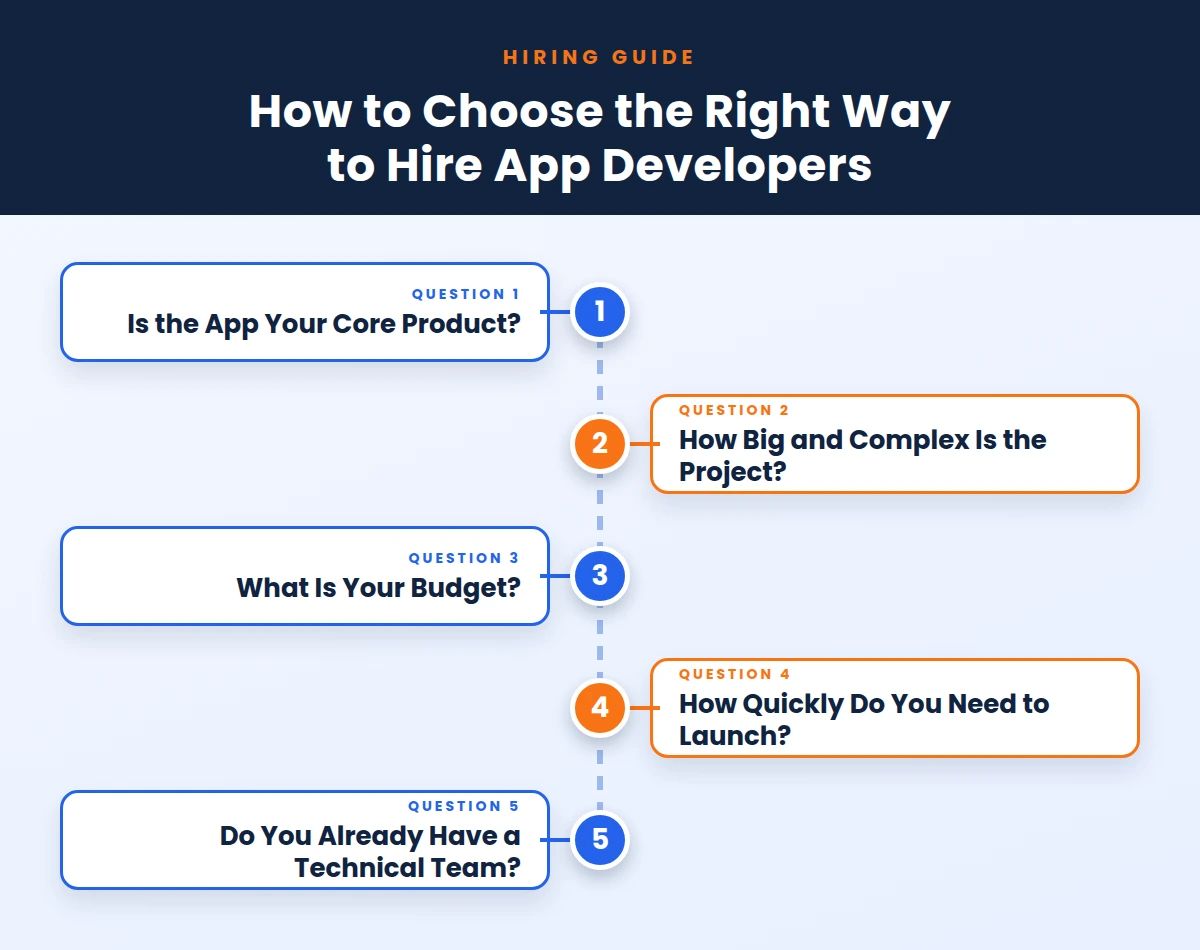
Is the App Your Core Product?
If the app is your main business and is going to be developed for years, building an in-house team or hiring dedicated mobile app developers is giving you the long-term control and the product knowledge you are needing.
How Big and Complex Is the Project?
For small tasks or quick fixes, a freelancer is usually enough, whereas a complete app with design, backend, integrations and testing is needing a full team from an agency or a dedicated team.
What Is Your Budget?
If the budget is limited, offshore agencies and dedicated teams are giving you a full team at a fraction of the cost of hiring in-house, especially in countries like India.
How Quickly Do You Need to Launch?
If you are needing to launch in a few months, an agency or a dedicated team is the fastest option, as the hiring time is already taken care of.
Do You Already Have a Technical Team?
If you are already having developers in-house but are missing specific skills, staff augmentation mobile development is the most practical way to fill the gap without building a whole new team.
Things to Ask Before You Hire Mobile App Developers
Whichever model you are choosing, asking the right questions before signing the contract is extremely crucial for avoiding problems later, and these are the things that are making the most difference:
- Apps they have built that are similar to yours.
- Experience of the developers working on your project.
- How often they are sharing progress updates.
- How they are handling changes in scope or features.
- Who is owning the source code and design files.
- How they are testing the app before launch.
- What support they are offering after the app goes live.
- What happens if a developer is leaving during the project.
The answers to these are telling you a lot about how the team is working, and a team that is giving clear and honest answers is usually the one that is delivering on its promises.
Red Flags to Watch Out For
And that is not all, there are also some warning signs that are worth looking out for when you hire app developers, as these are often leading to delays, poor quality and disputes, resulting in a project that is going off track:
- Very low quotes compared to everyone else.
- No clear process for design, development and testing.
- Unwillingness to share past work or client references.
- Vague answers about code ownership.
- No mention of testing or post-launch support.
- Unrealistic timelines for complex apps.
If you are noticing any of these, it is worth taking a step back and comparing a few more options before making the final decision.
Looking to Hire Dedicated Mobile App Developers?
Get a skilled team that works only on your project, with full transparency, flexible scaling and no hiring hassle.
Conclusion
Choosing the right way to hire mobile app developers is one of the most important decisions in your app journey, as it is affecting your cost, your timeline, the quality and how easily your app is growing in the future. In-house teams are giving you full control but are costing the most and taking the longest to build, freelancers are affordable but are working best for small tasks, agencies are handling the complete project from beginning until completion and dedicated mobile app developers are giving you the control of an in-house team with the speed and savings of outsourcing.
And if you are already having a team, staff augmentation is helping you fill the skill gaps without going through the long hiring process. At the end of the day, the right choice is the one that is matching your product, your budget and your long-term plans, and if you are looking for an experienced team to build your app, DianApps is here to help, we’ve got you covered.
 0 comments










Leave a Comment
Your email address will not be published. Required fields are marked *