















 0 comments




Key Takeaways:
- Fitness app development in 2026 is increasingly focused on AI personalization, wearable integration and data-driven coaching.
- You can build different types of fitness apps, including workout trackers, wearable-connected apps, on-demand coaching platforms, nutrition apps and gym management solutions.
- Essential features include AI-powered plans, wearable and health platform integration, progress tracking, social features, personalized reminders, offline mode, secure health data and subscriptions.
- The development process covers seven steps: idea validation, MVP planning, UX design, technology selection, development, testing and launch with ongoing support.
- Native development can be useful for deep wearable and HealthKit integration, while Flutter and React Native can help deliver cross-platform apps faster.
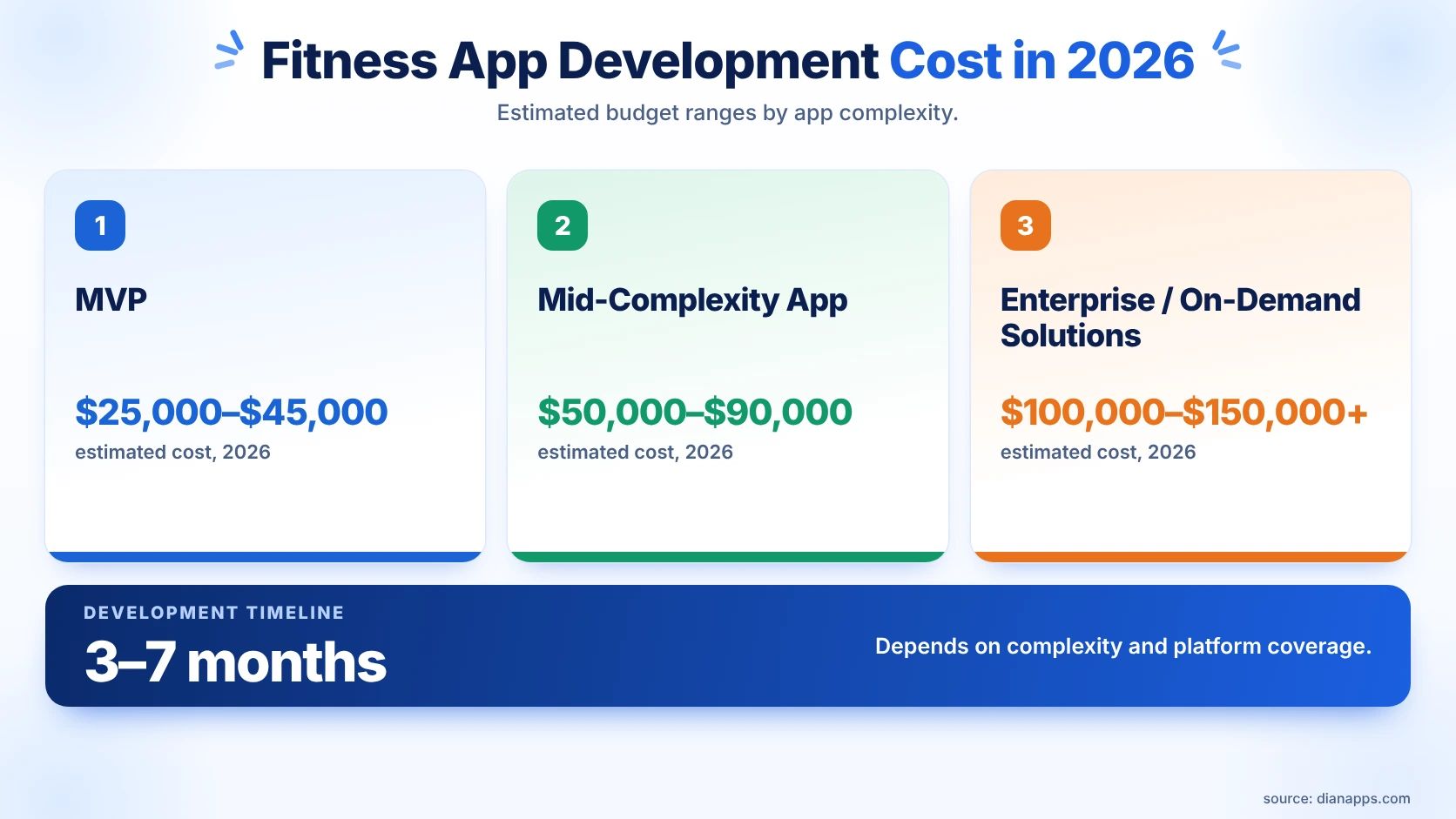
- Fitness app development can cost around $25,000–$45,000 for an MVP, $50,000–$90,000 for a mid-complexity app and $100,000–$150,000+ for enterprise or on-demand solutions.
- Most fitness apps take approximately 3 to 7 months to develop, depending on complexity, integrations and platform coverage.
- Common monetization options include subscriptions, one-time purchases, in-app purchases, B2B licensing and affiliate partnerships.
- Fitness apps may handle sensitive health-adjacent information, making privacy, security, consent and applicable regulations important considerations.
- Choosing a development partner with experience in HealthKit, Google Fit, wearable APIs, health-data security and post-launch support can reduce technical and compliance risks.
Quick Answer: Developing a fitness app in 2026 is a process that has seven stages. The fitness app process starts with market research then the fitness app type is chosen whether it is workout tracking, wearable‑connected, on‑demand coaching or nutrition‑focused. After that the UI/UX design is created. Next a tech stack is selected. Then the fitness app is built. After that the fitness app is tested. Finally, the fitness app is ongoing. Post‑launch support begins. Most fitness apps take between three and seven months to build. They cost from $25000 to over $150000 depending on the level of complexity AI personalization and wearable integrations.
Why Build a Fitness App in 2026
The health and fitness app market has moved past the pandemic‑driven boom that first pushed people toward digital workouts. It is now a competitive category. Users expect personalization, wearable integration and AI‑driven coaching as standard not as a premium add‑on. The fitness app development in 2026 looks meaningfully different from two years ago. Static workout libraries and step counters no longer hold user attention on their own.
For gyms personal trainers, wellness brands and health‑tech startups a well‑built fitness app is no longer a nice‑to‑have marketing extension. It is a channel, for retention recurring revenue and data‑driven personalization that a website simply cannot offer.
For the underlying business case in more depth, see our earlier guides on why fitness app development services and how mobile apps can boost your fitness business.
Types of Fitness Apps You Can Build
Before fitness mobile app development starts, it’s worth being precise about which category of fitness app you’re actually building — the features, tech stack and cost all shift significantly by type.
Workout & Exercise Tracking Apps
Apps focused on logging workouts, sets, reps and progress over time — think a digital training log with analytics built in.
Wearable-Connected Fitness Apps
Apps that sync with Apple Watch, Wear OS, Fitbit, Garmin or Whoop to pull in heart rate, sleep and activity data for a more complete picture of user health.
On-Demand Coaching & Class Apps
Apps offering live or recorded classes, real-time coaching and trainer-led programs — the model popularized by Peloton and Centr.
Nutrition & Diet Tracking Apps
Apps centered on meal logging, calorie tracking and diet plans, often paired with barcode scanning and AI-based food recognition.
Corporate Wellness & Gym Management Apps
B2B-facing apps that let gyms manage class schedules, memberships and engagement or that companies offer as an employee wellness benefit.
Must-Have Features for a 2026 Fitness App
Regardless of category a few features are now essential for any fitness app that launches in 2026:
- AI-personalized workout and nutrition plans that match each user’s goals and the data of how the user’s progressing.
- Integration with wearables and health platforms such as Apple Health, Google Fit, HealthKit and the Fitbit API.
- Progress tracking that shows analytics not only raw numbers but also how progress changes over time.
- Social and community features that allow challenges, leaderboards and sharing of progress.
- Push. Habit‑building reminders that are tuned to each user’s behaviour instead of generic blasts.
- An offline mode that lets users log workouts when there is no live connection.
- Secure handling of health data, with consent and privacy controls.
- A subscription and in‑app purchase infrastructure that allows the fitness app to earn revenue.
AI personalization in particular has shifted from differentiator to expectation — see our guide on how AI is transforming workout apps and personal training for where this is headed.
Build a Fitness App Users Want
Turn your fitness app idea into a scalable product with AI personalization, wearable integrations, secure data handling and the features your users actually need.
Choosing the Right Tech Stack for Fitness App Development
Choosing the right technology for fitness app development depends on how central wearable integration and real‑time data are to your app. The technology choice you make should match the importance of integration and real‑time data.
| Approach | Best For | Trade-off |
|---|---|---|
| Native (Swift / Kotlin) | Deep wearable integration and HealthKit integration for health tracking. | Separate codebases for iOS and Android — higher cost |
| Flutter | Fast, visually rich UI across both platforms on one codebase | Some native wearable APIs need platform-specific bridging |
| React Native | Teams with existing JavaScript/React expertise, faster MVP builds | Similar bridging needs for deep native health integrations |
For a full breakdown of this decision beyond fitness apps specifically, see our guide on native vs. cross-platform app development.
How to Develop a Fitness App: Step-by-Step
1. Validate the Idea and Define Your Niche
The fitness app market is full of options. A workout tracker” will struggle to stand out against big names already in place. Instead find a gap. Focus on a type of training like yoga for seniors or HIIT for office workers or target a group that isn’t getting enough attention. Maybe it’s users who rely on a smartwatch brand but can’t find a good app that works with it. Pick something narrow.
2. Plan Core Features and MVP Scope
Don’t try to include every feature at. Start small. Most apps that succeed don’t launch with everything. Think about the basics: tracking workouts maybe logging reps or time. Then add one thing that sets you apart. Like coaching, real-time feedback or a unique motivation system. Keep the list tight. Everything else can come later.
3. Design the User Experience
People using your app are moving, with one hand sometimes without looking. The interface must be easy. Buttons should be big. Text input should be kept to a minimum. Voice commands or gestures help. A screen that works when wet or blurry? That matters. Make sure people don’t have to stop their workout to use your app.
4. Choose Your Tech Stack and Wearable Integrations
Decide early if you’re building apps (iOS/Android) or using cross-platform tools. Then pick which wearables matter most. Apple Watch, Fitbit, Garmin or others. Check what APIs are available and how they work. Only integrate what you need now. Don’t lock yourself into tech that might change later.
5. Develop and Integrate
Build the backend so data stays safe and syncs across devices. Connect to any third-party services. Nutrition databases, payment systems, wearable SDKs. Make sure everything talks together smoothly. Security is not optional. Data protection needs to be built in from day one.
6. Test Rigorously; Including Real-World Conditions
Testing shouldn’t just happen on a desk. Put the app through workouts. Run it during a sweaty session test it at a gym where the signal drops. See how accurate the step count is compared to a trusted tracker. Check how the app behaves when the phone is wet or hard to read. Fix issues before people see them.
7. Launch and Support Post-Launch
After launch, plan for ongoing feature iteration based on retention data; fitness apps see some of the highest first-month churn of any app category, making post-launch optimization especially critical.
These seven steps map closely to the broader 7 stages of app development – the fitness-specific considerations above layer on top of that general framework.
Fitness App Development Cost in 2026
| Layer | Common Choices | Why It Matters for Construction |
|---|---|---|
| Mobile framework | Flutter, React Native, native iOS/Android | Cross-platform frameworks move faster; native is worth it when device integration (barcode scanners, IoT sensors) is critical |
| Backend | Node.js, .NET, Java | Handles RBAC, workflow logic and API traffic across field and office |
| API layer | REST or GraphQL | GraphQL is helping when multiple modules need overlapping data sets |
| Database | PostgreSQL for structured data | Supports the relational structure of projects, sites, teams and permissions |
| Media storage | Cloud object storage | Photos and videos at scale need dedicated storage, not database blobs |
| Offline layer | Local device storage plus a sync engine with conflict resolution | This is the single hardest technical piece of any construction app |
For general benchmarks and what drives cost up or down across any app category, see our 2026 mobile app development cost guide.
Monetization Models for Fitness Apps
- Subscription (freemium with premium tier)- the dominant model for workout and coaching apps
- One-time purchase for a specific program or plan
- In-app purchases for individual classes, plans or premium content
- B2B licensing to gyms or corporate wellness programs
- Affiliate and partnership revenue through connected wearable or supplement brands
Data Privacy and Compliance for Fitness Apps
Fitness apps collect health-adjacent data, such as heart rate, sleep patterns and sometimes location. This makes fitness apps subject to regulatory scrutiny than many other app categories. Depending on the market and the features of the fitness app the fitness app may need to comply with GDPR in the EU CCPA in California and, in some cases HIPAA if the fitness app connects to health data.
For a deeper look at what proper data protection requires, see our guide on building secure apps in the age of rising data breaches.
How to Choose a Fitness App Development Company
Not every mobile app development company truly knows the technical needs of fitness apps. These needs include SDK integration, health data compliance and real‑time sync all of which are specialized skill sets. When comparing fitness app development companies or choosing a fitness mobile app development company, look for:
- A history of health and fitness app development not just generic mobile apps.
- Hands‑on experience with Apple HealthKit, Google Fit and major wearable APIs.
- A transparent plan, for health data security and meeting rules.
- Support after launch built into the contract not sold as an extra.
For the general framework on vetting any development partner, see our complete guide to choosing the right mobile app development partner.
Let’s Plan Your Fitness App
Have a fitness app idea but unsure about the right features, technology or budget? Talk to our team and get a clearer path from concept to launch.
Why Choose DianApps for Fitness App Development
DianApps is a health and fitness app development company with direct experience building wearable-connected, AI-personalized fitness apps for gyms, trainers and wellness brands. Our fitness mobile app development team handles everything from wearable integration to compliant health-data architecture, under one engagement.
As a fitness app development company, we offer:
- End-to-end fitness app developers experienced with HealthKit, Google Fit and major wearable APIs
- AI-personalized workout and nutrition feature development
- Fitness app development services covering iOS android and cross-platform builds
- Post-launch support to manage the retention and iteration cycle fitness apps depend on
Explore our full mobile app development services or hire mobile app developers experienced in fitness and wellness app builds.
Final Thoughts
Fitness app development in 2026 rewards specificity. A clear niche, genuine AI personalization and real wearable integration outperform a feature‑for‑feature copy of established players. Getting the technical foundations right, around health data handling and wearable sync matters as much, as the workout content itself.
Ready to build your fitness app? Explore DianApps’ fitness app development services or get in touch to scope your project.
 0 comments










Leave a Comment
Your email address will not be published. Required fields are marked *