














 0 comments





Key Takeaways:
- Modern fleet management software turns raw GPS pings into live fuel savings, safer driving habits, and earlier repair alerts.
- Connecting OBD II telematics hardware directly to streaming cloud pipelines keeps dispatch maps accurate under heavy load.
- AI route optimization and predictive maintenance cut unplanned truck downtime far more effectively than static spreadsheet schedules.
- Custom fleet software budgets vary widely depending on hardware integrations, driver mobile apps, and offline sync rules.
- Separating high frequency geospatial telemetry from transactional billing databases prevents dispatch dashboards from lagging at scale.
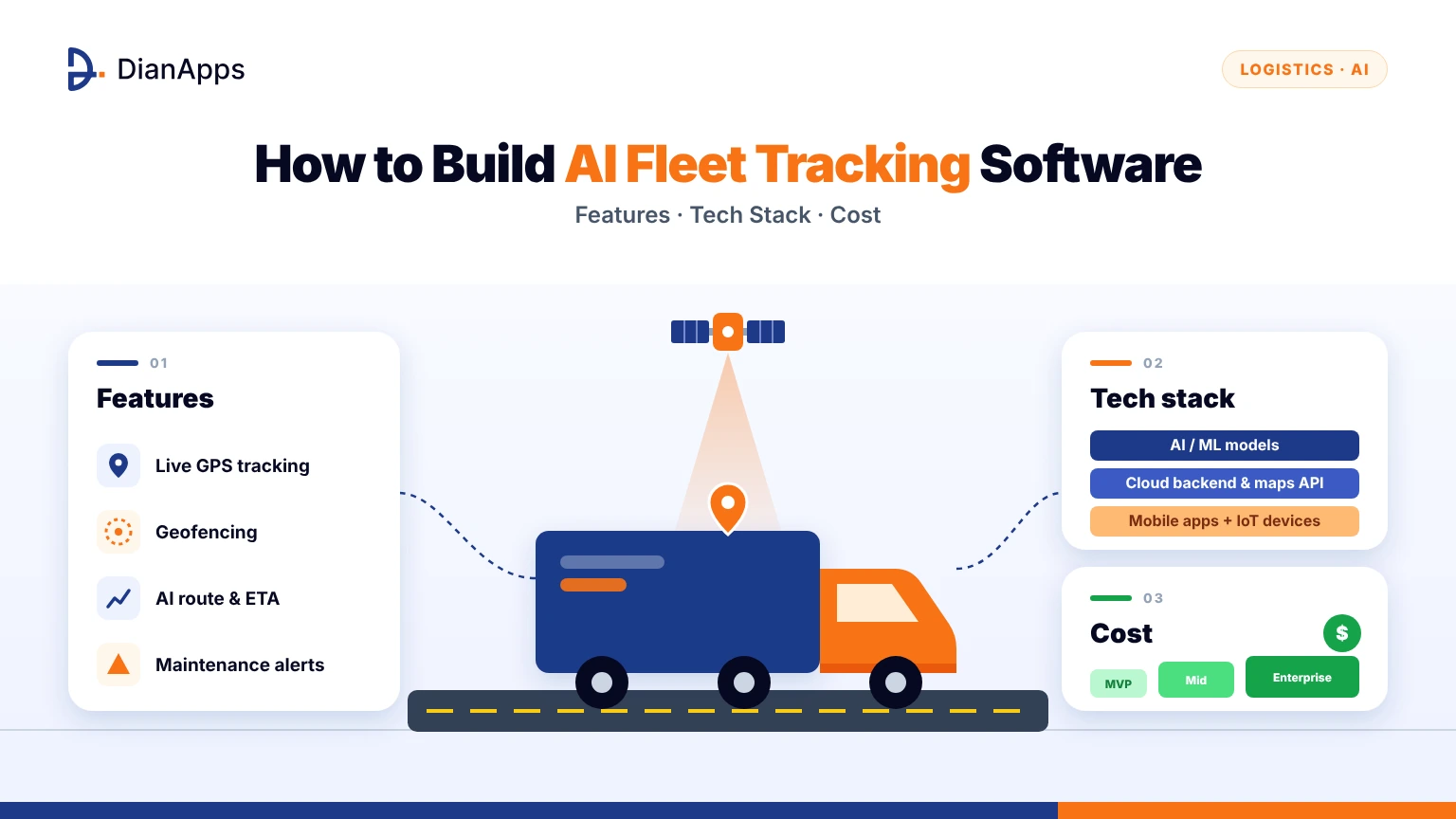
Quick Answer: Building AI fleet tracking software starts with streaming GPS and telematics data into a cloud pipeline, pairing driver mobile apps with dispatch dashboards, and layering machine learning models for live routing and predictive vehicle maintenance.
Fuel waste, surprise engine breakdowns, and missed delivery windows quietly eat away at margins across every commercial delivery fleet long before dispatchers spot the pattern on paper. That daily operational pressure is driving rapid investment in fleet management software development that replaces manual check in calls with automated vehicle intelligence. According to Fortune Business Insights, the global fleet management software market is projected to grow from $11.61 billion in 2026 to $47.81 billion by 2034. Logistics leaders partnering with Mobile App Development Services teams are building unified platforms that track live locations, predict parts failures, and guide drivers efficiently.
Why Legacy GPS Trackers Fall Short in 2027
Basic dot on a map GPS trackers tell dispatchers where a truck was sitting ten minutes ago, yet they offer zero guidance on how to save fuel or stop an overheating alternator before it strands cargo on the highway. Modern logistics operators expect software that turns raw coordinates into concrete operational savings.
- Passive location pins force dispatchers to phone drivers manually whenever traffic bottlenecks delay customer drop offs.
- Siloed maintenance spreadsheets miss subtle engine fault codes until a delivery van breaks down mid route.
- Disconnected fuel card exports hide idling waste, unauthorized detours, and inefficient stop sequencing for weeks.
Upgrading to AI fleet tracking software connects live vehicle telemetry directly with routing, safety coaching, and parts scheduling inside one unified command center.
How Do You Build Fleet Tracking Software?
Creating reliable AI fleet tracking software requires connecting physical vehicle sensors in the field with a fast cloud ingestion layer and clean web or mobile dashboards. You’re really building three synchronized systems that talk continuously without dropping packets in dead cellular zones.
- Install or integrate vehicle telematics units that transmit speed, engine fault codes, and GPS coordinates securely.
- Set up an MQTT or Kafka ingestion pipeline capable of buffering thousands of simultaneous location pings every second.
- Build a dispatch web console alongside lightweight driver apps that cache route updates when rural coverage disappears.
Starting with a modular data pipeline lets you ship core live tracking first before layering complex forecasting models onto historical trip logs.
What Features Does a Fleet Management App Need?
Every commercial carrier needs core operational visibility on day one before worrying about experimental automation features. Focusing on practical fleet management app features ensures drivers and dispatchers actually use the software on every shift.
- Live geofenced vehicle maps showing current speed, idle time, and estimated arrival windows at a glance.
- Automated driver behavior scorecards flagging harsh braking, speeding, and excessive engine idling for safety coaching.
- Digital proof of delivery workflows with photo capture, barcode scanning, and offline signature storage.
Teams exploring AI in logistics software often add automated fuel card reconciliation next so finance teams catch billing errors immediately.
Scope Your Fleet Platform Features
Talk with our logistics engineers about prioritizing the right tracking modules for launch.
Driver Mobile Apps vs Dedicated Hardware Telematics
Fleet operators often debate whether to rely strictly on smartphones inside truck cabs or invest in hardwired OBD II and J1939 telematics dongles. Understanding what each hardware layer captures helps you avoid blind spots across mixed vehicle fleets.
- Dedicated OBD II and CAN bus trackers read true odometer mileage, coolant temperatures, fuel tank levels, and diagnostic trouble codes directly.
- Driver mobile apps handle turn by turn navigation, barcode scanning, shift inspections, and instant dispatcher chat cleanly.
- Combining both sources prevents battery drain on driver phones while linking vehicle health data directly to assigned shift drivers.
When drivers switch trucks between morning and evening shifts, automatic Bluetooth tag pairing links the right driver profile to the active vehicle seamlessly.
Offline Sync and Cellular Dead Zone Handling
Commercial delivery trucks regularly pass through rural highways, underground loading docks, and concrete warehouses where cellular signals vanish completely for twenty minutes. If your mobile app or telematics buffer drops unsent packets, route histories develop frustrating gaps.
- Store queued GPS coordinates, inspection photos, and delivery signatures inside an encrypted local SQLite queue on the device.
- Compress batched telemetry payloads and flush them chronologically using exponential backoff as soon as LTE connectivity returns.
- Display clear offline status indicators to drivers so they know check ins are saved locally without tapping submit repeatedly.
Resilient store and forward engineering keeps audit logs complete and prevents duplicate proof of delivery records from flooding your backend APIs.
How Is AI Used in Fleet Management?
Machine learning turns years of messy trip logs and engine sensor readings into actionable decisions that dispatchers can execute before problems hit the highway. Instead of reacting to a stranded truck, operations teams fix issues during scheduled yard stops.
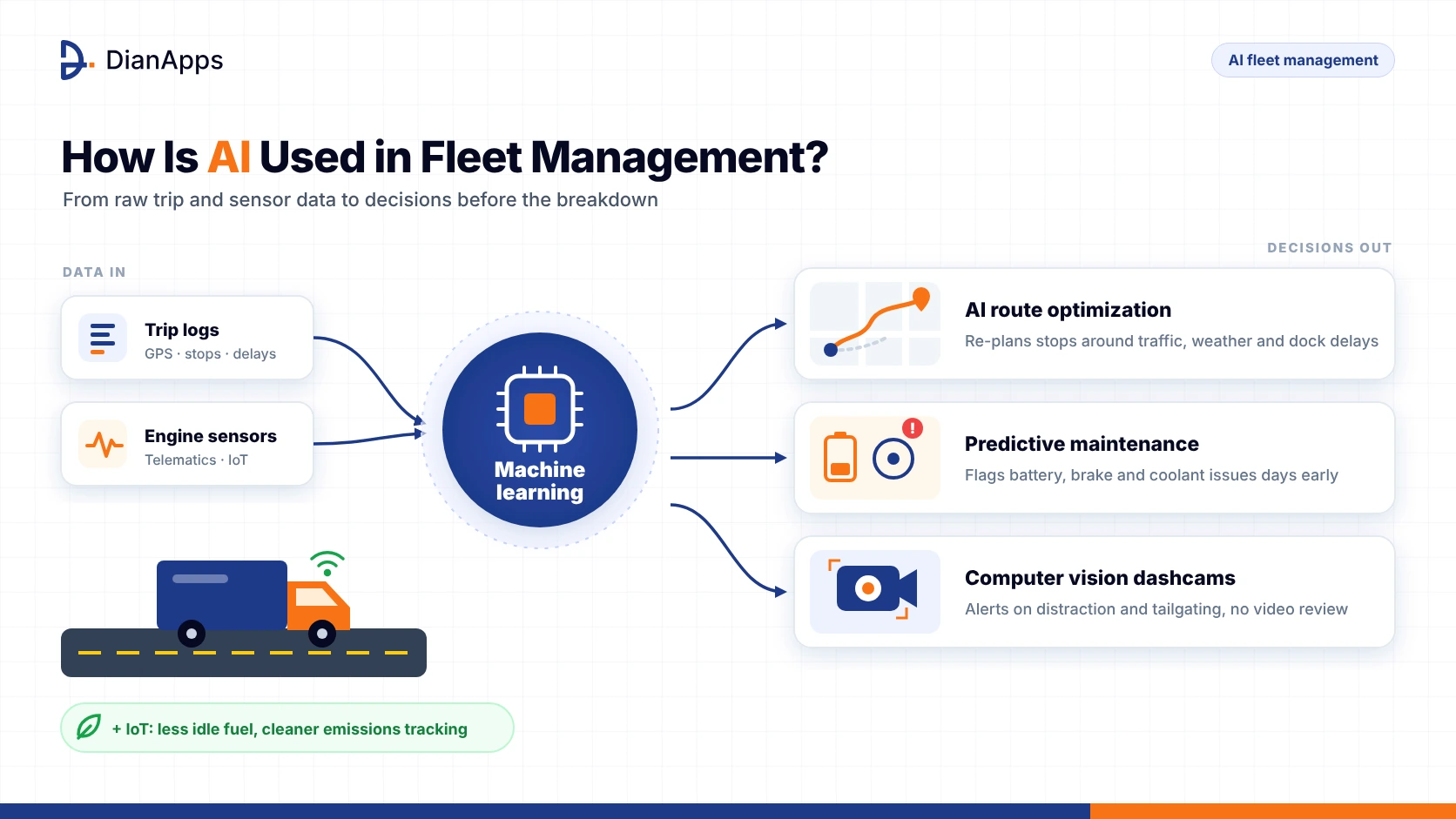
- AI route optimization recalculates delivery sequences in seconds around live traffic, weather alerts, and loading dock delays.
- Predictive maintenance for fleets spots battery voltage drops, brake wear, and coolant anomalies days before roadside breakdowns occur.
- Computer vision dashcam alerts detect distracted driving or tailgating without forcing managers to review hours of video.
Combining automated routing with IoT in fleet management apps also helps commercial operators lower idle fuel burn and track emissions targets cleanly.
How AI Route Optimization Cuts Fuel and Overtime
Static morning route sheets fall apart the moment a highway lane closes or a wholesale warehouse takes ninety minutes to unload one pallet. Adaptive solver engines reevaluate remaining stops continuously against time windows, truck weight limits, and driver hours of service rules.
- Multi constraint solvers balance vehicle payload capacity, refrigerated zone rules, and customer receiving hours automatically.
- Traffic aware ETA updates notify downstream customers proactively before late arrival complaints hit your support desk.
- Clustering nearby drop offs trims deadhead miles between zones and cuts overtime shifts noticeably within sixty days.
Even saving twelve minutes per truck daily compounds into substantial annual diesel and labor savings across a fifty vehicle fleet.
Predictive Maintenance Models Using OBD II Telemetry
Unplanned roadside breakdowns cost three to five times more than scheduled yard repairs once towing fees, spoiled cargo, and missed SLAs hit the balance sheet. Time series anomaly models turn routine engine diagnostics into early warning alerts.
- Track subtle voltage fluctuations during cold morning starts to flag weakening alternators and batteries weeks early.
- Correlate rising engine oil temperatures with heavy grade climbs to schedule cooling system inspections before head gaskets fail.
- Trigger automated work orders inside your maintenance portal complete with exact diagnostic trouble codes and parts lists.
Shifting mechanics from emergency firefighting to scheduled preventive bays extends vehicle lifespans while keeping delivery schedules dependable.
What Tech Stack Is Used for GPS Tracking Apps?
Selecting the right technology stack for GPS fleet tracking app development determines whether your map freezes when five hundred trucks report location updates simultaneously. Real time telematics integration demands time series databases built specifically for high frequency sensor writes.
| System Layer | Recommended Stack | Core Responsibility | Why Teams Pick It |
|---|---|---|---|
| Mobile driver app | Flutter or Kotlin | Offline routing and alerts | Reliable background GPS |
| Data ingestion | MQTT and Apache Kafka | Stream sensor telemetry | Handles burst traffic |
| Time series store | TimescaleDB or InfluxDB | Store historical coordinates | Fast geospatial queries |
| AI modeling | Python and PyTorch | Route and fault models | Mature ML libraries |
Keeping geospatial queries separated from transactional billing databases prevents heavy map analytics from slowing down driver check ins.
Architect Your Telematics Stack
Get expert guidance on MQTT pipelines, time series databases, and mobile GPS tracking.
Geospatial Databases, Geofencing, and Map Rendering
Rendering five hundred moving truck icons smoothly inside a browser dispatch console requires smart spatial indexing and WebSocket throttling rather than polling REST endpoints every two seconds. Poor map optimization quickly locks up dispatcher laptops during shift changes.
- Use PostGIS or TimescaleDB spatial indexes to evaluate arrival and departure geofence polygons in single digit milliseconds.
- Stream delta location updates over WebSockets or Server Sent Events only for vehicles currently visible inside the viewport.
- Cluster dense yard markers automatically at zoomed out levels so dispatchers read regional bottlenecks effortlessly.
Matching server side geofence rules with crisp map clustering gives operations teams instant clarity across national or regional delivery networks.
Integrating ELD Compliance, Fuel Cards, and ERP Systems
Fleet software rarely lives on an island because finance, payroll, and regulatory compliance teams already rely on established back office tools. Clean API integrations eliminate double data entry across dispatch and accounting desks.
- Sync electronic logging device hours of service timers directly into dispatch boards so planners never assign illegal overtime routes.
- Import automated fuel card transactions via webhooks and flag purchases whose GPS coordinates don’t match the truck’s location.
- Push completed delivery receipts and mileage logs straight into ERP invoicing systems to accelerate customer billing cycles.
Tight back office connectivity often pays for the software build quickly by catching fuel theft and billing delays automatically.
Security, Role Permissions, and Driver Privacy
Continuous GPS tracking raises understandable privacy concerns among drivers while exposing sensitive commercial routes and customer addresses to cyber risks. Designing strict data boundaries protects both your workforce and your enterprise contracts.
- Disable personal location tracking automatically the moment a driver clocks out of their shift inside the mobile app.
- Encrypt telematics broker channels with mutual TLS certificates so spoofed hardware packets can’t inject fake coordinates.
- Enforce role based permissions so regional dispatchers view assigned territories while finance teams access fuel and invoice logs only.
Respectful privacy controls improve driver retention while satisfying enterprise shipper security questionnaires effortlessly.
Cold Chain Temperature Monitoring and IoT Alerts
Food distributors and pharmaceutical carriers risk losing entire refrigerated cargo loads whenever a trailer cooling unit drifts three degrees above safe limits. Streaming wireless trailer sensors alongside GPS telemetry turns passive tracking into active cargo protection.
- Pair Bluetooth temperature probes inside cargo bays directly with cab telematics gateways for continuous thermal logging.
- Trigger instant cab alarms and dispatcher alerts whenever trailer doors stay open too long at urban stops.
- Generate immutable compliance temperature logs automatically upon delivery to satisfy food safety and healthcare audits seamlessly.
Real time cold chain visibility prevents spoiled shipments before customers reject trailers at the receiving dock.
Electric Vehicle Fleet Routing and Charging Schedules
Commercial fleets adding electric delivery vans face new routing math because battery range drops sharply under heavy payloads, steep grades, or freezing winter temperatures. Fleet platforms now factor charger availability directly into daily dispatch plans.
- Predict real remaining battery range using live payload weights, elevation profiles, and historical driver efficiency scores.
- Route commercial EVs automatically toward high speed depot chargers during scheduled midday lunch windows.
- Track utility off peak charging costs per vehicle alongside diesel expenses inside one unified energy cost dashboard.
Smart EV dispatch tools keep zero emission vans productive without stranding drivers at slow public charging stations.
How to Launch a Fleet Platform Without Disrupting Operations
Ripping out legacy spreadsheets across fifty trucks on a single Monday morning almost guarantees missed deliveries and frustrated dispatchers. Phased rollouts let operations teams verify hardware accuracy and train drivers calmly without risking live customer SLAs.
- Start with a ten truck pilot group running both old and new tracking workflows side by side for three weeks.
- Calibrate geofence radii around tight urban loading docks where GPS drift can trigger false arrival alerts.
- Gather direct feedback from veteran drivers on button sizes, night mode glare, and offline inspection flows before fleet wide rollout.
Steady pilot testing builds internal champions among dispatchers and turns launch week into a smooth operational upgrade.
How Much Does Fleet Management Software Cost to Build?
Budgeting for custom fleet software depends mostly on how many external hardware protocols you support and whether you need custom AI training pipelines. Off the shelf telematics APIs shorten early sprints, while proprietary hardware integrations add testing weeks.
- A focused MVP with live GPS maps, driver check ins, and basic alerts usually costs forty thousand to seventy thousand dollars.
- Mid tier platforms adding AI route optimization, geofencing, and maintenance scheduling generally range from eighty thousand to one hundred forty thousand dollars.
- Enterprise deployments integrating ERP billing, custom dashcams, and predictive models often exceed one hundred sixty thousand dollars.
Working with an experienced custom mobile app development partner helps you phase hardware integrations cleanly so initial rollout costs stay controlled.
Estimate Your Fleet Software Budget
Share your fleet size and hardware setup for a clear development timeline and quote.
Ongoing Cloud Infrastructure and Map API Costs
Initial development invoices represent only part of your multi year fleet software budget because map tiles, geocoding lookups, and time series storage scale with fleet size. Estimating monthly unit economics per truck prevents unpleasant cloud surprises later.
- Budget monthly Mapbox or Google Maps API fees based on active dispatcher map loads and route matrix calculations.
- Compress and archive raw second by second GPS pings older than ninety days into cold object storage to control database bills.
- Cache frequent warehouse address geocodes locally so recurring delivery stops don’t trigger paid lookup calls repeatedly.
Tracking cloud spend per active vehicle keeps gross margins healthy as your fleet grows from twenty trucks to two thousand.
Final Thoughts
Building AI fleet tracking software pays off fastest when you nail reliable GPS ingestion, offline driver sync, and clean ERP integrations before chasing complex automation. Once your vehicle telemetry flows reliably into a time series database, predictive maintenance and smart route optimization deliver measurable fuel, labor, and uptime savings every week.
 0 comments













Your email address will not be published. Required fields are marked *