















 0 comments
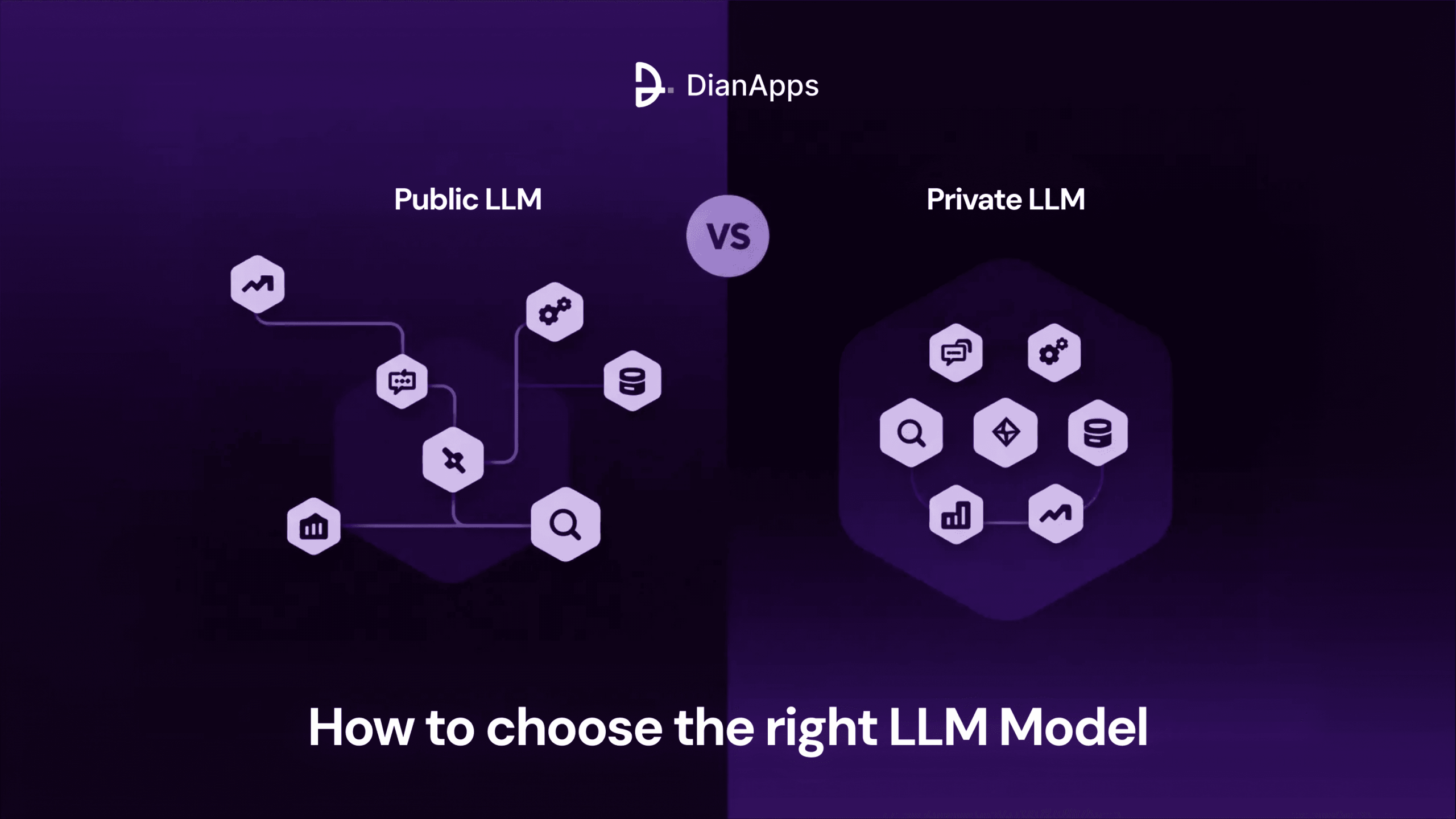





| Choosing between a public and a private LLM depends on how your organization prioritizes data control, compliance, scalability, and cost predictability. Public LLMs enable rapid adoption with minimal infrastructure and are ideal for general, low-risk workloads. Private LLMs offer stronger governance, customization, and data residency, making them better suited for sensitive or regulated environments. While public models optimize speed and flexibility, private deployments deliver long-term control and security. In practice, many enterprises adopt a hybrid strategy, leveraging public LLMs for routine tasks and private LLMs for confidential, mission-critical operations. |
Choosing an LLM isn’t a simple tech decision anymore. What once felt like a straightforward choice, plug into a powerful public model and move on, has evolved into something far more strategic.
Today, businesses are considering critical questions:
- Are we risking sensitive data exposure?
- Will API costs explode as usage scales?
- Do we need deeper customization and control?
- Are we building long-term dependency or long-term advantage?
Because the reality is clear: A wrong LLM decision affects more than performance; it impacts security, compliance, cost, and AI strategy.
Public LLMs offer speed, convenience, and modern innovation.
Private LLMs offer control, governance, and data sovereignty.
Both deliver value. Neither is universally “better.”
The smartest choice depends on your business model, risk tolerance, and growth plans.
This blog breaks down the trade-offs and helps you decide which LLM approach actually fits your organization.
Let’s get started.
What Is an LLM?
A Large Language Model (LLM) is the technology behind tools that can read, write, summarize, and respond in natural language.
If you’ve used an AI chatbot, a writing assistant, or a coding copilot, you’ve already interacted with one.
Businesses now use LLMs to create content, analyze documents, automate support, assist developers, and identify insights from internal data. What started as an experimental AI capability is quickly turning into a serious operational asset.
And once an organization decides to bring an LLM into its workflow, a very practical question follows:
Should you use a public model, or invest in a private one?
To answer that, let’s first look at public LLMs.
What Public LLM Actually Means?
A public LLM is a model hosted and managed by a third-party provider. You don’t own the infrastructure or the model; you access it via API or interface.
In simple terms: You rent intelligence instead of building it.
- No model training.
- No server management.
- No deployment complexity.
- Just connect and start using.
For companies exploring how to choose the right AI model, public LLMs often become the first entry point because they remove technical friction.
Advantages of Public LLMs
- Rapid Deployment: Integration can happen quickly, making public LLMs ideal for pilots, MVPs, and fast-moving teams.
- No Infrastructure Cost: No need to invest in GPUs, hosting environments, or MLOps pipelines.
- modern Updates: Providers continuously improve model performance, context windows, and capabilities.
- Experimentation-Friendly: Perfect for testing ideas without long-term commitments.
This is why startups, product teams, and innovation labs love them.
Limitations of Public LLMs
However, convenience introduces major limitations as well, so in this section, we have covered all the limitations of the public LLMs.
- Data Privacy Concerns: Your prompts are processed on external servers. For regulated industries, this raises compliance and governance questions.
- Usage-Based Cost Spikes: API pricing scales with tokens and requests. Costs that seem negligible at low usage can escalate rapidly in production. They celebrate low entry cost but rarely discuss long-term scaling economics, which can become a serious budgetary risk.
- Limited Model Control: You can guide outputs through prompts, but you can’t fully control model weights, training data, or internal behavior.
- Vendor Dependency: Pricing changes, rate limits, or policy updates are outside your control.
The Reality Check Most People Miss
Public LLMs are excellent for speed and accessibility. But at scale, businesses often encounter:
- Rising operational costs
- Data governance friction
- Control limitations
Which is exactly why organizations evaluating how to choose the right LLM model eventually consider private deployments.
What Private LLM Actually Means?
A private LLM is deployed within your own infrastructure on-premises, in a private cloud, or inside a secured VPC.
Unlike public models, you’re not renting access.
You’re operating within a controlled environment.
This means your data, prompts, and outputs stay inside your ecosystem.
For organizations evaluating how to choose the right LLM model, this distinction becomes critical when privacy, compliance, or governance enters the conversation.
Advantages of Private LLMs
- Data Control & Sovereignty: Sensitive data never leaves your environment, essential for finance, healthcare, legal, and enterprise operations.
- Stronger Security Posture: Reduced exposure to third-party processing risks.
- Customization & Fine-Tuning: Models can be adapted to domain-specific language, internal knowledge, and proprietary workflows.
- Predictable Cost at Scale: Higher upfront investment, but fewer surprises compared to usage-based API pricing.
- Compliance Alignment: Easier to meet regulatory and governance requirements.
Limitations of Private LLMs
- Higher Initial Investment: Infrastructure, hosting, optimization, and model management require capital.
- Operational Complexity: You need AI expertise, MLOps capability, and maintenance workflows.
- Slower Innovation Cycles: You don’t automatically inherit vendor updates or model improvements.
- Resource Commitment: This is a long-term strategic asset, not a plug-and-play tool.
The Strategic Trade-off
Private LLMs exchange convenience for control. They make sense when:
- Data sensitivity is high
- Compliance pressure is strict
- Usage volume is large
- Customization is essential
Private vs Public LLM: Core Differences
| Factor | Public LLMs | Private LLMs |
| Deployment | Hosted by third-party providers, accessed via API | Deployed within your own infrastructure |
| Setup Speed | Rapid integration, minimal technical overhead | Slower setup, requires infra & expertise |
| Upfront Cost | Low entry Cost | Higher initial investment |
| Cost at Scale | Usage-based pricing can escalate quickly | More predictable long-term economics |
| Data Privacy | Data processed externally | Data stays within your environment |
| Security Control | Governed by vendor safeguards | Full internal control |
| Customization | Limited (mostly prompt-based) | Deep tuning & domain adaptation |
| Maintenance | Managed by the provider | Managed internally |
| Best Suited For | Prototyping, general AI tasks, fast launches | Sensitive data, compliance-heavy, high-volume use |
What This Comparison Really Means?
The choice isn’t about which LLM is better. It’s about which model aligns with:
- Your risk tolerance
- Your scaling strategy
- Your compliance obligations
- Your budget predictability
For organizations exploring how to choose the right LLM model, this distinction becomes less technical and more strategic. Because a model that works brilliantly for a startup MVP may be completely wrong for an enterprise handling regulated data.
Recommended Read: How to Choose the Right Artificial Intelligence Development Company for Your Business?
When to Choose a Public LLM?
Public LLMs shine in environments where speed, flexibility, and low entry barriers matter more than deep control. They’re often the right choice when agility is the priority.
Rapid Experimentation & Prototyping
If your team is exploring ideas, validating use cases, or building MVPs, public LLMs offer immediate access without infrastructure delays. You can test, iterate, and pivot quickly.
Limited Budget or Early-Stage Adoption
When organizations are still figuring out how to choose the right AI model, committing to heavy infrastructure investment may not be practical. Public LLMs allow progress without high upfront costs.
General-Purpose AI Tasks
For use cases like:
- Content generation
- Brainstorming
- Basic automation
- Internal productivity tools
Public models are often more than sufficient.
Fast Time-to-Market Requirements
When launch timelines are aggressive, public LLMs remove deployment friction.
- No hardware setup.
- No model hosting.
- No complex configuration.
Unpredictable or Low Usage Volume
If LLM usage is occasional or variable, usage-based pricing may remain cost-efficient.
When to Choose a Private LLM?
Private LLMs make sense when control, security, and long-term stability outweigh convenience. They’re not about experimentation. They’re about infrastructure-grade AI.
Sensitive or Regulated Data Environments
If your AI interacts with:
- Customer records
- Financial data
- Healthcare information
- Legal documents
- Proprietary business intelligence
Keeping data inside your environment becomes a priority.
Strict Compliance Requirements
Industries governed by regulatory frameworks often require tighter oversight on:
- Data processing
- Storage
- Access controls
- Audit trails
Private LLMs simplify governance alignment.
High-Volume AI Usage
When LLMs power:
- Customer support at scale
- Enterprise copilots
- Large document workflows
- Continuous automation
Usage-based API costs can become unpredictable. Private deployments offer more stable economics.
Need for Deep Customization
If your business needs:
- Domain-specific tuning
- Proprietary knowledge integration
- Custom guardrails
- Industry language adaptation
Private LLMs offer greater flexibility.
Performance & Latency Control
For mission-critical applications, predictable performance matters more than shared infrastructure variability.
Hybrid LLM Strategy: A Practical Middle Ground
For many organizations, choosing between a public or private LLM is no longer a strict either-or decision. Business needs are rarely that simple.
A hybrid LLM strategy blends the strengths of both models, giving companies flexibility where they need speed and control where they need protection.
In real-world deployments, businesses often use public LLMs for tasks like content creation, brainstorming, and low-risk automation. These workflows benefit from rapid scalability and minimal setup.
Private LLMs, on the other hand, are typically reserved for sensitive operations, especially where customer data, proprietary information, or compliance requirements are involved.
This separation helps reduce security and governance risks without slowing down innovation across teams.
It also supports smarter cost management, preventing unnecessary infrastructure investments or excessive API spending.
For organizations evaluating how to choose the right AI model or how to choose the right LLM model, hybrid deployment is increasingly emerging as the most practical and sustainable approach.
Recommended Read: Embracing AI Transformation: gaining access to the Power of Innovation
Decision Framework: How to Choose the Right LLM Model
Choosing an LLM isn’t about picking the most powerful model. It’s about selecting the one that fits your business reality.
If you’re wondering how to choose the right AI model, or more specifically, how to choose the right LLM model, start with these core questions:
How sensitive is your data?
If your workflows involve:
- Customer information
- Financial records
- Healthcare data
- Proprietary business intelligence
Privacy and control should heavily influence your decision.
- In case of low sensitivity, Public LLM may work
- In case of high sensitivity, Private or Hybrid becomes safer
What will usage look like at scale?
Early usage can be misleading.
Estimate:
- Number of users
- Frequency of prompts
- Automation volume
- Document sizes
Heavy, continuous usage may strain API-based pricing models.
Do you need customization?
Ask yourself:
- Is general intelligence enough?
- Or do we need domain-specific accuracy?
Industry language, internal knowledge bases, and custom workflows often require deeper tuning.
What are your compliance obligations?
Regulated environments introduce constraints:
- Data residency
- Audit trails
- Security controls
- Legal approvals
Ignoring compliance early creates friction later.
How predictable must costs be?
Public LLM ensures Variable monthly spend
Private LLM ensures a higher upfront, steadier long-term
Budget stability matters more in production than in pilots.
What internal capabilities do you have?
Private deployments require:
- Infrastructure readiness
- AI / MLOps expertise
- Maintenance workflows
If these are missing, public models may be the practical entry point.
Recommended Read: How Can AI Tools Contribute to Business Growth?
Future of LLM Deployment
The way organizations deploy LLMs is changing quickly. What started as curiosity and experimentation is now becoming part of serious technology roadmaps. Businesses are thinking beyond model size and focusing more on relevance, control, efficiency, and risk.
Rise of Domain-Specific LLMs
Instead of relying only on general-purpose models, companies are adopting LLMs designed for specific industries or functions. These models tend to produce more accurate, context-aware responses that better reflect real operational needs.
Enterprise Shift Toward Private & Hybrid Models
As LLMs move closer to core systems and sensitive data, enterprises are re-evaluating deployment choices. Greater emphasis on privacy, compliance, and long-term cost stability is pushing many organizations toward private or hybrid approaches.
Emergence of AI Governance Platforms
With wider LLM adoption comes greater oversight. Companies are investing in governance tools to track usage, manage risks, enforce internal policies, and maintain accountability across teams using AI in different ways.
Smaller, Specialized Models Gaining Traction
There’s also a growing realization that bigger isn’t always better. Smaller, focused models often deliver faster responses, lower operating costs, and sufficient performance for clearly defined business tasks.
Final Words
There’s no single best choice between private and public LLMs. The right decision depends on your data, risk tolerance, scaling plans, and budget priorities. What works for experimentation may not work for long-term operations. For businesses focused on sustainable AI adoption, the real question isn’t just model capability; it’s control, cost stability, and strategic fit. This is where expert-led AI and ML development services help organizations design LLM solutions that are secure, efficient, and built for real business outcomes.
 0 comments










Leave a Comment
Your email address will not be published. Required fields are marked *