














 0 comments





Key Takeaways
- Market growth: The US online grocery market was USD 203.0 billion in 2025 and is expected to reach USD 712.2 billion by 2034, exhibiting a CAGR of 14.97% (IMARC Group, 2026).
- New energy: December 2025 saw USD 12.7 billion in US online grocery sales, a new record and a 32% growth rate compared to previous year, with online accounting for 19% of the entire grocery spend (Brick Meets Click and Mercatus, 2026).
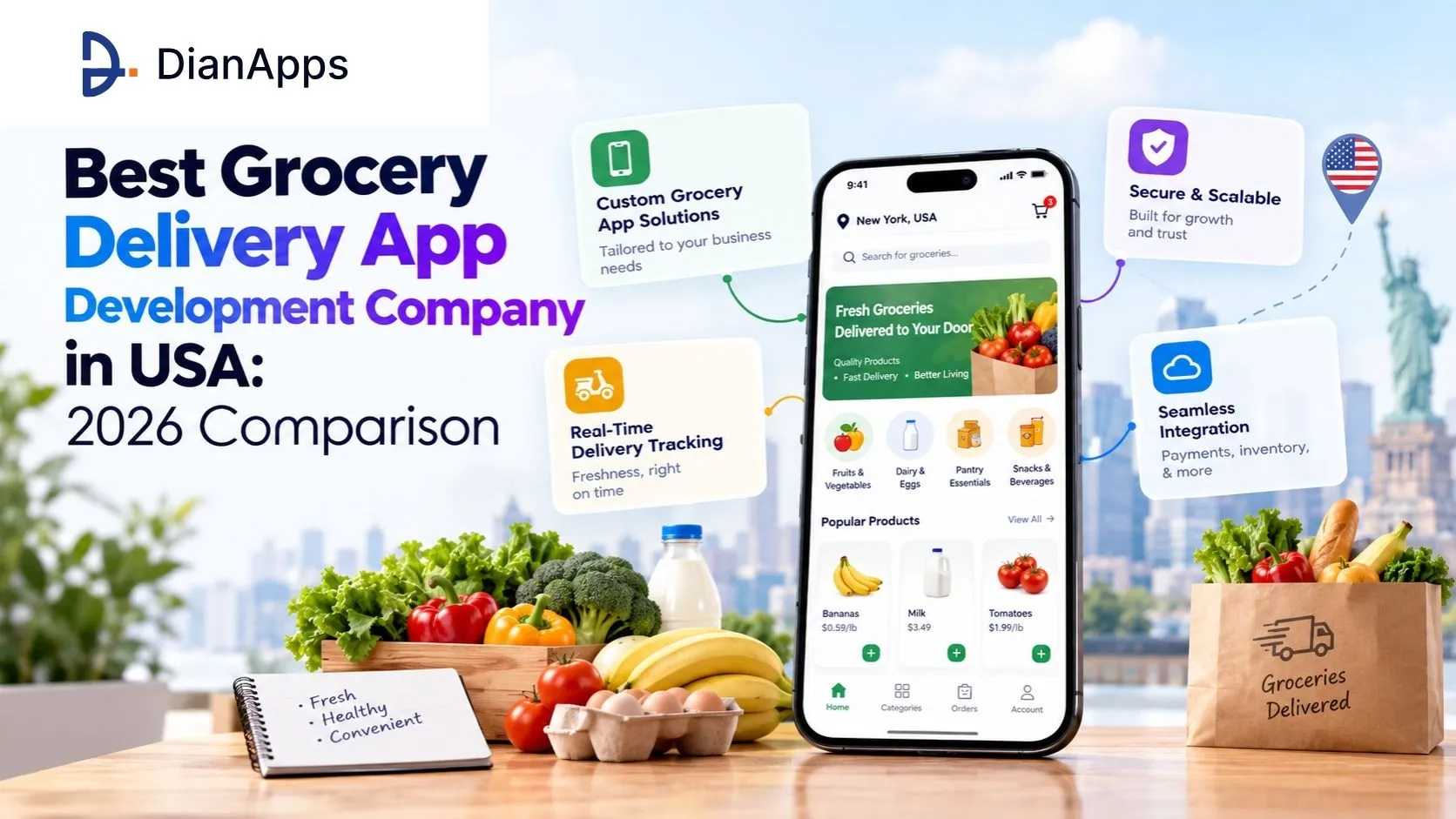
- About this guide: the best grocery delivery app development company in the USA rankings based on Clutch presence and grocery-specific experience, an analysis of grocery delivery app development costs by app complexity, and how Dianapps builds grocery delivery app solutions.
- Who it is for: grocery chains, quick-commerce startups, individual shops and Prop Tech founders shopping for a grocery app development company before making a deal.
Evaluation criteria: Clutch rating and review quality, verified grocery or on-demand experience, US delivery logistics proficiency, clear hourly billing.
Quick Answer
The Best Grocery Delivery App Development Company in USA Varies based on Project Stage and Your Budget Space-O Technologies is a great fit for hyper-scaling startups on-demand, Dianapps is on fire with full cycle grocery delivery app developments leveraging with AI, Binary Studio is an MVP-focused builder for teams wanting a boutique feel, Zco Corporation can integrate grocery platforms of any size with 3 decades of US-centric, end-to-end enterprise building.
DianApps is offering grocery delivery app development services with offline-ready ordering, real-time inventory sync and AI-driven personalization built in from day one.
Grocery ecommerce is no longer a pandemic convenience. It’s the one way tens of millions of US households regularly replenish their kitchens. Online grocery sales as a proportion of total US grocery spend are on a trajectory to a 19% share and rising at a pace quarter on quarter (Brick Meets Click and Mercatus, 2026). For a grocery business, restaurant chain or quick-commerce startup, choosing the right grocery delivery app development company in the USA is now a statement of revenue and not a technology box to tick.
This guide is examining five leading grocery app development company choices based on their Clutch profile, grocery-specific experience and USA delivery footprint, then comparing pricing, features and questions to ask before engaging.
This article is for companies interested in hiring a grocery delivery app development company. Independent grocers and regional chains looking to reach the convenience level of Instacart and Amazon Fresh, or startup founders building their on demand grocery delivery app development business from the ground up.
Best-fit development companies for on demand grocery delivery business companies will vary on a company-by-company basis, so we’ve segmented our list by use case instead of a unified top score.
Methodology: How These Companies Were Evaluated
This is not a sponsored placement list. Companies were rated based on the following criteria:
- Clutch presence: a supported history of rating and review, not self-reported numbers.
- Grocery or on-demand portfolio: hands on experience developing customer applications, delivery-partner apps or multi-vendor grocery marketplaces, rather than just general e-Commerce.
- Delivery logistics experience in the USA: experience with payment rails in the USA and relevant EBT/SNAP considerations, last mile delivery trends.
- Clear costs: We show you all the prices, based on actual project and hourly rates.
- What this list is not: a comprehensive rundown of every agency to boast grocery app experience.
Tons of popular “top 10 grocery app” articles online parrot the same unsubstantiated ratings dozens of times over, so companies that didn’t have confirmed, sourced info were omitted rather than added on hope.
Top Grocery Delivery App Development Companies in the USA
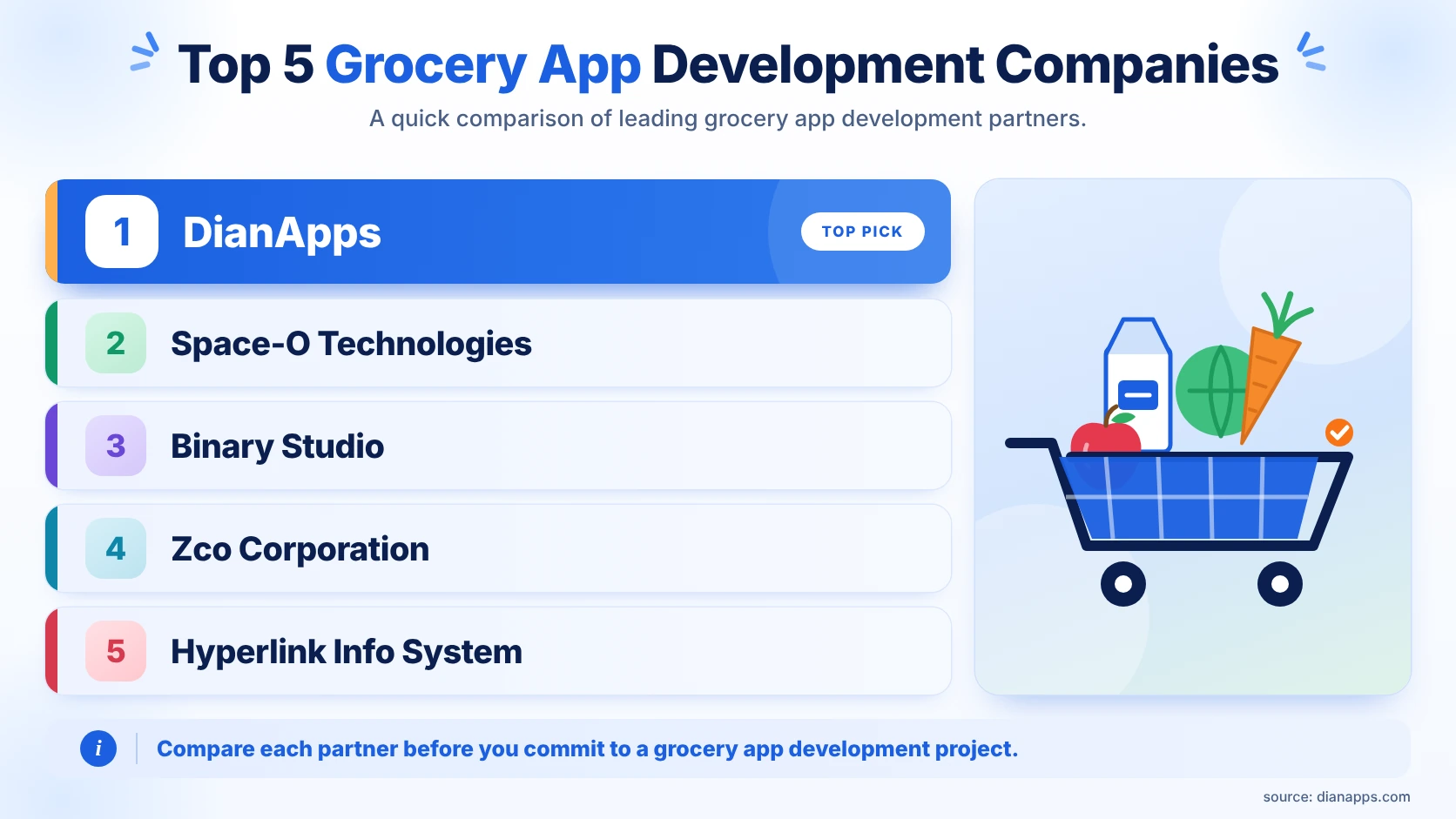
| Rank | Company | Clutch Rating | Hourly Rate | Best For |
|---|---|---|---|---|
| 1 | DianApps | 4.8/5 (81+ reviews) | Custom quote | Full-cycle grocery apps with AI personalization |
| 2 | Space-O Technologies | 4.8/5 | $25-49/hr | Fast-scaling on-demand and grocery startups |
| 3 | Binary Studio | 4.9/5 | $50/hr | Boutique, MVP-first grocery builds |
| 4 | Zco Corporation | 4.5+/5 | $25-49/hr | US-based teams needing ERP/POS integration |
| 5 | Hyperlink InfoSystem | 4.8/5 (174 reviews) | $25-49/hr | Large-scale, multi-vendor grocery platforms |
Top 5 Grocery App Development Companies
1. DianApps
DianApps, a mobile & AI app development company, is doing grocery delivery apps development with a one-team comprehensive model, where a separate customer app, delivery-partner app, vendor dashboard, and admin panel is developed in a single team of engineers. It has a 4.8/5 rating on Clutch from 81+ reviews, and its US-based work involves over 350+ clients spread over 25+ countries with a 150+ engineers team and Clutch Premier Verified. DianApps led in this category because the AI is baked into the grocery flow, such as recommending targeted products based on AI, demand-based inventory warning, intelligent suggestions on delivery slots, not in a separate piece of AI that comes later and can be tacked on to the app. The team is also transparent that a basic single-store grocery app doesn’t necessarily need a huge AI layer on day one, and is only scoping builds around what the business really needs at the moment, not trying to upsell every product in the range.
2. Space-O Technologies
Established in 2010, Space-O Technologies has developed over 4,400 apps in native iOS and Android across various industries. Its aggregated 4.8/5 Clutch score is rooted in excellent scores on quality, cost and willingness to refer. Space-O offers a quick-to-market, polished app solution for grocery start-ups going from concept to working MVP without waiting for a full product development cycle. The company works on SaaS-based systems, custom on-demand tools and AI applications, with project sizes ranging from smaller MVPs up to six-figure enterprise builds.
3. Binary Studio
Binary Studio is a boutique software house created in 2005 and, as a boutique business, it’s coming in strong at 4.9/5 on Clutch. It excels working with startups and SMBs interested in a small senior team, not a large outsourced bench. It has helped 60+ start ups and SMBs in the US alone, it also helped grocery-related projects such as multi-vendor grocery stores and grocery subscriptions. Binary Studio’s aggregated hourly rate is about $50/hr, which is on the higher end compared to other firms on this list, but is reflective of its senior engineer model.
4. Zco Corporation
Since 1989, Zco Corporation has been based out of Nashua, New Hampshire, and it is one of the most established companies on this list. If you are a grocery store that relies heavily on direct integration with your Point of Sale (POS), enterprise Resource Planning (ERP) or Inventory systems, Zco’s thirty years of experience in enterprise software development is a true benefit over other newer agencies. Zco has developed over 1000 software solutions for clients like Volkswagen, Microsoft and Verizon; Zco’s hourly rate is generally in the $25-49/hr range.
Editor’s note on the above rating: Individual project reviews for Zco on Clutch average between a 4.5 and 5.0 rating, but Clutch does not publish one fixed overall score as it does for a few of the other companies listed here. Verify the right now figure on Clutch before publishing.
5. Hyperlink Info System
Hyperlink Info System has its headquarters in Jersey City, New Jersey, and its teams across offices in India, the UK, the UAE and Canada have scaled it up into a 1,000-9,999 employee operation since its 2011 launch. It currently holds a 4.8/5-star rating on Clutch with 174 reviews, one of the most prolific review histories on this list. This team size should make it appropriate for grocery store chains with plans for a multi-regional or multi-vendor roll-out that would benefit from greater engineering capacity than a smaller shop could provide. Hourly rates tend to fall into the $25-$49 range, which is in line with the figures quoted for Space-O and Zco.
Must-Have Features for Grocery Mobile App Development
Building a Grocery App for the US Market?
Work with an experienced mobile app team to turn your grocery concept into a scalable product.
There’s more to selecting the right partner… As for the feature list, it’s one of the factors that determine if a grocery delivery mobile app will be actually used after launch. There are some functionalities that distinguish apps that users keep open from those they delete after their first order.
- Live Inventory Sync: The inventory number you see on the app needs to match what is on the shelf within minutes, not hours, or customers won’t trust your inventory number on the first out of stock surprise.
- Intuitive substitution processing: If an item is Depleted mid-order, the app should ask the shopper for an alternative item instead of auto-calculating or cancelling the order.
- Scheduling more flexible deliveries: Customers want to set delivery windows instead of “as soon as possible”-especially for regular weekly grocery shopping.
“Cards, digital wallets, and for some US grocers EBT/SNAP capability isn’t a “nice to have,” it’s a requirement.” - Recommendation: Recommendations based on order history is one of the simplest ways on demand grocery delivery app development can increase the average order value without introducing any friction.
You know the two biggest pain points for customers are solved when your grocery app gets real-time inventory and substitution processing right.
What to Look For in a Grocery Delivery App Development Company
Proven grocery-specific portfolio: Request for examples of customer apps, delivery-partner apps and vendor dashboards that they have collaborated on, not just an e-commerce app repurposed for “grocery” 10.
- Inventory levels in real time: Your app’s fate is tied to accuracy of stock view for the customer, so dig into how the company manages inventory at scale.
- Experience in delivery logistics: Route optimization, managing delivery slots and designing apps for drivers are skills that clearly set them apart from regular mobile development.
- Payment and compliance processing: US grocery apps typically require the ability to handle several different forms of payment and EBT/SNAP for specific retailers, so clarify this for us before you put the platform forward.
- Brand support model: Like a grocery store, a grocery app needs management post-launch, not once-off delivery; inquire as to the maintenance and features-updates support after go-live.
Grocery Delivery App Development Cost in 2026
Cost depends on the number of apps you’ll want (i.e. Customer, delivery partner, vendor, admin), the model (single-store and multi-vendor marketplaces) and the scope of AI and logistics capabilities.
| Build Type | Estimated Cost Range | Typical Timeline |
|---|---|---|
| MVP (single store, core ordering and tracking) | $25,000 - $50,000 | 2-4 months |
| Mid-range (multi-vendor, real-time inventory, notifications) | $50,000 - $150,000 | 4-7 months |
| Enterprise (AI personalization, multi-region, ERP integration) | $150,000 - $400,000+ | 7-12 months |
The most significant cost factors of grocery app development remain roughly the same: at-scale real-time inventory synchronization, delivery-partner app complexity, payment gateway integration & compliance, and AI-enabled demand forecasting & personalization.
One-vendor MVP The implementation of a MVP with a single-vendor provider is virtually always the right place to begin. It tests the ordering and delivery process before a company spends the necessary dollars for multi-vendor clutter.
What Teams Are Actually Asking
One often debated topic in the startup communities such as r/Entrepreneur and others is whether it’s better to license out a proven grocery delivery platform or to order a custom grocery app development from the startup vendors. Fact is licensed grocery delivery platform accelerates the business run for a single-location pilot, whereas custom grocery delivery app development goes to profit when your own inventory logic, loyalty program or delivery radius is required.
A thread that runs through all aspects of the grocery delivery app is the approach to substitutions when the moment of picking the purchase comes and an item is unavailable. Robust grocery delivery app platforms will prompt shoppers or pickers to substitute the item on the spot, rather than leaving it to the customer to discover the missing product postorder.
Another common question: How many delivery fleet members should be gig vs. in-house? The typical mid-size grocery operators begin with a gig-delivery-partner app and add in-house fleet capabilities later as they ramp up order volume and can afford the additional management complexity.
How DianApps Builds Grocery Delivery App Solutions
Dianapps is designing each grocery delivery app development project with four interconnected components: a customer app, an app for delivery-partners, an app for stores or vendors, and an admin panel, so one grocery business comes to market with a seamless setup rather than putting solutions together post-launch. Their team begins with a discovery phase that is used to document a real-world client product catalog, delivery radius, and the fulfillment model (single store, regional chain, multi-vendor marketplace).
Tech-wise, on mobile, Dianapps is building out Flutter and React Native apps for both customer and delivery-partner side with a scalable backend that does inventory sync in real time, route-aware delivery planning and payment processing. Its AI and ML work is focused on areas that give clear value to its grocers and customers, like personalized product recommendations based on previous purchase history and store restocking predictions for shop owners, but the company is also upfront about the fact that an indie grocer on its first app does not need the same degree of AI sophistication as a regional chain of 70-something store in 3 countries. By building this end-to-end (mobile, backend, devops and AI) team, just like in the software world, it’s removing cross-team bottlenecks that can slow things down.
Have a Grocery App Idea?
Discuss your grocery app requirements, integrations, timeline, and development scope with our team.
Conclusion
The Top Grocery Delivery App Development Company in the USA as suggested by the above table, the ideal grocery delivery company depends upon the company’s strength corresponding to the stage they stand at and not only the high rating. The one-location grocers testing their first app need a very different solution from a regional chain planning a multi-vendor rollout, and these five contenders are covering that whole spectrum between them. With the US online grocery market heading to USD 712.2 billion by 2034 (IMARC Group, 2026), the ones establishing their app now will be the prime benefactors of that growth.
Types of Grocery Delivery App Development We Develop Our grocery delivery app solutions cover everything from customer app, delivery partner app, AI-powered personalization, and more for grocery brands to start or grow in the USA.
 0 comments









Leave a Comment
Your email address will not be published. Required fields are marked *