













 0 comments





Key Takeaways:
- AI healthcare apps are supporting administrative tasks like documentation and scheduling, along with clinical use cases such as diagnosis and decision support.
- Administrative and clinical AI have different regulatory requirements, validation needs, timelines, liability and development costs.
- AI healthcare app costs can range from around $30,000 for an AI layer to $1 million+ for regulated clinical AI products.
- HIPAA, FDA, EU MDR and EU AI Act requirements depend on the app’s features, data, market and clinical involvement.
- Successful healthcare AI requires secure EHR integration, PHI protection, human oversight, regulatory planning and ongoing monitoring.
Quick Answer: AI healthcare app development involves building healthcare applications with AI for documentation, triage, patient communication, remote monitoring, telemedicine and clinical decision support. Costs can range from $30,000 for an AI layer to $1 million+ for regulated clinical AI, depending on complexity, integrations, validation and compliance requirements.
Clinicians are spending hours every week typing notes after their shift has ended, patients are waiting on hold just to reschedule an appointment, and care teams are trying to keep an eye on hundreds of patients with remote devices that are generating more data than anyone can realistically read. This is exactly where AI is stepping in, and healthcare organisations are now building apps that take care of the triage, documentation, imaging analysis, adherence, prediction and patient engagement work that has been slowing everyone down for years.
But what is AI healthcare app development really about? Well, it is the creation of web and mobile applications for patients, clinicians and health organisations where AI is doing actual operational or clinical work, and in 2026 each and every one of these projects is coming down to one choice. AI for documentation and administration (scheduling, drafting notes for human review, billing) is not regulated as a medical device and is spreading extremely fast, with ambient AI scribes alone reaching a majority of large hospital systems in less than three years. AI that diagnoses, treats or drives clinical decisions, on the other hand, is medical device software regulated by the FDA, EU MDR and the high-risk rules of the EU AI Act, and the FDA has now authorised well over 1,000 AI-enabled devices. Which side of that line your app is sitting on will decide your timeline, your costs and your legal liability.
That is the key thing to get your head around before you start building an AI medical app, and it is the theme running throughout this guide: which use cases are paying back, which laws relate to which use cases, what a HIPAA-compliant telemedicine app or healthcare mobile app development project really costs, and where the mistakes are hiding that turn a useful build into a compliance headache. Let’s take a look.
The Line That Decides Everything: Administrative AI vs Clinical AI
For regulators, it is about what the software does, not how complex it is. If the software is analysing or interpreting medical data, or giving a recommendation based on it, and claims that it is designed to diagnose, treat, cure, mitigate or prevent disease, it is Software as a Medical Device (SaMD), whether you are in the US, EU, UK, Canada or Australia. If it is just handling schedules, billing, transcription or reminders, it usually is not, and the differences between the two are not hard to see.
| Feature | Administrative and Documentation AI | Clinical AI (SaMD) |
|---|---|---|
| Examples | Scheduling, intake, ambient scribes, billing, prior-auth paperwork, adherence reminders, general wellness | Imaging analysis, symptom triage that influences decisions, risk prediction, dosing suggestions, diagnostic support |
| Regulation | Privacy law (HIPAA, GDPR, Privacy Act) and consumer protection | Privacy law plus FDA clearance, EU MDR CE marking, EU AI Act high-risk obligations, TGA or Health Canada equivalents |
| Typical time to market | Months | 12 to 24 months including validation |
| Why it matters | Fast adoption, lower cost, proven ROI | Higher value, higher evidence bar, higher liability |
Most successful healthcare apps with AI are starting on the administrative side, proving the value and then building the data and quality system needed to cross into clinical territory later. Deciding which side you are on in week one is the single biggest de-risking step in any healthcare app development project, and once that is clear, the next question is which use cases are worth building first.
12 AI Use Cases in Healthcare Apps That Pay Back
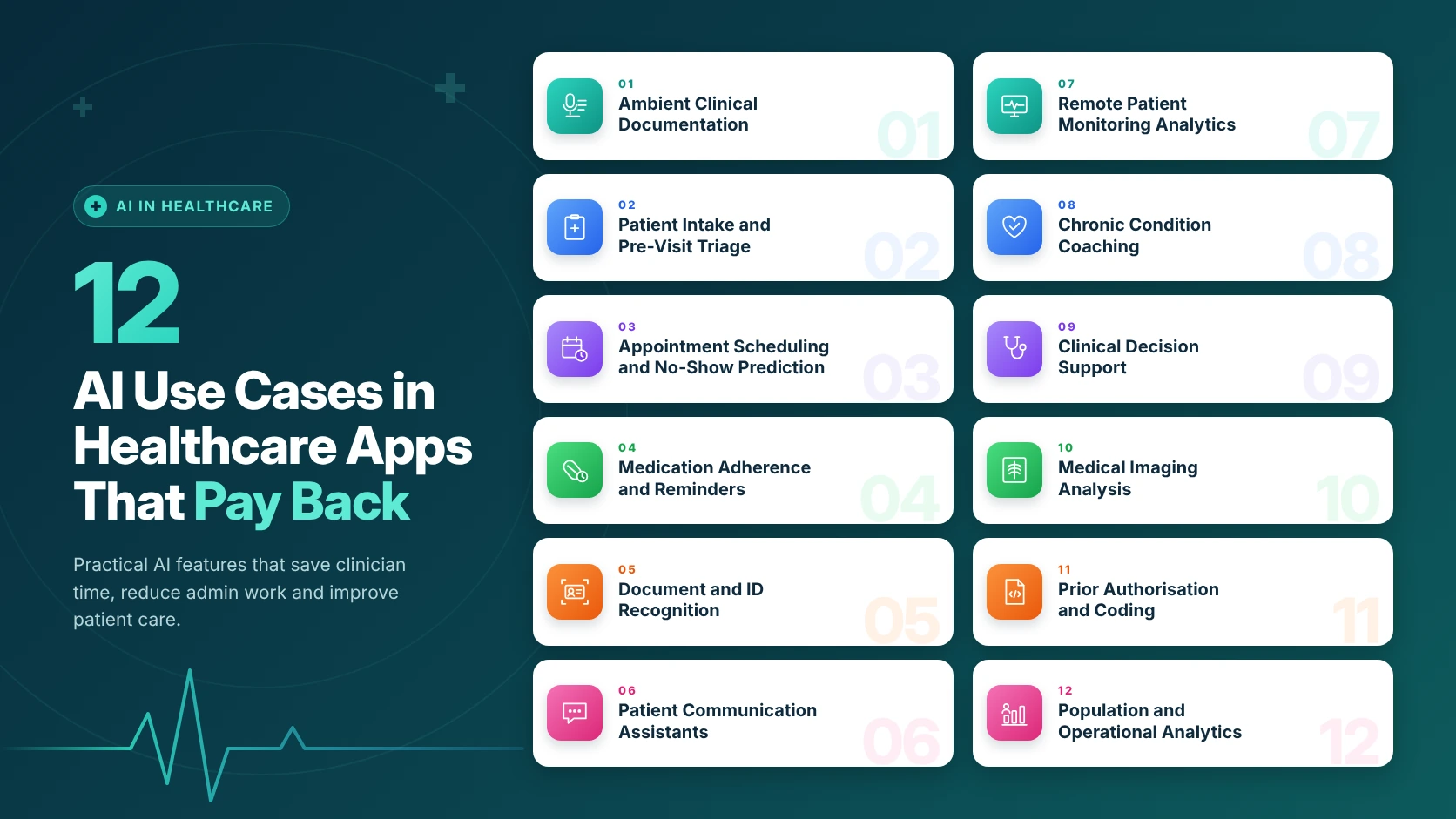
Not every AI feature is returning the same value, so we have ordered these roughly by how quickly they are paying back in 2026:
-
Ambient Clinical Documentation:
Recording a consultation and drafting the note for clinician review, which is saving clinicians hours every week and sitting outside device regulation.
-
Patient Intake And Pre-Visit Triage:
Structured symptom collection and routing to the right care pathway, administrative when it routes and clinical when it advises.
-
Appointment Scheduling And No-Show Prediction:
Predicting cancellations and filling slots automatically, which is directly measurable in revenue.
-
Medication Adherence And Reminders:
Personalised timing, refill prediction and escalation to care teams when doses are missed.
-
Document And Id Recognition:
Scanning insurance cards, referrals, prescriptions and lab reports into structured records.
-
Patient Communication Assistants:
LLM-powered answers from your own knowledge base for logistics, preparation and billing questions, with a human handoff, but not for mental-health advice, which several US states are now barring AI from delivering directly.
-
Remote Patient Monitoring Analytics:
Trend detection on wearable and home-device data, flagging deterioration for clinician review.
-
Chronic Condition Coaching:
Diabetes, hypertension and cardiac programmes that are adapting to the patient’s data and behaviour.
-
Clinical Decision Support:
Risk scores, alerts and suggested pathways inside the clinician’s workflow, which counts as SaMD in most jurisdictions.
-
Medical Imaging Analysis:
Dermatology, radiology, ophthalmology and wound assessment from phone or device images, SaMD with the strongest evidence requirements.
-
Prior Authorisation And Coding:
Drafting and checking the paperwork that is consuming so much administrative time
-
Population And Operational Analytics:
Demand forecasting, staffing and bed management for providers.
A practical filter here is really simple, for each and every feature, write down which metric it will move (clinician minutes, no-shows, readmissions or delay in diagnosis), by how much, and which side of the regulatory line it is falling on. If you are uncertain on this, you are not ready to build yet, and this is also where the compliance picture starts becoming extremely crucial.
Planning an AI Healthcare App?
Get a clearer view of your app’s scope, compliance needs and development cost before you commit.
Compliance Rules for AI Healthcare Apps in 2026
Healthcare AI compliance is running across three overlapping regimes, enforced by different regulators at the same time. Think of this as an engineer’s map rather than legal advice, take it to your counsel and both of you will have a much easier meeting. Let’s break it down.
Privacy: HIPAA, GDPR and National Equivalents
HIPAA is regulating how protected health information (PHI) is collected, stored and transmitted in the US, which means encryption at rest and in transit, role-based access, audit logs for each and every access and a signed Business Associate Agreement (BAA) with any third party that is touching PHI. Penalties are scaling per violation and can run into millions of dollars per category each year, while healthcare is still the sector with the most expensive data breaches, averaging over $7 million per incident. HIPAA’s minimum necessary rule is also applying to AI, so training a model on full patient records when it needs only three fields is not acceptable.
The most common mistake we are seeing in early-stage healthcare AI is routing PHI through a third-party LLM API without a signed BAA, usually because the integration was set up during prototyping and never revisited before production.
Device Regulation: FDA, EU MDR, TGA and Health Canada
If the AI is making a diagnosis or recommendation, or is driving clinical action, it is SaMD. In the US, it goes through the established FDA pathways, with the added flexibility of a Predetermined Change Control Plan that is allowing pre-authorised model updates, so adaptive AI can keep improving without a new submission each time. In the EU, SaMD needs CE marking under the Medical Device Regulation, and most device classes require a notified body to be involved. Regulators in 2026 are actively looking for AI diagnostic features that have been classified downward to avoid scrutiny, and having a clinician review the output does not exempt the software.
AI-Specific Law: The EU AI Act and US State Rules
The EU AI Act is placing healthcare AI in the high-risk category, requiring data governance, transparency, human oversight and technical documentation that overlap heavily with MDR. The EU’s recent simplification push has already moved some timelines for medical-device AI, so any guide still quoting August 2026 as the final deadline is outdated, and the smarter approach teams are taking is building one quality system that can satisfy both frameworks together. In the US, dozens of state bills on AI chatbots are following a similar pattern, AI can support clinicians, but a number of states are now prohibiting AI from delivering mental-health services directly.
What This Means for the Build
All of this is translating into a few practical rules for your development team:
- Decide administrative or clinical for each feature before design starts.
- Sign BAAs (or equivalents) with every AI vendor, or keep PHI on-device and away from third-party models entirely.
- Redact PHI before any external model call and log every access.
- Design human oversight into the interface for anything clinical.
- Keep validation evidence, model documentation and change logs from the first sprint, not the last.
This is why compliance is not something to bolt on at the end, it is shaping the architecture from day one, especially when you are building a telemedicine app.
Building an AI Telemedicine App: Features That Matter
Telemedicine is now accounting for a significant share of healthcare visits across North America and Europe, and patients are expecting virtual care to feel as smooth as an in-person visit. An AI telemedicine app in 2026 is combining a HIPAA-compliant core with a set of AI layers that are reducing the clinician’s workload rather than adding to it.
The HIPAA-compliant core is including:
- Identity verification and scheduling.
- Encrypted video and messaging.
- E-prescriptions, payments and insurance.
- HL7 FHIR integration with EHR systems.
- Audit logging across every access.
The AI layers on top are including:
- Symptom gathering and triage before the visit.
- Ambient note creation during the visit.
- Post-visit summaries and instructions in plain language.
- Medication adherence support.
- Remote monitoring alerts.
- A patient assistant for logistics questions, with handoff to staff.
And that is not all, there are some real-world challenges in mobile health app development that cannot be ignored. A large share of telemedicine patients are connecting on weak or unstable networks, so the app needs graceful degradation and offline queuing for video, uploads and AI features. App store reviews for healthcare apps are also stricter and slower than most other categories, so plan extra time and clear disclosures for any generative AI features. With the features sorted, the next question naturally is how much all of this is costing.
What AI Healthcare App Development Costs
Healthcare app development services are sitting at the upper end of AI app pricing because compliance, integration and validation are adding real work. Here is how the costs are breaking down:
| Project | Typical Scope | Indicative Cost (USD) | Timeline |
|---|---|---|---|
| AI layer added to an existing healthcare app | Intake triage, adherence, documentation or patient assistant via compliant APIs | $30,000 to $80,000 | 6 to 12 weeks |
| HIPAA-compliant patient app MVP with AI features | Scheduling, messaging, records, one or two AI features, EHR integration | $80,000 to $180,000 | 16 to 26 weeks |
| AI telemedicine app | Video, prescriptions, payments, EHR integration, AI intake and documentation | $120,000 to $300,000 | 5 to 9 months |
| Remote monitoring or chronic care platform | Device data, analytics, alerts, care-team dashboards, patient app | $150,000 to $400,000 | 6 to 12 months |
| Clinical AI (SaMD) product | Diagnostic or decision-support model, validation, regulatory submission, quality system | $300,000 to $1,000,000+ | 12 to 24 months |
| Ongoing compliance, inference and maintenance | Monitoring, patches, model updates, audit support | 15 to 25 percent of build per year | Ongoing |
There are two lines that healthcare app budgets are most often missing. The first is EHR integration, since FHIR mapping and vendor sandboxes are taking longer than any other integration, and the second is validation evidence for anything clinical, which is really a research programme and not a sprint. Knowing the cost is one part, understanding how the project is actually moving week by week is the other.
Timeline and Process
A compliant AI app development project for healthcare is following the standard stages with a few healthcare-specific additions, let’s take a look:
- Discovery, Data And Regulatory Classification (Weeks 1 To 4): Define the metric, audit data and consent, classify each feature as administrative or clinical, map the applicable laws for each market and decide on-device versus cloud, resulting in scope, architecture, a compliance plan and a fixed-price estimate.
- UX And AI Interaction Design (Weeks 3 To 7): Design uncertainty, oversight and escalation into every AI touchpoint and prototype with real model outputs.
- Compliant foundations (Weeks 5 To 10): Encryption, access control, audit logging, BAAs, PHI redaction, EHR sandbox integration and evaluation sets.
- Development In Sprints (Weeks 8 To 22): App and AI features are being built together, with a testable build every two weeks.
- Validation, Security And Store Preparation (Weeks 20 To 28): Penetration testing, accessibility, AI regression and safety testing, clinical validation where required and store disclosures.
- Launch, Monitoring And Updates (Week 28 Onwards): Production monitoring for cost, quality and safety, along with a documented change process for model updates.
Administrative AI features are usually shipping in months, while clinical AI is shipping when the evidence is ready, which is usually a year or more. Even with a clear process, there are a few mistakes that keep showing up again and again.
Mistakes That Sink Healthcare AI Projects
Most healthcare AI projects are not failing because of the AI itself, they are failing because of decisions made (or skipped) early on, resulting in:
- Classifying a clinical feature as administrative to avoid regulation, which is exactly what regulators are looking for in 2026.
- Sending PHI through a consumer LLM API with no BAA, a prototyping shortcut that becomes a breach.
- Letting AI deliver mental-health advice directly, which is now barred in several US states.
- Ignoring the minimum necessary rule in training and inference data.
- Leaving EHR integration until the end, even though it is the longest integration in the project.
- Having no validation evidence for anything that is influencing care.
- Designing for perfect networks when a large share of patients are on poor connections.
- Treating launch as done, when models are drifting, laws are changing and the FDA’s change-control expectations require a documented update process.
These mistakes don’t just delay the launch, they also put patient trust and the brand perception at risk, which is why choosing the right development partner is extremely crucial.
Build Your AI Healthcare App with DianApps
Explore healthcare app development services covering AI, telemedicine, EHR integration and compliance, all under one roof.
Choosing a Healthcare App Development Company
Beyond the usual questions you would ask any AI development company, a healthcare app development partner should be able to clearly answer these:
- Which of their shipped healthcare apps handled PHI, and under which regulations?
- How are they classifying features as administrative or clinical, and who is signing off?
- Have they integrated with major EHR systems through FHIR, and how long did it take?
- What is their process for BAAs, PHI redaction and audit logging with AI vendors?
- Have they supported an FDA, CE or TGA submission, or built a quality system that could?
- How are they designing human oversight and escalation into AI features?
- What does post-launch look like for model updates, monitoring and audit support?
A partner without a clear answer on the administrative versus clinical line, or on BAAs, has not really shipped healthcare AI in production, and this is where DianApps is bringing healthcare, AI and compliance engineering together in one team.
Final Note
The healthcare AI apps that are winning in 2026 are not the flashiest ones, they are the ones where the team decided early on which side of the regulatory line each feature was sitting, kept PHI away from any vendor without a BAA, planned EHR integration from the very beginning and placed a clinician in each and every decision that really mattered. The AI is definitely the easier part, it is the discipline around it that is making the product work for patients, clinicians and the business alike.
At DianApps, we are building AI-powered healthcare and telemedicine apps from beginning until completion, bringing the future of healthcare app development, AI and compliance engineering together in one team, so you are not juggling multiple vendors. We can also run a discovery sprint that is sorting your features, mapping the rules for your target markets and giving you a clear build and running cost before you commit to anything. So if you are planning your next healthcare product, we’ve got you covered.
 0 comments








Leave a Comment
Your email address will not be published. Required fields are marked *