












 0 comments
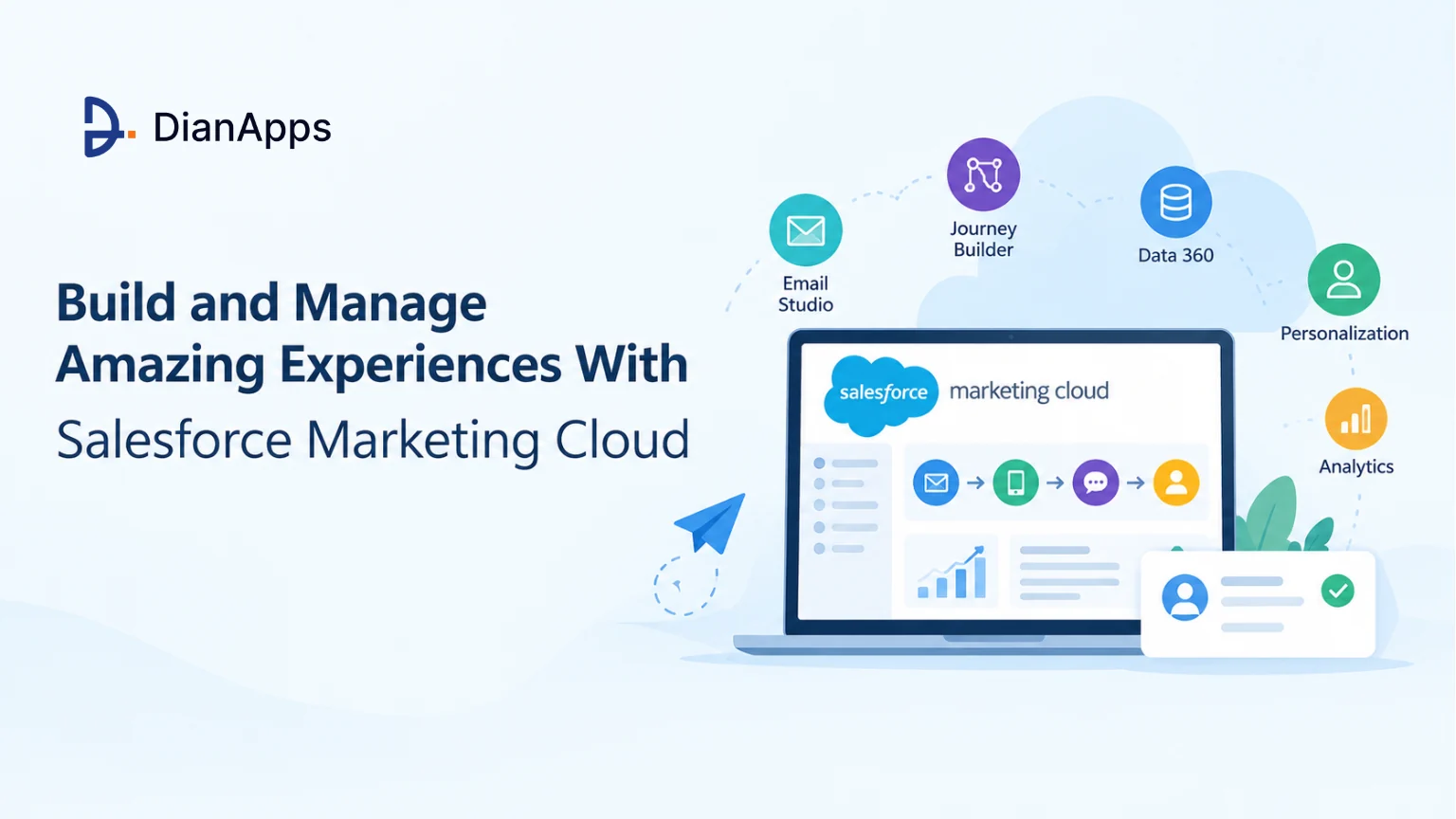





Is Salesforce Marketing Cloud hard to use? How to manage lead generation in Marketing Cloud? Can Marketing Cloud enhance the overall business engagement and experience? All your questions are valid and must be answered!
Salesforce Marketing Cloud acts as fuel to business engines offering a combined force of marketing channels all in one place. Starting from allowing marketers to send automated personalized messages to manage data and analytics effectively, the usefulness of this Salesforce platform has become the center of interest to many potential business owners and marketers.
So, we are assuming you are someone who needs to build and manage your digital marketing strategy and capture amazing experiences. However, do not know the products of Salesforce Marketing Cloud services.
Don’t worry!
This blog will cover everything you need to know in a step-by-step manner!
What is Salesforce Marketing Cloud?

Salesforce Marketing Cloud is one of the most renowned Salesforce products for businesses to grow the visibility of their operations on the online marketplace with the best marketing tools and strategies.
In a nutshell, Marketing Cloud is designed to meet and boost a business’s digital marketing presence while assisting them in sending the right messages to the target audience, knowing the 360-degree of marketing, and providing various engaging solutions through all the verticals and horizons.
Marketing Cloud” is not one product. It is a family of products, each priced and sold separately:
- Marketing Cloud Engagement: high-volume B2C email, SMS, push, and journeys (Email Studio, Mobile Studio, Journey Builder, Automation Studio, Content Builder). It started life as ExactTarget.
- Marketing Cloud Account Engagement (formerly Pardot): B2B lead generation, nurturing and scoring
- Marketing Cloud Personalization (formerly Interaction Studio): real-time web and app personalization
- Marketing Cloud Intelligence (formerly Datorama): cross-channel marketing analytics
- Marketing Cloud Next: Salesforce’s newer marketing product, built on the core Salesforce platform with Agentforce and Data 360, sold in Growth and Advanced editions.
Let’s take this blog further and learn about the Salesforce Marketing Cloud products.
Salesforce Marketing Cloud Products
As a leading Salesforce consulting partner, we advise you to explore the various marketing cloud products to accelerate digital marketing activities. Each of the products has a different look and feel with exceptional features that perform individually to different types of customers and business sales needs.
Note: Social Studio, Salesforce’s social media tool, was retired on November 18, 2024, and is no longer part of Marketing Cloud. Salesforce pointed customers to third-party social media tools.
1. Email Studio
Email Studio is a powerful tool within Salesforce Marketing Cloud designed to streamline the creation, management, and execution of email marketing campaigns. With its user-friendly drag-and-drop email builder, marketers can easily design visually appealing emails without needing extensive coding skills.
The platform supports dynamic content personalization, allowing marketers to tailor email content based on individual recipient data such as purchase history, behavior, and preferences. This ensures that each email is relevant and engaging, which can significantly boost open rates and click-through rates.
In addition to creation tools, Email Studio offers reliable testing and analytics features. Marketers can conduct A/B testing to determine which email variations perform best, optimizing subject lines, content, and send times.
Detailed performance metrics, such as open rates, click-through rates, and conversions, are available to help marketers analyze the success of their campaigns and make data-driven decisions. This comprehensive suite of tools helps businesses maximize the effectiveness of their email marketing efforts, driving higher engagement and ROI.
2. Journey Builder
Journey Builder is a central feature of Salesforce Marketing Cloud, enabling businesses to create and automate customer journeys across multiple channels. Using a visual interface, marketers can map out the customer journey, setting up triggers and actions based on customer behaviors and interactions.
For instance, a customer who signs up for a newsletter can be automatically entered into a welcome journey that includes a series of personalized emails, SMS messages, and push notifications, guiding them toward a purchase.
The strength of Journey Builder lies in its ability to deliver a cohesive, personalized experience across various touchpoints. Marketers can segment customers into different journeys based on their actions, such as opening an email or visiting a website, ensuring that each customer receives relevant and timely communication.
Real-time journey tracking allows marketers to monitor the progress and effectiveness of these journeys, making adjustments as needed to optimize performance and improve customer satisfaction.
3. Data 360 Segmentation (replaced Audience Studio)
Audience Studio, Salesforce’s old data management platform (DMP), was retired on February 1, 2024. Audience building and segmentation now happen in Data 360 (formerly Data Cloud).
Data 360 brings customer data from Salesforce and outside sources into unified profiles. Marketers build segments from those profiles and activate them in Marketing Cloud journeys or on advertising platforms. Inside Marketing Cloud Engagement, you can still segment contacts with data extensions and filters.
Additionally, Audience Studio provides deep audience insights, enabling marketers to understand their customers better and refine their marketing strategies. By leveraging these capabilities, businesses can deliver more relevant and personalized marketing messages, enhancing customer engagement and conversion rates.
4. Mobile Studio
Mobile Studio in Salesforce Marketing Cloud empowers businesses to engage customers directly on their mobile devices through SMS, push notifications, and group messaging. This tool allows marketers to create and manage mobile campaigns that can reach customers anytime and anywhere, ensuring timely and relevant communication.
For example, businesses can send personalized SMS alerts about upcoming sales, appointment reminders, or order status updates, enhancing the customer experience and building loyalty.
Moreover, Mobile Studio provides capabilities for integrating mobile messaging into broader marketing strategies. For instance, push notifications can be used to re-engage inactive app users, offering them personalized incentives to return.
Group messaging allows businesses to target specific segments with tailored messages, making it easier to reach the right audience with the right content. With analytics and reporting features, marketers can track the performance of their mobile campaigns, measure engagement, and optimize their strategies for better results.
5. Advertising Studio (being retired)
Advertising Studio (also sold as Marketing Cloud Advertising and Active Audiences) pushed CRM audiences to ad platforms such as Facebook, Google, and LinkedIn. Salesforce announced its retirement in September 2025. From August 15, 2026, subscriptions cannot be renewed; existing customers can keep using it until their current contract ends.
For new projects, Salesforce recommends Data 360 Ad Audiences, which activates Data 360 segments to advertising platforms.
6. Analytics Builder
Analytics Builder is a powerful analytics tool within Salesforce Marketing Cloud that provides businesses with the ability to measure and analyze the performance of their marketing campaigns. It offers customizable dashboards and detailed reporting features that help marketers visualize data and gain insights into customer behavior, campaign effectiveness, and overall marketing performance. These insights are essential for making data-driven decisions and optimizing marketing strategies.
One of the key features of Analytics Builder is its ability to integrate data from various marketing channels, providing a unified view of marketing activities. This holistic approach allows marketers to understand how different channels and campaigns contribute to their overall goals.
Inside Analytics Builder, Intelligence Reports (formerly Datorama Reports) provide ready-made dashboards for email sends, engagement, and journey performance, plus pivot tables and scheduled reports. The older Discover reports were retired in April 2022.
7. Content Builder
Content Builder is a versatile content management tool in Salesforce Marketing Cloud that allows marketers to create, organize, and manage marketing content across multiple channels. It features a drag-and-drop content editor, enabling users to easily design and customize email templates, mobile messages, and reusable content blocks without needing extensive technical skills.
The centralized content repository ensures that all assets are stored in one place, making it easier to maintain brand consistency and streamline content creation processes.
Content Builder also supports reusable content blocks, which can be used across different campaigns and channels, saving time and ensuring consistency. Marketers can manage content approval workflows and collaborate with team members within the platform.
By using Content Builder, businesses can efficiently manage their marketing content and deliver a cohesive brand experience to enhance customer engagement.
8. Automation Studio
Automation Studio runs scheduled or triggered background tasks in Marketing Cloud Engagement: importing files, running SQL queries to build segments, extracting data, and sending batch emails. Journey Builder handles one-to-one customer journeys; Automation Studio handles the data work that feeds them.
9. Marketing Cloud Personalization (formerly Interaction Studio)
Marketing Cloud Personalization is a real-time personalization and interaction management tool within Salesforce Marketing Cloud. It enables businesses to deliver personalized customer experiences by analyzing customer behavior and interactions in real-time.
This tool tracks customer activities across various touchpoints, such as websites, mobile apps, and email, and uses this data to create personalized recommendations and messages that are relevant to each customer’s journey.
The real-time capabilities of Marketing Cloud Personalization allow businesses to respond immediately to customer actions with tailored content and offers. For example, if a customer browses a specific product category on a website, Interaction Studio can trigger personalized emails or push notifications with related product recommendations.
This level of personalization enhances customer engagement and increases the likelihood of conversions. Additionally, Marketing Cloud Personalization provides detailed insights and analytics on customer interactions, helping marketers refine their strategies and improve the overall customer experience.
10. Marketing Cloud Intelligence (formerly Datorama)
Marketing Cloud Intelligence (formerly Datorama) is a marketing analytics platform that brings data from many marketing sources into one place. It unifies data from CRM systems, social media, email, and advertising channels into a single set of dashboards.
This comprehensive view helps marketers understand the full impact of their marketing efforts and make informed decisions.
Marketing Cloud Intelligence AI-powered insights and customizable dashboards provide a clear and detailed picture of marketing performance. Marketers can track key metrics, identify trends, and uncover opportunities for optimization.
The platform also supports automated reporting, saving time and ensuring that stakeholders have access to up-to-date information. By leveraging Marketing Cloud Intelligence, businesses can gain a deeper understanding of their marketing data. Enhance their strategies and drive better results across all their marketing initiatives.
11. Marketing Cloud Account Engagement (formerly Pardot)
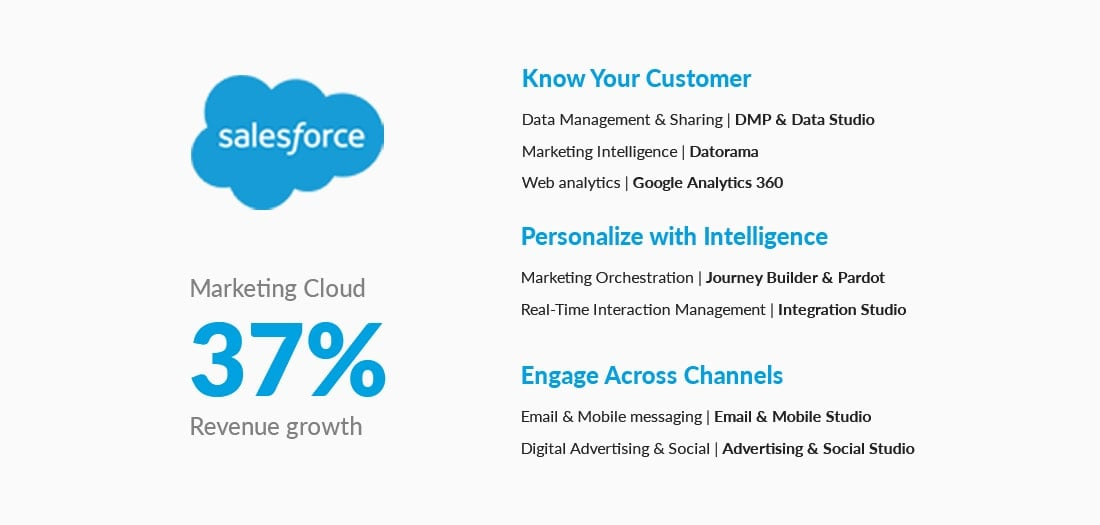
Marketing Cloud Account Engagement (still widely called Pardot) is a B2B marketing automation solution that maximizes sales productivity with Salesforce automation, designed to help businesses streamline and optimize their lead generation and nurturing processes.
It offers tools for creating and managing email marketing campaigns, landing pages, and forms. All are aimed at capturing and engaging potential leads. Account Engagement also supports lead scoring and grading. Enabling marketers to prioritize leads based on their likelihood to convert and their fit with the business’s ideal customer profile.
One of the key strengths of Account Engagement is its ability to automate complex marketing workflows. Marketers can set up automated nurturing campaigns that guide leads through the sales funnel with personalized content and interactions.
12. Marketing Cloud Next
Marketing Cloud Next is Salesforce’s newest marketing product. Unlike Marketing Cloud Engagement, it runs on the core Salesforce platform, so it shares data with Sales Cloud and Service Cloud without a connector. It is sold in two editions, Growth and Advanced, and includes Agentforce features such as AI-assisted campaign creation, multi-channel journeys, and forms and landing pages. Advanced adds path experimentation and two-way SMS and WhatsApp conversations.
Salesforce Marketing Cloud Editions and Pricing (2026)
All prices are list prices in US dollars per org per month, billed annually. Check Salesforce’s pricing page before you budget, because prices and packaging change.
Marketing Cloud Next
- Growth: $1,500
- Advanced: $3,250
Marketing Cloud Engagement+ (existing Engagement customers)
- Pro: $2,000
- Corporate: $5,500
- Enterprise: $30,000
Marketing Cloud Account Engagement+ (formerly Pardot)
- Growth: $1,250 (up to 10,000 contacts)
- Plus: $2,750 (up to 10,000 contacts)
- Advanced: $4,400 (up to 10,000 contacts)
- Premium: $15,000 (up to 75,000 contacts)
Marketing Cloud Personalization+
- From $15,000
Beyond the edition price, Engagement costs also depend on contact and message volumes.
Benefits of Salesforce Marketing Cloud
Personalization
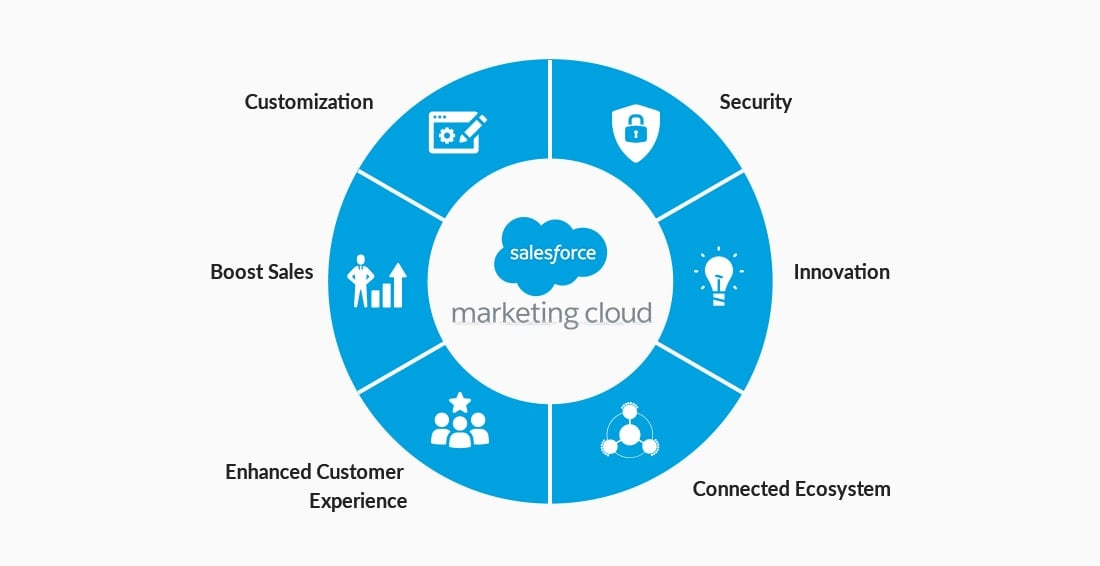
Customization is among the Salesforce Marketing Cloud’s most important advantages. This platform personalizes the experience with the aid of AI. Einstein AI features, such as send-time optimization and engagement scoring, use your customer data to decide what to send and when, and Marketing Cloud Next adds Agentforce for campaign creation. It makes it possible for you to interact with them more successfully.
Safety
Marketing Cloud includes enterprise security controls such as encryption, role-based permissions, and audit trails. As with any platform, your own configuration (user access, data retention, consent management) determines how secure your data really is.
Creativity
Numerous tools are included in the Salesforce Marketing Cloud platform to assist companies in making extensive connections with prospective clients. Whether you need B2B lead generation in Account Engagement or high-volume B2C campaigns in Engagement, the tools can be shaped to the way your team works. It provides distinctive methods for reaching clients and providing them with a flawless client experience.
Interconnected Ecosystem
The Salesforce Marketing Cloud is a single platform with a variety of options. Marketing Cloud connects to Sales Cloud and Service Cloud, so marketing can use CRM data to send email, SMS, and push messages and build journeys from one place. Marketing Cloud Next goes further by running on the same platform as your CRM.
Enhanced Customer Experience
Personalized, well-timed messages across channels encourage customers to engage more with your brand. It offers businesses a comprehensive 360-degree perspective, enabling them to comprehend their clients at a deep level. This enables them to increase interaction and provide customized solutions for their clients.
Increase Sales
Lead scoring in Account Engagement and engagement data passed to Sales Cloud help sales teams focus on the prospects most likely to buy.
Steps To Integrate Salesforce Marketing Cloud
- Choose the right product and edition: Engagement for high-volume B2C messaging, Account Engagement for B2B lead nurturing, or Marketing Cloud Next if you want marketing on the core Salesforce platform.
- Set up the account: business units, users, roles and permissions, sender authentication (domains) for email deliverability.
- Connect your CRM with Marketing Cloud Connect so contacts, leads, and campaign data sync with Sales Cloud or Service Cloud.
- Bring in data: build your data model in data extensions, and use Automation Studio for scheduled imports. If you use Data 360, connect it for unified profiles and segments.
- Create content in Content Builder: email templates, mobile messages, and reusable content blocks.
- Build journeys in Journey Builder to automate personalized messages across email, SMS, and push.
- Launch and measure: send through Email Studio and Mobile Studio, then track results in Analytics Builder and Intelligence Reports.
- Add real-time personalization with Marketing Cloud Personalization if you need web and app personalization.
Conclusion
While this is a lengthy document, we hope you find it helpful in understanding how Salesforce digital marketing operates. And that you like using the Marketing Cloud guide. Today’s businesses want to be the best in their respective industries. To do so, they must balance all aspects of their operations.
Salesforce offers a variety of company solutions, encompassing marketing, sales, service, and commerce operations.
Thus, why do you delay? Before you buy, decide which Marketing Cloud product fits your business, because Engagement, Account Engagement, and Marketing Cloud Next are priced and built very differently.
Do you know how to set up Salesforce Marketing Cloud or utilize it? If not, we can assist you. Being a top Salesforce development company, we have a lot of expertise with CRM programs.
Connect with DianApps, and let’s begin your journey to enhance visibility and capture leads authentically today!
 0 comments






Your email address will not be published. Required fields are marked *