













 0 comments





Key Takeaways
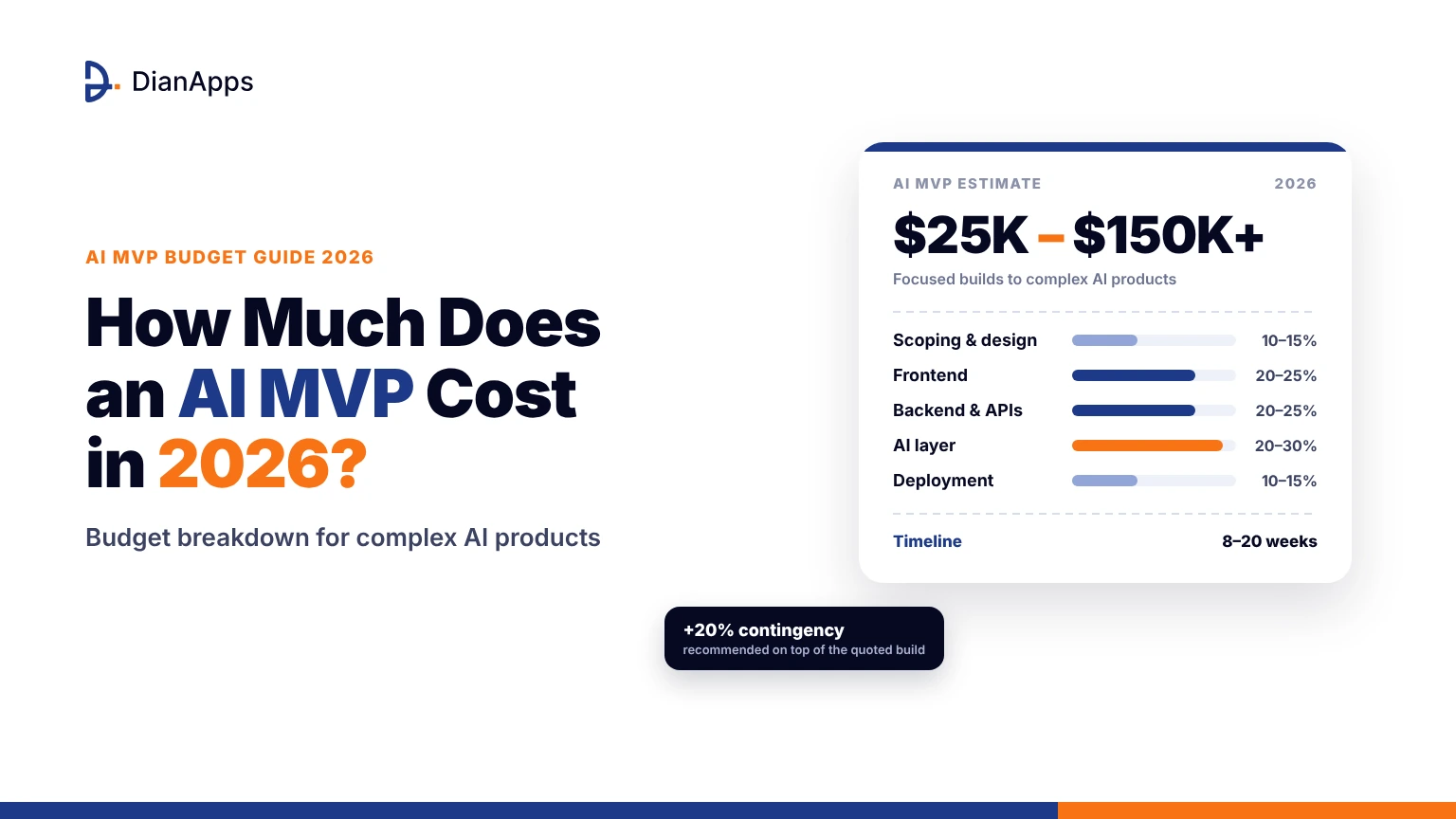
- The AI MVP development cost for a focused build usually lands at $25,000 to $60,000. Complex builds with agents, sensitive data or several integrations run $60,000 to $150,000 or more.
- Architecture drives the price more than the interface. A hosted-API build sits at the low end, while custom models and regulated data push toward the high end.
- Model fees depend on the tier you pick, not just on user count. The same pilot traffic costs about $72 a month on a small model, $1,400 on a mid-tier one and $7,250 on GPT-6 Astra.
- Budget 10 to 30% extra for monitoring, evaluation, compliance and rework, plus 15 to 20% of the build per year for upkeep.
- Plan for 8 to 20 weeks, or up to 24 for regulated products.
- Cutting scope to one workflow, one success metric and one evaluation set saves more than switching vendors.
Quick answer: A focused AI MVP costs $25,000 to $60,000. A complex one, with agents, sensitive data or several integrations, costs $60,000 to $150,000 or more (Fitworks, 2026). Expect 8 to 20 weeks of work and $50 to $500 a month in infrastructure before model fees. DianApps scopes lean builds around a single workflow through its MVP development services.
Every kickoff call starts with the same two questions. What is the real AI MVP development cost, and what will the bill look like six months after launch? The honest answer is a range. A chat assistant on a hosted model and a multi-agent platform with compliance scope are different projects with different price tags. This guide breaks the budget down by tier, phase and running cost so the quote on your desk makes sense. DianApps, an AI-first product development company, also points out where lean scoping saves real money.
What does a lean MVP look like for a complex AI product?
A lean MVP is the smallest product that tests one risky assumption with real users. It is not a cheaper copy of the full roadmap. For a complex AI product, the risky assumption is usually whether the model output is good enough to trust, and that changes what the first release has to contain. Our primer on what is an MVP in app development covers the basics. This guide sticks to the AI-specific budget.
In scope: one core user journey, one AI capability, authentication, basic analytics, a test set for judging answer quality and a feedback button. Left for later: secondary user roles, admin portals, multi-model routing, custom training and any integration you do not need on day one. Retrieval pipelines (RAG, Retrieval-Augmented Generation), agent tool use, guardrails and data security stay in scope if the product depends on them.
The test is simple. If a feature does not help prove the one risky assumption, it waits.
How much does it cost to build an AI MVP in 2026?
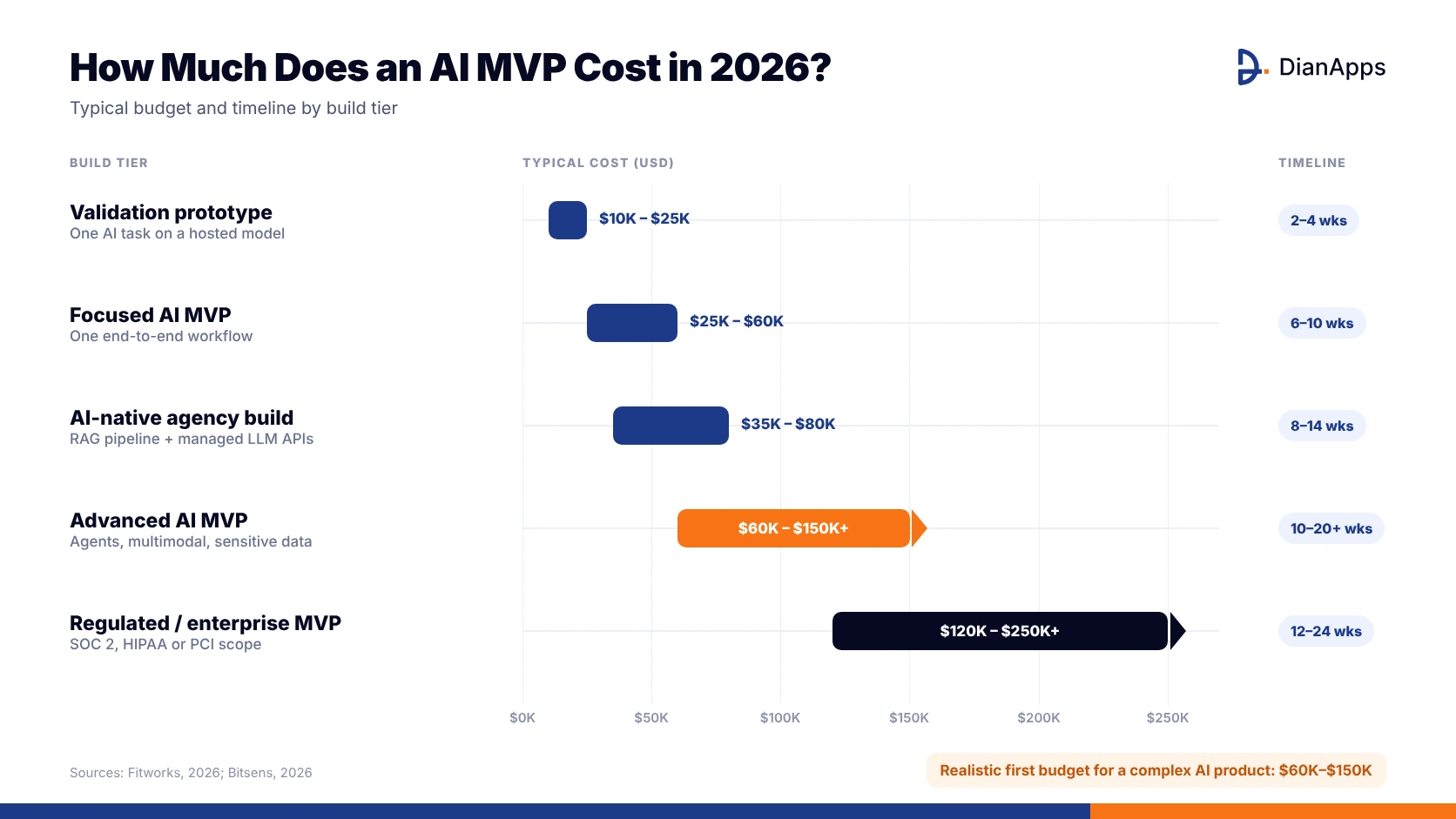
Published 2026 figures for AI MVP development cost land in the same neighborhood once you separate the tiers. The table combines numbers from agencies that publish them, so the spread is visible instead of hidden behind one average.
| Budget Tier | Typical Cost | Timeline | What Is Included | Source |
| Validation prototype | $10,000 to $25,000 | 2 to 4 weeks | One AI task on a hosted model, thin screen, no real integrations | Fitworks, 2026 |
| Focused AI MVP | $25,000 to $60,000 | 6 to 10 weeks | One end-to-end workflow for a controlled user group | Fitworks, 2026 |
| AI-native agency build | $35,000 to $80,000 | 8 to 14 weeks | RAG pipeline with managed LLM APIs, the seed-stage B2B SaaS sweet spot | Bitsens, 2026 |
| Advanced AI MVP | $60,000 to $150,000+ | 10 to 20+ weeks | Agents, multimodal features, sensitive data, several integrations | Fitworks, 2026 |
| Regulated or enterprise MVP | $120,000 to $250,000+ | 12 to 24 weeks | SOC 2, HIPAA or PCI scope with audit logging | Bitsens, 2026 |
For a complex AI product, a realistic first budget is $60,000 to $150,000. A quote far below that usually leaves out evaluation, security or integrations.
SoluLab (2026) gives wider ranges: $10,000 to $35,000 for API-based MVPs and $80,000 to $300,000 or more for custom, compliance-heavy or agentic builds. The pattern holds either way. Architecture sets the tier. Our AI development cost breakdown covers the full lifecycle.
What drives AI MVP development costs?
The same idea can get a $30,000 quote from one team and $120,000 from another, and both can be honest. Seven things explain most of the gap.
- AI architecture. A hosted model behind an API is the cheapest route. RAG and tool-using agents add cost, and custom training or fine-tuning adds the most.
- Data readiness. Clean, labeled, accessible data saves weeks. Messy documents and missing labels turn into data engineering work nobody budgeted for.
- Integrations. Every connection to a CRM, payment gateway, ERP or internal database adds build time, testing and edge cases.
- Compliance scope. SOC 2, HIPAA and PCI bring audit logs, access controls and security reviews, which is why regulated MVPs cost two to four times more.
- Model tier and token volume. The same traffic costs about 100 times more on a frontier model than on a small one, so model choice is a budget decision as much as a technical one.
- Platforms. A web-only MVP is cheaper and faster than one that also ships on iOS and Android. Pick the channel where early users already are.
- Team model, covered next.
Team structure moves the number too (Technource, 2026). An in-house team runs $120,000 to $300,000 or more per year. For a comparable AI MVP, a US or UK agency charges $80,000 to $200,000, an offshore AI development company $20,000 to $80,000, and a hybrid of offshore and in-house $30,000 to $90,000. Rate matters, but a tight scope on a mid-priced team usually beats a loose scope on a cheap one.
Get a Lean AI MVP Estimate
Share your idea and our team will map one workflow, one AI approach and a phase-wise budget in a free scoping call. No long proposal, just a number you can plan around.
AI MVP development cost breakdown by phase
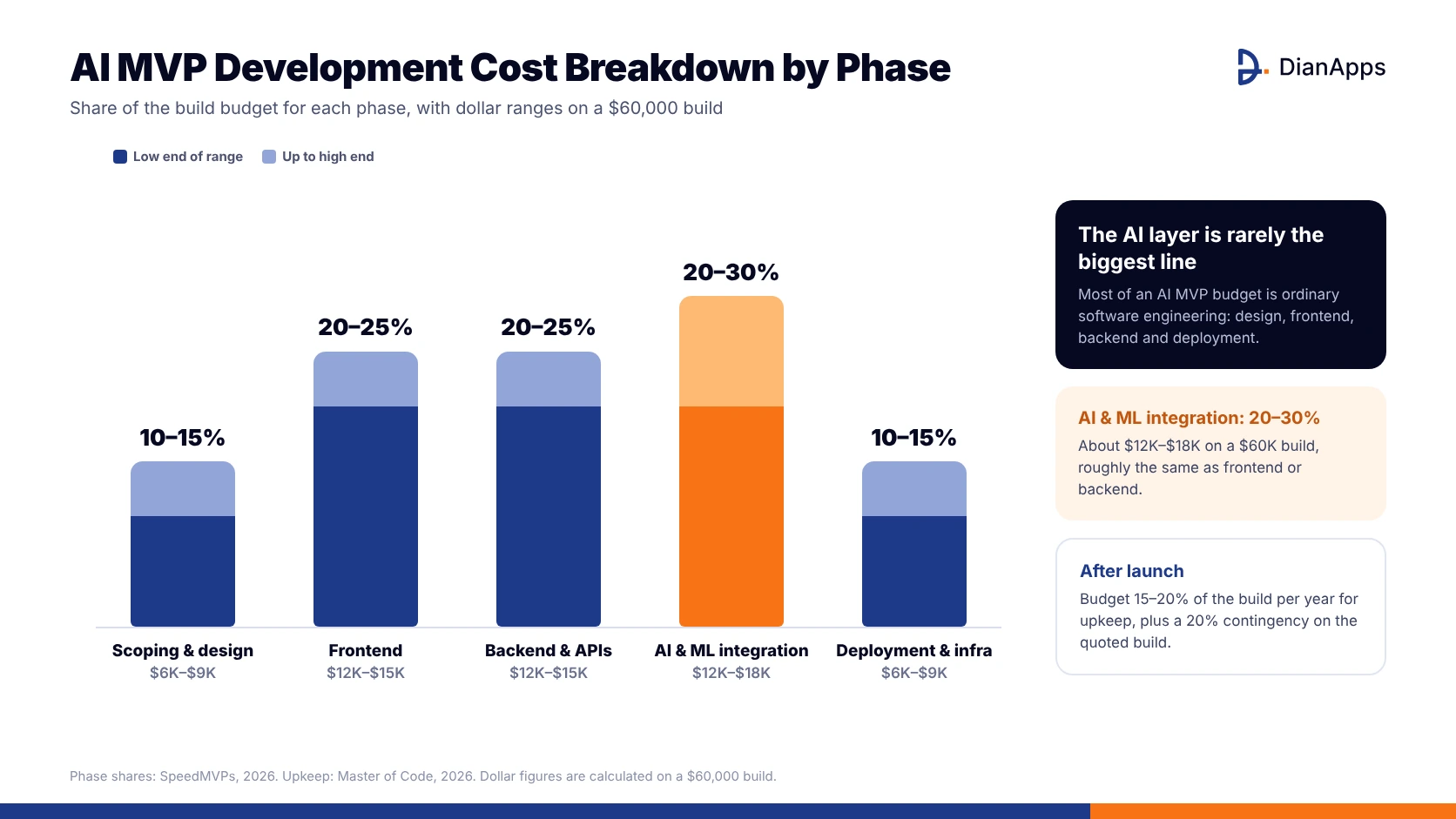
Knowing where the money goes makes every quote easier to question. SpeedMVPs (2026) splits a typical build like this: scoping and design 10 to 15%, frontend 20 to 25%, backend and APIs 20 to 25%, AI and ML integration 20 to 30%, and deployment and infrastructure 10 to 15%.
On a $60,000 build that works out to roughly $6,000 to $9,000 for scoping, $12,000 to $15,000 each for frontend and backend, $12,000 to $18,000 for the AI layer and $6,000 to $9,000 for deployment. The dollar figures are our arithmetic, not SpeedMVPs.
The AI layer is rarely the biggest line, which surprises first-time founders. Most of an AI MVP budget is ordinary software engineering.
LLM API costs for an AI MVP: token counts and model prices by provider
LLM API costs are one slice of AI MVP development cost. They are billed per million tokens, with output tokens priced above input tokens. The prices below are standard list rates from three roundups published between October and mid-November 2026 (Maximem, 30 October, IoT Digital Twin PLM, 15 November and Digital Tatva, October). Model prices move fast, so read every number as a dated snapshot.
How many tokens does an AI MVP actually use?
A token is a chunk of text, about four characters or three quarters of an English word. So 1,000 tokens is roughly 750 words. Counts vary by provider. The same text can produce 20 to 30% more or fewer tokens on a different model (IoT Digital Twin PLM, 2026), and Digital Tatva (2026) notes that the Anthropic 5.5 tokenizer produces about 30% more tokens than earlier Haiku models.
Chat history is the part that surprises people. Every turn sends the whole conversation, so input tokens grow much faster than output tokens.
The workload budgets below come from the pricing roundups. They are illustrative, not measurements from a live product, so replace them with logged numbers from your own prototype as soon as you have them.
- A RAG query uses about 6,000 input tokens (a 1,000-token cached system prompt plus 5,000 retrieved tokens) and 400 output tokens.
- A 25-turn agent run uses about 600,000 input tokens, 510,000 of them cache hits, and 15,000 output tokens including thinking.
- A 40-turn chat uses about 476,000 input and 14,000 output tokens. Turn 1 sends 2,150 input tokens and turn 40 sends 21,650.
- Batch classification uses about 800 input and 50 output tokens per document, so a million documents is 800M input and 50M output.
Sources: IoT Digital Twin PLM (November 2026) for the RAG, agent and batch figures, Maximem (October 2026) for the 40-turn chat.
LLM API pricing by model tier
The 2026 market runs from $0.10 to $10 per million input tokens, a roughly 100-fold spread (Digital Tatva, 2026). The table groups 17 popular models from a dozen providers into tiers. All prices are per million tokens in USD.
| Model | Tier | Input | Cached Input | Output |
| GPT-6 Astra (OpenAI) | Frontier | $10.00 | $1.00 | $50.00 |
| Claude Fable 5.2 (Anthropic) | Frontier | $8.00 | $0.20 | $40.00 |
| Claude Opus 5.5 (Anthropic) | Premium | $4.00 | $0.20 | $20.00 |
| Gemini 4 Argon (Google) | Premium | $2.00 | $0.10 | $10.00 |
| GPT-6.1 Sol (OpenAI) | Premium | $2.00 | $0.10 | $10.00 |
| Grok 4.7 (xAI) | Premium | $2.00 | $0.50 | $6.00 |
| Claude Sonnet 5.5 (Anthropic) | Mid | $2.00 | $0.10 | $10.00 |
| Gemini 3.5 Flash (Google) | Mid | $1.50 | $0.15 | $9.00 |
| GPT-6.1 Terra (OpenAI) | Mid | $1.00 | $0.05 | $5.00 |
| DeepSeek V4 Pro | Value flagship | $1.32 | $0.044 | $3.96 |
| Mistral Large 4 | Value flagship | $0.70 | $0.07 | $2.10 |
| Gemini 3.1 Flash-Lite (Google) | Small | $0.25 | $0.025 | $1.50 |
| DeepSeek V4.1 Flash | Small | $0.30 | $0.006 | $1.20 |
| Mistral Small 4 | Small | $0.15 | $0.015 | $0.60 |
| GPT-6 Luna (OpenAI) | Small | $0.10 | $0.01 | $0.50 |
| Claude Haiku 5.5 (Anthropic) | Small | $0.10 | $0.01 | $0.50 |
| GPT-OSS 120B (Fireworks) | Open-weight | $0.15 | $0.015 | $0.60 |
A few other models are priced close to these rows. Gemini 3.1 Pro Preview is $2.00 in and $12.00 out, Grok 4.3 is $1.25 and $2.50, Mistral Medium 3.5 is $1.50 and $7.50, Kimi K3.1 Pro is $2.00 and $10.00, GLM-5.3 is $1.40 and $4.40 and Qwen3.8-Flash is $0.15 and $0.47. GPT-OSS 120B is also listed at $0.15 and $0.60 on Groq and Together.
Two caveats. Gemini 4 Argon doubles to $4.00, $0.20 and $20.00 from 1 December 2026, and the DeepSeek rates shown are peak, with half price off-peak. The sources also disagree on a few rows: Digital Tatva reports Argon at $4 and $20 today, while the others show the $2 and $10 introductory rate. Confirm on the provider page before you sign off a budget.
The cheapest and most expensive tiers differ by about 100 times the input price. Routing each job to the right tier saves more than haggling over any single rate.
What do real workloads cost on each model?
A price per million tokens is hard to picture, so here is the model share of AI MVP development cost converted into cost per task. The pilot month assumes 10,000 RAG queries, 500 agent runs and 1,000 forty-turn chats, a plausible early-user mix for a complex AI product.
| Model | Per RAG Query | Per Agent Run | Per 40-Turn Chat | Pilot Month |
| GPT-6 Astra | $0.071 | $2.16 | $5.46 | $7,250 |
| Claude Fable 5.2 | $0.056 | $1.42 | $4.37 | $5,641 |
| Claude Opus 5.5 | $0.028 | $0.76 | $2.18 | $2,847 |
| Claude Sonnet 5.5 | $0.014 | $0.38 | $1.09 | $1,424 |
| DeepSeek V4 Pro (peak) | $0.008 | $0.20 | $0.68 | $866 |
| GPT-6.1 Terra | $0.007 | $0.19 | $0.55 | $712 |
| Mistral Large 4 | $0.004 | $0.13 | $0.36 | $472 |
| DeepSeek V4.1 Flash (peak) | $0.002 | $0.05 | $0.16 | $203 |
| Claude Haiku 5.5 | $0.0007 | $0.02 | $0.05 | $72 |
These are our calculations from the token budgets and list prices above. RAG and agent runs use the cached-input rate for the cached share, chats are priced with no caching, and reasoning tokens, batch discounts and regional uplifts are left out. GPT-6.1 Sol and Gemini 4 Argon at the introductory rate cost the same as Claude Sonnet 5.5 here, Argon from 1 December matches Claude Opus 5.5, and Mistral Small 4 and GPT-OSS 120B land near $105 a month. The Astra chat figure matches the 40-turn result Maximem published.
The same pilot traffic costs about $72 a month on a small model and about $7,250 on the top frontier model. That decision belongs in the design phase, not after launch.
Long chats cost the most. On GPT-6 Astra, 1,000 chats account for $5,460 of the $7,250 a month. The first fixes are capping session length, summarizing older turns and turning on prompt caching.
Which model tier should handle which job?
A lean AI MVP rarely needs one model for everything. Routing work across tiers keeps quality up and AI MVP development cost down, and it is easy to build in from the first release.
- Intent routing, classification and extraction: small models such as GPT-6 Luna, Claude Haiku 5.5, DeepSeek V4.1 Flash or Mistral Small 4. Call volume is high and the reasoning load is low.
- User-facing answers and RAG generation: mid-tier models such as Claude Sonnet 5.5, GPT-6.1 Terra, Gemini 3.5 Flash or Grok 4.3, for the best balance of quality and cost.
- Agent planning, complex reasoning and code: premium models such as Claude Opus 5.5, GPT-6.1 Sol, Gemini 4 Argon or Grok 4.7. Fewer calls, higher accuracy per call.
- Hardest edge cases only: GPT-6 Astra or Claude Fable 5.2, escalated to rarely so you pay the top rate only when needed.
- High-volume batch or data-sensitive work: DeepSeek V4 Pro, Mistral Large 4 or GPT-OSS 120B on Groq, Fireworks or Together, for the lowest rates.
Quality differs by task, so test two or three models from each tier on your own evaluation set before you commit. Several of the value providers are based outside the United States, so check data residency and procurement rules with your compliance team first. Self-hosting an open-weight model swaps token fees for GPU rent, which rarely pays off at MVP volume.
What moves the LLM bill: caching, batch and surcharges
The rate card is only the starting point. Discounts and surcharges can change the final invoice by a wide margin.
- Prompt caching cuts repeated input by 90% or more. Claude Sonnet 5.5 costs $0.10 cached against $2.00 uncached, and GPT-6.1 Sol costs $0.10 cached, a 95% saving (Digital Tatva, 2026).
- Batch processing gets about 50% off at OpenAI, Anthropic and Google for asynchronous jobs that finish within 24 hours. It suits document classification and nightly summaries.
- DeepSeek halves its prices outside peak windows of 01:00 to 04:00 and 06:00 to 10:00 UTC on weekdays (IoT Digital Twin PLM, 2026).
- Long prompts cost more. GPT-6 requests above 272K input tokens are billed at 2x input and 1.5x output for the whole request. Claude Haiku 5.5 moves to $0.50 and $2.50 above a 100K prompt, and Gemini 3.1 Pro moves to $4 and $18 above 200K.
- OpenAI Fast mode costs 2x, and regional or US-only endpoints add roughly 10% (IoT Digital Twin PLM, 2026).
- Reasoning tokens bill as output and are missing from the tables above, so reasoning-heavy products cost more than shown.
- Prices change. Gemini 4 Argon doubles on 1 December 2026, Gemini 3.8 Flash doubles on 1 January 2027, and Mistral Large 4 was cut in late October (Maximem, 2026). Add a 20 to 30% buffer.
Fitworks (2026) puts core infrastructure for a controlled MVP at roughly $50 to $500 a month. Add the model bill from the tables above and a pilot month costs anywhere from a few hundred dollars on small models to a few thousand on premium ones.
What are the ongoing costs of running an AI product?
A standard MVP costs money once. The AI MVP development cost shows up twice, once to build and again to run, monitor and improve (SoluLab, 2026).
Token fees grow with every user and every long conversation, so set per-user limits and alerts before launch. Answer quality drifts as models update and user behavior changes, which means someone has to run the test set on every release. Yearly upkeep commonly lands at 15 to 20% of the original build (Master of Code, 2026), and regulated products keep paying for documentation, audits and security reviews after launch. Real users also expose edge cases within weeks, so hold back part of the budget for fixes.
Hidden items together can add 10 to 30% to the build cost of an AI app MVP (Biz4Group, 2025). A contingency of at least 20% on top of the quoted build is sensible.
How can startups reduce AI MVP costs?
Lowering AI MVP development cost is mostly about cutting the wrong features before anyone builds them. These levers work most often.
- Narrow the scope to one user, one workflow and one metric. Removing features is far easier than adding them later.
- Start with a hosted model API. Move to fine-tuning only when evaluation data shows you need it.
- Run a two to four week prototype first. At $10,000 to $25,000 it is far cheaper than finding out after a full build that the riskiest assumption was wrong.
- Launch on one platform where your early users already are, usually web, and add mobile once the signal is clear.
- Use small models for classification and routing, and keep large models for the steps that need reasoning.
- Get phase-wise milestones and a change-request process in writing. Scope creep is a common reason budgets double.
How long does it take to build an AI MVP?
Most complex AI MVPs take 8 to 20 weeks. Prototypes finish in 2 to 4 weeks, focused builds in 6 to 10, agency-built RAG products in 8 to 14 and regulated products in 12 to 24 (Fitworks, 2026 and Bitsens, 2026).
A typical build runs in four steps: discovery and data review in the first one to two weeks, then design and architecture, then the core build with an evaluation loop, then a closed pilot with real users. Slow data access is a common cause of delay, so ask for sample data in week one, not week six.
What are founders actually asking about AI MVP budgets?
Community threads show where the real doubts are, and they tend to be more candid than vendor pages. Three questions come up again and again, including in a recent Product Hunt thread on startup budgets.
“Can I just build this myself for a few hundred dollars?” For a simple wrapper around an API, yes, and AI coding tools make that cheaper than ever. Once the product needs logins, several data sources, audit logs and a security review, the budget moves into the tens of thousands. Validate demand cheaply first, then hire engineers once the workflow is proven.
“Will I run out of money on the build or on getting users?” Plenty of founders say runway ends on distribution, not development. Keep a separate line for your first 100 users, because a well-built product with no audience is still a failed MVP.
“Is every AI product just a wrapper?” Some are, and a cheap build is fine for them. Products with proprietary data, workflow depth or compliance needs are not wrappers, and pricing them like wrappers is how teams end up rebuilding from scratch.
Plan Your AI MVP Budget With DianApps
Book a free scoping call and leave with a lean scope, a phase-wise budget and a timeline for your AI product.
How does DianApps build lean AI MVPs?
DianApps works with more than 350 clients across 25+ countries, with 150+ engineers and a U.S. presence. It holds a 4.8 out of 5 rating on Clutch across 81+ reviews and is Premier Verified. That record shapes how we scope MVPs: budget discipline first, technology second, and every AI MVP development cost estimate built that way.
Core AI work covers LLM development, generative AI, machine learning, AI agents, conversational AI, computer vision and NLP (Natural Language Processing). What sets the team apart is full-cycle delivery. AI powered mobile app development, web development, backend and DevOps sit under one team, so the MVP does not stall on handoffs between vendors.
We also tell clients when custom AI is the wrong first move. If a hosted model, a no-code prototype or a rules engine can test the same assumption for a fraction of the cost, we recommend that path and keep the custom build for later.
Conclusion
AI MVP development cost in 2026 is a range, not a number. Focused builds land between $25,000 and $60,000, complex products between $60,000 and $150,000 or more, and the monthly bill starts small and grows with usage. Three things protect your budget: a tight scope, a phase-wise plan and a 20% contingency. Pick your model tier before you pick a vendor, because that one decision swings the model bill by up to 100 times.
If you are weighing a complex AI product and need a number you can defend to investors, DianApps can map it with you.
 0 comments







Your email address will not be published. Required fields are marked *