















 0 comments





Key takeaways
- A super app backend is a set of domain microservices behind an API gateway and a shared identity service, with a separate open-platform layer for third-party mini apps.
- Start with a modular monolith and split out services once a module has its own team, scaling profile or compliance scope.
- The mini-app boundary is the weakest point, with hard-coded secrets found in 32.8% of 110,993 WeChat mini apps studied (RAID, 2023), so never keep long-lived credentials in a mini-app client.
- Zero trust means mutual TLS between services and an authorization check inside every service, not only at the gateway (NIST SP 800-207A, 2023).
- Keep card data in one isolated payment service to limit PCI DSS v4.0.1 scope.
Quick answer
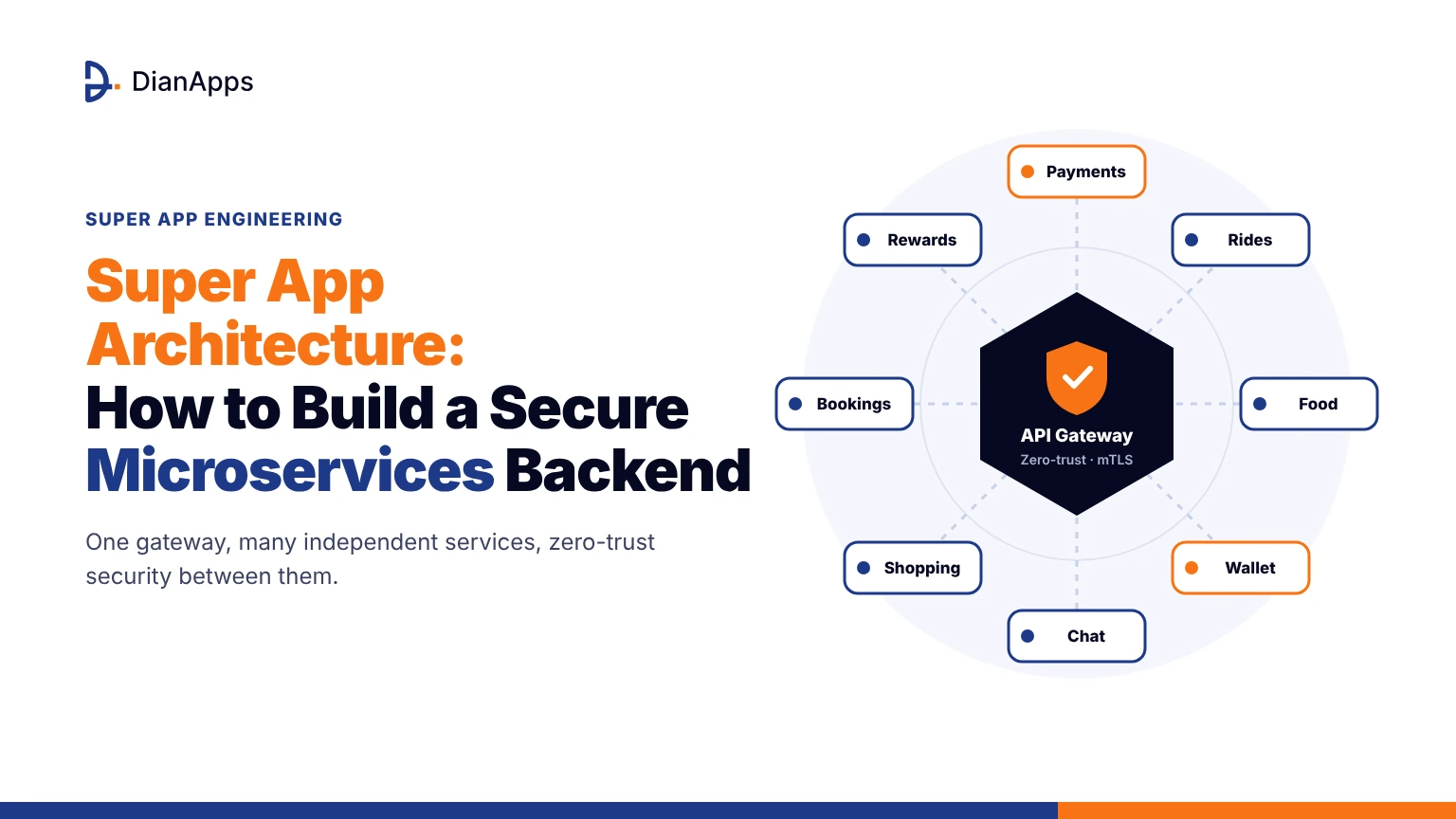
Super app architecture is a platform design in which a native app shell hosts mini apps while a microservices backend handles identity, payments, messaging and every other domain behind an API gateway. Security rests on zero trust, so each request is authenticated at the gateway and authorized again inside the service, and service-to-service traffic is encrypted with mutual TLS. DianApps builds this through its super app development services.
Super app architecture looks simple on a slide: a shell, a few mini apps and a backend. The hard part is the backend, where payments, chat, delivery and third-party mini apps share one login, one wallet and one API surface, so a single weak endpoint can expose all of them. This guide covers how the layers fit together, how mini apps reach your services and which security controls matter most, drawing on NIST guidance, the OWASP API risk list and published research on super app flaws. DianApps, a mobile and AI app development company, adds notes on what to build first.
What is super app architecture?
The W3C describes a super app as a software platform that hosts and supports other applications, called MiniApps, and lets them run using the platform’s own resources (W3C MiniApp Standardization White Paper, version 2, August 2026). In production that usually means four parts: a native shell that owns navigation and notifications, a mini-app runtime that executes third-party code inside a sandbox, platform services every module shares (identity, wallet, messaging, analytics) and the domain backends behind them. Most of the cost and most of the risk end up in the backend, so that is where this guide spends its time.
The scale explains the investment. Tencent reported 1,449 million combined Weixin and WeChat monthly active users at 30 September 2026, up 2% from a year earlier (Tencent Q3 2026 results, 18 November 2026), and published estimates put the whole super app market at roughly $154 billion to $162 billion in 2026, with annual growth forecasts between about 20% and 30% (Grand View Research, Persistence Market Research and Mordor Intelligence, 2026). For the business case behind those numbers, see our overview of super apps and the future of mobile apps.
Why do super apps use microservices?
A super app bundles domains with very different needs. A ride-booking service peaks in the evening commute, a chat service holds long-lived connections all day, and a payment service has to meet card-industry rules that nothing else in the product does. Microservices let each of those scale, deploy and fail on its own, so a slow menu service does not take the wallet down with it. NIST makes the same argument in general terms: smaller codebases speed up development, suit independent teams and let each component scale on its own, but the volume of API calls between services calls for protections such as API gateways and a service mesh (NIST SP 800-204, 2019).
The pattern is not free. In 2023 the Amazon Prime Video team described moving its audio and video quality monitoring service from a distributed design to a single process and reported cutting infrastructure cost by more than 90% (Analytics India Magazine, 2023, quoting the team). Write-ups of the case say that service passed large payloads between tightly coupled steps over the network, which is a different problem from a super app with clear business domains, but it does show that splitting a system does not pay off automatically. We would start with a modular monolith for the core platform and carve out services one at a time.
| Approach | Best when | Main risk | Security profile |
| Single monolith | One team and one or two services, or a prototype | Every change redeploys everything and one breach exposes everything | One trust zone |
| Modular monolith | Early platform with a small team and clear module boundaries | Boundaries erode without code review discipline | Internal module APIs and one deployable unit |
| Microservices | Several teams, or services with different load and compliance needs | Network latency, operational overhead and a larger attack surface | Per-service identity and policy |
The signal to extract a service is a module that needs its own release cadence, scaling curve or compliance boundary. In our experience payments meet that test first and messaging usually follows.
Plan Your Super App Platform
Tell us which modules you want first and how mini apps should fit in, and we will come back with a phased architecture, a timeline and a realistic budget range.
How should a secure super app architecture be layered?
The layers below follow a request from the device to the data. Each layer of the super app architecture has a security job the others cannot do for it, so a skipped layer rarely shows up as a missing feature and usually shows up later as an incident.
Edge and API gateway
All client and mini-app traffic should enter through one API gateway, usually behind a CDN and a web application firewall. The gateway terminates TLS, authenticates the caller, applies coarse authorization, enforces rate limits and schema validation and routes to the right service. Kong, Spring Cloud Gateway and AWS API Gateway are common choices, and our guide to backend technologies for mobile apps compares the surrounding stack. The gateway should never be the only place permissions are checked, and the security section below explains why.
Identity and sessions
One identity service built on OAuth 2.0 and OpenID Connect gives users a single sign-in across every module and gives you one place to revoke access. Keep access tokens short-lived and narrowly scoped, and bind refresh tokens to a device so that copying one is not enough to use it.
Domain services and data
Each service owns its data store and exposes it only through its API, because a shared database quietly turns many services back into one. Workflows that cross domains, such as placing an order, charging the wallet and sending a receipt, run through an event broker with compensating steps for failures. Payment, identity and KYC data get their own services and stores so they can be locked down separately.
Mini-app platform layer
Third-party mini apps should reach your backend through a dedicated open-platform gateway rather than the same one your own app uses. That layer handles mini-app registration, permission scopes, per-app quotas, review and revocation, which keeps a bad mini app away from core services.
Observability and audit
Central logging, distributed tracing and an immutable audit trail are what let you check that the other four layers work. They also make a breach investigation possible, because a trace ID that follows each request ties the gateway log, the mesh telemetry and the service log into one story, and alerts on odd token use, mini-app call volume or failed authorization checks give the team an early warning.
How do mini apps connect to the backend?
A typical flow starts when the user opens a mini app inside the host. The host authenticates the user and asks for the permission scopes the mini app declared, the mini-app front end calls native capabilities through a host-controlled bridge, and any call that needs your data goes to the mini-app provider’s own server. That server then calls your open platform with its server-side credentials, receives a short-lived token for that specific user and scope, and every request passes through the open-platform gateway before it touches a domain service. The point of the design is that secrets stay on servers and the client stays on a thin, untrusted surface.
Real platforms show what happens when that rule is broken. One study of 110,993 WeChat mini apps found that 36,425 of them, about 32.8%, contained valid hard-coded secrets that could be used to generate access tokens, allowing an attacker with no account on the platform to bypass authentication between the mini app and the super app (RAID, 2023). A larger NDSS 2025 study examined credential systems across 21 super-app platforms and analysed 413,775 mini apps from six platforms, finding 84,491 credential leaks across 54,728 mini apps, roughly 13.2% by arithmetic, and 89 of its reports received CVE identifiers. Separately, a USENIX Security 2022 study of 47 super apps found every one of them vulnerable to at least one kind of identity confusion, where a privileged API is available to a wider set of callers than intended, and nine had no identity checks at all.
For your own platform, assume every mini-app client will leak whatever you put in it. Long-lived credentials stay on the provider’s server, tokens are short-lived and bound to a user, and capabilities are tied to a verified app ID and domain, not to a name or a URL pattern.
How do you secure microservices in a super app?
Zero trust is the right starting point. NIST SP 800-207, published in August 2020, shifted the focus from network location to continuous verification of every request, and SP 800-207A, published in September 2023 and updated in February 2025, applies the idea to cloud-native applications by combining network-tier and identity-tier policies enforced through API gateways, sidecar proxies and application identity systems such as SPIFFE (NIST, 2020 and 2023). For zero trust microservices that comes down to a cryptographic identity for each workload, mutual TLS between every pair of services and an authorization decision made inside each service, not only at the edge. NIST SP 800-204B, from August 2021, covers the service mesh version of this, with mutual authentication between services and attribute-based access control. SPIFFE and its reference implementation SPIRE are both CNCF graduated projects, so they are a safe default for workload identity.
The OWASP API Security Top 10 for 2023 is the most useful checklist for gateway and service code. It starts with broken object level authorization and broken authentication, and one analysis of the list points out that most of the top categories are authorization failures a firewall cannot see (Orca Security). That is why authorization has to live inside each service as well. The table maps the risks that matter most in a super app to a control for each.
| Risk | Where it appears | Control |
| Broken object level authorization (OWASP API1:2023) | Any endpoint taking an object ID, such as orders, wallets and chats | Check ownership inside each service, not only at the gateway |
| Broken authentication (OWASP API2:2023) | Login, token refresh and mini-app sign-in | One identity provider, short-lived tokens and sender-constrained tokens |
| Hard-coded mini-app secrets | Mini-app client bundles | Keep secrets on the mini-app server and issue per-user tokens |
| Identity confusion between mini apps | Host bridge and WebView boundary | Bind capabilities to verified app ID and domain, deny by default |
| Service impersonation | Service-to-service traffic | Mutual TLS with workload identity and mesh policy |
| Unrestricted resource consumption (OWASP API4:2023) | Public and mini-app APIs | Per-client rate limits and quotas at the gateway |
| Card data exposure | Wallet and checkout | Isolated payment service, tokenization and a small PCI scope |
Tokens need their own care. RFC 9449 (DPoP, September 2023) has the client prove it holds a private key each time it uses an access token, so a stolen token cannot simply be replayed, and RFC 8693 (January 2020) defines token exchange, where a gateway swaps a broad user token for a narrow one before calling a downstream service. Used together, they mean the credential that reaches your payment service is far weaker than the one the app started with.
Payments add compliance on top of design. PCI DSS v4.0 introduced 64 new requirements, 51 of them future-dated, and those 51 became mandatory on 31 March 2025. PCI DSS v4.0.1, published in June 2024, was a limited revision that added or deleted no requirements (PCI Security Standards Council). The practical answer is to keep cardholder data inside one payment service with tokenization, which leaves the rest of the super app outside the audit scope.
What are the most common super app architecture mistakes?
Most failures trace back to shortcuts that look harmless in the first months and turn expensive once real traffic and third-party developers arrive. Each one below maps to a control covered earlier.
- Authorization only at the gateway, which leaves every internal service open to anything that gets past the edge or comes from another service.
- A shared database across services, which removes the isolation that justified splitting them and lets one compromised service read another domain’s data.
- Long chains of synchronous calls between services, which multiply latency and failures and push teams to add retries that overload the system further.
- Secrets or long-lived tokens inside mini-app bundles, which the research above shows is common enough to plan for as the default failure.
- No per-mini-app quotas or revocation path, so one misbehaving partner can slow or break the experience for everyone.
- Adopting a full service mesh before basic hygiene such as secret rotation, least-privilege roles and dependency patching is in place.
How long does it take to build a super app backend?
DianApps lists 4 to 6 months for a basic super app MVP and 9 to 12 months or more for a full platform, with budgets from $80,000 to $500,000 and above depending on scope (DianApps super app development page). Those figures are our own estimates and vary with the number of modules, payment integrations and the depth of the mini-app ecosystem.
We usually plan three phases. The first builds the core platform, meaning identity, gateway, a payment or wallet service and one or two domain services, and ships to a small user group. The second adds more services and a mini-app SDK for internal teams, and the third opens the platform to outside developers with a developer portal, review process, quotas and revenue sharing. Opening the platform last is deliberate, since it carries the largest security exposure and should sit on a backend that real traffic has already tested.
How does DianApps build super app backends?
DianApps has delivered 350+ projects worldwide, has a 150+ member team and holds a 4.8 out of 5 rating on Clutch across 84 verified reviews as a Premier Verified company. Its super app service page describes backends built from APIs and microservices for each module, a mini-app ecosystem with an SDK, sandbox runtime, developer portal, single sign-on and governance tools, and security work that includes end-to-end encryption, secure payment gateways and regular audits. The listed stack covers Node.js, Python, Java, GraphQL, REST and gRPC, with Docker and Kubernetes on the major cloud providers.
We also tell clients when a full super app is the wrong first step. A focused app with a modular backend and a clear path to services is often the better launch, and it can grow into a platform on this architecture without a rewrite.
Get Your Super App Backend Reviewed
Share your current or planned architecture and our engineers will walk through gateway design, service boundaries and mini-app security with you, and point out the gaps worth fixing first.
Conclusion
Most of the weight in super app architecture sits on a few early decisions. Split services along real domain and compliance boundaries, put identity and the API gateway at the center, and assume attackers will probe the mini-app boundary first, because the published research on WeChat and other platforms shows secrets and identity checks failing there again and again. NIST zero trust guidance gives a workable answer: mutual TLS, workload identity and authorization inside every service. Build the core platform, prove it with real traffic and open it to outside developers last. If you are planning a super app and want a second opinion on the backend, DianApps can help you scope it.
 0 comments










Your email address will not be published. Required fields are marked *