















 0 comments
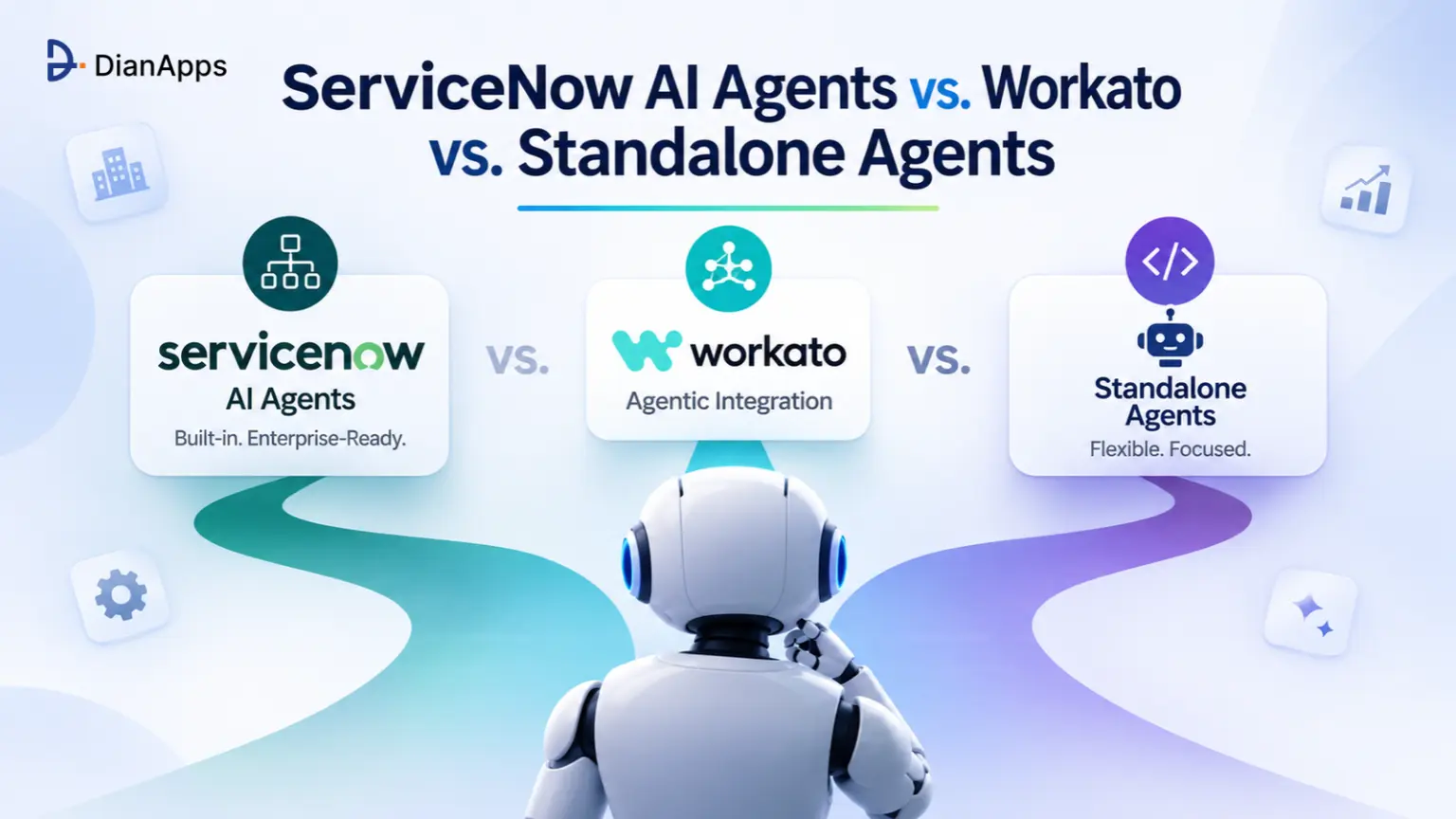





Key Takeaways:
- ServiceNow AI Agents are best for workflows that rely on native platform data, permissions and governance.
- Workato suits cross-application orchestration involving multiple SaaS systems, connectors and governed agent access.
- Standalone agents offer greater control over logic, models and integrations but require custom governance and maintenance.
- Compare licensing, activity-based charges, recipe usage, token costs and engineering effort when evaluating total cost.
- Hybrid architectures combine native, cross-app and custom agents while using MCP and open protocols to reduce lock-in.
Quick Answer: Choose ServiceNow AI Agents for workflows that start and end inside the Now Platform, Workato for processes spanning multiple enterprise applications, and standalone agents for specialised logic or integrations that existing platforms cannot handle. Each option has different trade-offs in governance, pricing, flexibility and vendor dependence. For many enterprises, a hybrid architecture offers the best balance by assigning each type of agent to the layer where it works best.
There is a particular meeting happening in enterprise IT this year, and it is the one where the ServiceNow account team, the integration platform owner and the in house AI engineers each present a different plan for the same agent.
The ServiceNow AI Agents vs. Workato vs. Standalone Agents decision is really a decision about where orchestration should live, inside the system of record, inside a cross application layer, or inside code your own team controls, and each answer is carrying a different bill, a different governance story and a different kind of lock in.
Teams still sorting out whether they’re buying assistance or autonomy will find our comparison of an AI copilot vs an AI agent useful before this one. This guide is laying out all three options the way an architect would, so let’s break it down.
Three Ways to Put Agents Into an Enterprise
The vendors are describing their products with overlapping words, so it is worth naming the three architectures plainly before comparing them, because the architecture is deciding nearly everything that follows. When we’re mapping a client’s options, we’re separating them like this:
- Native SaaS agents, where the agent is living inside a platform such as ServiceNow and is acting on that platform’s data, workflows and permissions by default.
- Cross application orchestration platforms, where a layer such as Workato is connecting hundreds of apps through connectors and MCP servers and is letting agents act across all of them.
- Standalone agents, where your team is building with a framework or SDK, exposing tools through custom MCP servers, and owning the runtime, the prompts and the state.
- Hybrids, where a native agent is handling work inside its home platform and is handing off to an orchestration layer or a custom agent for anything beyond it.
Most enterprises are ending up with some combination, and the reasons are not hard to see once you’ve watched a native agent hit the edge of its own platform, so let’s put the three side by side.
ServiceNow AI Agents vs. Workato vs. Standalone Agents at a Glance
The table below is summarising how the three approaches compare on the dimensions that are deciding production success, drawing on what each vendor is shipping in 2026 and what deploying teams are reporting.
| Dimension | ServiceNow AI Agents | Workato | Standalone Agents |
| Where the agent lives | Inside the Now Platform | Inside Workato’s orchestration layer | In your own runtime and cloud |
| Reach | Deepest inside ServiceNow, extending outward through Action Fabric and integrations | Fourteen thousand plus apps through connectors and pre built MCP servers | Anything you build a tool or MCP server for |
| Context and data | Native access to tickets, CMDB, HR and workflow data | Context assembled from connected systems and knowledge sources | Whatever retrieval and memory you design |
| Governance | AI Control Tower, platform roles and audit built in | Verified User Access, MCP Gateway, recipe level governance | Yours to build or assemble from tools |
| Builder experience | AI Agent Studio, low code | Agent Studio and Genies, low code | Code, with LangGraph, OpenAI Agents SDK or similar |
| Pricing model | Tiered licensing moving toward activity based pricing | Platform subscription with usage based components | Tokens, infrastructure and engineering time |
| Lock in | High, tied to the ServiceNow estate | Medium, tied to recipes and connectors | Low on platform, high on your own engineering |
| Best fit | Work that starts and ends in ServiceNow | Processes spanning many SaaS systems | Differentiated or unusual agent logic |
Each cell is hiding a story, and the next three sections are telling them from the perspective of someone who has to run these systems.
ServiceNow AI Agents: Native Agents Inside the System of Record
ServiceNow’s pitch has shifted in 2026 from adding AI to workflows toward becoming the governed layer that every enterprise agent routes through, and the Knowledge 2026 announcements made that ambition explicit. As the Futurum Group reported in May 2026, the refresh centred on the AI Control Tower for governing agents and models, the Autonomous Workforce of role based specialist agents, and Otto as a single front door that interprets intent and routes work, with the platform opened to third party and custom agents regardless of model or cloud.
For a buyer, the practical meaning is that native ServiceNow agents are arriving with the ticket, asset, employee and workflow context already attached, with approvals and audit inherited from platform roles, and with a builder in AI Agent Studio that business analysts can use. The limit is equally practical, because the deeper you lean on native agents, the more your automation estate is becoming inseparable from your ServiceNow licence, and the pricing is moving toward activity based models that are harder to forecast than seats.
Workato: Cross Application AI Agent Orchestration Through Enterprise MCP
Workato is approaching the same problem from the integration side, and its 2026 story is built on the idea that the hard part of enterprise agents isn’t the model, it is governed access to the hundreds of systems an agent needs to touch. Its Genies are purpose-built agents that retrieve knowledge, take action across connected applications and orchestrate processes, Agent Studio is the low code builder behind them, and the Enterprise MCP layer is the piece that is turning the company’s connector library into something agents from any vendor can use.
Through 2026 Workato has been shipping pre-built MCP servers monthly, has added an MCP Gateway with Verified User Access so that agents act as the authenticated person rather than a service account, and has introduced its own Otto experience and the AIRO multi agent builder.
For cross application AI agent orchestration platforms, this is the strongest reference design on the market, with an agent able to read a Salesforce opportunity, update NetSuite, open a Jira ticket and post to Slack under one governed identity. The trade off is that the intelligence is living in Workato’s runtime, and the agent is only as capable as the recipes and servers underneath it.
Standalone and Custom MCP Agents: Building Your Own Orchestration
The third option is building the agent yourself, with a framework handling the control flow, your own MCP servers wrapping the systems the agent needs, and your own cloud running the result, and it is the route that engineering-led organisations are choosing when neither platform fits. The appeal is total control, since you’re deciding the model, the prompts, the memory, the evaluation and the exact permissions of every tool, and you’re paying for tokens and infrastructure rather than for a platform.
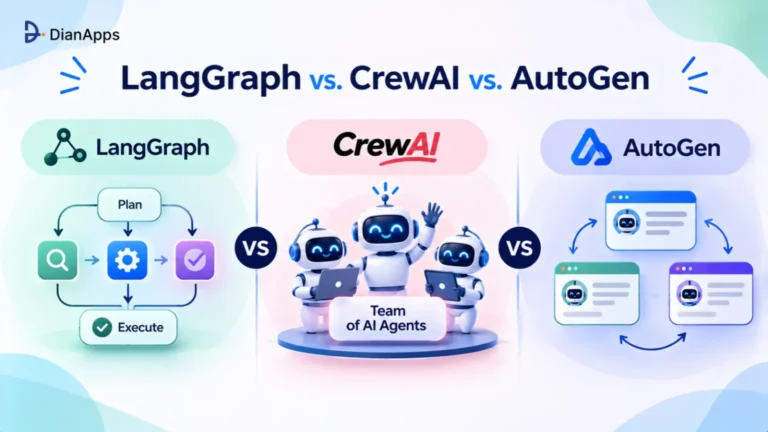
The cost is that governance, identity, observability and approvals are all yours to assemble, and the framework choice matters a great deal, which is why our comparison of LangGraph vs CrewAI vs AutoGen is required reading before this path is chosen. A custom MCP agent is typically exposing each system as a server with a handful of narrowly scoped tools, and a graph based orchestrator is deciding when to call which, with checkpointed state and a human approval node before anything irreversible.
Done well it is the most capable option on this page, and done casually it is the one that generates the incident reports.
Unsure Where Your Agents Should Live?
Our architects are mapping your systems, processes and governance needs to the right mix of native, orchestrated and custom agents.
Native SaaS AI Agents vs Custom MCP Agents: The Core Trade Off
Strip away the product names and the native SaaS AI agents vs custom MCP agents question is reducing to one trade, which is convenience and context against control and reach, and most of the disagreements in that IT meeting are really disagreements about which side of that trade matters more. The points below are the ones that are deciding it in practice:
- Native agents are starting with context and permissions already in place, while custom agents are starting with nothing and earning every piece of context through retrieval and integration work.
- Custom agents can reach any system and implement any logic, while native agents are bounded by what the platform exposes and what its builder allows.
- Native agents are inheriting the vendor’s governance, which is excellent inside the platform and thin outside it, while custom agents are only as governed as you make them.
- Platform agents are improving on the vendor’s roadmap and timetable, while custom agents are improving on yours, for better and for worse.
- Native pricing is converging on activity based models that reward the vendor as usage grows, while custom cost is tracking tokens and engineers.
Neither side is winning universally, and the next sections are working through the dimensions where the trade is sharpest, beginning with the one that catches most teams, which is data.
Data, Context and the System of Record Problem
Agents are only as good as the context they’re reasoning over, and the three approaches are solving the context problem in fundamentally different ways.
ServiceNow’s advantage is that for IT, HR, customer service and security operations work, the system of record is the platform itself, so a native agent is seeing the full ticket history, the configuration items, the employee record and the approval chain without a single integration, which is why its internal results on employee requests are so strong.
Workato’s answer is Enterprise Context and the knowledge connectors, which are assembling a working picture from many systems, and it is working well when the process genuinely spans those systems and less well when the richest data sits inside one platform that the connector only partly exposes.
Custom agents are relying on whatever retrieval you build, which can be the best of the three for a narrow domain and is usually the weakest on day one. The honest rule is that the agent should live closest to the data it needs most, and if that data is in ServiceNow, a native agent is starting with an advantage that is hard to buy elsewhere.
Governance, Identity and Approvals Across the Three
Governance is the dimension enterprise buyers are weighing most heavily in 2026, and it is also where the gap between the three options is narrowing fastest as every vendor races to answer the same concerns. When we’re assessing a design on governance, the questions we’re asking of each option are these:
- Identity, meaning whether the agent is acting as the requesting user with their permissions or as a broad service account, where ServiceNow’s platform roles and Workato’s Verified User Access are both strong and custom agents must implement delegation themselves.
- Approvals, meaning whether a human gate can be inserted before an irreversible action, where all three can do it and only custom agents are letting you design the gate’s logic freely.
- Audit, meaning whether every decision and tool call is recorded in a form a regulator will accept, where the platforms are ahead and custom builds need tracing from day one.
- Scope limits, meaning whether an agent can be confined to specific systems, records and actions, where MCP tool scoping is giving custom agents the finest control if you’re disciplined.
- Monitoring of agent behaviour over time, where the AI Control Tower and Workato’s conversation log streaming are mature and custom stacks are assembling the same from observability tools.
For security sensitive work, these controls are the whole product, and our guide to AI agents for cybersecurity is explaining why a governed identity model is worth more than any amount of model capability there.
Cost Models: Seats, Tasks, Recipes and Tokens
The three options are billing in three different units, which is making comparison harder than it should be and is also where buyers are most often surprised eighteen months in. The table below is summarising how each one charges and where the cost is tending to drift.
| Cost Element | ServiceNow AI Agents | Workato | Standalone Agents |
| Base cost | Platform licence tiers, with native agents included at higher tiers and custom agents on premium packaging | Platform subscription sized by recipes, tasks and connectors | Cloud infrastructure and framework tooling, often modest |
| Usage cost | Activity or assist based units that grow with agent volume | Task or transaction volume across recipes and MCP calls | Model tokens, which vary with task complexity |
| People cost | Low code builders and platform admins | Low code builders and integration engineers | Software engineers and ML or platform specialists |
| Where cost drifts | Agent activity exceeding forecast as adoption grows | Task counts rising as agents trigger more recipes | Token usage rising with context size and agent loops |
| Predictability | Medium, improving as pricing matures | Medium, well understood from iPaaS history | Low without hard caps and per run cost tracking |
| Typical sweet spot | Large existing ServiceNow estates | Processes crossing five or more systems | High volume or highly differentiated agents |
A fair comparison is modelling total cost at three times your expected volume, because agent usage is growing faster than any forecast once employees discover that something works.
When Native ServiceNow Agents Win?
Native agents are the right answer more often than engineering teams like to admit, and recognising the cases where they win is saving months of custom work that would have reproduced what the platform already does. In our experience the Workato vs ServiceNow AI agents comparison is landing on ServiceNow when these conditions hold:
- The process starts and ends inside ServiceNow, such as IT requests, incident triage, HR cases or change approvals, where the context is already native.
- Governance requirements are strict and the AI Control Tower’s audit, policy and monitoring features are matching what the risk team is asking for.
- The team building agents is made up of platform administrators and analysts rather than software engineers, and AI Agent Studio is fitting their skills.
- Your organisation has already standardised on ServiceNow as the system of action and is willing to accept deeper dependence in exchange for speed.
- The vendor roadmap, including the Autonomous Workforce specialists and Action Fabric for routing third party agents, is covering your next two years of needs.
When those conditions hold, a native agent usually lives for weeks and is improving with every platform release without your team lifting a finger.
Want a Total Cost Model for All Three Options?
We’ll model your agent volume against ServiceNow, Workato and custom pricing so finance sees the real comparison.
When Workato Wins: The Cross Application Orchestration Case?
Workato is winning when the work is refusing to stay inside any single platform, and in large organisations that is describing a surprising share of valuable processes. The cases where a cross application orchestration layer is the clear choice are looking like this:
- A process is spanning five or more systems, such as lead to cash across a CRM, a CPQ tool, an ERP, a billing system and a collaboration tool, and no single vendor’s native agent can see all of it.
- You’re already running Workato recipes for integration, and the agentic layer is extending an estate your team understands rather than introducing a new one.
- Multiple AI vendors are in play, and Enterprise MCP is giving agents from OpenAI, Anthropic or your own models one governed gateway into enterprise systems.
- Identity propagation matters, and Verified User Access is ensuring every action is attributable to the person who asked for it across every connected app.
- The business wants low code builders to assemble agents without waiting on engineering, and Agent Studio is meeting that need.
In these situations, the platform’s connector breadth and governance are doing work that would take a custom team a year to replicate, and that is the whole value proposition.
When Standalone Agents Win?
Custom agents are earning their place when the logic is the product, when the volume is high enough that platform pricing becomes punitive, or when neither platform can reach the systems or implement the reasoning you need. A company whose competitive advantage is a proprietary underwriting process, a specialised research workflow or a customer facing agent with its own brand and memory isn’t going to express that inside a low code builder, and it shouldn’t try.
High volume is the second trigger, because an agent handling hundreds of thousands of runs a month is often cheaper on tokens and infrastructure than on any activity based platform unit, provided the team is disciplined about context size and loop limits. Unusual integrations are the third, since a custom MCP server can wrap a mainframe, a lab instrument or an internal API that no connector catalogue is covering.
The build path is well documented now, and our guide to building AI agents with OpenAI is a practical starting point, but the decision should be made with eyes open about the governance, observability and operations work that comes with owning the runtime.
Hybrid Architectures: Letting All Three Coexist
The most mature enterprises we’re working with aren’t choosing one option, they’re assigning each to the layer where it is strongest and connecting them through open protocols, and 2026 is the year that became practical rather than aspirational. A typical pattern is running native ServiceNow agents for everything that lives in the platform, using Workato or a similar orchestration layer for processes that cross many SaaS systems, and building custom agents only for the two or three workflows where the logic is genuinely differentiating.
The glue is MCP and increasingly agent to agent protocols, because ServiceNow’s Action Fabric is designed to route work to and from third party agents, Workato’s Genies can act as both MCP clients and MCP servers, and a custom LangGraph agent can call either as a tool. The governance story in a hybrid is the hardest part, since three systems are each holding part of the audit trail, and the practical answer is choosing one of them, usually the system of record, as the place where every agent action is ultimately logged. Done this way, the architecture is avoiding both the trap of total dependence on one vendor and the trap of building everything by hand.
Migration and Lock In Risks
Every option is carrying a form of lock in, and the mistake is assuming that only the vendor platforms have it, because a custom estate built by three engineers who have since left is as locked in as any licence. Before committing, the risks worth weighing against each option are these:
- ServiceNow lock in is commercial and architectural, since agents, workflows and data are intertwined with the platform and pricing is moving toward activity units that are hard to walk away from.
- Workato lock in is in recipes and connectors, which are portable in logic but not in implementation, and in MCP servers that are easier to recreate elsewhere than recipes are.
- Standalone lock-in is in people and undocumented code, mitigated by frameworks with large communities, infrastructure as code and the kind of handover discipline that few teams apply to agents.
- Protocol adoption is the common mitigation, because tools exposed through MCP and agents reachable through open protocols can be re-pointed when a platform changes.
- Data portability should be tested rather than assumed, by exporting agent configurations, logs and knowledge from each platform before the contract is signed.
Choosing a partner who has migrated agents between these environments is reducing every one of these risks, and our guide on how to choose an AI agent development company is covering what to ask.
A Decision Framework for 2027
With the trade offs laid out, the decision is becoming a short series of questions that most organisations can answer in an afternoon, and we’re using the sequence below with clients to settle the buy versus build argument without the vendor pitches. Work through these in order:
- Decide whether the task needs an agent at all, since many candidates are deterministic processes better served by the options in our comparison of AI agents vs RPA vs traditional automation.
- Identify where the richest context lives, and if it is inside ServiceNow, start with a native agent and only move outward when the process does.
- Count the systems the process touches, and if it is five or more with no dominant platform, a cross application orchestration layer is the default.
- Ask whether the logic is differentiating, and if the answer is a confident yes, plan a custom agent with proper governance from the start.
- Model total cost at three times forecast volume for each option, because the pricing units are different and adoption is always exceeding the plan.
- Insist on MCP and open protocols at every boundary, so the decision you make now can be revised in 2028 without a rebuild.
A team that answers these six honestly is usually arriving at a hybrid, with each option doing the job it was built for.
Ready to Settle the Buy vs Build Question?
We’re designing and delivering native, orchestrated and custom agent systems, and we’ll tell you plainly which you need.
What to Watch: Action Fabric, MCP Gateways and Agent to Agent Protocols?
The landscape is moving quickly enough that a decision made in 2026 should be revisited yearly, and three developments are worth tracking because each is shifting the balance between the options. ServiceNow’s Action Fabric is the clearest signal that the vendor wants to be the routing layer for agents it didn’t build, and if that lands well, native and custom agents are coexisting far more easily than they do today.
Workato’s MCP Gateway and its monthly stream of pre-built servers are turning the integration platform into a governed tool layer for any agent, which is strengthening the case for custom agents by removing the integration burden that used to argue against them.
Agent to agent protocols are the third, because once a ServiceNow specialist, a Workato Genie and a LangGraph agent can hand work to each other through a standard, the question of where an agent lives is mattering less than the question of who is governing the handoff. Watch pricing too, since both platforms are shifting toward activity based models, and the economics of custom agents will look different again as model costs continue to fall.
Final Thoughts
The ServiceNow AI Agents vs. Workato vs. Standalone Agents’ decision is less about which product is best and more about where each kind of work belongs, with native agents earning the work that starts and ends in the system of record, cross application orchestration earning the processes that span many systems, and custom agents earning the logic that makes your business different.
Organisations that are locating context first, counting systems second, reserving custom builds for genuine differentiation, modelling cost at realistic volumes and insisting on open protocols at every boundary are ending up with hybrid estates that stay governable and stay changeable, which is the only kind of agent architecture worth having in a market moving this fast. The tooling from all three directions is mature enough in 2026 to support that approach, and if you’d rather have a team that has built on all of them to help you decide and deliver, we’ve got you covered.
There is no one-size-fits-all solution. The right approach may even involve combining native AI capabilities with cross-app orchestration and custom-built agents to create a connected automation ecosystem. Before investing, evaluate integration requirements, scalability, governance, implementation costs, and long-term business value.
For organizations looking to build AI solutions beyond platform limitations, AI Agent Development Services can help design and develop customized AI agents that integrate with existing systems, automate complex workflows, and align with specific business objectives. The goal isn’t simply to deploy more AI agents; it’s to build an intelligent automation strategy that delivers measurable business outcomes.
 0 comments







Your email address will not be published. Required fields are marked *