













 0 comments
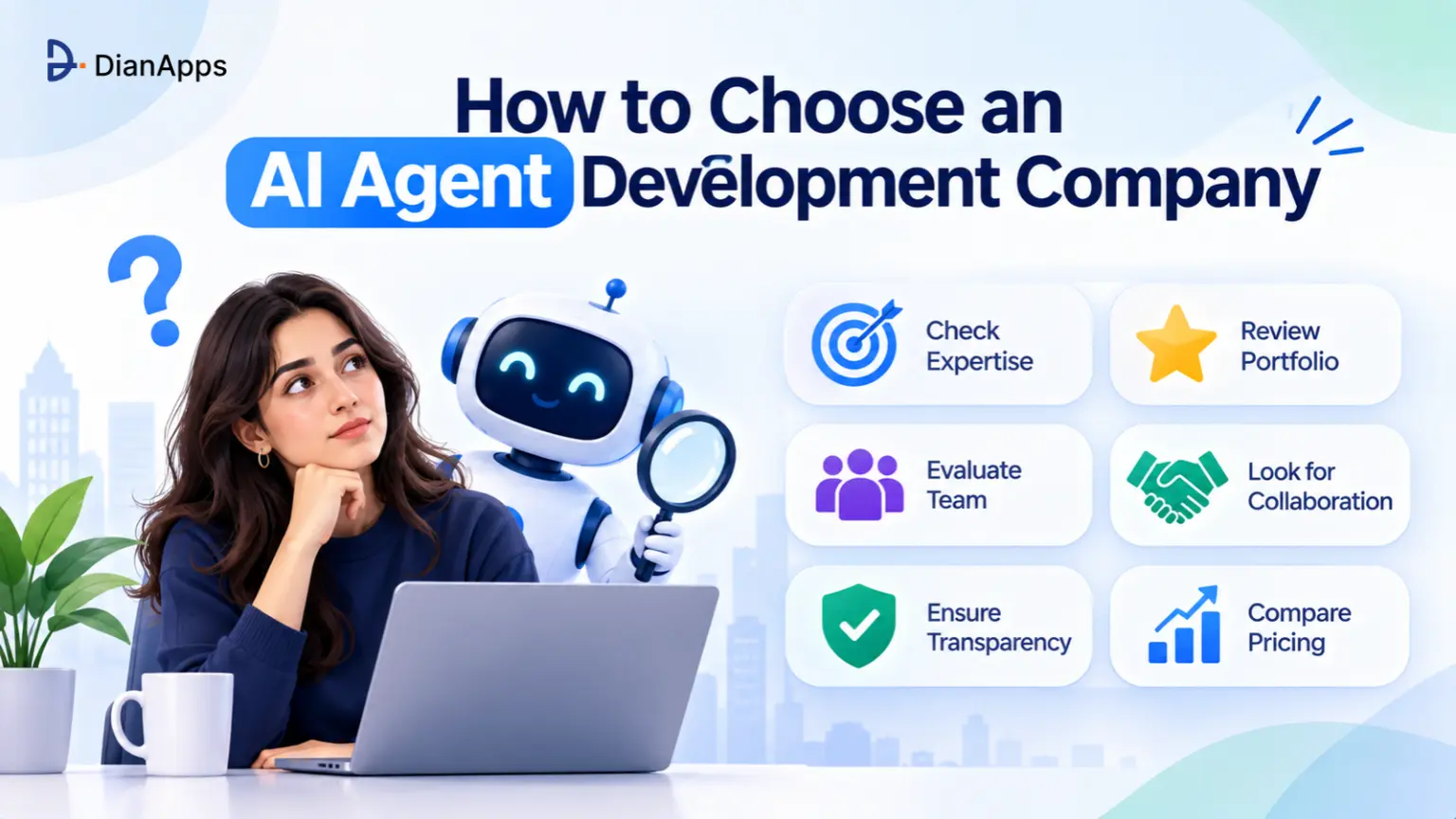





Key Takeaways:
- Define your use case, budget and expected outcomes before contacting vendors.
- Evaluate real project experience, technical expertise and integration capabilities.
- Check security controls, data handling, compliance and human oversight.
- Clarify team responsibilities, development costs and intellectual property ownership.
- Verify production results, client references and post-launch support.
Quick Answer: Choose an AI agent development company by evaluating its relevant project experience, technical capabilities, security practices, testing process, pricing transparency and post-launch support. Ask all shortlisted vendors the same 15 questions, request live production demos and client references and compare their answers using a weighted scorecard. Prioritize security, testing and clear ownership over low pricing or impressive sales presentations.
Most teams look for AI agent development services the way they shop for any software, comparing feature lists and a couple of demos and that habit is exactly how projects go sideways. If you want to know how to choose an AI agent development company properly, the useful move is to ask questions that a polished sales deck can’t answer for them, such as who owns the prompts and what happens when the agent gets something wrong. We’ve put together the 15 questions we’d ask ourselves if we were in your seat, along with what good and bad answers tend to sound like.
The stakes are higher than they look, because a July 2027 Forbes analysis of Gartner’s forecast warns that more than 40% of agentic AI projects could be cancelled by 2027. The piece makes a point that surprised us a little: the projects rarely die because the model was too weak and they die far more often over governance, data access, ownership and an ROI nobody defined at the start. Every one of those problems is something a vendor either handles well or ignores, which makes your choice of partner the biggest lever you have.
Below you’ll find what to settle before any sales call, the questions themselves in five groups, the warning signs worth walking away from and a scorecard for comparing vendors afterwards. There’s also a short section on what the best AI agent development companies have in common, which is easier to spot than you’d think.
Why The Vendor Decides More Than The Model Does?
Here’s a detail that gets lost in the excitement, the model underneath your agent will almost certainly change during the first year and the switch is rarely the hard part of the project. What you can’t swap out so easily is the team around it, meaning the people who set the permissions, write the tests, watch the logs and answer the phone when something breaks. An agent reads your data, calls your tools and takes real actions, so most of the risk sits in the engineering around the model and very little of it sits in the model itself.
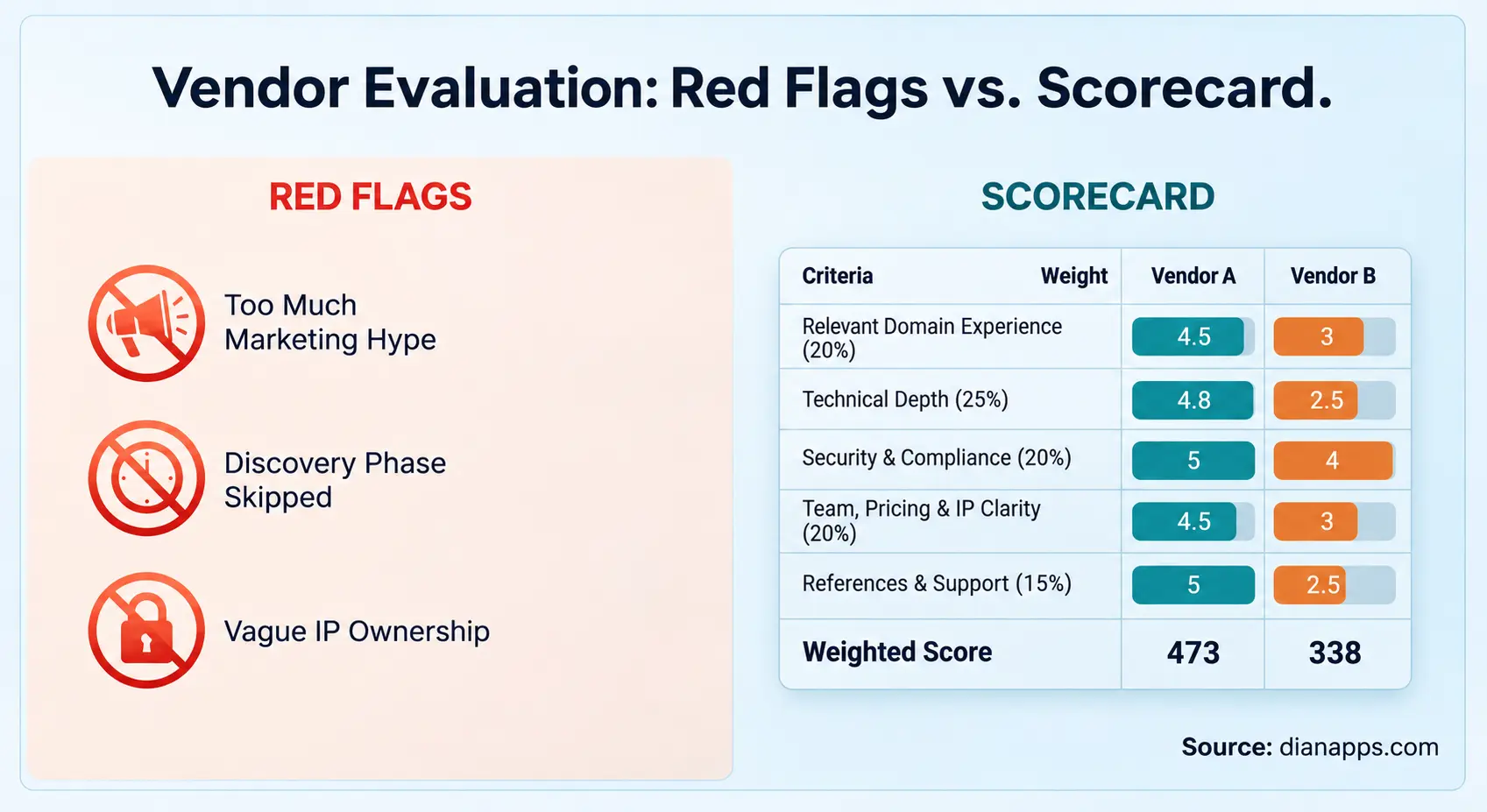
The market adds its own confusion, because plenty of products that were called chatbots a year ago now carry the word agent with very little change underneath. Gartner calls this agent washing and estimates that only about 130 of the thousands of vendors pitching agentic AI have anything genuinely agentic to sell. Gartner also expects 40% of enterprise applications to include task-specific AI agents by the end of 2026, up from under 5% in 2025, which helps explain why so many vendors are suddenly selling agents. A few hours of proper vendor screening is cheap next to a year spent on the wrong build.
Choose an AI Partner That Understands Your Business
Get expert guidance on building AI agents that solve real business challenges.
The One-Page Brief You Need Before Any Sales Call
Vendors are very good at filling silence, so write a one-page brief before the first call and let them respond to your words instead of theirs.
Start with the job, described tightly enough that someone could quote against it. Say you run a logistics company: an agent that reads inbound delivery exceptions, checks the order system and drafts a reply for a human to approve is a real brief, while making our operations smarter is not.
Then decide roughly what kind of agent you’re after, because a single-task agent, a retrieval assistant and a team of cooperating agents are very different builds with very different price tags. Our guide to the seven types of AI agents with real examples is a quick way to find the right vocabulary and our explainer on what an AI agent is covers the basics for anyone newer to the topic.
Finally, put a number on your budget, including the running costs most first-time buyers forget about until the first invoice arrives. Our AI agent development cost breakdown by use case shows what typically moves the price, which makes a quote that’s too low or too high much easier to spot.
Group 1: Strategy And Fit
1. Have you built an agent like mine and can I see how it behaves today?
Domain experience matters more than most buyers expect, because a clinic scheduling agent and a retail returns agent run into completely different edge cases. Ask for named projects close to yours and have them walk through what the agent actually did, which systems it touched and what changed for the client afterwards. When the answer is that they can build anything, hear it as a polite way of saying they haven’t built much of anything in particular. Specifics are the signal here, even small ones, like how many tickets the agent handled in its first month.
2. What happens in the first two weeks, before anyone writes code?
A good discovery phase is where the vendor tries to find reasons not to build the thing, which feels strange until you realize how much money it saves. They should map the workflow as it exists today, look hard at whether your data is clean enough to use and agree on how success will be measured before anything gets scoped. Our view is that the way a vendor runs this phase predicts the rest of the engagement better than any pitch does. You should come out of it with a written plan you can keep and a fixed price offered before anyone has seen your systems should be treated as a guess.
3. Would you ever tell me an agent is the wrong tool?
Gartner points out that many use cases sold as agentic today could be handled by simpler tools and that’s worth remembering when a vendor’s answer to every problem happens to be an agent. A plain FAQ bot, for example, might need nothing more than a well-built AI chatbot that cuts support costs without any autonomy at all. The partners worth keeping are the ones who’ll say so out loud, even when it shrinks their contract. If someone has only ever pitched you one solution, you’re talking to a salesperson and not an advisor.
Group 2: Technical Depth
4. Which frameworks will you use and what would make you change your mind?
Framework choice affects your costs, your delivery speed and how painful it will be to change direction later, so a vague answer here deserves a follow-up. A capable team can talk through options such as CrewAI and AutoGen and tell you honestly when a multi-agent system justifies its extra complexity and when one agent will do. If you’d like to compare the main frameworks before those conversations happen, our guide to AI agent frameworks lays them out side by side. Be careful with anyone who reaches for the same locked-in stack on every project regardless of the problem.
5. How does the agent plug into the systems we already use?
Picture an agent that drafts perfect replies but can’t see your order system and you’ll understand why integration deserves as much attention as intelligence. Ask which integration patterns the vendor has used, what they do when a system has no clean API and how they handle authentication. Teams with real experience can tell you where integrations usually break and roughly how long the fixes take. Teams who say integration is easy have normally not done much of it.
6. How do you test an agent before launch and again after?
Ordinary software fails in predictable ways but agents get creative, arguing themselves into a wrong answer, calling the wrong tool or repeating one step forty times while the usage bill climbs. Ask to see an evaluation set, which is a collection of real scenarios from your business with the outcomes you’d expect and ask how often it’s rerun. Task completion rate and escalation rate are the first two numbers worth asking about. Clicking around manually before launch is simply not enough for software that makes decisions with your name on them.
7. What stops the agent from doing something expensive by mistake?
Think about an agent that can issue refunds, because that’s where the gap between a chatbot and an agent stops being theoretical. A chatbot that makes something up costs you an awkward moment, while an agent that makes something up and then acts on it costs real money. Good answers involve grounding the agent in your own data, hard limits on what it may do and a human sign-off before anything high-risk goes through. Ask where the line sits between the agent suggesting an action and the agent carrying it out and notice how quickly they can point to it.
Group 3: Security And Governance
8. Where exactly does our data travel and who can see it?
Customer records and internal documents pass through a model provider, probably a vector database and a handful of third-party tools, so you want the full route and not a summary. Ask for a real data flow diagram, find out whether private or region-specific hosting is possible and get it in writing whether your data is ever used to train models. Secure cloud infrastructure is a slogan and not an answer, so keep asking until you hear provider names, hosting regions and retention periods.
9. Which regulations have you actually worked under?
Healthcare, finance and public-sector work brings legal duties under rules like HIPAA and GDPR and many enterprise buyers also expect SOC 2-aligned practices from their vendors. Ask which regulated projects the team has delivered and who was responsible for what, because the answer should divide cleanly between your side and theirs. Certifications are easy to claim on a website, so ask to see the documents. Experienced teams don’t get defensive about this and can tell you exactly where their responsibility ends.
10. If the agent does something strange at 2 a.m., how will we find out why?
Gartner lists inadequate risk controls among the reasons agentic projects get cancelled and most of those controls turn out to be unglamorous engineering decisions made early. Ask what permissions each agent gets, whether there are spending or action limits, how rate limiting works and whether someone can hit a kill switch. Then ask about logs, since you’ll want a full record of what the agent did and why and that record should belong to you. Our AI agent security and governance checklist lists the controls worth putting into the contract.
Group 4: Delivery And Commercials
11. Who exactly will be on my project?
The people who impress you in the sales meeting aren’t always the ones who build your product and it’s worth finding that out before you sign. Ask for named roles, such as AI engineer, backend engineer, QA and project lead, along with their experience and how often you’ll actually speak to them. If the team is going to be assigned after the contract is signed, you’re buying a promise and not a team.
12. What will this cost a year after launch?
Most first quotes cover the build and little else, so the model usage, hosting and maintenance bills show up later and nobody has budgeted for them. Ask for pricing by phase, a running-cost estimate at the volume you expect and a clear answer on what happens to the price when you change your mind halfway through. Then lay the figures next to the ranges in our pricing breakdown for AI agent development and if anything sits far outside them, make the vendor explain why.
13. If we part ways, what do we walk away with?
Ownership feels dull until the day you want to switch vendors and discover that your own prompts and workflows belong to somebody else. A fair contract says you own the code, prompts, workflows, evaluation sets and data and anything the vendor keeps, like a licensed tool or a reusable component, should be listed by name. When a vendor gets awkward about putting intellectual property terms on paper, you’ve learned something useful about the next twelve months.
Group 5: Proof And Partnership
14. Can I talk to a client whose agent is live right now?
Case studies are marketing and references are evidence, so ask for two or three client calls and a demo of an agent running in production. Prototypes look great in a demo room and then wobble when real volume arrives, so a prototype alone shouldn’t satisfy you. On the call, ask what went wrong, how the vendor handled it and whether the client would sign with them again tomorrow. A vendor who can only offer logos and no contacts is asking you to take their word for it.
15. Who looks after the agent once the project is over?
Agents drift as your data, your policies and the underlying models change, which means launch day is closer to a starting line than a finish. A solid support plan covers performance monitoring, model updates, prompt and workflow tuning, regular reviews and response times written into the contract. If support stops at handover, you’ll end up paying a different company to repair things a few months later.
Red Flags Worth Walking Away From
Some warning signs show up early and they’re worth recognizing before you’ve spent a month on a vendor. Anyone promising 100% accuracy or a fully autonomous agent within thirty days, is telling you they haven’t looked at your data yet. The same goes for a vendor who gets through three calls without asking how your team works or what success would look like for you.
Watch what happens when you test the demo with an input of your own, because a demo that only works on their examples tells you very little. Be just as wary of a rush to sign, a suggestion that discovery is optional or references that are always available next week. One of these deserves a follow-up question but three of them mean it’s time to move on to the next vendor on your list.
A Simple Scorecard To Compare Vendors
After your calls, score each vendor from 1 to 5 on every row, multiply by the weight and add up the column.
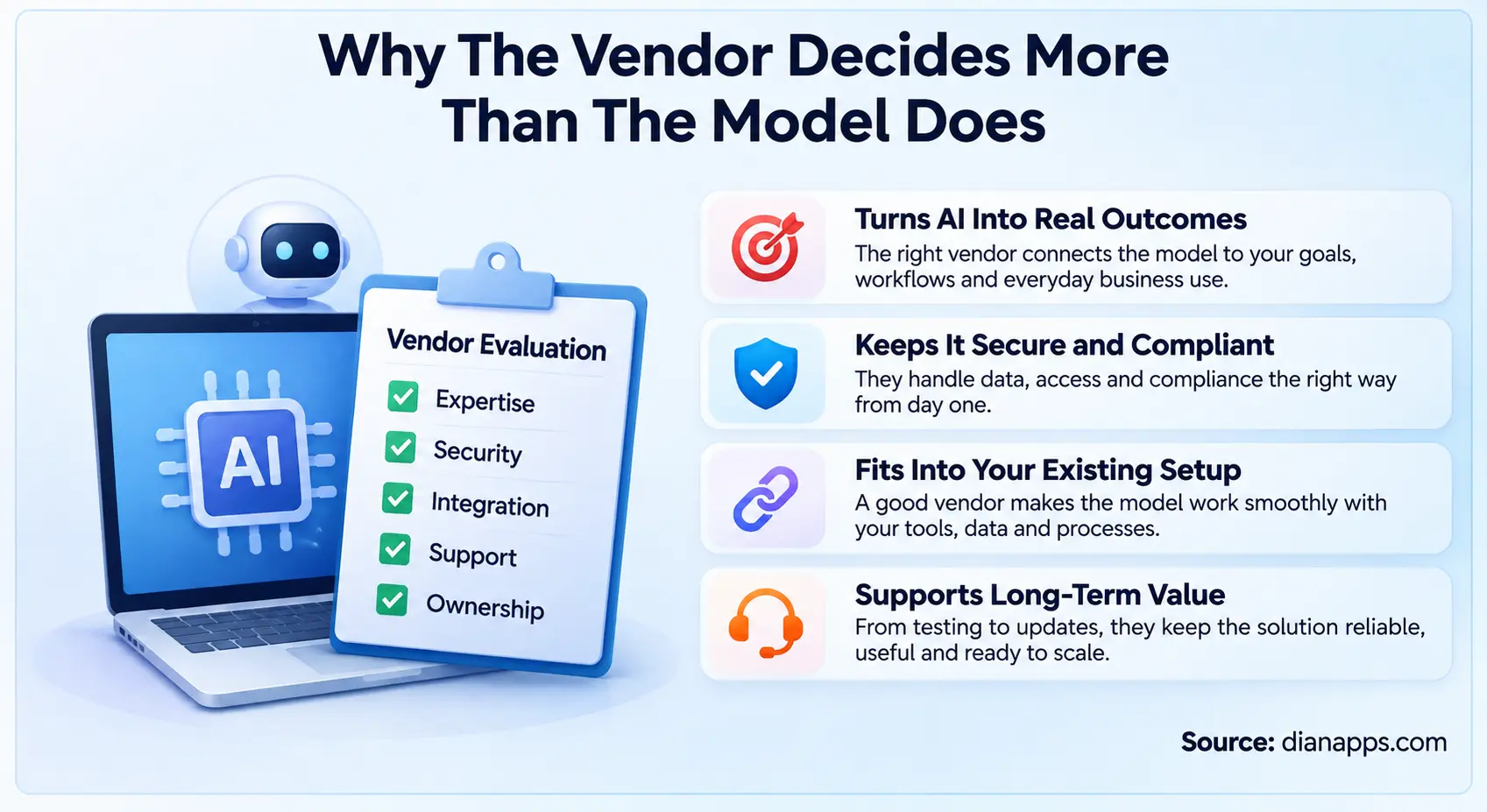
The weights are only a starting point, so change them freely, because a bank will care far more about security than a five-person startup does.
| Criteria | Weight |
| Relevant domain experience (Q1-3) | 20% |
| Technical depth and testing (Q4-7) | 25% |
| Security and compliance (Q8-10) | 20% |
| Team, pricing and IP clarity (Q11-13) | 20% |
| References and post-launch support (Q14-15) | 15% |
One rule outranks the arithmetic: A cheap price should never rescue a weak score on security or testing, since those are the two areas where shortcuts hurt most and are hardest to repair later.
Find the Right AI Agent Development Partner
Have an AI agent project in mind? Let’s discuss your requirements and development goals.
What The Best Ai Agent Development Companies Do Differently?
Lists of top vendors date quickly, so it’s more useful to understand what the best AI agent development companies have in common and you can check most of it yourself without reading a single press release. They start with your business problem instead of whichever model is fashionable this quarter and they’ll show you production results with real numbers attached. They’re open about limits, risks and running costs and they stay involved after launch because they treat monitoring as part of the job.
If you’re building a shortlist, our roundup of the top 10 agentic AI development companies in India to watch in 2026 gives you a starting point and explains how we evaluate each one. Because the market is moving quickly, it’s also worth reading up on where agentic AI is heading in 2026, including eight shifts with real use cases and examples, before you commit to a long contract.
Looking For The Best Ai Agent Development Company In Usa?
Buyers in the US tend to ask three extra things on top of the 15 questions above and all three are fairly practical. Time zone overlap comes first, since discovery and testing move much faster when you can reach someone during your own working day, so ask how many hours overlap and how handovers work between locations. Regulation comes next, because US projects often involve HIPAA, state privacy laws or SOC 2 expectations and you’ll want evidence that the vendor has delivered under similar rules before.
The last is the delivery model, since plenty of US companies keep strategy and product leadership close to home while a global team handles engineering, which can keep costs sensible as long as everyone knows who is accountable for what. Where the office sits matters less than whether the vendor can answer questions 1 to 15 with evidence, because a US address doesn’t guarantee production experience and an offshore team doesn’t guarantee lower standards.
How Dianapps Approaches Ai Agent Projects?
We hold ourselves to the questions in this guide and we’d honestly rather you ask them of us too. Our AI agent development services cover custom agents built with frameworks like CrewAI and AutoGen Studio, integration of single-agent and multi-agent systems into existing software, optimization of response times and efficiency and training that improves context handling. We’ve worked across healthcare, finance, retail, logistics and customer service, so the industry questions in Group 1 are ones we can answer with specifics.
Agents rarely work alone, because they depend on solid data, APIs and application logic, which is why our wider AI development services end up shaping the final result.
Turn Your AI Agent Vision Into Reality
Build secure, scalable AI agents with a team that understands your business requirements.
Conclusion
Picking a partner gets easier the moment you stop comparing pitch decks and start comparing answers to the same hard questions. Score every vendor on the same scale, watch for the red flags and insist on references and a live demo before anything gets signed. The best AI agent development companies will welcome that scrutiny, because it’s the quickest way to separate real builders from everyone else.
If you’re ready to test these questions on a real team, explore our AI agent development services and talk to the DianApps team about your use case.
 0 comments








Your email address will not be published. Required fields are marked *