













 0 comments





Key Takeaways:
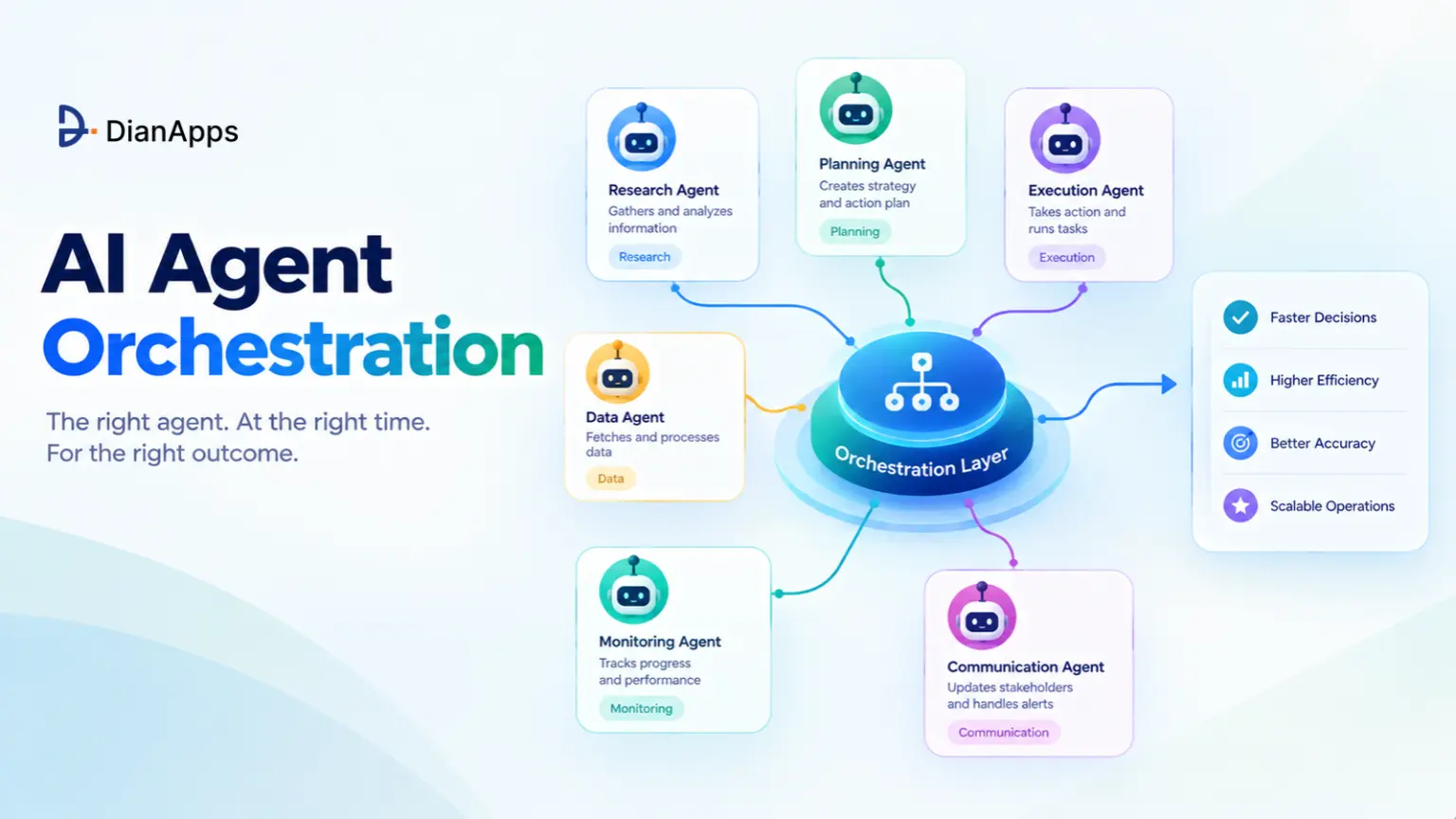
- AI agent orchestration is the layer that is coordinating multiple AI agents, deciding who is doing what, in which order and how each and every result is coming together in the end.
- Multi-agent systems are splitting one big task into smaller jobs and handing them over to specialised agents, like a planner, a researcher, a coder and a reviewer.
- Businesses are mostly using orchestrator-worker, sequential, parallel, router and hierarchical patterns, and most of the real systems are mixing a few of them together.
- Multi-agent AI is giving much better results on complex, multi-step work, but this also is costing more tokens, adding delays and making debugging harder for the teams.
- If one agent with the right tools is able to do the job, it is definitely the smarter choice, so start simple and add more agents only when the task is really demanding it.
Quick Answer: AI agent orchestration is the process of coordinating multiple AI agents so that they are working together on one task, where an orchestrator is assigning the work, passing the context from one agent to another and combining all the outputs into one final result. Multi-agent systems are the setups that are being built this way, with each agent specialising in one part of the job, just like a team where everyone is having their own role. A team offering AI Agent development services can help you understand whether your business is actually needing multiple agents or whether one well-built agent is enough.
Going back to the time, group projects where the teacher was handing over one big assignment, and somehow one person in the group was ending up doing the research, writing the content, making the charts and even presenting it on the final day, while the result was looking rushed and half-done? Most businesses are now facing the very same situation with AI, as they are starting their AI journey with one chatbot or one assistant that is answering questions, writing drafts and summarising documents really well, but the moment they are asking it to research a market, write a report, verify the numbers and share it with the right team, it is missing steps, mixing up information and giving results that are needing a lot of fixing before anyone can use them.
This is not happening because the AI is weak, it is happening because one agent is being asked to do the job of an entire team, and this is exactly where AI agent orchestration and multi-agent systems are stepping in, helping businesses/organisations build a team of AI agents where each one is handling what it does best, while an orchestrator is keeping everything running smoothly in the background. But what is the need for AI agent orchestration, and how are these agents actually working together? Well, let’s break it down, from what it is and how it works to the patterns, use cases, challenges and when you should or should not be using it.
Planning to Build an AI Agent System?
Get expert guidance on choosing the right agents, orchestration pattern and tools for your business.
What Is AI Agent Orchestration?
AI agent orchestration is the process of coordinating multiple AI agents so that they are working together towards one common goal, where the orchestration layer is deciding which agent is handling which task, in what order, what information is passing from one agent to another and when the job is actually complete. Just like a project manager is assigning tasks to the team, keeping track of the progress and putting the final deliverable together, the orchestrator is doing the same thing for AI agents, only much faster and in real-time.
The easiest way to understand it is to think about a busy restaurant kitchen, as nobody is expecting one chef to take the orders, cook each and every dish, plate it beautifully and then handle the billing too, instead there is a head chef who is coordinating a team of specialists, and the food is reaching the table faster, hotter and with much better quality. AI agent orchestration is working in the same way, where the orchestrator is the head chef and each agent is a specialist in the kitchen, doing one job really well.
Suggested Read- What is an AI agent?
The Challenges of Running AI Without Orchestration
Before understanding why AI agent orchestration is becoming so popular, it is important to look at what is happening when businesses are running multiple agents without any coordination, as the agents are just behaving like separate tools that are working in isolation, with no shared context and no clear handover between them.
Running multiple AI agents without orchestration is usually coming with a long list of problems, resulting in:
- Agents repeating each other’s work.
- Conflicting answers from different agents.
- Lost context between tasks.
- No one owning the final output.
- Errors going unnoticed until the end.
Inefficiencies like these don’t just frustrate the teams that are using the AI, they also affect the brand perception, as a wrong report or a half-finished customer reply is giving a poor impression before the business has even started seeing the value of its AI investment. With AI agent orchestration in place, those same agents are getting clear tasks, smooth handovers, retries when something is failing and one combined, reliable output at the end, and this is why it is becoming extremely crucial for businesses that are moving from simple AI experiments to AI that is actually running their real, day-to-day workflows.
Ready to Put AI Agents to Work?
Discuss your workflow with our team and find out which AI agent setup fits your business best.
Why AI Agent Orchestration Is Gaining Attention?
For a few years, most of the AI tools were working as single assistants that were only responding to one prompt at a time, but today the models are getting much better at reasoning, using tools and following longer instructions, and businesses are now expecting AI to complete entire processes and not just answer a few questions. Gartner, for instance, has predicted that 40% of enterprise applications will feature task-specific AI agents by 2026 (Gartner, 2025), and as the number of agents inside each and every company is growing, the need to coordinate them is definitely growing too.
And that is not all, the tooling is also catching up really fast, as frameworks for building agent teams are maturing, standards for connecting agents with tools and with each other are being adopted, and cloud platforms are now equipping businesses with built-in support for agent workflows. All of this is making AI agent orchestration far more practical for businesses of every size, and not just for the big tech companies with large research teams, and the reasons are not hard to see.
Know More- Types of AI Agents: 7 Kinds Explained With Real Examples
What Are Multi-Agent Systems?
Multi-agent systems are AI setups where two or more agents, each with its own role, instructions and tools, are working together to complete one task, and instead of one general-purpose agent trying to do everything on its own, multi-agent AI is breaking the work into smaller jobs and handing each one over to a specialist, like a research agent, a writing agent, a data analysis agent and a quality check agent.
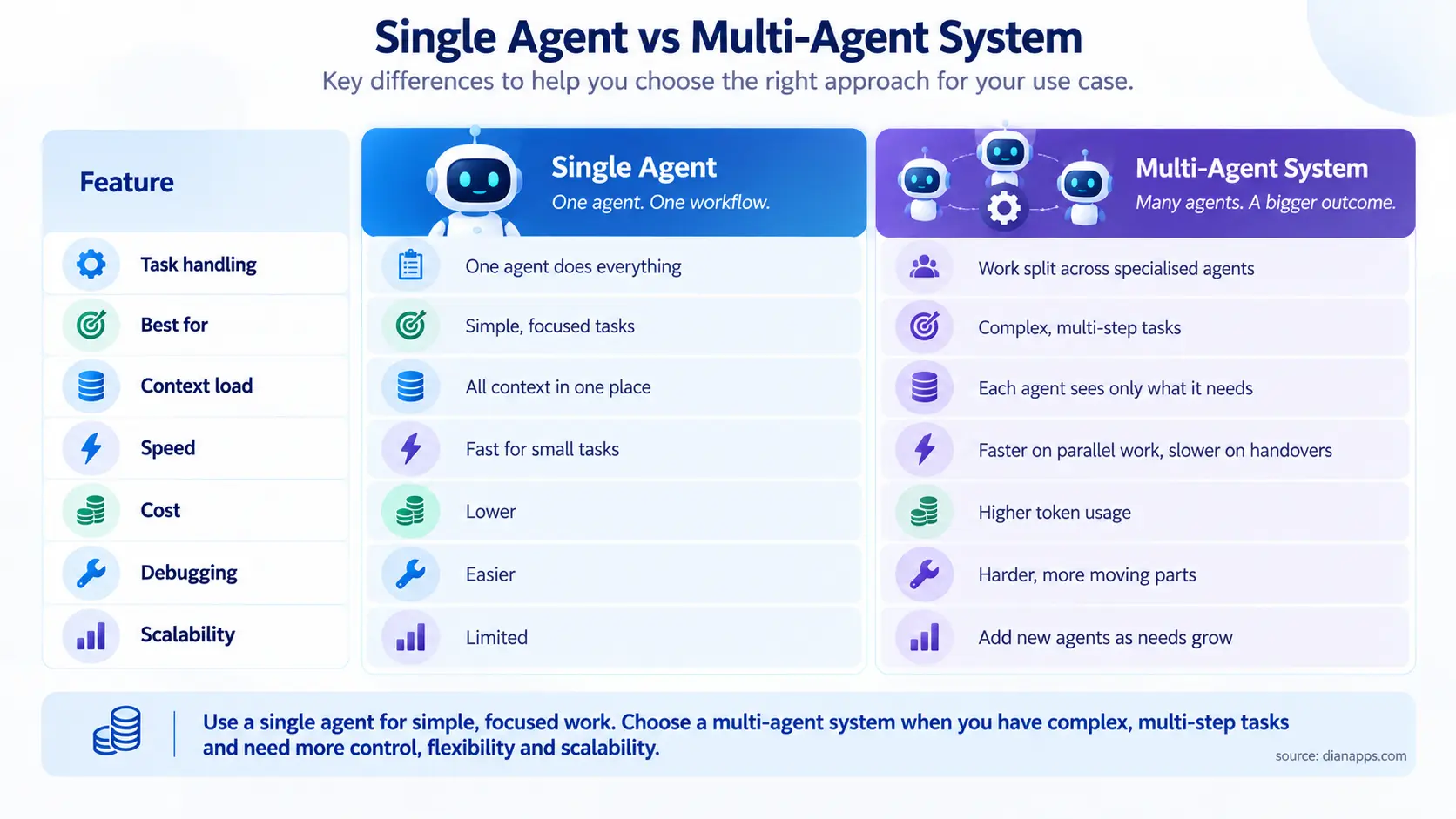
The biggest advantage here is focus, as each agent is getting a smaller, clearer job with its own context, which is reducing the confusion that is happening when one agent is juggling too many instructions at once. This also is making the whole system much easier to improve, as businesses are able to upgrade or replace one agent without rebuilding everything from the very beginning.
Types of Agents in a Multi-Agent System
Not every agent in a multi-agent setup is doing the same kind of work, and depending on the use case, businesses are usually combining a few of these roles, let’s take a look.
- Orchestrator or Manager Agent: Plans the work and combines the results.
- Router Agent: Sends each request to the right specialist.
- Research or Retrieval Agent: Finds information from documents, databases or the web.
- Task or Worker Agent: Handles one job, like writing, coding or data analysis.
- Tool-Using Agent: Connects with APIs and business systems to take actions.
- Reviewer or Critic Agent: Checks the work of other agents for errors.
- Memory Agent: Stores and recalls context from past tasks.
A small setup may only be needing two or three of these roles, while a large enterprise system can be running dozens of agents across different departments, but the key is giving each and every agent one clear responsibility, as agents with overlapping roles are creating the same confusion that one overloaded agent is facing.
How AI Agent Orchestration Works?
A multi-agent setup can look quite complicated from the outside, but most of them are running on the same basic building blocks, and once these are clear, the picture is becoming much simpler, so let’s break it down.
The Orchestrator
The orchestrator is the brain of the whole system, which is receiving the user’s request, breaking it into smaller tasks, deciding which agent should be handling each one and then bringing all the results together into one output. In many setups the orchestrator itself is an AI agent that is deciding the plan on the fly, while in others it is a fixed workflow written in code, which is more predictable but also less flexible.
Specialised Agents
These are the workers of the system, where each one has a specific role, its own instructions and access to only the tools it needs, like a search tool for the research agent or a code runner for the testing agent. Keeping tool access limited improves focus and reduces the risk of an agent taking an action it was never meant to take. Businesses can also decide whether to build agents around their specific workflows or use ready-made solutions, which is where custom AI agent development vs off-the-shelf agents becomes relevant.
Shared Memory and State
Agents need a way to share what they have already done, so the orchestrator maintains a shared state that stores task progress, intermediate results and decisions made so far, ensuring no agent has to start from zero. Some systems also use long-term memory to retain user preferences or past outcomes across sessions. When agents need access to company documents or domain-specific knowledge, techniques such as retrieval-augmented generation (RAG), fine-tuning and prompt engineering can help determine how that information is retrieved, learned or used to guide responses. Understanding RAG vs fine-tuning vs prompt engineering helps teams choose the right approach for their knowledge and instruction requirements.
Tools and Integrations
Agents are connecting with APIs, databases, CRMs and internal systems to actually get the work done, and standards like the Model Context Protocol (MCP) are making it much easier to connect agents with tools and data sources, while protocols like Agent2Agent (A2A) are helping agents that are built on different platforms talk to each other in a hassle-free way.
Guardrails and Human Checkpoints
And that is not all, a well-built system is also including guardrails, like limits on what each agent is allowed to do, checks on the outputs and human approval for high-risk actions such as sending payments or emails to customers. These checkpoints are really what is turning an impressive demo into a system that your business is able to trust each and every day, especially when the stakes are high.
AI Agent Orchestration in Action: A Simple Example
To make it easier to understand, let’s walk through how a multi-agent system is handling one single request from beginning until completion, where a sales manager is asking, “Prepare a competitor analysis for our new product and share it with the sales team.”
- The orchestrator receives the request and splits it into tasks, like finding competitors, gathering data, analysing it, writing the report and sharing it.
- A research agent searches the web and internal documents to find the main competitors and what they are offering.
- Several data agents work in parallel, with each one collecting pricing, features and reviews for a different competitor.
- An analysis agent compares all the data with your own product and highlights the gaps and strengths.
- A writing agent drafts the report in the company’s format.
- A reviewer agent checks the facts, numbers and tone, and sends it back if something is missing.
- A human approves the final report, and a tool agent shares it with the sales team on email or Slack.
A single agent could be trying this too, but it would be carrying all the research, data and drafting in one context, which is exactly where the quality is usually dropping, whereas with orchestration each and every step is getting full attention, and the parallel research is also saving the team a lot of time.
Common AI Agent Orchestration Patterns
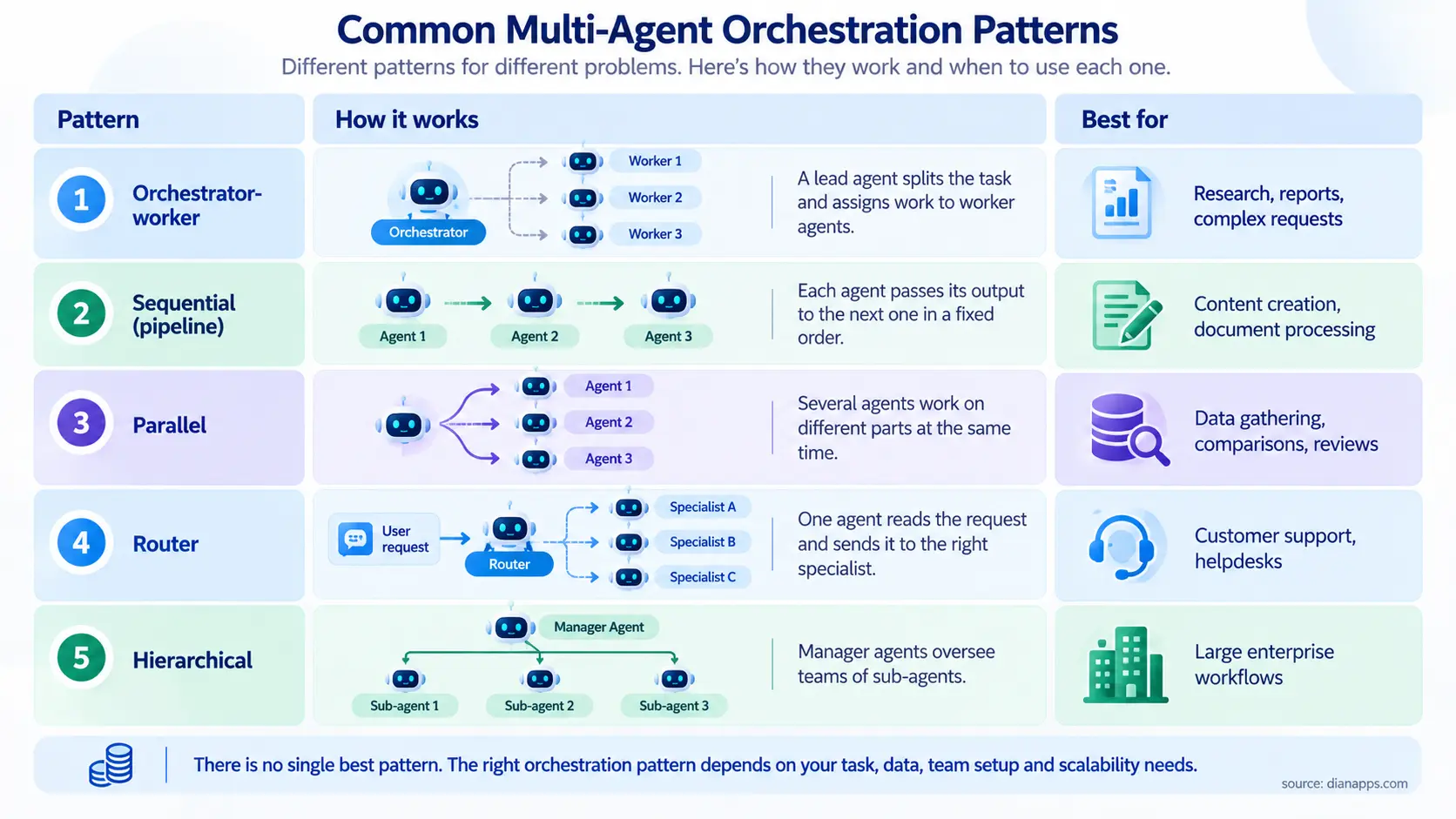
There is no single way to orchestrate agents, and the right pattern is really depending on how your task is structured and how the work is flowing, so here are the ones that businesses are using the most in real projects.
Orchestrator-Worker
This is the most popular pattern, where a lead agent is planning the work, handing it over to worker agents and then combining whatever they are sending back. It is flexible and is working really well when the steps are not known in advance, but the whole system is relying heavily on how well the lead agent is planning.
Sequential Pipeline
Here the agents are working just like an assembly line, where each one is taking the previous agent’s output, improving it and passing it on to the next one. It is predictable and easy to debug, but one slow or failing step is holding up the entire line.
Parallel
Multiple agents are working on separate parts of the task at the same time, and the results are being merged together at the end. This is cutting down the total time quite a lot, though it is also increasing the token usage, as several agents are running at once.
Router
A router agent is acting like a receptionist at the front desk, reading each request and sending it to the agent that is best suited to handle it. It is simple, fast and is working extremely well for customer support desks and internal helpdesks.
Hierarchical
For large systems, manager agents are looking after their own teams of sub-agents, just like different departments in a company. It is really powerful for enterprise-scale workflows, but it is also the hardest one to build, monitor and debug.
Most production systems are not sticking to just one pattern, they are mixing them together, for example a router is sending a request to an orchestrator, which is then running a few agents in parallel and passing the results through a review pipeline before anything is reaching the user.
Multi-Agent AI for Software Development
One of the fastest-growing use cases is multi-agent AI for software development, where different agents are taking up the roles of a real development team, and instead of one coding assistant writing everything, the work is being split into roles, like:
- Planner Agent: Breaks the feature request into tasks.
- Coding Agent: Writes the code for each task.
- Review Agent: Checks for bugs, security issues and standards.
- Testing Agent: Writes and runs tests, then reports failures.
- Documentation Agent: Updates the docs and change notes.
This setup is catching more errors before the code is even reaching a human reviewer, as each agent is checking the work of the one before it, and teams are also using it for the jobs that developers/engineers usually don’t enjoy, like upgrading old dependencies, fixing failing tests, moving code to a newer framework and writing documentation for legacy systems.
However, multi-agent AI for software development is still needing human developers in the loop for approving architecture decisions, reviewing the final code and owning what is going to production, as it is speeding up the team and not replacing it, and the teams that are getting the best results are the ones treating agents like junior team members whose work is always being reviewed.
Ready to Build Your AI Agents?
Discuss which AI agent setup fits your business best.
AI Agent Workflow Automation: Real Business Use Cases
For many years, businesses have been relying on rule-based automation that is following a fixed script, and it is working well until an invoice is coming in a different format or a customer is asking something unexpected, and then the whole flow is breaking. AI agent workflow automation is going far beyond this, as agents are able to read, reason and make decisions at each step, and businesses are already seeing real results in areas like:
- Customer Support: Agents are sorting tickets, finding answers and passing complex cases to humans.
- Sales and Lead Management: Agents are researching leads, updating CRM data and drafting outreach.
- Finance and Operations: Agents are processing invoices and flagging mismatches.
- Content and Marketing: Research, writing, SEO and editing agents are working as one pipeline.
- HR and Recruitment: Agents are screening resumes and scheduling interviews.
- Healthcare Administration: Agents are handling appointments, insurance checks and follow-ups.
- Ecommerce: Agents are managing listings, shopper questions, orders and returns.
What is common across all of these is that the work is having multiple steps, multiple systems and a few decision points, which is exactly where AI agent workflow automation is making the biggest difference for businesses and their customers/clients.
Benefits of Multi-Agent Systems
When the use case is right, switching to multi-agent systems is bringing a number of real advantages for businesses, resulting in:
- Better accuracy on complex tasks.
- Faster completion with tasks running in parallel.
- Easier updates without touching other agents.
- Reuse of the same agents across workflows.
- Clear ownership of each step.
- Easier scaling as the business is growing.
Anthropic has also shared that its multi-agent research system was performing noticeably better than a single agent on complex research tasks, mainly because the work was being spread across agents with their own context (Anthropic Engineering, 2025), and this is why more and more businesses are now exploring this approach.
Single Agent vs Multi-Agent: When Should You Use Which?
This is where many businesses are getting it wrong, as they are assuming that more agents are always giving better results, but multi-agent systems, as powerful as they are, are also adding cost and complexity. Anthropic, for example, has reported that its multi-agent research system was using around 15 times more tokens than a normal chat interaction (Anthropic Engineering, 2025), and Gartner has also predicted that over 40% of agentic AI projects will be cancelled by the end of 2027 because of rising costs and unclear business value (Gartner, 2025).
So before adding more agents, it is really helpful to compare both setups side by side and check which one your task is actually needing.
| Feature | Single Agent | Multi-Agent |
| Best For | Focused, simple tasks | Complex, multi-step work |
| Cost | Lower | Higher |
| Speed | Fast for small tasks | Faster with parallel work |
| Accuracy on Big Tasks | Drops with more steps | Higher |
| Debugging | Easy | Harder |
| Maintenance | Simple | Needs more monitoring |
The table makes it clear that multi-agent systems are winning on complex work, but the cost and debugging rows are also a reminder that they are not suitable nor suggested for each and every task, so the simple rule here is to start with one well-built agent, see where it is failing and add more agents only to solve those specific problems.
Recommended Read- Single-Agent vs. Multi-Agent Workflows
Challenges of Multi-Agent Systems
Building multi-agent AI is not just about connecting a few agents together, as there are real challenges that teams are facing on the ground, and planning for them early is saving a lot of rework later, such as:
- Higher Costs: More agents are meaning more model calls and tokens.
- Latency: Every handover is adding a little more time.
- Error Compounding: One agent’s mistake is travelling through the whole chain.
- Debugging Difficulty: Finding which agent caused a failure is harder.
- Security Risks: Agents with tool access are open to prompt injection.
- Governance: Businesses are needing clear logs of what each agent did and why.
This is why observability, logging and human checkpoints are not optional extras, they are an essential part of each and every production-ready system, and skipping them is putting both the business and its customers at risk.
Best Practices for AI Agent Orchestration
Teams that are getting multi-agent systems right are usually following a few common practices, and these are the ones that are making the most difference on the ground, let’s take a look.
- Give each agent one clear job, with focused instructions and only the tools it needs.
- Define clear handovers, so every agent knows what it is receiving and returning.
- Set limits on loops and retries, so agents are not running endlessly and burning tokens.
- Log every step, including inputs, outputs and tool calls.
- Test AI Agents with real scenarios, including the edge cases and messy data your business is actually seeing.
- Track cost per task, so you know whether the extra agents are paying off.
- Keep humans in the loop for decisions affecting customers, money or compliance.
Following these right from the beginning is helping businesses avoid the most common failures, while also keeping their AI agent orchestration reliable as the system is growing and more agents are being added over time.
Popular Frameworks for AI Agent Orchestration
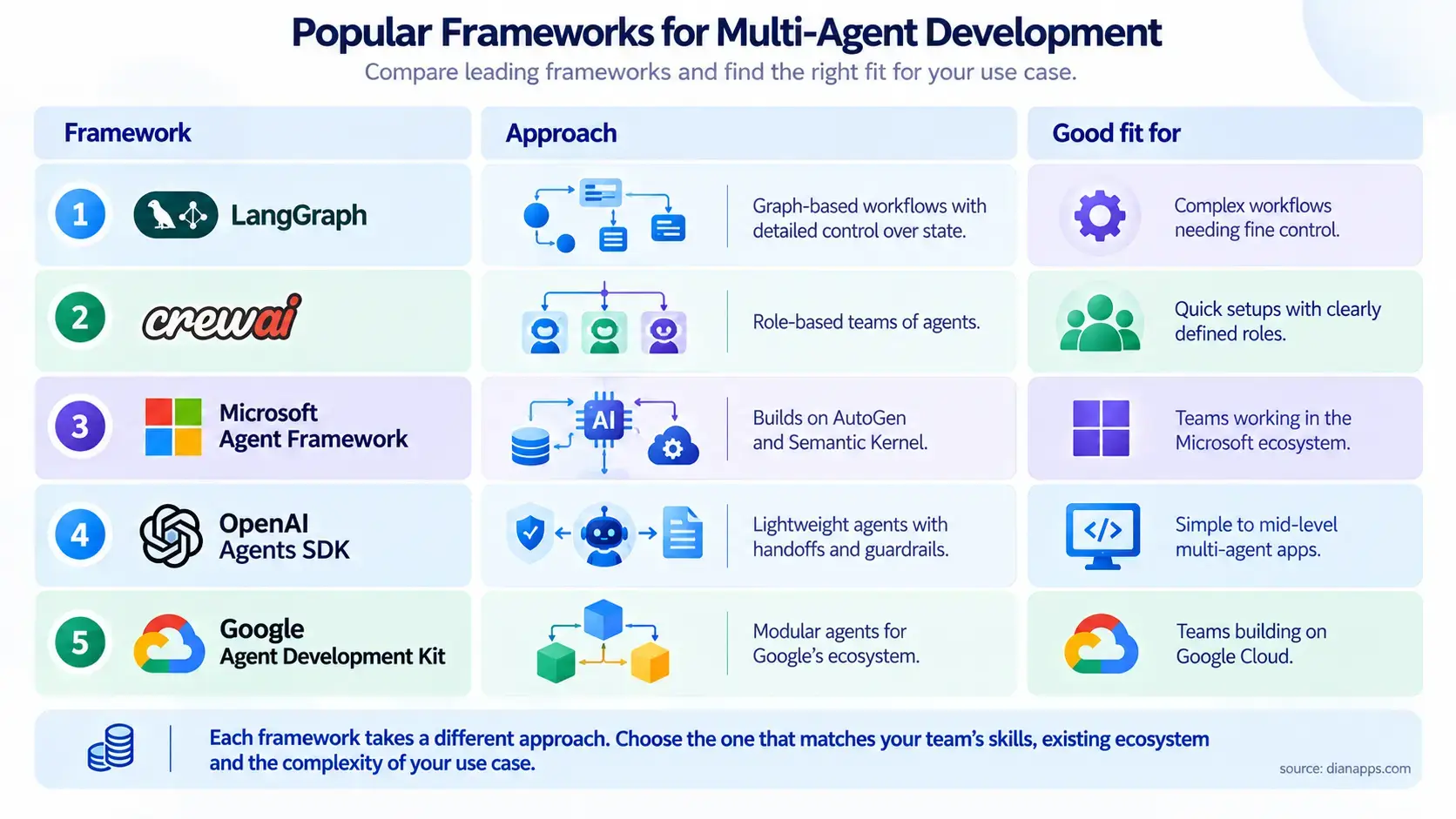
Teams are not building orchestration from scratch anymore, as there are now several frameworks that are handling most of the heavy lifting for them, and here is a simple summary of the popular ones for quick reference.
| Framework | Best For |
| LangGraph | Detailed control over agent workflows |
| CrewAI | Role-based agent teams |
| Microsoft Agent Framework | Microsoft and Azure ecosystems |
| OpenAI Agents SDK | Lightweight agents on OpenAI models |
| Google Agent Development Kit | Google Cloud and Gemini users |
Each one is coming with its own strengths, and the right choice is really depending on your tech stack, the level of control you are needing and the models you are planning to use, and in many cases it is better to start with the framework your team is already comfortable with rather than chasing the newest one in the market.
How to Get Started With AI Agent Orchestration?
Getting started with AI agent orchestration does not have to be complicated or stressful, as long as businesses are following a clear plan instead of jumping straight into building, and the process usually looks like this:
- Pick One High-Value Workflow: Choose a repetitive, multi-step process that is eating up real time.
- Map the Steps: Write down each step, decision and system involved.
- Start With a Single Agent: See how far one agent with the right tools is able to go.
- Split Where It Struggles: Add specialised agents only where the single agent is failing.
- Choose Your Pattern and Framework: Match the pattern to how the work is flowing.
- Add Guardrails and Human Approval: Especially for actions affecting customers or money.
- Measure and Improve: Track accuracy, cost and time saved, then keep refining.
This is why starting small is always the smarter way, as businesses are learning from a working system first and only then investing in more agents where they are really adding value.
How DianApps Builds Multi-Agent Systems?
DianApps, AI app development company, is helping startups and enterprises design and build AI agent systems that are solving real business problems and not just looking impressive in a demo, and each and every project is starting with understanding your workflow, so that we are able to tell you honestly whether you are needing a single agent or a full multi-agent setup.
From choosing the orchestration pattern and framework to building the integrations, guardrails and monitoring, our team is handling the complete process under one roof, so that your AI agents are working reliably from the very first release and are continuing to improve long after it.
Conclusion
AI agent orchestration is turning a set of separate AI agents into one coordinated team that is able to handle complex, multi-step work, from research and reporting to software development and everyday business operations, and this is definitely changing the way businesses are using AI. Multi-agent systems are giving businesses better accuracy and much more flexibility, but they are also bringing higher costs and more complexity, which is why the smartest approach is starting simple and scaling up only when the task is really demanding it. So if you are planning to bring AI agent workflow automation into your business, our AI development services team is always here to help you plan, build and scale it the right way from beginning until completion, we’ve got you covered.
 0 comments









Your email address will not be published. Required fields are marked *