













 0 comments





Key Takeaways:
- AWS offers the widest range of cloud services and a mature ecosystem, making it suitable for businesses seeking flexibility and extensive tooling.
- Microsoft Azure is a strong fit for organizations using Microsoft 365, Windows Server, SQL Server, and hybrid cloud environments.
- Google Cloud stands out for data analytics, Kubernetes, and AI-focused workloads.
- Cloud costs depend on workload requirements, licensing, usage commitments, data transfers, and cost optimization practices.
- Regional availability matters for latency, disaster recovery, and data residency requirements, particularly in India, Australia, the UAE, and the US.
- Compare providers against your existing technology stack, AI roadmap, security needs, and budget before making a decision.
Quick Answer: AWS, Microsoft Azure and Google Cloud each suit different business needs. AWS offers broad service choice, Azure integrates closely with Microsoft tools, and Google Cloud excels in data analytics and AI. The right platform depends on your workloads, pricing, existing infrastructure, compliance requirements, and regional data needs.
In the past, there were days when getting a new server meant calling up a hardware vendor, waiting weeks for the machines to arrive, setting them up in a corner room of the office, and then hoping that they would be enough for the next few years of business growth. Those days are long gone now, and businesses are renting computing power from the cloud within minutes, but this has also brought a new kind of headache for business leaders/decision makers, which is choosing between AWS, Microsoft Azure, and Google Cloud, when each one of them is promising the best pricing, the smartest AI, and the strongest security.
The IT team is recommending one, the finance team is leaning towards another, and the developers are having their own favourite, and the meeting is ending with more questions than answers. But which cloud is actually the right one for your business in 2026? Well, there is no single winner here, as the right choice really depends on your workloads, your existing tools, your budget, and the countries where your customers are sitting, so let’s break it down one factor at a time.
AWS vs Azure vs GCP: A Quick Comparison
Before getting into the details, here is a simple side-by-side view of how the three cloud providers are standing in 2026.
| Feature | AWS | Microsoft Azure | Google Cloud |
| Market Share (Q2 2026) | 28% | 20% | 15% |
| Launched | 2006 | 2010 | 2008 |
| Known For | Widest range of services | Microsoft integration and hybrid cloud | Data analytics and AI |
| AI Platform | Amazon Bedrock | Microsoft Foundry | Gemini Enterprise Agent Platform |
| Discounts | Savings Plans, Reserved Instances, Spot | Reservations, Savings Plan, Azure Hybrid Benefit | Sustained use and committed use discounts |
| Regions in India | Mumbai, Hyderabad | Pune, Chennai, Mumbai, Hyderabad | Mumbai, Delhi |
| Region in UAE | Yes | Yes | No |
| Best For | Businesses wanting maximum choice | Microsoft-based organisations | Data-driven and AI-first businesses |
This table is giving you the bigger picture, but the real difference is sitting in the details behind each row, so let’s take a look.
Who Is Leading the Cloud Market in 2026?
The cloud market has been growing for many years, but 2026 is really taking things to a different level, as businesses are now moving more and more of their AI, data, and day-to-day operations to the cloud. According to Synergy Research Group, enterprise spending on cloud infrastructure services in Q2 2026 rose by over $43 billion compared with the same quarter last year, reaching $143 billion, and Amazon is still holding the top position with a 28 percent share, while Microsoft is at 20 percent and Google at 15 percent. Together, AWS, Azure and Google Cloud are taking 67 percent of all cloud revenue in the quarter, which is showing just how much the market is revolving around these three names.
But the more interesting part is who is moving up and who is slowing down. Google Cloud is reaching 15%, its highest share since Synergy started tracking it, while AWS is dropping from around 30% in the same period last year to 28%, and Azure is holding steady at 20%. And the reason behind this shift is not hard to see, as GenAI-specific cloud services are growing at 165% year over year, and Google is benefiting from this AI demand faster than the others.
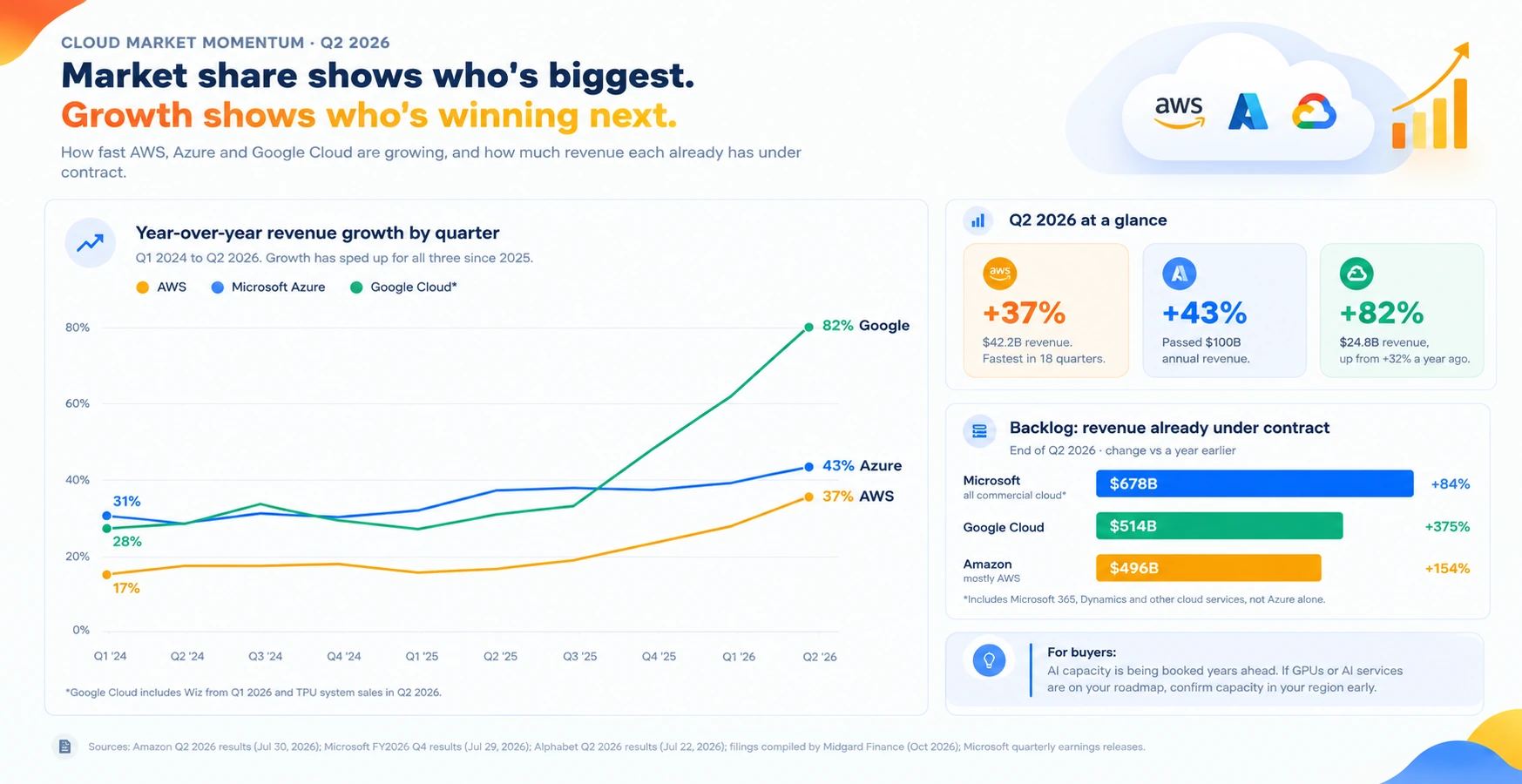
This is telling business leaders that AWS is still the biggest and most established platform, Azure is holding its ground with strong enterprise relationships, and Google Cloud is definitely the one to watch, but market share alone is not deciding which cloud is right for you, because that depends on what each platform is actually built for.
How Each Cloud Platform Is Built
Each and every one of these three providers is offering the basic building blocks a business needs, like compute, storage, databases, networking, and security, but each one has its own personality and strengths, resulting in:
- AWS offers the widest catalogue of services and the biggest partner network.
- Azure connects smoothly with Microsoft 365, Entra ID, Windows Server, SQL Server, and Dynamics.
- Google Cloud stands out in data analytics with BigQuery and in container workloads with Kubernetes.
- AWS has the largest pool of certified professionals, making hiring easier.
- Azure supports hybrid setups for companies still running on-premises systems.
This is why your existing technology stack is extremely crucial in this decision, because a company that is already running its emails, documents, and logins on Microsoft is going to find Azure feeling like a natural extension, while a data-heavy startup is often finding Google Cloud easier to work with, and businesses that want the most options and mature tooling are usually going with AWS. If you are curious about the providers beyond these three, our guide on the top cloud service providers in 2026 is covering the wider market.
AI and Machine Learning: The Factor That Is Changing Everything
For a lot of organisations, the AI roadmap is now deciding the cloud choice, and not the other way around, as businesses are planning chatbots, AI agents, smart analytics and automation, and they need a platform that is supporting all of this without making things complicated.
AWS is offering Amazon Bedrock, which is giving enterprises access to models from Anthropic, Meta, Mistral, Cohere, DeepSeek, Stability, and Amazon’s own Nova family under one contract and one IAM boundary, and this is really helping businesses that want the freedom to switch between models as the AI market keeps changing.
Microsoft is offering Microsoft Foundry on Azure, which is seen as the most natural home for OpenAI models, and one 2026 comparison notes that Foundry is leading for OpenAI’s GPT family, while Bedrock is strongest for Anthropic’s Claude. This is also helping companies that are already using Copilot and Microsoft 365, as their AI is staying inside the same security and identity setup they are already managing.
Google Cloud is making one of the biggest moves this year, as Vertex AI has been rebranded and expanded into the Gemini Enterprise Agent Platform at Google Cloud Next 2026, and Google is saying that the platform is giving access to more than 200 AI models through Model Garden, including third-party models and its own Gemini models.
And that is not all; the lines between these three are now getting blurry, as Claude models are reachable through Anthropic’s integrations on AWS Bedrock, Google Vertex AI, and Microsoft Azure as of mid-2026. So instead of asking which cloud has the best AI, the better question is which platform fits your data, your security needs, and the models your team is really planning to use. And if you are also deciding whether AI should run inside your app or in the cloud, our guide on on-device AI vs cloud AI explains it in detail.
Still Weighing the Pros and Cons?
Every business has different workloads, budgets, and compliance needs, and what is working perfectly for one company may not be the right fit for yours.
Is AWS Cheaper Than Azure and Google Cloud?
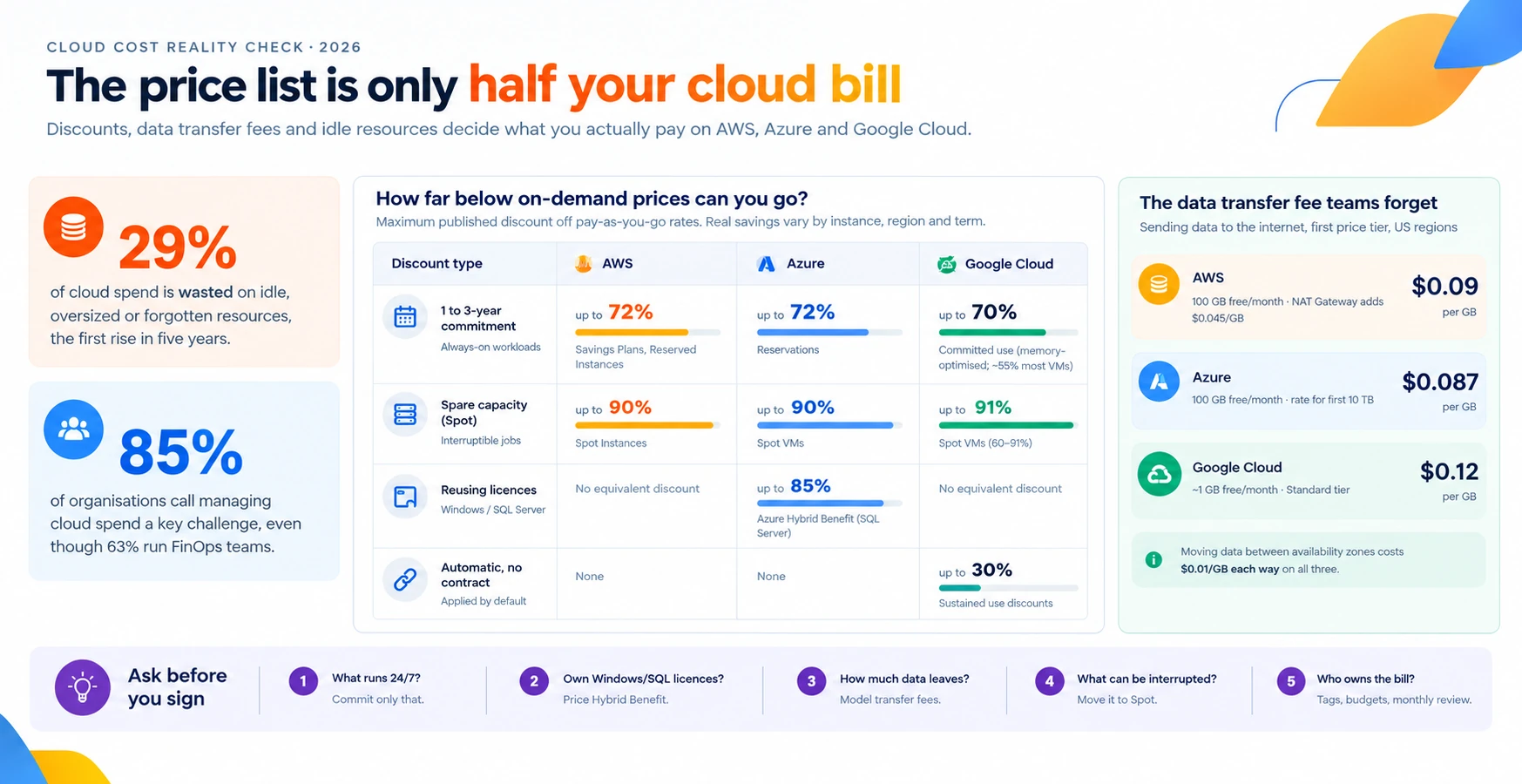
This is one of the most asked questions in the AWS vs Azure debate, and the honest answer is that none of the three is cheaper for each and every business, as all of them are following a pay-as-you-go model, and your final bill depends on the type of workload, the region, how long you are committing for, and how well your setup is managed.
The real cost differences usually come from a few areas, resulting in:
- Azure Hybrid Benefit allowing businesses to reuse their existing Windows Server and SQL Server licences.
- AWS Savings Plans and Reserved Instances rewarding long-term usage.
- Google Cloud applies sustained use discounts automatically on eligible compute.
- Spot pricing on all three cuts costs for interruptible workloads.
- Data transfer charges and premium support plans add hidden costs.
This is why a proper pricing comparison based on your actual workloads is definitely needed before signing any long-term commitment, because a business running Windows and SQL Server is going to get a completely different answer than a Linux-based startup working with heavy data, and choosing only on the basis of a price list often leads to bills that are much higher than expected.
Security, Compliance and Data Residency
When it comes to security, all three providers hold major global certifications like ISO 27001, SOC 1/SOC 2, PCI DSS, and HIPAA-eligible services, and all three are offering separate government environments in the US, namely AWS GovCloud (US), Azure Government, and Google Cloud’s Assured Workloads. Security is also following a shared responsibility model on all three platforms, which means the provider is protecting the infrastructure, but your team is still responsible for user access, configurations, and data, and a small mistake here doesn’t just create a security risk; it also affects customer trust.
Where these providers really differ is their local presence, because data residency laws are now shaping cloud decisions as much as features and pricing, and the reasons are not hard to see once you look at the regions.
Cloud Regions in India, Australia, UAE and the US
If your business is serving customers in India, Australia, the UAE or the US, the location of data centres is directly affecting your app speed, your compliance and your backup planning, so let’s take a look at each market.
India
Microsoft currently has the biggest footprint in India, as it is now running four cloud regions in the country: Central India in Pune, South India in Chennai, West India in Mumbai, and India South Central in Hyderabad. AWS is running regions in Mumbai and Hyderabad and is putting an additional $13 billion into expanding its data center capacity across both locations, while Google Cloud has data centers in Mumbai and Delhi, and in April 2026, Google started construction on its $15bn data center project in Visakhapatnam, Andhra Pradesh. With India’s Digital Personal Data Protection (DPDP) framework now in place, having more than one region inside the country is making it much easier for businesses to keep both their main data and backups within India.
Australia
AWS is running regions in Sydney and Melbourne, and Google opened its first Australian cloud region in Sydney in 2017 before adding Melbourne. Microsoft is offering Azure from three Australian cities, Sydney, Melbourne and Canberra, with the Canberra regions designed for government and critical infrastructure. For government work, the IRAP assessment is really important, and Microsoft has published an independent assessment of Azure services for handling official and PROTECTED Australian government information, with AWS and Google Cloud also publishing their own IRAP assessments.
UAE
This is where the difference is most visible, as AWS has two Middle East regions, in Bahrain and the UAE, and Azure is running UAE North in Dubai and UAE Central in Abu Dhabi. Google Cloud, on the other hand, has its Middle East regions in Doha in Qatar, Dammam in Saudi Arabia, and Tel Aviv in Israel, which means businesses that need their data to stay inside the UAE are finding AWS and Azure the more practical options for now.
United States
The US is still the centre of the cloud world, and Synergy is noting that the US market grew by 49% in Q2, well above the global average. All three providers are offering plenty of US regions along with FedRAMP-authorised services, so here the decision depends more on services, AI, and pricing rather than availability.
| Market | AWS | Microsoft Azure | Google Cloud |
| India | Mumbai, Hyderabad | Pune, Chennai, Mumbai, Hyderabad | Mumbai, Delhi |
| Australia | Sydney, Melbourne | Sydney, Melbourne, Canberra | Sydney, Melbourne |
| UAE | UAE region | Dubai, Abu Dhabi | No local region |
| US | Multiple regions, GovCloud | Multiple regions, Azure Government | Multiple regions, Assured Workloads |
Advantages and Disadvantages of AWS, Azure and Google Cloud
Every cloud platform comes with its own set of strengths and its own set of limitations, and knowing both sides is extremely crucial before you are putting your business, your data, and your budget on any one of them. So let’s take a look at what each provider is doing really well and where it is falling short.
Advantages and Disadvantages of AWS
AWS has been in the cloud market the longest, and this experience is showing in the way the platform is working, with businesses benefiting from:
- The widest range of cloud services across compute, storage, databases, AI, and analytics.
- The biggest share of the global cloud market, which means proven stability.
- A huge partner network and the largest pool of certified professionals.
- Multiple regions in India, Australia, the UAE, and the US.
- Access to many different AI models through Amazon Bedrock.
But AWS is not perfect for everyone, and some businesses are facing challenges like:
- A large number of services making the platform confusing for new teams.
- Pricing that is complex to understand without proper planning.
- Premium support plans adding extra cost.
- Windows and SQL Server workloads often costing more than on Azure.
This is why businesses moving to AWS usually need proper planning and cost monitoring from day one, because the same flexibility that makes AWS so powerful can also lead to unnecessary spending when it is not managed well.
Advantages and Disadvantages of Microsoft Azure
Azure is the natural choice for a lot of enterprises, and the reasons are not hard to see, with organisations getting:
- Smooth integration with Microsoft 365, Entra ID, Teams and Dynamics.
- Cost savings on Windows Server and SQL Server through Azure Hybrid Benefit.
- Strong hybrid cloud support for companies still running on-premises systems.
- The widest regional footprint in India, along with two regions in the UAE.
- Native access to OpenAI models through Microsoft Foundry.
At the same time, Azure has a few drawbacks, such as:
- Working best mainly when the business is already using Microsoft products.
- Licensing and pricing that can feel complicated.
- Frequent changes in product names and portal layouts.
- A learning curve for teams coming from Linux and open-source setups.
This is why Azure is making the most sense for organisations that are already deep into the Microsoft ecosystem, as businesses outside of it are not always getting the same level of value.
Advantages and Disadvantages of Google Cloud
Google Cloud is the fastest-growing of the three right now, and businesses are choosing it for:
- Strong data analytics capabilities through BigQuery.
- Leading AI tools with Gemini and the Gemini Enterprise Agent Platform.
- Deep expertise in Kubernetes and cloud-native development.
- Automatic sustained use discounts on eligible compute.
- Close integration with Google Workspace.
However, Google Cloud also has its own limitations, including:
- A smaller market share and partner network compared with AWS and Azure.
- No local cloud region in the UAE as of now.
- Frequent product rebranding, like Vertex AI recently becoming the Gemini Enterprise Agent Platform.
- Fewer enterprise-focused tools for businesses running on Microsoft.
This is why Google Cloud is suiting data-driven and AI-first businesses the most, while companies needing strict UAE data residency or a large local partner network are usually leaning towards AWS or Azure.
| Provider | Biggest Advantage | Biggest Disadvantage |
| AWS | Widest range of services | Complex pricing |
| Microsoft Azure | Microsoft ecosystem integration | Works best only within Microsoft setups |
| Google Cloud | Data analytics and AI | Smaller partner network and no UAE region |
Now that you know both sides of each platform, choosing the right one for your business is becoming much simpler, so let’s see which cloud is fitting which type of business.
Which Cloud Is Best for Your Business?
Now that each factor is clear, choosing between AWS vs Azure vs GCP is becoming much simpler once you match them with your own situation, resulting in:
- AWS for businesses wanting the widest choice of services and a mature ecosystem.
- Azure for organisations already running on Microsoft products.
- Google Cloud for businesses putting data analytics and AI at the centre.
- Azure or AWS for businesses needing data to stay inside the UAE.
- Multi-cloud for businesses operating across countries with different data rules.
In the AWS vs Google Cloud comparison, AWS is usually winning on range of services, ecosystem, and regional coverage, while Google Cloud is winning on data analytics and AI-led innovation, and in the AWS vs Azure comparison, the deciding factor is most often how much you have already invested in Microsoft. Whichever way you are leaning, having an experienced partner by your side is saving a lot of time and money, and businesses that are choosing Amazon’s platform are often bringing in AWS Consulting services to plan their architecture, migration, and cost control right from the start. And if you are still deciding whether to bring in outside help, our guide on hiring a cloud-managed service provider is covering everything you need to look for.
Final Thoughts
Choosing between AWS, Azure and Google Cloud is no longer just a technical decision that the IT team is making on its own, as it is now affecting your costs, your AI plans, your compliance and even how fast your customers are experiencing your app, from beginning until completion.
AWS is still leading the market with the widest range of services, Azure is remaining the natural choice for organisations running on Microsoft, and Google Cloud is growing the fastest with its strength in data and AI, so the right choice really depends on where your business is standing today and where you are planning to take it.
The smartest way forward is mapping out your workloads, licences, regions, and AI goals first and then letting that decide the cloud, and if you need a helping hand with that, our cloud experts are always here to guide you through it.
Confused Between AWS, Azure and Google Cloud?
Our cloud experts are helping businesses across India, Australia, the UAE, and the US compare each platform against their real workloads, budgets, and compliance needs.
 0 comments











Your email address will not be published. Required fields are marked *