













 0 comments
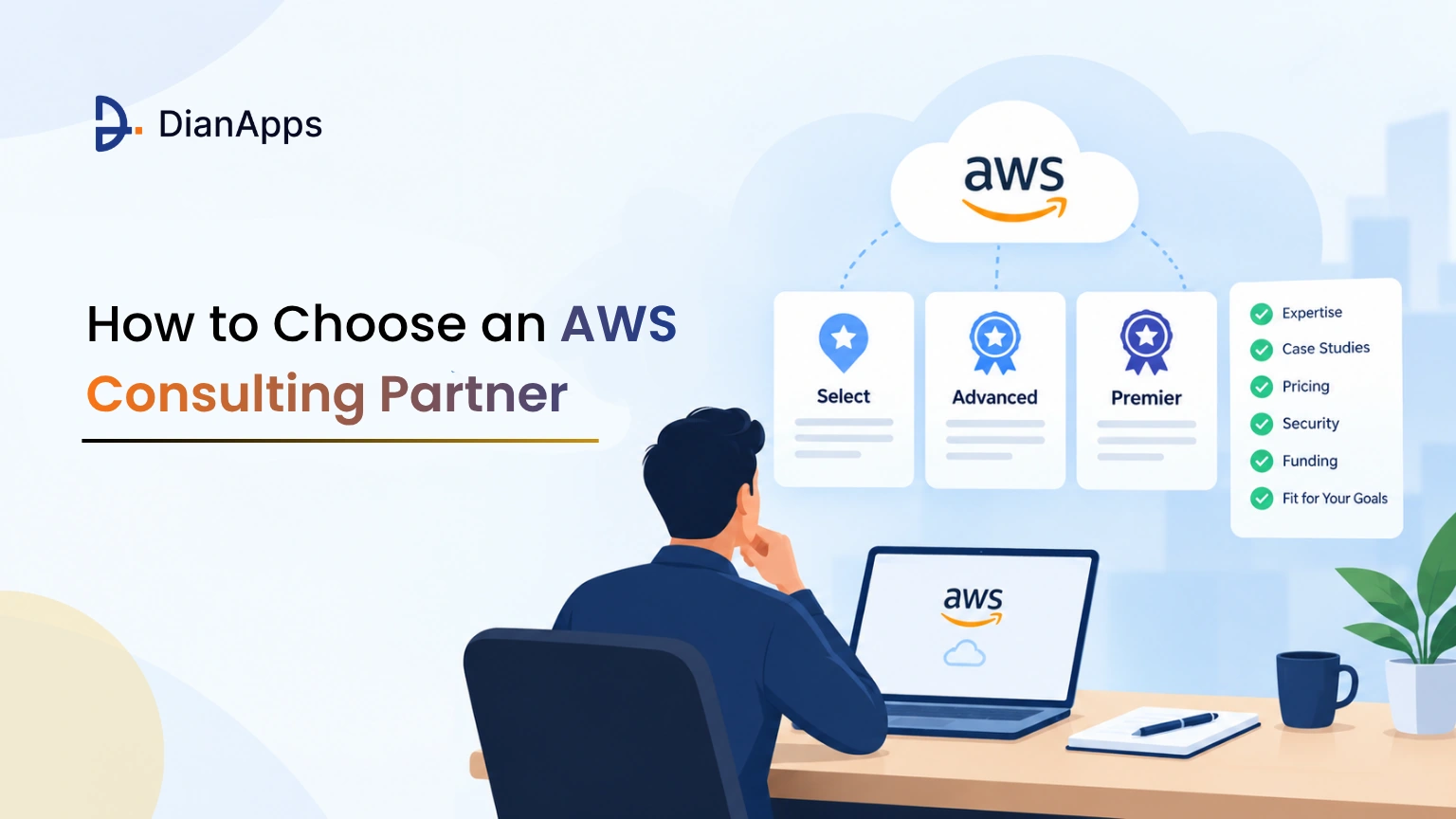





Key Takeaways:
- AWS Select, Advanced, and Premier tiers indicate partner scale, but do not guarantee the right expertise for your project.
- AWS Competencies, Service Delivery designations, and MSP validations offer stronger evidence of specialised capabilities.
- Verify partner tiers, specializations, and customer ratings through AWS Partner Solutions Finder before signing a contract.
- Compare fixed-fee, time-and-materials, monthly retainer, and outcome-based pricing using the same project scope.
- Check MAP funding eligibility, security practices, cost governance, case studies, and exit terms before committing.
- Use the 100-point partner scorecard and consider a 4-8 week paid pilot to evaluate delivery quality.
Quick Answer: To choose an AWS consulting partner, define your project goals, verify credentials through AWS Partner Solutions Finder, and review relevant case studies with measurable results. Compare pricing and funding eligibility, assess security and cost controls, score shortlisted firms against the same criteria, and run a paid pilot before signing a long-term contract.
Most guides on choosing an AWS consulting partner tell you to “look for certifications and experience.” That advice is true and almost useless, because every partner on your shortlist will claim both.
This guide covers what actually separates partners. You will learn what the tier badges really require, how to check a partner’s claims yourself in ten minutes, what AWS consulting services cost in 2026, which funding programs a partner can unlock for you, and the red flags that show up before a contract is signed.
What Does an AWS Consulting Partner Do?
An AWS consulting partner is a company registered in the AWS Partner Network (APN) on the Services path that designs, builds, migrates, or runs workloads on AWS for its clients. AWS calls this group “Services Partners.” Most buyers still call them consulting partners.
In practice, a partner does the hands-on work AWS itself mostly does not. AWS Support answers tickets and AWS staff advise, but they rarely work inside your account. A partner takes credentials, writes the infrastructure code, moves the data, and stays on call if you buy managed services.
If you are still deciding whether AWS is the right cloud at all, start with our AWS vs Azure vs Google Cloud decision guide or the plain-English explainer on what AWS is and how businesses use it.
Here is how a partner compares with the other ways to get AWS help:
| Option | What you get | Best for | Watch for |
|---|---|---|---|
| AWS consulting partner | Hands-on design, build, migration, optional ongoing operations | Most companies without a large in-house cloud team | Wide quality range between partners |
| AWS Professional Services (ProServe) | AWS’s own consultants, often working with a partner | Large enterprise programs | Premium pricing, limited availability for smaller projects |
| AWS Support plans | Ticket-based technical help, TAM on higher plans | Teams that already build in-house | Advice only, no one does the work for you |
| Freelance AWS engineer | One person’s time | Small, well-defined tasks | Single point of failure, no bench |
| In-house cloud team | Full control and context | Companies with steady, large cloud workloads | Hiring time and salary cost |
The table shows that a partner fills the gap between advice and a full in-house team. For a deeper cost comparison, see AWS partner vs freelancer vs in-house cloud team, and for when AWS’s own team makes sense, read what AWS Professional Services is and when to use a partner instead.
Step 1: Define the Job Before You Shortlist Anyone
The most common selection mistake happens before the first sales call. Buyers shortlist partners by reputation, then try to fit their project to whoever sounds strongest.
Write down four things first:
- The outcome: For example, “move 40 servers off our data center by Q3” or “cut our AWS bill by 25%.” Make it measurable.
- The type of work: Migration, a new build, cost optimization, DevOps, security, or ongoing operations. Each needs different proof.
- Your team’s role: Will your engineers build alongside the partner, review their work, or hand everything over?
- The budget shape: One-time project, monthly retainer, or both. This decides which pricing model fits.
Once this is on paper, most of the decisions below get easier. If you are not sure what kind of help you need, our explainer on what cloud consulting services actually include breaks down advisory, delivery, and managed work.
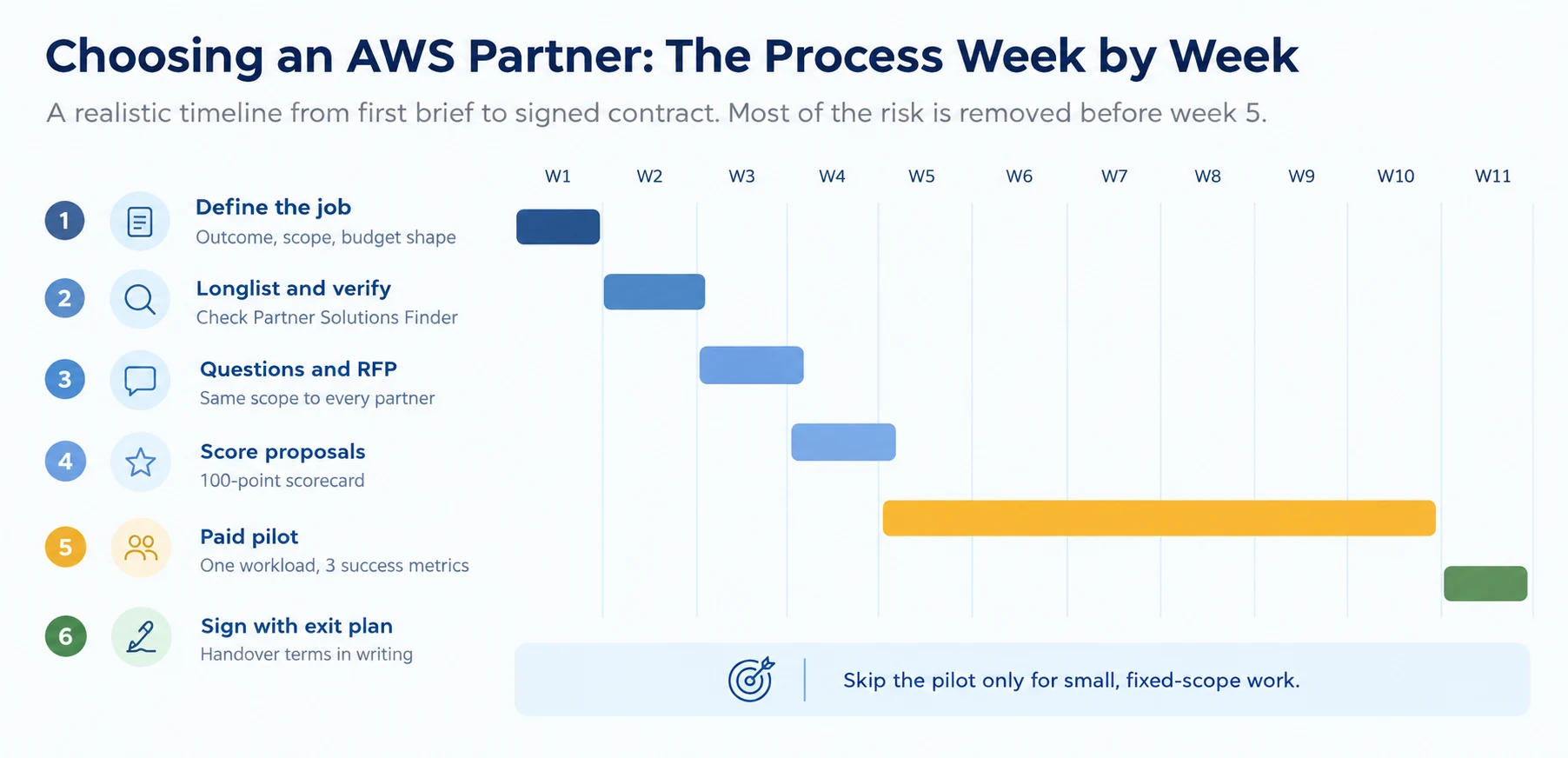
Plan for the whole process to take about 10 to 11 weeks if your project is large enough to need a pilot. Here is how the time usually breaks down:
AWS Partner Tiers Explained: Select, Advanced and Premier
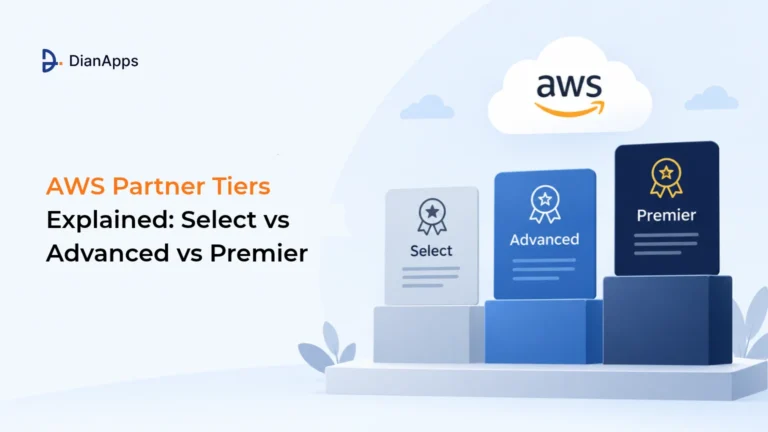
AWS ranks Services Partners in three tiers: Select, Advanced, and Premier. Older names such as Registered, Standard, Consulting Partner, and Technology Partner were replaced in 2022, so if a partner still uses them, their marketing is out of date.
Here is what each tier requires, taken from AWS’s Services Partner Tiers page (October 2026):
| Requirement | Select | Advanced | Premier |
|---|---|---|---|
| Technical certified individuals | 2 | 6 (3 Professional or Specialty) | 25 (10 Professional or Specialty) |
| Foundational certified individuals | 2 | 4 | 10 |
| Launched customer opportunities | 3 | 20 | 50 |
| Total MRR from those launches | $1,500+ | $10,000+ | $50,000+ |
| Partner business plan | Not required | Required | Required |
| Competency, MSP or Well-Architected validations | Not required | Not required | 3, including MSP, DevOps or CloudOps Competency |
| Can join the AWS Competency Program | No | Yes | Yes |
| Marketing Development Funds | No | Yes | Yes |
| Annual APN fee | $2,500 | $2,500 | $2,500 |
Read the table for what it does and does not prove. Tiers count certified people, launched customer projects, and the AWS spend those projects generate. They say nothing about whether the team has done a project like yours.
- Select Tier: A partner that has passed AWS’s entry bar. It has certified staff and live customer work, but it cannot yet hold AWS Competencies.
- Advanced Tier: A partner with a real AWS practice and a business plan agreed with AWS. It can earn Competencies.
- Premier Tier: A large partner with deep certification, at least three validated specializations, and sustained volume for over six months. Premier status is a strong signal for big enterprise programs.
What is an AWS Premier partner?
An AWS Premier Tier partner is a Services Partner that meets AWS’s highest tier requirements: 25 technical certified individuals with at least 10 at Professional or Specialty level, 50 launched customer opportunities with $50,000+ in total MRR, and three validated programs such as Competencies or MSP.
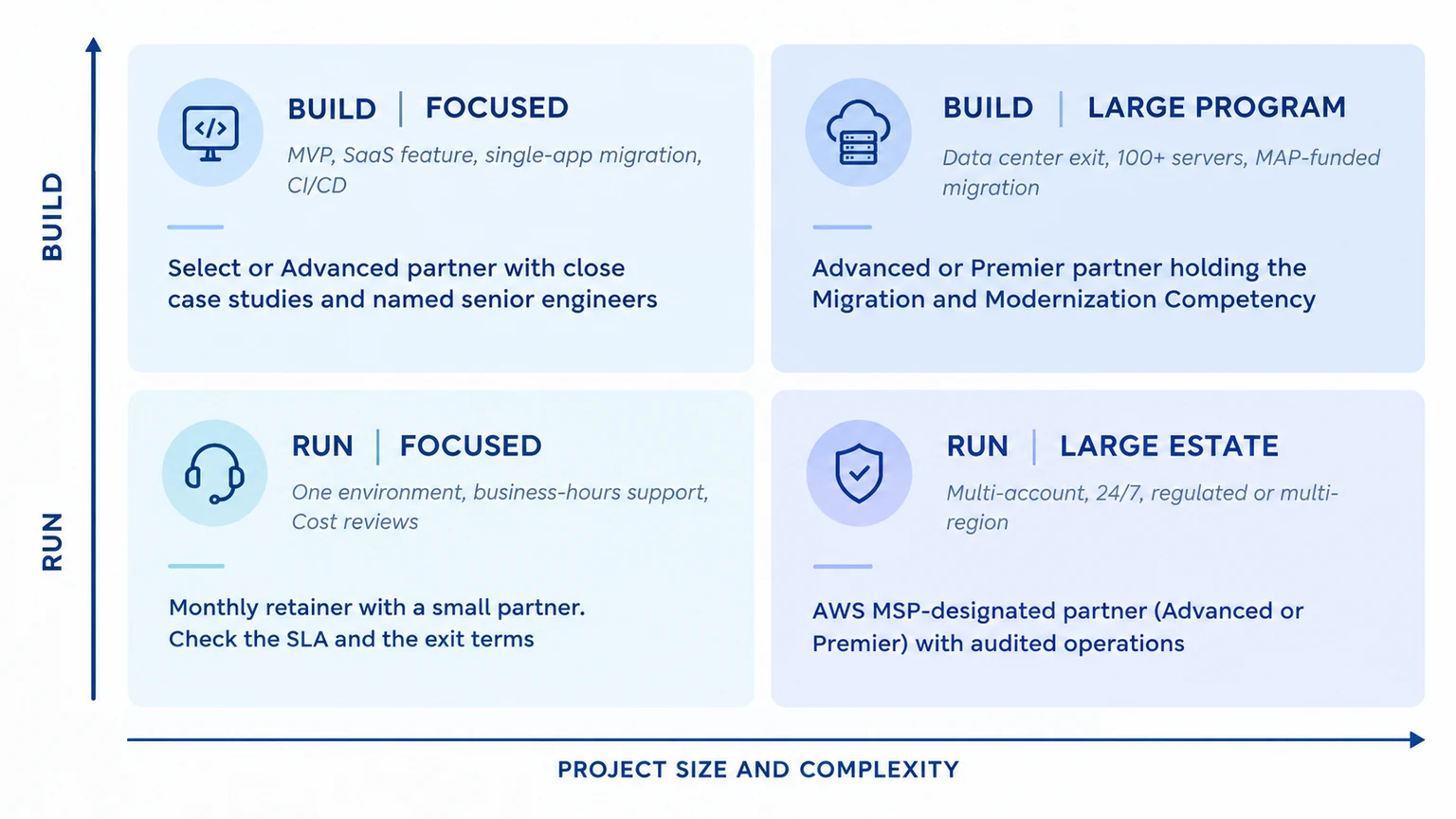
Premier is not automatically the right choice; Premier firms are built for large programs, and a 10-server migration or an MVP may get a junior team and a high rate. Smaller tiers can be a better fit when the team in front of you has done your exact work.
The simplest way to decide is to place your project on two questions: how big is it, and do you need something built or run?
AWS Specializations and Competencies: The Signal That Matters More
If tiers measure scale, specializations measure validated expertise. AWS runs four specialization programs:
| Program | What it validates | How AWS checks it | Tier needed |
|---|---|---|---|
| AWS Competency | Expertise in an industry, use case, or workload (Migration and Modernization, Security, Generative AI, DevOps, and more) | Technical checklist, customer case studies, and a third-party audit for service partners | Advanced or Premier |
| AWS Service Delivery | Delivery of one specific AWS service, such as Amazon RDS or AWS Lambda | Technical validation and customer case studies | All tiers |
| AWS Service Ready | Software products that integrate with specific AWS services | Review by AWS Solutions Architects | Software partners |
| AWS Managed Service Provider (MSP) | Full lifecycle support, from migration to ongoing operations | Detailed checklist, customer references, and a third-party audit | Advanced or Premier |
AWS’s own partner blog says partners report about 200 hours of preparation for a Competency and 9 to 12 months of team effort for MSP. That effort is why these badges carry more weight than a tier.
Start from your project and work back to the proof. A migration buyer should look for the Migration and Modernization Competency. A buyer who wants 24/7 operations should look for the MSP designation and read the SLA. A startup building its first product on AWS should care far more about similar builds in the portfolio than any badge.
Our guide to AWS competencies and which ones matter for your project lists the full set by workload.
Not sure which credentials your project needs?
Tell us what you are building or moving, and we will tell you which AWS specializations actually matter for it, even if that points you to another partner.
How to Verify an AWS Partner in 10 Minutes
Partner websites are marketing. AWS Partner Solutions Finder (partners.amazonaws.com) is the source of truth, because tier and specialization data there comes from AWS.
- Search the partner’s exact company name on AWS Partner Solutions Finder.
- Check the tier badge. It should match what the partner claims on its website and in its proposal.
- Read the specializations list. If a partner claims “migration expertise,” check for the Migration and Modernization Competency or a relevant Service Delivery designation.
- Look at customer ratings left through AWS’s rate-a-partner feature.
- Compare the website against the listing. Any gap, such as a claimed competency that is missing, is a question to raise directly.
- Ask for the named team’s AWS certifications. Individual certifications can be verified through AWS Certification’s credential validation.
A mismatch is not always dishonesty. Badges lapse when renewals are due, and specialization renewals now depend on recently launched opportunities. But you should get a straight answer.
For a full walkthrough with screenshots, see how to find and verify a partner on AWS Partner Finder.
How Much Do AWS Consultants Cost?
AWS consulting is usually sold in one of four pricing models. Matching the model to your project matters as much as the rate.
| Pricing model | How it works | Best for | Risk to watch |
|---|---|---|---|
| Fixed fee | One price for a defined scope | Migrations, assessments, CI/CD setup | Change requests priced high once scope moves |
| Time and materials | Hourly or daily rates | Advisory work, unclear scope | Budget creep without a cap |
| Monthly retainer | Fixed monthly fee for ongoing work | Managed services, cost governance | Paying for capacity you do not use |
| Outcome-based | Fee linked to a result, such as a share of savings | Cost optimization | Partner incentives skewed to short-term savings |
What the rates look like. One boutique AWS firm’s published 2026 price guide lists senior AWS engineers at $200 to $350 an hour, a small migration of 5 to 10 servers at $15,000 to $30,000, and a one-time cost audit at $5,000 to $10,000 (EaseCloud, June 2026). The same guide puts global systems integrators at 3 to 5 times boutique rates and offshore firms at 30% to 50% of them.
| Engagement | Typical published range (2026) |
|---|---|
| Architecture review (1 to 3 weeks) | $8,000 to $15,000 |
| Small migration (5 to 10 servers) | $15,000 to $30,000 |
| Medium migration (20 to 50 servers) | $30,000 to $60,000 |
| CI/CD pipeline setup | $20,000 to $35,000 |
| Managed services retainer | $6,000 to $25,000 per month |
Source: EaseCloud AWS consulting pricing guide, June 2026. These are one firm’s published ranges, not a market survey. Region, compliance scope, and urgency move them significantly.
Ask every partner to price the same scope in the same model. Comparing a fixed-fee migration quote with an hourly advisory quote tells you nothing. For rates by country and role, see AWS consultant hourly rates in 2026, and for ongoing work, AWS managed services pricing.
MAP Funding and Other Partner-Unlocked Programs
AWS funds part of many customer projects, and a partner is often the route to that money. What a partner can unlock depends on its tier and specializations, so ask before you assume.
| Program | What it covers | What the partner needs |
|---|---|---|
| Migration Acceleration Program (MAP) | Credits and funding for large migrations, run in three phases: Assess, Mobilize, and Migrate and Modernize | AWS ties enhanced MAP benefits to the Migration and Modernization Competency |
| Partner Opportunity Acceleration (POA) | Funding for proofs of concept and migrations, as cash reimbursement or AWS credits | Available to Select, Advanced, and Premier partners, subject to AWS approval |
| Well-Architected Partner Program | Funded Well-Architected reviews and remediation | Advanced or Premier tier with Well-Architected Program membership |
| AWS Activate | AWS credits for startups | Credits apply to AWS usage, not consulting fees |
Sources: AWS Services Partner Tiers page; AWS Partner Network Blog, 2026 partner program update; AWS MAP terms.
MAP is the one buyers most often get wrong. It is designed for sizable migrations; the credits are tied to an agreed migration plan, and not every partner can run it. Ask the partner which MAP phases it can deliver for you, and get the funding terms in writing before work starts.
For the details, read how AWS partner funding works and the AWS Migration Acceleration Program explained. Startups should also read how to get AWS Activate credits. If migration is your main project, our complete guide to AWS cloud migration and the AWS migration services page cover the process end to end.
Questions to Ask an AWS Consulting Partner
Good partners answer these quickly and with specifics. Vague answers are the signal.
| Question | A good answer sounds like |
|---|---|
| Show us two or three projects like ours. What were the measured results? | Named project types, numbers, and an offer to connect you with the client |
| Who exactly will work on our project, and what AWS certifications do they hold? | Named people, their certifications, and their time allocation |
| Which AWS specializations do you hold, and are they on Partner Solutions Finder? | A list that matches the AWS listing |
| How will you control our AWS bill from day one? | Tagging, budgets and alerts, rightsizing reviews, and a cost forecast |
| What access do you need to our accounts, and how will you secure it? | Least-privilege IAM roles, no root or management account use, logged access |
| What does your pricing include, and how are change requests priced? | Written assumptions and a rate card for changes |
| What happens when something breaks at 2 a.m.? | Named escalation path, response times and a sample incident report |
| How will you hand the work over to our team? | Runbooks, architecture diagrams, recorded sessions, and a handover period |
| What funding can you unlock for this project? | Specific programs, with eligibility explained honestly |
| What would make you tell us not to do this project? | A real answer. Good partners turn work down. |
The last question is the most revealing; a partner who cannot name a reason to say no will rarely give you an honest estimate. Our full list of 20 questions to ask an AWS consulting partner before you sign includes answer keys, and teams running a formal process can use our AWS consulting RFP template.
Comparing AWS consulting proposals right now?
Send us your shortlist and proposals. We will review scope, pricing model, and risk, and give you an honest view, even if the answer is that another partner fits better.
Red Flags When Choosing an AWS Partner
Most bad partner experiences show warning signs during the sales process. These are the ones that recur in practitioner discussions and in our own work:
- Asking for management account or root access early: The management account should stay with you for billing and administration. A partner should work through scoped roles.
- A “best practice” design with no cost estimate: Practitioners on community forums describe proposals that would have multiplied their AWS bill. Every design should come with a cost forecast.
- Badges they cannot show on Partner Solutions Finder: Claimed competencies should be visible on AWS’s listing.
- Senior people in the pitch, unknown people on the project: Ask for the delivery team by name before you sign.
- No exit plan: If the contract does not say how you get your code, documentation, and access back, assume you will not.
- Partner-led support that blocks direct AWS tickets: Some resale and support arrangements stop you from contacting AWS Support directly. Understand this before you agree to it.
- Vague deliverables: “Cloud transformation” is not a deliverable. An architecture document, a landing zone, or 40 migrated servers are.
- No pushback on your plan: A partner that agrees with everything is selling to you.
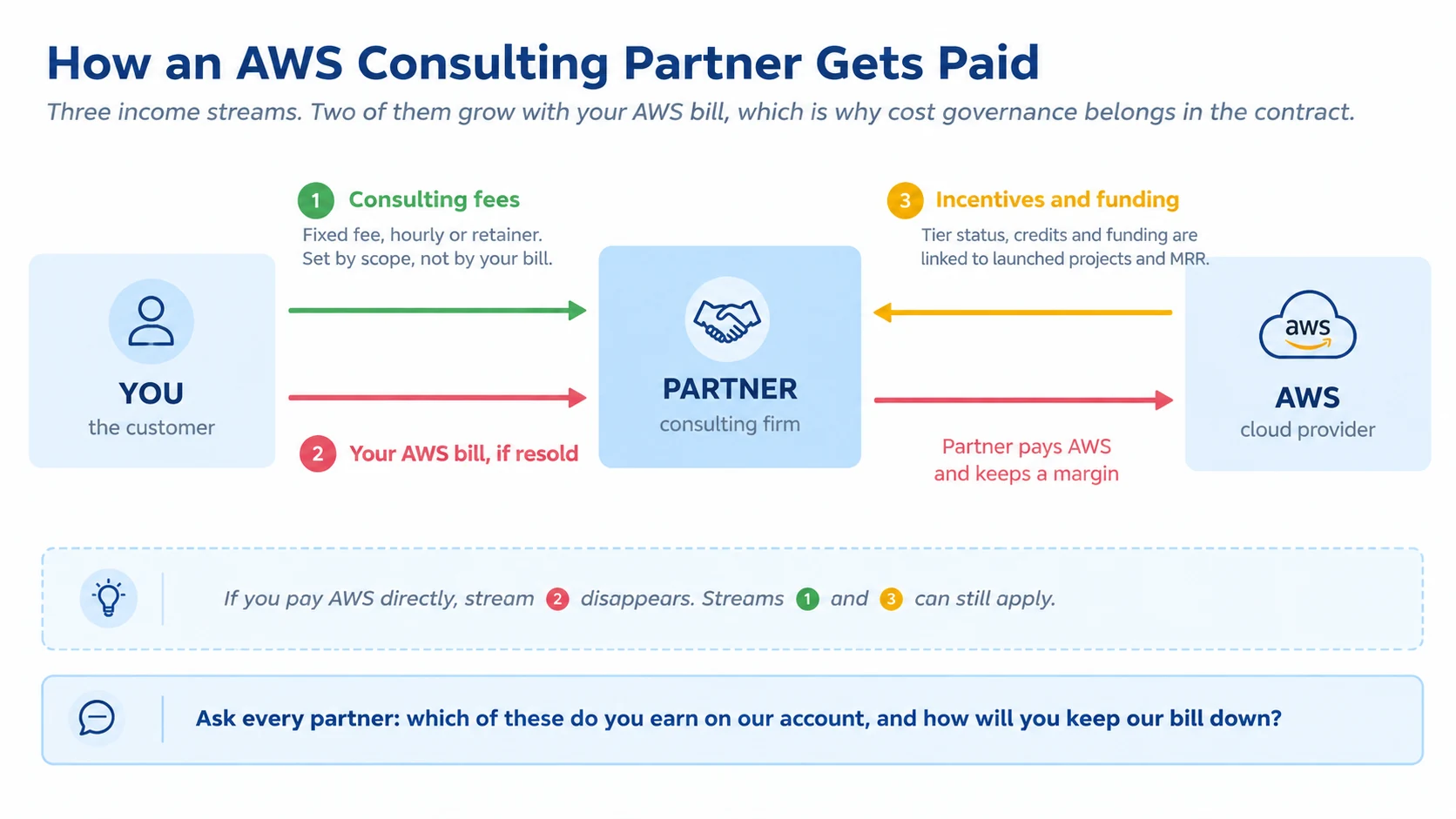
Keep in mind that partners earn more as your AWS spend grows, through resale margins and AWS incentives. That does not make them dishonest. It does mean cost governance should be in the contract, not left to goodwill. For the full list, read 12 red flags when hiring an AWS partner.
The Case Study Checklist
Case studies are the strongest evidence a partner has, which is why they deserve the most scrutiny. A useful case study answers six questions:
| Check | What to look for |
|---|---|
| Similar starting point | Same workload type, similar size, similar industry or compliance needs |
| Specific scope | What was built or moved, in numbers |
| Measured outcome | Cost, performance, or time results with a before and after |
| Timeline | How long it took against the original plan |
| What went wrong | Honest case studies mention a problem and how it was solved |
| A reference you can call | A client contact willing to talk, ideally without the partner on the call |
If a case study has no numbers, treat it as a brochure. Our guide on how to read and demand real results from a partner’s case studies goes deeper.
The AWS Consulting Partner Scorecard
Use this to compare two to four shortlisted partners on the same terms.
| Criterion | Weight | What earns a 5 |
|---|---|---|
| Case studies like your project | 25 | Two or more close matches with numbers and a reference |
| The named team and their certifications | 15 | Named engineers with AWS certifications relevant to your work |
| Validated specializations for this work | 15 | Matching specialization visible on Partner Solutions Finder |
| Cost governance from day one | 10 | Cost forecast, tagging and budget alerts in the plan |
| Security and account access practice | 10 | Least-privilege access, logging, clear security ownership |
| Delivery model, time zone and communication | 10 | Overlapping hours, named contact, regular reporting |
| Pricing clarity and change-request terms | 10 | Written assumptions and a published change rate |
| Knowledge transfer and exit plan | 5 | Runbooks, diagrams and a handover period in the contract |
How to score: rate each partner 0 to 5 on each row, divide by 5 and multiply by the weight. Add the rows for a total out of 100. Under 60 means keep looking, and a weak case-study score should outweigh a strong badge score.
A downloadable version of this scorecard is available from our team on request.
Run a Paid Pilot Before a Long Contract
For any project over a few months, buy a small piece first. A focused pilot of 4 to 8 weeks shows you how a partner works far better than a pitch does.
- Pick a narrow scope: An architecture review, one workload migration, a CI/CD pipeline, or a cost audit.
- Set three measurable success criteria: For example, deployment time, monthly cost, or a passed security review.
- Require real deliverables: Architecture diagrams, runbooks, a cost forecast, and a written retrospective.
- Judge the working style: Did they flag problems early? Did your team learn anything?
Good starting pilots include an AWS landing zone and multi-account setup, a review against the AWS Well-Architected Framework, or a cost audit from our AWS cost optimization guide. Teams with delivery pain often start with DevOps on AWS.
Where DianApps Fits (and Where It Does Not)
DianApps, a mobile and AI app development company, is an AWS Select Tier Partner. Our team holds AWS Certified Solutions Architect – Associate, AWS Certified Developer – Associate, AWS Certified AI Practitioner, and AWS Certified Cloud Practitioner certifications.
We are a good fit when you are building or scaling an application on AWS: mobile and web backends, SaaS products, AI features, DevOps pipelines, and cost reviews, delivered by the same team that builds the product.
We are not the right fit for every project. As a Select Tier partner, we cannot yet hold AWS Competencies, so we cannot unlock competency-gated programs such as enhanced MAP benefits. If you are planning a large, MAP-funded data center migration, an Advanced or Premier partner with the Migration and Modernization Competency is the better choice, and we will say so.
For the full list of what we offer, see our AWS consulting services. When your environment is live, AWS managed services, AWS cost optimization services, and AWS DevOps services cover what comes next.
Choosing Well Starts With the Right Questions
The right AWS consulting partner is the one whose evidence matches your project. Badges come second. Define the job, check claims on Partner Solutions Finder, compare like-for-like pricing, score each partner against the same criteria, and buy a pilot before a long contract.
If you want a second opinion on your shortlist, or a team that builds and runs applications on AWS, we are happy to talk.
Planning an AWS project in 2026?
Share your goals and timeline. We will scope it honestly, tell you what it should cost, and whether we are the right AWS consulting partner for it.
 0 comments










Your email address will not be published. Required fields are marked *