













 0 comments





Key Takeaways:
- The right logistics app development company should understand fleet operations, shipment tracking, dispatch workflows and supply chain integrations.
- DianApps, ScienceSoft, Intellias, ELEKS and LeewayHertz are among the companies to consider for different logistics software requirements.
- Essential logistics app features include GPS tracking, route optimization, driver management, delivery scheduling, proof of delivery and reporting dashboards.
- Evaluate vendors on industry experience, TMS and WMS integrations, scalability, security practices and post-launch support.
- Define your workflows, user roles, required features, existing systems and success metrics before requesting proposals.
- Compare case studies, pricing, source code ownership and maintenance terms before committing to a development partner.
Quick Answer: The top 10 logistics app development companies in 2026 include DianApps, ScienceSoft, Intellias, ELEKS, LeewayHertz, Chetu, Intellectsoft, Itransition, Simform and Mind Studios. The right choice depends on your project scope, logistics expertise, integration needs, budget and scalability requirements. Compare relevant case studies, technical capabilities, pricing and post-launch support before hiring.
Picture a regular Monday morning at a logistics company, where dispatchers are juggling phone calls from drivers, the warehouse team is updating stock on spreadsheets, customers are calling to ask where their shipment is and nobody has one clear view of what is actually happening on the road. Situations like these don’t just slow down operations, they also affect customer trust and brand perception, and this is exactly why logistics businesses are now moving towards custom apps that are bringing drivers, dispatchers, warehouses and customers into one connected system.
The demand is growing quickly too, as the global logistics software market is projected to grow from USD 17.47 billion in 2026 to USD 31.74 billion by 2034, at a CAGR of 7.75%, according to Fortune Business Insights. But with so many logistics app development companies in the market, how do you know which one is really the right partner for your business? Well, let’s break it down. For more details explore our logistics software development guide.
Why the Right Logistics App Development Company Matters
A logistics app is doing a lot more than just showing where a delivery truck is, it is connecting fleet operations, warehouse activity, order management and customer communication into one platform that is running all day, every day. Building something like this reliably is not just about mobile development skills, it is about understanding real-time data, third-party integrations, security and the daily challenges of moving goods from one place to another.
Choosing the right development partner is bringing a number of real advantages for logistics businesses, resulting in:
- Less manual coordination between teams.
- Better shipment visibility for customers and managers.
- Smarter route optimization and delivery scheduling.
- Fewer errors in orders, dispatch and inventory.
- Software that is growing along with your operations.
This is why picking a logistics app development company is a business decision and not just a technical one, as the wrong choice can leave you with an app that looks good but fails in real operating conditions. So, to help you make the right call, this guide is comparing 10 logistics app development companies worth considering in 2026, along with what to look for before you sign and what to prepare on your side before you speak to anyone.
How We Selected These Logistics App Development Companies
This list is bringing together companies that are offering dedicated logistics and transportation software services, along with broader software engineering firms that are capable of handling complex logistics products. Every company was evaluated on the same set of factors, including:
- Experience with fleet, transportation, warehouse or delivery projects.
- Strength in mobile apps, cloud, APIs and modern architecture.
- Ability to integrate with TMS, WMS, ERP, GPS and telematics systems.
- Security practices and scalability for growing transaction volumes.
- A structured development process and long-term support.
Even with this shortlist, the best choice is really depending on your requirements, your budget, your internal team and how complex your logistics workflows are, so it is always worth checking project experience and credentials yourself before hiring anyone.
Logistics App Development Companies Comparison Table
Here is a quick side by side view of all 10 companies, so you can see where each one is fitting best before we go into the details.
| Company | Primary Strength | Best Fit For |
|---|---|---|
| DianApps | Custom logistics apps with AI and cloud | Startups and mid-sized logistics businesses |
| ScienceSoft | Transportation systems and enterprise IT | Complex operations and modernization |
| Intellias | Transportation technology and connected mobility | Large fleets and data-heavy platforms |
| ELEKS | Logistics software and operational data | Connected supply chain workflows |
| LeewayHertz | AI-enabled logistics software | Automation and predictive features |
| Chetu | Transportation and dispatch software | Fleet and transportation operations |
| Intellectsoft | Enterprise digital transformation | Wider business system modernization |
| Itransition | Custom enterprise software | Complex internal workflows |
| Simform | Cloud-native product engineering | Scalable digital platforms |
| Mind Studios | Mobile product development | User-focused logistics apps |
The first six companies on this list are offering clearly defined logistics or transportation services, while the last four are broader engineering partners, so for them it is definitely worth confirming their logistics experience before moving ahead. Now, let’s take a look at each company one by one.
Top 10 Logistics App Development Companies in 2026
1. DianApps
DianApps is a technology company founded in 2017, building custom mobile apps, web platforms and AI-powered products for startups, growing businesses and enterprises across the USA, Australia, the UAE, Europe and India. What is making DianApps stand out as a logistics mobile app development company is that the same team is handling the mobile apps, the admin dashboards, the cloud backend and the AI features, so businesses are not stuck coordinating between multiple vendors for one product.
DianApps’ work is covering the kind of features logistics and delivery businesses are needing every day, from customer apps, partner/driver apps and admin panels to real-time tracking, booking flows, payment integrations and push notifications. One of its recent client projects, for example, included a customer app, a helper/partner app and an admin dashboard with real-time helper tracking, a conversational AI booking flow, scheduling and payment integration, and another included a multi-restaurant ordering and delivery workflow with Stripe Connect and vendor dashboards. On Clutch, DianApps is holding a 4.8 rating from 86 reviews with Premier Verified status, and its listed hourly rate is $25 to $49 with projects starting from $10,000, which is making it a really practical option for businesses that want quality logistics software without enterprise-level pricing.
Key capabilities:
- Custom iOS, Android and cross-platform logistics apps.
- Driver, dispatcher, customer and admin applications.
- Real-time tracking, scheduling and delivery management.
- AI features like smart booking, recommendations and automation.
- Cloud backend on AWS with secure APIs and integrations.
- Ongoing support, maintenance and scaling.
Best suited for: Startups and mid-sized logistics, delivery and on-demand businesses that want one team to design, build and scale a custom logistics app with AI and cloud built in from day one.
Why consider DianApps: DianApps is following a sprint-based agile process, from discovery and UI/UX design through development, testing and deployment, and clients on Clutch are regularly mentioning timely delivery, clear communication and strong project management. Its team also includes AWS-certified professionals and experience with OpenAI and Claude-based AI solutions, which is helping logistics businesses move from manual workflows to smarter, automated operations. You can explore its cloud app development services or hire dedicated developers for your logistics project.
2. ScienceSoft
ScienceSoft is a long-established software engineering and IT services company with a dedicated transportation and logistics practice, working with logistics providers, freight forwarders, carriers, courier companies, digital logistics marketplaces and enterprises running their own transportation. Its services are covering transportation management, warehouse management, operational analytics and fleet solutions, along with consulting, testing, cybersecurity and IT team augmentation.
Key capabilities:
- Transportation and warehouse management systems.
- Operational analytics and demand forecasting.
- Fleet and logistics system integration.
- Cloud, IoT, AI and data engineering.
- Testing, support and modernization.
Best suited for: Enterprises and logistics providers that are needing system integration or modernization of existing operations, where the project is going well beyond a single mobile app.
3. Intellias
Intellias is working on transportation technology, mobility and complex connected systems, with services covering fleet and freight management, location-based services, navigation and data-driven transportation solutions. For logistics businesses, this is meaning much more than just showing vehicles on a map, as connected systems are bringing together location data, routes, asset status and analytics, so that dispatchers and fleet managers are seeing the full network in real time.
Key capabilities:
- Fleet and freight management systems.
- Real-time tracking, ETA estimation and route optimization.
- Location intelligence and navigation.
- Telematics and predictive maintenance.
- Data-driven transportation platforms.
Best suited for: Transportation providers, large fleet operators and businesses building data-heavy or connected mobility platforms.
4. ELEKS
ELEKS is offering logistics software development across transportation, delivery optimization, fleet management, vehicle tracking, warehousing and telematics. Its focus is on connecting front-end apps with back-end operational systems, which is extremely crucial when orders, inventory, carriers, dispatch and delivery confirmations are sitting in separate tools that are not talking to each other.
Key capabilities:
- Transportation management and delivery optimization.
- Fleet management and vehicle tracking.
- Warehouse and inventory workflows.
- Telematics and connected-vehicle solutions.
- Custom software and system integration.
Best suited for: Organisations that are needing tailored logistics software to connect their operations and make better use of their transportation and supply chain data.
5. LeewayHertz
LeewayHertz is providing custom software development and AI engineering, with a dedicated logistics software offering covering route optimization, real-time tracking, inventory management, order processing, warehouse management and predictive analytics. AI in logistics is really working best when it is solving a specific operational problem, like combining past order data with live GPS data for better route planning, or using forecasting models for inventory decisions, and LeewayHertz is a good option to explore when automation is a big part of your roadmap.
Key capabilities:
- AI-enabled logistics and supply chain apps.
- Route optimization and shipment tracking.
- Warehouse and inventory management.
- Predictive analytics and demand forecasting.
- Software integration and modernization.
Best suited for: Businesses exploring AI-assisted logistics workflows or building apps that are mixing traditional software with data-driven features.
6. Chetu
Chetu is developing custom transportation software covering fleet management, dispatching, traffic management, parking, public transportation and supply chain management. This is really useful for businesses that are needing software built around a specific operating model, as a dispatch platform for a regional carrier is needing very different scheduling, mapping and reporting features compared to a public transport system.
Key capabilities:
- Fleet and dispatch management.
- Transportation and supply chain software.
- GPS, GIS and route optimization.
- Vehicle telematics and reporting.
- Custom development and managed IT services.
Best suited for: Transportation businesses that are needing customized dispatch, fleet or operations management software.
7. Intellectsoft
Intellectsoft is offering software engineering and digital transformation services for businesses building or modernizing digital platforms. Its wider engineering skills can be relevant for logistics companies whose projects are touching multiple business systems, customer apps and enterprise workflows, but it is worth asking for examples involving dispatch, shipment visibility, warehouse operations or logistics integrations before shortlisting.
Areas to evaluate:
- Custom enterprise app development.
- Mobile and web product engineering.
- Legacy system modernization.
- Cloud architecture and integration.
- Long-term development support.
Best suited for: Businesses looking for a broader engineering partner for a logistics modernization project.
8. Itransition
Itransition is providing software development and IT consulting across business applications and enterprise systems. Logistics apps are usually depending on several systems working together, as one order in a platform may need to trigger warehouse activity, update shipment status, notify the customer and send data to the ERP, and a development partner is needing to understand all of these dependencies before recommending an architecture.
Areas to evaluate:
- Custom business software.
- Enterprise application integration.
- Web and mobile development.
- Application modernization.
- Ongoing maintenance.
Best suited for: Companies with complex internal systems that are needing connected business workflows, after confirming the team’s logistics-specific experience.
9. Simform
Simform is offering digital product engineering and cloud development services, which can help when a logistics platform is handling growing users, frequent data updates, mobile access and multiple external services. A shipment visibility platform, for example, may need to collect location updates from different carriers, process status changes and show the same accurate information on both web dashboards and mobile apps.
Areas to evaluate:
- Digital product engineering.
- Cloud-native app development.
- API and system integration.
- Data engineering and analytics.
- Modernization and ongoing support.
Best suited for: Businesses prioritising scalable cloud architecture for a logistics product, after reviewing relevant logistics examples and integration scale.
10. Mind Studios
Mind Studios is developing custom mobile and web products, and its product development approach can be useful where usability and mobile workflow design are top priorities. Driver apps and customer apps are serving very different needs, as drivers are wanting quick status updates, navigation, proof of delivery and an app that is working well even with poor connectivity, while customers are caring more about tracking, notifications and delivery scheduling.
Areas to evaluate:
- Custom mobile and web apps.
- Product discovery and UX/UI design.
- Development and testing.
- Feature planning and iteration.
- Ongoing development support.
Best suited for: Businesses launching a new logistics product where user experience is the main focus, after checking experience with similar logistics workflows.
Have a Logistics App Idea in Mind?
Our team can help you define the right features, integrations and development roadmap for your business.
What to Look for in a Logistics App Development Company
A clean interface is just one small part of a good logistics app, as the software is also needing to work in real operating conditions, share accurate data with other systems and stay reliable as the business is growing. So, let’s take a look at what really matters.
1. Relevant Industry Experience
Check whether the team has built apps for workflows similar to yours, as fleet tracking, last-mile delivery, freight management, warehouse operations and logistics marketplaces are each coming with different requirements. Ask for case studies that are explaining the business problem, the solution, the systems involved and the actual results, because a general app portfolio is not proving logistics expertise.
2. Integration With Existing Systems
Your logistics app may need to share data with a TMS, WMS, ERP, CRM, payment gateway, mapping service, GPS device or telematics platform. Discuss integration methods, API limits, data syncing, error handling and what is happening when an external system goes down, because these details are often deciding whether the app is improving your operations or just adding one more disconnected tool.
3. Architecture and Scalability
A logistics app may start with a small fleet and grow into multiple locations, carriers and customer accounts, and the architecture should handle this growth without needing an expensive rebuild. Ask the team how they are planning for performance, monitoring, background processing, data storage and uptime.
4. Security and Data Protection
Logistics platforms are holding customer details, delivery addresses, employee information, business records and vehicle data, so security is extremely crucial. Look at authentication, role-based access, encryption, audit logs, secure APIs, backups and incident response, and if a vendor is claiming certifications like ISO 27001 or SOC 2, ask for the current certificate and what it is actually covering.
5. AI, IoT and Real-Time Data Capabilities
AI and IoT are helping with route planning, demand forecasting, predictive maintenance and shipment visibility, but only when the data is reliable and the purpose is clear. Ask how the team will measure results, deal with delayed or inaccurate data and keep a human involved when decisions are affecting costs, safety or delivery promises.
6. Ownership, Support and Commercial Terms
Before signing, get clarity on who owns the source code, designs, documentation and custom components, along with terms for third-party libraries, cloud services and handover. Also confirm who is monitoring the app after launch, how bugs are handled, which service levels apply and how future changes will be priced.
Logistics App Development Checklist: What to Define Before Hiring
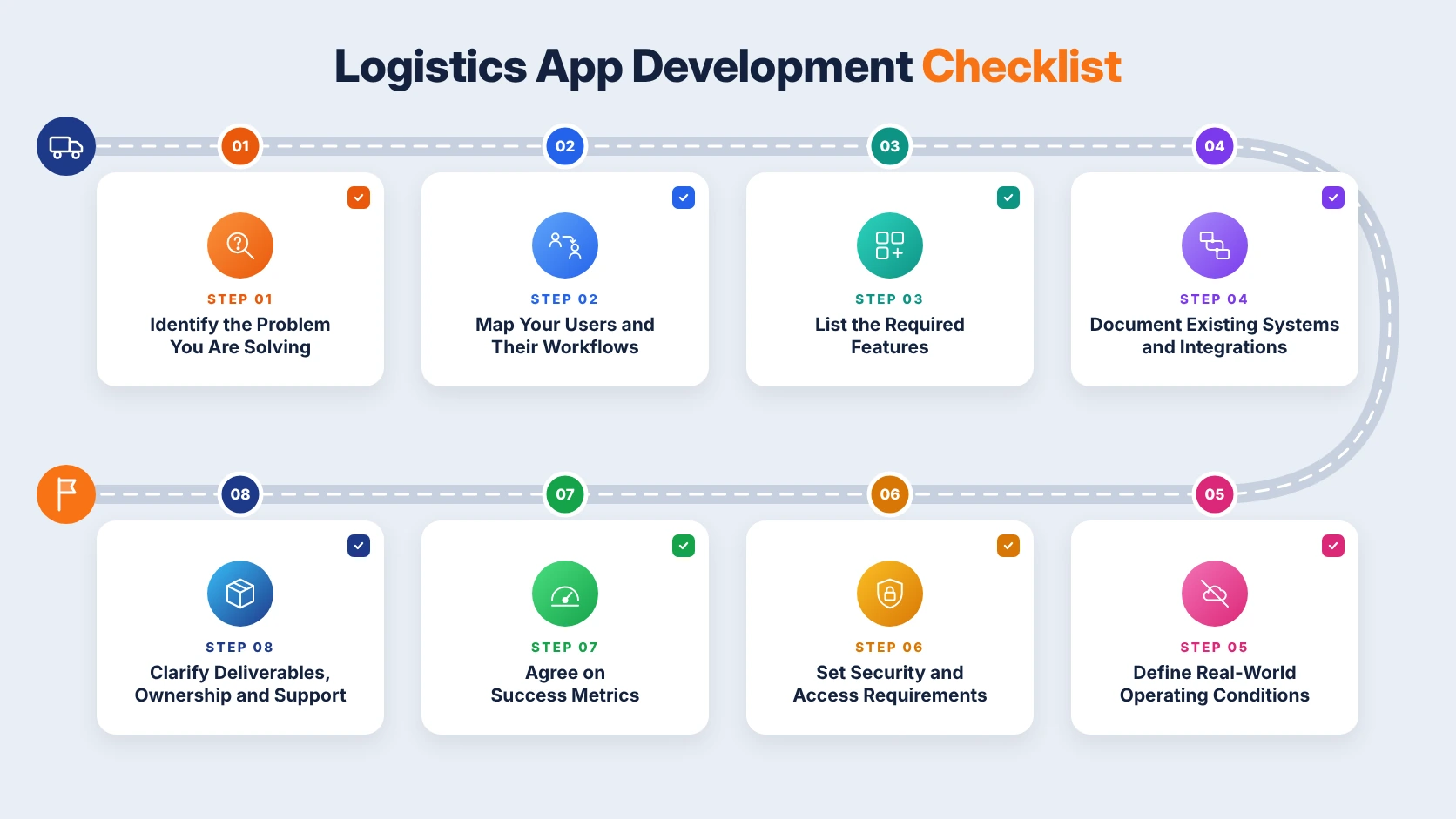
Shortlisting a logistics app development company is becoming much easier when you are already clear about what your app needs to do, as a good project brief is helping vendors understand your operations, suggest the right technical approach and estimate costs based on real requirements instead of guesses. Before speaking to any development partner, it is worth working through these eight areas.
1. Identify the Problem You Are Solving
Start with the real operational issue, whether dispatchers are spending too much time assigning drivers, customers are having no visibility of their shipments, warehouse teams are stuck with manual updates or deliveries are being managed across disconnected tools. Once the problem is clear, the features are naturally following from it.
2. Map Your Users and Their Workflows
List everyone who will use the app, such as drivers, dispatchers, fleet managers, warehouse staff, administrators and customers, and outline what each of them needs to do. A driver may need to accept jobs and upload proof of delivery, while a dispatcher may need to monitor shipments and reassign jobs, and mapping these workflows early is helping avoid gaps in the first version.
3. List the Required Features
Separate the must-have launch features from the ones that can come later, as your first version may include:
- GPS tracking and shipment status updates.
- Driver assignment and dispatch management.
- Route planning and delivery scheduling.
- Order management and proof of delivery.
- Push notifications and customer communication.
- Fleet reports and operational dashboards.
Not every logistics app is needing every feature, so it is always better to prioritise the ones that are directly connected to your business goals.
4. Document Existing Systems and Integrations
Note down all the software and devices your app will need to work with, like a TMS, WMS, ERP, CRM, payment gateways, mapping services, GPS devices and telematics platforms. Also write down what data needs to move between them, how often it needs to update and which system is the main source of truth, as this is giving development teams a much clearer picture of the integration work involved.
5. Define Real-World Operating Conditions
Logistics software is working outside the office, so think about poor network coverage, delayed location updates, device limitations, changing schedules and unexpected route disruptions. If drivers are needing to record information offline, decide which actions must keep working without a connection and how data should sync later, as sorting this out early is saving costly changes down the line.
6. Set Security and Access Requirements
Decide who can access shipment details, customer records, location data and admin controls, and identify any contractual, regulatory or internal security requirements. Ask vendors how they are handling authentication, permissions, encryption, audit logs, backups and incident response, and request evidence for any compliance claims that matter to you.
7. Agree on Success Metrics
Decide how you will measure the app’s success after launch, such as:
- Time spent assigning deliveries.
- On-time delivery performance.
- Accuracy of shipment status updates.
- Amount of manual data entry.
- Fleet utilization.
- Customer queries about delivery status.
Setting a baseline before development is starting is helping you see whether the app is actually improving operations, instead of calling it a success just because it went live.
8. Clarify Deliverables, Ownership and Support
Confirm what the vendor will deliver at each stage, how scope changes will be handled and who is responsible for testing and deployment. Also clarify source code ownership, documentation, third-party licences, maintenance and how the product can be handed over to an internal team later.
A clear project brief is not only helping you compare logistics app development companies on the same terms, it is also making early conversations more productive and bringing integration challenges to the surface before they are turning into expensive surprises.
Why Choose DianApps for Logistics App Development?
For logistics, delivery and on-demand businesses, the biggest challenge is usually finding a partner that is understanding both the operational side and the technology side, without charging enterprise-level rates. DianApps is bringing a few clear advantages here, resulting in:
- One team for driver apps, customer apps, admin dashboards and cloud backend.
- Real-time tracking, scheduling, payments and AI features under one roof.
- AWS-certified professionals for secure and scalable cloud architecture.
- Experience with OpenAI and Claude-based AI solutions.
- A 4.8 Clutch rating across 86 reviews.
- Transparent pricing from $25 to $49 per hour.
- Support across US, Australian, UAE and Indian time zones.
This is why DianApps is a practical choice for businesses that want to launch or modernize a logistics app quickly and affordably, with the flexibility to add AI, automation and integrations as operations are growing. Before choosing any partner, though, it is always worth discussing your requirements in detail and asking for a proposed architecture, a phased delivery plan, relevant case studies, a clear cost breakdown and written terms on code ownership and post-launch support.
Ready to Build a Logistics App That Works on the Road?
From driver apps to real-time tracking and dispatch dashboards, we build custom logistics software that cuts manual work and gives you full visibility, with one team from idea to launch.
Final Thoughts
Logistics software is needing to connect people, vehicles, orders and business systems without making daily operations more complicated, and choosing the right logistics app development company is really starting with understanding your own workflows, deciding which features matter most and checking whether a partner has the technical and industry experience to deliver them.
Enterprise firms like ScienceSoft, Intellias and ELEKS are bringing deep transportation and data expertise, specialists like LeewayHertz and Chetu are strong for AI and dispatch solutions, and broader engineering partners like Simform and Mind Studios are worth evaluating for cloud and user-focused products, while DianApps is giving startups and mid-sized logistics businesses a way to get custom apps, AI and cloud from one team at an accessible price.
So compare every vendor on real evidence rather than promises, because the right partner is not just building your app, it is shaping how smoothly your entire operation is running from beginning until completion.
 0 comments








Your email address will not be published. Required fields are marked *