













 0 comments
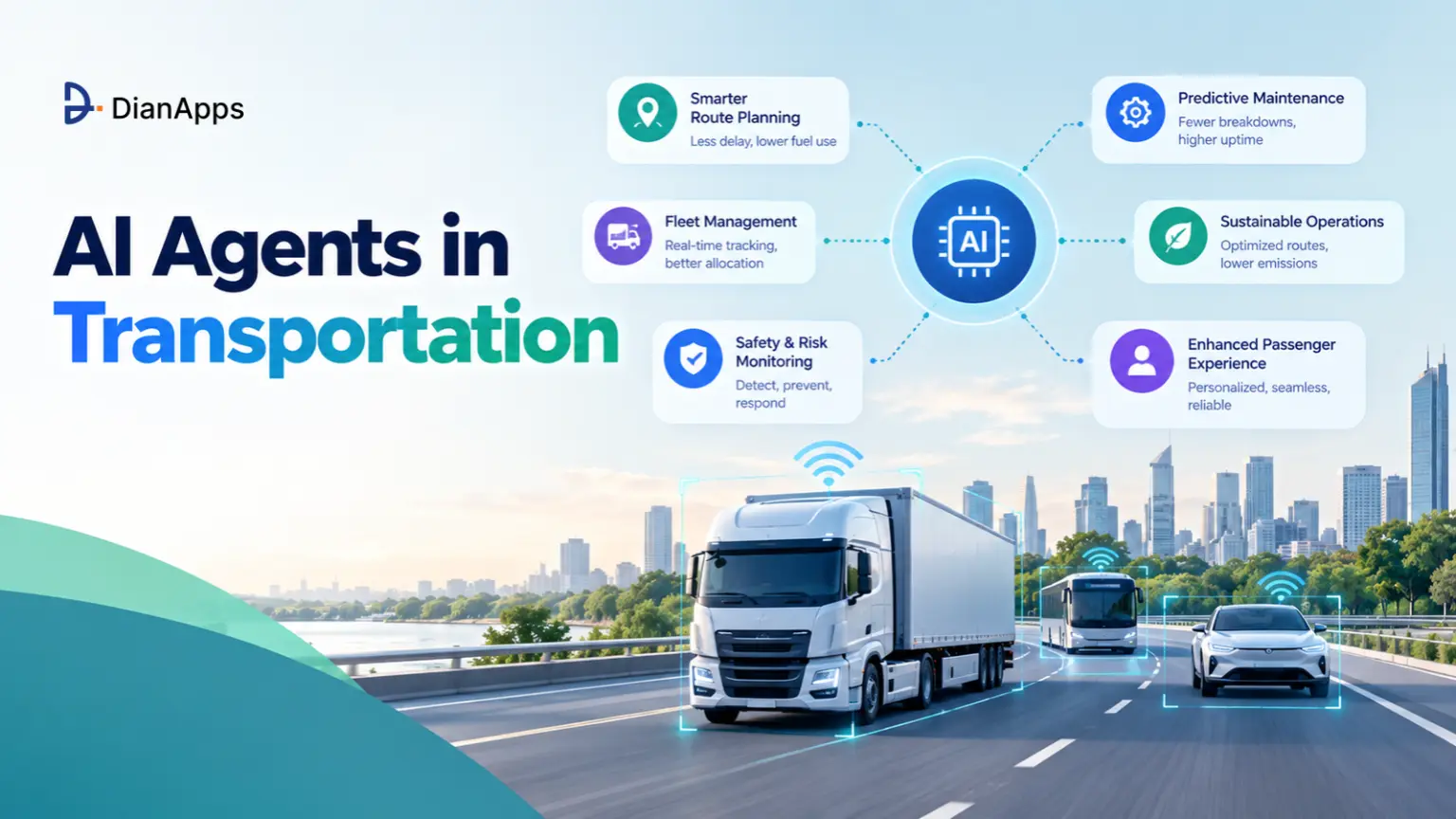





Key Takeaways:
- Rivian CEO RJ Scaringe said at TechCrunch Disrupt (October 2026) that Rivian vehicles will be running third-party AI agents from companies like Anthropic, with more details expected at its December “AI & Autonomy Day”.
- Agentic AI in transportation and smart mobility is valued at $6.3 billion in 2026 and is projected to reach $63.2 billion by 2034, a 33.4% CAGR.
- Gartner is forecasting supply chain software with agentic AI growing from under $2 billion in 2025 to $53 billion in spend by 2030.
- 97% of logistics executives are ranking AI as a strategic priority, yet only 13% say it is delivering measurable financial impact (BCG AI in Logistics Executive Survey, 2026).
- The operators seeing real ROI are linking agents across a whole workflow, not stacking standalone tools one on top of another.
Quick Answer: AI agents in transportation are software systems that are reading live data from vehicles, fleets and freight networks, deciding what to do and then acting on it, such as rebooking a carrier, scheduling maintenance or answering a driver by voice. The highest-ROI uses today are exception management, dispatch, freight procurement and predictive maintenance, and teams sitting on legacy TMS or telematics stacks are usually getting there faster with the help of specialist AI agent development services.
Think about the last time a shipment went quiet, the carrier was not picking up, the customer was calling every hour asking “where is my delivery?” and someone on your team was jumping between three different screens and a spreadsheet just to piece together what had happened. For many years, transportation and logistics teams have been relying on people to catch each and every one of these problems by hand, and as volumes are growing, that approach is simply not keeping up.
This is exactly the gap AI agents in transportation are stepping in to fill, and this week one announcement is showing just how far that is going. Rivian is preparing its electric vehicles to run AI agents built by frontier labs, so the car is becoming another place where your personal assistant lives (TechCrunch, 2026).
But is this only about cars? Well, not really. The bigger story is that agents are now spreading across every layer of transportation, from the driver’s seat to the dispatch desk to the freight network, and fleet platforms like Samsara and visibility networks like project44 have already shipped their own agent builders this year.
In this guide, we are breaking down what Rivian announced, the 9 use cases where agentic AI in transportation is already paying off, the guardrails that are keeping it safe and how you can build your own, so let’s take a look.
What Did Rivian Announce About AI Agents in Its Cars?
Rivian announced that its vehicles will eventually be running AI agents made by outside companies such as Anthropic, extending the voice assistant it has already rolled out to drivers. CEO RJ Scaringe did not share a launch date, and the company is pointing to its December “AI & Autonomy Day” for the full details (TechCrunch, 2026).
For anyone building AI agents in transportation, there are a few things making this announcement really worth paying attention to, and the reasons are not hard to see:
- An in-house agentic framework: Rivian says its own framework is working out what a person wants when they speak to the car, then routing that request to the right part of the vehicle software.
- Edge plus cloud routing: Scaringe described it like a traffic light, where simple requests are handled by a local model on the vehicle while complex ones are going up to the cloud, where different models are being used.
- External app access: As of May 2026, the agent could already reach external apps like Google Calendar, and frontier lab agents are the next step.
- Shared context across devices: A driver could ask for ventilated seats and then continue a meal-planning conversation they started on another device the day before.
- Hard limits on control: Scaringe was very clear that vehicle-level controls such as braking and steering are not going to an agent. In his words, “anything that’s vehicle-level controls are not being handed to an agent.”
And Rivian is not alone in this either, TechCrunch notes that Tesla added a feature earlier this year that is letting drivers talk to xAI’s Grok chatbot right inside the car (TechCrunch, 2026).
Ready to Put AI Agents to Work in Your Fleet or Freight Operations?
Whether you are managing exceptions, dispatch or driver communication, our team is helping transportation businesses.
Why It Matters For Businesses?
Rivian is building its software stack from the ground up rather than leaning on Apple CarPlay or Android Auto, and that is exactly why it is able to plug agents in so easily. Transportation companies that own their software and data layers are the ones adopting agents quickly, while everyone else is waiting on vendor roadmaps, and this is a lesson extremely crucial for any fleet operator, carrier or shipper planning its next move.
So now that we know what Rivian is doing, the next question is, what exactly counts as an AI agent in transportation? Let’s break it down.
What Are AI Agents in Transportation?
AI agents in transportation are software systems that are perceiving live operational data, reasoning about it and taking action across vehicles, fleets and freight workflows with very limited human prompting. Unlike dashboards that are only reporting what happened, an agent can rebook a shipment, open a work order or message a driver and then report back on what it did.
Trimble’s 2026 Transportation Pulse Report is describing agentic AI as autonomous software that monitors data, makes decisions and executes tasks within defined boundaries (Trimble, 2025), and it is those boundaries that are separating a safe agent from a risky one.
A production-grade transportation agent is usually combining four building blocks, resulting in:
- Data connectors: Live feeds from telematics, GPS, TMS (Transportation Management System), WMS (Warehouse Management System), ERP, weather and carrier APIs.
- Reasoning models: Large language models such as Claude, GPT-4o or Gemini for language tasks, plus optimization and ML models for routing, pricing and ETA prediction.
- Action tools: Permissioned write access to book loads, send emails, place calls, create work orders or update customer portals.
- Guardrails: Approval thresholds, audit logs and human-in-the-loop escalation for anything safety-critical or high-value.
Each of these blocks needs to be designed together, because an agent with great models but poor data connectors is still going to make poor decisions. And when it comes to grounding those models in your own lanes, rates and SOPs, choosing the right approach is really important, our guide on RAG vs fine-tuning vs prompt engineering is explaining which one fits which situation.
How Agents Differ From Automation and Chatbots?
This is where a lot of buyers are getting confused, as automation, chatbots and agents are often being sold under the same “AI” label, so the image below is separating the three approaches.
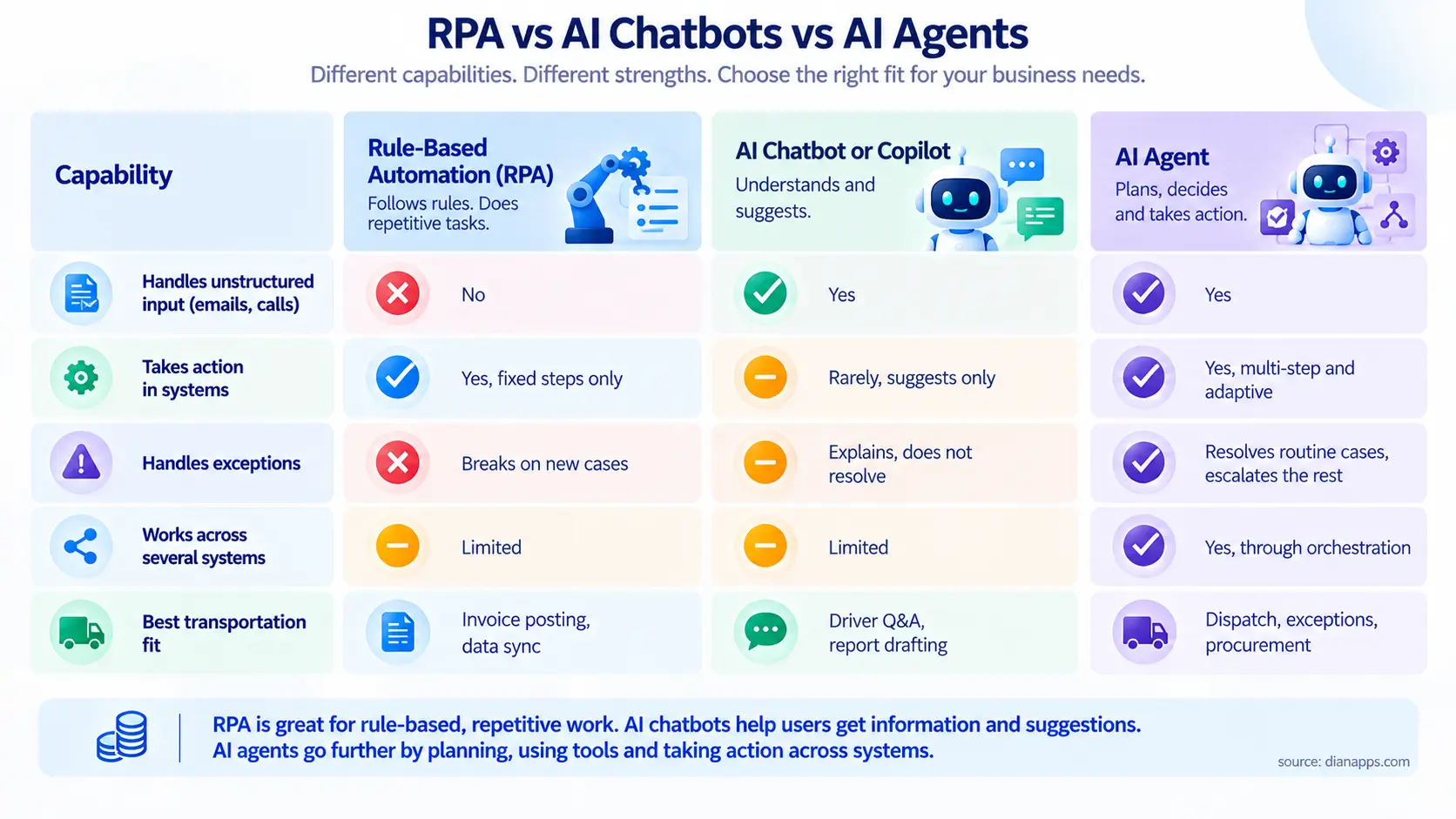
Takeaway: If the work is fixed and structured, RPA is cheaper and our guide to RPA use cases is covering those in detail. If the work involves judgment across several systems, an agent is the right tool, and if you are still unsure where the line sits, our breakdown of AI agent vs chatbot is making it much clearer.
With the definition out of the way, let’s take a look at where these agents are actually creating value today.
Not Sure Whether to Build or Buy Your Transportation Agent?
Our AI consultants are mapping your workflows, systems and data to recommend the right path.
9 Use Cases for AI Agents in Transportation and Logistics
The highest-value AI agents for logistics and transportation today are handling frequent, time-sensitive decisions that humans are struggling to sustain at scale, such as exception management, dispatch, carrier procurement and maintenance scheduling. Safety-critical vehicle control, on the other hand, is still staying with humans and certified driving systems.
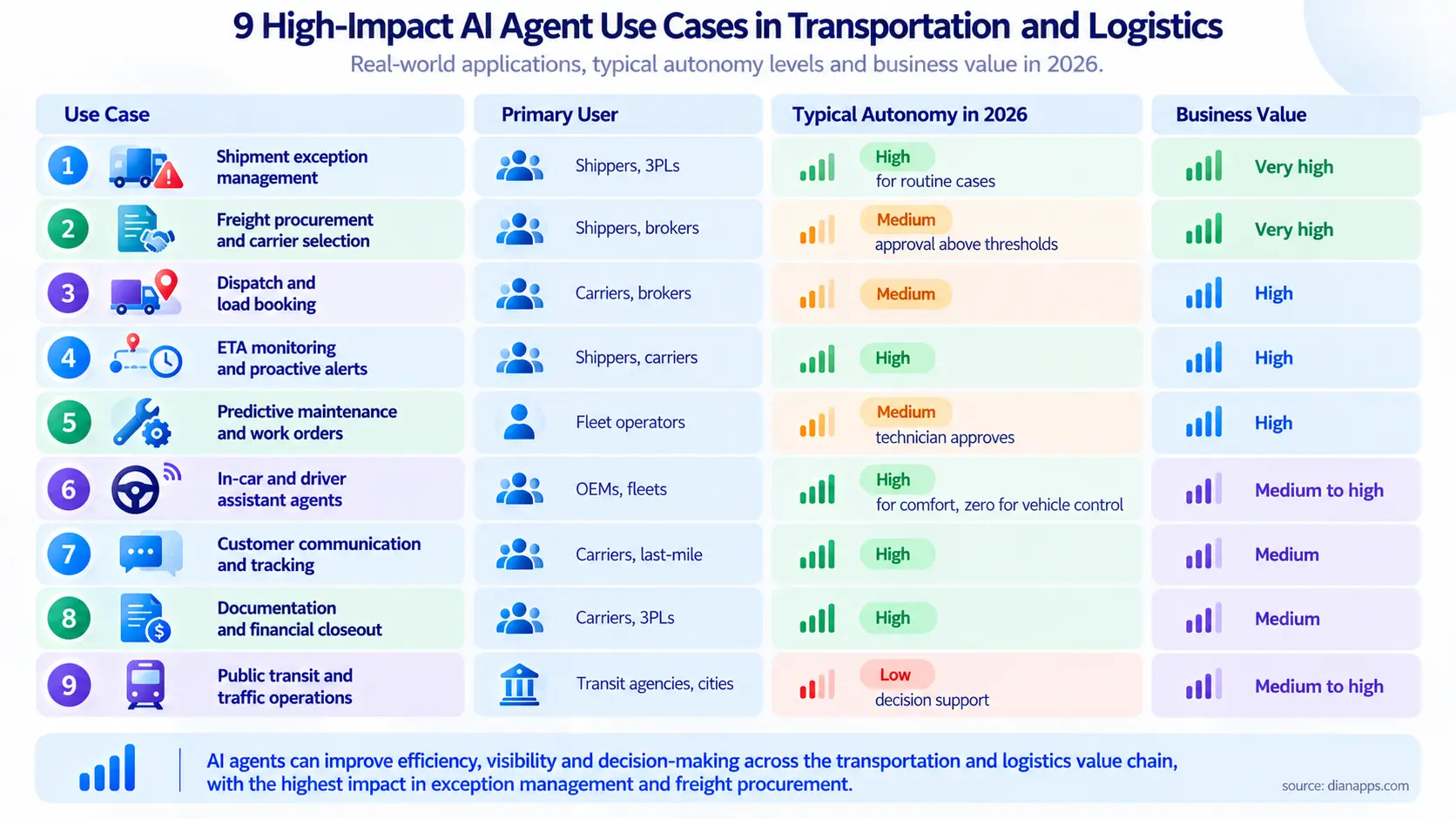
Autonomy levels are indicative planning guides, not industry standards. Actual autonomy should follow your risk and regulatory profile.
Takeaway: Start where autonomy is already high and value is high, which is exceptions and ETA alerts, then move into procurement and dispatch once trust is being built across the team.
1. Shipment Exception Management
Exception management agents are watching each and every shipment for late pickups, missed milestones, dwell time and silent carriers, then contacting the carrier, updating the ETA and notifying the customer without a human ever starting the task. Only the unusual cases reach the operations desk, and when they do, the context is already assembled, so the team is not wasting time digging for information.
Project44’s Exception Management Agent is now resolving routine cases autonomously, and the company is advising teams to start with one mode, one exception type and one workflow (project44, 2026).
2. Freight Procurement and Carrier Selection
Procurement agents are benchmarking contracted rates against live market data, selecting carriers and flowing negotiated rates straight into execution. project44 reports its agents are delivering a 4% reduction in freight spend and up to 75% faster sourcing cycles (project44, 2026), which for a high-volume shipper is definitely adding up to serious savings over a year.
3. AI Dispatch Agents and Load Booking
AI dispatch agents are searching load boards, emailing and calling brokers, negotiating within rate limits set by the carrier and booking freight. They are also handling check calls, those repetitive “where is my truck?” requests that are eating up so much of a dispatcher’s day, and this is where AI voice agents for business are really proving their worth.
Dispatch is where agents are saving the most hours per person, but rate negotiation is still the area where carriers are keeping a human on final approval.
4. ETA Monitoring and Proactive Alerts
ETA agents are combining GPS, traffic, weather and port congestion data to predict delays early and alert the right people before the customer even notices. In Trimble’s survey, real-time ETA monitoring is the top agentic AI opportunity for shippers at 52%, while ETA calculation and alerting is leading for carriers at 59% (Trimble, 2025).
5. Predictive Maintenance and Work Orders
AI agents in fleet management are turning a fault code or driver defect report into a finished action, checking parts availability, proposing a shop slot and drafting the work order. Samsara’s Agent Studio, launched in June 2026, is offering more than 15 pre-built agent templates across safety and maintenance (Samsara, 2026), and this is helping fleets reduce unplanned downtime instead of reacting after a truck is already off the road.
6. In-Car and Driver Assistant Agents
This is the category Rivian has just pushed into the spotlight. In-car AI agents are handling cabin settings, navigation, messages and calendar tasks by voice, while fleet versions are giving drivers hands-free answers about routes, delivery instructions and compliance rules.
The design rule here is simple, comfort and information can be agentic, driving controls cannot.
7. Customer Communication and Tracking
Customer-facing agents are answering tracking questions, sending proactive delay notices and rebooking delivery windows. This is becoming extremely urgent because customers are deploying their own agents too, and Gartner is forecasting that AI agents will intermediate 90% of B2B buying by 2028 (Gartner, as cited by BCG, 2026), which means your agent may soon be talking to their agent.
8. Documentation and Financial Closeout
Once a load is delivered, closeout agents are matching bills of lading to rate confirmations, chasing missing proof of delivery and preparing invoices. Pairing these agents with OCR (Optical Character Recognition) is turning a days-long admin tail into same-day billing, and this is improving cash flow while also freeing up the finance team for more valuable work.
9. Public Transit and Traffic Operations
Transit agencies and cities are using agents to let planners query traffic and ridership data in plain language, analyse congestion and support signal retiming studies. Here, agents are acting mostly as decision support, because public safety and accountability rules are limiting how much autonomy they can be given.
These use cases are not just theory either, a number of companies are already shipping them in production, let’s take a look at who they are.
Who Is Deploying Agentic AI in Transportation in 2026?
Agentic AI in transportation has moved from pilots to shipping products in 2026, with automakers, fleet platforms and freight networks all launching agent capabilities. The common thread among all of them is that each company is building on years of proprietary operational data, resulting in:
- Rivian: Announced at TechCrunch Disrupt in October 2026 that its vehicles will run third-party AI agents, building on an in-house agentic framework (TechCrunch, 2026).
- Tesla: Added in-car access to xAI’s Grok chatbot earlier in 2026 (TechCrunch, 2026).
- Samsara: Launched Agent Studio on June 24, 2026, built on 25 trillion data points the company captured across its network in 2025 alone (Samsara, 2026).
- project44: Launched Autopilot, a no-code platform for deploying AI agents, in May 2026, citing a 70% reduction in manual coordination and up to 40% lower disruption-related costs (project44, 2026).
- Flexport: Broke ocean freight forwarding into more than 100 discrete steps and is running 10 dedicated agents, with ocean operations now over 70% automated and cost-to-serve on track to fall by around 30% (BCG, 2026).
What Flexport is proving is that agents are compounding in value when they are deployed at the task level across a whole workflow, not bolted onto one single step and left there.
Why Are Most Transportation AI Programs Not Paying Off Yet?
With so much investment going in, you would expect the returns to be just as impressive, but the reality is quite different. Most transportation and logistics AI programs are not paying off because they are being built as isolated point solutions on top of fragmented data, with too little investment in process change and people, and BCG found that only 13% of logistics executives are seeing measurable financial impact from AI (BCG, 2026).
BCG’s 2026 survey is pointing to three root causes behind this gap:
- Fragmented data: Siloed legacy systems that were never designed to share information are starving agents of context.
- Isolated tools: 80% of executives named a single standalone tool as their most impactful AI solution, so the value is staying local (BCG, 2026).
- The human gap: 37% cited a lack of internal AI expertise as their primary barrier to adoption, ahead of legacy systems and budget (BCG, 2026).
Trimble’s research is confirming the data problem as well, with shippers and carriers both naming inconsistent data as their biggest obstacle to AI success (Trimble, 2025). And if the expertise gap is what is holding your team back, our guide on how to hire AI agent developers is walking you through what skills to look for and how to evaluate them.
So what is the fix? Well, it is mostly about sequencing, connecting a small bundle of agents inside one workflow, proving the compounding effect and then expanding from there. BCG estimates a full end-to-end AI transformation could lift logistics EBITDA margins by roughly 5 percentage points, which is about $250 billion in added industry profit each year (BCG, 2026).
But getting value out of agents is only one part of the picture, keeping them safe is just as important, so let’s break that down next.
How Do You Keep AI Agents Safe in Transportation?
You keep transportation agents safe by fencing off safety-critical controls, setting approval thresholds for high-value actions and logging each and every decision for audit. Rivian’s rule, that braking and steering never go to an agent, is a really useful template for every transportation company to follow.
Before any agent goes live, these are the five guardrails you should be putting in place:
- Hard control boundaries: Agents can request, recommend and communicate, but vehicle motion, safety systems and regulated driver decisions stay with certified systems and people.
- Value thresholds: Auto-approve a carrier rebook under a set cost and route anything above it to a human.
- Edge and cloud split: Run fast, private tasks on-device or on-premise and send only what needs heavier reasoning to the cloud, just as Rivian is doing.
- Full audit trails: Every agent action should be logged with its inputs, the model used and the outcome, for disputes and regulators.
- Human-in-the-loop by default: Two-thirds of shippers and more than half of carriers still see AI’s main role as augmenting people rather than replacing them (Trimble, 2025), so design for collaboration first.
This is why governance cannot be an afterthought in transportation, a single wrong action can affect a customer relationship, a driver’s safety or your compliance record. For a deeper look at permissions, monitoring and policies, our guide on AI agent security and governance is covering everything you need to set up.
What Are Transportation Teams Actually Asking About AI Agents?
Conversations across freight and fleet communities are revealing the same few concerns again and again, and they are worth addressing honestly. Here is what operators are asking, paraphrased, along with our answers.
“Will brokers and carriers actually talk to an AI agent?”
Some will not, Freight voice-agent providers are openly admitting that a share of brokers are hanging up once they detect an AI voice. Email and load-board agents are meeting much less resistance, so many carriers are starting there and keeping voice agents for check calls.
“What happens when an agent gets it wrong in production?”
A recurring thread in a freight brokerage community described agentic tools being deployed too early into high-stakes flows, causing outages and customer impact. The lesson here is not to avoid agents, it is to start in a narrow workflow with approval gates and expand only after accuracy is proven, and our guide on how to test and evaluate AI agents is showing you how to do exactly that.
“Can an agent handle disputes, detention or damaged freight?”
Not on its own yet. Even vendors building dispatch agents are saying these cases need human judgment. A well-built agent should be gathering the evidence and handing it to a person, not settling the dispute itself.
Once these concerns are clear, the next big decision most teams are facing is whether to build their own agent or buy one, so let’s take a look.
Should You Build or Buy AI Agents for Transportation?
Buying an off-the-shelf agent makes sense when your workflow is living inside one platform, such as your telematics or visibility provider, and the use case is fairly standard. Building a custom agent makes more sense when the workflow is spanning several systems, using proprietary pricing or routing logic or needing to run under strict data controls.
Platform agents from Samsara or project44 are giving you a fast start if you are already using those tools. Custom AI agent development, on the other hand, is the better choice when you need to:
- Connect legacy systems: Link an older TMS, a custom ERP and carrier portals that no prebuilt connector reaches.
- Protect differentiating logic: Keep proprietary pricing, lane strategy or service rules private and improvable.
- Own the in-vehicle or driver experience: Build branded driver apps or in-cab assistants that match your operations, the way Rivian owns its stack.
- Control data residency: Run agents inside your own cloud for customer, driver and location data.
For a deeper look at costs, timelines and trade-offs, read our guide on custom AI agent development vs off-the-shelf agents.
A 5-Step Plan to Launch Your First Transportation Agent
Once you have decided on the approach, launching your first agent is becoming much simpler when you are following a clear sequence:
- Step 1, pick one workflow: Choose a high-frequency, time-sensitive task such as late-shipment exceptions on one mode.
- Step 2, map the data: List every system, field and handoff the agent will touch and fix data quality gaps first.
- Step 3, set the boundaries: Define what the agent can do alone, what needs approval and what it must never touch.
- Step 4, pilot for 6 to 8 weeks: Measure resolution time, touchless rate, cost per exception and escalation accuracy against a baseline.
- Step 5, connect the next agent: Add an adjacent agent, such as customer notifications, so the two are sharing data and the value is compounding.
Timelines are indicative planning ranges, actual scope drives actual timelines.
Following this plan is keeping the risk low in the early stages while giving you real numbers to show leadership before scaling any further.
How DianApps Builds AI Agents for Transportation?
DianApps, a mobile and AI app development company, is building custom AI agents and intelligent apps for enterprises and scaling startups across 25+ countries, with 150+ engineers, 350+ clients served and U.S. delivery presence. The team is rated 4.8/5 on Clutch across 81+ reviews and holds Premier Verified status, which is why we are often featured among the top AI agent development companies in the USA.
What is making DianApps a strong fit for transportation is full-cycle delivery, with AI, mobile, web, backend and DevOps all being handled by one team. This really matters because a transportation agent is rarely just a model, it is a driver app, a dispatcher dashboard, telematics and TMS integrations and the cloud infrastructure behind them, all designed together from beginning until completion.
Our AI development services cover LLM development, generative AI, AI agents and multi-agent systems, conversational and voice AI, NLP, computer vision and machine learning for routing, ETA and demand prediction.
And that is not all, we are also honest about scope. If your telematics or visibility platform is already offering an agent that fits your workflow, our AI agent consulting team will say so and help you configure it, then build custom only where it is adding real value.
Let’s Build Your First Transportation AI Agent Together
Our team is designing, building and integrating AI agents that are fitting the way your operations actually run.
The Agent Era Is Reaching the Road
Rivian’s announcement is a signal and not just an isolated headline, AI agents in transportation are now spreading from fleet control towers and freight desks right into the vehicle itself, and the companies that own their software and data are the ones moving first. For everyone else, the opportunity is still very much open, as long as the approach is a thoughtful one.
The winners here are not going to be the ones with the most AI tools, they are going to be the ones connecting a few well-guarded agents across a workflow and measuring the results along the way. So start with one high-frequency workflow, set firm safety boundaries and keep expanding once the numbers are proving out, and if you are planning a transportation or logistics agent, the DianApps team is here to map your workflows, recommend build or buy and deliver the agent, the apps and the integrations behind it. We’ve got you covered.
 0 comments










Leave a Comment
Your email address will not be published. Required fields are marked *