












 0 comments





Key Takeaways:
- Off-the-shelf apps suit standard business needs with minimal upfront investment.
- White-label apps offer branded experiences with faster launches and limited customization.
- Custom apps provide full control over features, integrations, code and data ownership.
- Subscription and licensing fees can make ready-made apps expensive over time.
- Choose based on your budget, timeline, business needs and long-term growth plans.
Quick Answer: Off-the-shelf apps are ideal for standard business needs with minimal upfront costs, while white-label apps let businesses launch branded applications quickly with limited customization. Custom mobile app development costs more and takes longer, but provides complete control over features, integrations, design, source code and data ownership. The right choice depends on your budget, launch timeline, business requirements and long-term growth plans.
Remember the time when having just any app on the Play Store and App Store was enough for a business to look modern and get noticed by the customers? Well, that is not the case anymore, users now are expecting apps that are fast, easy to use and actually solving their problem, and with so many options available to build one, business owners are getting confused between custom vs off-the-shelf vs white-label apps, a white label app that can be rebranded in a few weeks and a fully custom app built from scratch.
Picking the wrong one is not suitable nor suggested for businesses planning to grow, as it is resulting in wasted budget and an app that needs replacing just when the users are starting to come in, and to tackle that, more and more businesses are now looking at custom mobile app development and comparing it properly with the other options before spending any money.
But which one should you actually build? Well, there is no one answer for every business, it depends on the budget, the timeline and how unique your app needs to be. If you are new to all of this, our guide on what mobile application development is explaining the basics, otherwise let’s take a look at what goes wrong when businesses choose the wrong type of app.
The Challenges of Choosing the Wrong Type of App
Most businesses have been picking their app on the basis of the lowest price or how fast it can go live, and not on what the business is going to need after a year or two. It works fine at the start, however, once the business is growing the problems are starting to show up, resulting in:
- Features not matching how the business works.
- Monthly fees that keep on increasing.
- Very little control on design and branding.
- Problems in connecting with existing systems.
- No ownership of the code or users data.
- Rebuilding the app from zero later.
Problems like these don’t just frustrate the team, they also affect the brand perception, as users can easily tell when an app looks like every other app in the market. This is why businesses need to understand what they are actually signing up for before choosing any one option.
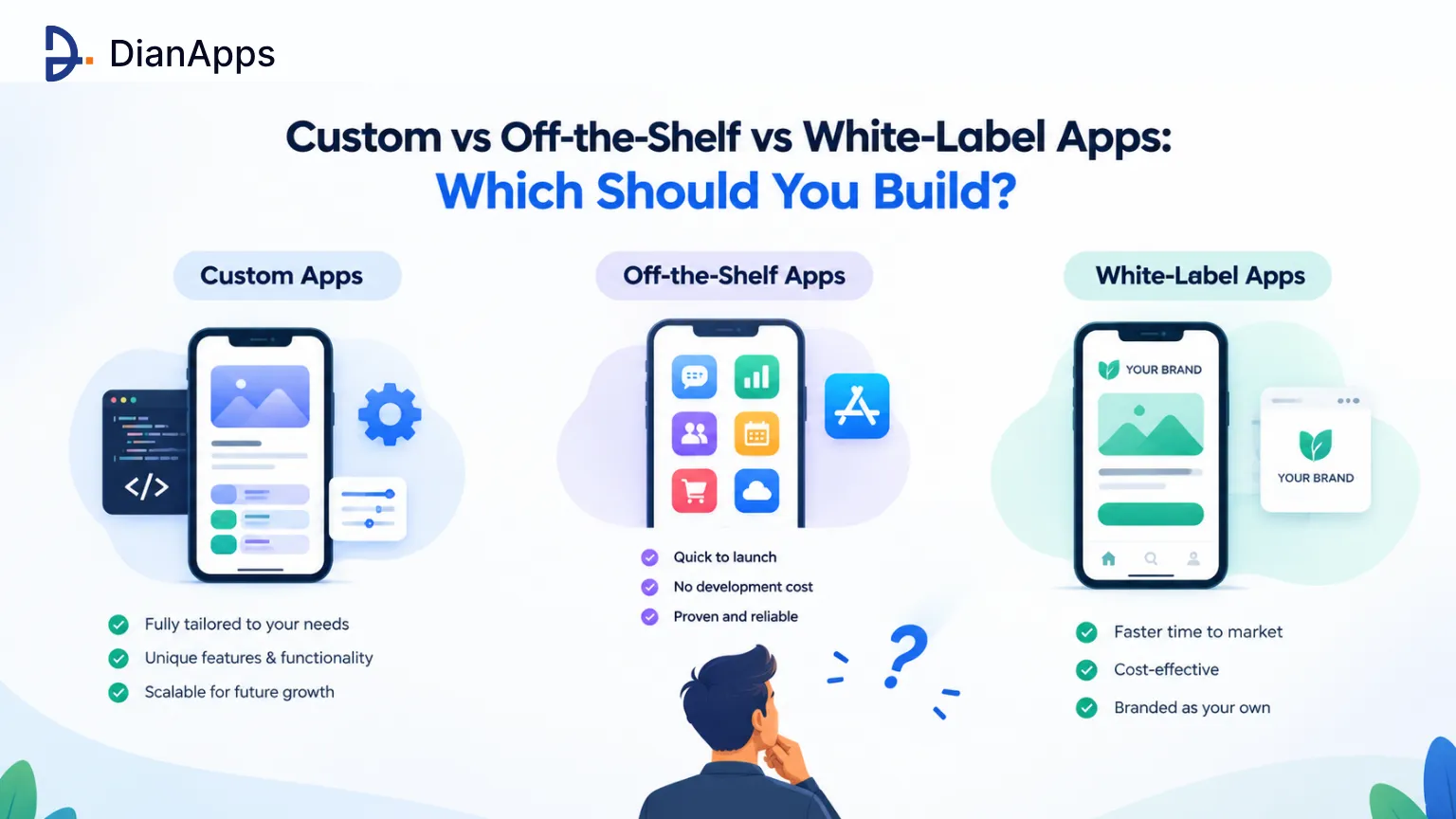
What Is an Off the Shelf App?
An off the shelf app is a ready-made app that is already built for a common need and many businesses are using it at the same time by paying a monthly or yearly subscription. Booking apps, inventory apps, loyalty program apps are some of the common examples, you sign up, do the setup and start using it within a few days without hiring any developer.
The vendor is taking care of the hosting, updates and security so it is saving a lot of time for small teams. But the app is made for everyone and not for your business specifically, so most of the time the business is changing its own process to fit the app.
The vendor’s branding shows up in most of these apps, customization is very limited and the code and data both stay with the vendor, which makes it very hard to stand out when your competitor is using the exact same tool.
Confused Between Custom, White-Label and Off-the-Shelf?
Talk to our team and get an honest suggestion on what fits your business, budget and timeline.
What Is a White Label App?
A white label app is an app that one company is building once and then selling it to many businesses, who are putting their own name, logo and colours on it and launching it on the app stores as their own app. For example a food delivery startup or a gym can take a white label app which already has ordering, payments and tracking, change the branding and go live in a few weeks time.
With this, the business is getting its own branded app at a lower cost and much faster than building from scratch, which is why startups and small businesses are going for it when they want to test an idea quickly. However the same app is being used by many other businesses also, so the features and the design are mostly fixed and adding anything unique is either very costly or not possible at all. You are also depending on the provider for every update and bug fix and in most cases the source code is not yours, so switching to another provider or scaling up later becomes a headache.
What Is Custom Mobile App Development?
Custom mobile app development is building the app from scratch only for your business, where every screen, feature and integration is planned around how your business is actually working and what your users are needing. Nothing is borrowed from a template and nothing is shared with any other business.
The business is getting full control on design, features, integrations, security and how the app scales, and the source code and the users data both are owned by the business, which is extremely crucial when the app needs to change as the business is changing. A custom app is also helping the brand look different, as competitors cannot just sign up and get the same thing.
Yes, custom mobile app development is costing more upfront and taking more time to launch because everything is designed, built and tested from the ground, but for businesses where the app is the main product or where the process is unique, it is usually paying back over time.
Custom vs Off the Shelf vs White Label App
| Feature | Off the Shelf App | White Label App | Custom App |
|---|---|---|---|
| Upfront cost | Lowest | Low to medium | Highest |
| Ongoing cost | Monthly subscription | License or revenue share | Maintenance |
| Time to launch | Few days | Few weeks | 2–12 months |
| Branding | Vendor’s | Yours | Yours |
| Customization | Very limited | Limited | Full |
| Code ownership | No | Mostly no | Yes |
| Data control | With vendor | Limited | Full |
| Scalability | Depends on vendor | Depends on provider | Built to scale |
Custom App vs Template
A lot of businesses are also looking at app templates and no-code app builders, where you pick a ready design, drag and drop a few features and publish the app yourself. In the custom app vs template comparison, the template is looking very attractive in the beginning because it is cheap and quick, but it has the same limits as the other ready-made options and sometimes even more.
Templates are good enough for something simple like a restaurant menu, an event schedule or a basic info app. The moment you need a feature that is not in the template, an integration with your CRM or a different user flow, the template is stopping you. Templates also carry a lot of extra code which the app is not even using, making the app slower and affecting the user experience, and users are not very patient with slow apps.
So in custom app vs template, a template is giving you the same starting point that thousands of others are using, whereas a custom app is something built only for your business and grows with it.
How Much Does Each Option Cost?
Cost is where most businesses are making the decision, but looking only at the upfront price is giving a wrong picture. An off the shelf app has almost no upfront cost but the monthly fee is charged per user or per feature and keeps going up as the team grows. A white label app has a setup and branding fee and then a yearly license or a revenue share. Custom mobile app development has the highest upfront cost depending on the features and complexity, and after that mainly the maintenance which is usually around 15–20% of the build cost every year.
If you add the subscription or license fees for three to five years, many times the total is coming close to or even more than a custom app, and at the end of it you still don’t own anything. For the detailed price bands of custom apps by type and features, you can check our guide on mobile app development cost.
How Long Does Each Option Take?
An off the shelf app is ready in a few days, a white label app is taking a few weeks for the branding, setup and the app store approval, and custom mobile app development is taking anywhere between two to twelve months depending on what you are building.
A simple custom app or an MVP can be done in two to four months while a fintech or marketplace app can go beyond eight months. Our post on how long it takes to build a mobile app is breaking down these timelines by app type and stage, which helps a lot in planning the launch.
Which One Should You Choose?
Every option is right for some business and wrong for another, let’s break it down.
An off the shelf app is a good choice for internal tools like HR, scheduling or inventory, for standard needs that many companies share and for teams with a small budget and no tech people.
A white label app is suitable for startups who want to test an idea with real users quickly, small businesses that want a branded app on a tight budget and common models like food delivery, fitness or ecommerce where launching fast matters more than being unique.
Custom mobile app development is the right fit when the business model or process is unique, the app is the main product or a big part of the revenue, the app needs to connect with many existing systems, there are security or compliance requirements or the business is planning to scale to a large number of users and wants full ownership of the code and data.
Why Businesses Are Moving Towards Custom Apps
Planning a Custom App?
Share your idea with us and get a detailed estimate on features, cost and timeline with no hidden charges.
Businesses are not choosing custom mobile app development only because it is the premium option, they are choosing it because ready-made apps are not solving the problems that come with growth, and the reasons are not hard to see.
User expectations are now changed, customers are now expecting personalised, fast and smooth apps as a standard and not something extra, and an app that looks like the competitor’s app is giving a poor impression before the user has even signed up. At the same time businesses are needing their app to work with CRM, payment gateways, inventory and analytics tools, and with a custom app all of this is possible without waiting for a vendor to allow it.
And that is not all, many businesses are starting with a white label app or off the shelf app to test the market and moving to a custom app once the idea is proven. If you are planning this, do check if you can export your users data from the ready-made app before signing up, as moving the data later is one of the biggest pain points. Another way is starting with a custom MVP with only the core features, so you own the app from day one and the cost and timeline also stays under control.
Conclusion
Custom, off the shelf and white label apps are all having their own place, an off the shelf app is quick and cheap for standard needs, a white label app gets a branded app live in weeks on a small budget and custom mobile app development gives full control, full ownership and an app made only for your business.
Whether you are stuck on custom app vs template or deciding between a white label app and an off the shelf app, the decision should come from where your business is going and not just from what is cheapest today. If you are looking for a team that can guide you on this and build an app that grows with your business, DianApps is here to help, we’ve got you covered.
 0 comments








Leave a Comment
Your email address will not be published. Required fields are marked *