















 0 comments





Key Takeaways:
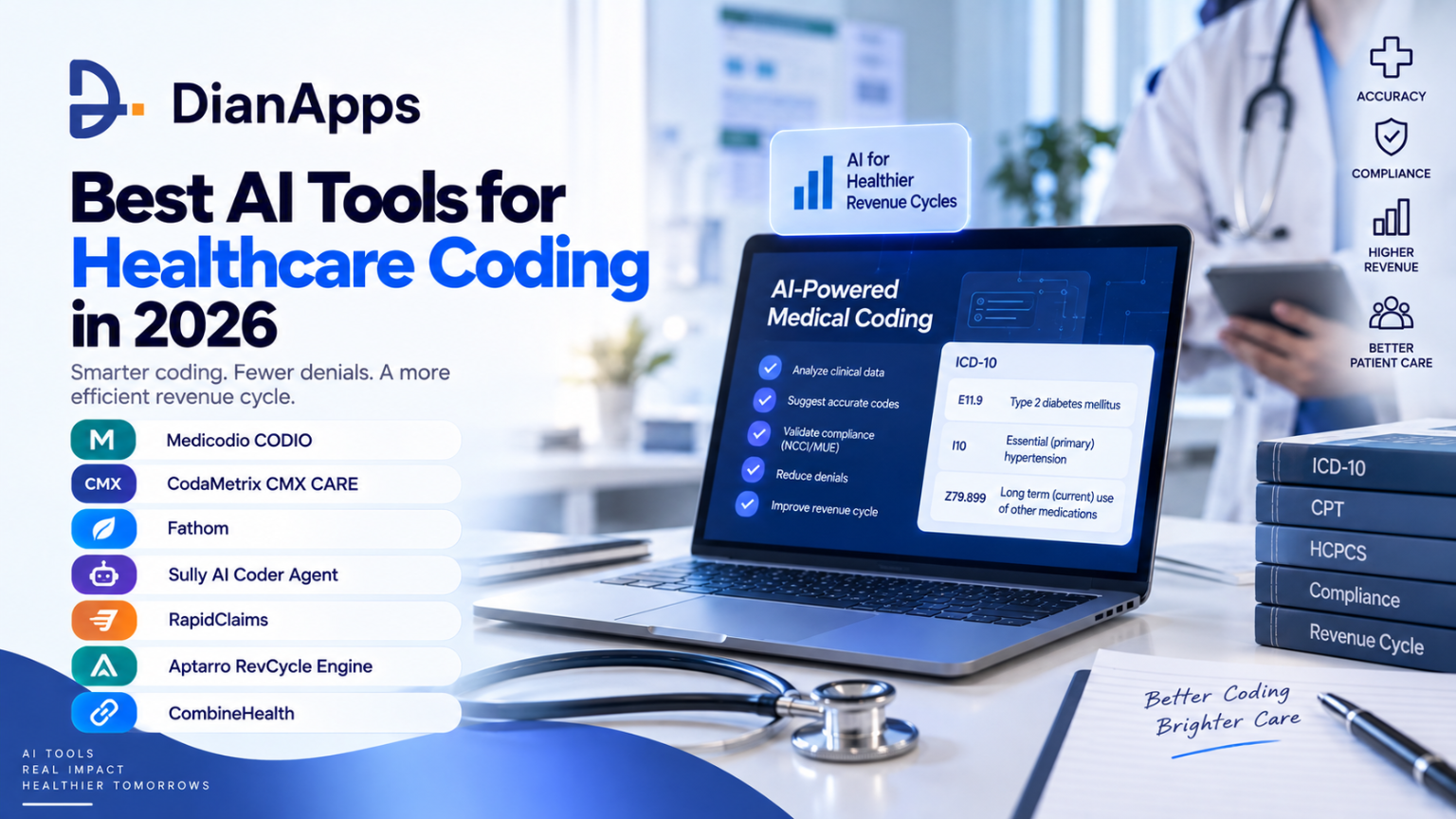
- AI medical coding uses NLP and machine learning to convert clinical documentation into standardized billing codes such as ICD-10, CPT, HCPCS and E/M codes.
- Leading AI coding platforms can automate high-volume routine encounters while reducing manual coding workload and improving first-pass accuracy.
- Medicodio CODIO stands out for its documented 98%+ first-pass accuracy, 35+ specialties, real-time validation and compliance architecture.
- CodaMetrix CMX CARE is designed for complex health systems and uses longitudinal patient records for contextual coding.
Quick Answer: The best AI medical coding software depends on the type and volume of healthcare encounters, specialty mix, EHR environment and level of automation required. Medicodio CODIO is a strong choice for multi-specialty organizations, CodaMetrix fits complex health systems, Fathom suits high-volume outpatient workflows and RapidClaims is designed for broader revenue cycle automation. Before choosing a platform, test it on your own de-identified charts and verify EHR integration, coding validation, HIPAA controls and human-review processes.
Up to 80% of medical bills contain errors and roughly 42% of claim denials result directly from coding issues, according to research cited in the 2026 AI medical coding review by Sully.ai. Medical coding errors cost the US healthcare system billions annually, according to a study published by the American Health Information Management Association (AHIMA). Manual coders process 25 to 30 charts per day at 75 to 85% first-pass acceptance rates. AI-powered medical coding tools process thousands of charts per day at 98%+ accuracy, without the variability, fatigue or staff turnover that make manual coding operationally fragile.
The market for AI healthcare coding tools has matured considerably in 2026. According to Black Book Research surveys, a majority of US health systems plan to expand AI-based automation within their revenue cycles this year, starting with autonomous coding. The technology that once required large academic medical centers with dedicated AI teams is now accessible to specialty practices, physician groups and community hospitals of all sizes.
This guide identifies the best AI tools for healthcare coding in 2026, covering how each platform approaches ICD-10, CPT and HCPCS coding automation, what specialty coverage it provides, what compliance certifications it holds and which type of healthcare organization each one is best suited for.
What Is AI Healthcare Coding and Why It Matters for Revenue Cycle Management?
AI healthcare coding is the use of machine learning and natural language processing to automatically translate clinical documentation, physician notes, discharge summaries, operative reports, lab results, into the standardized billing codes required for healthcare reimbursement: ICD-10-CM and ICD-10-PCS for diagnoses and inpatient procedures, CPT for outpatient and physician procedures, HCPCS for supplies and services and E/M level codes for office visits.
Manual medical coding is the most expensive bottleneck in the healthcare revenue cycle. The US faces a shortage of experienced medical coders across multiple markets, industry reports confirm, as demand for coding grows faster than the workforce pipeline. Experienced coders process 25 to 30 charts per day at 75 to 85% first-pass acceptance. AI systems process thousands per day at 98%+ accuracy, without the variability that comes from fatigue, inconsistent documentation interpretation or coder turnover.
The downstream financial impact of coding accuracy is direct and measurable. Higher first-pass accuracy means fewer claim denials. Fewer denials mean faster reimbursement cycles. Faster reimbursement cycles mean lower days-in-AR and better cash flow. The relationship between coding quality and revenue cycle performance is why AI medical coding has moved from experimental to standard across health systems of all sizes in 2026.
Manual Coding vs. AI Medical Coding
MANUAL MEDICAL CODING
- 25-30 charts/day per coder
- 75-85% first-pass acceptance
- Up to 80% of bills may contain errors
- 42% of denials linked to coding issues
- Performance affected by fatigue, workload & turnover
- Limited scalability as chart volume grows
AI MEDICAL CODING
- Thousands of charts processed daily
- 98%+ first-pass accuracy
- Real-time NCCI, LCD & NCD validation
- Consistent coding across encounters
- Scales with growing chart volume
- Continuously improves through feedback loops
How AI Medical Coding Tools Work: The Technical Foundation
Understanding the technical approach of each AI healthcare coding tool helps you evaluate whether it will handle your specific documentation types, specialty workflows and payer requirements. All platforms in this guide use some combination of the following capabilities, but their relative emphasis and implementation quality vary significantly.
| Technical Component | What It Does | Why It Matters for Accuracy |
| NLP document parsing | Reads unstructured clinical text (physician notes, discharge summaries, operative reports) and extracts the clinical concepts relevant to coding | Clinical documentation is rarely structured. NLP quality determines what clinical concepts are captured vs. missed before code assignment even begins. |
| Code assignment AI | Maps extracted clinical concepts to ICD-10-CM/PCS, CPT, HCPCS and E/M codes using models trained on large volumes of coded clinical documentation | The mapping model’s training data volume and specialty specificity determine first-pass accuracy. Generic models trained on broad data underperform specialist models on specialty encounters. |
| NCCI/MUE validation | Validates assigned codes against the National Correct Coding Initiative edits and Medically Unlikely Edits before claim submission | Catching edit violations before submission prevents the denial-appeal cycle. Real-time validation is the difference between a clean claim and a denial that costs 5x the original coding effort to resolve. |
| LCD/NCD policy checking | Validates codes against Local and National Coverage Determinations, the payer-specific rules that determine whether a service is covered for a given diagnosis | LCD/NCD compliance is payer-specific and changes regularly. Platforms that maintain current payer rule databases prevent denials that would be invisible to code-only validation. |
| HCC capture and risk adjustment | Identifies Hierarchical Condition Categories relevant to Medicare Advantage and value-based care contracts, surfacing documentation gaps that affect risk-adjusted payment | Organizations with significant Medicare Advantage populations leave substantial revenue on the table when HCC capture is incomplete. This capability directly affects risk-adjusted payment accuracy. |
| Denial feedback loop | Connects payer denial data back to the coding AI to update the model based on what specific payers are actually rejecting | Without this loop, AI coding tools repeat the same denial patterns. With it, the model improves over time on your specific payer mix, which is more valuable than generic accuracy benchmarks. |
Build AI That Fits Your Healthcare Workflow
Need more than an off-the-shelf AI coding tool? Build custom Gen AI solutions for clinical documentation, medical coding, EHR integration, and revenue cycle workflows.
Best AI Tools for Healthcare Coding in 2026: Platform by Platform
1. Medicodio CODIO – Highest Verified First-Pass Accuracy
| Accuracy | 98%+ first-pass accuracy on production charts across 35+ specialties |
| Specialty coverage | 35+ specialties including primary care, surgery, oncology orthopedics, cardiology |
| Certifications | ISO/IEC 27001:2022 · Veradigm Connect certified · AAPC/AHIMA-certified human review layer |
| Validation | Real-time NCCI edits, MUE limits, LCD/NCD policies, ICD-10 sequencing |
| EHR integration | All major EHRs via secure API |
| Human review | AAPC/AHIMA-certified coders review complex cases; every code comes with supporting clinical documentation passage |
Medicodio’s CODIO engine is the most thoroughly benchmarked AI medical coding tool in this guide, delivering 98%+ first-pass accuracy validated on production charts across 35+ specialties. That accuracy figure comes from a hybrid model: autonomous AI coding for routine encounters combined with AAPC/AHIMA-certified human review for complex cases. Every code assignment includes the supporting clinical documentation passage, providing the audit trail that compliance reviewers and payer auditors require.
CODIO validates against NCCI edits, MUE limits, LCD/NCD policies and ICD-10 sequencing rules in real time, before submission rather than after denial. Its ISO/IEC 27001:2022 and Veradigm Connect certifications address the security and compliance requirements that healthcare organizations in regulated markets need from any tool handling PHI (Protected Health Information).
The denial feedback loop, connecting payer rejection data back to the coding model, means CODIO’s accuracy on your specific payer mix improves over time rather than staying fixed at the general benchmark level. For organizations with consistent payer panels, this continuous improvement architecture is more valuable than a higher generic accuracy number that doesn’t account for your specific payer contracts and policies.
Best for: Hospitals, health systems and physician groups needing production-scale AI medical coding with full compliance architecture, multi-specialty coverage and documented accuracy benchmarks. Organizations with Medicare Advantage exposure benefit specifically from its HCC capture capabilities.
2. CodaMetrix CMX CARE – KLAS #1 Autonomous Medical Coding 2026
| Recognition | KLAS #1 Autonomous Medical Coding solution for 2026 |
| Key differentiator | First Contextual Coding Automation Platform, uses the entire longitudinal patient record not just the current encounter |
| Specialty | Inpatient and outpatient; strong in acute care and complex case mix environments |
| Target market | Large health systems and academic medical centers |
CodaMetrix’s CMX CARE holds the KLAS #1 Autonomous Medical Coding ranking for 2026, KLAS being healthcare technology’s most recognized independent research and rankings organization. Its defining technical advantage is contextual coding: CMX CARE uses the complete longitudinal patient record, all previous encounters, diagnoses and clinical history, rather than just the current encounter documentation. This contextual approach produces more accurate HCC capture, more appropriate code specificity and fewer missed secondary diagnoses than episode-only coding approaches.
This architecture is particularly valuable in complex case mix environments, academic medical centers, Level 1 trauma centers, tertiary care hospitals, where patients with multiple comorbidities require coding that accurately reflects the full clinical picture rather than the documentation from a single encounter. For large health systems managing high-complexity populations, CMX CARE’s longitudinal coding approach addresses the revenue integrity gaps that episode-only AI coding systems miss.
Best for: Large health systems and academic medical centers with complex case mix organizations with significant chronic disease populations where longitudinal coding accuracy affects both revenue and quality metrics and any inpatient coding environment where KLAS validation of autonomous coding performance is a procurement requirement.
3. Fathom – API-First Autonomous Outpatient Coding
| Architecture | API-first design; integrates via REST API rather than requiring workflow replacement |
| Strength | High-volume structured outpatient workflows; strong on consistent encounter types |
| Best fit | High-volume outpatient settings, physician practices, RCM companies integrating AI into existing systems |
Fathom’s API-first architecture is its primary distinguishing feature. Rather than deploying as a standalone coding platform that requires workflow replacement, Fathom integrates into existing EHR and billing systems via a clean REST API. For healthcare organizations that have invested significantly in existing revenue cycle software and want to add autonomous coding capability without replacing their workflow, this integration model is significantly lower friction than platforms requiring full deployment.
Fathom performs well on high-volume structured outpatient workflows, primary care, urgent care and specialty practices with relatively consistent encounter types. For practices coding thousands of similar encounters daily, Fathom’s throughput and outpatient coding accuracy reduce the manual review burden substantially. For high-complexity inpatient coding or specialties with highly variable documentation, CMX CARE or Medicodio’s broader specialty coverage is a stronger fit.
Best for: Outpatient physician practices, RCM companies that want to embed AI coding in existing systems without platform replacement and organizations with high-volume structured outpatient encounter types where Fathom’s clean API integration reduces implementation complexity.
4. Sully AI Coder Agent – Integrated Coding in an AI Clinical Operations Suite
| Verified outcome | One health system reported 11% revenue lift in a single month from more accurate documentation and reduced billing errors |
| Suite coverage | Receptionist agent, AI Scribe and Coder Agent working as a coordinated system |
| Coding capability | ICD and CPT code assignment from clinical notes; continuous learning via human feedback |
| Improvement model | Continuously learns via human feedback and rule updates; accuracy improves over time |
Sully’s Coder Agent sits within a modular AI clinical operations suite that also includes a front-desk Receptionist agent and an AI Scribe. This integrated approach addresses a problem that standalone coding AI doesn’t: the quality of coding AI output is directly constrained by the quality of the clinical documentation it reads. When the AI Scribe is generating clinical notes and the Coder Agent is reading those notes, the documentation quality feeding the coding model is more consistent than when the coder reads notes written without AI assistance.
One health system using Sully’s full suite reported an 11% revenue lift in a single month, the documented outcome of more accurate documentation combined with fewer billing errors from improved code assignment. The continuous learning model updates coding behavior based on human reviewer feedback and rule changes, which means accuracy on your specific patient population and documentation patterns improves over time rather than remaining static after deployment.
Best for: Physician practices and ambulatory surgery centers that want an integrated AI suite covering the full front-to-back clinical workflow organizations where documentation quality is a recognized problem upstream of coding accuracy and settings where gradual AI adoption starting from the front desk works better than a standalone coding platform implementation.
5. RapidClaims – Full Revenue Cycle AI Automation
| Scope | End-to-end revenue cycle: coding, validation, CDI and denial recovery in a single platform |
| Key capabilities | AI coding + payer rule validation + clinical documentation improvement + denial prevention + analytics |
| Differentiation | Closes the denial feedback loop not just coding automation but denial recovery that feeds back into coding improvement |
| Best fit | Organizations seeking full revenue cycle automation rather than just coding point solution |
RapidClaims distinguishes itself from point-solution coding AI by providing an integrated revenue cycle management platform: AI coding, payer-specific rule validation, clinical documentation improvement (CDI), denial prevention analytics and denial recovery that feeds back into the coding model. For healthcare organizations where the revenue cycle problem is broader than just coding accuracy, where denials, CDI and appeals management are all under-resourced, RapidClaims addresses the full cycle rather than automating one step while leaving adjacent problems manual.
The payer-specific LCD and NCD rule integration is production-grade rather than generic: the platform maintains current coverage policy databases for specific payers and validates codes against your actual payer panel rather than generic federal coverage rules. This distinction matters because up to 42% of claim denials result from coding issues and many of those denials are payer-specific rule violations that generic NCCI validation alone doesn’t catch.
Best for: Healthcare organizations with denial management challenges beyond coding accuracy, RCM companies managing the full revenue cycle for multiple provider clients and organizations that want a single AI vendor accountable for coding through denial recovery rather than integrating multiple point solutions.
6. Aptarro RevCycle Engine – Integrated RCM for Hospitals and Groups
| Model | Fully integrated RCM company offering AI coding as part of a complete managed revenue cycle service |
| Approach | AI automation combined with human oversight for complex cases; outsourced RCM + AI |
| Best fit | Organizations wanting managed RCM services with AI rather than standalone software deployment |
Aptarro takes a different approach from pure-software AI coding tools: the RevCycle Engine is the AI layer within a fully managed revenue cycle management service. For organizations that want to outsource their RCM function rather than deploy AI coding software internally, Aptarro provides both the AI automation and the human oversight, combining automation, analytics and coding expertise in a single managed service relationship.
This model suits smaller practices and specialty groups that lack the internal operational resources to configure, train and maintain AI coding software. Rather than buying software and managing the implementation, they buy a managed outcome, accurate coding, lower denials, faster reimbursement, with Aptarro accountable for the result rather than the client’s team.
Best for: Small to mid-sized practices that want managed RCM services with AI rather than internal software deployment, specialty practices without dedicated coding management resources and organizations evaluating full RCM outsourcing alongside AI automation.
7. CombineHealth – Explainable AI Coding with Policy – Aware Automation
| Key differentiator | Explainability-first: AI-generated codes are reviewable, policy-aware and connected to billing workflows |
| Capabilities | Coding transparency, payer-policy review, denial prevention analytics, appeals support |
| Best fit | Organizations that need explainable AI for compliance, audit defense or coder training |
CombineHealth addresses a problem that accuracy benchmarks alone don’t: explainability. When an AI tool assigns a code, how does a compliance reviewer, auditor or coder understand why that code was assigned? CombineHealth’s platform makes AI-generated codes reviewable at the evidence level, showing which clinical documentation elements supported each code assignment, which payer policies were checked and what the billing and denial implications are. For organizations where AI coding needs to coexist with human coder oversight and audit defense capability, CombineHealth’s transparency-first approach reduces the compliance risk that comes from opaque AI coding decisions.
Best for: Compliance-focused organizations that need explainable AI coding decisions for audit defense, healthcare systems using AI coding as a coder training and quality improvement tool alongside automation and ASCs and specialty practices where procedure-heavy coding requires human-reviewable AI assistance rather than fully autonomous coding.
AI Healthcare Coding Tool Comparison: Key Specs at a Glance
| Platform | Accuracy | Specialties | NCCI/LCD | Certifications | Best For |
| Medicodio CODIO | 98%+ first-pass | 35+ | Yes, real-time | ISO 27001:2022, Veradigm | Hospitals, health systems, multi-specialty practices |
| CodaMetrix CMX CARE | KLAS #1 2026 | Inpatient + outpatient | Yes | KLAS #1 validated | Large health systems, academic medical centers |
| Fathom | High outpatient | Outpatient focused | Yes | API-first | High-volume outpatient, RCM companies, API integration |
| Sully AI Coder | High first-pass | ICD + CPT | Yes | Continuous learning | Practices wanting integrated scribe-to-coder AI suite |
| RapidClaims | Production-grade | Multi-specialty | Payer-specific LCDs | Full RCM coverage | Full revenue cycle automation, RCM companies |
| Aptarro RevCycle | Managed service | Multi-specialty | Yes | Managed RCM | Small practices, specialty groups, full outsourcing |
| CombineHealth | Explainability focus | ASC, specialty | Policy-aware | Audit-ready outputs | Compliance-focused, audit defense, coder training |
Can AI Replace Medical Coders? The Honest Answer
This is the most common question healthcare organizations ask before adopting AI coding tools and it deserves a direct answer rather than a marketing deflection.
AI medical coding in 2026 handles routine, high-volume coding encounters with higher accuracy and far higher throughput than human coders. For straightforward encounters, primary care office visits with common diagnoses, standard surgical procedures with clear operative notes, routine outpatient visits, AI automation now handles the coding at accuracy levels that exceed experienced human coders on first-pass rates.
Where AI still needs human involvement: complex cases with ambiguous documentation, rare diagnoses without sufficient training data representation, procedures requiring clinical judgment about which codes are most appropriate when documentation supports multiple valid options and appeals where the coding decision needs a human who can articulate clinical rationale to a payer reviewer.
The most accurate framing is not “AI replaces coders” but “AI changes what coders do.” The high-volume routine coding that consumes most coder time gets automated. Coders shift to quality review, complex case management, CDI (Clinical Documentation Improvement) conversations with physicians, denial appeals and the oversight of AI coding outputs. Some organizations reduce coding headcount as AI handles routine volume. Many find that their coders’ value increases when they’re focused on complex cases and process improvement rather than repetitive high-volume coding.
The shortage of experienced medical coders, combined with growing documentation volume, means that even organizations that don’t reduce headcount benefit from AI coding: the AI handles growth in encounter volume without proportional increases in coding staff cost. That math is the primary driver of adoption, not workforce reduction.
How to Choose the Best AI Tool for Healthcare Coding: A Buyer’s Checklist
Every healthcare organization’s coding needs are different. The right platform for a 20-physician multispecialty practice is not the same as the right platform for a 500-bed health system or an RCM company coding for 100 provider clients. Use this framework before requesting demos.
1. Define Your Specialty Mix and Code Types First
The single most important input for AI coding tool selection. A platform optimized for outpatient primary care underperforms in inpatient complex cases. A platform with strong surgical specialty coverage may have limited capabilities on E/M coding for office visits. Map your actual encounter distribution, percentage of inpatient vs. outpatient, specialty distribution, procedure-heavy vs. evaluation-and-management-heavy, before any platform evaluation. Then filter to platforms that cover your specific specialty mix with documented accuracy in that mix.
2. Verify NCCI, MUE and LCD/NCD Coverage
Basic NCCI edit validation is table stakes in 2026. Differentiate on MUE (Medically Unlikely Edit) compliance and payer-specific LCD/NCD coverage. The latter matters most for Medicare and Medicare Advantage populations, where local coverage determination compliance directly affects payment and audit risk. Ask each vendor specifically: How often is your LCD/NCD database updated? Do you cover the specific MACs (Medicare Administrative Contractors) in our service area?
3. Confirm EHR Integration Approach
AI coding tools that require manual document upload are not production-grade for high-volume environments. Confirm: Does the platform integrate directly with your EHR via secure API? What is the integration implementation timeline? Does it support real-time coding as encounters close or only batch processing? The integration approach determines whether the tool fits into your actual workflow or becomes a parallel process that coders manage separately.
4. Ask for Accuracy Data on Your Encounter Types
Generic accuracy benchmarks (98%+ first-pass) are calculated on the vendor’s training data, which may not match your specialty mix or documentation quality. Ask vendors to run a proof of concept on 100 actual de-identified charts from your practice before committing. The accuracy on your charts is the number that matters, not the number on the marketing page.
5. Verify HIPAA Compliance Architecture
Every AI coding tool handling PHI must be HIPAA compliant under a signed Business Associate Agreement (BAA). But HIPAA compliance spans a range of implementation quality. Ask specifically: What encryption does PHI travel and rest under? Who at your organization has access to client data? What happens to your data if you terminate the contract? Is your data used to train models that serve other clients? A HIPAA-compliant label is a minimum threshold not a complete answer.
6. Evaluate the Denial Feedback Loop
The highest-ROI AI coding platforms close the loop between payer denials and coding model updates. Ask: When a claim is denied for a coding reason, how does that denial information feed back into the coding model? How frequently are payer-specific rules updated in the system? A platform that doesn’t close this loop will plateau at its initial accuracy level while your denial patterns continue repeating.
7. Understand the Human Review Model
Most production AI coding platforms combine autonomous coding with human review for complex cases. Understand: What percentage of encounters route to human review? Who performs that review, your coders, the vendor’s coders or a hybrid? Is human review AAPC or AHIMA certified? How are reviewed cases fed back to improve the model? The human review model affects both quality and cost and its design reveals how mature the vendor’s approach to production AI is.
Turn Your Healthcare AI Idea Into Reality
From HIPAA-compliant NLP to intelligent automation, our AI experts can help you design and build a Gen AI solution around your specific healthcare workflows.
What AI Healthcare Coding Software Costs in 2026?
Pricing models for AI medical coding tools vary significantly across platform type and engagement model. Here are the pricing structures used in the market, based on 2026 industry data.
| Pricing Model | Typical Range | Best For |
| Per-encounter / per-claim | $0.50-$3.00 per encounter depending on complexity and specialty | Variable-volume practices where encounter counts fluctuate significantly |
| Monthly platform fee + volume tier | $2,000-$15,000/month base + volume pricing for encounters above tier | Mid-size practices and specialty groups with predictable encounter volumes |
| Enterprise licensing (health systems) | $100,000-$1M+ annually depending on encounter volume and specialty coverage | Health systems coding hundreds of thousands of encounters annually |
| Managed RCM service (AI included) | 3-8% of collected revenue (replacing standalone coding cost) | Small practices outsourcing RCM with AI coding included in service |
| ROI benchmark | Most organizations recover AI coding investment within 6-18 months through denial reduction and coder productivity gains | Primary ROI drivers: denial rate reduction, coder throughput increase, faster AR cycle |
The revenue impact of AI coding accuracy makes the ROI math tractable for most healthcare organizations. A practice collecting $5 million annually from claims, operating at a 15% denial rate and recovering 60% of denied claims is losing approximately $300,000 annually in unrecovered revenue. Moving from 75% to 98% first-pass acceptance at that scale recovers more than most platforms cost at any pricing tier.
DianApps: Custom AI Development for Healthcare Revenue Cycle and Clinical Operations
Healthcare organizations with unique workflow requirements, proprietary EHR environments or specific specialty needs sometimes require custom AI development alongside or instead of commercial off-the-shelf AI coding platforms. DianApps builds custom AI systems for healthcare that commercial platforms can’t deliver.
As a Clutch #1 Premier Verified Healthtech AI Development Company with 200+ engineers and offices across the USA, Australia, UAE and India, our healthcare AI practice covers HIPAA-compliant NLP pipeline development, clinical documentation AI, custom EHR integration, revenue cycle AI and mobile healthtech applications. Verified production work includes Sinch (HIPAA and GDPR compliant architecture, billions of interactions annually) and clinical applications across primary care, specialist and telehealth workflows.
Our AI Agent Development Services for healthcare include custom NLP for clinical document parsing, HIPAA-compliant data pipeline architecture, EHR integration via HL7 FHIR and proprietary APIs and AI-powered mobile health applications. For organizations that need coding AI built to their specific specialty workflow rather than configured from a commercial platform, contact our team for a healthcare AI architecture review.
The Bottom Line
The best AI tool for healthcare coding in 2026 is the one that matches your specialty mix, integrates cleanly with your EHR, delivers verified accuracy on your encounter types and operates within a HIPAA-compliant framework your compliance team can stand behind.
Medicodio CODIO leads on independently benchmarked accuracy (98%+ first-pass, 35+ specialties, ISO/IEC 27001:2022 certified). CodaMetrix CMX CARE leads on KLAS validation and contextual longitudinal coding for complex health system environments. Fathom leads on API-first outpatient coding for RCM companies and high-volume physician practices. Sully AI Coder Agent leads on integrated scribe-to-coder workflow for practices adopting AI across the clinical operations stack. RapidClaims leads on full revenue cycle coverage for organizations whose denial management problem is broader than coding alone.
The universal starting point is a proof of concept on your own charts before any platform commitment. Generic accuracy benchmarks describe how the AI performs on vendor training data. Only a pilot on your actual clinical documentation, with your specialists’ documentation style, against your actual payer panel, produces the number that predicts your real-world ROI.
For healthcare organizations that need custom AI development, whether that’s a proprietary NLP coding pipeline, a HIPAA-compliant clinical documentation system or an AI-powered healthtech mobile application, the future of healthcare application development is moving toward systems where AI is embedded in clinical workflows from the ground up.
Build Your Next AI Solution With Expert Developers
Need a team to build, integrate, and scale your Gen AI solution? Hire experienced AI developers to turn your healthcare AI requirements into a secure, production-ready solution.
 0 comments










Leave a Comment
Your email address will not be published. Required fields are marked *