















 0 comments





Key Takeaways:
- Agents Are Crossing Into Production: 62% of organisations are experimenting with or scaling AI agents and 23% are already scaling them.
- The Market Is Compounding Fast: The agentic AI market is projected at USD 9.14 billion in 2026, on its way to USD 139 billion by 2034 at a 40.5% CAGR.
- A Correction Is Coming With The Boom: Gartner is predicting over 40% of agentic AI projects will be cancelled by the end of 2027 on cost, unclear value and weak risk controls.
- The Wins Are Real Where Scope Is Narrow: Klarna’s agent is doing the work of 853 full-time employees and saving USD 60 million and 66% of adopters are reporting productivity gains.
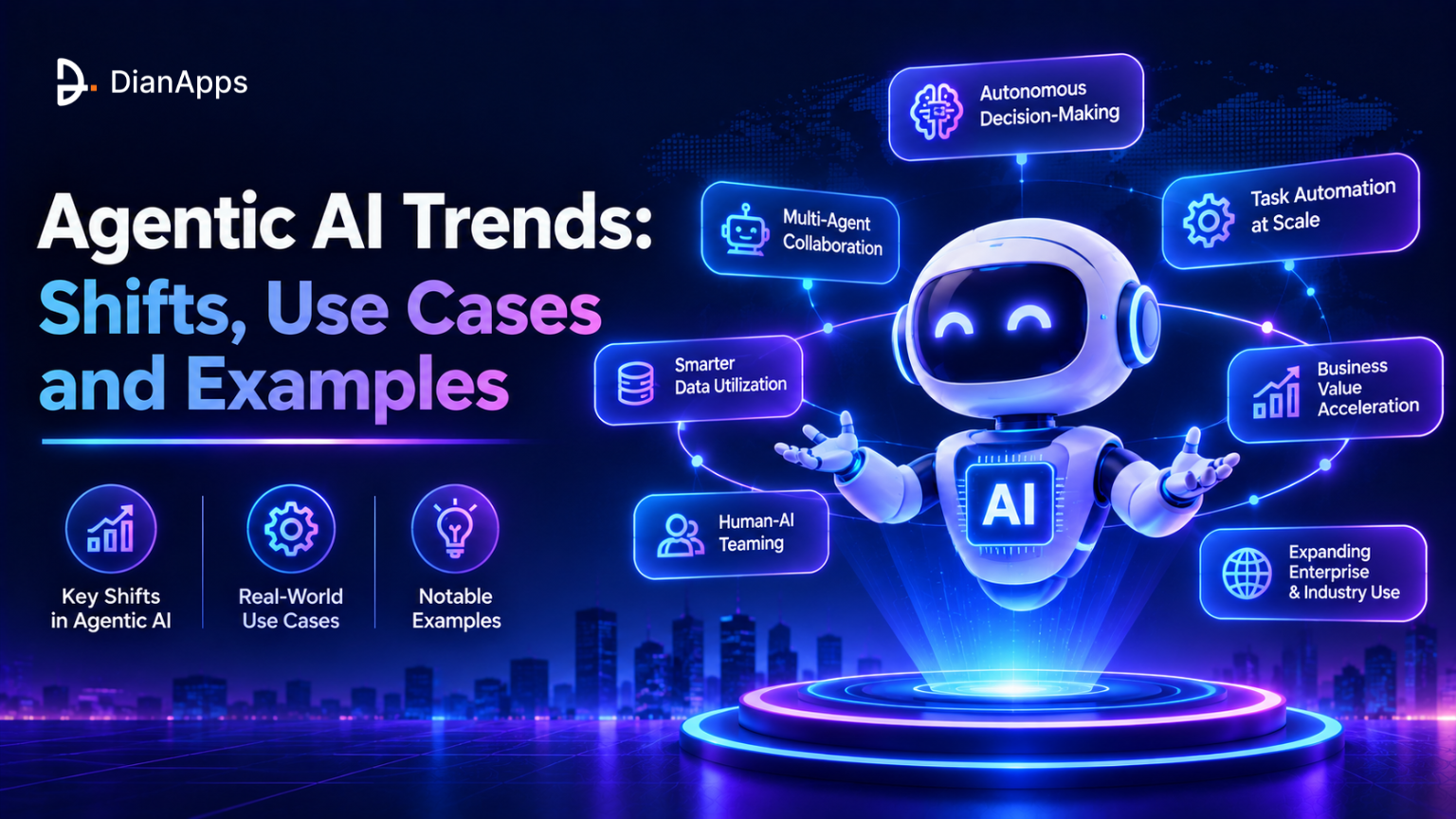
Quick Answer: The defining agentic AI trends of 2026 are AI agents moving from pilots to production, multiagent systems, vertical agents for specific industries, agent washing and the coming project shake-out, standardised tool protocols such as MCP, agent observability, agent security and orchestration frameworks maturing.
The agentic AI trends of 2026 are telling two stories at once. On one side, 23% of organisations are scaling AI agents and single deployments are saving tens of millions, on the other, Gartner is warning that over 40% of agentic AI projects will be cancelled by the end of 2027.
Both stories are true and the difference between them is scope, instrumentation and honest vendor selection. This guide is walking through what agentic AI actually is, the eight trends that are mattering this year and the use cases where the returns are already showing up.
Also Read: AI Development Trends to Watch in 2026
What Is Agentic AI?
Agentic AI is a class of systems where a large language model is not just answering a prompt but pursuing a goal, deciding which steps to take, calling tools and APIs, reading the results and adjusting its plan until the task is done or a human approves the outcome.
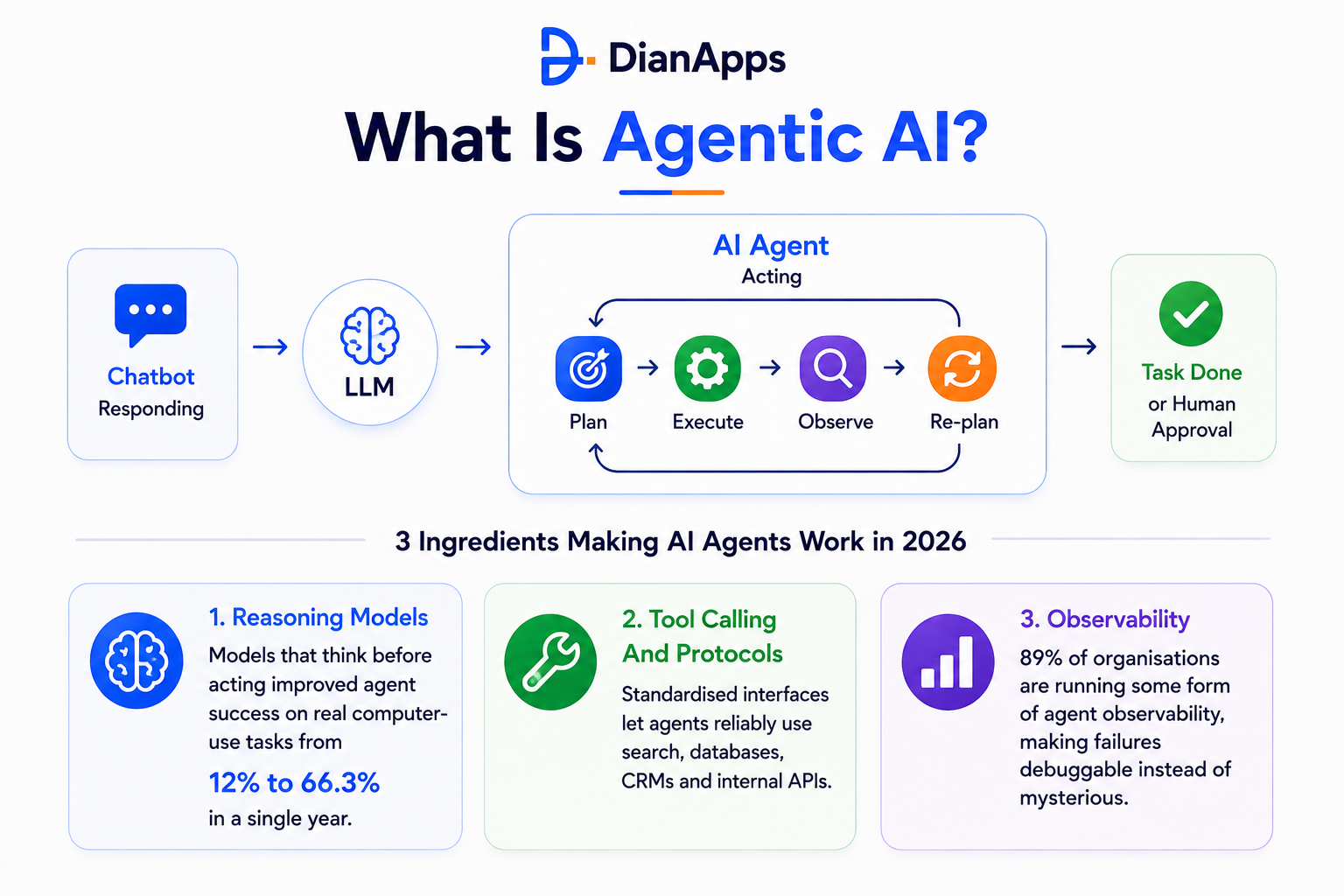
A chatbot is responding, an agent is acting. The practical difference is the loop, an agent is planning, executing, observing and re-planning, often across many steps and systems, with memory of what it has already done.
Three ingredients are making AI agents work in 2026 where they were failing in 2023:
- Reasoning Models: Models that are spending compute on thinking before acting pushed agent success on real computer-use tasks from 12% to 66.3% in a single year.
- Tool Calling And Protocols: Standardised interfaces are letting agents use search, databases, CRMs and internal APIs reliably.
- Observability: 89% of organisations are now running some form of agent observability, which is making failures debuggable instead of mysterious.
These capabilities sit within a broader AI development tech stack that includes models, data infrastructure, APIs, application layers, evaluation, monitoring, and deployment tooling.
The 8 Agentic AI Trends Defining 2026
1. AI Agents Are Moving From Pilots to Production
The headline trend is graduation. 62% of organisations are experimenting with or scaling AI agents, 23% are scaling them and 57% of surveyed teams are reporting agents in production.
The production pattern is consistent, one narrow workflow, human approval steps, tracing from day one, then expansion, teams that are skipping those steps are the ones feeding Gartner’s cancellation statistic.
2. Multiagent Systems Are the Next Architecture
Single agents are hitting limits on complex work, so teams are composed of specialists, a researcher, a writer, a reviewer, coordinated by an orchestrator. Multiagent systems are sitting on Gartner’s top strategic technology trends for 2026 and every major framework is now shipping handoff and delegation primitives.
- What to watch: Cross-vendor agent-to-agent communication, one company’s procurement agent negotiating with another’s sales agent is moving from demo to early practice.
Need AI Engineers for Your Agent Roadmap
Add experienced AI developers to build agent workflows, tool integrations, RAG systems, multiagent architectures, and production-ready backends.
3. Vertical Agents Are Beating General Assistants
The strongest agentic AI examples of the past year are vertical. Klarna’s customer-service agent is handling work equivalent to 853 full-time employees with USD 60 million in savings Hostinger’s support agent is resolving 75% of 750,000 monthly conversations and AtlantiCare’s clinical assistant is cutting documentation time 41%.
The lesson is repeating across every case, agents tuned to one domain with proprietary data and clear metrics are outperforming general-purpose assistants by a wide margin.
4. Agent Washing Is Forcing Buyers to Get Sharper
Gartner is estimating that of the thousands of vendors claiming agentic AI, only around 130 are offering genuine agentic capability, the rest are relabelling chatbots, RPA (Robotic Process Automation) and assistants. This “agent washing” is a direct cause of the predicted 40% project cancellation rate.
- What to watch: Buyers are learning to ask one question, “show me the agent deciding something”, if the demo is a scripted flow, it is not an agent.
That makes vendor selection increasingly important. Comparing the best agentic AI consulting companies can help buyers distinguish teams with genuine agent-building experience from vendors simply adding “agentic” to their pitch.
5. Standardised Tool Protocols Are Reducing Lock-In
MCP (Model Context Protocol) and similar standards are letting the same tool servers plug into different models and AI agent frameworks, which is cutting integration cost and making model switching a configuration change. This also is accelerating multiagent systems, because standard interfaces are what specialists need to cooperate.
6. Agent Observability and Evals Are Becoming Table Stakes
Among teams with agents in production, 94% are running observability and 62% have detailed tracing. Quality is the top production blocker for roughly a third of teams, ahead of cost, so evals, tracing and replay are moving from nice-to-have to procurement requirement.
7. Agent Security Is the New Attack Surface
Agents are holding credentials and permissions and the numbers are uncomfortable, 82% of organisations are using agents broadly while only 44% have security policies for them and 80% have already seen unintended agent actions. Gartner is expecting over 50% of enterprises to adopt AI security platforms by 2028.
- What to watch: Prompt-injection defences, least-privilege tool scoping and audit logs are becoming standard clauses in enterprise AI contracts.
8. Agent Frameworks Are Consolidating and Maturing
The AI agent frameworks market is settling into clear leaders, LangGraph for stateful production agents, CrewAI for role-based teams, Microsoft Agent Framework for Azure and .NET shops, PydanticAI for type-safe lightweight agents and the OpenAI Agents SDK for OpenAI-standardised stacks. Our full comparison of the top LLM frameworks is covering how to choose among them.
Agentic AI by the Numbers in 2026
The table below is condensing the data behind the agentic AI 2026 story and it is the evidence base for every one of the agentic AI trends above.
| Metric | Figure | Source, year |
| Agentic AI market size, 2026 | USD 9.14 billion | Fortune Business Insights, 2025 |
| Agentic AI market projection, 2034 | USD 139.19 billion (40.5% CAGR) | Fortune Business Insights, 2025 |
| Organisations experimenting with or scaling agents | 62% | McKinsey State of AI, 2025 |
| Organisations scaling agents | 23% | McKinsey State of AI, 2025 |
| Teams reporting agents in production | 57% | LangChain State of Agent Engineering, 2026 |
| Agent success on real computer-use tasks (OSWorld) | 66.3%, up from 12% | Stanford AI Index, 2026 |
| Adopters reporting productivity gains | 66% | PwC, 2025 |
| Agentic projects predicted cancelled by end of 2027 | Over 40% | Gartner, 2025 |
| Enterprise apps with task-specific agents by end of 2026 | 40% | Gartner, 2025 |
| Day-to-day work decisions made autonomously by 2028 | 15% | Gartner, 2025 |
Agentic AI Use Cases That Are Working in 2026
The agentic AI use cases delivering measurable returns are clustering in five areas and they are the practical face of the agentic AI trends this guide is tracking.
- Customer Support And Service: Triage, resolution and refund workflows with escalation to humans, this is where Klarna and Hostinger are proving the model at scale.
- Back-Office Operations: Invoice processing, claims handling, document intake and reconciliation, high-volume and rule-adjacent work where an agent plus approval step is cutting cycle times.
- Sales And Revenue Operations: Lead enrichment, meeting prep, CRM hygiene and follow-up drafting, agents are removing the administrative drag between conversations.
- Software Engineering: Coding agents are opening pull requests, fixing bugs and running tests, 31% of developers are already using agents and 69% of them are reporting productivity gains.
- Healthcare And Regulated Operations: Documentation assistants and prior-authorisation workflows, AtlantiCare’s 41% documentation-time reduction is the reference case, always with a human signing off.
Recommended Read- Best Agentic AI Consulting Companies in 2026
How to Ride These Trends Without Joining the 40%?
Gartner’s cancellation prediction is not an argument against agents, it is an argument against how most projects are being run and reading agentic AI trends without that context is how budgets get wasted. Five practices are separating the survivors.
- Scope One Workflow: Pick a single, high-volume process with a measurable baseline, resolution time, cost per ticket, hours per invoice.
- Keep A Human In The Loop: Approval checkpoints for anything touching money, customers or compliance, autonomy is earned gradually.
- Instrument Before You Scale: Tracing, evals and replay from week one, quality is the top blocker and you cannot fix what you cannot see.
- Verify The Vendor Is Not Agent Washing: Ask to see the agent plan, act and recover from a failure live, scripted demos are disqualifying.
- Plan The Model-Swap Path: Build on a framework and protocol stack that is letting you change models without a rewrite.
Cost also needs to be evaluated beyond the initial build, since model usage, infrastructure, integrations, evaluation, monitoring, and ongoing optimization all contribute to AI development cost.
Ready to Put AI Agents Into Production?
Start with one measurable workflow and get the engineering, evaluation, security, and infrastructure needed to turn an agent pilot into a production system.
How DianApps Is Building Production AI Agents?
DianApps, an AI development company with 150+ engineers, 350+ clients across 25+ countries and a 4.8/5 Clutch rating from 81+ reviews, is building agents the way the data is saying they succeed, narrow scope first, instrumented always.
Recent agentic work is including LangGraph agents with human-approval checkpoints for operations workflows, support agents with RAG (Retrieval-Augmented Generation) over client knowledge bases and agent back ends surfaced inside React Native and Flutter apps, with evals and tracing wired in before launch. The full-cycle model, AI, mobile, web, backend and DevOps under one team with U.S. delivery presence, means the agent and the product around it are shipping together.
We are also blunt about fit, if an off-the-shelf vertical agent or a simple automation is solving your problem, we are recommending it before proposing a custom build.
Have an Agentic AI Use Case in Mind?
Tell us what you want your agent to accomplish, and our AI team can help define the workflow, architecture, guardrails, and path to production.
Conclusion
The agentic AI trends of 2026 are describing a market growing 40% a year and a discipline problem washing out the teams that are skipping scope, metrics and controls. Agents are working in production today, the evidence is in the Klarna, Hostinger and AtlantiCare numbers and the failures are concentrating where hype replaced instrumentation.
Pick one workflow, keep a human in the loop, instrument everything and demand real agency from vendors. If you want a team that has shipped production agents to help you start, talk to DianApps’ AI development team.
Frequently Asked Questions
What is agentic AI in simple terms?
- Agentic AI is software where an AI model is pursuing a goal on its own, planning steps, calling tools and APIs, checking results and adjusting until the job is done. Unlike a chatbot that is answering one prompt at a time, an agent is completing multi-step work with minimal supervision.
What are the biggest agentic AI trends in 2026?
- The biggest agentic AI trends in 2026 are agents moving from pilots to production, multiagent systems, vertical industry agents, agent washing and a predicted project shake-out, standardised tool protocols such as MCP, agent observability, agent security and the maturing of AI agent frameworks such as LangGraph and CrewAI.
What are real examples of agentic AI?
- Klarna’s support agent is doing work equivalent to 853 full-time employees and saving USD 60 million, Hostinger’s agent is resolving 75% of 750,000 monthly conversations and AtlantiCare’s clinical assistant is cutting documentation time 41%. Coding agents opening tested pull requests are a fourth everyday example.
How big is the agentic AI market in 2026?
- The agentic AI market is estimated at USD 9.14 billion in 2026, up from USD 7.29 billion in 2025 and is projected to reach USD 139.19 billion by 2034 at a 40.5% CAGR. Gartner is separately projecting agents inside 33% of enterprise software by 2028.
Will most agentic AI projects fail?
- Gartner is predicting over 40% of agentic AI projects will be cancelled by the end of 2027, citing escalating costs, unclear business value and inadequate risk controls. Projects with narrow scope, baseline metrics, human approval steps and observability are the ones consistently surviving.
Which AI agent frameworks are best in 2026?
- LangGraph is leading for stateful production agents, CrewAI for role-based multi-agent teams, Microsoft Agent Framework for Azure and .NET organisations, PydanticAI for type-safe lightweight agents and the OpenAI Agents SDK for OpenAI-only stacks. All are open source under MIT or Apache 2.0 licences.
What are the top agentic AI use cases for small businesses?
- Customer-support triage, appointment booking, lead enrichment and follow-up, invoice and document intake and internal knowledge assistants are the highest-return agentic AI use cases for small businesses, each is high-volume, measurable and safe to run with an approval step.
Is agentic AI safe for regulated industries?
- Yes, with controls. Regulated deployments are keeping humans in the approval loop, scoping agent permissions to least privilege, logging every action for audit and validating outputs. The gap to close is real, 82% of organisations are using agents while only 44% have agent security policies.
 0 comments






Leave a Comment
Your email address will not be published. Required fields are marked *