















 0 comments





What Changed in 2026
The market landscape shifted meaningfully in the last twelve months. Here are the verified data points that shape the guidance below:
- React Native New Architecture (Fabric + TurboModules) is default in 2026, cutting native gap to under 8% (React Native 0.74+ release).
- React Native holds 39% share of cross-platform teams in 2026 (Stack Overflow Developer Survey 2026).
- Meta reports 40% faster iteration cycles for teams using RN 0.81 with Bridgeless Mode (Meta Engineering 2026).
- Average React Native app development cost in 2026: $30,000-$150,000 depending on complexity (DianApps 2026 client benchmark data).
- Popular RN apps in 2026: Discord, Shopify Shop, Facebook Marketplace, Coinbase, Microsoft Office (React Native showcase 2026).
Related Reading From Our 2026 Guides
For deeper context, see these companion guides:
- Mobile App Development Trends 2026
- React Native 0.81 Release Update
- Flutter vs React Native Architecture
- Top Frameworks for AI-Native Mobile Apps
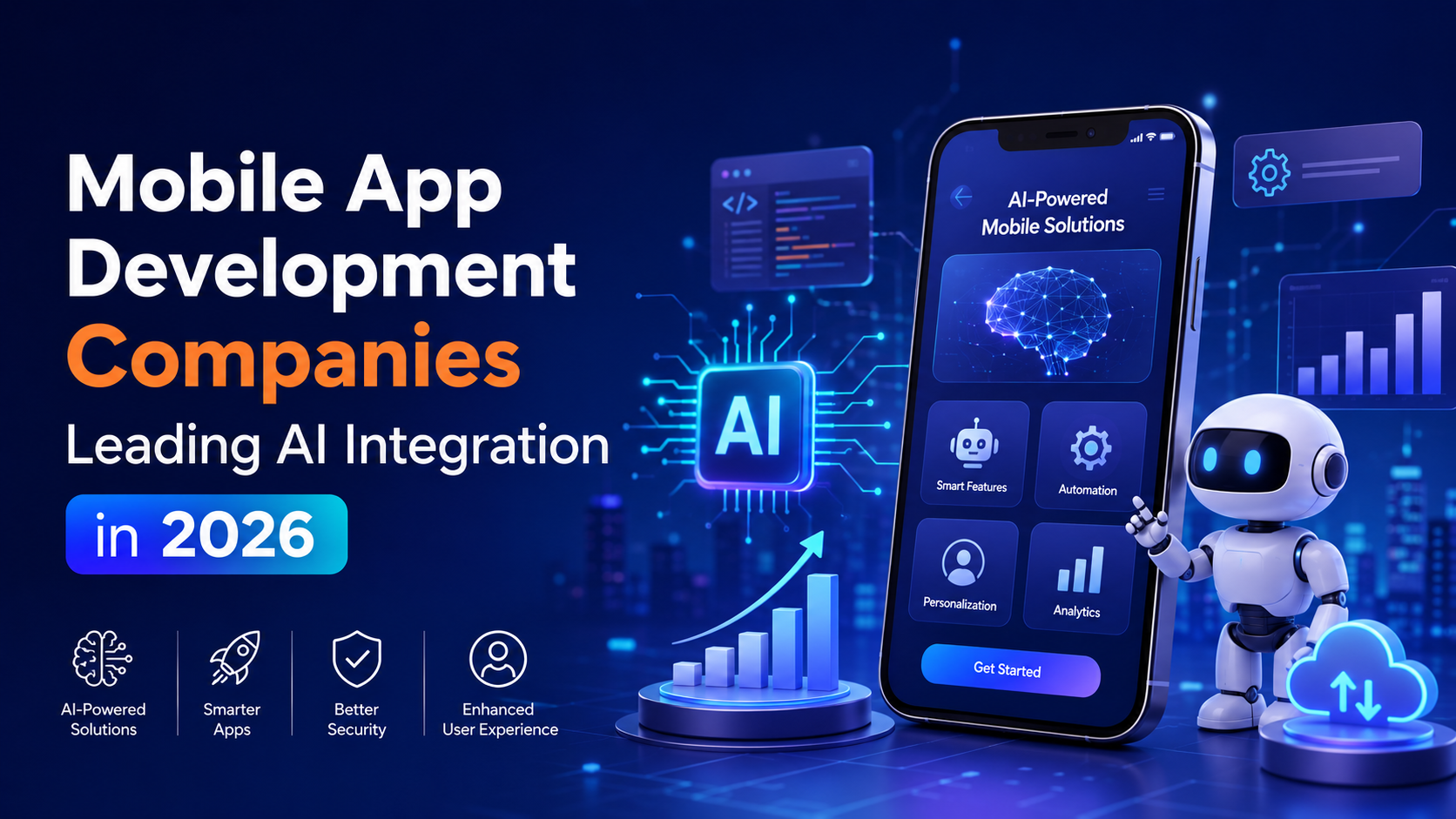
Every mobile app development company in 2026 has the word “AI” somewhere on their homepage. That is not the same thing as having the engineering depth to build AI features that actually work in production. There is a real gap between a team that can wire up an OpenAI API call and a team that can architect a data pipeline, train a custom recommendation model, manage an LLM’s context across a long-running session, and keep the whole thing performant on a mid-range Android phone.
That gap is exactly where AI projects either generate measurable business value or quietly become an expensive line item that nobody talks about a year later. Companies successfully implementing AI report meaningful improvements in customer satisfaction, output, and operational efficiency. The companies that get there are the ones who picked development partners with real AI engineering capability, not just AI vocabulary.
This guide looks at what genuine AI integration capability actually requires, evaluates the development companies worth considering in 2026, and gives you a framework to tell the difference between a partner who will build something that works and one who will build something that demos well and breaks at scale.
Quick Answer: The best mobile app development companies for AI integration in 2026 combine three things: a dedicated AI/ML engineering practice separate from general app development, a portfolio of AI features that shipped to production and measurably improved outcomes, and the mobile engineering depth to deliver those features without degrading app performance. DianApps, SparxIT, and a handful of specialized firms meet this bar; many agencies marketing “AI integration” do not.
What Genuine AI Integration in a Mobile App Actually Requires?
The phrase “AI-powered app” covers an enormous range of actual engineering work. On one end, a team adds a single API call to a third-party LLM and wraps it in a chat interface. On the other end, a team builds a data pipeline that captures user behavior, trains a model on that data, deploys it for real-time inference, and continuously retrains it as new data accumulates. Both get described as “AI integration.” Only one of them produces a product that genuinely understands and adapts to its users.
When evaluating a development partner’s AI capability, the question is not whether they say they do AI. It’s what layer of the stack they can actually deliver.
| AI Capability Layer | What It Involves | Engineering Difficulty |
|---|---|---|
| API integration | Connecting a pre-built AI service (OpenAI, Gemini, Claude) to your app’s UI | Low, most agencies can do this |
| Prompt and context engineering | Designing prompts and conversation memory that produce consistent, useful output at scale | Medium, requires real LLM experience |
| RAG and knowledge grounding | Connecting an LLM to your proprietary data so responses are accurate and current | Medium-High, vector databases, retrieval logic |
| Custom model training | Building recommendation engines, classifiers, or predictive models on your own data | High, requires genuine ML engineering team |
| On-device inference | Running ML models directly on the phone for real-time, offline, or privacy-sensitive tasks | High, mobile-specific ML optimization expertise |
| Multi-agent orchestration | Coordinating multiple AI agents to complete complex, multi-step workflows | Very High, emerging discipline, few teams have done this in production |
Most agencies marketing “AI integration” operate confidently at the first layer and struggle past the second. The companies worth genuinely considering for AI-native mobile products operate comfortably through layer four or five. That distinction is the single most useful filter when comparing vendors.
This is also why the question of whether to use a public or private LLM matters so much during vendor evaluation. A development partner who has never had to make that architecture decision for a client has likely never built anything beyond basic API integration.
How to Evaluate a Development Partner’s Real AI Capability?
Before getting into specific companies, here is the practical evaluation framework worth applying to any agency claiming AI expertise.
| What to Ask | Strong Answer Signals | Weak Answer Signals |
|---|---|---|
| Show me a custom model you’ve trained for a client | Specific model type, training data source, measured accuracy improvement | “We integrate the latest AI models” without specifics |
| How do you handle on-device vs. cloud AI decisions? | Discusses latency, privacy, cost tradeoffs with real project examples | Default to “we always use the cloud” without nuance |
| What happens when the AI feature gives a wrong answer? | Describes confidence thresholds, fallback logic, human escalation design | No clear answer, signals they haven’t shipped AI to real users |
| What’s your team’s split between mobile engineers and ML engineers? | Names a dedicated AI/ML practice with specific headcount | “Our developers can do AI too”, usually means no dedicated ML depth |
| What outcome did your last AI feature actually improve? | Specific metric, retention lift, cost reduction, accuracy gain | Generic claims about “enhanced user experience” |
With that framework established, here is an honest look at the companies that meet the bar in 2026.
DianApps – Full-Stack AI Integration With Verified Production Outcomes
HQ: USA, with offices in Australia, UAE, and India | Team: 150+ engineers | Clutch: 4.9/5, #1 Premier Verified | Rate: $25–$50/hr
DianApps approaches AI integration as architecture, not a feature added at the end of a build. Their AI/ML development services operate across the full capability stack, from API-based LLM integration through custom recommendation model training, RAG implementation, and on-device inference for privacy-sensitive use cases.
What separates them from agencies that bolt AI onto a mobile app shop is the depth of their actual delivery: predictive analytics models trained on client data, conversational AI built on LangChain and RAG architectures rather than raw API wrapping, computer vision for product and document recognition, and recommendation engines that learn from real user behavior instead of applying generic personalization rules.
Their client outcomes back this up with specifics rather than vague claims. Khatabook scaled to 50M+ users on a DianApps-built platform. Airblack saw a 50% increase in monthly active users and a 30% rise in subscription revenue. Uber Eats reduced service costs by 45% while improving retention by 35%. These numbers came from production systems serving real volume, not pilot programs.
DianApps AI Integration Capabilities
| Capability | What They Build |
|---|---|
| LLM and conversational AI | RAG-grounded chatbots, customer support automation, agentic workflows using LangChain |
| Predictive analytics | Churn prediction, demand forecasting, behavior-based personalization models |
| Computer vision | Product recognition, document scanning, defect detection, medical image analysis |
| On-device ML | TensorFlow Lite and CoreML integration for real-time, offline, and privacy-sensitive inference |
| Recommendation engines | Trained on real user behavior data, not generic content-matching rules |
Best for: Startups and enterprises building AI-native mobile products across fintech, healthtech, e-commerce, and enterprise SaaS who need both deep AI/ML engineering and mobile delivery from a single accountable team. Their accessible pricing relative to US-only agencies makes them particularly strong for funded startups working in the $50,000 to $250,000 range, where many enterprise AI agencies are simply out of reach.
SparxIT Solutions – Business-First AI Integration Across Verticals
HQ: Noida, India | Min. Project: $10,000+ | Rate: $25–$49/hr
SparxIT positions AI integration as a business strategy conversation before a technical one, their team works to understand business goals before recommending specific AI capabilities, which keeps client engagements focused on outcomes rather than feature lists. Their portfolio spans retail, healthcare, fintech, logistics, and education, with services covering machine learning integration, generative AI, predictive analytics, chatbot development, and computer vision.
Their tech stack, Flutter, React Native, Node.js, with Java, Kotlin, Swift, and Python for native and backend work, gives them genuine cross-platform delivery breadth alongside their AI capability.
Best for: Mid-market businesses wanting an AI-capable agency with broad industry experience at accessible pricing, particularly for projects where the AI strategy itself needs to be defined collaboratively rather than arriving pre-scoped.
AppsChopper – Recommendation Engines and Workflow Automation
HQ: New York, USA | Min. Project: $25,000+ | Rate: $50–$99/hr
AppsChopper’s AI work centers on practical automation: virtual assistants, intelligent search, recommendation engines, and workflow automation designed to reduce repetitive operational work. Their AI frameworks are built with scalability as a design principle from the start, which matters for clients expecting their AI feature usage to grow significantly post-launch.
Best for: US-based businesses wanting domestic accountability for AI-integrated enterprise apps, particularly where workflow automation and recommendation logic are the primary AI use case rather than conversational AI or computer vision.
WebbyCentral – Cloud-Native AI Across Multiple Industries
Known for: Combining cloud infrastructure expertise with AI integration | Industries: Retail, healthcare, logistics, finance, education
WebbyCentral’s positioning combines AI capability with cloud architecture expertise, which is a meaningful differentiator since AI features at scale are fundamentally infrastructure problems as much as model problems. Their agile delivery process is built around getting AI features to market quickly without compromising on quality assurance standards, a balance that many AI-focused agencies struggle with when AI feature complexity collides with shipping deadlines.
Best for: Mid-to-large businesses where the AI feature requires meaningful cloud infrastructure investment alongside the mobile application itself.
Comparison: AI Integration Depth Across the Market
| Company | AI Depth | Strongest Capability | Rate | Best Fit |
|---|---|---|---|---|
| DianApps | Full-stack, custom models through on-device inference | RAG, recommendation engines, computer vision, on-device ML | $25–$50/hr | Startups to enterprise, all verticals |
| SparxIT Solutions | Business-strategy-led AI integration | Predictive analytics, chatbots, NLP | $25–$49/hr | Mid-market, cross-industry |
| AppsChopper | Workflow automation focused | Recommendation engines, virtual assistants | $50–$99/hr | US-based enterprise apps |
| WebbyCentral | Cloud-infrastructure-paired AI | Scalable AI infrastructure | Mid-range | Infrastructure-heavy AI projects |
DianApps AI Integration
Looking for AI That Goes Beyond an API Call?
DianApps builds AI-native mobile products with real model training, RAG architecture, and on-device inference, not just connected endpoints. Clutch #1 Premier Verified with production outcomes serving 50M+ users.
★ Clutch #1 Premier Verified | 4.9/5 (79+ reviews) | 200+ Engineers
AI Features That Are Actually Worth Building in 2026
Not every AI feature earns its development cost. The market has matured to the point where 80%+ of companies will be using generative AI APIs or AI-enabled apps in production, which means basic chatbot integration is no longer a differentiator. The features that genuinely move business metrics in 2026 go further.
| AI Feature | Business Value | Engineering Requirement |
|---|---|---|
| Behavioral personalization | Higher engagement and conversion through content that adapts to actual usage patterns | Recommendation model trained on first-party behavior data |
| RAG-grounded support assistant | Reduces support cost while improving answer accuracy compared to generic chatbots | Vector database, retrieval pipeline, LLM orchestration |
| Predictive churn detection | Enables proactive retention intervention before users disengage | Classification model trained on historical churn data |
| On-device computer vision | Real-time scanning, recognition, or quality checks without latency or privacy exposure | TFLite/CoreML model optimization for mobile hardware |
| Multi-step agentic workflows | Automates complex tasks that previously required multiple manual steps | Agent orchestration framework, tool-calling architecture |
| Generic AI chat with no grounding | Low, users quickly recognize it doesn’t know anything about their actual context | Single API call, minimal engineering, minimal differentiation |
The honest pattern across 2026 is that AI personalization built on real user data outperforms generic AI features by a wide margin. There are 26 specific AI app concepts worth building that illustrate this, the apps with genuine staying power are the ones where AI learns from individual behavior over time rather than applying the same intelligence to every user.
What AI Integration Costs in 2026?
| AI Integration Type | Cost Range | Timeline |
|---|---|---|
| Basic AI API integration (chatbot, summarization) | $8,000–$25,000 | 3–6 weeks |
| RAG-grounded conversational AI | $25,000–$70,000 | 6–12 weeks |
| Custom recommendation engine | $40,000–$120,000 | 8–16 weeks |
| Computer vision (custom model) | $50,000–$150,000 | 10–18 weeks |
| Multi-agent orchestration system | $80,000–$250,000+ | 14–24 weeks |
These ranges reflect mature, production-grade implementation, not a prototype that demos well but breaks under real usage. The cost difference between a basic API integration and a fully custom recommendation system is large because the engineering work is fundamentally different, not because one vendor is charging more for the same thing.
Industries Where AI Mobile Integration Delivers Measurable Results?
AI integration value varies significantly by industry. The verticals seeing the clearest ROI in 2026 share a common trait: clean data, high-frequency user interaction, and decisions where personalization or prediction has direct economic value.
| Industry | Highest-Value AI Application | Compliance Consideration |
|---|---|---|
| Healthcare / Healthtech | Diagnostic assistance, remote monitoring, symptom triage | HIPAA, strongly favors on-device or private LLM architectures |
| Fintech | Fraud detection, credit scoring, investment personalization | PCI DSS, SOC 2, model auditability requirements |
| E-commerce / Retail | Recommendation engines, visual search, dynamic pricing | Standard data privacy, lower compliance burden |
| Enterprise SaaS | Agentic automation, knowledge retrieval, workflow assistance | SOC 2, data residency for enterprise clients |
| Logistics | Route optimization, demand forecasting, predictive maintenance | Lower regulatory burden, operational data primary concern |
The healthcare AI integration case is worth particular attention because the compliance constraints actually shape the technical architecture. A development partner that has shipped healthtech apps understands why on-device inference often beats cloud AI for clinical use cases, not because cloud AI is technically inferior, but because moving PHI through a third-party API creates compliance exposure that on-device processing avoids entirely.
How to Choose the Right LLM Strategy Before You Choose a Vendor?
One decision that should happen before you select a development partner, not after, is whether your AI features will run on public LLMs (OpenAI, Anthropic, Google) or require a private, self-hosted model. This decision shapes cost structure, data privacy posture, and which development partners are even capable of delivering it.
Public LLMs offer fast time-to-market and no infrastructure burden, you access intelligence via API rather than building it. They make sense for most consumer apps where the data being processed isn’t highly sensitive. Private LLMs require significant infrastructure investment and ML engineering depth, but they make sense when data sovereignty, cost at extreme scale, or full model customization are non-negotiable requirements.
Most development agencies can only deliver the public LLM path. The companies worth evaluating for genuinely complex AI products are the ones who can have an honest conversation with you about which LLM strategy actually fits your requirements, rather than defaulting to whichever approach their team happens to know.
Common Mistakes When Choosing an AI Integration Partner
Evaluating AI capability through the agency’s mobile development portfolio. A company can build beautiful Flutter and React Native apps and have zero genuine machine learning capability. Mobile design quality and AI engineering depth are different skill sets entirely, ask for AI-specific case studies, not general portfolio review.
Accepting “we use the latest AI models” as a sufficient answer. Every agency uses the latest models, that is table stakes, not differentiation. Ask what they built with those models: custom training, RAG architecture, agent orchestration, or just a wrapped API call.
Underestimating the cost of getting AI features wrong. A generic AI chatbot that gives unhelpful or factually wrong answers damages user trust faster than no AI feature at all. Budget appropriately for the engineering depth, RAG grounding, confidence thresholds, fallback design, that prevents this.
Choosing based on AI marketing language rather than technical specificity. Words like “intelligent,” “smart,” and “next-generation AI” appear on every agency’s website. Specific technical claims, “we implement RAG using Pinecone and LangChain,” “we train custom recommendation models with collaborative filtering”, signal genuine capability. Vague language signals marketing copy written without engineering input.
Not asking about the data pipeline behind the AI feature. AI personalization and prediction features are only as good as the data feeding them. A development partner who jumps straight to model selection without first asking how your data is structured, collected, and governed is skipping the step that determines whether the AI will actually work.
How DianApps Approaches AI-Native Mobile Development?
At DianApps, AI integration starts at the architecture stage, not as a feature added to an already-built app. As a Clutch #1 Premier Verified mobile app development company with 200+ engineers, our team includes dedicated AI/ML engineering capacity alongside mobile development, meaning the people building your Flutter or React Native app and the people building your recommendation model work from the same architecture from day one.
That integration matters because the most common failure mode in AI mobile projects is a mobile team and an AI team working in separate sprints, producing a feature that technically works but performs poorly, drains battery, or introduces latency that frustrates users. When AI architecture and mobile architecture are designed together, those problems get caught at the design stage rather than discovered after launch.
DianApps by the Numbers
| Metric | Detail |
|---|---|
| Clutch Rating | 4.9/5 across 79+ verified reviews, #1 Premier Verified |
| Engineering Team | 200+ engineers including dedicated AI/ML practice |
| Global Presence | USA, Australia, UAE, India |
| Verified Outcomes | Khatabook (50M+ users), Airblack (98% uptime, 50% MAU growth), Uber Eats (35% retention boost) |
| Rate Range | $25–$50/hr |
Frequently Asked Questions
How do I know if a mobile app company has real AI integration capability?
Ask for specific examples of AI features they built, not apps that simply use AI APIs. A company with genuine capability will discuss the model architecture, training data, and measured outcomes precisely. A company without it will speak in general terms about “integrating AI tools” and reference platform names rather than engineering specifics. Request to see how they’ve handled cases where an AI feature gave a wrong answer, this question reliably separates teams that have shipped AI to real users from those who have not.
What is the difference between AI integration and AI development?
AI integration typically connects an existing AI service, an LLM API, a vision API, a recommendation service, to your mobile app’s interface. AI development means building or training models specifically for your data and use case. Both have legitimate applications: integration delivers speed and lower cost for standard use cases, while custom development delivers higher performance for domain-specific problems where generic models underperform.
How much does it cost to add AI to a mobile app in 2026?
Basic AI API integration, like a simple chatbot or content summarization, typically costs $8,000 to $25,000. RAG-grounded conversational AI grounded in your own data runs $25,000 to $70,000. Custom recommendation engines trained on user behavior cost $40,000 to $120,000. Computer vision with custom models ranges from $50,000 to $150,000. Multi-agent orchestration systems, the most complex category, run $80,000 to $250,000 or more.
Which AI features actually improve mobile app business metrics?
Behavioral personalization trained on real user data, RAG-grounded support assistants that reduce service costs while improving answer accuracy, predictive churn models that enable proactive retention, and on-device computer vision for real-time tasks all show measurable business impact. Generic AI chat features with no data grounding tend to underperform because users quickly recognize the AI has no specific knowledge of their context.
Should I use a public LLM or a private LLM for my mobile app’s AI features?
Public LLMs (OpenAI, Anthropic, Google) work well for most consumer apps with standard data sensitivity, offering fast deployment without infrastructure investment. Private, self-hosted LLMs make sense when data sovereignty is a hard requirement, when you’re operating at a scale where API costs become prohibitive, or when full model customization is necessary. This decision should be made before selecting a development partner, since not every agency can deliver a private LLM architecture.
What industries see the best ROI from AI mobile app integration?
Healthcare sees strong returns from diagnostic assistance and remote monitoring, though HIPAA compliance shapes the technical architecture significantly. Fintech benefits from fraud detection and personalized investment guidance. E-commerce and retail see clear ROI from recommendation engines and visual search. Enterprise SaaS benefits from agentic automation and intelligent knowledge retrieval. The common thread across high-ROI industries is high-frequency user interaction combined with decisions where personalization has direct economic value.
Can a cross-platform app built with Flutter or React Native support real AI features?
Yes. Flutter supports on-device ML through TensorFlow Lite and ML Kit, and cloud AI through standard API integrations. React Native has strong native support for cloud AI through the JavaScript SDK ecosystem, with growing on-device capability through dedicated libraries. Cross-platform frameworks can implement the same AI capabilities as native apps for the vast majority of use cases, the difference becomes meaningful only for the most GPU-intensive or deeply hardware-integrated AI features.
The Bottom Line
The market in 2026 is full of mobile app development companies claiming AI integration capability. Far fewer of them have the actual engineering depth to deliver AI features that perform reliably, scale economically, and genuinely improve the metrics that matter to your business. The gap between those two categories is exactly where AI projects either succeed or quietly become expensive disappointments.
DianApps, SparxIT Solutions, AppsChopper, and WebbyCentral each occupy distinct positions in this market, and the right choice depends on your specific AI requirements, budget, and the regulatory context your app operates in. What separates the strong candidates from the rest is not whether they mention AI prominently in their marketing, it’s whether they can answer specific technical questions about model training, data architecture, and production performance without retreating into vague language.
Run any company you’re evaluating through the questions in this guide before you commit budget. The companies confident enough to answer them specifically are the ones worth trusting with your AI roadmap.
 0 comments





Leave a Comment
Your email address will not be published. Required fields are marked *