













 0 comments





Summary: Generative AI in enterprise app development is changing how enterprises plan, build, test, and maintain applications. This guide covers the key benefits, seven practical use cases, the main adoption challenges, and answers to six common questions.
Enterprise teams rarely build apps under simple conditions. Codebases carry years of past decisions, releases depend on several departments, and skilled developers are hard to hire and harder to keep. Traditional methods struggle under that weight. That is why enterprise AI application development has moved from experiment to planning priority. From AI code generation to requirements analysis, enterprises are using generative AI app development tools to remove repetitive work and give engineers more time for design and problem solving. Enterprise AI solutions now also support AI-powered mobile app development for enterprises, where release speed matters most.
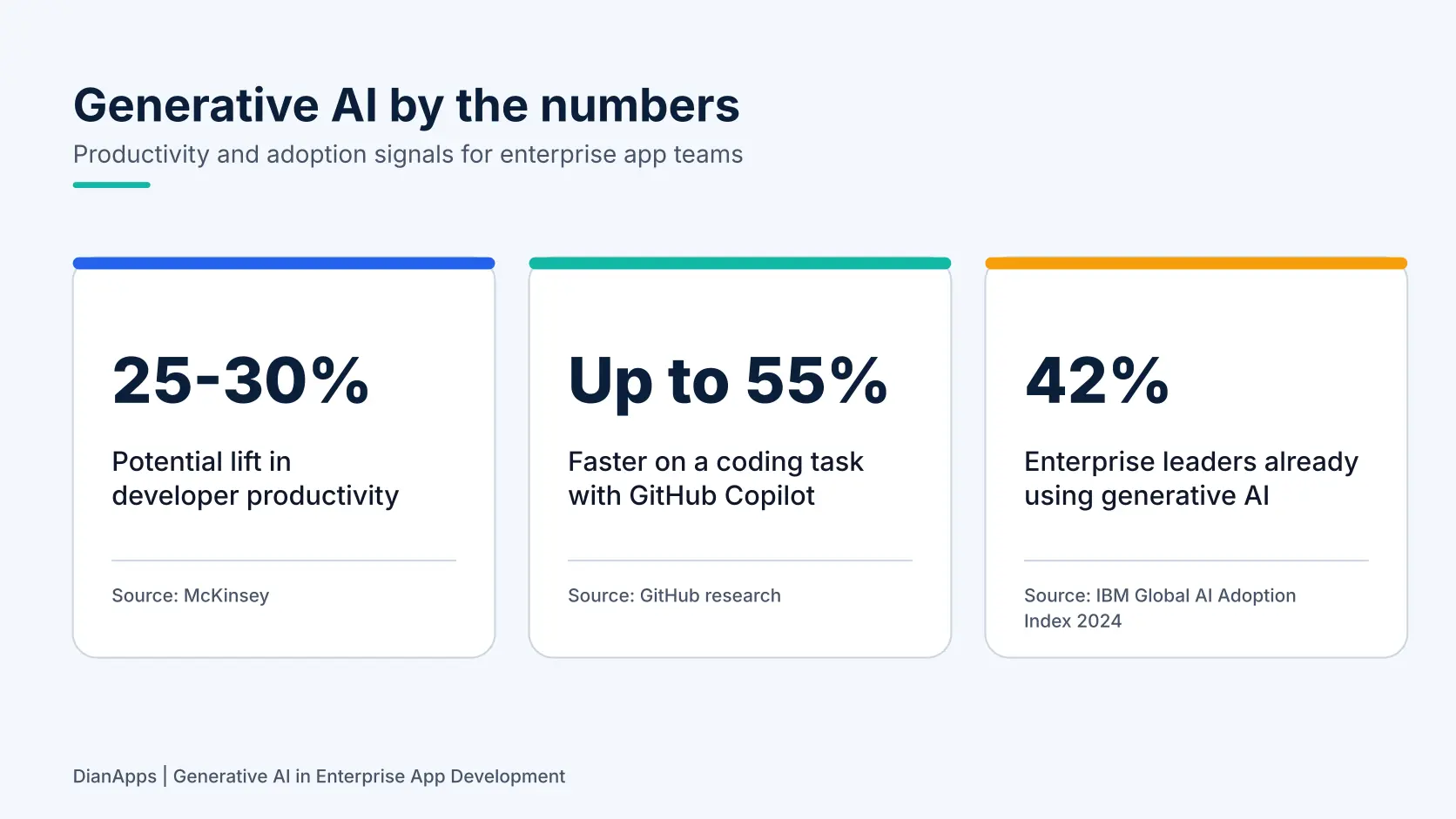
The interest is backed by data. McKinsey research suggests generative AI could lift developer productivity by 25-30%, and GitHub’s own research found developers finished a coding task up to 55% faster with Copilot. IBM’s 2024 Global AI Adoption Index reports that 42% of enterprise leaders have already deployed generative AI. Below, we look at where generative AI in enterprise app development delivers real value, and where enterprises still need to be careful. We also cover practical steps for getting started, so engineering leaders can move from interest to an enterprise AI app development pilot with confidence.
Benefits of Generative AI for Enterprise App Development
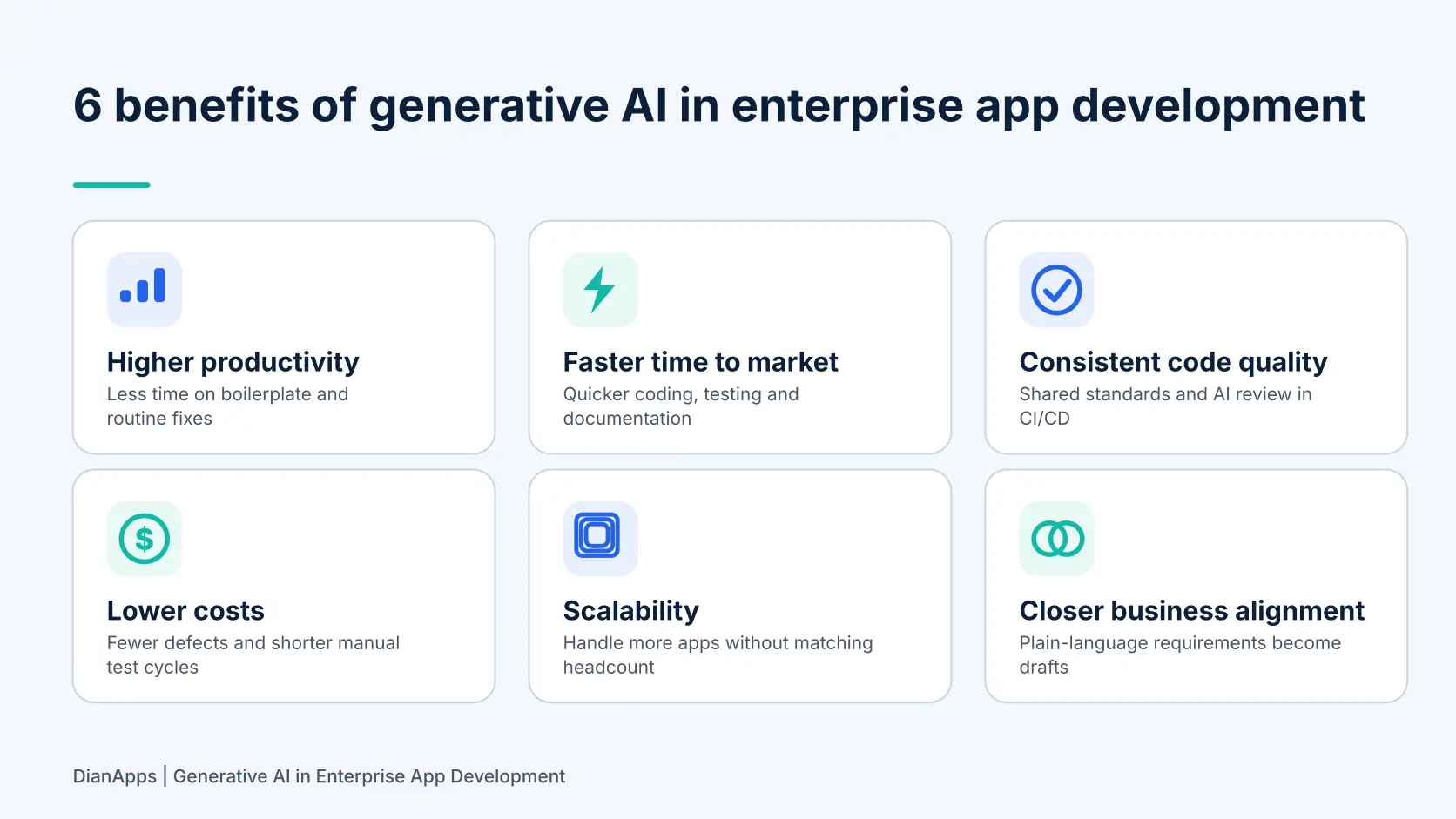
The adoption of generative AI in enterprise app development offers benefits that match enterprise priorities:
-
-
Higher productivity:
AI assistants handle boilerplate, suggestions, and routine fixes, so developers spend their time on architecture and business logic.
-
Faster time to market:
Shorter coding, testing, and documentation cycles help teams ship features and updates sooner. A feature that once needed a full sprint can reach staging in days when first drafts and tests are generated automatically.
-
Consistent code quality:
Generated code can follow shared standards, and AI review catches common errors before they reach production. It can also run inside CI/CD pipelines, so every pull request is checked against team standards.
-
Lower costs:
Less rework and fewer manual testing hours reduce the cost of building and maintaining large applications. Savings usually come from fewer defects reaching production and shorter manual test cycles.
-
Scalability:
As portfolios grow, enterprise AI solutions absorb extra volume without a matching rise in headcount.
-
Closer business alignment:
Teams can turn plain-language requirements into working drafts, which narrows the gap between business goals and technical delivery.
-
Ready to Bring Generative AI Into Your Enterprise App?
Stop experimenting without a plan. Talk to our AI and app development experts to map the right use cases, tools and pilot scope for your enterprise project.
Together, these gains explain why enterprise app development teams are making AI-assisted workflows, and enterprise AI development more broadly, part of their standard delivery model instead of treating them as side experiments. The strongest results appear when leaders set clear goals for each benefit and track them over time.
Read more:- Generative AI development companies
Use Cases of Generative AI in Enterprise App Development
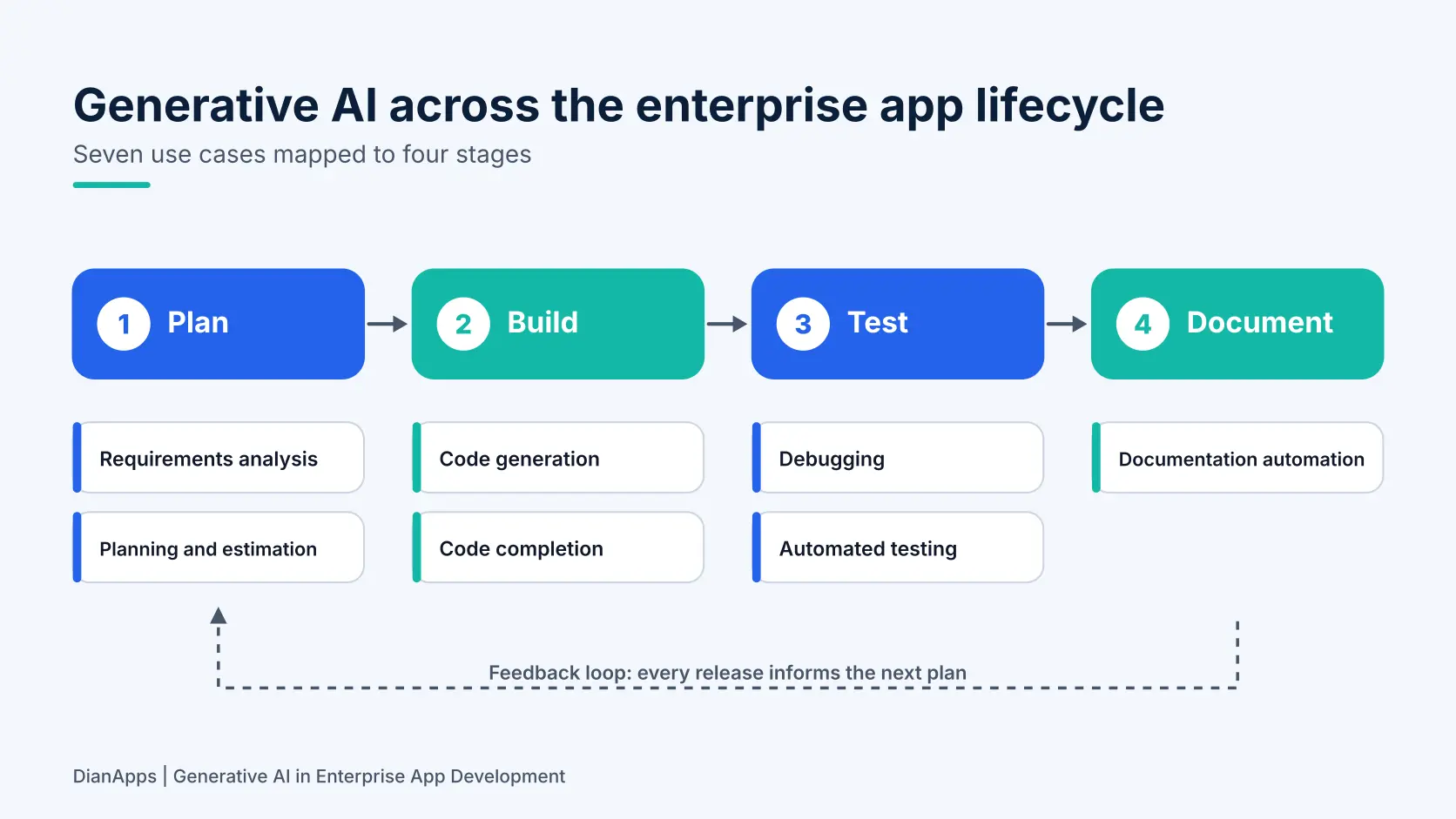
Large organizations apply generative AI across the whole app development lifecycle. These are the use cases with the clearest returns.
Code Generation
Generative AI can turn natural language prompts into working code blocks, functions, and even full modules. A developer describes an API endpoint, a screen layout, or a data validation rule, and the model returns a first draft in the chosen language. Tools such as GitHub Copilot and Amazon Q Developer are common examples. For enterprise app development, this speeds up scaffolding for new services, internal tools, and AI-powered mobile app development for enterprises. For example, a developer building a mobile banking app can prompt for a secure login flow with token refresh, then adapt the result to the team’s architectural patterns. Developers still review every output, but starting from a draft is far quicker than starting from a blank file. It also helps teams prototype ideas quickly, so stakeholders can react to something real early in the project.
Code Completion
Beyond full generation, AI code completion predicts the next line or block as a developer types. It learns from the surrounding context, naming conventions, and project structure. In large codebases with many contributors, this reduces typing, cuts syntax mistakes, and keeps style consistent between teams. New engineers benefit most, because suggestions help them follow existing patterns while they learn an unfamiliar system.
Debugging
AI debugging tools read error messages, stack traces, and related code, then explain the likely cause and propose a fix. Pasting a crash log from a failing payment service, for instance, can return the probable null reference and a patch to test. Instead of searching through logs for hours, developers get a starting point within seconds. Generative AI can also flag risky patterns, such as unhandled exceptions or insecure functions, before they cause incidents. For enterprises running legacy systems with thin documentation, this support shortens the time spent tracing faults.
Automated Testing
Testing is one of the biggest bottlenecks in enterprise app releases, especially across many devices and operating systems. Generative AI can write unit tests, build edge-case scenarios, use synthetic data generation to keep real customer records out of test environments, and update scripts when the code changes. These tests then run automatically in the CI/CD pipeline on every build. Automated testing powered by AI widens coverage without a large manual effort, and it lets QA teams focus on exploratory and risk-based work. The result is faster regression cycles and fewer defects slipping into production. Many enterprises also use AI to keep test suites healthy, since outdated scripts are a common source of false failures and slow pipelines.
Documentation Automation
Few teams enjoy writing documentation, and it often falls behind the code. Documentation automation lets generative AI produce code comments, API references, release notes, and onboarding guides straight from the source. Updates follow each change, so the material stays current. This matters in enterprises where staff turnover is common and new developers must understand systems they did not build.
Requirements Analysis
Poorly defined requirements cause expensive rework. Generative AI can read stakeholder notes, emails, and meeting transcripts, then draft user stories, acceptance criteria, a list of open questions, and outlines of API contracts for architects to review. It can also spot conflicts or gaps between requirements. Business analysts remain responsible for the final scope, but AI shortens the path from a rough idea to a clear specification that engineers can build against. Fewer misunderstandings at this stage mean fewer costly changes late in enterprise AI application development.
Project Planning and Estimation
Generative AI can use past project data to suggest task breakdowns, effort estimates, and likely risks. It can also help teams compare architecture options early, such as monolith versus microservices, before budget is committed. Managers can test different delivery scenarios and see how a change in scope affects the schedule. Estimates will never be perfect, but data-informed planning reduces guesswork and supports more honest conversations with stakeholders about timelines and trade-offs.
Challenges in Adopting Generative AI for Enterprise App Development
The potential is large, but enterprises should plan for several challenges before scaling enterprise AI app development.
-
Security and data privacy:
Prompts may contain proprietary code or customer data. Teams need approved tools, access controls, and clear rules about what can be shared with external models. Many enterprises choose private deployments of enterprise AI solutions so that prompts and outputs stay within their own environment.
-
Code accuracy and quality:
AI output can look correct and still contain bugs, outdated patterns, or security flaws. Human review and automated scanning remain essential.
-
Intellectual property and compliance:
Organizations in regulated sectors must understand licensing, auditability, and regional data rules before adopting any tool. Legal, security, and engineering leaders should review tool terms together, rather than leaving the decision to a single team.
-
Integration with legacy systems:
Generative AI platforms often lack the clean interfaces that AI tools expect, so integration can take real engineering effort. Wrapping older systems with APIs or modernizing key components first often makes AI-assisted work far smoother.
-
Skills and change management:
Developers need training in prompt writing and AI-assisted review, and some will resist new workflows without clear communication.
-
Unclear returns:
Without defined success metrics, such as cycle time or defect rates, it is hard to prove value and justify wider rollout.
A phased approach works best: start with a low-risk pilot, measure results, set governance rules, and expand from there.
Want an Accurate Quote for Your Enterprise AI App?
Stop guessing your development costs. Share your requirements and get a transparent, step-by-step cost breakdown tailored to your project scope.
Conclusion
Generative AI is becoming a practical part of how enterprises build and maintain applications. From code generation and debugging to documentation and planning, it removes friction across the lifecycle and frees skilled engineers for higher-value work. The organizations that benefit most pair the technology with sound governance, human review, and clear goals. If your team is exploring generative AI in enterprise app development, a focused pilot is the best first step. Pick one workflow, such as testing or documentation, define two or three measurable goals, and review the results after a few sprints. That evidence will guide where to invest next and how to scale responsibly.
 0 comments








Your email address will not be published. Required fields are marked *