














 0 comments





Key Takeaways:
- 62% of organizations are at least experimenting with AI agents, yet only 23% are scaling one anywhere in the enterprise.
- Gartner predicts over 40% of agentic AI projects will be canceled by the end of 2027 due to rising costs, unclear value or weak risk controls.
- Ready-made agents are deploying in days and suit standard, low-risk use cases like FAQ handling and first-draft content.
- Custom AI agent development is the stronger choice when workflows touch legacy systems, regulated data or logic that differentiates your business.
- Specialist-partnered AI projects are succeeding about 67% of the time, roughly twice the rate of purely internal builds.
- Prove value with an off-the-shelf tool or API, then move the workflows that matter into a custom agentic system.
Quick Answer: Choose an off-the-shelf AI agent when the use case is generic, low-risk and needs to be live this month. Choose custom AI agent development when the agent must write back into core systems, process regulated data or encode logic competitors do not have. Most enterprises are doing both, a bought tool for commodity tasks and a custom build, often through AI agent development services, for revenue-critical workflows.
Agentic AI is moving from demo to default faster than enterprise plans. Every quarter the pressure on technology leaders grows. Gartner predicts that forty percent of enterprise applications will have task‑specific AI agents by the end of 2026 up from than five percent in 2025.
The real question is no longer whether to adopt AI agents but whether to build them, buy them or set them up on a low‑code platform. Each path has different costs, risks and limits.
This guide breaks down custom AI agent development, versus off‑the‑shelf agents with a detailed comparison, five tipping points, a decision framework, a total‑cost‑of‑ownership model and a buyer’s checklist.
Custom AI Agent Development vs Off-the-Shelf Agents
Ready-made agents are cheaper to start and faster to launch while custom agents are affordable to scale and go deeper into integration and data control.
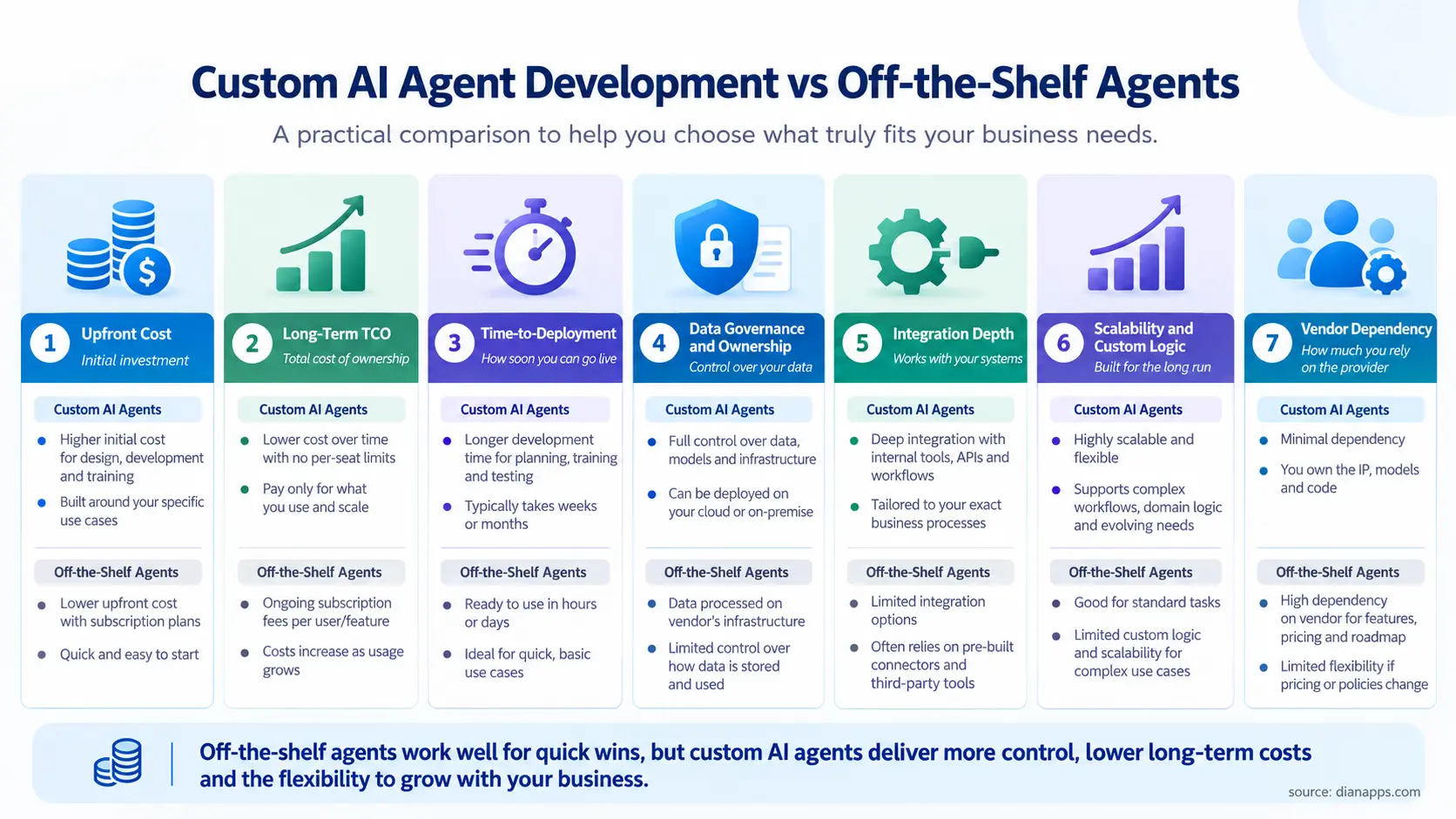
- Upfront Cost: Off-the-shelf AI agents usually need an initial payment often through monthly subscriptions or fees per user. Custom AI agents on the hand require a larger upfront investment. This includes the cost of understanding the needs, designing the system and building it from the ground up.
- Long-Term TCO: Over time off-the-shelf solutions may grow more expensive. As more users join, token usage increases and additional features are added the total cost can go up significantly. Custom AI agents also have costs. These include infrastructure, model usage and maintenance.. Once the system is up and running these costs tend to be more stable and easier to predict.
- Time-to-Deployment: Ready-made AI agents can be set up quickly. They are often ready to use in a few days or a couple of weeks. Custom AI agent development takes longer. A minimum viable product that is ready for use usually takes between six and sixteen weeks. The exact time depends on how big the project is and how complex the goals are.
- Data Governance and Ownership: With off-the-shelf agents data is processed on the vendor’s servers. The vendor controls how the data is stored, secured and used and users must follow the vendor’s terms. Custom AI agents give businesses control. They can choose where to host the data, how long to keep it, what encryption to use and which models to run. This gives freedom and better alignment with internal policies.
- Integration Depth: Off-the-shelf agents come with tools to connect with some systems.. These connections are often limited, they may not work well with systems or with complex business processes. Custom AI agents can connect deeply. They can access APIs, older databases and enterprise systems like ERPs. They can also write data making them more flexible for real-world use.
- Scalability and Custom Logic: Off-the-shelf agents can handle users, their ability to change how workflows work is limited. They only support the options the vendor provides. Custom AI agents allow for control. Businesses can build their logic, create complex workflows and even manage multiple agents working together. This makes them much better for evolving needs.
- Vendor Dependency: Off-the-shelf solutions depend a lot on the vendor. Changes in pricing, roadmap or models can affect how the system works. Custom AI agents reduce this risk. Since businesses own the code prompts and how the system is organized they are not tied to any company. They have control and can adapt when needed.
Takeaway: If the deciding factor is speed this quarter, buy. If it is control, integration or cost at scale over three years, build.
What is Custom AI Agent Development?
Custom AI agent development means designing, building and putting into use AI agents that are made to match the workflows, data and systems of a particular organization. We have seen how Custom AI agent development can change a business rather than choosing a ready to use tool engineers choose the models, tools, memory and permissions that Custom AI agent uses allowing Custom AI agent to think about proprietary data and perform real actions, inside business systems.
What separates professional custom AI development services from a prompt wrapper is the architecture that lies underneath.
A production‑grade Custom AI agent is usually built from four layers.
- Custom Tool Selection: The agent is given exactly the tools it needs, such as a pricing API, an inventory query or a ticket-creation endpoint and nothing it should not touch.
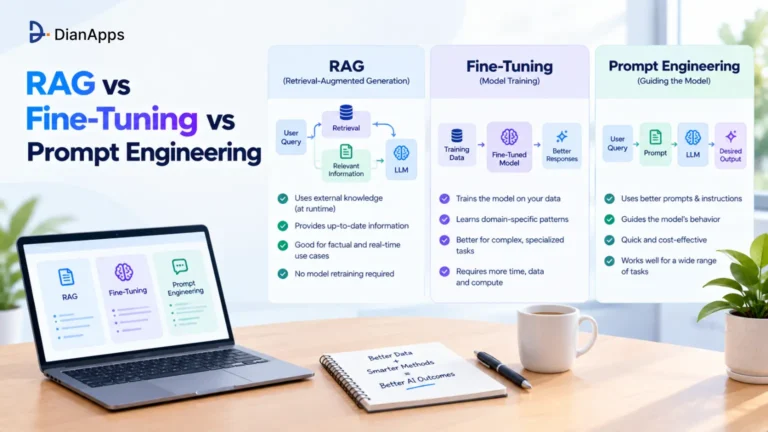
- Custom Memory Architecture: Teams are choosing between RAG (Retrieval-Augmented Generation), which pulls fresh knowledge from your documents at query time and fine-tuning, which bakes domain behavior into the model itself. Most enterprise agents are starting with RAG because it is cheaper to update and easier to audit. Understanding the differences between RAG, fine-tuning and prompt engineering can help teams select the right approach for their agent’s data and reasoning requirements.
- Multi-Agent Orchestration: Complex workflows are split across specialist agents, for example a planner, a researcher and an executor, coordinated through frameworks like LangGraph, CrewAI or the OpenAI Agents SDK.
- Deep API Execution: The agent is not only reading data, it is writing back, creating purchase orders, updating CRM records or triggering approvals under defined permission scopes.
Key Enterprise Benefits of Custom AI Agent Development
- IP ownership: The orchestration logic, prompts, evaluation sets and integrations belong to you, which is making them a durable asset rather than a rented feature.
- Granular data security: Agents can run inside your own cloud or VPC (Virtual Private Cloud) with role-based access and audit trails aligned to GDPR, HIPAA or PIPEDA requirements.
- Model flexibility: You can swap between GPT-4o, Claude, Gemini or open-weight models like Llama as pricing and performance change.
- Competitive advantage: When your agent encodes the way your business uniquely operates, competitors cannot buy the same capability off a shelf.
What Are Off-the-Shelf AI Agents?
Off-the-shelf AI agents are -built AI tools that come as SaaS products, vertical bots or features added to platforms you already use. These agents are set up rather than built from scratch, which means they can be launched quickly.. Because they are limited to what the vendor decides to support, their capabilities are also limited.
This category covers a range of tools. It includes AI features built into customer relationship management systems and help desk platforms. It also includes bots for industries like real estate or e-commerce. Then there are general-purpose agent builders that’re part of productivity suites. All of these fall under the umbrella of off-the-shelf AI agents.
Strengths of Off-the-Shelf Solutions
- Instant deployment: Many tools are going live in days with templates for common use cases.
- Lower initial outlay: A monthly subscription replaces a capital project, which is easier to approve.
- Vendor-managed maintenance: Model upgrades, uptime and security patches are the vendor’s responsibility.
- Proven patterns: Standard workflows like ticket triage or meeting summaries are already tested across thousands of customers.
Inherent Limits
- Shared vendor infrastructure: Your data is processed in the vendor’s environment, under the vendor’s retention and sub-processor terms.
- Read-only connectors: Many prebuilt integrations can read records but cannot safely write back into ERPs or custom databases.
- Vendor lock-in: Prompts, workflows and conversation history often cannot be exported cleanly if you leave.
- Generic workflows: The agent is behaving the way the vendor designed it, not the way your process actually runs.
There is also an “agent washing” problem buyers should know about. Gartner estimates only about 130 of the thousands of vendors marketing agentic AI are offering genuine agentic capabilities (Gartner) and 40% will be canceled. Many products are rebranded chatbots or RPA tools, so testing real autonomy before signing is essential.
When Does an Off-the-Shelf AI Agent Stop Being Enough?
An off-the-shelf AI agent stops being enough when the work it needs to do is crossing system boundaries, data restrictions or cost thresholds that the vendor was never designed to handle. If two or more of the tipping points below apply to you, a custom build is usually the better long-term path.
1. Your Workflows Span Multiple Legacy Systems or Complex Permission Models
A ready-made agent is working well inside one app. The moment a task needs data from SAP, a 15-year-old SQL Server database and Salesforce, under different user permissions, prebuilt connectors are running out of road.
2. Proprietary Data Privacy Requirements Prevent Third-Party Cloud Processing
Healthcare records, financial transactions and legal files often cannot leave your environment. If your compliance team is blocking vendor processing, a self-hosted custom agent is the only compliant option.
3. Subscription Scaling Costs Exceed Custom Development TCO Over 3 Years
Per-seat and per-token pricing is looking cheap at 20 users and painful at 2,000. When your projected three-year subscription spend passes the cost of building and running your own agent, buying is no longer the economical choice.
4. Off-the-Shelf Agents Fail at Multi-Step Tasks Requiring Deep Write-Back Access
Summarizing a ticket is easy, resolving it end to end is not. Tasks like issuing a refund, updating inventory and notifying the customer are needing orchestrated write access most packaged tools do not allow.
5. Your Competitive Differentiation Relies on Unique Operational Logic
If your underwriting rules, pricing models or routing logic are what make you better, putting them inside a generic tool is giving away your edge. Custom AI agent development is keeping that logic private and improvable.
Should I Build a Custom AI Agent or Use a Platform? (Decision Framework)
We recommend buying off‑the‑shelf when the use case’s standard is low risk and time sensitive. We also suggest building custom when the agent touches core revenue, proprietary data or compliance‑heavy workflows. If you are uncertain, start a hybrid. Let a proof of concept tell you which direction is best.
Use the framework below to decide between custom AI agent development and off‑the‑shelf agents for each use case, scoring it against budget, timeline and strategic priority; the question of custom AI agent development versus off‑the‑shelf agents can be settled using this framework.
- Budget: We recommend buying ready‑made agents if your first‑year budget’s below $25,000. If you need funding in phases choose an approach. If you can commit to a long‑term investment, build custom agents.
- Timeline: We find ready‑made agents work best when you need to deploy within thirty days. A hybrid approach can give you a proof of concept in weeks and full production in a quarter. Custom development usually takes two to four months.
- Strategic Priority: We advise using ready‑made agents for commodity tasks. We suggest an approach for important but untested use cases. We think custom agents are best for main revenue drivers or features that set you apart.
- Data Sensitivity: Ready‑made agents are suitable for low‑risk data. Hybrid solutions can use data during proof‑of‑concept testing. Custom agents give you control for regulated or proprietary information.
- Integration Needs: We recommend ready‑made agents when you only need to connect one or two SaaS applications. We suggest solutions for multiple systems that start with read‑only access. We advise custom development, for legacy systems that need write‑back capabilities.
Not Sure Whether to Build or Buy Your AI Agent?
Get expert guidance on choosing the right AI agent approach for your workflows, budget, integration needs and long-term business goals.
Takeaway: If most of your answers land in one column, that is your path. A split result is usually pointing to a hybrid.
When to Buy Off-the-Shelf?
- Basic FAQ bots: Answering policy, shipping or account questions from a public knowledge base.
- Routine marketing drafts: First drafts of emails, social posts and product descriptions.
- Meeting and document summaries: Internal productivity tasks with low error cost.
- Standard ticket triage: Tagging and routing inside a single help desk tool.
When to Build Custom?
- Core revenue drivers: Sales, underwriting, claims or pricing workflows where agent accuracy is affecting revenue directly.
- Unique data workflows: Processes that combine proprietary datasets no vendor can access.
- Strict compliance needs: HIPAA, GDPR, PIPEDA, SOC 2 or sector rules that demand self-hosting and full audit trails.
The Hybrid Approach
The hybrid path is starting with off-the-shelf APIs, such as hosted GPT-4o or Claude models, to build a fast proof of concept on a narrow workflow. Once the POC is proving measurable value, the team is moving into full custom agentic development with proper orchestration, guardrails and integrations.
Hybrid is reducing risk because you are spending custom-build money only after the business case is proven. This also aligns with Gartner’s advice that agentic AI should be pursued only where it is delivering clear value or ROI (Gartner, 2025).
Can Non-Developers Build Custom AI Agents?
Yes, non-developers can build useful AI agents on low-code and no-code platforms but mostly for contained, low-risk workflows. Once an agent needs secure write access to core systems, complex orchestration or regulatory compliance, professional engineering is still required.
Custom AI agent model development for non-developers is a real and growing category. It typically includes three kinds of tools.
- Visual agent builders: Drag-and-drop canvases like n8n, Microsoft Copilot Studio or Zapier Agents, where business users chain triggers, AI steps and actions.
- Prompt interfaces: Configurable assistants, such as custom GPTs or Claude Projects, that are given instructions and documents without code.
- Low-code connector studios: Platforms that wrap common SaaS APIs into reusable blocks a citizen developer can configure.
Where Non-Developer Platforms Work Well?
- Departmental automations: Lead enrichment, internal Q&A or report generation within one team.
- Rapid prototyping: Testing whether an agent idea is worth funding before engineering gets involved.
- Low-stakes outputs: Tasks where a human reviews every result before it is acted on.
Where You Need a Custom AI Agent Development Company?
- Production reliability: Error handling, retries, evaluation suites and monitoring that visual builders rarely cover.
- Security and access control: Fine-grained permissions, secrets management and audit logging.
- Scale and cost control: Token optimization, caching and model routing that keep per-task costs predictable.
- Complex orchestration: Multi-agent systems with planning, memory and human-in-the-loop checkpoints.
Low-code is a great way to discover what an agent should do, a custom AI agent development company is how you make it run safely at scale. Many teams are bringing in AI agent consulting at exactly this handoff point.
The True Cost of Ownership: Upfront vs. Long-Term ROI
Off-the-shelf agents are cheaper in year one but their costs are growing with every seat and token. Custom agents are costing more upfront and then flattening, so the break-even point usually depends on how many users and transactions you are running.
Financial Comparison: An Illustrative 3-Year Model
The model below is using illustrative assumptions not quotes, so you can see how the custom AI agent development vs off-the-shelf agents math behaves. Replace each figure with your own vendor pricing and build estimates.
Assumptions:
- Off-the-shelf pricing: $30 per user per month, before usage overages or premium tiers.
- Custom build cost: $120,000 one-time for discovery, development and integration.
- Custom running costs: $4,000 per month for cloud infrastructure and model API usage, plus 20% of the build cost per year for maintenance.
- For 100 users: Off-the-shelf agents cost $108,000 over three years. A custom build would cost $336,000. At this size buying an existing solution is the choice.
- For 500 users: The cost of off-the-shelf agents goes up to $540,000. A custom build stays around $336,000. This means a custom build can save about $204,000 over three years.
- For 1,000 users: Off-the-shelf agents come to around $1.08 million in three years. A custom build costs about $380,000 with infrastructure use. This leads to savings of $700,000.
Note: All figures are illustrative and exclude internal staff time, change management and vendor overage fees.
Takeaway: In this example, the break-even point is landing at roughly 310 users. Below that, buying is cheaper, above it, custom is pulling ahead every month.
Hidden Costs on Both Sides
- Off-the-shelf hidden costs: Seat escalation, token overages, premium connector tiers, annual price increases and the cost of migrating out later.
- Custom hidden costs: Model API usage spikes, ongoing prompt and evaluation tuning, MLOps (Machine Learning Operations) monitoring and the internal time needed for requirements and testing.
How to Calculate ROI for Custom vs Off-the-Shelf Agentic Systems?
Use the same formula for both options so the comparison is fair:
ROI = (Annual value created − Annual total cost) ÷ Annual total cost × 100
- Labor value: Hours saved per task × tasks per year × fully loaded hourly cost.
- Error reduction: Rework, refunds or compliance penalties avoided.
- Revenue lift: Faster quotes, higher conversion or reduced churn attributable to the agent.
- Total cost: Licenses or build amortized over three years, plus infrastructure, maintenance and oversight time.
The highest returns are often hiding in back-office work, not front-office tools. MIT’s NANDA research found more than half of generative AI budgets going to sales and marketing, while the biggest ROI was appearing in back-office automation (MIT NANDA, 2025).
How to Choose the Right Path (And When to Hire AI Agent Consulting)
Choose your path by scoring the use case on value, risk, integration depth and scale, then validate it with a small proof of concept. Bring in AI agent consulting when the workflow is business-critical, touches regulated data or needs architecture decisions your team has not made before.
Evaluation Checklist for Business Leaders
- Business outcome: Can you state the metric this agent will move and by how much?
- Workflow mapping: Have you documented every system, handoff and exception the agent is touching?
- Data classification: Do you know which data is regulated, proprietary or safe to send to a vendor?
- Integration depth: Does the agent need read access only or write-back into core systems?
- Scale forecast: How many users and transactions are you expecting in years one, two and three?
- Risk tolerance: What happens when the agent is wrong and who is reviewing its actions?
- Exit plan: If you buy, can you export your prompts, data and workflows later?
The Role of an Expert Custom Agentic AI Development Company
There is strong evidence that partnering is outperforming going solo. MIT’s NANDA study found that AI projects run with specialized vendors and partners are succeeding about 67% of the time, while purely internal builds are succeeding only about a third as often (MIT NANDA, 2025). The lesson is not “never build”, it is “do not build alone”.
A capable custom agentic AI development company adds value at three stages: workflow audits, model architecture choices and production monitoring. For businesses evaluating external partners, comparing AI agent development companies in the USA can help narrow the shortlist based on technical expertise, integration experience and enterprise delivery capabilities.
A capable custom agentic AI development company is adding value at three stages:
- Workflow audits: Identifying which processes are genuinely agent-ready and which are better served by simple automation or an off-the-shelf tool.
- Model architecture choices: Selecting models, deciding between RAG and fine-tuning and designing multi-agent orchestration around cost and accuracy targets.
- MLOps and monitoring: Setting up evaluation suites, guardrails, audit logs, drift detection and cost dashboards so the agent stays reliable after launch. Regularly testing and evaluating AI agents also helps teams identify accuracy issues, measure performance against business goals and catch failures before they affect production workflows.
How DianApps Approaches Custom AI Agent Development?
DianApps, a mobile and AI app development company, is building custom AI agents for enterprises and scaling startups across 25+ countries with a team of 150+ engineers, 450+ clients served and U.S. delivery presence. As a custom AI agent development company, DianApps is rated 4.8/5 on Clutch across 84+ reviews and holds Premier Verified status.
What is making the difference is full-cycle capability, AI, mobile, web, backend and DevOps are all sitting under one team. That means the agent, the app your users touch and the infrastructure it runs on are designed together. DianApps’ AI Agent Development Services cover LLM development, generative AI, conversational AI, multi-agent systems, NLP and computer vision, helping businesses build AI solutions around their specific workflows and integration requirements.
We are also honest about where custom is not the answer. If an off-the-shelf tool is solving your problem at your scale, our AI agent consulting team will tell you and help you configure it well.
Conclusion: Build, Buy or Both
The custom AI agent development vs off-the-shelf agents decision is not a one-time verdict, it is a portfolio choice. Buy for commodity tasks, build for the workflows that drive revenue, risk or differentiation and use a hybrid POC when you are not yet sure.
The organizations scaling agentic AI successfully are the ones tying every agent to a measurable outcome, modeling three-year TCO honestly and partnering with experienced engineers rather than going it alone.
If you are mapping your agentic AI roadmap, DianApps can audit your workflows, model the costs of each path and recommend the right mix, even when that answer is a tool you can simply buy.
 0 comments





Leave a Comment
Your email address will not be published. Required fields are marked *