















 0 comments





Key Takeaways:
- Evaluating autonomous software agents requires testing multi-step execution paths, API tool calls, and state persistence rather than just static text outputs.
- Comprehensive AI agent evaluation relies on tracking trajectory accuracy, schema validation compliance, and step-level latency across dynamic operational runs.
- Relying on LLM-as-a-judge scoring often introduces position bias and inconsistency that require few-shot reference calibration and deterministic guardrails.
- Building curated golden evaluation datasets based on actual production failures prevents regressions and runaway token consumption during iterative sprints.
- Integrating automated evaluation pipelines into regular pull request workflows ensures fragile prompt adjustments do not break upstream database integrations.
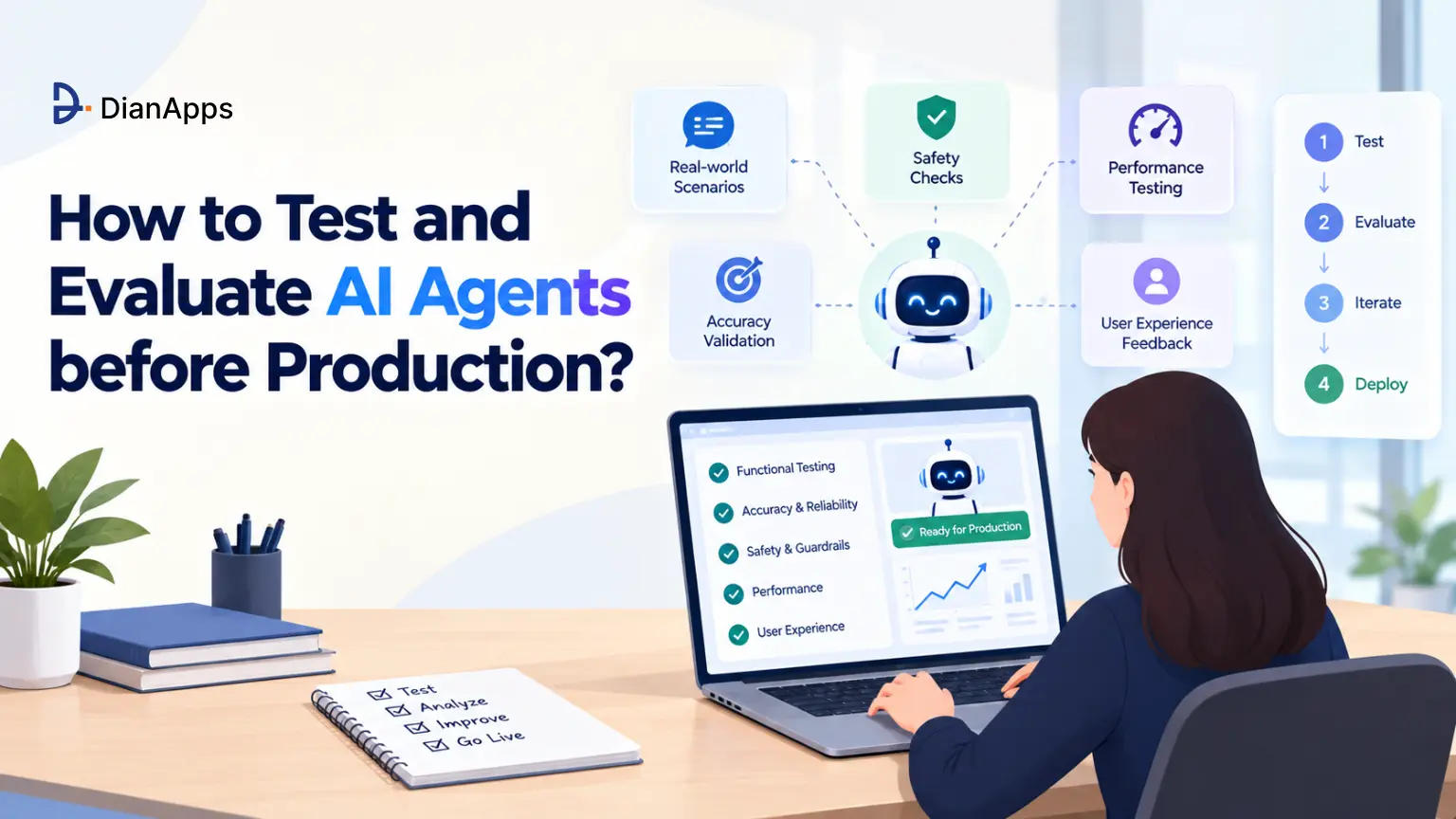
Quick Answer: AI agent evaluation requires testing dynamic reasoning trajectories, API tool-calling accuracy, state management, and edge-case error recovery across multi-step execution graphs before releasing autonomous workflows into live production environments.
Shipping an autonomous software agent can feel terrifying. We have all seen it happen: an agent works fine during a brief demo, yet once it touches real accounts, it hallucinates database queries, triggers infinite API loops, and burns thousands of dollars in tokens before anyone notices. It is a genuine headache. Traditional testing relies on deterministic assertions where input X always yields output Y. With probabilistic agents executing dynamic tools, that testing playbook completely falls apart.
This is not suggested for engineering leaders managing critical enterprise workflows, and to tackle that, software teams are now establishing rigorous AI agent evaluation frameworks that test planning logic, validate schema parameters, and stress-test failure modes before code ships to production. This also is helping engineering teams get rid of unpredictable model behavior and improving overall deployment confidence.
Now, why is evaluating autonomous systems so tricky? Well, with non-deterministic reasoning steps and variable API responses, there were always painful operational bottlenecks that needed a permanent fix, let us take a look.
Why AI Agent Evaluation is Different from Traditional Software Testing?
Quality assurance teams used to depend on deterministic unit tests, integration test cases, and end-to-end browser automation scripts. These approaches served well for single-step services with predictable outputs. But in a multi-agent, multi-step system where agents decompose problems into sub-tasks, invoke external webhooks, and assess their internal results, conventional unit tests break every time and lead to:
- Unit test pass but agents jump into recursive execution loops in live staging.
- Fake API calls conceal bugs in parameter formatting that takes down production databases.
- Flaky test suites where the same prompts with change in tokens get false negatives.
- Engineering teams who haven’t identified the cost of trajectory, token bloat, and step level latency.
- Silent logic failures where agents give a polite response but background transaction fails.
Such deficiencies not only frustrate the engineering teams that build generative software but weaken organizational faith in the software. As such, comprehensive AI agent evaluation requires augmenting single-input-and-output comparison with trace capture of all intermediary tool interactions.
Where a microservice would hand back a static JSON, an Autonomous Agent is a state machine – it plans, chooses tools, extracts data, updates its memory, and determines if it should continue or stop. Any single choice can only be truly judged by seeing the whole chain of thought. When a team overlooks trajectory visibility, small missteps escalate quickly and break within seconds of using money to burn billions of dollars of compute.
Core Engineering Challenges in AI Agent Testing
As engineering leads venture into the design of an automated pipeline for AI agent testing, there are immediate structural challenges they face when designing around agentic architectures. Let us break it down.
Non-Deterministic Trajectories and Path Explosion
Given the same prompt, an autonomous agent might go down different paths in different runs. On run 1, it queries a vector store. On run 2, it queries a SQL database. Both paths eventually get the answer, but brittle test scripts mark the difference as a failure. Path explosion is one of the challenges here.
Stateful Memory Drift Across Multi-Turn Interactions
Workflow agents are stateful over many dozens of turns. As the context expands, prompt buffers begin to fill with noise. This bloat leads the agents to forget instructions or retrieve stale entries from vector stores. To test behavior on turn twenty-five, you need multi-turn synthetic test fixtures rather than a single prompt.
Flaky Tool Interfaces and Environmental Dependencies
Autonomous agents rely on third-party APIs. An inventory API can, for example, be slow or cut off the returned JSON. Poorly tested agents hallucinate parameters or throw an exception. Testing should ensure that the agents retry with backoffs on network timeouts and escalate to a human when faced with an unresponsive third-party API.
Evaluation Latency and Token Expenses
Running hundreds of end-to-end agentic test cases on every code commit can easily become slow and expensive. Teams need to weigh the cost of lightweight local unit assertions against end-to-end integrations.
Need Custom AI Agent Architecture?
Work With our Autonomous Agents Engineering Team Build, assess, and implement autonomous agent workflows that are ready for production.
What Metrics Measure AI Agent Accuracy and Performance?
Units to ensure each impression has a clear and measurable baseline. Engineering teams should track definitive AI agent evaluation metrics to verify that changes made to the model, prompt changes, tool refactors and everything in between result in performance improvements:
- Goal Completion Rate: Did the agent successfully execute an intent on behalf of the user, like paid invoices or resolved a support ticket? Comparing binary completion rates from validation datasets can serve as a baseline for deployment.
- Tool Selection and Argument correctness: Checks if the argument was the correct one for the chosen tool and the parameters returned by the tool adhere precisely to the expected Pydantic schema. This stops malformed queries and incorrect types from reaching the production database.
- Trajectory Efficiency and Step Count: The agent should be able to attempt to traverse work in a straight line. An agent that makes eighteen calls to a tool to achieve a three-step question experiences reasoning loops. Count steps to avoid unnecessary cycles to avoid spamming; it reduces latency and token expenses.
- Hallucination & Faithfulness Scores: Measures the percentage of generated claims that can be independently fact-checked with the retrieved source context. Flagging ungrounded claims stops agents from passing on made-up information to users.
- Adhering to Negative Constraints: Checks that agents avoid safety constraints such as not revealing customer phone numbers, or not surpassing a set spend limit without authorization. Adversarial test cases confirm that negative constraints stay “firm” even when challenged.
Step-by-Step Framework for AI Agent Evaluation Before Production
To build a robust evaluation harness, you must follow a methodical development sequence. The wrong approach – neglecting to build structures up, testing informally with ad-hoc scripts and failing to follow basic engineering best practices during evaluation – results in brittle stack, late availability. Here are the five proven-steps to AI agent evaluation used by engineering teams:
Step 1: Create Curated Golden Evaluation Datasets
A comprehensive set of test data is the key to effective evaluation of AI agents. Don’t start from sparse synthetic prompts; instead, collect real user questions, edge cases, and logs of failures. Each sample should specify the environment conditions, user request, the expected tool call, an alternative route, and the desired result.
Step 2: Implement Component-Level Deterministic Assertions
Decide between building; and then accelerating; model evaluators, Before spinning up the model evaluators test any deterministic components. Use normal Python unit tests to test that your prompt variables populate correctly, the output parser is robust to malformed JSON and vector scores are above a certain threshold … these fast tests are able to return regressions in a matter of milliseconds.
Step 3: Track Step-Level Execution Paths
Instrument your agent orchestration graph with open-source tracing libraries like Lang Chain Lang Smith or Open Telemetry monitor every intermediate piece of information, intermediate decision, tool output, and tool input. Your engineering teams can store the full execution trace to find the precise instant where the agent lost the plot.
Step 4: Deploy Calibrated Evaluation Judges
For qualitative parameters such as helpfulness, tone and synthesis, include secondary evaluation models. Develop detailed rubrics to assess this work on binary or 1-to-5 scales. Test automated judges against blinded human expert assessments to validate them prior to running in production.
Step 5: Automated Regression Testing in CI/CD
Use evaluation suites in the pull request flow. When engineers change a prompt or tools schema, fire off a test run on the golden set. Fail the merge if goal satisfaction dips below 95% or token burn exceeds 15%.
If your team is exploring complete enterprise architectures or evaluating external development partners to build these systems, our comprehensive analysis of top AI agent development companies provides detailed insights into agency capabilities and technical stacks.
What is LLM-as-a-Judge for AI Agents?
Manual review as an unsustainable bottleneck Generative systems are active in more delicate workflows, requiring thousands of multi-step agent training trajectories per week, which is slow, costly, and reviewer-dependent. To overcome this scalability challenge, engineering teams are adopting llm-as-a-judge architectures.
In this LLM-as-a-judge configuration, the judging role is played by a proficient frontier model, like GPT-4o or Claude 3.5 Sonnet. The judge is presented with the user’s initial prompt, the complete agent trajectory, the retrieved context, the end-agent response, and a rubric. The judge then determines if the agent was faithful to instructions, used the right tools, and accomplished the goal.
Automated Judges These come with huge benefits:real-time feedback loops for developers’ scalability:saving millions of graded scripts at once and running them in a batchmass-consistencylapsed coverage of subject matter.
But trusting an LLM judge as an infallible oracle is risky. Frontier models have cognitive biases such as position bias, verbosity bias and self-enhancement bias. It is important to be aware of these when doing AI agent evaluation at enterprise scale.
LLM as Judge Low Accuracy Solutions for AI Agents Iterative Development
When doing model-based judges for the first time, engineering teams almost always start with frustratingly low agreement scores between the automation and the human ground truth. If the automation judge only agreed with senior engineers 65% of the time, you can assume chaos will ensue if you gate your production releases with it. Practicel LLM as judge low accuracy solutions AI agents iterative workflows.
Decompose Complex Judgments into Single-Criterion Binary Assertions
Multi-criteria prompts a single judge model for helpfulness, conciseness, factuality and tool choice results in noise. Breakdown your pipeline into one attribute in single task prompts, e.g. an agent bought something on the credit card without permission. Single-criterion binary assertions improve judge accuracy during AI agent evaluation runs.
Ground Judges with Few-Shot Reference Exemplars
Zero-shot prompts often get the score criteria wrong. Provide 3-5 fewshot examples in the prompt of good, mediocre, and failed trajectories with scoring explanations. Fewshot calibration gets the judge built directly for your engineering criteria.
Implement Chain-of-Thought Evaluation Before Scoring
Never let an automated judge output scores in a number, solely. Ask the model to make a verbal judge earlier than outputting a grade. Forcing the judge to analyze intermediate calls and state variables, by asking them to verbalize their steps, exposes nuanced logical flaws.
Perform Continuous Human-in-the-Loop Calibration
Create an active learning loop, with engineering leads performing a weekly review of judge decisions for a 5% sample. When a mismatch occurs, look into failure modes, iterate on the rubric, add in a few shots, and rerun the tests. This rigorous iterative development cadence achieves judge alignment above 90% for AI agent evaluation workflows.
Build Resilient Agentic Workflows
Connect with senior AI engineers to establish automated evaluation pipelines and launch production-grade agents.
Best Practices for AI Agent Evaluation in Continuous CI/CD
Building a robust testing culture around autonomous software agents requires establishing clean developer habits. As your team iterates on agent capabilities, keep these proven engineering principles at the forefront of your continuous deployment cycle:
- Separate Deterministic Guardrails from Model-Based Evaluators: Do not waste model tokens verifying things Python checks in microseconds. Use Pydantic models to validate JSON schemas, write regex patterns to detect leaked keys, and enforce database constraints programmatically. Save model evaluators for semantic nuance, reasoning validation, and conversational quality.
- Benchmark Across Tiered Model Configurations: Autonomous agents frequently rely on model routing, directing simple queries to fast models and complex planning to frontier models. Ensure your AI agent evaluation suite benchmarks across all target model tiers. A prompt that excels on top-tier models may fail on smaller models with weaker instruction following.
- Simulate Adversarial Tool Failures and Chaos Scenarios: Production environments are messy. Real APIs fail, servers throw 502 errors, and databases lock unexpectedly. Inject controlled chaos into testing harnesses by mocking erratic API behaviors. Validating error recovery under simulated stress ensures agents remain resilient during live production outages.
For engineering teams seeking expert guidance on designing end-to-end autonomous systems and implementing custom testing infrastructure, partnering with specialized AI development services accelerates the journey from experimental prototypes to robust production deployments.
Final Thoughts
Systematic AI agent evaluation before production is not software engineering. You are not writing boilerplate unit tests against deterministic functions; you are authoring evaluation harnesses against autonomous self-orchestrating decision systems. By incrementally enabling trajectory metrics, calibrating automated evaluation judges, and gating regressions into your CI/CD pipeline, you insulate your business from expensive model failures, smother out runaway cloud bills, and keep your customers’ experience intact. Teams that prioritize rigorous evaluation from the get-go will deliver more quickly, iterate more boldly, and craft agents that actually work.
 0 comments












Leave a Comment
Your email address will not be published. Required fields are marked *