















 0 comments





Key Takeaways:
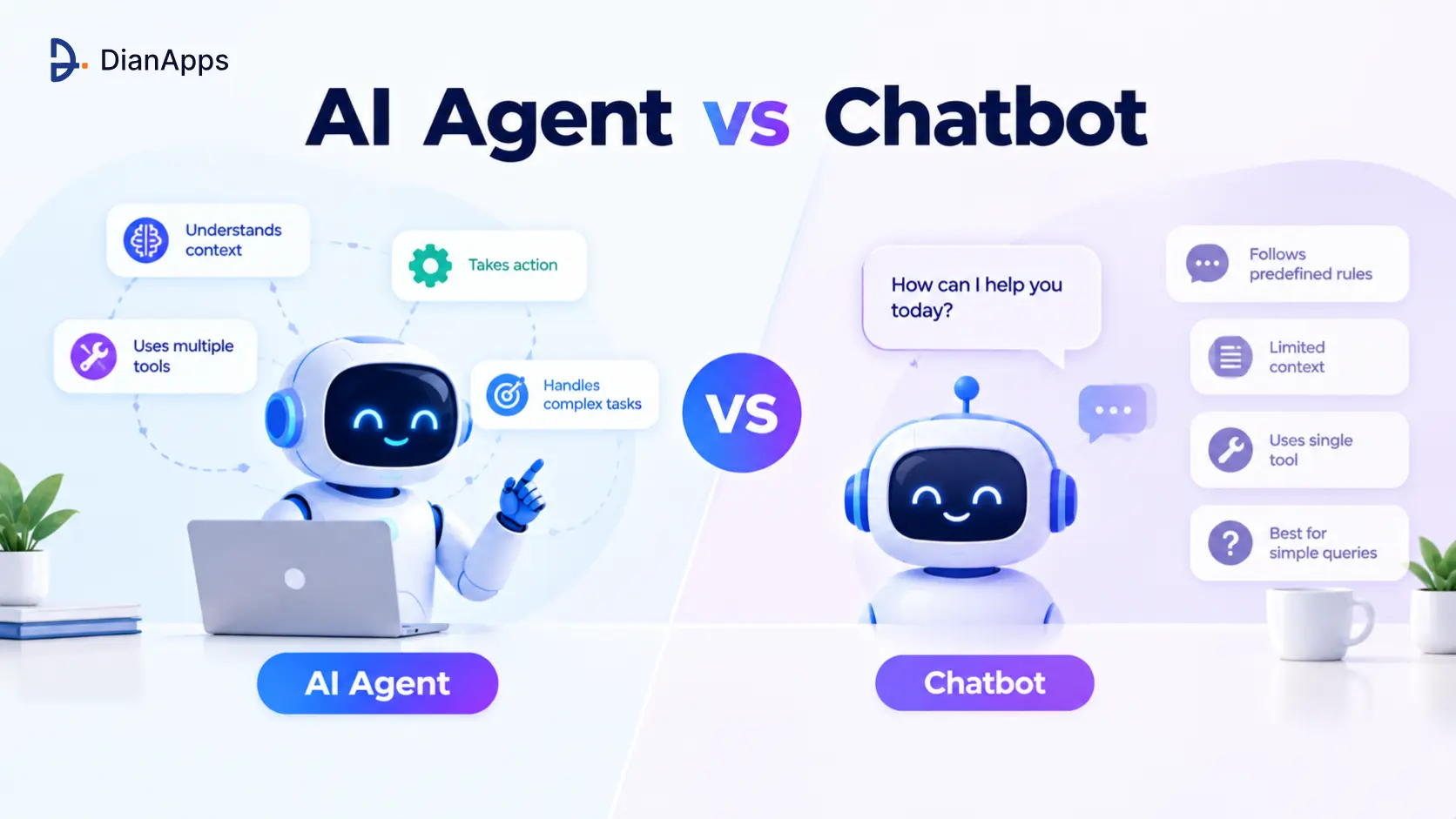
- Chatbots answer questions, while AI agents can plan, use tools, and complete tasks.
- Chatbots fit information-based requests; agents fit multi-step workflows and actions.
- AI agents cost more because they need integrations, testing, guardrails, and ongoing monitoring.
- Many businesses can start with a chatbot and gradually add agent capabilities.
- The right choice depends on task complexity, risk, integrations, and measurable outcomes.
Quick Answer: A chatbot answers questions and guides users, while an AI agent can plan steps, use connected tools, and complete tasks. Choose a chatbot for simple information requests and an AI agent for workflows that require actions across business systems.
A chatbot answers your customer’s question. An AI agent fixes the problem behind the question. That gap sits at the center of the AI agent vs chatbot debate, and picking wrong costs real money: either you overpay for autonomy you never use, or you keep a script-reader on the front line while customers wait for a human anyway.
This guide gives you a straight answer on AI agent vs chatbot for your business. You’ll see what each one actually does, where the line between them sits, what each costs in effort and risk, and how to move from one to the other without throwing away what you’ve already built.
AI Agent vs Chatbot in One Minute
An AI agent is software that takes a goal, plans the steps, uses your business tools and acts until the job is done. A chatbot is software that holds a conversation and returns answers. Both can sound equally smart in a demo. Only one can issue the refund.
Here’s the short version of the AI agent vs chatbot question:
- Core job
- Chatbot: Answer and guide
- AI agent: Decide and act
- Input
- Chatbot: A message
- AI agent: A goal
- Output
- Chatbot: A reply
- AI agent: A completed task
- Tool access
- Chatbot: Little or none
- AI agent: Many (CRM, billing, inventory, email)
- Memory
- Chatbot: Usually one session
- AI agent: Persistent across sessions
- Best for
- Chatbot: FAQs, lead capture, routing
- AI agent: Multi-step work with real consequences
If your users mostly need information, a chatbot is enough, and the chatbot vs AI agent question answers itself. If they need something done, you’re in agent territory. Everything below is about helping you settle AI agent vs chatbot for your own workflows.
The Chatbot Side of AI Agent vs Chatbot: What It Actually Is?
A chatbot is a conversational interface that responds to user messages inside a defined script or knowledge base. That’s it. The intelligence under the hood varies a lot, though, and that variation is where most of the confusion about chatbot vs AI agent starts.
There are three generations worth knowing:
- Rule-based chatbots: Decision trees. Click a button, get a canned reply. Cheap, predictable, brittle.
- NLU chatbots: They detect intent (“where’s my order?”) and pull a matching answer. Better, but they break the moment someone phrases a request in a way nobody trained for.
- LLM-powered chatbots: Built on large language models, so they handle messy, natural phrasing and can answer from your documents. These feel almost like agents.
Here’s the catch with that third group. An LLM chatbot still talks. Ask it to change a shipping address and it will politely tell you how. It won’t open the order system and change it.
We’ve seen teams call a polished LLM chatbot “our AI agent” in a pitch deck. It isn’t one. And that mislabeling is a big reason the AI agent vs chatbot conversation gets so muddy.
The Agent Side of AI Agent vs Chatbot: What an AI Agent Does
An AI agent is a system built around a language model that can pursue a goal on its own. Understanding the underlying AI agent architecture helps explain how planning, memory, tools, feedback loops, and guardrails work together.
- A goal: “Resolve this refund request,” not “answer this message.”
- A planning loop: It breaks the goal into steps, tries one, checks the result, and adjusts.
- Tools. Real access to your systems through APIs: look up an order, check policy, issue the credit, send the confirmation.
- Memory and guardrails: It remembers context across interactions and operates inside limits you set, such as refund caps or approval rules.
That loop of plan, act, observe, and adapt is what people mean by “agentic.” Where a chatbot waits for the next message, an agent keeps working until the task is finished or it knows it needs a human.
Picture a customer who writes, “My package never arrived and I need it by Friday.” A chatbot shares the tracking link and apologizes. An agent checks the carrier status, sees the parcel is lost, books a replacement with expedited shipping, refunds the original charge, and tells the customer exactly what happens next. Same customer, same words, completely different outcome. That one scenario shows the AI agent vs chatbot difference better than any definition.
AI Agent vs Chatbot: The Detailed Comparison
The table earlier gave you the headline. This is the longer AI agent vs chatbot comparison, the one worth showing your operations lead.
- Autonomy
- Chatbot: Reactive; waits for input
- AI agent: Proactive; pursues goals
- Task complexity
- Chatbot: Single-turn or short flows
- AI agent: Multi-step, branching workflows
- Integrations
- Chatbot: Optional, shallow
- AI agent: Essential, deep
- Handling surprises
- Chatbot: Falls back to “I didn’t get that”
- AI agent: Re-plans or escalates
- Setup effort
- Chatbot: Days to weeks
- AI agent: Weeks to months
- Running cost
- Chatbot: Low and predictable
- AI agent: Higher; varies with task length
- Risk profile
- Chatbot: Wrong answer
- AI agent: Wrong action
- Measurement
- Chatbot: Deflection, CSAT
- AI agent: Resolution rate, cost per outcome
Look at the risk row twice. A chatbot that gets something wrong gives a bad answer. An agent that gets something wrong might issue a bad refund. That’s why the AI agent vs chatbot choice is partly a governance decision, not only a technology one.
Not Sure Which AI Approach Fits?
Unsure whether your business needs a chatbot, AI agent, or a hybrid approach? Talk to our team about your workflows, integrations, and automation goals, and find the right starting point for your use case.
How Is Agentic AI Different From Traditional Automation?
This question comes up in almost every scoping call, because many businesses already run automation and wonder whether agents are just a rebrand. It’s a close cousin of AI agent vs chatbot, since both ask how much judgment software should exercise. They’re not, and the difference matters.
Traditional automation follows rules you wrote in advance. Robotic process automation (RPA), scheduled scripts, and “if this, then that” workflows do exactly what they’re told, in the order they’re told. They’re fast and cheap for stable processes. They also shatter when a form changes layout or an input shows up in a format nobody planned for.
Agentic AI works toward a goal and decides the steps itself. It reads context, picks a path, and recovers when something unexpected happens.
Here’s how does agentic AI differ from traditional automation, in practice:
- Input Handling: Automation needs structured, predictable data. Agents handle emails, PDFs, and free-form requests.
- Decision Making: Automation branches only where you pre-wrote a branch. Agents reason through situations you never listed.
- Failure Behavior: Automation stops or errors out. Agents retry differently or escalate with context.
- Maintenance: Automation needs a developer each time the process changes. Agents adapt more, though they need monitoring.
- Oversight: You audit automation by reading its code. You audit an agent by reviewing its logs and outcomes.
- Best Fit: Automation wins on high-volume, unchanging tasks. Agents win where judgment and exceptions are part of the job.
So when someone asks how agentic AI is different from traditional automation, the one-line answer is this: automation executes a script, while an agent pursues an outcome. Neither replaces the other, much like AI agent vs chatbot isn’t a winner-takes-all contest. Plenty of strong systems, and plenty of good AI agent vs chatbot setups, use automation for the predictable 80% and an agent for the messy remainder.
One more point. How does agentic AI differ from traditional automation on cost? Agents typically cost more per run because they reason through each case. They earn it back only where the work is variable enough that rules can’t keep up. Don’t point an agent at a task a ten-line script already handles perfectly.
Conversational AI Agents for Businesses: Where the Two Worlds Meet?
The cleanest way to settle the AI agent vs chatbot argument is to notice that the best modern products blend both. Conversational AI agents for businesses combine a chat interface (the chatbot part) with a reasoning and action layer (the agent part). Customers still talk in plain language. Behind the chat window, the system decides what to do and does it.
Think of it as a spectrum rather than two boxes. That spectrum also connects to the different types of AI agents businesses can build, from simple reflex and goal-based agents to hierarchical and multi-agent systems:
- Level 1: Scripted FAQ bot
- Level 2: Intent-based chatbot that matches questions to known answers
- Level 3: LLM chatbot answering from your knowledge base
- Level 4: Chatbot that reads data (order status, account balance) through integrations
- Level 5: Conversational agent that takes approved actions (refunds, bookings, updates)
- Level 6: Multi-agent system where specialized agents hand work to each other
Most businesses don’t need level 6. The AI agent vs chatbot label stops mattering once you pick a level. Many get excellent results at level 4 or 5. Conversational AI agents for businesses also change the staffing question: your team stops answering and starts supervising. They make the most sense when customers already talk to you in chat, voice, or email and the real friction is what happens after the conversation.
Treat this ladder as your roadmap. Every rung answers a slightly different version of AI agent vs chatbot. You can climb one rung at a time, which brings us to the next big question.
Chatbot vs AI Agent for Customer Service
Customer service is where the chatbot vs AI agent question gets asked most, so let’s be specific.
- In the AI agent vs chatbot choice, pick a chatbot when most contacts are repetitive questions with known answers: store hours, return policy, password resets, order tracking links. A good chatbot deflects those at near-zero marginal cost, and you can launch fast.
- Pick an AI agent when resolving the contact means touching systems: processing returns, rebooking, adjusting subscriptions, correcting billing, updating accounts. If a human currently has to log into two or three tools to close the ticket, that ticket is agent work.
- Industry analysts see where AI agent vs chatbot is heading for service teams: In March 2025, Gartner predicted that by 2029 agentic AI will autonomously resolve 80% of common customer service issues without human intervention, leading to a 30% reduction in operational costs. Treat that as a forecast, not a promise. But it tells you where the market expects chatbot vs AI agent to land for service teams.
- A practical rule for AI agent vs chatbot in support: measure your last 500 tickets. Tag each as “needed information” or “needed an action.” If 70% needed information, buy a chatbot first. If 60% needed an action, a chatbot will frustrate you and your customers.
Turn AI From Answers Into Action
Have a workflow that still depends on your team to complete repetitive tasks? Let’s discuss where an AI agent can connect your systems, automate actions, and reduce manual work.
AI Agent vs Chatbot by Department: Seven Business Use Cases
The AI agent vs chatbot choice looks different in every department. Here’s how it plays out.
- Lead capture and qualification: Chatbot. Ask four questions, route the lead. Done.
- Appointment booking: Either. A chatbot works for simple calendars; an agent handles rescheduling, conflicts, and reminders across systems.
- E-commerce support: Chatbot for “where’s my order?” Agent for returns, exchanges, and refund decisions.
- IT helpdesk: Agent. Resetting access, provisioning software, and checking device status all require tool use.
- HR onboarding: Chatbot for policy questions; agent for creating accounts, scheduling training, and chasing missing documents.
- Sales operations: Agent. Updating CRM records, drafting follow-ups, and enriching leads is multi-step work.
- Internal knowledge search: Chatbot. Employees ask, the bot retrieves. Simple and effective.
Notice the pattern. In chatbot vs AI agent terms, information flows favor a chatbot. Workflows with consequences favor an agent. Once you see that, the AI agent vs chatbot decision gets much easier.
AI Agent vs Chatbot Costs and Risks
In the AI agent vs chatbot trade-off, agents are the impressive option. They’re also easier to get wrong. Three things to know before you commit a budget.
- Wrong actions cost more than wrong answers: (That’s the sharpest AI agent vs chatbot difference in risk terms.) In 2024, a Canadian tribunal held Air Canada responsible for wrong refund information its website chatbot gave a customer. If a chatbot’s words can create liability, imagine an agent that actually moves money. Set spending limits, approval steps, and audit logs from day one.
- “Agent washing” is real: Gartner has warned about vendors rebranding chatbots, RPA, and AI assistants as agents. In its June 2025 analysis, Gartner estimated that only about 130 of the thousands of agentic AI vendors are real. In any AI agent vs chatbot evaluation, ask every vendor to show the agent completing an action in a live system, not a scripted demo.
- Many agent projects stall: The same Gartner release predicts over 40% of agentic AI projects will be canceled by the end of 2027, citing escalating costs, unclear business value, or inadequate risk controls. The fix isn’t to avoid agents. It’s to start with a narrow, measurable job.
Pricing for an AI agent vs chatbot project varies too widely to quote honestly in a blog post. It depends on integrations, task volume, model usage, and how much human oversight you need. What we can say: a chatbot’s cost mostly sits in setup. An agent’s cost shows up again every time it runs, so pick tasks where each completed outcome is worth more than the run cost.
If you’re trying to put numbers around a potential project, our guide to AI agent development cost breaks down the major cost drivers, including integrations, infrastructure, model usage, testing, and ongoing maintenance.
A Six-Question Framework for the AI Agent vs Chatbot Decision
Answer these honestly. They’ll point you faster than any vendor’s AI agent vs chatbot comparison sheet.
- Does resolving the request require changing something in another system? Yes, lean agents.
- How predictable are the requests? Highly repetitive leans chatbot.
- What does a mistake cost? Cheap and reversible, the agent is safe to try. Expensive or legal, add human approval.
- Do you have clean APIs for the tools involved? Without them, an agent has nothing to act with.
- Can you measure the outcome? Agents need a clear success metric such as resolved tickets or hours saved.
- How fast do you need to launch? Weeks favors a chatbot. A quarter or more gives room for an agent.
Score it. Mostly “chatbot” answers mean start there. Most “agent” answers mean scope for a pilot. Run the chatbot vs AI agent test per workflow, not per company. A mix means a hybrid, which is the most common outcome in the AI agent vs chatbot question, honestly.
Can a Chatbot Become an AI Agent?
Yes. And in the AI agent vs chatbot decision, that’s usually the smartest path: both, in sequence. You don’t need to bin your chatbot to adopt an agent; you add capabilities in layers.
- Clean up the knowledge base: Agents inherit your content’s flaws. Fix outdated policies first.
- Add read-only integrations: Let the bot look up orders, accounts, and statuses.
- Pick one low-risk action: Order cancellation, address change, appointment reschedule. Wire it up with a confirmation step.
- Add guardrails: Spend caps, allowed actions, escalation triggers, full logging.
- Measure, then widen: Track resolution rate and error rate. Add a second action only when the first is stable.
- Introducing planning: Once actions work, let the system chain them into multi-step tasks.
In the AI agent vs chatbot journey, teams that jump straight to a fully autonomous agent tend to be the ones in Gartner’s cancellation statistic. Teams that climb the ladder tend to ship something useful by month two.
Latest Developments Reshaping the Chatbot vs AI Agent Landscape
Three shifts matter for any business weighing AI agent vs chatbot right now.
- Standard ways for AI to use tools: Anthropic introduced the Model Context Protocol (MCP) in late 2024 as an open standard for connecting AI assistants to data sources and tools. That lowers the effort of giving an agent real access to your systems, because you’re not hand-building every connector.
- Agents talking to agents: Google announced the Agent2Agent (A2A) protocol in 2025 to help agents from different vendors coordinate. Multi-agent setups, level 6 on our ladder, are getting more practical.
- Agents arriving inside business software: Gartner expects 33% of enterprise software applications to include agentic AI by 2028, up from less than 1% in 2024, and at least 15% of day-to-day work decisions to be made autonomously by then. Your CRM, helpdesk, and ERP vendors are already building toward this, and conversational AI agents for businesses are the front end; most of them are shipping.
Meanwhile, plain chatbots keep improving too. Better language models mean better answers, voice support, and multilingual coverage at lower cost. So the chatbot vs AI agent question isn’t “old versus new.” It’s “which job needs which tool.” The AI agent vs chatbot choice is about fit, not fashion.
Six Mistakes in the AI Agent vs Chatbot Decision
Watch for these. We see versions of them again and again.
- Buying on the demo: A scripted demo proves nothing about your systems. Test the AI agent vs chatbot candidates on your own messy data.
- Skipping the ticket sort: Without it, you’re guessing which side of AI agent vs chatbot you’re on.
- Giving the agent too much, too soon: Start with capped, reversible actions.
- Ignoring handoffs: The best agent still needs a graceful path to a human, with the full context passed along.
- Forgetting the humans: Support staff who weren’t consulted will route around the new system. Involve them in the chatbot vs AI agent choice early.
- Treating launch as the finish line: Models, policies, and products change. Review the AI agent vs chatbot setup quarterly, or it drifts.
Build, Buy, or Blend: Making the AI Agent vs Chatbot Call Real
Once you know which side of the chatbot vs AI agent line your workflow sits on, you still have to decide how to get it. There are three routes.
- Buy: Off-the-shelf chatbot platforms and packaged conversational AI agents for businesses get you live fastest. They fit common cases like FAQ deflection and standard helpdesk flows. The trade-off is limited control over how the agent reasons, what it can touch, and where your data goes.
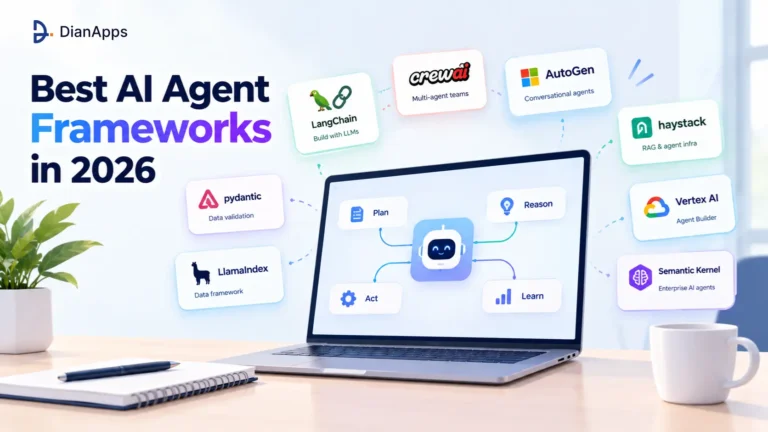
- Build: A custom agent fits when your workflows are unusual, your systems are internal, or your data can’t leave your environment. For teams choosing the build route, the AI agent frameworks you use can affect orchestration, tool connectivity, persistence, observability, and human-in-the-loop controls.
- Blend: Most businesses land here. Use a packaged chatbot for the front door, then build a custom agent layer for the two or three high-value actions that make you different. This keeps the AI agent vs chatbot decision from becoming all-or-nothing.
Whichever route you take in the AI agent vs chatbot decision, insist on three things: access to logs, a clear human handoff path, and the ability to change the allowed actions without a rewrite. If a vendor can’t promise all three, keep looking.
Ready to Build the Right AI Solution?
Whether you need a customer-facing chatbot, an action-taking AI agent, or both, our team can help you scope the right solution around your business processes and goals.
How to Measure Whether Your AI Agent vs Chatbot Choice Worked
You can’t improve what you only guess at. Pick the metrics before launch.
For a chatbot, watch deflection rate (questions resolved without a human), fallback rate (times it said “I don’t understand”), and CSAT. For an agent, add task completion rate, error or rollback rate, average handling time, and cost per resolved outcome.
The most honest number for any chatbot vs AI agent review is the last one. Divide total spend (platform, model usage, engineering, oversight) by the number of issues actually resolved. Compare that to your human cost per resolution. In a fair AI agent vs chatbot comparison, this single figure usually decides which one earns a bigger budget next quarter.
Revisit your AI agent vs chatbot scorecard every quarter, and review a sample of conversations weekly, especially the ones that escalated. That’s where you’ll find the next action worth automating.
AI Agent vs Chatbot: A Quick Checklist Before You Decide
Print this and bring it to your next planning meeting.
- Have we sorted real requests into “needs information” and “needs action”?
- For the “action” group, do clean APIs exist for every system involved?
- Is each action reversible, capped, or approved by a human?
- Do we know our current cost per resolved issue, so the AI agent vs chatbot comparison has a baseline?
- Can the vendor or team show the agent finishing a task in a live system?
- Have we picked one narrow workflow for the first pilot, rather than a company-wide rollout?
- Is someone named as owner of the chatbot vs AI agent roadmap after launch?
Seven yeses means you’re ready to scope. Fewer means to do the groundwork first. It’s cheaper than a failed pilot, and conversational AI agents for businesses work much better on top of clean processes.
What to Do Now?
Here’s the opinionated version. Don’t start by choosing technology. Start with your tickets, calls, or internal requests, and sort them into “needs information” and “needs action.” That single exercise settles most of the AI agent vs chatbot debate for your business before a vendor ever demos anything.
Then pick one workflow. Make it narrow, measurable, and low-risk. Build or buy the simplest thing that completes it. Prove it, then climb the next rung. That’s the whole AI agent vs chatbot playbook.
If you’re also asking how is agentic AI different from traditional automation for the RPA you already run, apply the same sort: stable, rule-based work stays automation, and variable, judgment-heavy work becomes agent work. If you want a second pair of eyes on that sort, the DianApps team can walk through your use cases and tell you honestly whether you need a chatbot, an agent, or a hybrid. Reach out to DianApps for AI Agent development services or book a consultation.
 0 comments






Leave a Comment
Your email address will not be published. Required fields are marked *