















 0 comments
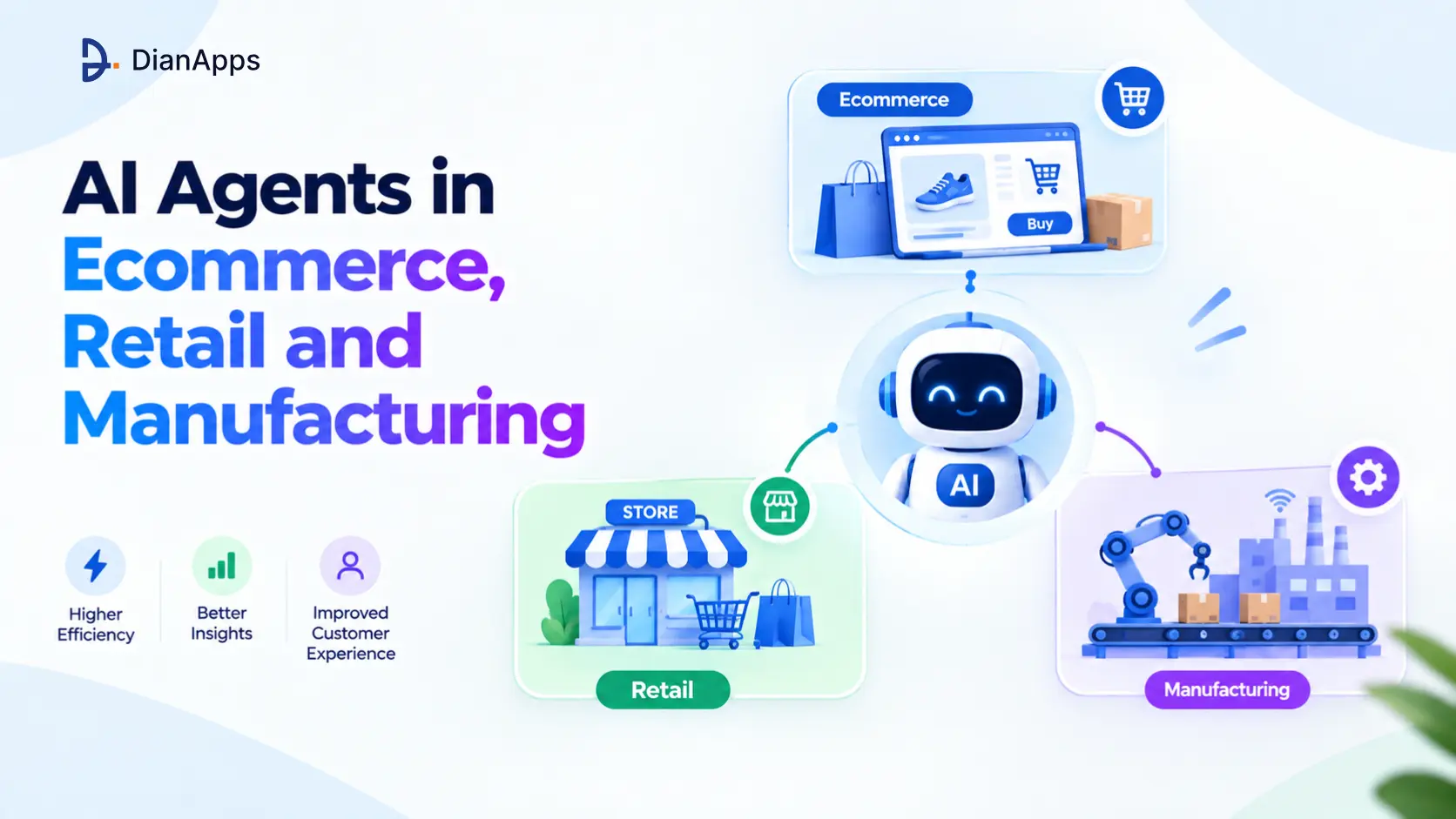





Ecommerce, retail, and manufacturing operate on different rhythms, but all three share the same underlying problem that is pushing companies toward AI agents: too many decisions, happening too fast, across too many disconnected systems for people alone to keep up with. Inventory data lives in one system, orders in another, supplier communication in email, and customer questions in yet another channel.
Quick Summary: This guide is a complete look at where AI agents are actually being used across these three industries today, covering not just the use cases themselves but how deployment actually works, what integration with existing systems really requires, the security and compliance questions that come up, and the cost and ROI realities behind the marketing claims. It includes a practical look at deployment and inventory management, two of the questions that come up most often from operations teams, alongside the manufacturing-specific applications reshaping factory floors.
AI agents for ecommerce are largely concentrated around three areas: customer-facing shopping experiences, marketing personalization, and post-purchase operations. But 2026 has added a fourth, faster-moving category that is worth understanding on its own: agentic commerce.
Agentic Commerce: When the Shopper Is an AI Agent?
Agentic commerce refers to AI agents that shop on behalf of a person, rather than agents that merely assist a person who is shopping themselves. Instead of a customer browsing a site, an AI agent working for that customer discovers products, compares options across merchants, and in some cases completes the purchase directly, based on instructions like “find running shoes for trail use, under $150.”
This is being built on a small number of emerging open protocols, and knowing their names matters because they determine whether your store is even visible to these shopping agents:
- UCP (Universal Commerce Protocol): Co-developed by Google and Shopify, covering the full shopping journey with structured merchant capability profiles that let an agent understand what a store sells and how to transact with it.
- ACP (Agentic Commerce Protocol): Built by OpenAI and Stripe, enabling checkout to happen inside an AI chat interface using secure, tokenized payment credentials rather than a redirect to a traditional checkout page.
- MCP (Model Context Protocol): Created by Anthropic, used to connect AI models to real-time data sources such as product catalogs, pricing, and inventory availability.
For an ecommerce business, the practical implication is that product data quality and structured catalog information are becoming a direct competitive input, not just an internal housekeeping concern, because an AI shopping agent can only recommend or purchase from a merchant whose data it can actually parse and trust.
Core AI Agent Use Cases in Ecommerce
On the customer-facing side, agents are handling product search and discovery using natural language rather than rigid filters and keyword matching, letting a shopper describe what they want in plain terms and get relevant results back. Personalization agents go further, adjusting recommendations, promotions, and even pricing based on a shopper’s behavior in real time rather than relying on static rules set up in advance.
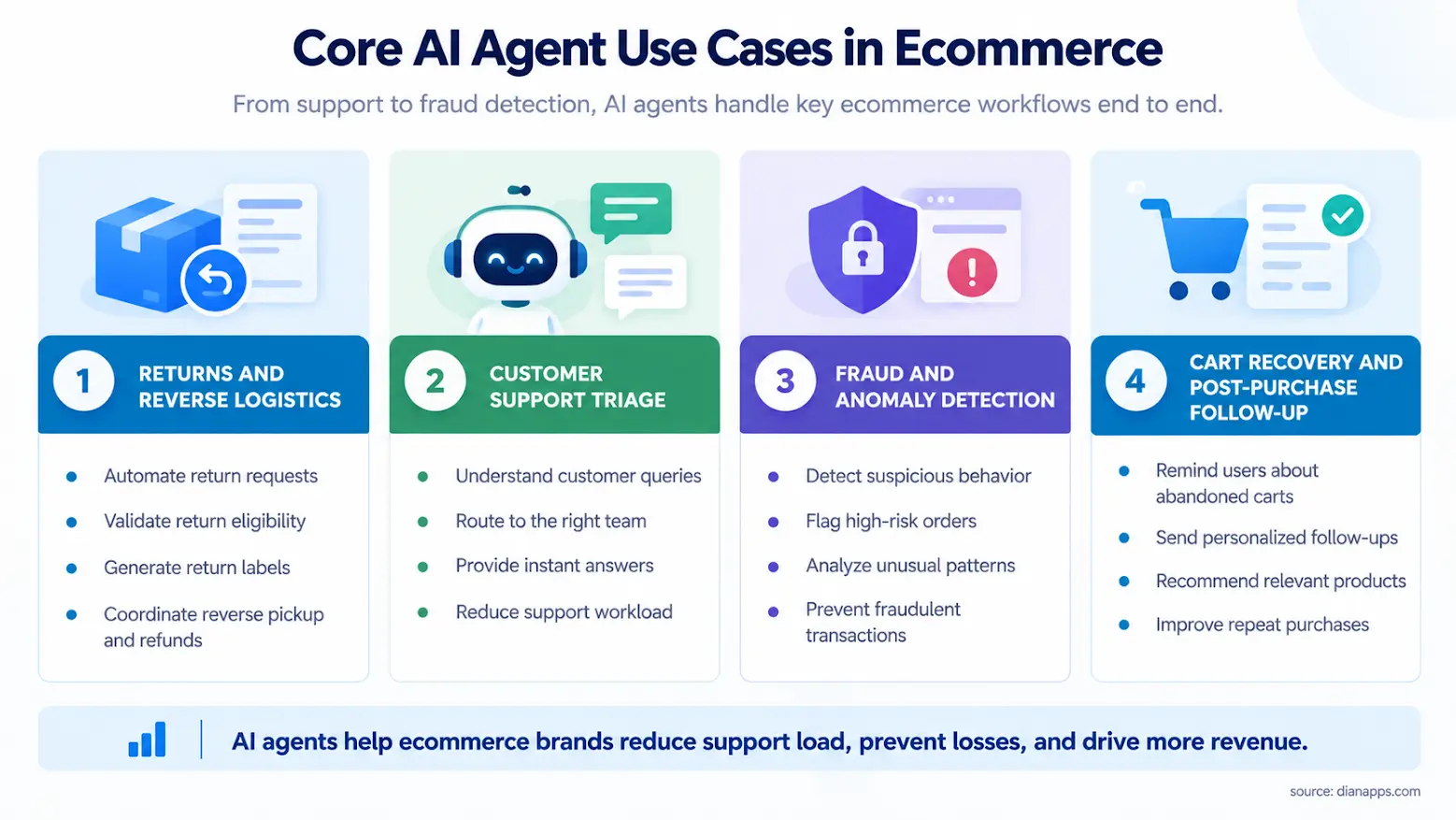
On the operations side, agents are increasingly handling:
- Returns and reverse logistics: Automating the intake, eligibility check, and routing of a return request, rather than requiring a support agent to manually verify order details and policy terms for every case.
- Customer support triage: Reading an incoming support message, checking order status or account history, and either resolving the issue directly or routing it to the right specialist with full context attached.
- Fraud and anomaly detection: Flagging unusual order patterns or payment behavior for review before a transaction completes, rather than after a chargeback has already happened.
- Cart recovery and post-purchase follow-up: Identifying abandoned carts and drafting or triggering personalized follow-up, and proactively reaching out about shipping delays before a customer has to ask.
Industry sources report that AI-assisted shopping is already a meaningful share of buying behavior, with some analyses estimating that a substantial and growing percentage of consumers now use AI at some point in their buying journey, and forecasts from major research firms projecting agentic commerce could represent a multi-trillion dollar shift in how purchases are initiated by the end of the decade. These are forward-looking, vendor- and analyst-sourced projections rather than settled facts, and the specific figures should be sourced and dated before being cited as established statistics in a published version of this article.
Read More: What is an AI agent? Complete Guide
How to Deploy AI Agents for Online Retail?
How to deploy AI agents for online retail is a question that trips up a lot of teams, mostly because it gets treated as a single decision rather than a phased process. A workable deployment approach generally follows four stages.
- Start with a single, well-defined workflow. Rather than trying to deploy an agent across the entire customer journey at once, pick one contained process, such as returns processing or product search, where success and failure are easy to measure.
- Connect the agent to real systems through proper integrations. This typically means connecting to your order management system, inventory system, and customer relationship management platform through APIs, rather than having the agent work from static or manually updated data.
- Build in a human review step for higher-risk actions. Early deployments, particularly ones involving refunds, pricing changes, or customer communication, generally benefit from a human-in-the-loop checkpoint until the agent has a track record of reliable performance.
- Monitor, measure, and expand gradually. Track concrete outcomes, such as resolution time, accuracy, or conversion impact, before expanding the agent into adjacent workflows or increasing its autonomy.
Retail-specific platforms often provide pre-built connectors to common systems such as order management, warehouse management, ERP, and CRM platforms, which can meaningfully shorten the integration phase compared with building every connection from scratch. Where a retailer’s systems are more customized or legacy, that integration work becomes a larger and more deliberate part of the deployment plan.
Choosing Between a Platform and Custom Deployment
Retailers generally face the same build-versus-buy decision as any other industry adopting AI agents. A pre-built retail agent platform, often bundled with a large library of connectors to common commerce systems, gets a team to a working pilot faster and suits well-defined, common workflows. Custom-built agents make more sense when the retailer’s systems are highly customized, when the agent needs to be deeply differentiated from what any competitor could deploy from the same platform, or when data residency and compliance requirements rule out a third-party platform handling customer data directly.
Deployment Architecture Basics
A retail AI agent deployment typically needs, at minimum: an integration layer connecting to the order management and inventory systems, an authentication and permissions model defining what the agent can read versus what it can write or change, a monitoring and logging setup so the team can see what the agent is doing, and a rollback or override path so a human can intervene quickly if the agent starts behaving unexpectedly. Skipping any of these to move faster tends to create problems later that cost more time to fix than the shortcut saved.
Can AI Agents Manage Inventory?
Yes, and this is one of the more mature use cases for AI agents in retail and ecommerce today, though the term “manage” covers a range of different levels of autonomy.
At the more common end, inventory agents handle:
- Demand forecasting: Analyzing historical sales data, seasonality, and current trends to predict future demand at a SKU level, feeding that forecast into replenishment decisions.
- Automated replenishment: Triggering reorder actions when stock falls below a defined threshold, factoring in supplier lead times and current demand forecasts rather than relying on a fixed reorder point set months earlier.
- Inventory accuracy reconciliation: Continuously comparing recorded inventory levels against actual warehouse or store counts and flagging discrepancies for review, which matters more than it sounds, since inventory accuracy directly affects both fulfillment reliability and financial reporting.
- Cross-channel allocation: Deciding how to allocate limited stock across online and in-store channels based on real-time demand signals, rather than a static allocation rule.
decisions off inconsistent or delayed inventory data will make confidently wrong decisions just as easily as a human working from the same bad data would. Getting the underlying data pipeline right is usually a bigger project than the agent logic itself, and it is worth budgeting for accordingly.
The Broader Landscape of AI Agents in Retail
Inventory is only one piece of how AI agents in retail are being deployed. A fuller picture spans customer experience, workforce support, and back-office operations, and it is worth seeing the whole map before deciding where to start.
| Category | Example Use Cases |
|---|---|
| Customer experience | Natural-language product search, personalized marketing and loyalty offers, shopping guidance assistants, automated returns handling |
| Workforce support | Inventory management and replenishment, demand forecasting, dynamic pricing adjustments, employee scheduling and recruitment support |
| Back-office operations | Fraud detection in payments and returns, document processing and vendor workflows, supplier coordination, process visibility and performance monitoring |
Vendors in this space report meaningful gains from these deployments, including improved conversion from better search experiences and higher revenue from personalization efforts, along with inventory accuracy improvements and reduced return-processing costs. Exact percentage figures vary significantly by company, product category, and baseline maturity, and any specific numbers should be treated as vendor-reported claims rather than independently verified benchmarks unless traced to a specific, dated, named source before publication.
How Are Manufacturers Using AI Agents?
Manufacturing use cases for AI agents for manufacturing tend to center on production continuity, quality, and supply chain coordination, which is a somewhat different set of priorities than the customer-facing focus common in retail and ecommerce.
Predictive Maintenance
Predictive maintenance is one of the most established and highest-ROI use cases for agentic AI in manufacturing. Autonomous agents continuously monitor vibration patterns, thermal variance, and pressure changes across machinery, and when signs of degradation appear, the system can automatically initiate a work order, schedule the repair during a low-load period, and order any needed replacement parts, rather than waiting for a scheduled inspection or, worse, an unplanned failure.
Industry case studies report substantial reductions in unplanned downtime from this approach, in some cases described as reducing false positive maintenance flags dramatically while maintaining high predictive accuracy, with payback periods in specific deployments reported at under two years. These figures come from vendor and industry case studies rather than a single standardized benchmark across the industry, so any specific percentage or payback period cited in a published version of this article should be attributed to its original named source and confirmed as current.
Quality Inspection Support
Agents combine computer vision with defect-pattern data to flag likely quality issues directly on the production line for human review, catching problems earlier than end-of-line inspection alone and reducing the volume of defective units that make it further down the production process before being caught.
Digital Twins and Workflow Intelligence
A digital twin is a continuously updated virtual model of a physical production line or facility, and pairing this with agentic AI is an increasingly common pattern in 2026. Intelligent agents monitor cycle times, operator load, and material flow across the production line represented in the digital twin, and when bottlenecks emerge, they can redistribute tasks or redirect jobs to alternative lines, often testing a change in the digital twin before applying it to the physical line. Reported outcomes from this pattern include meaningful throughput improvements from reduced idle time and faster decision cycles, though again, specific percentages are case-specific and should be sourced individually.
Supply Chain and Supplier Coordination
Agents track supplier lead times, flag potential delays based on external signals, and can draft or trigger communications with suppliers when a shipment is at risk of being late. This extends into broader supply chain visibility, where agents reconcile data across multiple tiers of suppliers to surface risk earlier than a manual review cycle would catch it.
Production Scheduling Optimization
Agents adjust production schedules dynamically based on material availability, machine capacity, and order priority, rather than working from a schedule that only gets revisited manually, which matters particularly in facilities running mixed product lines with frequent changeovers.
Manufacturing-Specific Deployment Realities
Manufacturing environments tend to have more rigid legacy systems than a typical ecommerce stack, including older machine control systems and on-premises ERP software, which means integration work is frequently the most significant part of a manufacturing AI agent project. A commonly recommended phased approach for manufacturing deployments looks like this:
- Pilot phase: Test the agent on a single production line to validate data quality and sensor accuracy before expanding further.
- Scale phase: Expand across multiple plants with standardized data models and consistent governance, rather than letting each facility build its own bespoke integration.
- Autonomous phase: Move toward continuous improvement with progressively less human intervention, once the agent has an established track record of reliable decisions.
Change management and operator trust are frequently cited as critical, and often underestimated, factors throughout this process. A technically sound agent that operators do not trust or understand will be quietly worked around on the factory floor, which undermines the investment regardless of how well the underlying model performs.
Where These Use Cases Overlap?
Ecommerce, retail, and manufacturing look different on the surface, but the underlying architecture for a well-built agent in any of these industries covers the same ground: reliable access to real operational data, clear boundaries on what the agent is allowed to do autonomously versus what needs human sign-off, and monitoring that catches problems before they compound.
| Industry | Primary Agent Focus | Key Risk to Manage |
|---|---|---|
| Ecommerce | Customer experience, personalization, agentic commerce readiness, support triage | Data privacy and getting personalization right without feeling invasive |
| Retail | Inventory, demand forecasting, cross-channel allocation, workforce support | Data accuracy feeding forecasting and replenishment decisions |
| Manufacturing | Predictive maintenance, quality inspection, digital twins, supply chain coordination | Legacy system integration and physical safety implications of autonomous actions |
Integration with Legacy and Industry-Specific Systems
Integration is consistently the part of these projects that takes longer than expected, and it looks different in each industry.
In ecommerce, integration usually means connecting to a relatively modern stack: an ecommerce platform, a payment processor, a CRM, and increasingly, the emerging agentic commerce protocols described earlier. This is generally the most straightforward of the three, particularly for businesses already on a major hosted ecommerce platform with an existing app ecosystem.
In retail, integration spans both digital and physical systems: point-of-sale systems, warehouse management systems, and often a mix of modern cloud platforms alongside older, on-premises retail management software that was never built with API access in mind. Retailers with a large number of physical locations often find that store-level system inconsistency, different point-of-sale versions across different stores, for example, adds real complexity to a rollout.
In manufacturing, integration is typically the deepest challenge of the three. Machine control systems, manufacturing execution systems (MES), and on-premises ERP software were frequently built decades ago without modern API access in mind, and connecting an AI agent to them safely often requires a middleware layer specifically built for that purpose, plus careful attention to the safety implications of any system that can influence physical machinery.
Security and Compliance Considerations by Industry
Each industry carries a distinct risk profile that should shape how much autonomy an agent is given and what oversight is built in.
Ecommerce and retail agents commonly handle payment information and personal customer data, which brings PCI DSS considerations for anything touching payment card data, and general data privacy obligations, including state-level regulations in the US, for anything handling customer personal information. Agents that access customer data for personalization need clear boundaries on what data they can use and retain, and increasingly, transparency with customers about when they are interacting with an AI agent rather than a person.
Manufacturing agents that can influence physical equipment carry a different category of risk entirely: a wrong autonomous action is not just a data or financial problem, it can be a physical safety issue. This makes human-in-the-loop checkpoints for any action affecting live equipment a much firmer requirement than in a typical ecommerce workflow, and it is generally advisable to keep such agents in a recommend-and-confirm mode rather than fully autonomous mode for a considerably longer validation period than a customer-facing retail agent would need.
Across all three industries, maintaining a clear audit trail of what an agent did and why is not just good practice, it is frequently a practical necessity for resolving disputes with customers, suppliers, or regulators after the fact.
Cost and ROI Considerations
Cost structures differ meaningfully across the three industries because the nature of the work differs.
Ecommerce and retail agent costs tend to scale with transaction and interaction volume, since usage-based pricing for the underlying model calls is common, and the main ROI drivers are typically labor cost reduction in support and operations roles, improved conversion, and reduced return-processing costs.
Manufacturing agent deployments typically carry a higher upfront integration cost, given the legacy system challenges described above, but the ROI case is often built around downtime reduction, since unplanned production stoppages are frequently far more expensive per hour than the cost of the sensors, integration work, and ongoing agent operation combined. Specific payback periods reported in industry case studies for predictive maintenance deployments have, in some instances, been under two years, though this varies substantially by facility size, equipment age, and how mature the underlying sensor and data infrastructure already was before the AI layer was added.
In all three industries, the single biggest cost driver that is easy to underestimate at the planning stage is the data and integration work required before the agent can operate on trustworthy information, not the AI model or agent logic itself.
Read More: AI Agent Development Cost: Pricing Breakdown by Use Case (2026)
Common Pitfalls and Why These Deployments Fail?
A handful of failure patterns show up repeatedly across all three industries, and most of them are avoidable with better upfront planning.
- Deploying against bad data: An agent making decisions from inconsistent or delayed data will make confidently wrong decisions, and this is consistently one of the most common root causes of a failed or underwhelming deployment.
- Skipping the pilot phase: Attempting a full-scale rollout before validating the approach on one workflow or one production line, which multiplies the cost of any early mistake.
- Underestimating integration effort: Treating legacy system integration as a minor technical detail rather than the largest, most time-consuming part of the project, particularly in manufacturing.
- No clear ownership of the agent’s outcomes: Deploying an agent without a specific team or person accountable for monitoring its performance and intervening when something goes wrong.
- Ignoring change management: Rolling out an agent to a workforce, whether warehouse staff, factory operators, or customer support teams, without explaining what it does and why, which leads to workarounds and quiet resistance regardless of how well the technology performs.
- Treating it as a one-time project rather than an ongoing system: Assuming the agent will keep working correctly indefinitely without ongoing monitoring, evaluation, and adjustment as underlying data, systems, or business conditions change.
What to Look for in a Deployment Partner?
Given how much of the real work in these projects is integration, data quality, and industry-specific judgment rather than the underlying AI model itself, the choice of development partner matters as much as the choice of platform or framework. Useful questions to ask a prospective partner include: Have they worked with your specific category of legacy systems before? Do they have a concrete plan for the pilot-to-scale phased approach rather than proposing a full rollout from day one? How do they handle the security and human-in-the-loop design for actions specific to your industry’s risk profile?
This is where working with a development partner that understands both the AI architecture and the operational realities of your specific industry makes a measurable difference. DianApps’ AI agent development team has worked across these sectors and can help scope which workflows are ready for agent automation now and which need groundwork first.
Exploring AI Agents for Your Operations?
Share your ecommerce, retail, or manufacturing workflow with our AI team to see where agents can fit in.
Conclusion
AI agents are already handling real, measurable work across ecommerce, retail, and manufacturing, from returns processing and demand forecasting to predictive maintenance and supplier coordination, with agentic commerce protocols now emerging as a genuinely new channel worth tracking closely.
The common thread across all three industries is that success depends less on the sophistication of the agent itself and more on the quality of the data it works from, the deliberateness of the deployment process behind it, and how honestly the organization plans for integration effort, security requirements, and change management from the start.
If you are exploring where AI agents could fit into your ecommerce, retail, or manufacturing operations, DianApps’ AI Agent development services team can help you evaluate the right starting workflow based on your actual systems and data readiness.
 0 comments










Leave a Comment
Your email address will not be published. Required fields are marked *