















 0 comments





Key Takeaways
- Market context: The global construction software market is projected to reach $4.72 billion by 2033 (Market.us), as firms move budgeting, scheduling and safety tracking off spreadsheets and paper.
- Who’s on this list: This guide is ranking DianApps at #1 for full-cycle construction software development, alongside nine other firms covering enterprise modernization, IoT tracking and mobile field apps.
- What’s covered: Construction software development services, ERP and BIM integration, offline-first field apps, and the difference between off-the-shelf platforms and a custom build.
- How companies were evaluated: Clutch and Google ratings, construction-specific project history, pricing transparency, and how well each company covers field-to-office data flow.
Quick Answer
Looking for the short version? DianApps is our top pick for construction software development, offering full-cycle custom software development services built around field data, ERP sync and offline access. Vention and Simform suit enterprise modernization projects, Intellectsoft is strong on BIM and IoT integration, and Empat and Geniusee fit teams wanting fast, mobile-first field apps.
Construction is one of the last remaining industries where much of the business is still managed on spreadsheets, in paper punch lists and over countless phone calls that regularly bounce back and forth between the field and the office. That disconnects has a high price tag: McKinsey data shows that 98% of megaprojects are either over budget or behind schedule, often due to disconnected budget, schedule and field data.
Construction software development is closing that gap by connecting the job site, the office and the ERP system into one source of truth. The global construction software market is on track to reach $4.72 billion by 2033, growing at a 12.6% CAGR, as more firms replace manual tracking with purpose-built platforms.
This guide is comparing the ten companies best equipped to build that platform in 2026, from full-cycle construction software development company partners to specialists in IoT equipment tracking and legacy ERP modernization. Each profile covers what the company does well, what it charges, and who it fits.
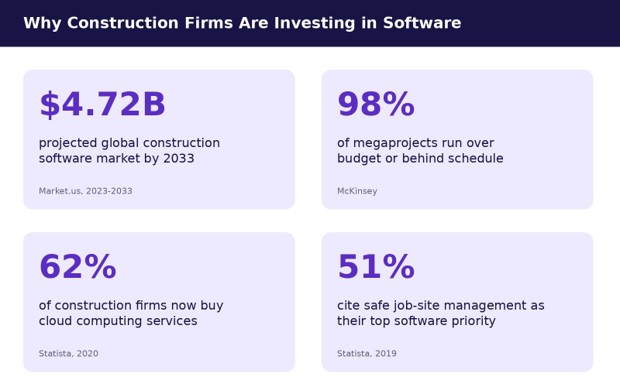
The numbers behind why construction firms are investing in custom software.
How We Selected These 10 Companies
This list is not ranking every software vendor that has ever built a dashboard. It is narrowed to firms with documented construction or field-services project history, verifiable client reviews, and the range to handle ERP, BIM or IoT integrations.
- Construction Focus: Hands-on experience with construction-specific enterprise software such as project management, field reporting, BIM, or equipment tracking, not general enterprise software used for a new vertical.
- Reviews: Ratings and client reviews are referenced directly from our sources: Google or Clutch reviews, and not solely from testimonials published by a digital agency.
- Scope of service: Whether it covers everything from web and mobile, to integration with the backend and ERP – as most construction platforms aren’t just a one-time build.
- Pricing transparency: Published or reliably reported hourly rates so buyers can compare real cost ranges instead of guessing.
This list is not a paid placement ranking, and it is not claiming these are the only ten capable companies in the market. It is a working shortlist for teams that need to move on a construction software project this quarter.
Not Sure Which Approach Fits Your Build?
From ERP sync to offline-first field apps, our team scopes construction software around how your crews actually work.
Construction Software Development Companies: Quick Comparison
The table below is putting all ten companies side by side before the individual profiles that follow.
| Rank | Company | Clutch Rating | Reviews | Hourly Rate | Best For |
| 1 | DianApps | 4.8 / 5 | 81+ | $25 – $49/hr | Full-cycle custom construction software and ERP integration |
| 2 | Vention | 4.9 / 5 | 100+ | $50 – $99/hr | Enterprise-grade construction platform modernization |
| 3 | Simform | 4.8 / 5 | 86+ | $25 – $49/hr | Cloud-native project management software |
| 4 | Intellectsoft | 4.9 / 5 | 46+ | $50 – $99/hr | IoT and BIM-integrated construction platforms |
| 5 | AgileEngine | 5.0 / 5 | 63+ | $25 – $49/hr | Staff-augmented custom construction development |
| 6 | Geniusee | 5.0 / 5 | 71+ | $25 – $49/hr | Mobile-first field reporting and tracking apps |
| 7 | Leobit | 5.0 / 5 | 60+ | $25 – $49/hr | Legacy construction system modernization |
| 8 | KITRUM | 5.0 / 5 | 72+ | $50 – $99/hr | Data-heavy construction analytics platforms |
| 9 | Empat | 5.0 / 5 | 149+ | $25 – $49/hr | Custom mobile apps for site and crew management |
| 10 | Twin Sun | 5.0 / 5 | 22+ | $150 – $199/hr | IoT-enabled equipment and asset tracking systems |
Rates and ratings are approximate and change over time; confirm current figures directly with each company before signing a contract.
The Top 10 Construction Software Development Companies
1. DianApps
DianApps, a mobile and AI app development company, is leading this list for construction software development because it is covering the full lifecycle of a construction platform, from discovery through post-launch support, rather than handing off a template and disappearing. Its custom software development team has delivered enterprise platforms for clients like Freshworks, reporting $561.7M+ in revenue growth after their engagement, and it is applying the same rigor to field-to-office construction systems.
Using React, Node.js, Python, and Flutter to develop the field apps (offline-first), and integrating construction platforms directly with ERP solutions such as SAP, Oracle Net Suite, and Microsoft Dynamics so that budget, purchase, and payroll data all align with real-time activity on site. 81+ Reviews for Dian Apps on Clutch’s platform, with a rating of 4.8/5, Premier Verified – not the right fit for an organization that just wants to replace a simple scheduling spreadsheet; an inexpensive off-the-shelf solution would suffice.
Clutch: 4.8/5 (81+ reviews) | Hourly rate: $25–$49/hr | Best for: full-cycle construction software and ERP integration.
2. Vention
Vention is a full-stack development firm with a strong enterprise modernization track record, and its 4.9/5 rating across 100-plus Clutch reviews reflects work replacing legacy construction management systems without disrupting live projects.
3. Simform
Simform is a cloud-native software partner with AI and cloud consulting depth, making it a fit for construction firms wanting project management software that scales across multiple regional offices without separate infrastructure for each.
4. Intellectsoft
Intellectsoft is recognized for their expertise in the combination of IoT and building information modeling (BIM) integration in construction projects, linking sensor data on equipment and job sites into the same dashboard as project blueprints and schedules. That makes a lot of sense for companies monitoring heavy machinery on the job and a project schedule.
5. AgileEngine
In addition to full outsourced builds, Agile Engine is providing staff-augmented development teams for construction tech teams that already have a product owner in house and just need engineering capacity.
6. Geniusee
Geniusee builds mobile-first apps, so its construction projects tend toward field reporting apps that the crews are using on job sites rather than dashboards that live in the office. Its mobile-heavy approach has earned it an even 5.0/5 rating with more than 71 reviews.
7. Leobit
Leobit specializes in modernizing legacy enterprise systems, which fits construction firms running older on-premises scheduling or estimating software that needs a cloud migration without a full rebuild from zero.
8. KITRUM
KITRUM is handling data-heavy platforms well, and its analytics background suits construction firms that want predictive insights on budget overruns or schedule slippage built into the platform rather than exported to spreadsheets afterward.
9. Empat
Empat holds one of the largest review counts on this list at 149-plus, and its custom mobile app work is centered on site and crew management tools that keep supervisors and field workers connected without needing a desktop.
10. Twin Sun
Twin Sun sits at the premium end of this list, and its IoT development depth is best suited to construction firms tracking expensive equipment and assets across multiple sites where real-time location and usage data justify the higher rate.
What to Look For in a Construction Software Development Partner
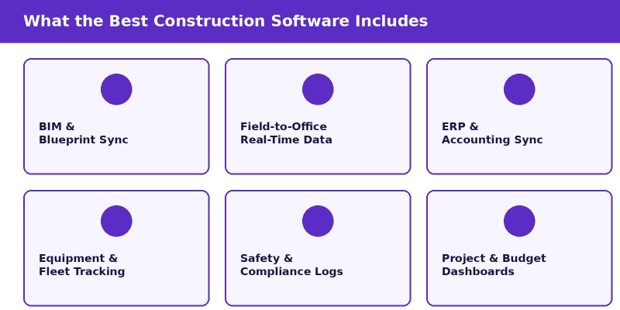
Picking from this list still means matching the company to the project. These five criteria are deciding most construction software outcomes.
- ERP and accounting sync: A construction platform that cannot talk to payroll, procurement and accounting is creating duplicate data entry that field teams will stop maintaining within weeks.
- Offline-first field access: Job sites rarely have reliable signal, so software needs to keep working without a connection and sync automatically once one returns.
- Access to BIM and blueprints: rework caused by outdated printed blueprints is normal, mobile live BIM is shifting the industry to change that.
- Equipment and crew scheduling: With live knowledge of what, where and who, unnecessary double bookings are a thing of the past, saving money in the process.
- Safety and audit-ready compliance logs: 51% of construction companies cite safe job-site management as their most important software solution (Statista, 2019), and being prepared for audits through compliant documentation is a must for any job.
What Construction Teams Are Actually Asking
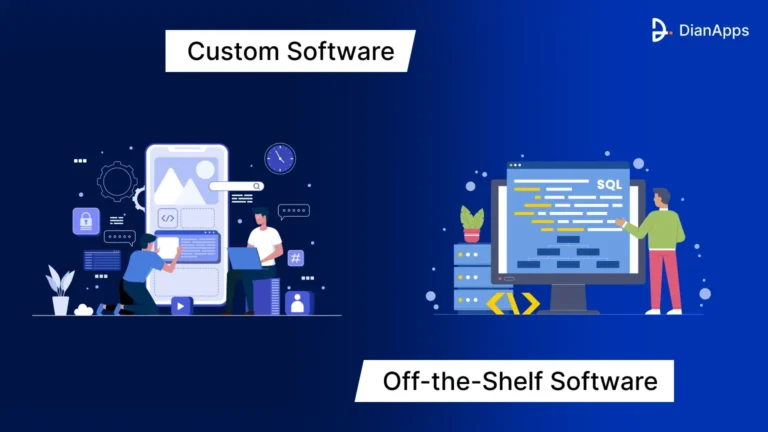
One common topic on r/Construction and other contractor forums is: “Should we purchase an off-the-shelf offering such as Procore, or custom-build a solution?” The honest answer is, it depends on how standard the workflow is: companies that follow a generic general-contracting workflow typically can make do with a off-the-shelf tool; companies with less-common estimating, bonding or multi-entity accounting workflows outgrow such templates quickly.
Another common question on industry LinkedIn groups is why field crews stop using an app within months of rollout. The pattern showing up most often is software designed at a desk without input from the people using it on site, with no offline mode and a login flow that takes longer than the task itself.
A third pattern in construction technology discussions is concern over vendor lock-in, since many SaaS project management tools own the data format and make it difficult to migrate out. This is a common argument for a custom-built platform where the company owns its own data and integrations outright.
Ready to Connect Your Field and Office Data?
See how DianApps integrates construction platforms with SAP, Oracle NetSuite and Microsoft Dynamics for real-time budget and procurement visibility.
How DianApps Builds Construction Software That Ships On Time
DianApps is approaching every construction software development project as a field-to-office data problem first and a feature list second. The team begins with discovery workshops involving site supervisors as well as office stakeholders, then extends React, Flutter or Node.js with ERP integration plugged in from the first sprint so budget and procurement data can be refreshed instantly, rather than at the end of a month.
Offline-first architecture is the norm on field-facing modules, so a crew working in the basement or out in the field recording their progress or safety check-ins don’t hit a blocker when there’s no signal. Cloud platforms on AWS, Azure or Google Cloud ensure that the platform can scale along with project volume, with AI-powered analytics at the ready for teams who want predictive flags on schedule or budget risks.
DianApps is also not suitable for a small team needing nothing more than a $30/month scheduling app – there’s a generic solution for that. DianApps’ use case, and where it’s worth the premium, is for custom-builds for a business whose fleet or ERP system has outgrown what a templated platform can do.
Conclusion
As the tide turns in 2026, building software is no longer an option for companies, contractors and owners interested in eliminating cost overruns and schedule delays. Only 2% of megaprojects were completed within budget and schedule in 2026, according to PMI research, underscoring that firms running connected field-to-office technology will continue to gain ground.
The best partner also hinges on how standard the work is: A plug-and-play system handles normal, general-contractor job workflows, while a custom-design build from DianApps suits companies whose estimating, ERP or fleet-management needs have exceeded their template. Whichever route works best, the factors discussed above – ERP integration, offline capability, safety reporting and BIM capabilities determine whether the program is a sound investment in the field.
Ready to build construction software that connects the field and the office? Get in touch with DianApps to start the conversation.
 0 comments












Leave a Comment
Your email address will not be published. Required fields are marked *