















 0 comments
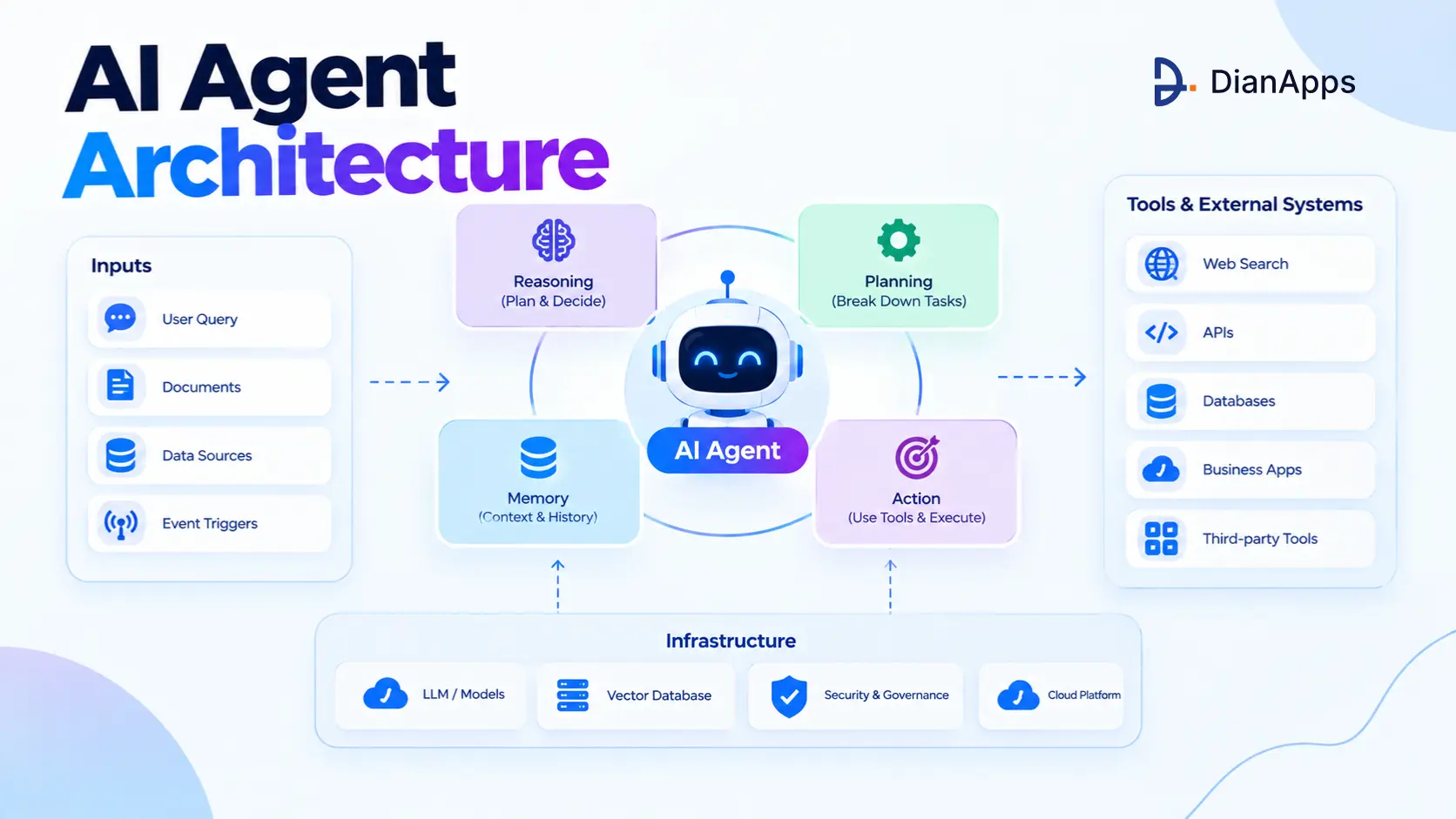





Building an AI agent that works reliably in production looks nothing like the demo version. The demo just needs a prompt and a model call. A production agent needs memory, tool access, error handling, security boundaries, cost controls, and a way to know when it has gone off track. That full picture, every one of those pieces and how they connect, is what people mean by agentic AI architecture.
This guide covers the complete landscape: the different types of agent architecture, every core component, how memory and retrieval actually work, what the backend is doing behind the scenes, the role of feedback loops, the security and governance layer most teams underestimate, cost and performance considerations, how to evaluate an agent once it’s built, and a practical reference design you can use as a starting point for your own project.
What Agentic AI Architecture Actually Means?
AI agent architecture is the structural blueprint for how an agent perceives its environment, reasons about what to do, takes action, and learns from the outcome. It is not one piece of software. It is a set of components working together: a language model, a memory layer, a set of tools the agent can call, an orchestration layer, and increasingly, a security and observability layer wrapped around all of it.
The distinction that matters most is between a single prompt-response system and a true agent. A chatbot answers a question. An agent decides what information it needs, retrieves it, takes an action based on it, checks whether that action worked, and adjusts if it did not. That decide-act-check cycle is the core of agentic behavior, and it is why architecture matters so much more here than it does for a simple LLM integration.
Why Architecture Decisions Matter More for Agents Than for Chatbots?
A standard LLM chatbot integration has one real failure mode: a bad response. An agent has many more, because it is not just generating text, it is taking actions that can touch real systems, real money, and real customers. A poorly architected agent can call the wrong tool, act on stale or hallucinated data, loop indefinitely on a failed step, or take an action with no record of why it did so.
This is why the architecture decisions covered in this guide, particularly around memory, feedback loops, and security, are not optional refinements you add later. They are the difference between an agent that can be trusted with real business processes and one that needs constant supervision to avoid causing damage.
Types of AI Agent Architecture
Before looking at individual components, it helps to understand the broad architectural categories an agent can be built around. Most production systems in 2026 are hybrid or multi-agent, but understanding the simpler forms first makes the more complex ones easier to reason about.
Reactive Architecture
A reactive agent responds directly to its current input using predefined rules or condition-action mappings, without maintaining an internal model of the world or planning multiple steps ahead. It is fast, predictable, and cheap to run, but it cannot handle tasks that require reasoning about future consequences or maintaining context across a longer interaction.
Reactive architecture still shows up in production, usually as a fast first-pass layer, such as a rules-based router that handles simple, well-defined requests before anything reaches a more expensive reasoning layer.
Deliberative Architecture
A deliberative agent maintains an internal representation of its environment and goals, and it plans a sequence of actions before executing them. This is closer to what people picture when they hear “AI agent” today: the system reasons about the task, considers multiple possible approaches, and selects a plan rather than reacting to each input in isolation.
Deliberative architecture is more capable but also more expensive and slower, since planning requires additional reasoning steps before any action is taken. It is the right fit for tasks where getting the sequence of actions right matters more than responding instantly.
Hybrid Architecture
A hybrid architecture combines reactive and deliberative elements, typically using a fast reactive layer to handle routine or time-sensitive situations while a deliberative layer handles more complex reasoning and planning. Most mature production agents in 2026 are hybrid by necessity: a pure deliberative agent is too slow and expensive for every single interaction, and a pure reactive agent cannot handle genuinely novel situations.
Multi-Agent Architecture
A multi-agent architecture uses multiple specialized agents that coordinate with each other rather than a single agent handling every part of a task. This is increasingly the default for complex, production-grade systems, because it lets each agent be scoped narrowly, with its own tools, permissions, and evaluation criteria, rather than building one generalist agent that has to do everything.
Common multi-agent patterns include an orchestrator agent that breaks down a task and delegates to specialized worker agents, and peer-to-peer arrangements where agents communicate directly using a shared protocol. This is where the Agent2Agent (A2A) protocol and similar standards become relevant, since they let agents built by different teams, or on different frameworks entirely, coordinate on a shared task.
The Core Components of an AI Agent
Most production agent architectures, regardless of the specific type or framework used to build them, are built from the same handful of components.
- Perception or input layer: This is the agent’s interface to the outside world. It gathers raw input, whether that is a user message, a webhook payload, a document, or a sensor reading, and processes it into a form the reasoning layer can use.
- Reasoning and planning layer: This is the cognitive core, typically the large language model itself, responsible for interpreting the goal, evaluating possible next steps, and deciding what to do. This is where an agent differs from a scripted workflow: the path is not fixed in advance.
- Memory systems: Agents typically use two kinds of memory, short-term for the current task and long-term for continuity across sessions. This deserves its own detailed section, covered next.
- Tool use: This is what lets an agent act rather than just talk. Tools are typically APIs, database queries, or connections to enterprise systems that let the agent retrieve real data or execute real actions, such as updating a record or sending a message.
- Orchestration layer: This component manages the flow of data and control across everything else. It decides which component runs next, handles retries when a step fails, and routes errors to a fallback path or a human reviewer.
- Security and governance layer: A set of controls, covered in depth later in this guide, that scope what the agent is permitted to do, log what it actually did, and catch unsafe behavior before it causes damage.
- Observability layer: Tracing, logging, and evaluation tooling that let a team see what the agent is doing at every step and measure whether it is performing correctly over time.
Memory Architecture: Short-Term, Long-Term, and Retrieval
Memory is one of the most consequential and most frequently under-designed parts of an agent’s architecture, so it is worth going into more depth than a single bullet point allows.
Short-Term (Working) Memory
Short-term memory holds the immediate context of the current task: the conversation so far, intermediate reasoning steps, and any data retrieved during the current session. In most frameworks, this is implemented as a rolling context window, sometimes with a summarization step that compresses older parts of the conversation once it grows too long to keep verbatim, so the agent does not exceed the model’s context limit or lose track of the original goal in a wall of text.
Long-Term Memory
Long-term memory persists information across sessions, so the agent does not start from zero every time it interacts with the same user or system. This typically involves storing structured facts, past interactions, or learned preferences in a persistent store that the agent can query at the start of a new session.
Vector Databases and Retrieval-Augmented Generation
Retrieval-Augmented Generation, or RAG, is the technique of retrieving relevant information from an external knowledge source and inserting it into the model’s context before it generates a response, rather than relying purely on what the model learned during training. In an agent architecture, this typically works through a vector database: documents are converted into numerical representations called embeddings, and the agent’s retrieval step finds the embeddings most similar to the current query.
A common point of confusion worth clearing up directly: a vector database and an agent’s memory system are related but not the same thing. A vector database is a tool for similarity search over a knowledge base, typically static or slowly updated content such as documentation or policies. An agent’s memory system is broader, covering the dynamic, evolving record of what has happened in a specific conversation or task, which may or may not be backed by a vector store depending on the architecture.
For most business-process agents, such as one handling customer support or internal research, both are usually present: a vector database for retrieving relevant knowledge, and a separate memory system for tracking the state and history of the current task.
What “Backend” Means in Agentic AI?
When people ask what the backend in agentic AI means, they are usually asking about the infrastructure layer that keeps an agent’s state consistent while it works through a multi-step task, often across multiple systems and sometimes across multiple agents.
In agentic AI, the backend is the state and infrastructure layer that keeps an agent’s progress, memory, and context intact between steps, even when those steps are separated by seconds, minutes, or an interruption.
This typically includes:
- State management: A store, often something like Redis or a managed document database, that holds where the agent currently is in a multi-step task, so the agent can resume correctly if a process restarts or a step takes longer than expected.
- Session and context persistence: The mechanism that keeps a user’s or task’s context available across multiple calls to the language model, rather than treating each call as an isolated event.
- Execution infrastructure: The compute layer that actually runs the agent’s reasoning loop and tool calls, whether that is a serverless function, a container, or a managed runtime provided by a platform.
- Integration layer: The connective tissue, usually APIs and message queues, that lets the agent reach the actual business systems it needs to act on, such as a CRM, an order management system, or an internal database.
This is different from a traditional application backend mainly in one respect: it has to account for non-deterministic, multi-step reasoning rather than a fixed request-response cycle. A traditional API call either succeeds or fails in one step. An agent’s task might take ten steps, and the backend has to track where things stand at every one of them, including partial progress if something fails midway through.
What Role Do Feedback Loops Play in Agentic AI Systems?
Feedback loops are what separate a genuinely agentic system from a one-shot AI feature, and this is one of the more misunderstood parts of agent architecture.
A feedback loop is the mechanism by which an agent evaluates the outcome of its own actions and adjusts its next step accordingly, rather than executing a fixed sequence regardless of what happens.
In practice, this plays out in a few ways:
- Self-correction within a task: If an agent calls a tool and gets an error or an unexpected result, a well-designed feedback loop lets it recognize that and try a different approach, rather than blindly continuing or failing silently.
- Evaluation against a goal: Some architectures include an explicit evaluation step where the agent, or a separate evaluator component, checks whether the output actually satisfies the original request before finishing.
- Learning across tasks: Over a longer time horizon, feedback from past actions can inform future behavior, particularly in systems that log outcomes and use them to refine prompts, tool selection, or routing logic.
- Human-in-the-loop feedback: For higher-stakes actions, the feedback loop often includes a human review step before the agent is allowed to proceed, which is less about the agent learning and more about controlling risk in production.
Without a feedback loop, an agent behaves like a script: it runs the same sequence whether or not each step actually succeeded. With one, it behaves more like a system that can recognize when something is not working and change course, which is a large part of what makes agentic AI useful for real, messy business processes rather than clean demo scenarios.
Common Architectural Patterns
A few orchestration patterns show up repeatedly across agentic AI systems in production today.
| Pattern | How It Works | Best Suited For |
|---|---|---|
| Single-agent with tools | One agent with access to multiple tools handles the entire task end to end | Well-scoped tasks like support triage or research summarization |
| Orchestrator-workers | A central agent breaks a task into subtasks and delegates them to specialized worker agents, then combines the results | Complex tasks that naturally split into independent parts |
| Routing | An incoming request is classified and routed to the most appropriate specialized agent or process | Systems handling varied request types, such as a support desk with different ticket categories |
| Parallelization | Multiple agents or processes run simultaneously on independent parts of a task | Time-sensitive tasks where subtasks do not depend on each other |
| Human-in-the-loop | The agent completes its reasoning and proposed action, then pauses for human approval before executing | High-stakes actions such as financial transactions or customer-facing communications |
Most real deployments combine two or more of these patterns rather than relying on a single one throughout.
Security, Guardrails, and Governance in Agent Architecture
Security deserves its own dedicated section because it is consistently the part of agent architecture that gets the least attention during initial design and causes the most damage when skipped. An agent that can take autonomous action introduces failure modes a standard application simply does not have, since a bad output is not just wrong text, it can be a wrong action against a real system.
The main risk categories that agent architecture needs to account for include:
- Context hallucination: The agent fabricates facts, figures, or policies when its available knowledge is incomplete, and then acts on that fabricated information.
- Autonomous action failures: The agent executes an unverified or incorrect action against a production system, such as a database update or a payment, without adequate checks.
- Prompt injection and data exfiltration: Malicious content embedded in a document, email, or webpage the agent processes manipulates it into ignoring its instructions or leaking sensitive data.
- Compliance gaps: The agent operates outside required policy or regulatory boundaries because there is no enforcement layer checking its actions against those rules.
- Privilege escalation: An agent with overly broad permissions, often inherited from a shared service account rather than a properly scoped identity, can take actions well beyond what its actual task requires.
A commonly referenced way to structure defenses against these risks is a layered guardrail model:
- Data and context foundation: Ensuring the information an agent retrieves is accurate, current, and clearly scoped, rather than pulling from inconsistent or outdated sources.
- Design-time governance: Requiring approval and review before an agent goes into production, with a registry that tracks what each agent is, what it can access, and who owns it.
- Runtime guardrails: Filtering for prompt injection, redacting sensitive data before it reaches the model, and in some architectures, using a separate “guardian” agent that monitors the primary agent’s behavior.
- Identity and access controls: Giving each agent its own scoped identity and permissions rather than a shared service account with broad access, so a compromised or misbehaving agent cannot reach more than it strictly needs to.
- Human-in-the-loop oversight: Requiring explicit approval for higher-risk actions and maintaining a complete audit trail of what the agent did and why.
Treating security as a layer to bolt on after the agent works is a common and costly mistake. The identity and access model in particular, deciding what each agent can and cannot touch, needs to be part of the initial architecture decision, not a retrofit.
Cost, Latency, and Scaling Considerations
An agent architecture that works well in a proof of concept can become financially or operationally impractical at scale if these factors are not designed in from the start.
- Token costs compound quickly in multi-step agents. Because an agent may call the model multiple times per task, once for planning, once or more for tool-calling decisions, and again for the final response, its per-task cost is a multiple of a single chatbot exchange, not equivalent to one. This is frequently underestimated when a team prices a project based on a single model call rather than the full reasoning loop.
- Latency stacks up across steps. Each reasoning step and tool call adds real-world time, and a plan that seems fast for one call can become slow once the agent needs five or six steps to complete a task. Architectures that route simple requests through a faster, cheaper reactive layer, rather than sending everything through a full deliberative reasoning loop, tend to manage this better.
Common cost and latency controls include:
- Model routing: Using a smaller, cheaper model for simple classification or routing tasks, and reserving the most capable model for genuinely complex reasoning steps.
- Caching: Storing and reusing results for repeated or similar queries rather than re-running the full reasoning loop each time.
- Step limits and timeouts: Capping how many reasoning steps or tool calls an agent can take on a single task, both to control runaway costs and to prevent infinite loops.
- Batching and parallelization: Running independent subtasks concurrently rather than sequentially where the architecture allows it.
Scaling considerations also extend to the backend infrastructure covered earlier: state management systems need to handle concurrent sessions without becoming a bottleneck, and integration points with downstream systems need rate limiting so an agent cannot inadvertently overwhelm a connected API during a burst of activity.
Observability and Evaluation
An agent’s behavior is non-deterministic by nature, which makes traditional software testing insufficient on its own. Observability and evaluation are the practices that let a team actually know whether an agent is working correctly, rather than assuming it is because it worked during a demo.
Tracing captures the full sequence of an agent’s reasoning steps, tool calls, and intermediate outputs for a given task, so a developer can reconstruct exactly what happened when something goes wrong. Without this, debugging a multi-step agent failure becomes close to guesswork.
Evaluation measures whether an agent’s outputs meet quality and correctness standards, using a mix of methods:
Metric-based evaluation: Automated checks against defined success criteria, such as whether a retrieved answer contains the expected information.
LLM-based evaluation: Using a separate model call to judge the quality of the agent’s output against a rubric, which scales better than manual review for large volumes of interactions.
Human review sampling: Periodically reviewing a sample of the agent’s real interactions, particularly important for catching subtle failures that automated checks miss.
Regression testing: Re-running a fixed set of test cases whenever the agent’s prompts, tools, or underlying model change, to catch unintended behavior changes before they reach production.
No single framework is universally best. The right choice depends on which cloud and model ecosystem you are already committed to, how much of the orchestration logic you want to control directly in code versus configure visually, and whether your use case is single-agent or genuinely multi-agent from the outset.
Common Architecture Mistakes
A few mistakes show up repeatedly across agent projects that run into trouble after launch, and most of them trace back to skipping one of the sections above during initial design.
- Treating memory as an afterthought: Adding persistent memory only after users complain the agent “forgets” things, rather than designing short-term and long-term memory into the architecture from the start.
- No feedback loop at all: Building an agent that executes a fixed sequence of tool calls with no check on whether each step actually succeeded, which behaves like a fragile script rather than a genuine agent.
- Overly broad permissions: Giving an agent a service account with far more system access than its actual task requires, because scoping permissions precisely takes more upfront design work.
- Skipping observability until something breaks: Deploying without tracing or evaluation in place, then having no way to reconstruct what went wrong during an incident.
- Ignoring cost at the architecture level: Designing an agent that seems reasonably priced in testing, without accounting for how token and latency costs compound across many production users and repeated multi-step tasks.
- Choosing a framework before defining the architecture: Picking a tool because it is popular, then bending the actual use case to fit its assumptions, rather than defining the required architecture first and picking the framework that fits it.
A Simple Reference Design
For a mid-complexity agent, such as one that handles customer support triage across email and chat, a workable reference architecture typically looks like this:
- Input layer receives the incoming message and normalizes it into a standard format.
- Routing step (reactive layer) classifies the request and determines whether it needs the general support agent or a specialized agent, such as a billing-specific one, handling simple, well-defined requests directly without invoking the full reasoning loop.
- Reasoning and planning (deliberative layer) uses the language model to determine what information is needed and which tools to call for anything beyond the simple cases.
- Tool calls retrieve order or account data, check policy documents through a retrieval-augmented generation setup, or query a knowledge base as needed.
- Feedback loop evaluates whether the retrieved information is sufficient to resolve the request; if not, the agent tries an alternative tool or escalates.
- Memory layer logs the interaction and outcome for future context and, where relevant, updates long-term memory such as a customer profile.
- Security layer enforces scoped permissions for each tool call and filters any content that looks like a prompt injection attempt before it reaches the reasoning layer.
- Backend and state management persists progress at each step, so the task can resume cleanly if interrupted.
- Human-in-the-loop gate, where configured, holds higher-risk resolutions for approval before the agent executes them.
- Observability layer traces every step for later debugging and feeds outcomes into ongoing evaluation.
This is a starting point rather than a fixed template. The right architecture for a given use case depends on how many systems the agent needs to touch, how much autonomy it should have, how costly a wrong action would be, and what regulatory or compliance constraints apply.
How to Choose the Right Architecture for Your Use Case?
A short decision checklist helps translate everything above into an actual starting point for a specific project:
- How reversible is a wrong action? If mistakes are cheap and easy to undo, lean toward more agent autonomy and simpler architecture. If they are costly or irreversible, build in human-in-the-loop checkpoints from the start.
- How many systems does the agent need to touch? A single-system agent can often use a simpler single-agent pattern. An agent spanning many systems and responsibilities benefits from a multi-agent, orchestrator-worker approach.
- How much does response time matter? Time-sensitive use cases favor a hybrid architecture with a fast reactive layer handling routine cases, reserving full deliberative reasoning for genuinely complex requests.
- What is the realistic task volume? High-volume use cases make cost and latency optimization, model routing, caching, step limits, a first-class design concern rather than an afterthought.
- What compliance or regulatory requirements apply? Regulated industries need the security and governance layer designed in from day one, not added after an audit finds gaps.
Getting this architecture right the first time, rather than retrofitting it after a prototype breaks in production, is one of the more common reasons teams bring in a specialized partner. DianApps’ AI agent development team works through this exact design process with clients before writing a line of implementation code, covering everything from the initial architecture pattern through security and cost modeling.
Designing Your AI Agent Architecture?
Talk to our AI engineers about the right components, integrations, and backend design for your use case.
Conclusion
Agentic AI architecture is not a single technology decision, it is a complete system: architecture type, core components, memory design, backend state management, feedback loops, security controls, cost management, and observability, all working together to determine whether an agent behaves reliably in production or falls apart the moment something unexpected happens. Teams that treat any one of these as an afterthought, particularly security and cost, tend to be the ones retrofitting their architecture after a costly production incident.
If you are planning an AI agent and want the architecture right from the start, DianApps’ AI development services team can help you design a system that fits your actual integrations, risk tolerance, and scale requirements, not a generic template.
 0 comments










Leave a Comment
Your email address will not be published. Required fields are marked *