















 0 comments
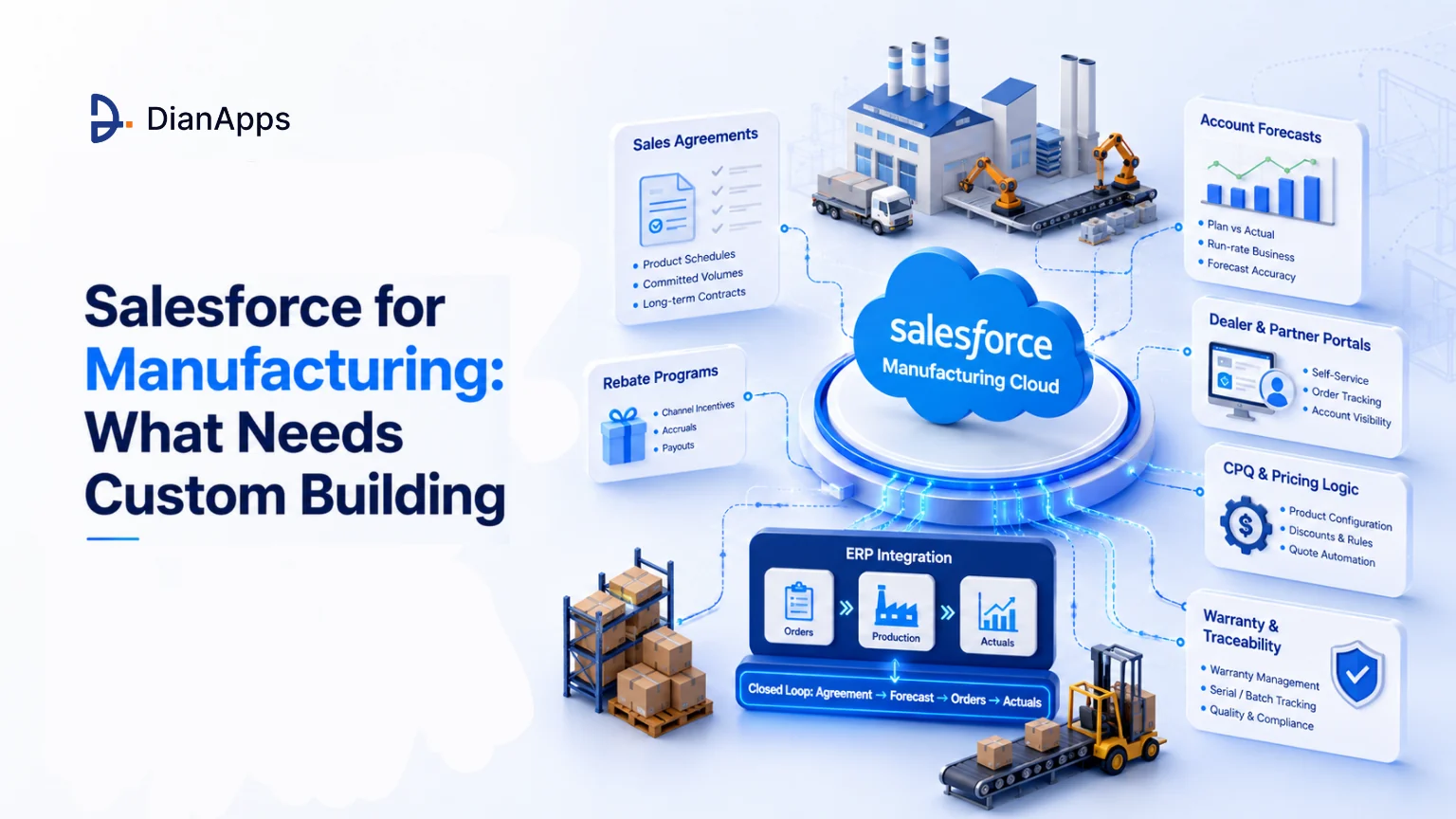





Key Takeaways :
- Manufacturing Cloud is built around account-based, run-rate business, making forecast complexity and long-term commitments more important than company size when deciding whether to use it.
- Don’t rebuild the Manufacturing Cloud data model, because Sales Agreements, Account Forecasts, Rebates, Partner Accounts, Assets, and Work Orders are already standard capabilities.
- ERP integration is usually the critical delivery risk, particularly product master alignment, batch windows, and reliable order-actuals flow back into Salesforce.
- The strongest custom-development opportunities are dealer portals, CPQ logic, warranty workflows, traceability, rebate calculations, and ERP middleware.
Quick Answer: Manufacturing Cloud’s objects are standard, so extend them rather than rebuilding them. The real custom work is around dealer portals, CPQ logic, warranty and traceability workflows, and ERP middleware. The closed loop from agreement to forecast to ERP actuals is what makes the platform valuable.
Manufacturing Cloud already contains most of what manufacturers start by scoping as custom development.
Sales Agreement, Sales Agreement Product, Product Schedule, Account Forecast, Account Manager Target, Rebate programs – all standard, all maintained by Salesforce, all wired together so that agreement data feeds forecasts and ERP actually closes the loop. Teams that build custom equivalents spend six figures recreating it, then own the maintenance forever.
This guide covers what genuinely needs building, what only needs extending, and where manufacturing projects actually go wrong – which is almost always the ERP integration.
Where Standard Salesforce Stops for Manufacturing
Sales Cloud assumes a deal: an opportunity that opens, progresses, and closes. Manufacturing assumes something structurally different – run-rate business under long-term agreements, volumes committed by product and period, forecasts that matter more than pipeline, and revenue arriving through distributors and dealers rather than direct.
Manufacturing Cloud closes most of that gap. It provides sales agreements with product schedules, account-based forecasting that compares planned against actual, account manager targets, and rebate programs for channel incentives.
What it doesn’t close is your configure-price-quote logic, your dealer experience, your warranty process, and the ERP that holds the actual orders. That’s where development starts.
Don’t Rebuild What Manufacturing Cloud Gives You
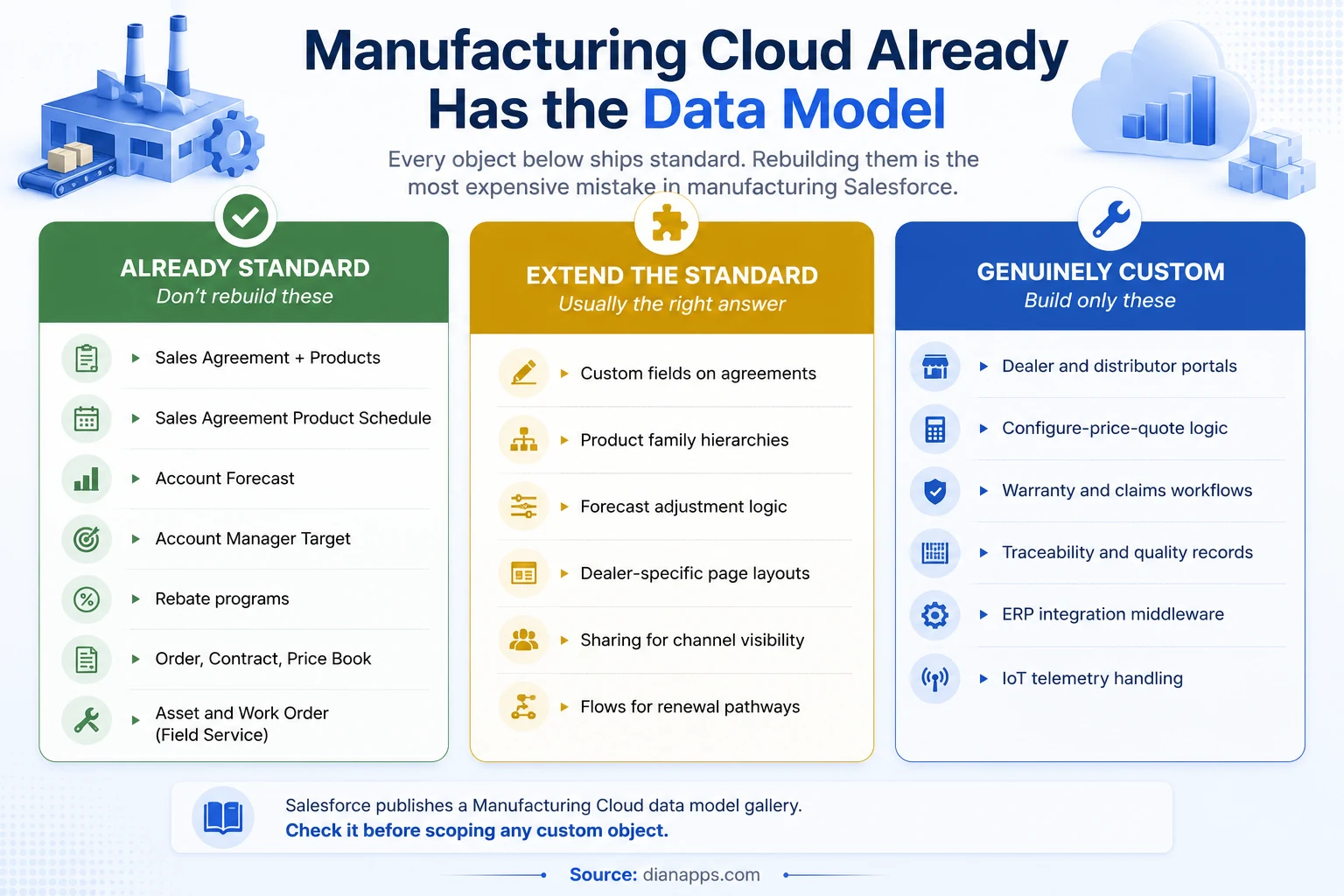
Salesforce publishes a Manufacturing Cloud data model gallery with the full object diagram – Account, Contact, Contract, Order, Product, Price Book, Product, Sales Agreement, Sales Agreement Product, Sales Agreement Product Schedule, and their relationships. Check it before scoping a single custom object.
- Worth Knowing: Asset and Work Order are standard Field Service objects, not things to build. Partner Account is standard. Rebate Management is a standard capability. Almost everything a manufacturer lists as “we’ll need a custom object for…” already exists somewhere in the platform.
- The Honest Exception: Genuinely unusual commercial structures – complex multi-tier distribution, consignment models, or engineering-to-order businesses where the product doesn’t exist until the order does. Those are architect conversations.
Related: The Salesforce data model explained · Configuration vs customization
The Architectural Distinction That Decides Everything
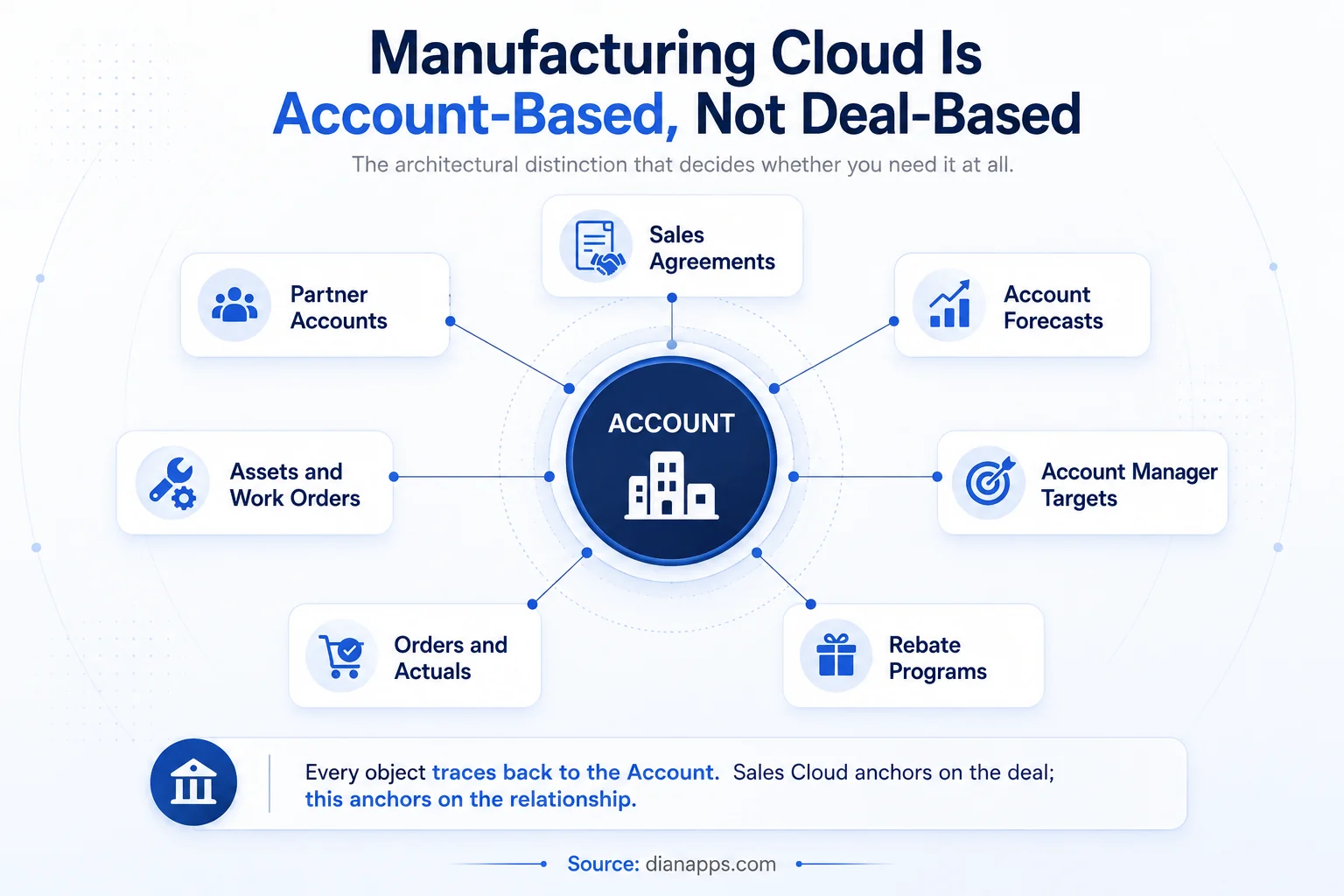
- Every Manufacturing Cloud Object Traces Back To The Account: That’s deliberate, and it’s the clearest way to decide whether you need it.
- Sales Cloud Anchors On The Deal: Good when revenue comes from discrete, competitive, one-off transactions.
- Manufacturing Cloud Anchors On The Relationship: Right when revenue is committed volume over time, renegotiated annually, delivered in scheduled quantities.
- The Deciding Factor Isn’t Company Size: It’s forecast complexity and the cost of being wrong. A manufacturer with fifty accounts and complex multi-year commitments needs it more than one with five hundred accounts buying transactionally.
- The Closed Loop Is The Point: a rep enters a product schedule on a sales agreement, planned quantities roll into the account forecast, ERP order data flows back as actuals, and the forecast compares planned against actual by product, period, and account. Without the ERP half, you have an expensive spreadsheet.
Manufacturing Cloud or Build on Core?
| Manufacturing Cloud | Sales Cloud + custom | |
|---|---|---|
| Sales agreements with schedules | Standard | Custom objects and roll-up logic |
| Account-based forecasting | Standard, plus Advanced Account Forecasting | You build the forecasting engine |
| Planned vs actual comparison | Built in | Custom calculation and storage |
| Rebate programs | Standard capability | Substantial custom build |
| Data model maintenance | Salesforce’s problem | Yours, permanently |
| Licence cost | Higher per seat | Lower per seat |
| Build cost | Lower - configuration over construction | Substantially higher |
- Where The Maths Lands: Manufacturing Cloud costs more per seat and less overall wherever run-rate business and forecasting matter. Building the equivalent on Sales Cloud is cheaper in year one and more expensive by year three – and every Salesforce release becomes your regression problem.
- Where Core Salesforce Is Genuinely Fine: Transactional B2B manufacturing with no long-term agreements or the administrative side of a manufacturing business – procurement requests, facilities, internal IT.
- Advanced Account Forecasting: Is worth knowing about specifically, as it generates forecasts from multiple inputs, opportunities, orders, sales agreements, historical orders, and custom data, rather than a single source. If your forecasting genuinely needs that, it’s a strong argument against building your own.
Need to Build Salesforce for Manufacturing?
Map your Manufacturing Cloud capabilities, ERP dependencies, custom workflows, and integration requirements before deciding what to configure, extend, or build.
Related: Salesforce customization cost
The Integration Surface
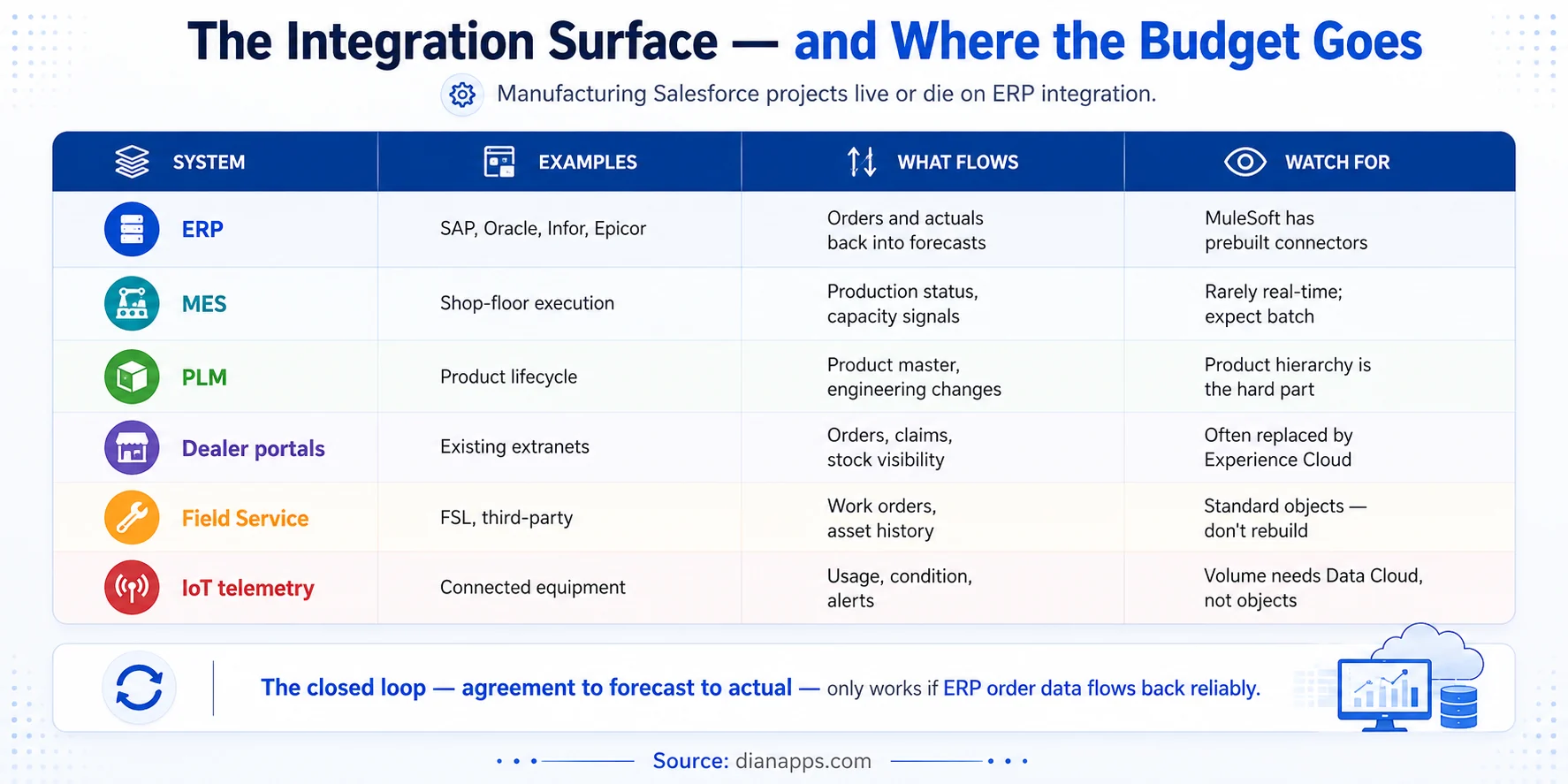
ERP is where manufacturing Salesforce projects succeed or fail.
The closed loop depends on order actuals flowing back from SAP, Oracle, Infor, or Epicor. If that integration is unreliable, forecasts drift from reality, and users stop trusting the system – which is the failure mode, not a technical outage.
Three Things That Consistently Cost More Than Expected:
- Product Master Alignment: Salesforce products and ERP material masters rarely map one-to-one. Product families, variants, units of measure, and regional part numbers all need reconciling before anything else works. This is usually the hidden first project.
- Batch Windows: Most ERPs weren’t built for real-time API access. Expect nightly or hourly batches and design the forecast refresh cadence around that rather than promising live data.
- IoT Volume: Telemetry from connected equipment doesn’t belong in custom objects – the volume will overwhelm them. That’s a Data Cloud conversation, and it’s a different budget line.
- MuleSoft Has Prebuilt ERP Connectors, which reduces custom development meaningfully for SAP and Oracle. Worth checking before scoping bespoke middleware. See MuleSoft for Salesforce.
Related: Salesforce integration guide · Salesforce API integration
ERP integration quoted as a line item rather than a project?
The product master alignment alone is usually weeks. We’ll scope it honestly before you commit to a timeline.
What Manufacturers Actually Build
- Dealer and Distributor Portals: Experience Cloud sites for ordering, stock visibility, claims submission, and co-op funds. Almost always custom, because channel experience is a competitive differentiator and every manufacturer’s channel is shaped differently.
- Configure-Price-Quote Logic: Salesforce CPQ handles a lot, but complex configurable products with engineering constraints usually need custom rules on top.
- Warranty and Claims Workflows: Registration, entitlement checking, claim submission, adjudication, and the parts and labour reimbursement behind it. Highly manufacturer-specific.
- Quality and Traceability Records: Batch and lot tracking, non-conformance handling and audit trails that satisfy customers and regulators. Where ITAR or export controls apply, this becomes a security design problem too.
- Field Service Extensions: Asset history, preventive maintenance scheduling and mobile workflows for engineers. Built on standard Field Service objects, extended for your equipment.
- Rebate and Incentive Calculation: Rebate Management covers standard programmes; genuinely complex tiered, multi-product or growth-based incentives usually need calculation logic on top.
This is where Salesforce Development Services become valuable, extending Manufacturing Cloud with the dealer experiences, CPQ logic, warranty workflows, traceability, rebate calculations, and ERP integrations that are specific to each manufacturer.
Need Salesforce Developers for Your Manufacturing Build?
Add Salesforce development expertise for dealer portals, CPQ logic, warranty workflows, traceability, rebates and ERP integrations.
What It Costs
Indicative bands, excluding Manufacturing Cloud licences:
| Build | Typical range |
|---|---|
| Custom fields, layouts and record types per persona | $5,000 – $18,000 |
| Forecast adjustment or override logic | $12,000 – $35,000 |
| Warranty and claims workflow | $25,000 – $75,000 |
| Rebate calculation beyond standard | $20,000 – $60,000 |
| Dealer or distributor portal | $40,000 – $120,000 |
| ERP integration (SAP/Oracle, bi-directional) | $60,000 – $200,000+ |
| Product master alignment and data migration | $25,000 – $90,000 |
That last line is the one people leave out of budgets, and it’s frequently the first thing that has to happen.
Where ITAR or export controls apply, add a compliance workstream. Controlled technical data has access restrictions that shape the sharing model, and it constrains who – including which offshore development team – may touch the org. That’s worth raising before selecting a delivery partner rather than after.
The Mistakes That Cost Most
- Rebuilding the Manufacturing Cloud data model. The expensive one.
- Treating ERP integration as a connector. It’s a project. Product master alignment alone is usually weeks.
- Promising real-time forecasts against a batch ERP. Set the cadence expectation early.
- Putting IoT telemetry in custom objects. Volume will break it. Use Data Cloud.
- Building a dealer portal before agreeing on the data model for channel partners. Partner Account structure constrains what the portal can show.
- Ignoring export control implications when choosing a delivery team. Discovered late, this can invalidate a partner selection.
Where to Go Next
For the integration surface, Salesforce integration, Salesforce API integration, and MuleSoft for Salesforce.
For the build decision, configuration vs customization and custom Salesforce development.
For budgeting, Salesforce customization cost.
For the security model that export controls constrain, Salesforce compliance and data security.
The complete Salesforce development guide is the hub.
Before You Scope a Manufacturing Build
Two questions change the shape of most manufacturing Salesforce projects, and both take minutes.
What’s already standard in Manufacturing Cloud? Usually more than the scope assumes.
How does order data get back from ERP? Usually harder than the timeline assumes.
Getting both wrong produces the characteristic manufacturing failure: a well-built forecasting system nobody trusts, because the actuals never arrive reliably.
We’re a certified Salesforce Consulting Partner with developers, architects, and consultants across the US, UK, Australia, Canada, UAE, and India.
Ready to Scope Your Manufacturing Salesforce Build?
Tell us what’s standard in Manufacturing Cloud, how your ERP handles actuals, and where custom development or integration is genuinely required.
 0 comments









Leave a Comment
Your email address will not be published. Required fields are marked *