















 0 comments




Key Takeaways:
- Agents Are Now Mainstream: 57% of the 1,340 teams surveyed are already running AI agents in production and quality not cost, is the top blocker.
- One Size Is Not Fitting All: The best LLM framework for a RAG chatbot (LlamaIndex, Haystack) is rarely the best framework for a stateful multi-agent workflow (LangGraph, CrewAI).
- Langchain Is Still Leading: With roughly 136,700 GitHub stars it is the most-starred developer framework but LangGraph is where new agent builds are heading.
- Every Framework Here Is Open Source: All 10 LLM frameworks reviewed are MIT or Apache 2.0 licensed, the cost is in the model tokens and the hosting not the library.
- What We’ve Covered: Framework types, a comparison table, 10 detailed profiles, a use-case decision matrix and production concerns most lists skip.
- Evaluation Base: Production readiness, agent and tool-calling support, RAG capability, model portability, community velocity, learning curve and licence.
Quick Answer: The best LLM frameworks in 2026 are LangGraph for production AI agents, LlamaIndex for RAG (Retrieval-Augmented Generation) and data-heavy apps, LangChain for fast all-round prototyping, CrewAI for role-based multi-agent teams and DSPy for prompt optimisation, Vercel AI SDK is the pick for web and mobile front ends.
Choosing between LLM frameworks is becoming one of the first architectural decisions in any AI project and it is one that is surprisingly hard to reverse. If you pick a chain-based library for what turns into an agent workflow, you would be rewriting in six months, pick a heavyweight agent framework for a simple summariser and you are debugging abstractions you never needed.
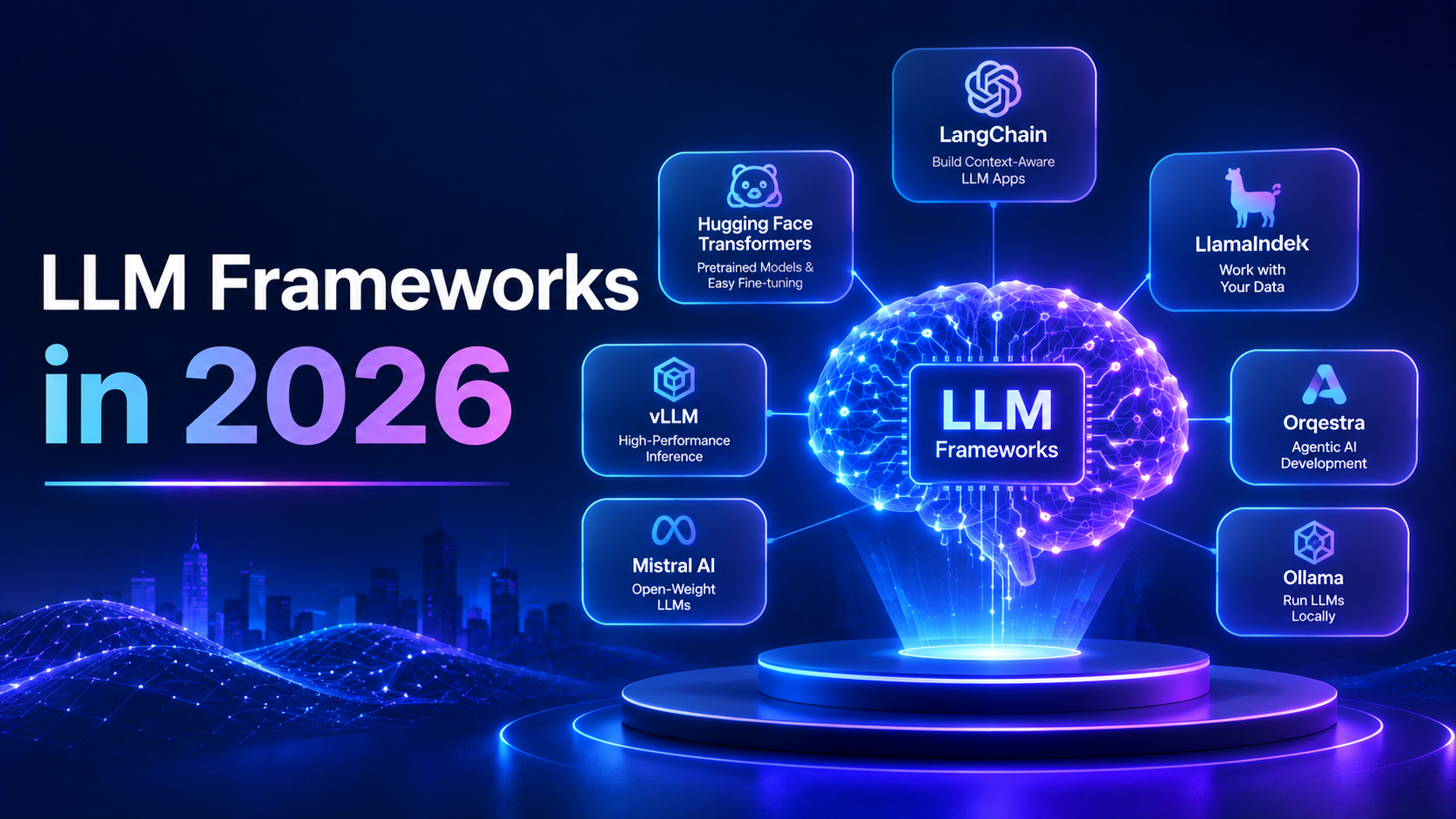
This article compares the top 10 LLM frameworks that are actually delivering results in 2026, grouping them by what they are good at and giving you a decision matrix so you are choosing by workload rather than by GitHub hype.
What Is an LLM Framework?
An LLM framework is a software library that is sitting between your application code and one or more large language models, handling prompts, model calls, tool use, memory, retrieval and orchestration so you do not have to write that plumbing yourself.
Without one, every project is re-implementing the same things, prompt templates, retry logic, output parsing, conversation memory, document chunking, vector search and the loop that lets a model call a tool and read the result. LLM frameworks are packaging those pieces into reusable components.
It is worth separating four terms that are often blurred together in framework lists:
- LLM framework or library: Code you import into your app (LangChain, LlamaIndex, Haystack), this is exactly what this guide is comparing.
- Model SDK: The vendor’s own client (OpenAI, Anthropic, Google SDKs), thin, fast, single-provider.
- LLM Gateway: A proxy for routing, caching and cost control across providers (LiteLLM, Portkey, OpenRouter), useful alongside a framework not instead of one.
- Low-code Platform: Visual builders such as Flowise, Dify or n8n which is great for prototypes, limiting for complex production logic.
Understanding where an LLM framework sits within the broader AI development tech stack is important because frameworks, model SDKs and LLM gateways solve different problems.
Do You Actually Need an LLM Framework?
No, you don’t always need one and this is the honest answer most comparison posts are skipping. If your app is making single-turn calls to one provider with structured output, the vendor SDK plus 100 lines of your own code is simpler, faster to debug and easier to upgrade.
You are needing a framework when your app is crossing at least two of these lines: multiple models or providers, retrieval over your own data, multi-step tool use, persistent state across turns or more than one developer touching the prompts.
At that point the framework is paying for itself in consistency and observability.
5 Types of LLM Frameworks and Which One You Need?
Most confusion in this space is coming from lists that rank an agent framework against a search tool against a gateway, grouping by type first is making the choice far easier.
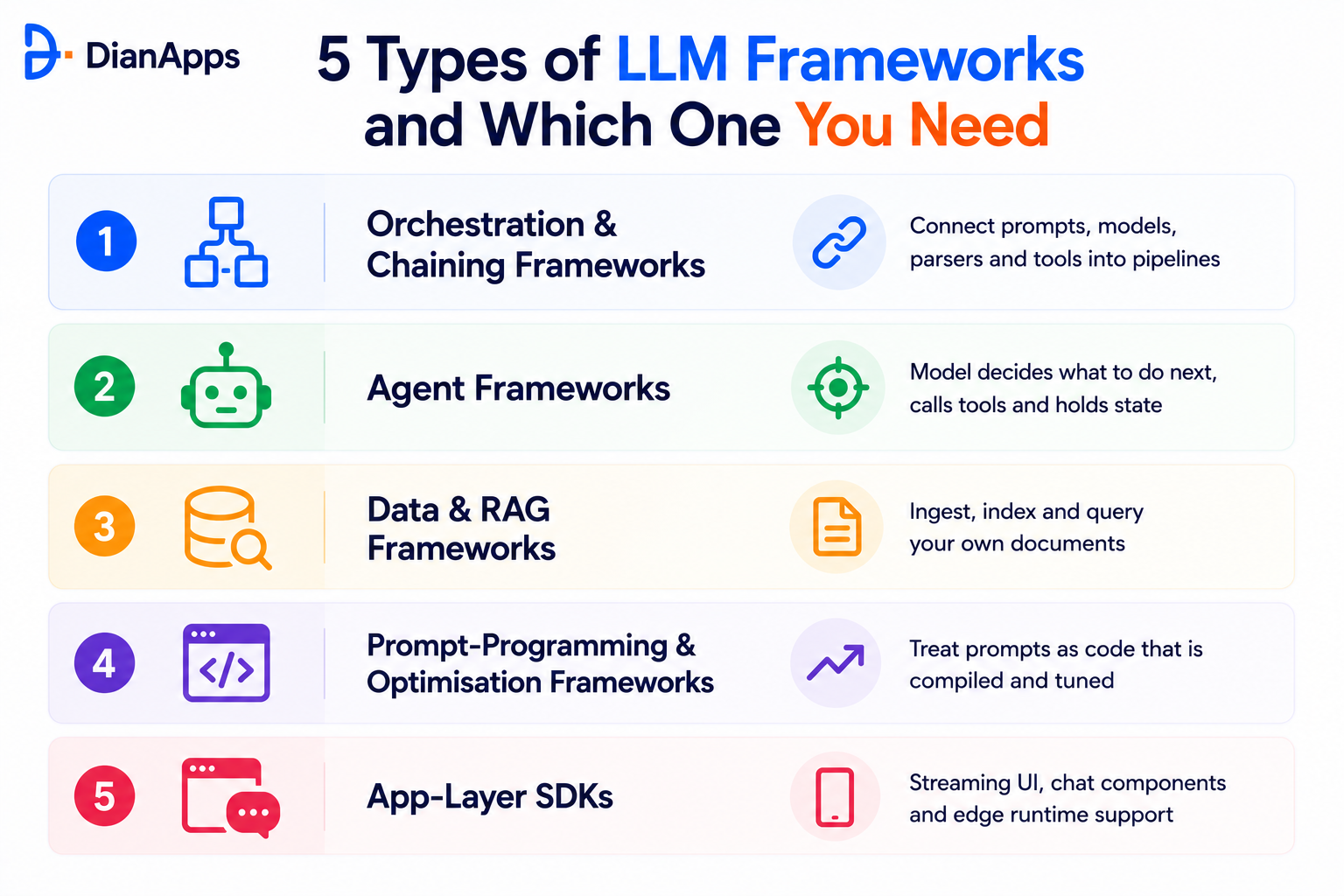
- Orchestration And Chaining Frameworks: General-purpose LLM orchestration tools that are connecting prompts, models, parsers and tools into pipelines, LangChain, Haystack and Semantic Kernel are living here.
- Agent Frameworks: Built for loops where the model is deciding what to do next, calling tools and holding state, LangGraph, CrewAI, Microsoft Agent Framework, PydanticAI and OpenAI Agents SDK.
- Data And Rag Frameworks: Optimised for ingesting, indexing and querying your own documents, LlamaIndex is the clearest example, Haystack is overlapping here too.
- Prompt-Programming And Optimisation Frameworks: Treating prompts as code that is compiled and tuned against metrics. DSPy is the category leader.
- App-Layer Sdks: Streaming UI, chat components and edge runtime support for web and mobile front ends. Vercel AI SDK.
Evaluation frameworks (DeepEval, RAGAS) and serving engines (vLLM, Ollama) are deliberately out of scope, they are complements to the LLM frameworks below rather than alternatives.
Also Read- Agentic AI Trends 2026: 8 Shifts, Use Cases and Examples
How These LLM Frameworks Are Evaluated?
This list is a comparison of open source LLM frameworks that DianApps’ engineers are actively using or have shipped client work on, it is not a sponsored ranking and it is not a list of every library on GitHub.
Each framework is being scored on six criteria:
- Production Readiness: Stability of the API surface, release cadence and how many known companies are running it in production.
- Agent And Tool-Calling Support: Native support for tool use, multi-step loops, state and human-in-the-loop checkpoints.
- RAG Capability: Built-in loaders, chunking, indexing and retrieval strategies or clean integrations for them.
- Model Portability: How much code is changing when you swap GPT-4o for Claude or an open-weight model.
- Community Velocity: GitHub stars, contributor activity and how fast issues are being answered.
- Learning Curve And Licence: Time to a working prototype and whether the licence is permissive.
Where we are stating a preference, it is coming from building with these libraries not from reading their landing pages.
LLM Framework Comparison Table (2026)
The table below is summarising all 10 LLM frameworks at a glance before the detailed profiles.
| Framework | Type | Language | Best for | Licence | GitHub stars (May 2026) | Learning curve |
| LangChain | Orchestration | Python, JS/TS | All-round prototyping, integrations | MIT | ~136,700 | Medium |
| LangGraph | Agent | Python, JS/TS | Stateful production agents | MIT | ~32,000 | Medium-High |
| LlamaIndex | RAG / Data | Python, TS | RAG over private data | MIT | ~49,400 | Low-Medium |
| Haystack | Orchestration / RAG | Python | Enterprise search and RAG pipelines | Apache 2.0 | ~25,200 | Medium |
| CrewAI | Agent | Python | Role-based multi-agent teams | MIT | ~51,400 | Low |
| Microsoft Agent Framework | Agent | Python, .NET | Azure and .NET enterprises | MIT | ~58,000 (AutoGen) + ~27,900 (Semantic Kernel) | Medium |
| DSPy | Prompt optimisation | Python | Metric-driven prompt tuning | MIT | ~34,400 | High |
| PydanticAI | Agent | Python | Type-safe lightweight agents | MIT | ~17,100 | Low |
| OpenAI Agents SDK | Agent | Python, TS | Teams standardised on OpenAI | MIT | ~26,300 | Low |
| Vercel AI SDK | App-layer SDK | TS/JS | Streaming web and mobile UIs | Apache 2.0 | ~24,200 | Low |
Source: GitHub star counts from Presenc AI framework rankings, May 2026. Licences from each project’s repository.
The takeaway is that stars are measuring popularity not fit, LangGraph has a quarter of LangChain’s stars and is still the stronger choice for most new agent builds.
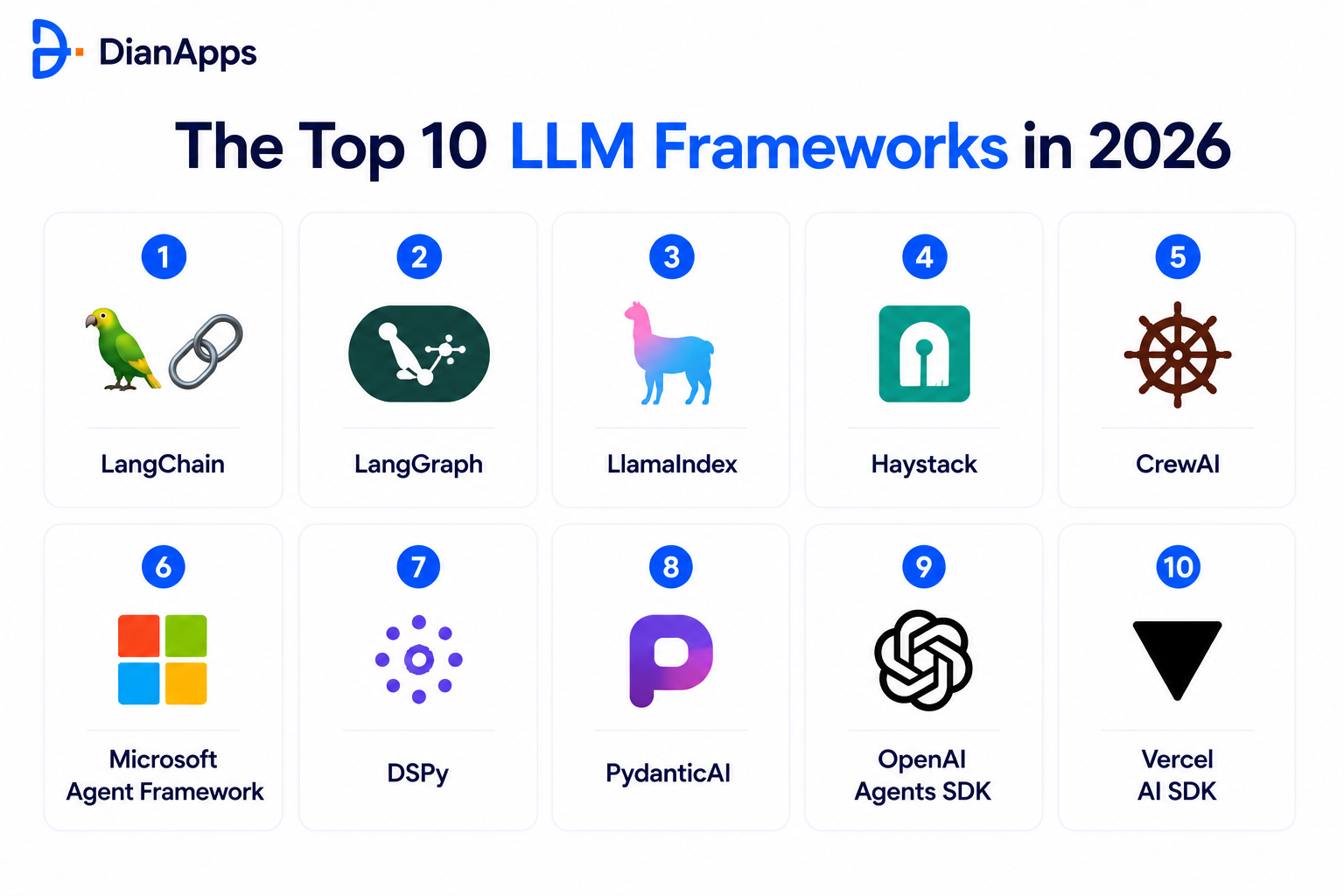
The Top 10 LLM Frameworks in 2026
Each profile is following the same structure so you can scan and compare quickly.
1. LangChain
LangChain is still the widest on-ramp into LLM development, with more integrations than any other library and both Python and JavaScript support.
LangChain is offering standard interfaces for models, prompts, retrievers, tools and output parsers, plus the LCEL expression language for composing them. Its biggest strength is the integration catalogue, hundreds of vector stores, document loaders and model providers are already wired in. Its biggest weakness is the same breadth, abstractions are stacking up quickly and debugging a deep chain is not always pleasant.
- Best For: Prototyping, integration-heavy apps, teams that want one library across Python and TypeScript.
- Limitations: Abstraction overhead, frequent API changes historically, agent logic is now living in LangGraph rather than here.
- Adopters: Widely used across startups and enterprises, LangSmith is offering paid observability on top.
- Licence: MIT.
|
1 2 3 4 5 6 7 8 9 |
from langchain_openai import ChatOpenAI from langchain_core.prompts import ChatPromptTemplate prompt = ChatPromptTemplate.from_template("Summarise this in one line: {text}") chain = prompt | ChatOpenAI(model="gpt-4o-mini") print(chain.invoke({"text": "LLM frameworks are abstracting model plumbing."}).content) |
2. LangGraph
LangGraph is the framework the LangChain team is pointing you toward for anything agentic and for good reason.
For teams moving from basic LLM applications to production workflows, agentic AI development requires careful decisions around state, tools, guardrails and human approval.
- Best For: Long-running agents, approval workflows, anything that needs to pause, resume or replay.
- Limitations: Steeper learning curve, more boilerplate than CrewAI for simple cases.
- Adopters: Companies such as Klarna, Replit and Elastic are publicly building on the LangChain and LangGraph stack.
- Licence: MIT.
|
1 2 3 4 5 6 7 8 9 10 11 12 13 14 15 16 17 18 19 20 21 22 23 |
from langgraph.graph import StateGraph, START, END from typing import TypedDict class State(TypedDict): question: str answer: str def answer(state): return {"answer": f"Answering: {state['question']}"} g = StateGraph(State) g.add_node("answer", answer) g.add_edge(START, "answer") g.add_edge("answer", END) print(g.compile().invoke({"question": "Which LLM framework?"})) |
3. LlamaIndex
If your app is mostly “answer questions over our documents”, LlamaIndex is the fastest route to a good result.
LlamaIndex is treating data as the first-class citizen, with 300+ loaders through LlamaHub, rich document metadata, multiple index types and advanced retrieval strategies such as hybrid search, re-ranking and sub-question decomposition. Its agent tooling (Workflows) is improving but retrieval is where it is shining.
- Best For: RAG frameworks comparison winner for knowledge bases, internal search, document Q&A.
- Limitations: Less flexible for complex agent orchestration, smaller JavaScript ecosystem than LangChain.
- Adopters: LlamaCloud and LlamaParse are the commercial layer for enterprise document parsing.
- Licence: MIT.
|
1 2 3 4 5 6 7 |
from llama_index.core import VectorStoreIndex, SimpleDirectoryReader docs = SimpleDirectoryReader("./policies").load_data() index = VectorStoreIndex.from_documents(docs) print(index.as_query_engine().query("What is our refund window?")) |
4. Haystack
Haystack, from deepset, is the most “boring in a good way” of the open source LLM frameworks, stable pipelines, clear components and strong enterprise search roots.
Its pipeline model is explicit and serialisable, which is making it easy to version, test and deploy. It is integrating with Elasticsearch, OpenSearch, Weaviate and most major vector stores and it is one of the few frameworks with a real story for hybrid keyword plus semantic retrieval out of the box.
- Best For: Enterprises with existing search infrastructure, regulated industries, teams that value stability over novelty.
- Limitations: Python only, smaller community, fewer bleeding-edge agent features.
- Licence: Apache 2.0.
5. CrewAI
This is making multi-agent systems approachable, you are defining agents with roles, goals and tools, then assigning tasks and letting the crew collaborate.
It is standalone (no LangChain dependency since 2024) and its Flows feature is adding event-driven control for production. It is a favourite for content pipelines, research assistants and back-office automation where the mental model of “a team of specialists” is mapping cleanly to the problem.
- Best For: Quick multi-agent prototypes, business-process automation, teams new to agents.
- Limitations: Less fine-grained control than LangGraph, debugging emergent agent behaviour is harder.
- Licence: MIT.
6. Microsoft Agent Framework
Microsoft is merging AutoGen’s multi-agent research with Semantic Kernel’s enterprise plumbing into a single Agent Framework and it is the obvious pick if your stack is .NET or Azure.
You are getting first-class C# and Python support, Azure OpenAI and Azure AI Foundry integration, enterprise identity and compliance features and the group-chat and handoff patterns AutoGen pioneered.
- Best For: Enterprises on Microsoft 365, Azure or .NET, Copilot-style internal tools.
- Limitations: Still consolidating, documentation is spread across the older AutoGen and Semantic Kernel repos.
- Licence: MIT.
7. DSPy
From Stanford NLP, is replacing hand-written prompts with declarative signatures and then optimising them against your own metric.
Instead of tweaking wording, you are declaring input and output fields, picking a module (predict, chain-of-thought, ReAct) and letting an optimiser search for the prompt and few-shot examples that maximise accuracy on your dataset. Teams that are moving between models are loving it because re-optimisation is a rerun not a rewrite.
- Best For: Classification, extraction and QA pipelines with a measurable metric, multi-model portability.
- Limitations: Steep conceptual curve, needs labelled data to shine not an app-building framework.
- Licence: MIT.
8. PydanticAI
PydanticAI is bringing FastAPI-style ergonomics to agents, typed inputs, validated structured outputs and dependency injection, with very little magic.
Built by the Pydantic team, it is model-agnostic, supports streaming and tool calling and is integrating with Logfire for tracing. It is the framework we are reaching for when a client wants an agent that is small, testable and easy for any Python developer to read.
- Best For: Production microservices, teams that prioritise type safety and testing.
- Limitations: Younger ecosystem, fewer prebuilt integrations, Python only.
- Licence: MIT.
9. OpenAI Agents SDK
The OpenAI Agents SDK is a minimal, opinionated way to build agents with handoffs, guardrails and built-in tracing and it is the path of least resistance if OpenAI is your only provider.
It is small enough to learn in an afternoon and it is pairing naturally with the Responses API and OpenAI’s hosted tools (web search, file search, computer use). It is technically able to call other providers through compatible endpoints but the design centre is OpenAI.
- Best For: OpenAI-only stacks, fast agent MVPs, teams that want vendor-supported primitives.
- Limitations: Provider lock-in in practice, thinner RAG story than LlamaIndex or Haystack.
- Licence: MIT.
10. Vercel AI SDK
The Vercel AI SDK is the best framework for LLM apps whose hard problem is the front end, streaming tokens into React, Next.js, Svelte or Expo screens.
It is offering a unified provider interface (OpenAI, Anthropic, Google, Mistral, open-weight models), useChat and useCompletion hooks, structured output with Zod and edge-runtime support. It is not trying to be an orchestration layer, pair it with a Python back end running one of the frameworks above when the logic gets heavy.
- Best For: Chat UIs, streaming, mobile apps built with React Native or Expo, TypeScript-first teams.
- Limitations: Not a full orchestration or RAG framework, JavaScript ecosystem only.
- Licence: Apache 2.0.
Which LLM Framework Should You Choose? Use Case Comparison
Pick by workload not by popularity, the matrix below is mapping the most common project types to a first choice and a runner-up.
| Use case | First choice | Runner-up | Why |
| RAG chatbot over company docs | LlamaIndex | Haystack | Best loaders, indexing and retrieval strategies |
| Multi-step autonomous agent with approvals | LangGraph | PydanticAI | Explicit state, persistence, human-in-the-loop |
| Multi-agent “team of specialists” | CrewAI | Microsoft Agent Framework | Fastest path to collaborating agents |
| Enterprise on Azure or .NET | Microsoft Agent Framework | Semantic Kernel (legacy) | Native C#, Azure identity and compliance |
| Rapid prototype or hackathon | LangChain | OpenAI Agents SDK | Most integrations, most tutorials |
| Accuracy-critical extraction or classification | DSPy | PydanticAI | Metric-driven prompt optimisation |
| Streaming chat UI in web or mobile app | Vercel AI SDK | LangChain.js | Hooks, streaming, edge runtime |
| Strictly OpenAI models | OpenAI Agents SDK | LangGraph | Vendor-supported, minimal |
If you are still torn, prototype the same thin slice in two frameworks over one week, the difference in developer experience is usually obvious by day three.
Not Sure Which LLM Framework Fits Your Product?
Tell us what you’re building, and our AI team can help evaluate the framework, architecture and implementation approach that best fits your use case.
LangChain vs LlamaIndex vs Haystack: Quick Comparison
The langchain vs llamaindex debate is mostly a question of what your app is doing most. LangChain is winning on breadth and agent tooling through LangGraph, LlamaIndex is winning on retrieval quality and speed to a working RAG app and Haystack is winning on pipeline stability for enterprise search. Many production systems are using LlamaIndex for indexing and LangGraph for orchestration together.
LangGraph vs CrewAI vs Microsoft Agent Framework: Quick Verdict
LangGraph is for control, CrewAI is for speed and Microsoft Agent Framework is for the Microsoft ecosystem. If you are needing to explain to a compliance team exactly what an agent did and why, LangGraph’s explicit graph is the easiest to defend.
Production Considerations Most LLM Framework Comparisons Skip
Getting a demo working is the easy part. According to LangChain’s State of Agent Engineering report, quality is the number-one blocker to production for roughly a third of teams, followed by latency at 20% (LangChain, 2026). The framework choice is shaping all of the following.
Observability and Tracing
89% of organisations are already running some form of observability for their agents and 62% have detailed tracing (LangChain State of Agent Engineering, 2026). LangGraph pairs with LangSmith, PydanticAI with Logfire, OpenAI Agents SDK has built-in traces and Haystack, LlamaIndex and CrewAI are all supporting OpenTelemetry-based tools such as Langfuse and Arize Phoenix. Check this before you commit, retrofitting tracing is painful.
Cost Control and Token Efficiency
Frameworks are not charging you, models are, look for prompt caching support, the ability to route cheap tasks to small models and, in DSPy’s case, optimisers that are shrinking prompts while holding accuracy. An LLM gateway such as LiteLLM in front of any framework is giving you per-team budgets and fallbacks.
Framework licensing is rarely the biggest expense, so understanding AI development cost means accounting for model usage, hosting, infrastructure and engineering effort as well.
Vendor Lock-In and Model Portability
Model-agnostic LLM frameworks (LangChain, LlamaIndex, Haystack, PydanticAI, Vercel AI SDK, DSPy) are letting you swap providers with a one-line change. The OpenAI Agents SDK and Microsoft Agent Framework are technically portable but culturally tied to their vendors. Decide up front how much that matters to you.
Security, Guardrails and Compliance
Look for input and output validation (PydanticAI and OpenAI Agents SDK are strongest here), PII redaction hooks, tool-permission controls and audit logs. Enterprises with 2,000+ employees are naming security as a leading concern in the same LangChain survey and that pressure is only growing.
Mobile and On-Device Considerations
Most LLM frameworks are server-side and that is fine but mobile teams are needing to think about streaming over unreliable networks, token-level UI updates and when to run a small model on the device instead. Vercel AI SDK with Expo is covering the streaming UI and a Python back end on LangGraph or LlamaIndex is handling the heavy lifting. Our comparison of on-device AI vs cloud AI is going deeper on that split.
Need Engineers Who Know the LLM Stack?
Hire AI developers experienced with LLMs, RAG, AI agents and production frameworks such as LangGraph, LlamaIndex, LangChain and Vercel AI SDK.
What Changed in LLM Frameworks in 2025 and 2026?
- Chains gave way to graphs and agents: New builds are starting in LangGraph, CrewAI or PydanticAI rather than vanilla LangChain agents.
- MCP is standardising tools: The Model Context Protocol is letting the same tool servers plug into multiple frameworks, which is reducing lock-in and duplicated integrations.
- Microsoft consolidated: AutoGen and Semantic Kernel are converging into the Microsoft Agent Framework.
- Typed, minimal frameworks arrived: PydanticAI and OpenAI Agents SDK are winning developers who were tired of deep abstraction stacks.
- Observability became table stakes: 94% of teams with agents in production are running observability (LangChain, 2026) and every serious framework is now shipping tracing hooks.
We are refreshing this section and the star counts every quarter, last updated August 2026.
How DianApps Is Building With LLM Frameworks?
DianApps, an AI-first product development company with 150+ engineers, 350+ clients across 25+ countries and a Clutch rating of 4.8/5 from 84+ reviews, is building LLM-powered products end to end, from the RAG or agent back end through to the mobile and web apps users are touching.
Our AI teams are working across LLM development, generative AI, AI agents, conversational AI, ML, NLP and computer vision and we are choosing the framework per project rather than per company. Recent work is including LlamaIndex-based knowledge assistants for enterprise document sets, LangGraph agents with human-approval steps for operations workflows and Vercel AI SDK front ends streaming into React Native apps.
What is setting DianApps apart is the full-cycle model, the same team is owning AI, mobile, web, backend and DevOps, so the framework decision is being made with the whole product in view, including U.S.-based delivery for North American clients. We are also honest when custom LLM work is not the right path, sometimes an off-the-shelf assistant or a simple SDK integration is the better answer and we are saying so.
Build With the Right LLM Framework From Day One
Turn your LLM idea into a production-ready product with the right combination of models, frameworks, RAG, agents and application architecture.
Conclusion
The LLM frameworks landscape in 2026 is rewarding teams that are choosing by use case, LangGraph for agents, LlamaIndex or Haystack for RAG, LangChain for breadth, CrewAI for multi-agent speed, DSPy for accuracy tuning and Vercel AI SDK for the front end. Every one of them is open source, so the real cost is in tokens, hosting and the engineering time you are spending on the wrong abstraction.
Whichever framework you are picking, keep your business logic portable, add tracing and evals early and plan the model-swap path before you need it. If you want a team that has shipped on these frameworks to help you choose and build, take to DianApps’ AI development Services.
Frequently Asked Question About LLM Frameworks
What is the best LLM framework in 2026?
- There is no single best LLM framework, the right pick is depending on workload. LangGraph is leading for production agents, LlamaIndex for RAG, LangChain for broad prototyping, CrewAI for multi-agent teams, DSPy for prompt optimisation and Vercel AI SDK for streaming web and mobile front ends.
Is LangChain still worth using or should I use LangGraph?
- LangChain is still worth using for integrations, prompt management and quick prototypes. For anything agentic, stateful or long-running, LangGraph is the better choice, it is built by the same team and is designed to be the agent layer that LangChain itself is now recommending.
LangChain vs LlamaIndex: which is better for RAG?
- LlamaIndex is generally better for RAG when retrieval is the core of your product, thanks to richer loaders, indexing and retrieval strategies. LangChain is better when RAG is one step in a wider workflow. Many teams are combining LlamaIndex indexing with LangGraph orchestration.
Which LLM framework is best for building AI agents?
- LangGraph is the best framework for production AI agents that need explicit state, persistence and human-in-the-loop control. CrewAI is fastest for role-based multi-agent prototypes, PydanticAI is best for small type-safe agents and Microsoft Agent Framework is best on Azure or .NET.
Are LLM frameworks free and open source?
- Yes, all 10 LLM frameworks in this guide are open source under MIT or Apache 2.0 licences and free to use. Costs are coming from model API tokens, hosting and optional commercial add-ons such as LangSmith, LlamaCloud or Logfire for observability and document parsing.
Do I need an LLM framework or can I call the OpenAI or Anthropic API directly?
- You can call the API directly for single-provider, single-step features and it is often the simpler option. You are needing a framework once you are combining multiple models, retrieval over your own data, tool use, persistent state or several developers sharing prompts.
Which LLM framework is best for enterprise applications?
- Haystack and LangGraph are the strongest for enterprise use thanks to stable pipelines, tracing and mature deployment stories. Microsoft Agent Framework is the natural pick for Azure and .NET organisations. Whichever you choose, add observability, evals and guardrails from the start.
Which LLM framework works best for mobile apps?
- Vercel AI SDK is the best framework for the mobile-facing layer, streaming responses into React Native or Expo apps. Pair it with a Python back end on LangGraph, LlamaIndex or PydanticAI for orchestration and retrieval and consider on-device models for offline or privacy-sensitive features.
 0 comments





Leave a Comment
Your email address will not be published. Required fields are marked *