















 0 comments





Key Takeaways:
- AI development costs vary widely by project complexity, ranging from $5,000 for basic AI chatbots to $500,000+ for custom enterprise AI platforms with advanced integrations and proprietary model training.
- Data preparation is the biggest cost driver, often consuming 60 – 80% of the project timeline, making data quality and availability critical for accurate budgeting.
- Project scope, model complexity, integrations, compliance, team expertise and technology stack are the six primary factors that determine the final AI development cost.
- Businesses should budget beyond initial development, accounting for cloud infrastructure, model retraining, maintenance, API usage and security audits, which typically require 15 – 25% of the original project cost annually.
- Development costs differ significantly by region, with experienced AI developers in South Asia and Eastern Europe offering competitive rates that can reduce overall project expenses without compromising quality.
- A phased AI strategy helps optimize costs, where starting with an MVP, leveraging pre-trained models, investing in data readiness and partnering with the right AI development company can reduce total development costs by 30–50% while maintaining quality.
Quick Answer: AI development costs can range from $5,000 to over $500,000, depending on project complexity, data quality, integrations and customization requirements. Businesses should account for hidden expenses like cloud infrastructure, model retraining and maintenance while adopting cost-saving strategies such as building an MVP, using pre-trained models and partnering with experienced AI development teams to maximize ROI.
Budgeting for artificial intelligence has become one of the most critical planning exercises for businesses across every industry in 2026.
The AI development cost varies dramatically based on factors affecting AI development cost such as the project scope, data maturity and the level of customization a business requires from its solution.Gartner estimates global AI spending at $2.5 trillion for 2026, while IDC’s forecast places AI infrastructure spending alone at $497 billion for the same period.
These numbers reflect serious financial commitment and organizations that don’t understand the full pricing structure risk underestimating their budgets before the project even begins.
This guide provides a complete AI development cost breakdown covering pricing by project type, hourly rates, hidden expenses and ongoing operational costs that decision makers need to plan for accurately.
To know more about AI development, read our complete guide on what is AI Development, which covers all aspects of AI development in 2026.
How Much Does AI Development Cost in 2026?
The AI development expenses range anywhere from $5,000 for a basic rule based chatbot to over $500,000 for a fully custom enterprise grade AI platform. The range depends on its technical complexity, the volume and quality of training data available and how deeply the AI system needs to integrate with existing business infrastructure. Straightforward AI applications that rely on pre-trained models and standard APIs usually stay within the $5,000 to $30,000 bracket comfortably.
Mid complexity projects such as recommendation engines, demand forecasting tools and document processing systems will require budgets between $30,000 and $150,000 to reach production readiness. Enterprise systems that involve custom model training on proprietary datasets, real time inference capabilities and multi platform integrations regularly exceed $300,000 and can scale beyond the $500,000 mark.
According to the Stanford 2026 AI Index Report, AI adoption has now reached 53% across US households faster than either the personal computer or the internet and this accelerating demand continues pushing development costs upward across all project categories.
Need a realistic cost estimate for your AI project?
Talk to our AI consultants and get a detailed scope and budget breakdown customized to your use case.
AI Development Cost Breakdown by Project Phase
Knowing where the budget goes inside a project helps businesses plan more accurately than top level cost ranges alone.
The following breakdown reflects current market data.
| Project Phase | Budget Allocation | Key Cost Drivers |
| Discovery and Scoping | 5% to 10% | Architecture decisions, data audit, risk assessment |
| Data Preparation and Annotation | 20% to 25% | Labeling labor, storage, pipeline configuration |
| Model Training and Fine Tuning | 15% | GPU compute hours on A100 and H100 instances |
| Deployment and Integration | 15% | Inference infrastructure and API connectivity |
| Testing and Evaluation | 10% | Performance benchmarking and validation |
| Maintenance and Monitoring | 25% to 30% | MLOps infrastructure, retraining cadence, drift monitoring |
Data preparation commands the largest active development share because raw data needs extensive cleaning, deduplication and feature engineering before training begins. In one documented case, labeling alone consumed 22% of the total budget, roughly $55,000 of a $250,000 engagement, before any model training started.
Maintenance and monitoring carries the highest long term allocation because post deployment work accounts for roughly 65% of total lifecycle cost according to Keyhole Software’s enterprise TCO analysis. Over a three to five year period, total spend often reaches two to three times the initial development cost. Inference costs in year two typically run three to six times higher than year one as user adoption scales.
A computer vision system allocates more toward model training while a chatbot project shifts budget toward integration and conversation design. The consistent pattern is that data work and ongoing operations together consume 50% to 55% of total investment and underestimating either one remains the most common source of budget overruns.
Not sure how to allocate your budget for the project?
Our AI team can map your requirements to a phase wise cost plan.
What Changed in AI Development Costs From 2025 to 2026?
AI development pricing has not stayed flat between 2025 and 2026. Several technology and market shifts have directly changed what businesses pay to build, deploy and maintain AI systems.
-
Inference costs dropped by up to 95%
GPT-4 class capability that cost $30 per million input tokens in 2023 now runs under $0.50 per million tokens in 2026. NVIDIA’s Blackwell architecture delivers up to 25x lower cost and energy per inference token compared to the previous Hopper generation. Projects spending $8,000 to $12,000 monthly on inference hosting in 2025 can now run comparable workloads for significantly less as cloud providers expanded GPU fleet availability.
-
Fine tuning costs fell dramatically:
LoRA and QLoRA techniques now achieve 95% of full fine tuning performance at roughly 10% of the cost. A 70B parameter model that required eight H100 GPUs and $250 to $500 for full fine tuning now costs $15 to $30 using QLoRA on a single H100. Complete fine tuning projects including data preparation and evaluation now range from $5,000 to $15,000, making custom LLM work accessible to mid market companies that found it prohibitive twelve months ago.
-
Open source model quality shifted the equation:
Models like Llama 3, Mistral and DeepSeek V3 now deliver performance matching proprietary alternatives for many use cases. DeepSeek V3 runs at $0.27 per million input tokens compared to early GPT-4 pricing of $30 per million tokens. Teams can build production grade features using freely available model weights and redirect savings toward data preparation and integration.
-
AI talent costs rose 9% year over year:
Mid level machine learning engineers now earn $149,000 to $192,000 and senior ML engineers command $168,000 to $220,000 according to Motion Recruitment’s 2026 salary benchmarks. Staff and principal level AI engineers with ten or more years of experience reach $250,000 to $400,000 in base salary. This talent premium flows directly into project budgets whether teams hire internally or engage external partners.
-
Regulatory compliance costs expanded:
The EU AI Act now requires roughly €29,277 per AI model annually for compliance, with high risk systems costing approximately €52,000 per year. Organizations allocate 10% to 15% of their AI budgets to compliance activities. SMEs face total compliance costs between €50,000 and €500,000 depending on system complexity. Quality management system setup alone runs €20,000 to €80,000 initially with €10,000 to €25,000 in annual maintenance.
The net result is that compute and model access costs decreased meaningfully while talent and compliance costs rose in parallel. Total AI development cost for most project types has remained roughly stable or decreased slightly for organizations that leverage infrastructure savings strategically.
Also Read: AI App Development Cost: What You’ll Pay in 2026
Factors That Affect AI Development Cost
Several interconnected variables determine the final AI development cost for any given project and overlooking even one of them during the estimation phase leads to significant budget overruns down the line.
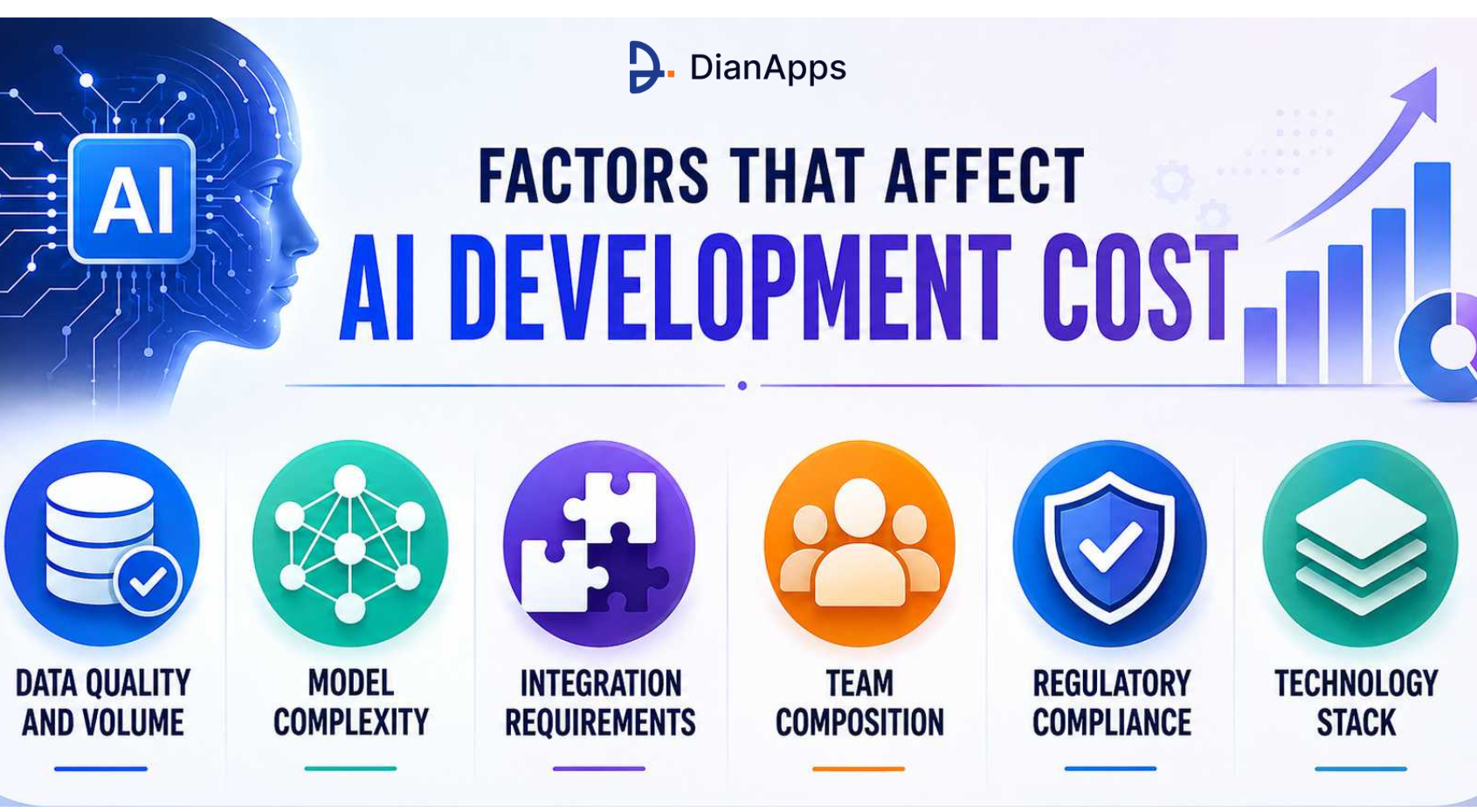
These are the primary factors that directly influence how much a business ends up spending on its AI initiative:
- Data Quality and Volume: Remains the single biggest cost driver because raw data almost never arrives in a format that machine learning models can use directly and the cleaning, labeling and structuring process alone consumes 60% to 80% of the total project timeline according to Deloitte’s State of AI in the Enterprise report.
- Model Complexity: Shapes the engineering effort required since a basic classification model demands far fewer resources than a deep learning system that processes unstructured text, images or real time video feeds simultaneously.
- Integration Requirements: Add considerable cost when the AI solution needs to connect with existing CRM platforms, ERP systems, data warehouses or legacy infrastructure that wasn’t designed for AI compatibility originally.
- Team Composition: Affects pricing directly because projects that require senior machine learning engineers, data scientists and domain experts working together carry higher personnel costs than those staffed with general software developers alone.
- Regulatory Compliance: In sectors like healthcare, finance and insurance introduces mandatory testing, documentation and audit preparation that adds both time and specialized legal overhead to the overall budget.
- Technology Stack: Decisions between open source frameworks and proprietary platforms create fundamentally different cost structures that compound across the full duration of the project lifecycle.
Accurate AI development cost estimation requires evaluating all six of these factors before a single line of code gets written, which is exactly why experienced development partners invest heavily in the discovery and scoping phase.
How Do You Calculate the Total Cost of an AI Development Project?
A more complete AI development estimate should account for the initial implementation as well as the expected operational expenses over the selected planning period.
A simple budgeting framework is:
This is a planning framework rather than a universal pricing formula. Some cost categories may overlap depending on the vendor contract and deployment model.
Example: AI Application Budgeting
Consider a business developing an AI-powered document assistant. The team may need to budget for:
-
Initial application development and integrations.
-
Data preparation and knowledge retrieval setup.
-
Testing and evaluation.
-
Cloud infrastructure and model usage.
-
Monitoring and ongoing maintenance.
-
Security and access management.
The business can estimate each category separately and then calculate the expected total cost over a defined period, such as the first 12 months.
This approach helps decision-makers understand whether an AI solution fits their budget and identifies the expenses that may increase as usage grows.
How Much Does It Cost to Maintain an AI Application After Launch?
AI application maintenance costs vary according to usage volume, architecture, integration complexity, model provider, and the level of monitoring and support required.
Unlike a conventional application that may have relatively predictable hosting costs, an AI application can incur usage-dependent expenses when it processes model requests, retrieves information, executes tools, or performs automated workflows.
Factors That Influence AI Maintenance Costs
-
Model inference and API usage: Costs associated with processing user requests and generating outputs.
-
Cloud infrastructure: Computing, storage, networking, and other infrastructure expenses.
-
Monitoring and evaluation: Tracking system performance, errors, latency, and output quality.
-
Data and knowledge updates: Maintaining documents, indexes, retrieval sources, and other connected data.
-
Security and dependency updates: Maintaining integrations, access controls, and application dependencies.
-
Technical support: Troubleshooting issues, improving workflows, and implementing new requirements.
AI Development Cost Breakdown by Project Type
The most practical way to understand AI development pricing is by examining costs through the lens of project type, since each category carries its own set of technical requirements and resource demands.
| Project Type | Complexity | Estimated Cost Range | Typical Timeline |
| Rule Based AI Chatbot | Low | $5,000 – $15,000 | 2 to 4 weeks |
| NLP Powered Chatbot | Medium | $15,000 – $50,000 | 1 to 3 months |
| Recommendation Engine | Medium | $25,000 – $80,000 | 2 to 4 months |
| Predictive Analytics Platform | Medium to High | $40,000 – $150,000 | 3 to 6 months |
| Computer Vision System | High | $60,000 – $250,000 | 4 to 8 months |
| Custom LLM or NLP Platform | High | $100,000 – $500,000+ | 6 to 12 months |
These ranges represent market averages sourced from Clutch’s 2026 AI development pricing data and reflect projects delivered by verified development firms across multiple geographies.
AI Chatbot Development Cost
The AI chatbot development cost splits into two distinct tiers based on the underlying technology powering the conversational experience. Rule based chatbots that operate on predefined decision trees and scripted responses typically cost between $5,000 and $15,000, which makes them accessible for businesses testing AI for the first time. NLP powered chatbots require trained intent recognition models, entity extraction capabilities and contextual memory, which pushes the investment toward $15,000 to $50,000 depending on the number of supported languages and conversation flows.
Enterprise chatbots that handle thousands of concurrent users while integrating with CRM and helpdesk platforms can exceed $80,000, particularly when they require sentiment analysis and automated ticket routing capabilities alongside the core conversational functionality.
Looking to build an AI chatbot?
See how we design and deploy intelligent chatbots for businesses across industries.
AI Model Development Cost
The AI model development cost reflects the depth of customization and the computational resources required during the training phase of the project. Standard machine learning models built on structured datasets for tasks like churn prediction or lead scoring generally cost between $20,000 and $60,000 with a focused engineering team. Deep learning models that process images, audio or unstructured text require substantially more GPU compute hours during training and those infrastructure costs push budgets into the $80,000 to $200,000 range consistently.
Custom large language models fine tuned on proprietary business data represent the highest investment tier, where the combination of massive data preparation, distributed training infrastructure and iterative evaluation cycles regularly drives costs above $200,000.
From fine tuning LLMs to training custom NLP models, our ML engineers build production ready AI tailored to your business data.
How Do Token Usage and AI Inference Affect Development Costs?
Token usage and model inference can influence the operating cost of applications that use language models through APIs. The total expense depends on the provider’s pricing structure, the model selected, the amount of input and output processed, and the frequency of requests.
Token usage is only one component of the overall AI development budget. The cost of integrating the model into a reliable application can include backend development, retrieval systems, tool integrations, evaluation, monitoring, and security controls.
Factors That Can Increase AI Inference Costs
-
Large input prompts or extensive conversation history.
-
Processing lengthy documents.
-
High request volumes.
-
Repeated model calls within multi-step workflows.
-
Using higher-priced models for tasks that could be handled by less expensive alternatives.
-
Inefficient retrieval or repeated processing of the same information.
What Is the Cost Difference Between an AI Prototype and a Production-Ready Application?
An AI prototype is designed to test a concept or demonstrate a specific capability, while a production-ready application must support real users, operational requirements, and ongoing maintenance.
The difference in cost is not determined solely by the AI model. Production systems may require additional engineering work for reliability, security, data integration, evaluation, deployment, and monitoring.
Typical prototype activities include:
-
Testing an AI model with sample inputs.
-
Building a basic user interface.
-
Connecting to an existing API.
-
Validating the initial use case.
-
Identifying technical limitations.
Production-Ready AI Application
A production-ready system requires additional work to operate reliably in its intended environment.
This may include:
-
Authentication and authorization.
-
Error handling and fallback mechanisms.
-
Data protection and access controls.
-
Performance testing.
-
Monitoring and logging.
-
Automated evaluation and quality checks.
-
Deployment and maintenance procedures.
Should Businesses Build an AI Solution From Scratch or Use Existing AI APIs?
Businesses can choose between integrating existing AI services, customizing an available model-based solution, or developing a more specialized AI system. The appropriate approach depends on the project’s requirements, data, performance expectations, and available technical resources.
Using Existing AI APIs
An API-based approach allows developers to integrate existing model capabilities into a software application without building and training a foundation model from scratch.
This approach may be suitable for:
-
AI-powered chat interfaces.
-
Content generation features.
-
Document summarization.
-
Basic intelligent automation.
-
Applications that require access to hosted models.
The development cost still depends on integration requirements, data handling, testing, and production readiness.
AI Prototype
A prototype typically focuses on validating an idea or testing whether a proposed AI workflow is feasible. It may use limited data, a small number of integrations, and a simplified user interface.
AI Development Hourly Rates by Region
The AI development hourly rate varies significantly across geographies and choosing the right region for your development team can reduce the total project cost by 40% to 60% without compromising technical quality.
| Region | Hourly Rate Range (USD) |
| North America | $100 – $250 |
| Western Europe | $80 – $200 |
| Eastern Europe | $40 – $100 |
| South Asia (India) | $25 – $80 |
| Latin America | $35 – $90 |
| Southeast Asia | $20 – $60 |
These figures align with Clutch’s 2026 AI pricing benchmarks across verified development agencies. Organizations that partner with South Asian or Eastern European teams frequently access senior level ML talent at rates that allow them to allocate more budget toward data preparation and infrastructure without inflating the overall project cost.
Hidden AI Development Costs Most Businesses Overlook
The initial development quote rarely captures the full financial picture and several significant expenses tend to surface after the project is already underway and the budget has been committed, but there are certain hidden costs of AI development that we need to take a look at.
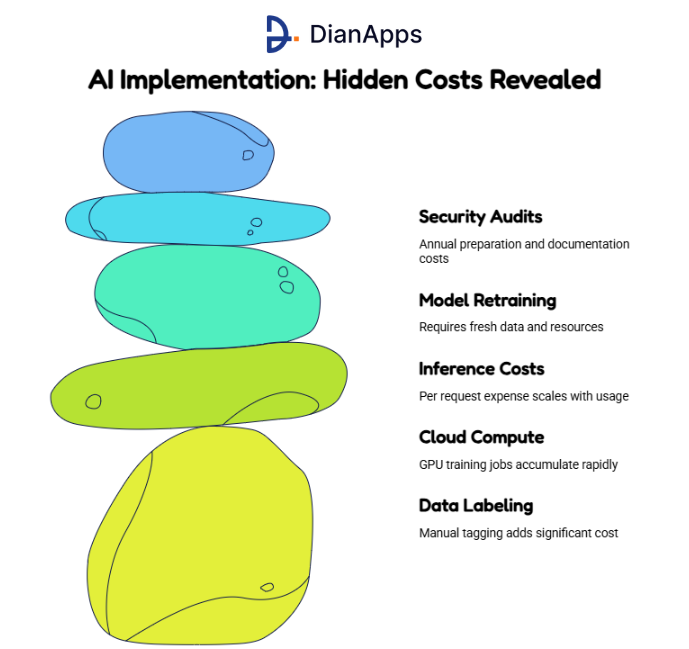
These are the costs that consistently catch organizations off guard during and after AI implementation:
- Data Labeling and Annotation: Requires either dedicated in-house staff or third party labeling services to manually tag thousands of training examples and this process alone can add $10,000 to $50,000 depending on the dataset size and the complexity of the labeling taxonomy required.
- Cloud Compute for Model Training: Accumulates rapidly when teams run GPU intensive training jobs across platforms like AWS, Google Cloud or Azure, particularly during iterative experimentation phases where dozens of model configurations get tested before settling on the final architecture.
- Inference Costs After Deployment: Represent the per request compute expense that occurs every time a user interacts with the AI system in production and these costs scale linearly with usage volume, which means high traffic applications can generate cloud bills that rival the original development cost within months.
- Model Retraining Cycles: Become necessary whenever the underlying data patterns shift and each retraining cycle requires fresh data preparation, engineering hours and compute resources that weren’t included in the original project scope.
- Security and Compliance Audits: Carry their own price tag in regulated industries, with annual audit preparation and documentation costs ranging from $10,000 to $50,000 depending on the regulatory framework and the sensitivity of the data involved.
Also Read: AI Outsourcing Companies: A 2026 Buyer’s Guide
IDC’s AI infrastructure research confirms that infrastructure and compute costs represent a growing share of total AI investment, which makes budgeting for these hidden expenses essential rather than optional.
Ongoing Monthly and Annual AI Development Costs
The AI development cost doesn’t conclude when the system reaches production and treating AI as a one time capital expenditure leads to underfunded systems that degrade in performance over time. Monthly infrastructure costs for cloud hosting, API access and compute resources typically range between $1,000 and $15,000 depending on the scale of deployment and the volume of inference requests processed daily. Maintenance services covering performance monitoring, bug resolution and minor feature updates generally add another $2,000 to $8,000 per month when managed by an external development partner.
Annual model retraining, which involves refreshing the system with new data to maintain prediction accuracy, costs between $10,000 and $50,000 depending on how frequently the business data environment changes.
As a general benchmark organizations should allocate between 15% and 25% of the original AI development cost annually for ongoing operational expenses and this figure holds consistently across industries according to Deloitte’s enterprise AI research.
AI Development Cost for Startups vs Enterprises
The AI development cost varies widely by organization size, ranging from $15,000 to $75,000+ for lean startup MVPs up to $500,000 to $5M+ for large scale enterprise deployments. Startups prioritize rapid, low cost API integration to get a working product in front of users quickly, while enterprises invest heavily in custom security frameworks, regulatory compliance and legacy data scaling that demand substantially larger budgets and longer timelines.
Startup AI Development Costs
- Scope and Budget: Most startup AI projects focus on lean Minimum Viable Products and proof of concepts, with total costs typically falling between $15,000 and $75,000 depending on the use case complexity and the amount of custom model work involved.
- Architecture: Startups rely heavily on third party APIs from providers like OpenAI, Anthropic or Google Gemini alongside open source models rather than building proprietary systems from scratch, which keeps initial development costs significantly lower.
- Infrastructure: Upfront computing expenses remain minimal at the startup stage and monthly inference plus cloud token usage generally runs between $500 and $5,000 depending on early user volume and the frequency of API calls to external model providers.
- Team Strategy: Early stage companies keep labor costs down by working with small agile freelance networks, boutique development agencies or multi hat founding teams that handle engineering alongside product decisions simultaneously.
Enterprise AI Development Costs
- Scope and Budget: Enterprise AI initiatives involve comprehensive multi system rollouts that range from $200,000 to over $1.5M+ for fully customized production platforms deployed across multiple business units and geographic regions.
- Compliance and Security: Mandatory regulatory frameworks including GDPR, HIPAA and SOC 2 introduce substantial operational overhead through continuous auditing, documentation and security infrastructure that smaller organizations don’t face at the same scale.
- Data and Integration: Legacy system integration alone consumes 30% to 50% of total project spend in most enterprise environments, with extensive data preparation and governance work adding another $150,000 to $400,000 per initiative depending on data volume and quality.
- Infrastructure and Talent: Enterprise projects demand dedicated internal teams with AI architects commanding $160,000 to $220,000 annually, alongside dedicated GPU hosting clusters that run between $100,000 and $500,000+ per year depending on training and inference workloads.
Enterprises face a different set of cost drivers entirely, where AI development cost often includes multi department stakeholder alignment, enterprise security compliance, integration with legacy systems spanning decades of accumulated technical debt and custom model training on proprietary datasets.
Mid size enterprise AI projects commonly range between $100,000 and $500,000, while large scale deployments across global operations can exceed that range depending on the number of business units and geographies involved. Grand View Research values the global AI market at over $200 billion in 2026 and enterprise adoption accounts for the largest share of that spending by a significant margin.
Also Read: How to Choose an AI Development Company (2026 Checklist)
How to Reduce AI Development Cost Without Cutting Quality?
Lowering the AI development cost doesn’t require compromising on the quality of the final product and several proven strategies help organizations achieve strong results within tighter budgets.
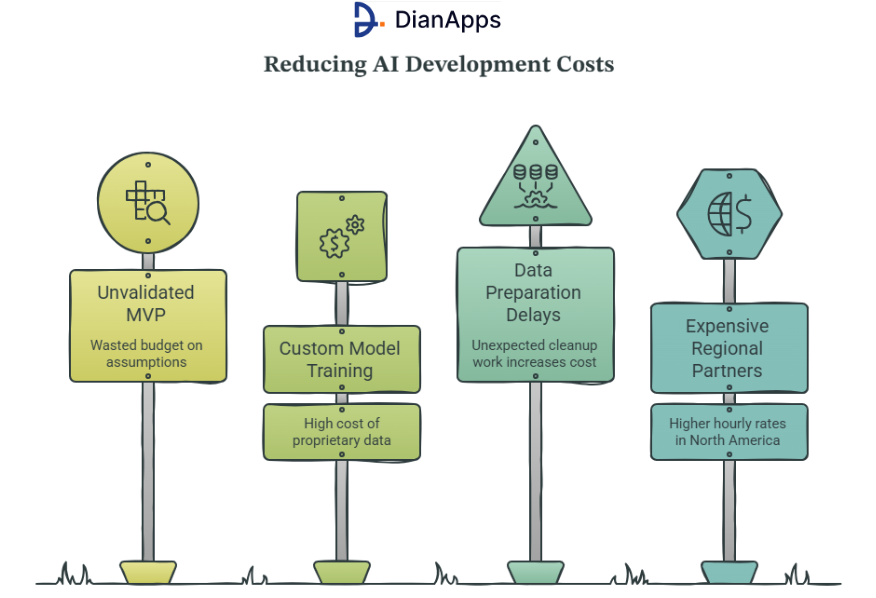
Approaches that consistently deliver cost savings without sacrificing technical outcomes:
- Begin With A Focused MVP: That validates the highest value use case first because building a $15,000 prototype before committing to a $200,000 full build protects the budget from being spent on assumptions that haven’t been tested with real users yet.
- Use Pre-Trained Models: Wherever the use case permits, since fine tuning an existing foundation model costs substantially less than training a custom model from scratch on proprietary data alone.
- Invest In Data Preparation Upfront: Before the development phase begins because the single most common reason AI development cost exceeds the original estimate is that teams discover their data requires months of unexpected cleanup work after engineering has already started.
- Select The Right Regional Partner: Since development teams in South Asia and Eastern Europe deliver senior ML engineering capability at $25 to $80 per hour compared to $150 or more in North America and Clutch’s verified reviews confirm that geographic cost differences don’t correlate with quality differences across top rated firms.
Each of these strategies addresses a specific cost driver identified in the factors section above and applying them together can reduce total project costs by 30% to 50% compared to the market average.
Want to start lean and scale smart?
Our team specializes in building AI MVPs that validate your concept before you commit to a full build.
Top 5 AI Development Companies
Selecting the right development partner determines whether the AI development cost translates into a production ready system that delivers measurable business value or becomes a sunk expense with nothing to show for it.
1. DianApps
DianApps delivers end-to-end AI development services spanning machine learning, natural language processing, computer vision and intelligent automation for clients across healthcare, fintech, ecommerce and logistics.
With 81+ verified client reviews on Clutch and formal recognition as a top development agency for startups, DianApps combines deep technical expertise with transparent pricing structures that align project scope with realistic budget expectations from the very first discovery call.
The team works equally well with early stage startups building lean AI MVPs and with enterprises that require custom model training, complex integrations and regulatory compliance support throughout the engagement.
How DianApps Helped Orby Integrate AI Automation While Maintaining Costs?
DianApps worked with Orby to integrate AI in their existing workflow, where the team developed a custom, AI drive workflow engine which was designed and trained to automate complex enterprise tasks. All of these were documented, and the team kept 100% transparency which helped Orby’s management always have a gist of the cost that would come up with the development process. This resulted in:
- Increase in valuation.
- Improved enterprise tasks.
- Improved accuracy rates with claims up to 98%.
All of these improvements led to a strong grip in the US Market.
2. TechAhead Corp
TechAhead Corp brings over a decade of mobile and AI development experience with 121+ verified reviews on Clutch and recognition as a top global development company across multiple categories. Their recent partnership as an official OpenAI Services Partner positions them at the forefront of enterprise AI adoption and their team serves clients across the United States with AI native app development, physical AI solutions and custom enterprise software that integrates large language models directly into existing business workflows.
3. AlgoWorks
Algoworks operates as both a Salesforce Summit (Platinum) Partner and a global AI engineering services provider, which makes them one of the few firms that deliver deep expertise across both disciplines under a single roof. Their 2025 launch as a global AI and engineering services leader confirmed their expansion into artificial intelligence alongside their established Salesforce consulting, custom development and AppExchange product portfolio. With exceptional client reviews on Clutch and 78+ customer references on FeaturedCustomers, Algoworks serves enterprises that need AI powered automation tightly integrated with their Salesforce ecosystem, covering everything from Einstein AI customization to standalone machine learning model development and intelligent workflow automation.
4. LeewayHertz
LeewayHertz specializes in AI and blockchain development with a strong focus on enterprise grade solutions for supply chain optimization, financial services automation and media intelligence platforms. Their verified delivery track record is documented across both Crunchbase and PitchBook and their dual expertise in decentralized systems alongside artificial intelligence gives them a distinct advantage for projects that require secure, distributed data processing capabilities built into the AI architecture from the ground up.
5. Damco Solutions
Damco Solutions operates a full spectrum AI and ML services practice alongside a well established Salesforce partnership that covers consulting, custom development and CRM integration for mid market and enterprise clients. Their AI capabilities span machine learning model development, generative AI services, AI application development and industry specific AI agents for sectors like insurance, which gives them depth across both horizontal and vertical use cases.
Final Thoughts
Planning AI development cost accurately requires understanding every layer of the investment, from initial data preparation through ongoing model maintenance and infrastructure expenses.
The organizations that succeed with AI aren’t necessarily the ones with the largest budgets but rather the ones that allocate their resources strategically across the right priorities at the right time.
Gartner’s forecast of 47% growth in worldwide AI spending for 2026 confirms that competitive pressure around AI adoption continues intensifying, which makes informed budgeting more important than ever before.
For businesses ready to move from planning into execution, DianApps provides the technical expertise and cost transparency needed to deliver AI solutions that produce measurable results within defined budget parameters.
FAQs
How much does it cost to build an AI system?
Building an AI system costs between $5,000 for a simple chatbot and over $500,000 for a custom enterprise platform, depending on project complexity, data requirements and integration scope.
How much do AI developers charge per hour?
AI developer hourly rates range from $25 to $80 in South Asia, $40 to $100 in Eastern Europe and $100 to $250 in North America depending on experience and specialization.
What factors affect AI development cost?
Data quality, model complexity, integration requirements, team composition, regulatory compliance and technology stack decisions are the six primary factors that determine the final project cost.
How much does AI cost for a startup?
Startups typically invest between $15,000 to $75,000 in an AI MVP to validate their concept before scaling into a full production build with larger resource commitments.
Why is AI development so expensive?
Data preparation consumes 60% to 80% of the project timeline, GPU compute for model training carries significant infrastructure costs and specialized ML engineers command premium rates globally.
Is $50k reasonable for an AI MVP?
Yes, $50, 000 is a very reasonable estimate for an AI Minimum Viable Product (MVP). This amount covers AI features, cloud or API integrations and basic user testing.
Is AI a one time or ongoing cost?
AI requires continuous investment in cloud hosting, model retraining, performance monitoring and infrastructure maintenance, typically amounting to 15% to 25% of the original cost to build an AI application each year.
 0 comments










Leave a Comment
Your email address will not be published. Required fields are marked *