















 0 comments





What Changed in 2026
The market landscape shifted meaningfully in the last twelve months. Here are the verified data points that shape the guidance below:
- Global mobile app market projected to hit $633.71 billion in 2026 (Statista App Market Forecast).
- Over 80% of mobile apps will integrate AI features by end of 2026 (Sensor Tower State of Mobile 2026).
- Average data breach cost is $4.88 million globally in 2025 (IBM Cost of a Data Breach Report 2025).
- DianApps 2026 project data shows AI-integrated builds add 15-25% to standard cost (DianApps client benchmarks).
Related Reading From Our 2026 Guides
For deeper context, see these companion guides:
Choosing the right frontend technology can determine how quickly your product reaches the market, how easily it scales, and how efficiently your development team works.
Among the most popular options today, React, Next.js, and Angular dominate the future of frontend ecosystem, but each serves a different purpose.
If you’re planning a new web application in 2026, here’s a practical breakdown to help you make the right decision.
Quick Overview
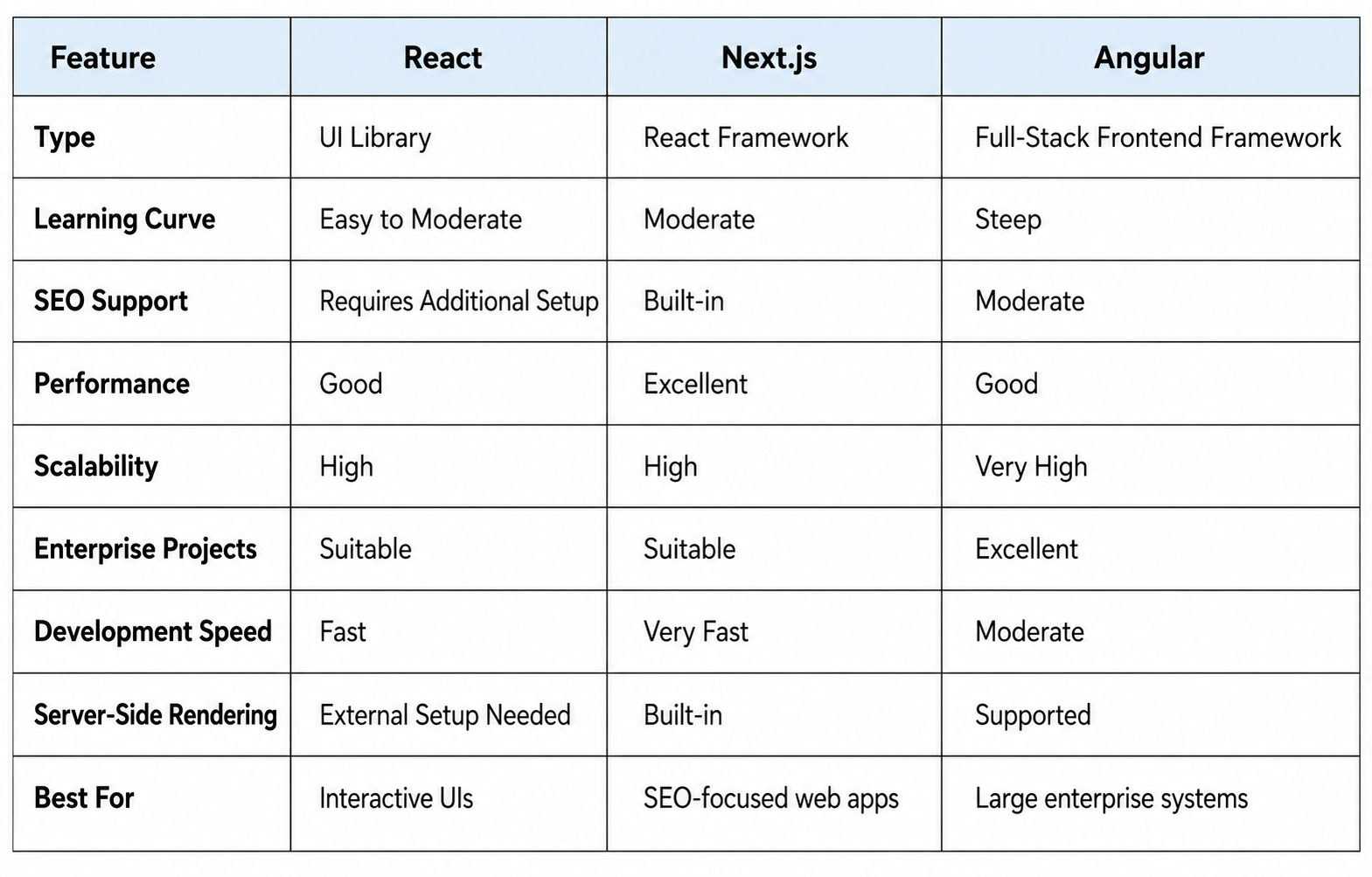
According to the latest Stack Overflow Developer Survey, frontend development services remain among the most actively discussed technologies in software development, with React continuing to dominate adoption while Next.js experiences rapid growth and Angular maintains a strong enterprise presence.
As businesses increasingly invest in digital transformation, choosing the right frontend technology has become a strategic decision rather than just a technical one.
So, should you choose React, Next.js, or Angular? Let’s find out.
Understanding the Difference Between React, Next.js, and Angular
Before comparing them, it’s important to understand that React, Next.js, and Angular are not direct competitors in the traditional sense.
- React is a JavaScript library for building user interfaces.
- Next.js is a framework built on top of React.
- Angular is a complete frontend framework maintained by Google.
Also read: Top JavaScript frameworks for website development.
A simple analogy:
- React gives you the building blocks.
- Next.js gives you the building blocks plus the blueprint.
- Angular gives you the building blocks, blueprint, tools, and predefined development standards.
This distinction significantly impacts development speed, scalability, and maintenance.
What is React?
React is an open-source JavaScript library developed by Meta for building user interfaces through reusable components.
Since its launch, React has transformed frontend development by enabling developers to build dynamic and interactive web applications with greater efficiency.
Key Features of React
- Component-based architecture
- Virtual DOM rendering
- One-way data flow
- Massive ecosystem
- Flexible architecture
- Strong community support
Advantages of React
- Fast Development: Reusable components reduce development time and improve consistency.
- Massive Talent Pool: React remains the most in-demand frontend skill globally, making hiring significantly easier.
- Flexibility: Developers can choose their preferred routing, state management, and backend integration tools.
- Ecosystem Strength: Thousands of open-source packages help accelerate development.
Limitations of React
- Requires additional libraries for routing and state management.
- SEO implementation requires additional setup.
- Architecture can become inconsistent across teams.
Best Use Cases
- SaaS applications
- Social media platforms
- Dashboards
- Internal business tools
- Real-time applications
What is Next.js?
Next.js is a React framework developed by Vercel that simplifies the creation of production-ready applications.
It introduces advanced capabilities such as server-side rendering, static site generation, API routes, and image optimization without requiring third-party integrations.
Key Features of Next.js
- Server-Side Rendering (SSR)
- Static Site Generation (SSG)
- Incremental Static Regeneration (ISR)
- Built-in Routing
- API Routes
- Image Optimization
- Automatic Code Splitting
Advantages of Next.js
- Better SEO: Search engines can easily crawl and index content.
- Superior Performance: Built-in optimization features improve loading speed and user experience.
- Faster Time-to-Market: Many production-ready features are available out of the box.
- Scalability: Supports everything from startup MVPs to enterprise platforms.
Limitations of Next.js
- More concepts to learn than React.
- Can be excessive for very small projects.
- Requires understanding of rendering strategies.
Best Use Cases
- Marketing websites
- SaaS platforms
- E-commerce stores
- Content-driven websites
- Startup products
Now read the quick comparison between React vs Next.js and know which one should you choose in 2026.
What is Angular?
Angular is a complete frontend framework maintained by Google. Unlike React and Next.js, Angular provides a fully integrated development environment that includes routing, dependency injection, form management, testing tools, and enterprise-grade architecture. That’s what makes it a popular framework.
Key Features of Angular
- TypeScript-first development
- Dependency Injection
- Two-way Data Binding
- Modular Architecture
- Angular CLI
- Built-in Testing Tools
Advantages of Angular
- Enterprise Scalability: Angular is designed for large applications with multiple development teams.
- Strong Structure: Enforces coding standards and architectural consistency.
- Built-In Capabilities: Most functionalities come included without external libraries.
- Long-Term Maintainability: Large organizations benefit from Angular’s governance and predictability.
Limitations of Angular
- Steep learning curve.
- More boilerplate code.
- Longer development cycles.
Best Use Cases
- Banking platforms
- ERP systems
- Government applications
- Healthcare software
- Enterprise-grade business applications
Market Statistics & Future Outlook
Technology selection should align not only with current requirements but also with market adoption, hiring trends, and long-term viability.
React Market Statistics
React continues to dominate the frontend ecosystem.
Key Numbers
- Approximately 44.7% of developers actively use React, making it one of the most-used frontend technologies worldwide.
- React remains one of the most requested frontend skills in global hiring markets.
- Thousands of enterprise organizations use React as their primary frontend technology.
Future Outlook
Industry analysts predict React will maintain leadership through 2030 because:
- It has the largest developer ecosystem.
- AI-assisted coding tools strongly support React workflows.
- Most modern frontend innovations continue to emerge from the React ecosystem.
Market Verdict
React remains the safest choice for businesses prioritizing flexibility, developer availability, and long-term support.
Next.js Market Statistics
Next.js has become one of the fastest-growing frontend frameworks globally.
Key Numbers
- More than 17,000+ companies actively use Next.js.
- Adoption has accelerated among SaaS, eCommerce, and content-driven businesses.
- A significant percentage of professional React developers now choose Next.js for production applications.
Future Outlook
Growth is being driven by:
- Increased focus on SEO.
- Core Web Vitals optimization.
- Server-side rendering requirements.
- Content marketing and organic acquisition strategies.
Market Verdict
Next.js is rapidly becoming the default framework for customer-facing React applications.
Angular Market Statistics
Angular remains a strong enterprise choice despite slower growth compared to React.
Key Numbers
- Approximately 18% of developers actively use Angular.
- More than 50,000 companies worldwide rely on Angular.
- Angular maintains strong adoption across banking, healthcare, insurance, and government sectors.
Future Outlook
Angular is expected to remain highly relevant because:
- Google continues long-term support.
- Enterprise organizations value architectural consistency.
- TypeScript-first development aligns with modern software engineering standards.
Market Verdict
Angular remains one of the strongest frameworks for enterprise-grade software development.
Next.js vs React vs Angular: Feature Comparison
| Feature | React | Next.js | Angular |
|---|---|---|---|
| Technology Type | Library | Framework | Framework |
| Learning Curve | Moderate | Moderate | High |
| SEO Support | Additional Setup | Built-In | Moderate |
| SSR Support | External Configuration | Native | Supported |
| Performance | High | Very High | High |
| Development Speed | Fast | Very Fast | Moderate |
| Scalability | High | High | Very High |
| Enterprise Readiness | Good | Very Good | Excellent |
| Community Support | Excellent | Excellent | Strong |
| Time-to-Market | Fast | Fastest | Moderate |
Cost of Development Comparison
The cost of frontend development varies depending on application complexity, developer location, project duration, and the experience level of the development team. However, the following estimates represent average market rates for developing a medium-sized web application in 2026.
| Cost Factor | React | Next.js | Angular |
|---|---|---|---|
| Average Developer Hourly Rate | $25–$150/hr | $30–$170/hr | $35–$180/hr |
| MVP Development Cost | $8,000–$30,000 | $10,000–$35,000 | $15,000–$45,000 |
| Mid-Sized Application | $30,000–$80,000 | $35,000–$90,000 | $50,000–$120,000 |
| Enterprise Application | $80,000–$300,000+ | $90,000–$350,000+ | $120,000–$500,000+ |
| Developer Availability | Very High | High | Moderate |
| Training & Onboarding Cost | Low | Medium | High |
| Maintenance Cost | Moderate | Low to Moderate | Low |
| Time-to-Market | Fast | Fastest | Moderate |
React Development Costs
React generally offers the lowest entry cost among the three technologies because of its enormous developer ecosystem and flexible architecture.
Typical Project Budget
| Project Type | Estimated Cost |
|---|---|
| Startup MVP | $8,000–$25,000 |
| SaaS Platform | $25,000–$75,000 |
| Enterprise Dashboard | $50,000–$200,000+ |
Cost Advantages
- Largest global talent pool
- Competitive hiring costs
- Extensive reusable libraries
- Faster team scaling
Hidden Costs
React applications often require additional tools for:
- Routing
- State management
- Authentication
- SEO optimization
Next.js Development Costs
Next.js requires slightly higher upfront investment because developers must understand advanced concepts such as server-side rendering, static generation, and modern deployment workflows.
Typical Project Budget
| Project Type | Estimated Cost |
|---|---|
| Startup MVP | $10,000–$35,000 |
| SaaS Platform | $35,000–$90,000 |
| Enterprise Platform | $75,000–$350,000+ |
Cost Advantages
- Better SEO reduces marketing acquisition costs.
- Faster websites improve conversion rates.
- Built-in features reduce third-party dependencies.
- Lower optimization and performance engineering expenses.
Hidden Costs
- Specialized Next.js expertise can command higher hourly rates.
- Hosting infrastructure may require additional planning for SSR applications.
Angular Development Costs
Angular generally carries the highest initial investment because of its steeper learning curve and enterprise-oriented architecture.
Typical Project Budget
| Project Type | Estimated Cost |
|---|---|
| Startup MVP | $15,000–$45,000 |
| Enterprise Application | $50,000–$150,000 |
| Large Enterprise System | $120,000–$500,000+ |
Cost Advantages
- Strong architecture reduces technical debt.
- Lower maintenance costs over long project lifecycles.
- Better suited for large teams and multi-year projects.
Hidden Costs
- Longer onboarding periods.
- Smaller hiring pool compared to React.
- Slower initial development speed.
Popular Companies Using React, Next.js, and Angular: At a Glance
| Framework | Popular Companies Using It | Why Companies Choose It |
|---|---|---|
| React | Facebook, Instagram, WhatsApp Web, Airbnb, Dropbox, Atlassian | Flexible architecture, massive developer ecosystem, reusable components, and rapid UI development. |
| Next.js | Netflix, TikTok, Twitch, Hulu, Notion, Vercel | Superior SEO capabilities, faster page loads, server-side rendering, and optimized user experiences. |
| Angular | Google Cloud Platform, Microsoft Enterprise Solutions, Deutsche Bank, Forbes, Upwork, PayPal | Enterprise-grade architecture, strong maintainability, TypeScript support, and scalability for large applications. |
Which Framework Should You Choose?
1. Choose React If:
- You want maximum flexibility.
- You’re building highly interactive applications.
- SEO is not a major concern.
- You want access to the largest developer pool.
2. Choose Next.js If:
- SEO matters.
- You need fast performance.
- You’re building a customer-facing application.
- Organic growth is part of your acquisition strategy.
3. Choose Angular If:
- You’re building enterprise software.
- Multiple teams will contribute to development.
- Long-term governance and maintainability are priorities.
Final Verdict
From a market perspective in 2026:
- React leads in adoption, ecosystem maturity, and hiring availability.
- Next.js leads in performance, SEO, and modern web application development.
- Angular leads in enterprise architecture and large-scale software systems.
For startups, SaaS companies, marketplaces, and growth-focused digital products, Next.js has emerged as the strongest overall choice because it combines React’s flexibility with enterprise-grade performance and SEO capabilities.
However, the best framework is not necessarily the most popular one. The right choice depends on your product goals, website development company you choose, scalability requirements, and long-term business strategy.
The framework you choose today will influence your application’s growth for years to come, so choose based on where your business is headed, not just where it is today.
 0 comments













Leave a Comment
Your email address will not be published. Required fields are marked *